The 2026 Elections, Perusasion, and Turnout
Ruy Teixeira at AEI:
There’s no doubt vote-switching played a big role in the 2026 election. That is, many, many voters who supported Trump in 2024 wound up supporting Democrats for the House and/or Senate in 2026. The shifts were too big for that factor not to have played a central role.
But what of turnout—not so much by demographic group but by Trump vs. Harris 2024 supporters and through new voters? Democrats prefer to focus on the undeniable fact that they won over an amazing number of Trump supporters to their side in 2026. The evidence is strong though that 2024 Harris supporters were far more likely to show up in 2026 than 2024 Trump supporters. Logically, that must have also played a role in the big swing toward the Democrats.
But how big? Estimates vary but it appears that that role was quite large indeed; accounts of the 2026 pro-Democratic swing that downplay or leave out this factor are missing something of potentially great political consequence as we move into the 2028 cycle.
Jason Corley of Quantus Insights summarizes some of the relevant findings:
J.L. Partners ran an Election Day poll alongside more than 30,000 campaign interviews. They found the national swing from 2024 was about 15 points, and that 10 of those points came from turnout and 5 from switching. Lenny Bronner, a data scientist formerly with the Washington Post, worked from actual precinct results in 11 states and puts it at about 75% turnout and 20% switching. The exit polls imply a bit more switching, around 35%, and still have turnout in front.
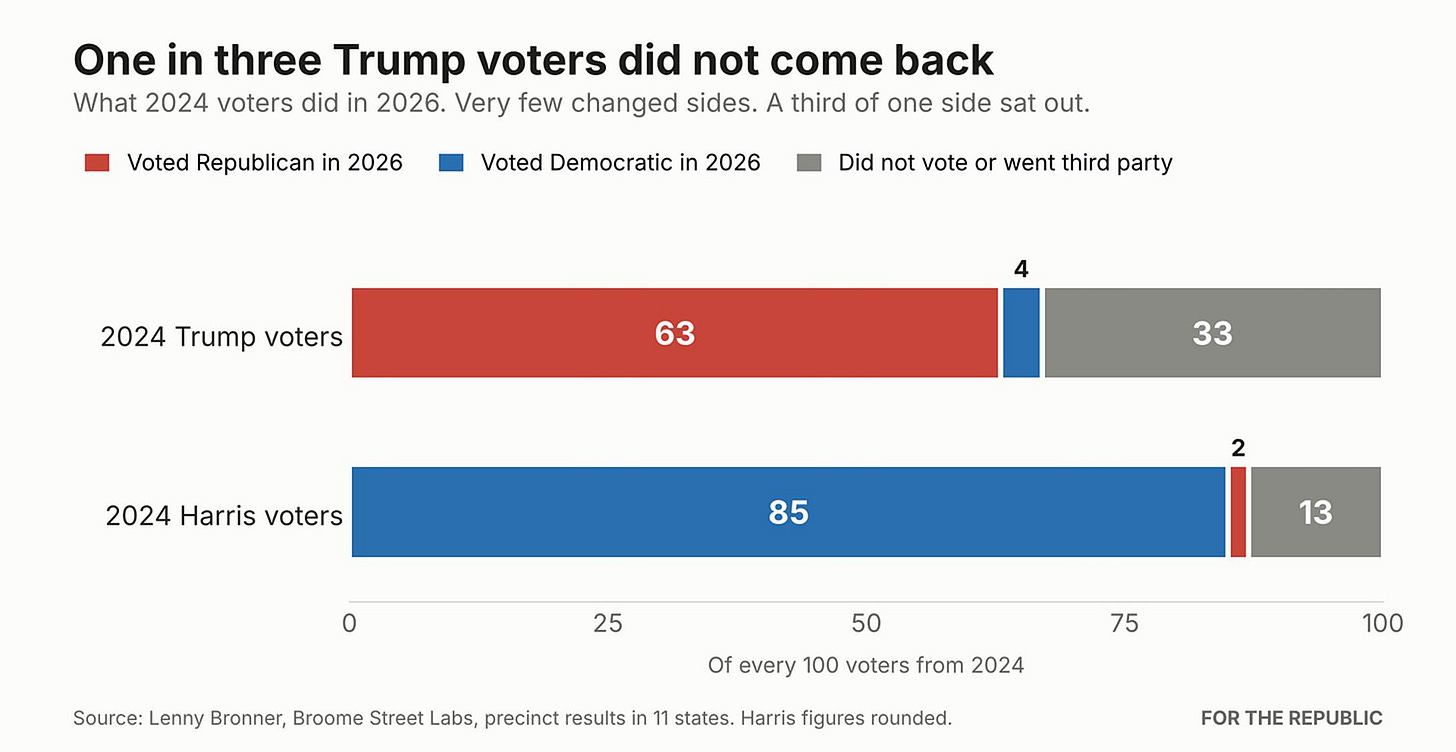
Bronner’s version is the easiest to understand. If we take 100 people who voted for Trump in 2024, about 63 voted Republican this year, 4 voted Democratic, and 33 stayed home or went third party. If we take 100 Harris voters, about 85 voted Democratic, 2 voted Republican, and 13 sat out.
The crossover vote is tiny in both directions. The gray area in the char[t] is where the election was decided. By Bronner’s count, eight of every nine Trump voters who did not vote Republican simply did not vote.
That fact changes the shape of the electorate considerably. The country voted for Trump by a point and a half in 2024. The people who cast ballots in 2026 had voted for Harris by somewhere close to 7 points. It was a different set of voters, and, therefore, a different electorate and would have produced a Democratic year even if no one had changed their mind. J.L. Partners ran that counterfactual and found Republicans lose both chambers with zero switching
.