Search This Blog

Showing posts with label turnout. Show all posts

Saturday, February 19, 2022

Youth Civic Engagement

From the Brennan Center:
Civic engage­ment is a key indic­ator of adult­hood. Young adults respond to the social and polit­ical issues of the day in a vari­ety of ways. After the police killings of George Floyd and Breonna Taylor in 2020, young people demon­strated against racial injustice in more than 10,000 peace­ful protests around the coun­try.

foot­note1_g6xcuor1 That fall saw record numbers of youth turn out for the pres­id­en­tial elec­tion; half of eligible voters ages 18–29 parti­cip­ated, compared with 39 percent in 2016. foot­note2_3ycctnz2 Climate change like­wise cata­lyzed young people, as nearly 30 percent of Gener­a­tion Z and Millen­ni­als made dona­tions, contac­ted public offi­cials, volun­teered, or protested, surpass­ing Gener­a­tion X and Baby Boomers. foot­note3_pisb­s1c3 Young people are commonly assumed to be disen­gaged, disil­lu­sioned, and unin­ter­ested in civic life. These trends chal­lenge that propos­i­tion.

Research­ers have consist­ently found that early civic engage­ment is mutu­ally bene­fi­cial to young people and to the communit­ies in which they parti­cip­ate. For example, devel­op­mental psycho­lo­gist Parissa Ballard and colleagues found that early civic engage­ment is asso­ci­ated with posit­ive health outcomes later in life. Voting, volun­teer­ing, and activ­ism in young adult­hood were related to improved mental health, greater educa­tional attain­ment, and higher personal and house­hold incomes. foot­note4_n49aljr4 Beyond these indi­vidual bene­fits, young adults are import­ant contrib­ut­ors to their local communit­ies. Tufts University’s Center for Inform­a­tion and Research on Civic Learn­ing and Engage­ment (CIRCLE) projec­ted that in the 2020 elec­tion cycle, young adults would play a partic­u­larly import­ant role in the pres­id­en­tial battle­ground states Wiscon­sin, North Caro­lina, and Flor­ida, as well as in Senate races in Color­ado, Maine, and Montana and congres­sional races in Iowa’s 1st District, Maine’s 2nd, and Geor­gi­a’s 7th. foot­note5_9alq4i75 The youth vote proved decis­ive in several states where the margin of victory was less than 50,000 votes, includ­ing Arizona, Geor­gia, and Pennsylvania. foot­note6_um60jqh6

National legis­la­tion and educa­tional policy reflect the import­ance of prepar­ing young people to become engaged and parti­cip­at­ory members of soci­ety. Recog­niz­ing the mutual bene­fits of community service for the advance­ment of communit­ies and the well-being of young people, Congress passed the National and Community Service Act of 1990 and the National and Community Service Trust Act of 1993. The first law created the Commis­sion on National and Community Service to support school-based service-learn­ing programs, volun­teer and service programs in higher educa­tion, youth corps, and national service models; the second merged the commis­sion with the National Civil­ian Community Corps to estab­lish the Corpor­a­tion for National and Community Service, to support volun­teer and service oppor­tun­it­ies for all Amer­ic­ans. In 2009 Congress passed the Edward M. Kennedy Serve Amer­ica Act, reau­thor­iz­ing and expand­ing national and community service legis­la­tion to support lifelong volun­teer­ism and community service. Through these acts, Congress has emphas­ized the need for civic engage­ment, which helps youth become informed citizens as well as active members of their communit­ies through­out their life­time.

School curricula rein­force the expect­a­tion that young people will become engaged citizens. Accord­ing to the Center for Amer­ican Progress, 40 states and the District of Columbia require a civics course for high school gradu­ation, and 16 states require a civics exam to gradu­ate. However, only Mary­land and the District of Columbia require community service for all high school gradu­ates. foot­note7_eslmnjr7

1 Armed Conflict Loca­tion & Event Data Project (here­in­after ACLED), Demon­stra­tions and Polit­ical Viol­ence in Amer­ica: New Data for Summer 2020, Septem­ber 2020, https://acled­data.com/2020/09/03/demon­stra­tions-polit­ical-viol­ence-in-amer­ica-new-data-for-summer-2020/.
foot­note2_3ycctnz
2
 Center for Inform­a­tion and Research on Civic Learn­ing and Engage­ment (here­in­after CIRCLE), “Half of Youth Voted in 2020, an 11-Point Increase from 2016,” April 29, 2021, https://circle.tufts.edu/latest-research/half-youth-voted-2020–11-point-increase-2016.
foot­note3_pisb­s1c
3
 Alec Tyson, Brian Kennedy, and Cary Funk, “Gen Z, Millen­ni­als Stand Out for Climate Change Activ­ism, Social Media Engage­ment with Issue, ” Pew Research Center, May 26, 2021, https://www.pewre­search.org/science/2021/05/26/gen-z-millen­ni­als-stand-out-for-climate-change-activ­ism-social-media-engage­ment-with-issue/.
foot­note4_n49aljr
4
 Parissa J. Ballard, Lind­say T. Hoyt, and Mark C. Pachucki, “Impacts of Adoles­cent and Young Adult Civic Engage­ment on Health and Socioeco­nomic Status in Adult­hood, ” Child Devel­op­ment 90, no. 4 (2019): 1138–54, https://doi.org/10.1111/cdev.12998.
foot­note5_9alq4i7
5
 CIRCLE, “Youth Elect­oral Signi­fic­ance Index (YESI), ” last updated August 18, 2020, https://circle.tufts.edu/yesi2020.
foot­note6_um60jqh
6
 CIRCLE, “Elec­tion Week 2020: Young People Increase Turnout, Lead Biden to Victory, ” Novem­ber 25, 2020, https://circle.tufts.edu/latest-research/elec­tion-week-2020#young-voters-and-youth-of-color-powered-biden-victory.
foot­note7_eslmnjr
7
 Sarah Shapiro and Cath­er­ine Brown, “The State of Civics Educa­tion,

Thursday, October 28, 2021

College Voter Turnout 2020

From the Institute for Democracy & Higher Education at Tufts:

  • At 66%, student turnout far exceeded the rate of 52% from the prior presidential election. This comes close to the national voting rate of 67% for all voters in 2020, as calculated by the U.S. Census Bureau.
  • In past years, we’ve pointed to low “yield” rates as a problem—students were registering, but not following through and voting. In 2020, the rate of registered students who then voted hit 80%, an important milestone and signal that they are vested in their own futures and the health of democracy
  • Maybe campuses attached class registration to voter registration. Maybe first-year students were eager to have their voices heard. For whatever reason, students ages 18-21 defied national patterns and prior student voting patterns and voted at slightly higher rates than older (30+) student voters.
  • The highest voting rates were achieved at private baccalaureate degree-granting (BA) and private doctoral-granting (PhD) institutions, and indeed, voting rates at private BA institutions jumped 17 percentage points from 2016. These changes might point to differences in institutional and student resourcing and/or the retention of more affluent students (who vote at significantly higher rates than their poorer peers) in a difficult semester. They may also point to the liberal arts and sciences as a catalyst for voting
  • Asian American student participation rose dramatically—a change also observed in the general population3 —although Asian American student turnout was still lower than other demographic groups. Although they participated at high levels and remain among the most consistently reliable group of voters, the increase in Black women’s turnout was significantly lower than was typical across demographic groups. Overall, turnout gaps were no larger between students of different races and sexes than they were in 2016.
  • Biggest Gain: Asian-American students up 17 percentage points. Also Significant: Multiracial and White men boast increases of 16-17 percentage points. Largest Gap: Asian-American to White non-Hispanic: 20 percentage points. Most Consistently Reliable Voters: Multiracial, Black, and White women


Monday, June 7, 2021

Election Adaptations During COVID

Kevin Kosar at AEI:

COVID-19 forced states to make myriad adjustments to their elections administration in order to ensure sufficient access to the ballot. Changes included expanding voter access to the use of absentee ballots, extending voter registration deadlines, and increasing the number of polling places, among others. How well did states do in adapting their elections administration?

To answer this question, I turned to Professor Zachary Courser and Professor Eric Helland. They co-direct Claremont McKenna College’s Policy Lab, an interdisciplinary policy research program that teaches students policy writing and research skills that prepare students for work in legislatures, think tanks, and non-governmental organizations. Zach, Eric, and their Policy Lab students spent the past year examining states’ emergency election statutes and election administration adaptations during the pandemic, and they have some interesting findings.
...

You and your students created a scorecard to measure states’ adaptations to make voting accessible during the pandemic. How did you create the scorecard, and which states scored highest?

Before the election, we evaluated state statutes dealing with elections emergencies to understand the legal framework for adaptation during an emergency, and then tracked all the adaptations that states took to ensure access to voting for the general election. We then analyzed which measures were most likely to have an effect on increasing access during the pandemic and assigned each a score accordingly. Adaptations clustered in four main categories: vote-by-mail, drop-off boxes, deadline adjustments, and polling place adjustments. We assigned measures for mail-in voting the highest point value, as we think they did the most to protect health and promote perceptions of safety during the pandemic. As a result, states that already had all-mail elections, or adapted by increasing access to absentee balloting, tended to score higher.

The average grade was a C, and as you can see from the map below, the highest scoring states clustered in the west. Hawaii, Oregon, Washington, and Utah all score A’s, with New Jersey scoring the highest in the nation. Southern states were laggards on access generally, scoring the lowest as a region — with most states rating a D or F. Missouri scored the lowest in the nation.

Saturday, May 1, 2021

The 2020 Election

Nathaniel PersilyCharles Stewart III have an article at The Journal of Democracy titled " The Miracle and Tragedy of the 2020 U.S. Election."

The abstract:

The 2020 election was both a miracle and a tragedy. In the midst of a pandemic posing unprecedented challenges, local and state administrators pulled off a safe, secure, and professional election. This article discusses metrics of success in the adaptations that took place—record-high turnout, widespread voter satisfaction, a doubling of mail voting without a concomitant increase in problems often associated with absentee ballots, and the recruitment of hundreds of thousands of new poll workers. However, a competing narrative of a “stolen election” led to a historically deep chasm between partisans in their trust of the election process and outcome.

Tuesday, April 13, 2021

Polling Problems, Again

 Politico Playbook:

As our polling guru Steve Shepard reports today, the competing firms — ALG Research, GBAO Strategies, Garin-Hart-Yang Research Group, Global Strategy Group and Normington Petts — banded together in an unusual collaboration after the election to conduct a self-autopsy of sorts. It acknowledged “major errors” and a failure “to live up to our own expectations” — yet, frustratingly, no easy solution to the problem of consistently overestimating how major Democratic candidates, including JOE BIDEN, would perform.

Among the culprits:
  • Deteriorating public trust in institutions, government, the news media and, yes, the polling industry — driven by DONALD TRUMP’S bashing of those very institutions. Essentially, Trump voters were less willing to participate in polls.
  • Pollsters again underestimated turnout among rural and white non-college-educated voters, who overwhelmingly backed Trump.
  • Failure to detect late movement toward Trump and Republican candidates in the run-up to the election.
  • Not accurately accounting for the fact that Democrats stayed home and answered their phones in greater numbers last year than Republicans who did not follow Covid-19 restrictions as closely.
Read the full story here. And read the memo here.
Pew:
Pew Research Center is among the organizations examining its survey processes. The Center does not predict election results, nor does it apply the likely voter modeling needed to facilitate such predictions. Instead our focus is public opinion broadly defined, among nonvoters and voters alike and mostly on topics other than elections. Even so, presidential elections and how polls fare in covering them can be informative. As an analysis discussed, if recent election polling problems stem from flawed likely voter models, then non-election polls may be fine. If, however, the problem is fewer Republicans (or certain types of Republicans) participating in surveys, that could have implications for the field more broadly.

This report summarizes new research into the data quality of Pew Research Center’s U.S. polling. It builds on prior studies that have benchmarked the Center’s data against authoritative estimates for nonelectoral topics like smoking rates, employment rates or health care coverage. As context, the Center conducts surveys using its online panel, the American Trends Panel (ATP). The ATP is recruited offline via random national sampling of residential addresses. Each survey is statistically adjusted to match national estimates for political party identification and registered voter status in addition to demographics and other benchmarks.2 The analysis in this report probes whether the ATP is in any way underrepresenting Republicans, either by recruiting too few into the panel or by losing Republicans at a higher rate. Among the key findings:

  • Adults joining the ATP in recent years are less Republican than those joining in earlier years. 
  • Donald Trump voters were somewhat more likely than others to leave the panel (stop taking surveys) since 2016, though this is explained by their demographics. 
  • People living in the country’s most and least pro-Trump areas were somewhat less likely than others to join the panel in 2020. 
  •  

Monday, November 23, 2020

Ease of Voting 2020

A slim majority of voters (54%) say they voted in person this November, compared with 46% who voted by absentee or mail-in ballot. About one-quarter (27%) report having voted in person on Election Day, and an identical share say they voted in person before Election Day.
...

Among voters who voted in person in this election, 35% say they did not wait in line to vote at all. An additional 27% say they waited for less than 10 minutes. One-in-five waited for 10 to 30 minutes, 11% waited for 31 minutes to an hour, and 6% say they waited in line for more than an hour to vote.

Those who voted early waited longer than those who voted on Election Day: 21% of early in-person voters waited more than half an hour, compared with 14% of Election Day voters.

Black in-person voters also waited longer to vote than White or Hispanic in-person voters. Black voters are 5 percentage points slightly more likely than white voters to say they waited more than 30 minutes to vote and 9 points more likely than Hispanic voters to say this.
...
More than nine-in-ten voters (94%) say that voting in the election this November was either very easy (77%) or somewhat easy (17%), while just 6% say that voting was very or somewhat difficult.

Monday, July 20, 2020

Youth Voter Participation in 2020

A release from the Center for Information and Research on Civic Learning & Engagement (CIRCLE):
Our polling data makes clear that a majority of young people are interested in the 2020 election and understand its importance. Whether they are ready to vote in an election shaped by restrictions due to the COVID-19 pandemic may be another story. Election processes are in flux and will likely vary from state to state. Young people’s access to, information about, and familiarity with online voter registration (OVR) and mail-in voting will be critical. In this regard, our poll reveals that there are reasons for concern that should be seen as a call to action.
We asked youth in our survey whether they could register to vote online in their state. (Online registration is widely available in 38 states and Washington, D.C.) A third of youth (32%) said they did not know. Among youth who answered yes or no, 25% were incorrect. Overall, just half (51%) of youth could correctly identify whether OVR is an option for them or not. Worryingly, among respondents from states where OVR is not available, only 14% correctly identified that was the case. This means a large segment of young people in these states may be relying on an option that isn’t available to them, thereby complicating or delaying their voter registration. Another potential stumbling block: 7.5% of young people—which translates to 3.5 million youth—say in our poll that they have not had good enough access to the Internet during the pandemic.
...
We have previously shared that, if mailing in ballots becomes the primary voting method in the 2020 elections, it will be an unfamiliar process for most youth. Indeed, only 24% of young people in our poll have previously voted by mail. There are major and troubling differences by race/ethnicity: 34.5% of Asian youth and 25% of White youth have had access to and experience with voting by mail, compared to 22% of Black youth and just 20% of Latino youth. However, greater availability of absentee voting in Western states (where all-mail voting is common) compared to Southern states (where excuses to vote absentee are often needed) means that access to this method of voting differs greatly, especially between Asian and Black youth because Asian American youth are concentrated in the Western States while Black youth are concentrated in the Southern States.
Approximately two-thirds of young people say they have seen information about absentee ballots this year, and the same percentage say that if their state’s voting occurs entirely by mail, they know where to get information about receiving their ballot. Of course, this means that a third of youth—more than 15 million—currently lack this critical information.
As the electoral landscape continues to evolve in many states across the country, one of the major challenges for our democracy will be ensuring that young people have access to timely information about the tools and processes that may determine whether they cast a vote in November. Our poll reveals that we are far from meeting that goal, and that it will be up to election administrators, educators, media, organizers, parents, and peers to act in concert to do so. It also highlights that these efforts must focus especially on youth of color in order to avoid perpetuating racial/ethnic inequities in political participation.

Thursday, September 19, 2019

Youth Turnout

Amy Gardner at WP:
College students across the United States more than doubled their rate of voting between the 2014 and 2018 midterm elections, according to a study published Thursday by Tufts University — a dramatic spike in political engagement that could draw unprecedented attention to these voters in next year’s presidential election.
The study found that 40 percent of students who are eligible to vote cast ballots last year, up from 19 percent in 2014.
Census Bureau data has shown that turnout rose in nearly all demographic groups between the two midterm cycles, but it rose most sharply among young adults. The Tufts study shows the turnout spike was particularly stark among college students — an extraordinary level of engagement for voters who typically stay home in nonpresidential elections.
Among all eligible voters, for instance, turnout reached 50 percent in 2018 — less than a 14-point jump since 2014, according to the United States Elections Project.

Thursday, May 2, 2019

High Turnout in 2018

From Pew:
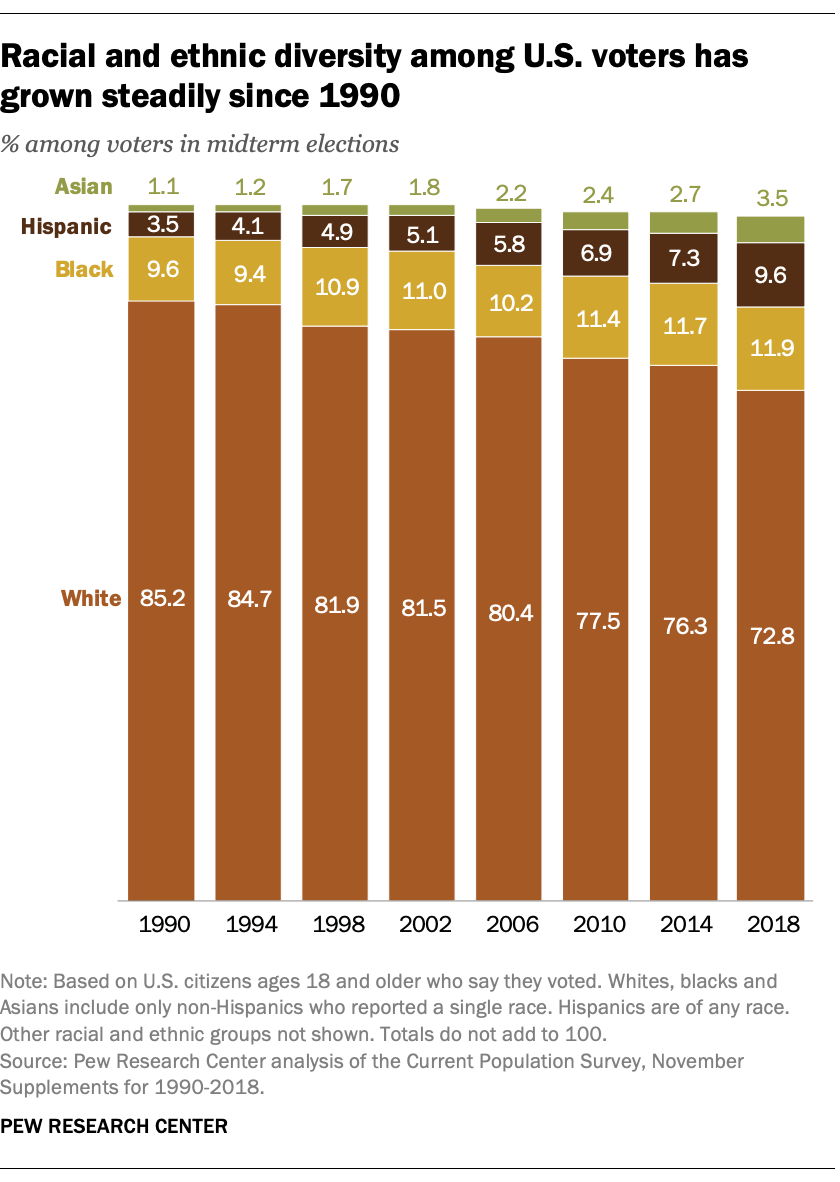
More than half of U.S. eligible voters cast a ballot in 2018, the highest turnout rate for a midterm election in recent history, according to a Pew Research Center analysis of newly released data from the U.S. Census Bureau. The increased turnout was particularly pronounced among Hispanics and Asians, making last year’s midterm voters the most racially and ethnically diverse ever.
With enthusiasm at a record high, more than 122 million people voted in the 2018 elections, the highest in a midterm election year since 1978. Last year also marked the first time since 1982 that the voter turnout rate in midterm elections surpassed 50%. This was a stark reversal from the previous midterm year, when turnout had decreased – from 45.5% in 2010 to 41.9% in 2014. (The voter turnout rate is the share who cast a ballot among eligible voters, defined as U.S. citizens ages 18 and older. Historical data in this analysis starts in 1978, the first year the Census Bureau gathered citizenship data for its survey of voters.)

 Racial and ethnic diversity among U.S. voters has grown steadily since 1990

Saturday, April 27, 2019

Voter Turnout in 2018: Gender Gap

Jordan Misra at the Census Bureau:
A record number of women were elected to the House of Representatives in the November 2018 election. Additionally, women continued to vote at higher rates than men, just as they have in every midterm election since 1998.
In the 2018 midterm election, 55 percent of women voted compared with 52 percent of men, a 3 percentage point gap.
...
In 2018, among those age 65 and older, voter turnout was 65 percent for women and 68 percent for men. In contrast, 38 percent of women 18-29 years old voted and 33 percent of men of the same age group voted.
...
Voter turnout for non-Hispanic black women was 55 percent, compared with 47 percent for non-Hispanic black men, an 8 percentage point gap.
Hispanic women voted at higher rates than Hispanic men, with 2018 voter turnout rates of 43 percent and 37 percent, respectively.
..

In 2018, 49 percent of unemployed women and 40 percent of unemployed men voted, a 9 percentage point difference.
The gap between employed men and women is smaller than the gap between unemployed men and women. In 2018, 57 percent of employed women voted compared with 52 percent of employed men.
Among those who were not in the labor force, 53 percent of women voted compared with 51 percent of men.

Tuesday, February 19, 2019

Millennials Voting

Kristen Bialik and Richard Fry at Pew:
Younger generations (Generation X, Millennials and Generation Z) now make up a clear majority of America’s voting-eligible population. As of November 2018, nearly six-in-ten adults eligible to vote (59%) were from one of these three generations, with Boomers and older generations making up the other 41%.
However, young adults have historically been less likely to vote than their older counterparts, and these younger generations have followed that same pattern, turning out to vote at lower rates than older generations in recent elections.
In the 2016 election, Millennials and Gen Xers cast more votes than Boomers and older generations, giving the younger generations a slight majority of total votes cast.
However, higher shares of Silent/Greatest generation eligible voters (70%) and Boomers (69%) reported voting in the 2016 election compared with Gen X (63%) and Millennial (51%) eligible voters. Going forward, Millennial turnout may increase as this generation grows older.
Generational differences in political attitudes and partisan affiliation are as wide as they have been in decades. Among registered voters, 59% of Millennials affiliate with the Democratic Party or lean Democratic, compared with about half of Boomers and Gen Xers (48% each) and 43% of the Silent Generation. With this divide comes generational differences on specific issue areas, from views of racial discrimination and immigration to foreign policy and the scope of government.

Thursday, February 7, 2019

American Dream, Religion, Civic Life

AEI survey on the American Dream:
  • While most Americans are dissatisfied with the direction of the country, they are optimistic about life in their communities and their ability to achieve the American dream.
  • Most people say their neighbors get along well and are willing to help each other, even though fewer report regularly helping their neighbors or trying to work together to fix or improve something in their neighborhood.
  • Americans derive a sense of community from their friends, neighborhoods, and hometowns more than their ideology or ethnic identity. Regular interaction with friends and neighbors produces a strong sense of community.
  • People who live close to an ample number of amenities such as schools, parks, libraries, and restaurants are happier with their communities, more engaged with their neighbors, and less lonely.
  • While loneliness is a significant problem, it may not be the epidemic that some claim.
From the report:
The SCS [AEI Survey on Community and Society] asks Americans about their involvement in a variety of organizations. The question is specific, asking people whether they have been active members in the past year, “by which we mean you do volunteer work, participate, and/or attend meetings and events, doing more than just donating, paying dues or following on social media” in any of 11 different types of organizations. As Figure 7 shows, 44 percent indicate no active membership in these types of groups. A quarter have been active in only one type of group in the past year, and 29 percent have been active in two or more.
Membership in a religious organization is most common, with 22 percent saying they have been active members, followed by 14 percent who have been active in an education- or school-based organization, 13 percent in a volunteer public service organization, 12 percent in a business or professional organization, 11 percent in an organization for hobbies or cultural activities, and 10 percent in an athletic team or outdoor activities group. Fewer than 10 percent report active membership in each of the other types of organizations mentioned.
...
The SCS asks respondents whether they had done any of nine different political activities in the past two years. (See Figure 9.) Seventy-one percent report that they voted regularly in national elections, and 61 percent say they voted regularly in local elections. Thirty-one percent say they publicly expressed their support for a political campaign on Facebook, Twitter, or other social media. Around a quarter say they contacted any elected official or politician in the past two years (27 percent); asked their friends, neighbors, family, or coworkers to support a candidate or political position (26 percent); or displayed a political or campaign poster, bumper sticker, lawn sign, or clothing (24 percent). Twenty percent say they attended a rally, protest, speech, or campaign event, and 18 percent say they contributed money to a candidate running for office or a group working to affect public policy. Twelve percent say they worked or volunteered for a political party, candidate, or group that tried to influence policy.  
 From Pew:
People who are active in religious congregations tend to be happier and more civically engaged than either religiously unaffiliated adults or inactive members of religious groups, according to a new Pew Research Center analysis of survey data from the United States and more than two dozen other countries.
Religiously active people also tend to smoke and drink less, but they are nothealthier in terms of exercise frequency and rates of obesity. Nor, in most countries, are highly religious people more likely to rate themselves as being in very good overall health – though the U.S. is among the possible exceptions.
...
In the U.S., 58% of actively religious adults say they are also active in at least one other (nonreligious) kind of voluntary organization, including charity groups, sports clubs or labor unions. Only about half of all inactively religious adults (51%) and fewer than half of the unaffiliated (39%) say the same.7
...
In addition, a higher percentage of actively religious adults in the United States (69%) say they always vote in national elections than do either inactives (59%) or the unaffiliated (48%).

Tuesday, October 9, 2018

Doctors in Politics

Suhas Gondi, Jonathan Kusner, and Yosef Berlyand at STAT:
Physicians do many things well. One thing they aren’t good at is showing up to vote. That bad habit starts early, and we believe it can — and must — be changed.

We don’t have data from recent elections, but studies from a decade ago show that physicians voted less often than the general population. (Lawyers, in contrast, were more likely to vote than the general population.) Given that health care accounts for almost one-fifth of the U.S. gross domestic product, and that new laws and regulations continuously alter the norms of medical practice, it is both curious and shameful that medical professionals fail to fulfill the basic civic responsibility of voting.

Several reasons have been tossed around to explain why physicians vote at such low rates. One is that doctors are so busy that it’s difficult to fit a trip to a polling place into an already packed day. Another explanation is that some physicians decide that the value of their single vote is too small to justify taking time away from patients in need. Low voting rates could also be part of broader disengagement from public life, consistent with evidence that physicians volunteer less often than other highly educated professionals and are less likely to donate to candidates.

But now more than ever physicians need to vote because the outcomes of elections are increasingly affecting their patients and their ability to care for them. Realizing this, many have called for more doctors to get politically involved. Although we’ve seen in recent years a swelling of physician advocacy on political issues, from repeal and replace the Affordable Care Act to “Dreamers” to gun violence, this engagement has largely taken the form of protests, marches, and social media campaigns. Far less energy has been invested into boosting the number of doctors who cast votes, the most fundamental form of civic engagement.

Friday, October 5, 2018

Youth Vote 2018

Campbell Streator and Harold Ekeh at The Hill:
We need young Americans to vote — not just once, but always. That’s why Every Vote Counts — a student-led, nonpartisan organization of which we’re proud to be a part — is dedicated to (channeling the energy that young Americans expend marching and protesting to boosting turnout on Election Day around the country.
This week, we’re lighting a fire under our peers by launching the National Pledge to Vote. We’re kicking off the pledge with events at 23 participating campuses nationwide, and with more to come. Yale University is challenging Harvard University to see which campus can deliver higher voter turnout. Basketball teams are challenging football teams to see who can get the most players to vote. Young Americans are also partnering with local community organizations to engage non-voters like never before.
Same theme, different organization -- a video from NAIL Communications:

Monday, May 21, 2018

Voter Turnout: International Data

In 2015, Charles Lane wrote at WP:
One of political science’s better-established findings is that “the frequency of elections has a strongly negative influence on turnout,” as Arend Lijphart of the University of California at San Diego put it in a 1997 article.

Yet in the United States, we constantly hold elections: Every two years, we elect a new Congress and, in many states, a new legislature. Every four years, that’s combined with a presidential election. Some jurisdictions squeeze local balloting — for sheriff, school board, judge, coroner, you name it — into the years between midterm congressional and presidential elections. Of course, these are often twice-a-year exercises, since a primary precedes the general election. Sometimes primaries have runoffs!
...
In practice, it’s costly — in time, effort and, indeed, money — to stay politically informed and active.
Those costs must be weighed against the potential benefits of participating in an election whose results might last no more than a couple of years, to the extent they affect you personally at all. Frequent elections therefore bring on what Lijphart calls “voter fatigue.”
In a famous paper nearly 30 years ago, Richard W. Boyd of Wesleyan University found that the introduction of presidential primaries in northern states after 1968 accounted for a 10 percentage-point drop in those states’ ­general-election voter turnout by 1980.

Fro Pew:


Tuesday, June 27, 2017

Who Is Not Voting in California?

Eric McGhee writes at PPIC:
  • California’s falling registration rate relative to other states is strongly driven by the growing diversity of its population. California’s Latino and Asian American communities have become eligible to vote at faster rates than their counterparts in other states. At the same time, Latinos and Asian Americans register at lower rates than members of other groups, leading to an overall decline in the registration rate compared with states where the eligible voting population is not changing as quickly.
  • The registration problem is especially pronounced for Latinos and Asian Americans more closely connected to the immigrant experience, that is, naturalized citizens and children born in the United States to immigrant parents.
  • The behavior of young voters largely accounts for California’s declining turnout in midterm elections. Young people have been voting at slightly higher rates in presidential elections and at much lower rates in midterms than voters of the same age did two decades ago.
  •  No other demographic factors significantly drive declining midterm participation. In particular, California’s expanding Latino and Asian American populations are not a significant part of the falling midterm turnout story. Once registered, the voting patterns of these groups have not changed meaningfully over time.

Saturday, May 20, 2017

Turnout: International Perspectives

Pew reports:


One reason for relatively low turnout is the complexity of the American political system.  Over half a million Americans hold elected office, and there are also many ballot measures at the local and state level.  The sheer size of the ballot discourages participation.

Sunday, May 14, 2017

Turnout

Many posts have discussed voter turnout.

From the Census:
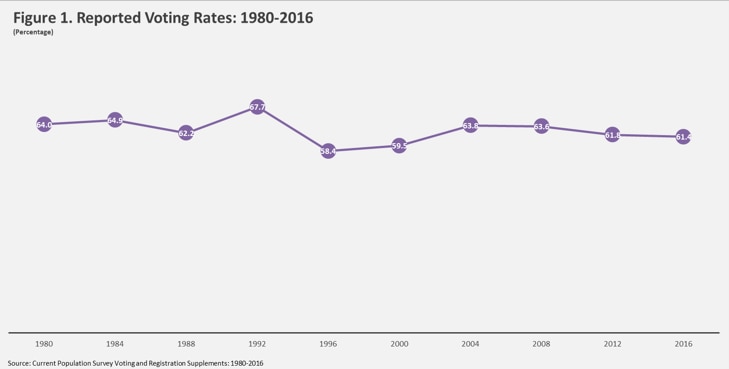
Figure 1 presents voting rates for the citizen voting-age population for each presidential election since 1980. In 2016, 61.4 percent of the citizen voting-age population reported voting, a number not statistically different from the 61.8 percent who reported voting in 2012.
And education:


See here for more on race and turnout in 2016.

Friday, November 4, 2016

Shy and Missing Voters?

Steven Shepard reports at Politico:
According to a POLITICO/Morning Consult study conducted by Morning Consult this past weekend and released Thursday, a hidden army of Trump voters that's undetected by the polls is unlikely to materialize on Election Day.
The study — which was composed of interviews with likely voters conducted over the phone with a live interviewer, and other interviews conducted online without a personal interaction — showed only a slight, not-statistically-significant difference in their effect on voters’ preferences for president.

Nate Cohn writes at The New York Times:
 Mr. Trump may yet win this election. But if he does, it probably won’t be because of a huge influx of Republican-leaning “missing” voters.
There has been no surge in registration among white voters since 2012, and the white voters who have joined the electorate are younger and likelier to support Mrs. Clinton than those who were already registered.

Tuesday, May 31, 2016

Student Turnout

At Inside Higher Ed, Ellen Wexler reports on a new study (infographic here) from Tufts University’s Institute for Democracy & Higher Education finding that only 45 percent of college students cast a ballot in 2012.
Voting behavior varies widely among college majors, the researchers found. Students in STEM fields were less likely than their peers to vote -- and across all disciplines, engineering and math majors (at 35 percent) were the least likely to vote.
Forty-nine percent of humanities majors voted, with health, communications and social sciences majors following close behind. But while they all voted at above-average rates, only one major broke 50 percent.
“When I talk to groups and I ask, ‘What do you think the highest voting rate in the country is?’ everything says, ‘Oh, political science or sociology,’” said Nancy Thomas, director of the institute. “Well, it isn't. It’s education.”
Education majors voted at 55 percent in 2012 -- higher than any other discipline. They beat the engineering and math students by a 20-point margin