Search This Blog

Showing posts with label civic duty. Show all posts

Sunday, December 3, 2023

Civic Opportunity

de Vries, M., Kim, J.Y. & Han, H. The unequal landscape of civic opportunity in America. Nat Hum Behav (2023). https://doi-org.ccl.idm.oclc.org/10.1038/s41562-023-01743-1

The hollowing of civil society has threatened effective implementation of scientific solutions to pressing public challenges—which often depend on cultivating pro-social orientations commonly studied under the broad umbrella of social capital. Although robust research has studied the constituent components of social capital from the demand side (that is, the orientations people need for collective life in pluralistic societies, such as trust, cohesion and connectedness), the same precision has not been brought to the supply side. Here we define the concept of civic opportunity—opportunities people have to encounter civic experiences necessary for developing such orientations—and harness data science to map it across America. We demonstrate that civic opportunity is more highly correlated with pro-social outcomes such as mutual aid than other measures, but is unequally distributed, and its sources are underrepresented in the public dialogue. Our findings suggest greater attention to this fundamentally uneven landscape of civic opportunity.

Wednesday, May 17, 2023

Religion and Civic Participation

From PRRI:
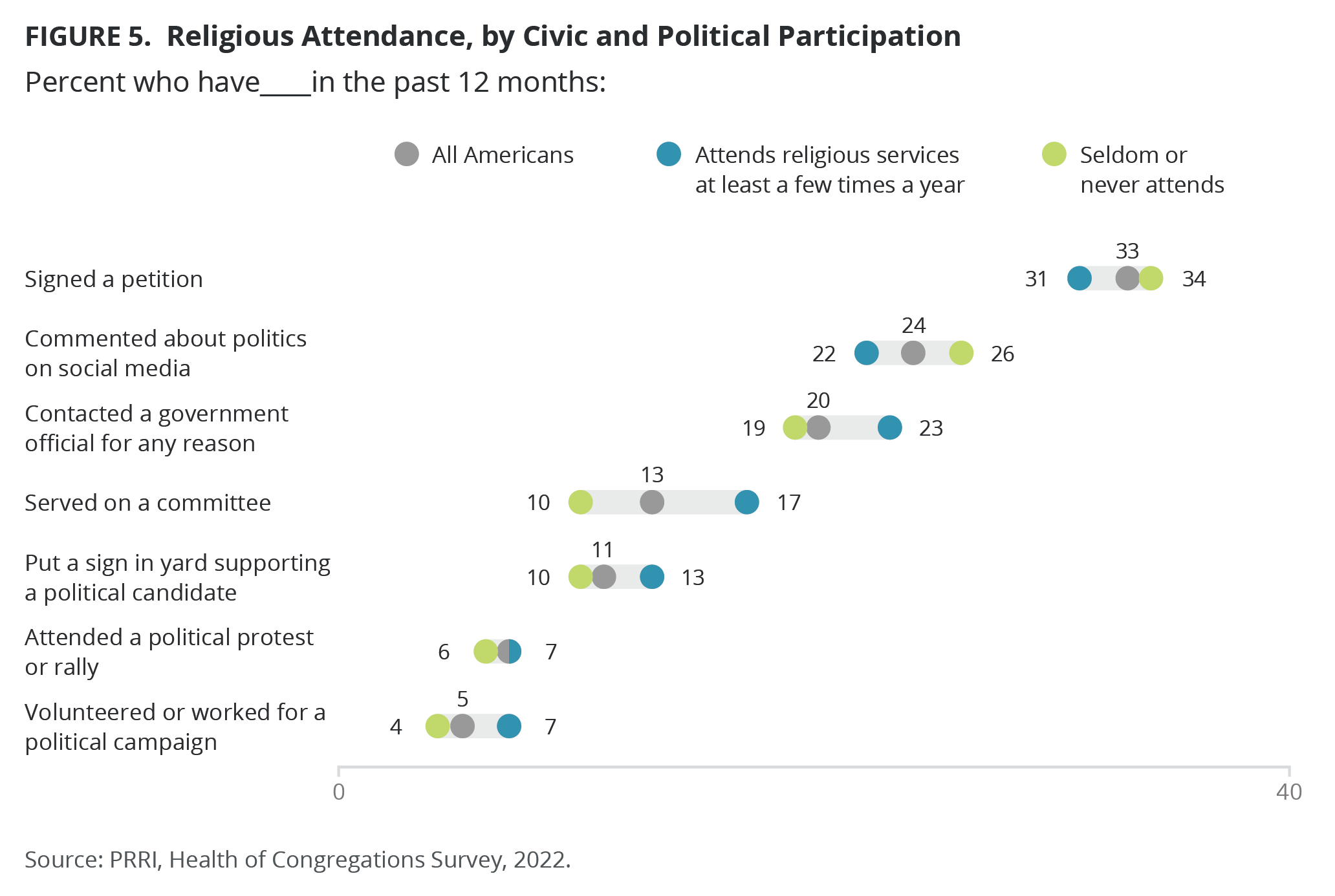
When asked about their civic and political participation in the past year, one-third of Americans (33%) said they signed a petition either in person or online; 24% said they commented about politics on a message board or internet site, including social media; 20% said they contacted a government official; 13% said they served on a committee for a civic, nonprofit, or community organization or event; 11% said they put a sign in their yard or a bumper sticker on their car supporting a candidate for political office; 7% said they attended a political protest or rally; and just 5% said they volunteered or worked for a political campaign.

Americans who attend church at least a few times a year are notably more likely than those who seldom or never attend church to have contacted a government official (23% vs. 19%), served on a committee (17% vs. 10%), put up a sign supporting a political candidate (13% vs. 10%), or volunteered for a political campaign (7% vs. 4%). By contrast, Americans who attend church more frequently are less likely than those who seldom or never attend to have commented about politics (22% vs. 26%).

White Americans participate in civic and political activities more than nonwhite Americans do. For example, white Americans are more likely to have signed a petition (35%) or contacted a government official (24%) than both Black Americans (29% and 15%, respectively) and Hispanic Americans (26% and 14%, respectively). White Americans are also more likely than Black Americans to have commented about politics (27% vs. 15%) and are more likely than Hispanic Americans to have served on a committee (14% vs. 10%) or put a sign in their yard supporting a candidate (12% vs 8%).

When examining religious attendance together with race and civic and political participation, white churchgoers are notably more likely than white non-churchgoers to have served on a committee (17% vs. 12%), but are less likely to have commented about politics (24% vs. 29%). Black churchgoers are more likely than Black non-churchgoers to have contacted a government official (20% vs. 11%), served on a committee (19% vs. 7%), or volunteered for a political campaign (9% vs. 3%). Hispanic churchgoers are also more likely than Hispanic non-churchgoers to have contacted a government official (20% vs. 11%), served on a committee (15% vs. 6%), or put up a sign supporting a candidate (12% vs. 5%). Churchgoers of other racial groups are more likely than non-churchgoers of other races to have served on a committee (20% vs. 7%) or volunteered for a political campaign (12% vs. 3%).[5]


Wednesday, May 3, 2023

Declines in Civics and History Proficiency

 Donna St. George at WP:

Just 13 percent of the nation’s eighth graders were proficient in U.S. history last year, and 22 percent were proficient in civics, marking another decline in performance during the pandemic and sounding an alarm about how well students understand their country and its government.

The findings, released Wednesday, show a five-point slide since 2018 in the average history score on the National Assessment of Educational Progress, or NAEP, often called “the nation’s report card.” In civics, eighth grade scores fell two points, the first decline ever recorded on the tests, which cover the American political system, principles of democracy and other topics.

Peggy G. Carr, commissioner of the National Center for Education Statistics, referred to the results as “a national concern,” saying that “too many of our students are struggling … to understand and explain the importance of civic participation, how American government works and the historical significance of events.”

Thursday, November 10, 2022

Being a Good Member of Society

Many posts have discussed topics such as civic duty and partisan polarization.

Laura Silver at Pew:

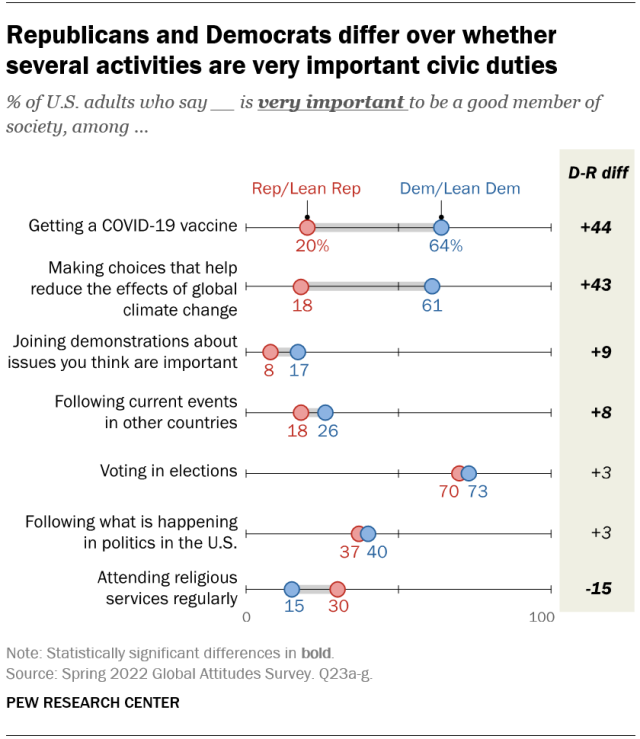
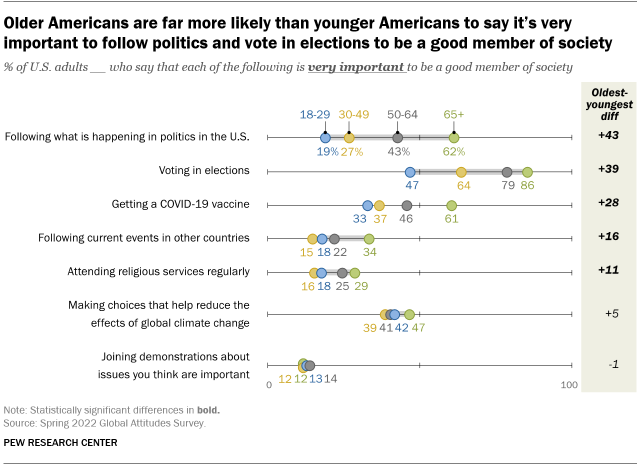
Around seven-in-ten U.S. adults (69%) say it’s very important to vote in elections to be a good member of society – more than say the same about any of the other activities included in a Pew Research Center survey conducted earlier this year. 


Young and old differ on some points.


Saturday, February 19, 2022

Youth Civic Engagement

From the Brennan Center:
Civic engage­ment is a key indic­ator of adult­hood. Young adults respond to the social and polit­ical issues of the day in a vari­ety of ways. After the police killings of George Floyd and Breonna Taylor in 2020, young people demon­strated against racial injustice in more than 10,000 peace­ful protests around the coun­try.

foot­note1_g6xcuor1 That fall saw record numbers of youth turn out for the pres­id­en­tial elec­tion; half of eligible voters ages 18–29 parti­cip­ated, compared with 39 percent in 2016. foot­note2_3ycctnz2 Climate change like­wise cata­lyzed young people, as nearly 30 percent of Gener­a­tion Z and Millen­ni­als made dona­tions, contac­ted public offi­cials, volun­teered, or protested, surpass­ing Gener­a­tion X and Baby Boomers. foot­note3_pisb­s1c3 Young people are commonly assumed to be disen­gaged, disil­lu­sioned, and unin­ter­ested in civic life. These trends chal­lenge that propos­i­tion.

Research­ers have consist­ently found that early civic engage­ment is mutu­ally bene­fi­cial to young people and to the communit­ies in which they parti­cip­ate. For example, devel­op­mental psycho­lo­gist Parissa Ballard and colleagues found that early civic engage­ment is asso­ci­ated with posit­ive health outcomes later in life. Voting, volun­teer­ing, and activ­ism in young adult­hood were related to improved mental health, greater educa­tional attain­ment, and higher personal and house­hold incomes. foot­note4_n49aljr4 Beyond these indi­vidual bene­fits, young adults are import­ant contrib­ut­ors to their local communit­ies. Tufts University’s Center for Inform­a­tion and Research on Civic Learn­ing and Engage­ment (CIRCLE) projec­ted that in the 2020 elec­tion cycle, young adults would play a partic­u­larly import­ant role in the pres­id­en­tial battle­ground states Wiscon­sin, North Caro­lina, and Flor­ida, as well as in Senate races in Color­ado, Maine, and Montana and congres­sional races in Iowa’s 1st District, Maine’s 2nd, and Geor­gi­a’s 7th. foot­note5_9alq4i75 The youth vote proved decis­ive in several states where the margin of victory was less than 50,000 votes, includ­ing Arizona, Geor­gia, and Pennsylvania. foot­note6_um60jqh6

National legis­la­tion and educa­tional policy reflect the import­ance of prepar­ing young people to become engaged and parti­cip­at­ory members of soci­ety. Recog­niz­ing the mutual bene­fits of community service for the advance­ment of communit­ies and the well-being of young people, Congress passed the National and Community Service Act of 1990 and the National and Community Service Trust Act of 1993. The first law created the Commis­sion on National and Community Service to support school-based service-learn­ing programs, volun­teer and service programs in higher educa­tion, youth corps, and national service models; the second merged the commis­sion with the National Civil­ian Community Corps to estab­lish the Corpor­a­tion for National and Community Service, to support volun­teer and service oppor­tun­it­ies for all Amer­ic­ans. In 2009 Congress passed the Edward M. Kennedy Serve Amer­ica Act, reau­thor­iz­ing and expand­ing national and community service legis­la­tion to support lifelong volun­teer­ism and community service. Through these acts, Congress has emphas­ized the need for civic engage­ment, which helps youth become informed citizens as well as active members of their communit­ies through­out their life­time.

School curricula rein­force the expect­a­tion that young people will become engaged citizens. Accord­ing to the Center for Amer­ican Progress, 40 states and the District of Columbia require a civics course for high school gradu­ation, and 16 states require a civics exam to gradu­ate. However, only Mary­land and the District of Columbia require community service for all high school gradu­ates. foot­note7_eslmnjr7

1 Armed Conflict Loca­tion & Event Data Project (here­in­after ACLED), Demon­stra­tions and Polit­ical Viol­ence in Amer­ica: New Data for Summer 2020, Septem­ber 2020, https://acled­data.com/2020/09/03/demon­stra­tions-polit­ical-viol­ence-in-amer­ica-new-data-for-summer-2020/.
foot­note2_3ycctnz
2
 Center for Inform­a­tion and Research on Civic Learn­ing and Engage­ment (here­in­after CIRCLE), “Half of Youth Voted in 2020, an 11-Point Increase from 2016,” April 29, 2021, https://circle.tufts.edu/latest-research/half-youth-voted-2020–11-point-increase-2016.
foot­note3_pisb­s1c
3
 Alec Tyson, Brian Kennedy, and Cary Funk, “Gen Z, Millen­ni­als Stand Out for Climate Change Activ­ism, Social Media Engage­ment with Issue, ” Pew Research Center, May 26, 2021, https://www.pewre­search.org/science/2021/05/26/gen-z-millen­ni­als-stand-out-for-climate-change-activ­ism-social-media-engage­ment-with-issue/.
foot­note4_n49aljr
4
 Parissa J. Ballard, Lind­say T. Hoyt, and Mark C. Pachucki, “Impacts of Adoles­cent and Young Adult Civic Engage­ment on Health and Socioeco­nomic Status in Adult­hood, ” Child Devel­op­ment 90, no. 4 (2019): 1138–54, https://doi.org/10.1111/cdev.12998.
foot­note5_9alq4i7
5
 CIRCLE, “Youth Elect­oral Signi­fic­ance Index (YESI), ” last updated August 18, 2020, https://circle.tufts.edu/yesi2020.
foot­note6_um60jqh
6
 CIRCLE, “Elec­tion Week 2020: Young People Increase Turnout, Lead Biden to Victory, ” Novem­ber 25, 2020, https://circle.tufts.edu/latest-research/elec­tion-week-2020#young-voters-and-youth-of-color-powered-biden-victory.
foot­note7_eslmnjr
7
 Sarah Shapiro and Cath­er­ine Brown, “The State of Civics Educa­tion,

Monday, February 14, 2022

True Faith

 Former RNC chair Mark Racicot at The Billings Gazette:

The Oath of Office taken by every member of the United States Senate and House of Representatives, as well as the president, requires those office holders to “solemnly swear that I will support and defend the Constitution of the United States against all enemies foreign and domestic [and] that I will bear true faith and allegiance to the same.” The Oath concludes with a solemn promise that “I will well and faithfully discharge the duties of the office on which I am about to enter. So help me God.”

Bearing true faith means maintaining fidelity to the preservation of the union, fidelity to our fellow citizens, fidelity to a shared set of values and fidelity to the law and the Constitution. That transcendent fidelity or faithfulness to the Constitution is demonstrated by our continuing and unequivocal loyalty, first and above all else, to the United States of America, without interruption, without condition, without exception, without avoidance, without arrogance, without deceit, without connivance and without obfuscation.

The faithfulness referred to in the Oath of Office presumes not just faithfulness to the actual words of the Constitution, but faithfulness to its spirit as well. A spirit recognized and requited by humility, respect for others and the rights of others, honor, decency, integrity and self-discipline. Fidelity is the exact opposite of seeking power for its own sake or craving victory at any cost, each of which history has revealed time and time again to be a fool’s errand.

All of the above is to say that I have discovered no facts nor evidence, anywhere, of the “sabotage” or “persecution” or efforts to “destroy” the former president that serve as the basis for the accusations cited in the RNC Resolution and lodged against Representatives Cheney and Kinzinger. Quite the opposite, the evidence reveals two Republican members of the House of Representatives honorably performing their investigative duties and searching for the truth as members of a duly constituted investigative committee. In other words, they’re doing their job with fidelity and loyalty to the Constitution.

Monday, January 24, 2022

Civic Education and Civic Virtue

 Albert Cheng and Jay Greene at National Affairs:

Civic education does not occur merely within the life of the school; it also occurs in homes, neighborhoods, the marketplace, religious institutions, and any other voluntary association in which individuals gather with others to unite around a common purpose. It is within the context of these communities that people learn to seek the interest of others instead of their own and to work together for their mutual flourishing. It is where they practice virtues like showing kindness, hospitality, and charity to others. It is also where they practice having the courage to defend their convictions or compromising to build coalitions with those whose views may not fully align with their own. These and other "habits of the heart," as the late sociologist Robert Bellah and his colleagues articulated nearly 40 years ago, are cultivated in all spheres of civil society. Schools are but one of the many institutions where this kind of formation happens.

Civic education, then, requires a kind of knowledge. But not merely civic knowledge, narrowly understood as knowledge of history and government institutions; it also requires knowledge of ultimate things — of truth, goodness, and beauty — so that a flourishing polis can be discerned.

Civic education likewise requires training in a kind of skill. But not merely civic skill, narrowly understood as possessing competencies in democratic procedures like voting, petitioning, assembling, or staying informed; it also requires cultivation of habits that give rise to the practices of good citizens. In sum, civic education requires the cultivation of civic virtue for making sense of civic knowledge and guiding the application of civic skills.


Thursday, August 12, 2021

Masks in 1918

Many posts have discussed COVID, vaccines, and masks.

We have been here before.

 J. Alexander Navarro at The Conversation:

In mid-October of 1918, amidst a raging epidemic in the Northeast and rapidly growing outbreaks nationwide, the United States Public Health Service circulated leaflets recommending that all citizens wear a mask. The Red Cross took out newspaper ads encouraging their use and offered instructions on how to construct masks at home using gauze and cotton string. Some state health departments launched their own initiatives, most notably California, Utah and Washington.

Nationwide, posters presented mask-wearing as a civic duty – social responsibility had been embedded into the social fabric by a massive wartime federal propaganda campaign launched in early 1917 when the U.S. entered the Great War. San Francisco Mayor James Rolph announced that “conscience, patriotism and self-protection demand immediate and rigid compliance” with mask wearing. In nearby Oakland, Mayor John Davie stated that “it is sensible and patriotic, no matter what our personal beliefs may be, to safeguard our fellow citizens by joining in this practice” of wearing a mask.

Health officials understood that radically changing public behavior was a difficult undertaking, especially since many found masks uncomfortable to wear. Appeals to patriotism could go only so far. As one Sacramento official noted, people “must be forced to do the things that are for their best interests.” The Red Cross bluntly stated that “the man or woman or child who will not wear a mask now is a dangerous slacker.” Numerous communities, particularly across the West, imposed mandatory ordinances. Some sentenced scofflaws to short jail terms, and fines ranged from US$5 to $200.

Wednesday, July 7, 2021

Encouraging Trend on Jury Duty

Russell Contreras at Axios:
Driving the news: Jury consultant Jason Bloom tells Axios that, historically, as many as one in four U.S. adults who are called for jury duty seek to be excused, citing hardships. But now, that number has shrunk to around only 5%-10%, he says.

Why it matters: There's a clear upside to enhanced civic engagement, but former prosecutors warn that it's as essential as ever to make sure that potential jurors are fair and don't come into cases with agendas.

The big picture: The projected jump in participation follows the killing of George Floyd; the trial, conviction and 22.5-year sentence of former police officer Derek Chauvin; and record voter turnout in 2020.
  • During Chauvin jury selections earlier this year, a surprising number of Hennepin County residents in Minnesota were OK with serving, and a few were been flat out excited, as Nick Halter, the author of Axios Twin Cities, reports.
  • One prospective juror said she voted in the November election because she wanted to become eligible for jury duty and called the process "fascinating." Another potential juror even said he was willing to delay his wedding to serve on the jury.
Courts are also facing case backlogs as they reopen following pandemic shutdowns.

What they're saying: “There are many ways to impact our communities," District of Columbia Attorney General and National Association of Attorneys General president Karl Racine tells Axios. "A critical piece of civic engagement is serving on a jury and I hope this means more people will answer that call to service."

Sunday, September 6, 2020

Guns and the Social Compact

David French:
We know the obligation of the government, but what about the obligation of the citizen? Here’s where we turn to Thomas Jefferson’s rival, John Adams. And Adams gives us the second quote that frames our constitutional republic. Writing to the Massachusetts militia, he says, “Our Constitution was made only for a moral and religious People. It is wholly inadequate to the government of any other.”

But that’s not all he said. In a less-famous section, he wrote, “We have no Government armed with Power capable of contending with human Passions unbridled by morality and Religion. Avarice, Ambition, Revenge or Galantry, would break the strongest Cords of our Constitution as a Whale goes through a Net.” Our government wasn’t built to force men to be moral. Instead, it depends on man’s morality for the system to work.

Thus, the American social compact—the government recognizes and defends fundamental individual liberty, and the individual then exercises that liberty virtuously, for virtuous purposes. Or, to kinda-sorta paraphrase Spiderman’s Uncle Ben, with great liberty comes great responsibility.

That brings me to American gun rights and to Kyle Rittenhouse, the young man who killed two people and wounded one during a series of encounters with protesters in Kenosha, Wisconsin. Let me be clear: I’m not going to use this newsletter to adjudicate his case. The investigation is ongoing, and there is both evidence that he acted in self-defense during the fatal encounters, and evidence he threatened at least one innocent individual prior to the encounters by pointing his weapon at him without justification. There is still much we don’t know.

But here are some things we do know. By arming himself and wading into a riot, Rittenhouse behaved irresponsibly and recklessly. I agree completely with Tim Carney’s assessment here:
The 17-year-old charged with two homicides in Kenosha, Wisconsin, was not a hero vigilante, nor was he a predatory white supremacist. He was, the evidence suggests, a foolish boy whose foolish decisions have taken two lives and ruined his own.

If you go armed with a rifle to police a violent protest, you are behaving recklessly. The bad consequences stemming from that decision are at least partly your fault

.

Sunday, January 5, 2020

The Military Draft

The possibility of war with Iran has raised questions about the military draft.  Under current law, women do not have to register, but men do.  From the Selective Service System:
Virtually all male U.S. citizens, regardless of where they live, and male immigrants, whether documented or undocumented, residing in the United States, who are 18 through 25, are required to register with Selective Service
The law says men must register with Selective Service within 30 days of their 18th birthday. That means men are required to register with Selective Service sometime during the 30 days before their 18th birthday, their 18th birthday, and the following 29 days after their 18th birthday – that is a 60-day registration period. 
Men who do not register with Selective Service within the 60-day window are technically in violation of the law and should register as soon as possible. Late registrations are accepted up to the 26th birthday. However, once a man reaches his 26th birthday and still has not registered with Selective Service, it is too late!
It’s important to know that even though a man is registered, he will not automatically be inducted into the military. Registering with Selective Service does not mean you are joining the military.
In a crisis requiring a draft, men would be called in a sequence determined by random lottery number and year of birth. Then, they would be examined for mental, physical, and moral fitness by the military before being deferred or exempted from military service or inducted into the Armed Forces.
Reasons to Register
Registration is the Law — A man’s only duty right now under the Military Selective Service Act is to register at age 18 and then to let Selective Service know within 10 days of any changes in the information he provided on his registration form until he turns 26 years old.
Fairness and Equity — By registering all eligible men, Selective Service ensures a fair and equitable draft, if ever required. However, there has not been a draft since 1973.
Insurance for the Nation — By registering, a man’s voluntary participation helps provide a hedge against unforeseen threats. It is a relatively low-cost insurance policy for our nation.
Civic Duty — It’s your responsibility to ensure that young men 18 through 25 understand the law so they can make an informed decision about registration compliance. Currently, more than 90 percent of eligible young men are registered. It’s a civic duty of every young man to comply with the law.
Protect Eligibility for Future Benefits — It’s what a man’s got to do. By registering, a young man stays eligible for jobs, college loans and grants, job training, driver’s license in most states, and U.S. citizenship for immigrant men.


Wednesday, July 17, 2019

Religion: "Nothing in Particular"


Ryan Burge at Religion News Service:
The 2016 Cooperative Congressional Election Study asked respondents if they had engaged in one of five activities: attended a local political meeting, put up a political yard sign, donated money to a candidate/campaign, volunteered for a political campaign or given blood.

Guess which group was the least likely to check any of those boxes?
The “nothing in particulars.”
According to the CCES 2018, nearly two-thirds of the “nothing in particulars” had participated in none of the five activities in the past 12 months. That was the highest of any of the groups in the survey.
Education, rather than religion, might play a role. It is possible that lower levels of education may account for lower levels of social capital and civic involvement.
However, at each level of education, the “nothing in particular” group is less likely to engage in activities than the American public at large.
 In sum, we have a group that currently comprises 20%  of all Americans, and is growing at an unbelievably rapid pace. This group has the lowest level of education of any religious group, and “nothing in particulars” are less likely to engage in political or social activity than the average American.
As a social scientist, I find this represents a troubling confluence of factors.
By all measures, “nothing in particulars” appear to be a growing segment of society that is “checked out.” They don’t obtain high levels of education, they don’t get involved in the political process and they don’t affiliate with a religious group. In addition, they are three times more likely to say their political partisanship is “other” as well. They are adrift in modern society, refusing to be labeled by a religious group or a political party.

Tuesday, March 5, 2019

Teaching Deliberation

A release from the University of Houston-Clear Lake:
In a world full of politically divisive and polarizing issues, the level of public discourse can quickly become hostile and antagonistic. That is why Se-Hyoung Yi, assistant professor of political science at University of Houston-Clear Lake, teaches students the difference between debating and deliberative dialogue—so that they can facilitate politically themed forums in which people from opposing sides learn to accept each other’s differences and concentrate on finding common ground and shared direction among themselves. For his efforts, Yi has been awarded the Taylor L. Willingham Legacy Fund Award, administered by the National Issues Forums Institute in Dayton, Ohio.
The award, explained Yi, is established to help those who are working to develop an understanding of deliberative democracy and to promote deliberative dialogue forums in their communities as a way to help people talk productively about polarizing public issues.
“In order to win the award, I showed my desire to become involved in the democratic deliberation movement, demonstrated my commitment to implement and conduct democratic deliberation in a forum environment, and presented a detailed plan to moderate and host deliberative forums in my community,” Yi said. “This university is my community.”
Since 2017, Yi has partnered with Lone Star College-Kingwood Political Science Professor John Theis to train student moderators in deliberative dialogue. “The goal is to teach student moderators a different kind of political dialogue,” Yi said. “Unlike in a debate, where one side tries to ‘win’ an argument against the other, we teach students to help opposing sides find a shared ground. We do not try to change each other’s perspectives. When discussing daunting political issues that divide all of us, even compromise might not be possible. In the deliberative setting, participants explore the unbiased facts, weigh different options, and balance tradeoffs to find where their various interests overlap.”
Then, Yi said, they are shown how to move on for the sake of the community and to find the places where agreement can be achieved.
Yi said the award is accompanied by a $500 grant. “I plan to use this money to host at least five new deliberative dialogue forums on campus,” he said. “It’s important to be able to switch moderators with other campuses. In the past, we have invited student moderators from Lone Star College and from Sam Houston State University, and with these funds, I can invite more student facilitators from other universities here, and send our student moderators to other universities.”
He said that by April 2018, he and Theis had trained over 20 student moderators. With support from the College of Human Sciences and Humanities, Yi had hosted a campus-wide deliberative dialogue forum on immigration during the UHCL Student Conference in 2018.
“We are showing students how to become more engaged in the process of democracy,” Yi said. “Student moderators are learning that they must learn to frame the issue in a non-partisan way and to encourage participants to listen to each other, not just insisting upon their own perspectives.”

Thursday, February 28, 2019

Demographic Difference on Civic Participation

Nearly six-in-ten Americans (57%) participate in some type of community group or organization, including about one-in-ten (11%) who say they participate in four or more community groups, according to a new analysis of data from a December 2017 Pew Research Center survey.
...
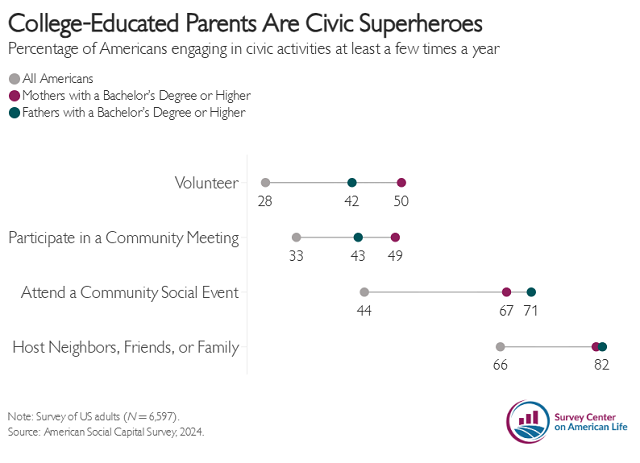
 Generally, adults who are better educated and wealthier are more likely to be involved in some community or other group. A majority of college graduates are active in at least one community group, while only half of those with a high school education say the same (70% vs. 48%). And two-thirds of those who have a household income of at least $75,000 say they are active in at least one community group, compared with 47% of those with a household income of $30,000 or less.

There also are some differences along age and racial/ethnic lines. Notably, adults who have reached retirement age are more likely to be involved – two-thirds of Americans ages 65 and older say they participate in at least one community organization, compared with 55% of younger adults. And blacks (62%) and whites (59%) are more likely than Hispanics (49%) to say they are active in at least one community group.
Among religious groups, about six-in-ten Protestants (61%) say they participate in at least one group, with 12% saying they are active in four or more organizations. And about seven-in-ten Jews (72%) say they participate in at least one community group or organization, including a quarter (24%) who participate in four or more. By comparison, fewer Catholics (53%) and religiously unaffiliated adults (51%) say they participate in one or more community groups

Friday, December 28, 2018

Military: the Oath and Civic Participation

General Joseph Dunford, Jr., chairman of the Joint Chief of Staff, wrote in 2016:
Every Servicemember swears “to support and defend the Constitution of the United States” and to “bear true faith and allegiance to the same.” This oath is embedded in our professional culture and underpins the values that shape and define our all-volunteer force. Beginning with General George Washington resigning his military commission, our deliberate and disciplined commitment to upholding the principle of civilian control of the military underpins not only our warrior ethos but also the expectations of how we conduct ourselves while in uniform.
...
Every member of the Joint Force has the right to exercise his or her civic duty, including learning and discussing—even debating—the policy issues driving the election cycle and voting for his or her candidate of choice. Provided that we follow the guidance and regulations governing individual political participation, we should be proud of our civic engagement. What we must collectively guard against is allowing our institution to become politicized, or even perceived as being politicized, by how we conduct ourselves during engagements with the media, the public, or in open or social forums.

Monday, December 24, 2018

Grace in America

Pete Wehner at NYT:
In 2014, Steve Hayner, my spiritual confidant, was diagnosed with pancreatic cancer. Upon learning it had spread, Steve wrote, “In all probability, the remainder of my life on this earth is now to be counted in weeks and months.” (He died in January 2015.) Steve acknowledged that pain and death are reminders of the nature of our broken world. Yet he went on to say: “There is a much bigger story of which this is only a tiny part. And it is God’s story of love, hope, forgiveness, reconciliation, and joy. We went into this journey choosing to trust God and to offer our fears to God. We’ve been so grateful for the freedom from fear and the abundance of peace that we have experienced.” He added, “There are, of course, times of discouragement, grief, pain, and wonder. After all, there are a lot of unknowns ahead of us.”

I sent Steve’s reflections to my friend Jonathan Rauch, who responded, “It’s letters like this — the wisdom, the grace — that make me wish I weren’t an atheist.”

When I recently asked Jonathan how, as a nonbeliever, he understood grace and why it inspires us when we see it in others, he told me that grace is “some combination of generosity and magnanimity, kindness and forgiveness, and empathy — all above the ordinary call of duty, and bestowed even (or especially?) when not particularly earned.” We see it demonstrated in heroic ways and in small, everyday contexts, he said. “But I guess, regardless of the context, it’s always at least a little unexpected and out of the ordinary.”

A lot like if the incarnate deity, veiled in flesh, were born in a manger in Bethlehem.

A September CBS news story nicely illustrated the point, along with Tocqueville's observations about community and voluntary action.

Todd Kirnan has been making deliveries to businesses in downtown Gresham, Oregon, for years. So in return, his community decided to give back and honor him with a parade and a statue. Steve Hartman has his story "On The Road."

Tuesday, August 28, 2018

McCain Farewell

From the late Senator John McCain:
"My fellow Americans, whom I have gratefully served for sixty years, and especially my fellow Arizonans,

"Thank you for the privilege of serving you and for the rewarding life that service in uniform and in public office has allowed me to lead. I have tried to serve our country honorably. I have made mistakes, but I hope my love for America will be weighed favorably against them.

"I have often observed that I am the luckiest person on earth. I feel that way even now as I prepare for the end of my life. I have loved my life, all of it. I have had experiences, adventures and friendships enough for ten satisfying lives, and I am so thankful. Like most people, I have regrets. But I would not trade a day of my life, in good or bad times, for the best day of anyone else's.

"I owe that satisfaction to the love of my family. No man ever had a more loving wife or children he was prouder of than I am of mine. And I owe it to America. To be connected to America's causes – liberty, equal justice, respect for the dignity of all people – brings happiness more sublime than life's fleeting pleasures. Our identities and sense of worth are not circumscribed but enlarged by serving good causes bigger than ourselves.

"'Fellow Americans' – that association has meant more to me than any other. I lived and died a proud American. We are citizens of the world's greatest republic, a nation of ideals, not blood and soil. We are blessed and are a blessing to humanity when we uphold and advance those ideals at home and in the world. We have helped liberate more people from tyranny and poverty than ever before in history. We have acquired great wealth and power in the process.

"We weaken our greatness when we confuse our patriotism with tribal rivalries that have sown resentment and hatred and violence in all the corners of the globe. We weaken it when we hide behind walls, rather than tear them down, when we doubt the power of our ideals, rather than trust them to be the great force for change they have always been.

"We are three-hundred-and-twenty-five million opinionated, vociferous individuals. We argue and compete and sometimes even vilify each other in our raucous public debates. But we have always had so much more in common with each other than in disagreement. If only we remember that and give each other the benefit of the presumption that we all love our country we will get through these challenging times. We will come through them stronger than before. We always do.

"Ten years ago, I had the privilege to concede defeat in the election for president. I want to end my farewell to you with the heartfelt faith in Americans that I felt so powerfully that evening.

"I feel it powerfully still.'

"Do not despair of our present difficulties but believe always in the promise and greatness of America, because nothing is inevitable here. Americans never quit. We never surrender. We never hide from history. We make history.

"Farewell, fellow Americans. God bless you, and God bless America."

Monday, November 13, 2017

National Service

Gallup:
Almost half (49%) of Americans favor requiring young men and women to give a year of service to the nation. But a majority (57%) of the group most likely to be affected -- those under the age of 30 -- oppose the idea.
The idea of mandatory national service has been floated numerous times by think tanks and opinion writers over the past decade and a half, but it has never become a major issue in national politics. U.S. Rep. Charles Rangel unsuccessfully pushed a version of the idea in every legislative session from 2003 to 2015; at one point, it even reached the House floor, where it was defeated by a vote of 402-2.
Though the idea has never garnered much attention as a national policy proposal, there is support for the concept among segments of the public. A majority of Republicans, including independents who lean Republican, favor it (57%), as do men (57%) and those 65 or older (66%).

Friday, August 25, 2017

Jury Duty and Good Citizenship

John Gramlich writes at Pew:
In an April Pew Research Center survey, two-thirds of U.S. adults (67%) said serving on a jury “is part of what it means to be a good citizen.” Just 31% took the opposite view and said jury duty service “does not have much to do with being a good citizen.”
Majorities in most demographic groups connect jury duty service with good citizenship, but younger people, racial and ethnic minorities and those without a college education are less likely to do so.
For example, only half of those ages 18 to 29 say jury service is part of being a good citizen, compared with seven-in-ten or more in older age groups. Blacks and Hispanics are less likely than whites to see jury duty as a part of good citizenship, as are those with a high school diploma or less when compared with people with at least some college education.

When it comes to the number of Americans who actually serve on a jury in a given year, recent statistics are hard to find. But the National Center for State Courts, an independent research organization focused on the state judiciary, has estimated that only about 15% of U.S. adults receive a jury summons each year, and fewer than 5% of those who are summoned end up on a jury. The center’s 2007 estimates are based on a survey of 1,546 counties, representing about 70% of the U.S. population at the time.