Search This Blog

Showing posts with label citizenship. Show all posts

Monday, May 29, 2023

A MEMORIAL DAY REMINDER THAT PUERTO RICO IS PART OF THE UNITED STATES


Thursday, November 10, 2022

Being a Good Member of Society

Many posts have discussed topics such as civic duty and partisan polarization.

Laura Silver at Pew:

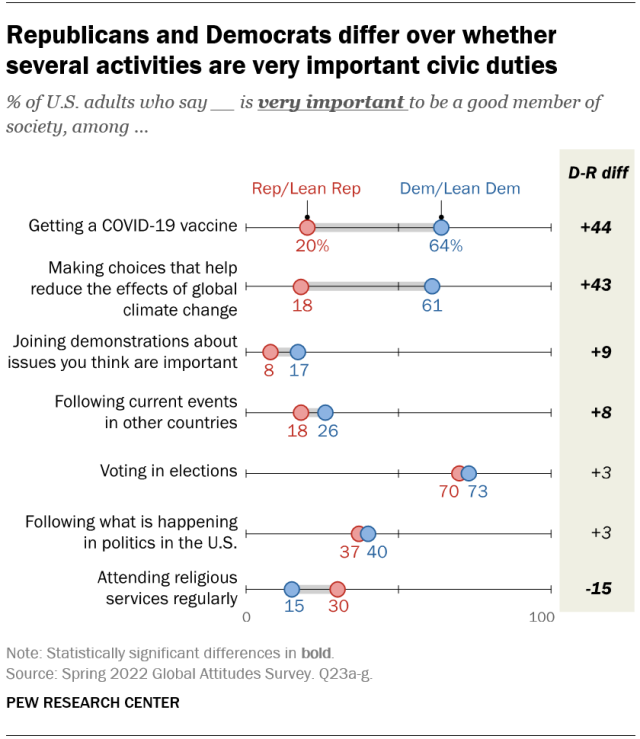
Around seven-in-ten U.S. adults (69%) say it’s very important to vote in elections to be a good member of society – more than say the same about any of the other activities included in a Pew Research Center survey conducted earlier this year. 


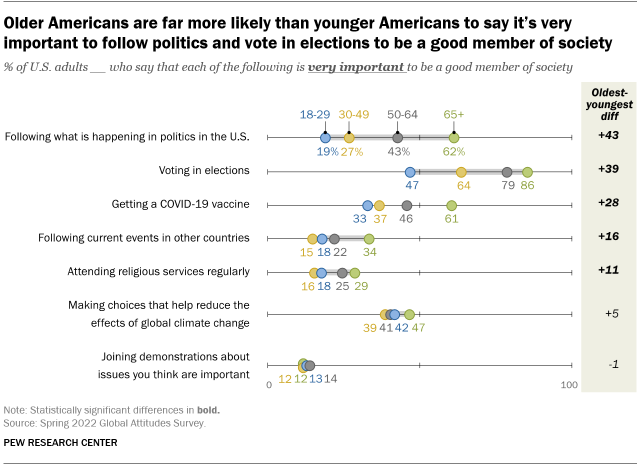
Young and old differ on some points.


Wednesday, October 19, 2022

Noncitizen Voting in DC?

The Washington Post opposes a proposal to allow noncitizens to vote in DC elections:

This newspaper has opposed efforts over the past decade to rewrite D.C.’s election code so green-card holders could vote. What’s now before the council is more radical. The proposal has been expanded to give voting rights in local elections to all noncitizen adults, regardless of whether they are in the country legally, so long as they’ve resided in the District for 30 days.

Anyone who has ever been to a naturalization ceremony can attest to how special it feels to welcome new members into the American family. New citizens must swear an oath renouncing all allegiances to foreign powers and promising to support and defend the Constitution against all enemies. There’s nothing in this measure to prevent employees at embassies of governments that are openly hostile to the United States from casting ballots. Or foreign students who are studying abroad in Washington for a semester.


Wednesday, August 24, 2022

Oaths as Bonds

Many posts have discussed oaths of office.

Daniel Knox, Director, Information Protection 88th Air Base Wing, Wright-Patterson AFB:
For most of us in the Department of Defense, federal service became “real” when we first took an oath to “protect (or support) and defend the Constitution of the United States,” even though many of us may not have fully understood what an oath even was at that point in our lives.

Oaths go far back into history, predating the American Revolution by centuries, and they remain the highest standard of commitment. But why is this oath so important today? What sets us apart from corporate employees who have similar skill sets and jobs, but don’t have to swear an oath?

Oaths have been a part of societies since the dawn of time. Historically, they have been tied to deities or sacred in nature. An oath was the ultimate testament of commitment to a person, ideal or task. Men and women would often die rather than break an oath.

Our oath of office in DOD is administered differently for military officers and enlisted — and incorporated in yet another format for civilian personnel, but all contain the same core elements. The oath is usually the last step in a military or civilian employee’s hiring process, signifying the final opportunity for an individual to decline this commitment to serve.

The public utterance of this commitment is important, not just for the employment process, but all those with whom that employee will serve, as well as for those he or she serves, namely other U.S. citizens.

It is a promise to put the Constitution’s values ahead of personal ambitions. It is a promise to always work toward the goal of bettering the government in which that employee serves by holding to individual values that best serve the intent of that Constitution.

You’ll note there is no step to rescind or retract that oath when you leave government service, because again, it is to the Constitution versus any organization or person. It is also inherently part of being a U.S. citizen. If you look online, you might be surprised at the expectations of naturalized citizens in addition to an almost identical fealty to the Constitution to which you publicly affirm as a government employee.

Using the civilian oath of office as a model, let’s look at its seemingly simple parts:

“I do solemnly swear…”

You are verbally committing, in public and formally before witnesses, to perform to a standard that you consider sacred, honor-bound to hold to this commitment. To break this oath would impugn your personal honor, and possibly that of your family. These are possibly the most important words of our oath. It imbues a personal commitment by you and you alone.

That I will support/protect and defend the Constitution of the United States…”

You aren’t swearing allegiance to any particular person or office, but to the ideals and values of the codified Constitution, a document held as the gold standard by other countries and the highest law of our land.

“Against all enemies, foreign and domestic…”

You vow to protect the law of the land as defined in our Constitution against not just foreign powers threatening our sovereignty, but internal efforts to thwart our constitutional values and articles.

“That I will bear true faith and allegiance to the same…”

You will be faithful to the Constitution’s intent and its articles, and you will hold allegiance to those values versus any person or office of any government or agency. You won’t commit or actively tolerate violations of those articles or the Constitution.

“That I take this obligation freely without any mental reservation or purpose of evasion…”

You know the gravity of your oath, and you have no reservations in committing your support to the Constitution’s ideals, nor are you taking it with intent to deviate from that promise to hold those values sacred on behalf of all Americans to whom you are bound to serve, and to whom you would answer if you broke that oath.

“And that I will well and faithfully discharge the duties of the office on which I am about to enter. So help me God (optional).”

You close your oath of office with a reaffirmation of your promise to do your duty, and if you wish, even ask God for support.

That’s why our leadership emphasizes the oath so much. It is intended to make you think about not only your role as a citizen but its additional importance when taking the mantle of government service.

If you still don’t understand this, just look around at the missions of this installation and how they directly support the nation’s security on a scale broader than most other bases. Whether you are screening personnel at base-entry points, or a research engineer working on top-secret programs, you have committed to basically the same oath.

You serve the same people, and we all work under the same Constitution. Take time to learn what the Constitution entails if you don’t already know, and embrace the spirit of that document in your daily lives.

The oath of office is a bond between you and the people of this nation, all of whom are here because of our Constitution’s principles. It is also a public, verbal commitment of your role as a citizen while serving our country.

Always remember that your service is important to your fellow Americans who haven’t publicly taken that oath, and they expect a higher level of accountability and performance because of your promise. Serve them, and yourself, well.

Thursday, July 21, 2022

Citizenship and the Census

 Sam Levine at The Guardian:

Donald Trump’s administration tried to add a citizenship question to the decennial census as part of an effort to alter the way the US House’s 435 seats are divvied up among the 50 states, a new tranche of documents reveals.

The documents, released by the House oversight committee on Wednesday, offer the clearest evidence to date that the Trump administration’s public justification for adding the question was made up. For years, the administration said that it needed to add a citizenship question to the decennial survey because better citizenship data was needed to enforce the Voting Rights Act (VRA). The US supreme court ultimately blocked the Trump administration from adding the question in 2019, saying the rationale “seems to have been contrived”.

...

Excluding non-citizens from the apportionment count, and therefore diminishing their political representation, has long been a goal of hard-right immigration groups. It would have clear political impact: California, Texas, and Florida all would have lost out on a congressional seat if unauthorized immigrants were excluded from apportionment, a 2020 projection by Pew found. Alabama, Minnesota, and Ohio all would have been able to hold on to an additional seat.

Commerce secretary Wilbur Ross became interested in adding a citizenship question shortly after taking office in 2017.

That year, James Uthmeier, a commerce department attorney, set out to analyze the legality of adding a citizenship question to the census at the request of Earl Comstock, a political appointee serving in a top policy role at the agency. In an undated memo released Wednesday, he concluded that doing so would not be lawful. The document makes it clear there is little evidence those who drafted the constitution wanted to exclude non-citizens from apportionment.

“Their conscious choice not to except aliens from the directive to count the population suggests the Founders did not intend to distinguish between citizens and non-citizens for the ‘actual Enumeration’ used for apportionment,” Uthmeier wrote in the draft memo.

“Over two hundred years of precedent, along with substantially convincing historical and textual arguments suggest that citizenship data likely cannot be used for purposes of apportioning representatives,” he added. “Without opining on the wisdom of such an action, a citizenship status question may legally be included on the decennial census so long as the collected information is not used for apportionment.”

But in subsequent drafts throughout 2017, Uthmeier and Comstock substantially changed that analysis.

They revised the memo to suggest there was much more ambiguity into whether a citizenship question could be added for apportionment purposes. By August 2017, they turned in a memo to Ross suggesting there was a legal basis for adding the question for apportionment purposes. “There are bases for legal arguments that the Founding Fathers intended for the apportionment count to be based on legal inhabitants,” the new memo said. “If the Secretary decides that the question is needed for apportionment purposes, then it must be included on the decennial.”

Thursday, January 13, 2022

Case on Civic Education

Mark Walsh at Education Week:

Students asserting the right to an adequate civics education have lost their appeal of a federal court ruling that dismissed their suit accusing the state of Rhode Island of failing to prepare them for the duties of citizenship.

Like the federal district judge who had ruled in the case, now known as A.C. v. McKee, a three-judge panel of the U.S. Court of Appeals for the 1st Circuit, in Boston, lauded the student plaintiffs for their effort but ultimately concluded that their suit could not prevail.

“The students have called attention to critical issues of declining civic engagement and inadequate preparation for participation in civic life at a time when many are concerned about the future of American democracy,” a unaninous three-judge appeals panel said in an unanimous Jan. 11 decision.“Nevertheless, the weight of precedent stands in the students’ way here, and they have not stated any viable claim for relief.”
The lawsuit was filed in 2018 on behalf of 14 students, but was also a proposed class action on behalf of all public school students in Rhode Island. It alleged that state officials have failed to provide students with a meaningful opportunity to obtain an adequate education to prepare them to be capable citizens.


Friday, November 26, 2021

Being Truly American

 From PRRI:

More than nine in ten Americans say that it is somewhat or very important to being “truly American” to believe in individual freedoms, such as freedom of speech (slightly up from 91% in 2018 to 95% today), to believe that every citizen should be able to vote in elections (93%), to accept people of diverse racial and religious grounds (up from 86% in 2018 to 92% today), and to respect American political institutions and laws (91%). Nearly eight in ten (79%) say it is somewhat or very important to being truly American to be able to speak English.[4] This percentage has gone down consistently, from 89% in 2015 to 83% in 2018 and 79% today.

Fewer Americans, but still a majority, think it is very or somewhat important to being truly American to believe that capitalism is the best economic system (59%) and to believe in God (56%). Thinking a belief in God is important to being truly American declined substantially, from 69% in 2015 to 52% in 2018. Republicans are significantly more likely than Democrats to think that both belief that capitalism is the best economic system (77% and 50%, respectively) and belief in God (78% and 45%, respectively) are important to being truly American. Independents closely mirror all Americans. Most religious groups have similar beliefs, but members of non-Christian religions and religiously unaffiliated Americans are less likely than Christian groups to say that believing capitalism is the best economic system (50% and 44%, respectively) and believing in God (40% and 21%, respectively) are important to being truly American.

Less than half of Americans think being born in America (48%, substantially down from 58% in 2015, but similar to 50% in 2018) is somewhat or very important to being truly American. Most Republicans (62%) say it is important to be born in America, compared to 44% of independents and 43% of Democrats. Majorities of Black Protestants (70%), white evangelical Protestants (58%), and white Catholics (54%) agree that being born in the country is important for being truly American. Other Christians (52%), white mainline (non-evangelical) Protestants (51%), and Hispanic Catholics (49%) are divided over this question. Members of non-Christian religions (39%) and the religiously unaffiliated (33%) are the least likely to think that being born in America is important to being truly American.

Just over four in ten Americans believe that being Christian (43%, substantially down from 53% in 2015 and 39% in 2018) is somewhat or very important to being truly American. Republicans (63%) are more likely than independents (37%) and Democrats (35%) to say that being Christian is important to being truly American. Solid majorities of white evangelical Protestants (76%) and Black Protestants (75%) say that being Christian is important to being truly American. Around half of Hispanic Catholics (52%), white mainline (non-evangelical) Protestants (49%), white Catholics (46%), and other Christians (46%) think the same. Only one in ten religiously unaffiliated Americans (12%) and members of non-Christian religions (9%) say that being Christian is important to being truly American.

Less than one in five Americans (17%) believe that being of Western European heritage is important for being truly American. About one in five or fewer Americans across party and religious affiliations think that Western European heritage is important to being truly American. Republicans (21%) are slightly more likely to say this than independents (15%) and Democrats (17%) are.

Monday, July 5, 2021

Promoting American Citizenship


A Friday release from U.S. Citizenship and Immigration Services:
Today the Department of Homeland Security’s U.S. Citizenship and Immigration Services released the Interagency Strategy for Promoting Naturalization (PDF, 3.77 MB), a whole-of-government approach to breaking down barriers to U.S. citizenship and promoting naturalization to all who are eligible, as outlined in President Biden’s Executive Order 14012.

Becoming a United States citizen is a tremendous privilege,” said Secretary Alejandro N. Mayorkas. “New citizens, strengthened with the power and responsibilities that American citizenship brings, make our Nation better. This strategy will ensure that aspiring citizens are able to pursue naturalization through a clear and coordinated process.”

This report reflects the collaboration of USCIS, the Department of Education, Department of Health and Human Services, Department of State, Department of Labor, Department of Housing and Urban Development, Department of Defense, Department of Justice, Department of Veterans Affairs, Department of Agriculture, and the Social Security Administration, who are part of the interagency Naturalization Working Group. This working group was established pursuant to the President’s executive order to prioritize citizenship education and awareness through capacity building and expanded partnerships, which is at the heart of the interagency strategy.

“USCIS remains committed to empowering immigrants to pursue citizenship along with the rights and opportunities that come with it. It is fitting that this report is being released days before our nation’s 245th birthday. There is no greater testament to the strength of America than our willingness to encourage others to join us as U.S. citizens as we work together to build a more perfect union,” said USCIS Acting Director Tracy Renaud.

“We look forward to the work ahead in welcoming and supporting aspiring Americans and equipping them with the tools they need to be successful in their journey to citizenship, and beyond.”

Since the beginning of the Biden-Harris administration, USCIS has taken a number of steps to reduce barriers to naturalization and restore confidence in our nation’s legal immigration system. More information on naturalization policies issued since January 2021 is available on the USCIS website (PDF, 972.45 KB).

Tuesday, May 11, 2021

Polarization, Culture, National Identity

Laura Silver at Pew:
When it comes to key cultural issues, Americans are significantly more divided along ideological lines than people in the United Kingdom, France and Germany, according to a new Pew Research Center analysis of surveys conducted in the four countries in fall 2020.

Across 11 questions on cultural subjects ranging from nationalism to political correctness, the gap between the ideological left and right in the United States – or liberals and conservatives, in the common U.S. parlance – is significantly wider than the ideological gaps found in the European countries surveyed. In some cases, this is because America’s conservatives are outliers. In other cases, it’s because America’s liberals are outliers. In still other cases, both the right and left in the U.S. hold more extreme positions than their European counterparts, resulting in ideological gaps that are more than twice the size of those seen in the UK, Germany or France.

On issues of “belonging” or what it takes to truly be part of a country (e.g., to be “American” or “French”), those on the ideological right in all four countries are more likely than those on the left to say being Christian, speaking the national language, sharing the country’s customs and traditions and being born in the country are “very important.”

Across all four items, though, the ideological gap in the U.S. is larger than in other countries. This is often – but not always – because the views of America’s conservatives stand out. (The U.S. survey was fielded in November and December 2020, after the presidential election but before the inauguration of Joe Biden.)

For example, around a third of U.S. adults who place themselves on the ideological right (32%) say being Christian is very important for being American, but no more than 17% on the right in any other country say the same.

When it comes to the importance of being born in the country, around a third on the U.S. right (32%) think it is very important for being American, compared with no more than 24% of those on the right in any other country. Similarly, those on America’s ideological right (57%) are more likely than their counterparts in France (47%), Germany (39%) and the UK (29%) to say that sharing national customs and traditions is very important to national identity.

The pattern is somewhat different when it comes to speaking the country’s language. While the overall ideological gap is again wider in the U.S. than in the other three countries, America’s liberals are notably less likely than their counterparts in other nations to see speaking English as critical to being American. Only around a quarter of the left in the U.S. (24%) say it’s very important to speak English to be truly American, whereas at least four-in-ten of those on the left in every other country say the same about speaking their national languages.

The ideological left in the U.S. also stands out in its views of whether immigrants want to adopt the country’s customs and way of life. Around eight-in-ten Americans on the left (79%) say this, compared with around two-thirds or fewer in the other countries.

Friday, August 21, 2020

Immigration Data


Abby Budiman at Pew:
  • The U.S. foreign-born population reached a record 44.8 million in 2018. Since 1965, when U.S. immigration laws replaced a national quota system, the number of immigrants living in the U.S. has more than quadrupled. Immigrants today account for 13.7% of the U.S. population, nearly triple the share (4.8%) in 1970. However, today’s immigrant share remains below the record 14.8% share in 1890, when 9.2 million immigrants lived in the U.S.
  • Most immigrants (77%) are in the country legally, while almost a quarter are unauthorized, according to new Pew Research Center estimates based on census data adjusted for undercount. In 2017, 45% were naturalized U.S. citizens.
  • By race and ethnicity, more Asian immigrants than Hispanic immigrants have arrived in the U.S. in most years since 2010. Immigration from Latin America slowed following the Great Recession, particularly for Mexico, which has seen both decreasing flows into the United States and large flows back to Mexico in recent years.
  • Looking forward, immigrants and their descendants are projected to account for 88% of U.S. population growth through 2065, assuming current immigration trends continue. In addition to new arrivals, U.S. births to immigrant parents will be important to future growth in the country’s population. In 2018, the percentage of women giving birth in the past year was higher among immigrants (7.5%) than among the U.S. born (5.7%). While U.S.-born women gave birth to more than 3 million children that year, immigrant women gave birth to about 760,000.
  • Immigrants convicted of a crime made up the less than half of deportations in 2018, the most recent year for which statistics by criminal status are available. Of the 337,000 immigrants deported in 2018, some 44% had criminal convictions and 56% were not convicted of a crime. From 2001 to 2018, a majority (60%) of immigrants deported have not been convicted of a crime.

Tuesday, August 18, 2020

Discouraging Immigration


The price for naturalization will jump to $1,170 or $1,160 for online applications. The rule will also lower the income threshold to qualify for a fee waiver and eliminate the partial subsidy for the application.
Almost all other exceptions that allowed immigrants to waive the fee will be eliminated, including extenuating financial hardship and means-tested public benefits, like food stamps. Only some protected immigrants, including victims of domestic violence and human trafficking, will remain eligible.
Quinn Owen at ABC:
The federal government agency that handles United States asylum requests, processes visa applications and grants citizenship is preparing to furlough most of its employees while would-be citizens remain stuck waiting to get naturalized ahead of the November election.
Originally planned for the beginning of August, the furloughs were bumped back to the end of the month after Democrats and independent immigration experts questioned whether such action was necessary amid the coronavirus pandemic.
...
Joseph Edlow, the U.S. Citizenship and Immigration Services' deputy director, told lawmakers at the end of July that the agency was able to catch up on its backlog of 100,000 pending naturalization ceremonies delayed by the pandemic. However, the average number of monthly naturalizations still trails far below prior years by tens of thousands, according to data from the Department of Homeland Security.
"All USCIS operations, including naturalization ceremonies, will be impacted by a furlough," spokesperson Joe Sowers said in a statement. "At this time, we do not have the number of naturalization ceremonies that will be impacted. In the event of a furlough, we will continue to conduct naturalization ceremonies, but we anticipate it will be on a more limited basis."
An analysis from the Migration Policy Institute found budget problems at USCIS -- which is almost entirely funded by the immigration application fees it collects -- were apparent well before the pandemic and likely the result of ... "extreme vetting" of applicants.

Monday, August 17, 2020

More Americans Are Renouncing Citizenship

Many posts have discussed citizenship and expatriation.

Robert W. Wood at Forbes:
2020 has already seen a big uptick in the number of Americans giving up their citizenship. So says the U.S. government’s 2020 second quarter list of published expatriates, the second highest number ever. Every three months, the U.S. Treasury Department publishes the names of individuals who renounced their U.S. citizenship or handed in a long-term green card. For the second quarter of 2020, the name and shame list included 2,406 people. That may not sound like many, but it’s the second highest number ever. The first quarter of 2020 tally was the highest quarter of all time, and with 5,315 leavers in just six months, the total for 2020 should be over 10,000. That is nearly double the number for 2016. The quarterly public list is required by law, but it seems likely that the actual number of expatriates is higher, since many apparently are not counted. Curiously, both the IRS and FBI track Americans who renounce. Of course, to give up your U.S. passport, you first need to have or citizenship somewhere else.

Thursday, August 13, 2020

Veterans and Higher Education Leadership

Using a semi-structured qualitative interview design of currently serving higher education leaders and practitioners with prior military service, this paper identifies the reasons why veterans choose to work in higher education, captures the leadership skills and traits learned in the military that practically apply to their roles, identifies current challenges in higher education’s mission to serve students, and provides recommendations for recruiting more veterans into leadership roles. Among this paper’s most significant findings are:
  • Veterans choose to work in higher education as an extension of their military service because of overlapping values, traditions, and progressive leadership opportunity. Budget management, empowering teams toward mission attainment, and being adaptable in the midst of constant change and uncertainty are broad skill categories gained through military service and applied in higher education that have fostered an unquestionable desire by veterans to continue what began when they joined the All-Volunteer Force.
  • Veterans who work in higher education have leadership tools gained through military service at their disposal, including, among others: mission focus, strategic thinking, adaptability, resiliency, comfort with ambiguity and leading change, experience working with individuals from diverse backgrounds, and personnel and budget management experience.
  • The leadership tools identified above will help veterans navigate our system of higher education as a corps of adaptive leaders ready and willing to confront profound challenges that, when asked, they identified as:
  • Higher education’s slow pace of change relative to the changing needs and characteristics of today’s students
  • Decreasing perception in the value of a post-secondary degree
  • Decreasing enrollment
  • Aging infrastructure and unsustainable cost to the student
  • The lack of focus on the intersection of diversity, equity, and inclusion by campus leaders, and competing spheres of influence on campus.
Solutions to the key challenges confronting higher education can be supported, in part, through a critical mass of adaptive leaders, and military service provides fertile ground for the development of adaptive leadership skills.
Through intentional academic programming, recruitment efforts, and partnerships, the higher education, nonprofit, and government sectors can help veterans view higher education not only as a waypoint for separating service members, but also as a viable career opportunity.

Saturday, August 1, 2020

The Cost of Citizenship and Asylum

Rachael Levy at WSJ:
The Department of Homeland Security said it would increase the fee to apply for U.S. citizenship by 81% to $1,160 and impose a fee for the first time to apply for asylum, according to a filing in the Federal Register on Friday.
The fee increases, proposed last year, come as the government agency that handles applications faces a budget shortfall and are the latest in a string of rule changes making it tougher for low-income people to immigrate legally or become U.S. citizens.
...

A USCIS spokesperson said 97% of the agency’s budget is supported by fees. USCIS, unlike most of the federal government, largely depends on funding from fees it collects on citizenship, green-card and other immigration applications, which have fallen in the past few years ... That decline has been compounded during the coronavirus pandemic as the agency has shut its offices.
The spokesperson added the new asylum application fee of $50 is “well below the $366 estimated cost of adjudicating the application.”
The rule also changes fee-waiver requirements to make fewer people eligible for waivers. The final rule is scheduled to be published in the Federal Register on Monday and will take effect on Oct. 2.
The fee for asylum seekers would make the U.S. one of four countries to charge a fee for humanitarian protections, according to the Migration Policy Institute, a nonpartisan Washington think tank. The other countries are Iran, Australia and Fiji, the institute said.
The fee may be prohibitive for asylum seekers. “While $50 may sound like a relatively modest amount, it may be a significant hurdle for those lacking a reliable income for extended periods,” the think tank said in a December 2019 report.

Friday, July 31, 2020

Buying Foreign Passports

Natalie B. Compton at WP:
For generations, the American passport afforded its holders the privilege of hassle-free travel around much of the world. That has changed with the coronavirus pandemic. While borders are beginning to reopen to international travel, some countries are staying closed to Americans because of the ongoing coronavirus outbreak stateside.
These travel restrictions are producing an emerging trend among some wealthy Americans: buying a second passport.
“This limitation of mobility has made more people aware of ... the benefits of having more than one passport,” said Armand Arton, the president of financial firm Arton Capital, which specializes in citizenship through investment.
The firm defines citizenship by investment as “the process of obtaining a second citizenship and passport by investing in the economy of the host country.” These investments can come in the form of real estate, bonds or various new business ventures.

Arton says his firm has seen a 30 to 40 percent increase, year to date, in demand for services that help clients obtain citizenship in a sovereign state through financial means. The price tag for these services varies, ranging from $100,000 for some Caribbean options to more than $2 million for European ones.
Before the coronavirus, the plan mainly appealed to Americans for tax purposes, Arton says. But mid-pandemic, motivations have shifted. Some of Arton Capital’s American clients are in mixed-nationality relationships where couples have been separated because of pandemic travel bans. Others are worried about the impact of U.S. politics on their passport’s global standing.
...
The concept is about 35 years old, Arton says. Today there are approximately 25 countries, including Portugal, Dominica and the United Kingdom, that offer forms of residency or citizenship-by-investment programs as a revenue source.

Monday, July 13, 2020

Frederick Douglass on the Composite Nation

In an 1869 speech in Boston, Frederick Douglass advocated the acceptance of Chinese immigration. Excerpts:
I am especially to speak to you of the character and mission of the United States, with special reference to the question whether we are the better or the worse for being composed of different races of men. I propose to consider first, what we are, second, what we are likely to be, and, thirdly, what we ought to be.

Without undue vanity or unjust depreciation of others, we may claim to be, in many respects, the most fortunate of nations. We stand in relation to all others, as youth to age. Other nations have had their day of greatness and glory; we are yet to have our day, and that day is coming. The dawn is already upon us. It is bright and full of promise. Other nations have reached their culminating point. We are at the beginning of our ascent. They have apparently exhausted the conditions essential to their further growth and extension, while we are abundant in all the material essential to further national growth and greatness.
...
I need to stop here to name or describe the missions of other and more ancient nationalities. Ours seems plain and unmistakable. Our geographical position, our relation to the outside world, our fundamental principles of Government, world embracing in their scope and character, our vast resources, requiring all manner of labor to develop them, and our already existing composite population, all conspire to one grand end, and that is to make us the make perfect national illustration of the unit and dignity of the human family, that the world has ever seen.
...
There are such things in the world as human rights. They rest upon no conventional foundation, but are external, universal, and indestructible. Among these, is the right of locomotion; the right of migration; the right which belongs to no particular race, but belongs alike to all and to all alike. It is the right you assert by staying here, and your fathers asserted by coming here. It is this great right that I assert for the Chinese and Japanese, and for all other varieties of men equally with yourselves, now and forever. I know of no rights of race superior to the rights of humanity, and when there is a supposed conflict between human and national rights, it is safe to go to the side of humanity. I have great respect for the blue eyed and light haired races of America. They are a mighty people. In any struggle for the good things of this world they need have no fear. They have no need to doubt that they will get their full share.

But I reject the arrogant and scornful theory by which they would limit migratory rights, or any other essential human rights to themselves, and which would make them the owners of this great continent to the exclusion of all other races of men.

I want a home here not only for the negro, the mulatto and the Latin races; but I want the Asiatic to find a home here in the United States, and feel at home here, both for his sake and for ours. Right wrongs no man. If respect is had to majorities, the fact that only one fifth of the population of the globe is white, the other four fifths are colored, ought to have some weight and influence in disposing of this and similar questions. It would be a sad reflection upon the laws of nature and upon the idea of justice, to say nothing of a common Creator, if four fifths of mankind were deprived of the rights of migration to make room for the one fifth. If the white race may exclude all other races from this continent, it may rightfully do the same in respect to all other lands, islands, capes and continents, and thus have all the world to itself. Thus what would seem to belong to the whole, would become the property only of a part. So much for what is right, now let us see what is wise.

Thursday, July 9, 2020

COVID, Community, and Citizenship

Nicholas Romanow, who just became a citizen, writes at The Bulwark:
The political philosophers, historians, and sociologists who argue that a kind of rugged individualism is at the heart of the American character aren’t entirely wrong, but the familiar caricature of the individualistic American—someone ruthless doing whatever it takes to get ahead—does not match the reality we can see all around us. When the administration of my university sent students home in response to the COVID-19 pandemic, many of my friends and classmates returned to frightened siblings, laid-off parents, and ailing grandparents. If there was ever a time where narrow self-interest would be socially and morally acceptable, it would have been this spring. But the isolation-induced breakdown of social bonds that some commentators anticipated did not occur. Instead, friendships deepened, and new ones formed. Social media—typically a bastion of self-aggrandizement—transformed into a hub for offering free meals, empty couches, and FaceTime calls to talk about life. As generations of Americans before them, people my age put their communities first in a time of crisis. Which is to say that, as Tocqueville pointed out long ago, American individualism is not about a simplistic autonomy but is fundamentally rooted in community.
In 2018, while still in college, I applied to teach a civics class at an underprivileged Austin high school. My idealism led me to believe I could teach kids to love democracy. In the first class, I encountered some of the most cynical teenagers I have ever met. For these kids, the only thing that felt longer than this class period was the list of problems with American society.
These students had a perspective on America very different from that of the suburban kids with whom I had taken civics lessons in high school. They did not accept America as it is. Instead, they dreamed of and believed in a brighter future. Sure, as young people, they leaned left. But even as they spoke about injustice and dysfunction, they judged their visions of a better society by how it would strive to realize America’s ideals. These high schoolers from South Austin taught me about patriotism: not wave-a-flag and grill-a-hot-dog patriotism but a true, sincere desire to forge a more perfect union.

Monday, June 22, 2020

Drive-Through Naturalization

From the Administrative Office of the U.S. Courts
Federal judges in the Motor City are embracing a novel approach to welcoming people eager to take their citizenship oaths in the age of coronavirus: Drive-through naturalization ceremonies.
This month in Detroit, federal district and magistrate judges began swearing in new citizens in drive-through ceremonies in a parking structure at the U.S. Citizenship and Immigration Services (USCIS) field office.
Citizens-to-be drive into the parking structure, are checked in by USCIS employees clad in protective gear, and then roll up to a podium where a federal judge swears them in – all without ever leaving their vehicles. The new process eliminates the need for people to gather for indoor ceremonies at the Theodore Levin U.S. Courthouse in downtown Detroit, in the Eastern District of Michigan.
Image of a drive-through naturalization ceremony

Monday, March 2, 2020

Immigrant Voters

Abby Budiman, Luis Noe-Bustamante and Mark Hugo Lopez at Pew:
More than 23 million U.S. immigrants will be eligible to vote in the 2020 presidential election, making up roughly 10% of the nation’s overall electorate – both record highs, according to Pew Research Center estimates based on Census Bureau data.
The number of immigrant eligible voters has increased steadily over the past 20 years, up 93% since 2000. By comparison, the U.S.-born eligible voter population grew more slowly (by 18%) over the same period, from 181 million in 2000 to 215 million in 2020. 1 (Immigrant eligible voters are those ages 18 and older born outside the United States who have gained U.S. citizenship through naturalization.)
The nation’s immigrant voters have diverse backgrounds. Most immigrant eligible voters are either Hispanic or Asian, though they hail from countries across the globe. Immigrants from Mexico make up the single largest group, at 16% of foreign-born voters. More than half of all U.S. immigrants (56%) live in the country’s four most populous states: California, New York, Texas and Florida. Two-thirds have lived in the U.S. for more than 20 years and 63% are proficient in English.

Thursday, February 27, 2020

Denaturalization Section

A release from the Department of Justice:
The Department of Justice today announced the creation of a section dedicated to investigating and litigating revocation of naturalization. The Denaturalization Section will join the existing sections within the Civil Division’s Office of Immigration Litigation—the District Court Section and the Appellate Section. This move underscores the Department’s commitment to bring justice to terrorists, war criminals, sex offenders, and other fraudsters who illegally obtained naturalization.

While the Office of Immigration Litigation already has achieved great success in the denaturalization cases it has brought, winning 95 percent of the time, the growing number of referrals anticipated from law enforcement agencies motivated the creation of a standalone section dedicated to this important work.
“When a terrorist or sex offender becomes a U.S. citizen under false pretenses, it is an affront to our system—and it is especially offensive to those who fall victim to these criminals,” said Assistant Attorney General Jody Hunt. “The Denaturalization Section will further the Department’s efforts to pursue those who unlawfully obtained citizenship status and ensure that they are held accountable for their fraudulent conduct.”
Denaturalization cases require the government to show that a defendant’s naturalization was “illegally procured” or “procured by concealment of a material fact or by willful misrepresentation . . . .” 8 U.S.C. § 1451. Civil denaturalization cases have no statute of limitations, and the Department has successfully denaturalized numerous categories of individuals who have illegally obtained citizenship, including terrorists and other national security threats, war criminals, human rights violators, sex offenders, and other fraudsters.
National Security/Terrorism
  • U.S. v. al Dahab, No. 15-cv-5414 (D.D.C.). Successful civil denaturalization of individual convicted of terrorism offenses in Egypt who admitted recruiting for al Qaeda within the United States and running a communications hub in California for the Egyptian Islamic Jihad terrorist organization. The defendant was denaturalized while in Egypt, stripped of his passport, and prevented from returning to the United States.
  • U.S. v. Kariye, No. 15-cv-1343 (D. Or.). Successful civil denaturalization of individual who received military training in a jihadist training camp in Afghanistan; coordinated with Osama bin Laden and other known terrorist leaders; and was associated with terrorist organizations including Makhtab Al-Khidamat, a U.S. government-designated terrorist organization and pre-cursor to al Qaeda. The Office of Immigration Litigation coordinated a settlement that facilitated the defendant’s self-deportation to Somaliland despite his presence on No Fly List.
  • U.S. v. Hamed, No. 2:18-cv-0424 (W.D. Mo.). Successful civil denaturalization of an individual convicted of conspiring to illegally transfer more than $1 million to Iraq in violation of federal sanctions and of obstructing internal revenue laws with respect to tax-exempt charities. In furtherance of those crimes, the defendant regularly authorized and transferred tax-exempt funds from a non-profit organization’s accounts in the United States to an account in Jordan controlled by a Specially Designated Global Terrorist.
War Crimes & Human Rights Violators
U.S. v. Dzeko, No. 18-cv-759 (D.D.C.). Successful civil denaturalization of an individual who was convicted in Bosnia of executing eight unarmed civilians and POWs during the Balkans conflict. Defendant was denaturalized while incarcerated in a Bosnian prison, and thereby prevented from returning to the United States upon his release.
U.S. v. Yetisen, No. 18-cv-570 (D. Or.). Successful civil denaturalization of an individual who pled guilty in Bosnia of executing six unarmed civilians and POWs during the Balkans conflict.

Sex Offenders
  • U.S. v. Omopariola (N.D. Tex.). Successful civil denaturalization of an individual engaged in sexual contact with a 7-year-old family member.
  • U.S. v. Lopez, No. 18-cv-00527 (D. Md.). Successful civil denaturalization of an individual who sexually abused a minor victim for multiple years.
  • U.S. v. Arizmendi, No. 4:15-cv-454 (S.D. Tex.). Successful civil denaturalization of an individual convicted of multiple sex offenses, including as to students. The defendant was denaturalized while incarcerated in a Mexican prison related to a sex offense, and thereby prevented from returning to the United States upon his release.
Fraudsters & Other Criminals
  • U.S. v. Mondino, No. 18-cv-21840 (S.D. Fla.). Successful civil denaturalization of an individual convicted of conspiring to defraud the U.S. Export-Import Bank of more than $24 million, resulting in more than $12 million in unrecovered losses. Because of the denaturalization proceedings, the defendant self-deported.
  • U.S. v. Warsame cases, Nos. 17-cv-5023, -5024, -5025, -5027 (D. Minn.). Successful civil denaturalizations of four individuals who fraudulently claimed to be a family to gain admission to the United States through the Diversity Immigrant Visa Program.