Search This Blog

Showing posts with label voting rights. Show all posts

Wednesday, August 26, 2026

Noncitizen Voting?

 Many posts have discussed immigration. Illegal voting by noncitizens is rare.

Jude Joffe-Block and Miles Parks at NPR:

In a call with Nevada state election officials earlier this month, the Trump administration's point person on noncitizen voting insisted her team was working "in good faith."

"We are an open book here," said Heather Honey, an official at the Department of Homeland Security, who previously worked to push election falsehoods before her current post. "We are acting in very good faith. And we just want to help you."

But more than a month after President Trump touted in a primetime address that his administration had found more than 250,000 noncitizens on the voter rolls of Nevada and just three other states, those states are still asking for proof or even a complete list of the voters federal officials say should be investigated.

In the Nevada call, federal officials did more to detail how they arrived at their numbers, but their statements also undermined the broader claim that American elections are rife with noncitizen voters.

DHS initially announced it had found close to 16,000 noncitizens on Nevada's voter list. But a DHS official acknowledged in the meeting with Nevada officials that number was "the ceiling" and each voter still had to be manually reviewed. Then, a day later, DHS provided the state with a list of 185 ID numbers pertaining to voters the agency said it was confident were noncitizens. NPR acquired records and a recording of the video call, first reported by The New York Times, via a public record request.

Nevada asked for more information on that smaller group of 185 voters, and the data points used to match them to noncitizens. DHS declined to provide that. The agency did say it still had more than 14,000 Nevada voters that "need additional review," and it also provided the state with a list of more than 6,000 voter IDs the agency said were "higher confidence" matches but had yet to be reviewed.


Friday, July 17, 2026

Noncitizens on the Voter Rolls?

Many posts have discussed immigration. Illegal voting by noncitizens is rare.

 Last night, Trump claimed there were 278,000 noncitizens who had registered to vote.  At PolitiFact, Louis Jacobson provides reasons for skepticism.

Experts cited several reasons to be cautious about the headline number and how Trump and Mullin framed it.

For starters, Homeland Security’s letters to state officials used more cautious language — glossed over in public remarks by Trump and Mullin — that called it a "preliminary review" and said that there "may be as many as" the number of noncitizens they found on the voter rolls.

At his press conference, Mullin did not identify the individuals as potential noncitizens; he simply called them "noncitizens."

Another reason for caution is history.

In the past, when government officials have announced initial numbers of noncitizens on voter rolls, those figures have dropped dramatically after months of vetting by state and local officials and the media.

In 2012, then-Florida Gov. Rick Scott ordered state officials to clear the rolls of noncitizen voters ahead of the election.

Florida initially assembled a list of about 180,000 potential noncitizens. With more scrutiny, however, officials whittled the count to about 2,600 names, then 198, then 85. The initial list was rife with errors, even flagging a Brooklyn-born World War II veteran.

Thursday, April 4, 2024

Misinformation about Arizona Voter Registration

 Many posts have discussed myths and misinformation, including falsehoods about elections

On X, Maricopa County Recorder Stephen Richer responds to Elon Musk:

Hi Elon!

The post you're quote-tweeting seems to suggest that, based on Social Security Administration data, 220,731 illegal immigrants have registered to vote in Arizona since January 1, 2024.

A few things if I may be so bold (since I have easy access to Maricopa County's data -- which makes up 62% of Arizona):

1) Only 39,653 new voters have registered in Maricopa County in 2024 in total.  For Arizona, that number is about 60,000.

2) Arizona's voter rolls have actually been going down.  In Maricopa County, we've gone from about 2.6 million active registered voters in 2020 to about 2.4 million active registered voters in 2024.

3) SSA is not used to check citizenship.  It's used to check proof of identity.

4) Motor Vehicle Divisions are typically used for proof of citizenship.  In Arizona, since October 1, 1996, drivers have had to provide proof of citizenship for driver's licenses (except Type F).  We use this data to confirm citizenship for the vast majority of registration applicants.  We also have some other tools at our disposal, or we communicate directly with the voter to get documentation.

5) If the voter cannot provide documented proof of citizenship, but still attests under penalty of law that he is a citizen, he goes on what is called the "Federal Only" list in Arizona.

6) In Maricopa County, there are 20,768 registered voters on the Federal Only list.  There are about 30,000 for all of Arizona.

7) Again, these people attest that they are U.S. Citizens, but they have not provided documented proof.

8) Most studies show that these people are disproportionately college-aged students (perhaps who don't have ready access to a birth certificate).

But there is 0 validity to the suggestion in the original post that 220,731 illegal immigrants have registered in Arizona in 2024.

Hope this helps.

We loved the recent rocket launch that we could see in the Arizona sky.  Thanks for all the cool sciencey stuff you continue to do.

Stephen

(owner of many, many Musk-related products, and former user of TBC "flamethrower")


Saturday, March 30, 2024

Illegal Noncitizen Voting is Vanishingly Rare


At Axios, Stef Kight explains that illegal voting by noncitizens is extremely uncommon:
Non-citizen immigrants are barred by law from voting in federal elections. The very few who try it typically do so by accident, and are caught. The penalties can be severe, and include prison time or deportation.
Voting as a non-U.S. citizen "is a federal crime ... a removable offense, meaning that you can be deported," Sean Morales-Doyle, director of the Brennan Center Voting Rights Program, told Axios.
"The stakes are really, really high. And it's really easy to figure out that you did it," Morales-Doyle said.

Undocumented immigrants in particular are widely known to steer clear of giving out personal information or registering for anything involving U.S. and state governments, out fear of facing arrest or deportation.Some have even avoided public services they're entitled to, such as food stamps or housing benefits.

...

When non-citizens have ended up on voter rolls it's often by accident — not part of any conspiracy to affect an election, Morales-Doyle said.There have been several cases in which DMV officials have mistakenly led non-citizens to register to vote under "motor voter" policies.

Zoom in: Republicans seeking to justify claims of illegal voting by immigrants point to a few reports and probes that purported to have found large numbers of non-citizens who registered to vote or voted. Those claims wilted under scrutiny.In 2019, Texas began investigating what GOP officials claimed were as many as 100,000 non-citizens on the state's voter rolls. The alleged number of illegal registrants ticked down as the claims were examined. The investigation fizzled, and eventually a federal judge killed the probe, saying it was infringing on eligible voters' rights.
On the heels of Trump's first campaign for president in 2016, the Brennan Center for Justice examined about 23.5 million votes in 42 jurisdictions, looking for evidence of the illegal voting by non-citizens that Trump had claimed was prevalent. It found about 30 suspected illegal votes.


Wednesday, October 19, 2022

Noncitizen Voting in DC?

The Washington Post opposes a proposal to allow noncitizens to vote in DC elections:

This newspaper has opposed efforts over the past decade to rewrite D.C.’s election code so green-card holders could vote. What’s now before the council is more radical. The proposal has been expanded to give voting rights in local elections to all noncitizen adults, regardless of whether they are in the country legally, so long as they’ve resided in the District for 30 days.

Anyone who has ever been to a naturalization ceremony can attest to how special it feels to welcome new members into the American family. New citizens must swear an oath renouncing all allegiances to foreign powers and promising to support and defend the Constitution against all enemies. There’s nothing in this measure to prevent employees at embassies of governments that are openly hostile to the United States from casting ballots. Or foreign students who are studying abroad in Washington for a semester.


Sunday, October 31, 2021

Florida v. Academic Freedom


Michael Wines at NYT:
Three University of Florida professors have been barred from assisting plaintiffs in a lawsuit to overturn the state’s new law restricting voting rights, lawyers said in a federal court filing on Friday. The ban is an extraordinary limit on speech that raises questions of academic freedom and First Amendment rights.

University officials told the three that because the school was a state institution, participating in a lawsuit against the state “is adverse to U.F.’s interests” and could not be permitted. In their filing, the lawyers sought to question Gov. Ron DeSantis, a Republican, on whether he was involved in the decision.

Mr. DeSantis has resisted questioning, arguing that all of his communications about the law are protected from disclosure because discussions about legislation are privileged. In their filing on Friday, lawyers for the plaintiffs said the federal questions in the case — including whether the law discriminates against minority groups — override any state protections.

Two university representatives said they could not comment on pending litigation. Mr. DeSantis’s office did not immediately reply to a request for comment.

From the Foundation for Individual Rights in Education:

FIRE is deeply concerned by a report in The New York Times that the University of Florida has barred three professors from participating as witnesses in a voting rights lawsuit against the state of Florida.

FIRE has said it before, and we’ll say it again: The profound civic importance of fair trials requires the ability of fact and expert witnesses to come forward to testify truthfully without fear that their government employer might retaliate against them. Public university faculty are no exception. We call on UF to reverse course immediately.

UF should be aware that Plymouth State University’s ill-considered decision to punish faculty who had testified in a trial ultimately cost the state of New Hampshire’s taxpayers $350,000. FIRE warned Plymouth State then, and we’re warning UF now: If you pick a fight with the First Amendment, you will lose.


Saturday, October 9, 2021

Counting the Vote


The 2020 election witnessed a continuation oftrends established in recent elections, whereby vote counting has slowed and the votes counted are disproportionately Democratic the further away from Election Day the counting proceeds. These trends are due to certain types of ballots taking longer to count completely and large urban areas taking longer to complete the vote count. » Despite these national generalities, many states deviated from the national trend. » In 2020, most states counted nearly 100% of their final totals of ballots within 48 hours of polls closing on Election Day. Six states — Iowa, Florida, North Carolina, Oklahoma, Tennessee, and Louisiana — counted nearly one hundred percent of their total ballots within four hours of polls closing. » Research that has looked at the speed with which states reported their votes has concluded that (1) states with more mail ballots are slower to report vote totals, (2) states that limit the pre-processing of mail ballots are slower, and (3) states that allow mail ballots to arrive after Election Day are slower. » The magnitude of the “blue shift,” the pattern whereby later-counted ballots are disproportionately Democratic, depends on when one starts the 4 comparison. Indeed, if one compares final election results with vote reports in the first three hours following polls closing, there was a national “red shift” in 2020. » Many states have certification deadlines that come very close to the “safe harbor” benchmark for certifying elections, thus perhaps giving insufficient time for careful consideration of recounts and challenges.

Saturday, July 24, 2021

Voting: Right or Privilege?

 Vianney Gomez and Carroll Doherty at Pew:

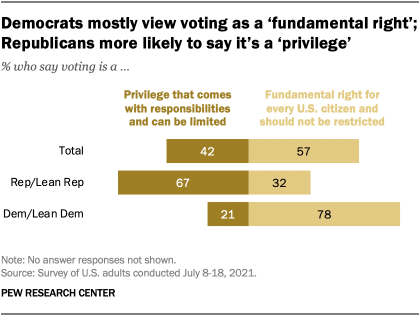
As political battles continue around the nation over voting access and restrictions, a new Pew Research Center survey finds that a majority of Americans (57%) say voting is “a fundamental right for every adult U.S. citizen and should not be restricted in any way.”

Fewer (42%) express the view that “voting is a privilege that comes with responsibilities and can be limited if adult U.S. citizens don’t meet some requirements.”

Democrats and Democratic-leaning independents overwhelmingly say voting is a fundamental right that should not be restricted in any way – 78% hold this view, while fewer than a quarter (21%) say it is a privilege. Two-thirds of Republicans and Republican leaners say voting is a privilege that can be limited if requirements are not met, compared with about half as many (32%) who say it is a fundamental right.


A bar chart showing that Democrats mostly view voting as a ‘fundamental right’; Republicans more likely to say it’s a ‘privilege’


Saturday, May 1, 2021

The 2020 Election

Nathaniel PersilyCharles Stewart III have an article at The Journal of Democracy titled " The Miracle and Tragedy of the 2020 U.S. Election."

The abstract:

The 2020 election was both a miracle and a tragedy. In the midst of a pandemic posing unprecedented challenges, local and state administrators pulled off a safe, secure, and professional election. This article discusses metrics of success in the adaptations that took place—record-high turnout, widespread voter satisfaction, a doubling of mail voting without a concomitant increase in problems often associated with absentee ballots, and the recruitment of hundreds of thousands of new poll workers. However, a competing narrative of a “stolen election” led to a historically deep chasm between partisans in their trust of the election process and outcome.

Tuesday, March 30, 2021

Survey of Military Families

From Blue Star Families:
Blue Star Families’ annual Military Family Lifestyle Survey (aMFLS) has been providing a comprehensive understanding of the experiences and challenges encountered by military families since 2009. It offers crucial insight and data to help inform national leaders, local communities, and philanthropic actors—functions that are even more important as decision makers assess how to support military and veteran families while the nation recovers from a global pandemic. Blue Star Families conducted its 11th annual Military Family Lifestyle Survey from September to October 2020. Capturing experiences of nearly 11,000 respondents worldwide, and generating millions of data points, it remains the largest and most comprehensive survey of active-duty, National Guard, and Reserve service members, veterans, and their families.

SUPPORTING MILITARY FAMILIES STRENGTHENS NATIONAL SECURITY & LOCAL COMMUNITIES

The tumultuous events of 2020 intensified some pre-existing concerns common across military families including spouse employment, child care, military children’s education and time away. This year’s events underscored the importance of addressing these long-standing concerns, while also shining a spotlight on systemic problems. While the stormy year of 2020 created significant challenges, it also clarified issues and sparked changes, giving stakeholders interested in supporting military and veteran families a clearer view of the path to recovery.

The 2020 Military Family Lifestyle Survey Comprehensive Report examines these shifts and opportunities through the social determinants of health, exploring the five pillars that set the conditions for individual and family health and well-being: community and social context, health care access, education access and quality, neighborhood and the built environment, and economic stability.1


Executive Summary

Comprehensive Infographic

COVID-19 Impacts Infographic

Community and Social Context

Discrimination in the Military: Service members reported experiencing racial and gender discrimination, potentially impacting readiness and retention. Most did not report the most recent incident of discrimination. Also, a smaller proportion of those active-duty service member respondents who experienced military connected racial discrimination (43%) would recommend service than those who had not experienced discrimination (63%). Nearly one in 10 veterans of color reported racial discrimination was one of the reasons they left military service.

Unit Communication and Leadership: Fewer than half of service members reported feeling a sense of belonging to their unit. The number was even lower for female service members. Fewer than half agreed their command communicates well, and makes good decisions, but those who did agree reported significantly less stress.

Family Needs During Deployment: More than half of families who experienced a deployment or activation during COVID-19 experienced an unanticipated extension of their time apart. Service members and their family members reported their top needs during deployment include communication, opportunities to exercise, and access to medical care and mental health resources.

Voting: The overwhelming majority of military family respondents are registered to vote. Their decisions about where they registered were influenced by rules/regulations and their desire to maintain connection to specific communities. Military families are highly civically engaged.

National Guard/Reserve Service Members: Reserve and National Guard service members reported negative employment consequences during their career after an activation or deployment. Despite federal legal protections, nearly a quarter (23%) of National Guard and a third (34%) of Reserve service member respondents noted negative consequences with their civilian employers after returning from activation, such as losing promotion or training opportunities, involuntary reductions in hours or pay, or loss of employment.

Female Service Members and Veterans: Throughout the military life cycle, female service member respondents face greater challenges with balancing military and family life and report more negative experiences associated with service than their male counterparts. Service experiences are complex, and experiences of gender-based discrimination, harassment, assault, and general life challenges often occur alongside positive experiences of meaningful work and camaraderie with peers.

Health Care Access

Mental Health: Families still experience barriers to mental health care; 21% would like to receive care but do not currently. Nearly one-quarter (23%) of active-duty spouse respondents and 16% of active-duty service member respondents indicated having a current diagnosis for Generalized Anxiety Disorder. Despite increased use of telehealth services, active-duty family member respondents continue to report difficulty scheduling appointments, difficulty getting time off work for treatment, difficulty finding child care, and concerns about confidentiality.

Education Access and Quality

Relocation and Military Children with Special Needs: Active-duty families with children with special needs experience difficulty accessing educational and health care support services, particularly during relocation; these issues were exacerbated by COVID-19. The majority (78%) of active-duty family respondents with a child receiving special education services lost all or some of those educational support services during COVID-19 closures. Those transitioning to a new duty station encountered additional challenges; half of active-duty 6 family respondents with a child enrolled in special education, who PCSed since March 2020, reported they had trouble transferring their child(ren)’s IEP (51%) or 504 Plan (48%) to their new school.

Changing School Modality: Virtual education tripled in the last year, and more families are moving to homeschooling. Fifty-one percent of active-duty family respondents reported their oldest child participated in virtual education delivery in the 2020-2021 school year; 13% reported homeschooling. The shift to virtual education has impeded spouse employment; 36% of active-duty spouse respondents who are not working reported they were not working so they could homeschool their child(ren) or supervise virtual schooling.

Neighborhood and the Built Environment

Housing Choices: Most families pay well over the monthly out-of-pocket housing costs the Department of Defense projects they should be paying ($70-$158); of those active-duty families who reported out of pocket costs, 77% pay more than $200 out-of-pocket each month. When choosing housing, families prioritize proximity to base, family safety, a desirable school district, pet acceptance, and whether BAH will cover the costs. Financial stress increases with greater out-of-pocket housing costs.

Economic Stability

Child Care: Child care remains a top barrier to spouse employment, and it has intensified during COVID-19; it’s a greater challenge for families with kids with special needs. Lower income families have a harder time finding child care that works for their situation, but higher-income families still encounter challenges. Over half of service member respondents reported “permission to work remotely” would alleviate child care and schooling challenges.

Food Insecurity: While low food security is most prominent among junior enlisted family respondents (29%), higher ranking enlisted families also experience it. Fourteen percent of enlisted active-duty family respondents reported low or very low food security.

Spouse Employment: The spouse unemployment rate is higher in active-duty spouse respondents of color (27% vs. 17%) and recently relocated spouses (31% vs. 16%). Since March 2020, 42% of active-duty spouse respondents who had been working prior to the pandemic reported they had stopped working at some point during it, with layoffs and furloughs as the top reported cause. Most (68%) of those who stopped working remained unemployed at the time of survey fielding. Spouses identified remote/telework, transferring to a new location within the same company, and more flexibility from their service member’s command over their day-to-day job demands as preferred solutions.

The full report can be found here:
2020 Military Family Lifestyle Survey Comprehensive Report

Monday, July 20, 2020

Youth Voter Participation in 2020

A release from the Center for Information and Research on Civic Learning & Engagement (CIRCLE):
Our polling data makes clear that a majority of young people are interested in the 2020 election and understand its importance. Whether they are ready to vote in an election shaped by restrictions due to the COVID-19 pandemic may be another story. Election processes are in flux and will likely vary from state to state. Young people’s access to, information about, and familiarity with online voter registration (OVR) and mail-in voting will be critical. In this regard, our poll reveals that there are reasons for concern that should be seen as a call to action.
We asked youth in our survey whether they could register to vote online in their state. (Online registration is widely available in 38 states and Washington, D.C.) A third of youth (32%) said they did not know. Among youth who answered yes or no, 25% were incorrect. Overall, just half (51%) of youth could correctly identify whether OVR is an option for them or not. Worryingly, among respondents from states where OVR is not available, only 14% correctly identified that was the case. This means a large segment of young people in these states may be relying on an option that isn’t available to them, thereby complicating or delaying their voter registration. Another potential stumbling block: 7.5% of young people—which translates to 3.5 million youth—say in our poll that they have not had good enough access to the Internet during the pandemic.
...
We have previously shared that, if mailing in ballots becomes the primary voting method in the 2020 elections, it will be an unfamiliar process for most youth. Indeed, only 24% of young people in our poll have previously voted by mail. There are major and troubling differences by race/ethnicity: 34.5% of Asian youth and 25% of White youth have had access to and experience with voting by mail, compared to 22% of Black youth and just 20% of Latino youth. However, greater availability of absentee voting in Western states (where all-mail voting is common) compared to Southern states (where excuses to vote absentee are often needed) means that access to this method of voting differs greatly, especially between Asian and Black youth because Asian American youth are concentrated in the Western States while Black youth are concentrated in the Southern States.
Approximately two-thirds of young people say they have seen information about absentee ballots this year, and the same percentage say that if their state’s voting occurs entirely by mail, they know where to get information about receiving their ballot. Of course, this means that a third of youth—more than 15 million—currently lack this critical information.
As the electoral landscape continues to evolve in many states across the country, one of the major challenges for our democracy will be ensuring that young people have access to timely information about the tools and processes that may determine whether they cast a vote in November. Our poll reveals that we are far from meeting that goal, and that it will be up to election administrators, educators, media, organizers, parents, and peers to act in concert to do so. It also highlights that these efforts must focus especially on youth of color in order to avoid perpetuating racial/ethnic inequities in political participation.

Sunday, May 19, 2019

Census Citizenship Question

The 1950 census was the last one to date that collected citizenship information from the whole U.S. resident population. The 1960 census had no citizenship question per se but queried a sample of respondents about birthplace. From 1970 on, the Census Bureau asked a population sample about citizenship or naturalization status, first as part of the census, then in the American Community Survey (ACS). Secretary of Commerce Wilbur Ross and his staff reportedly asked the U.S. Department of Justice (DOJ) if it would request the Census Bureau to collect citizenship data in the 2020 census. DOJ made the request on December 12, 2017. Secretary Ross announced on March 26, 2018, that the 2020 census will ask the ACS question “Is this person a citizen of the United States?” The choice of ACS answers is “Yes, born in the United States”; “Yes, born in Puerto Rico, Guam, the U.S. Virgin Islands, or Northern Marianas”; “Yes, born abroad of U.S. citizen parent or parents”; “Yes, U.S. citizen by naturalization—Print year of naturalization”; or “No, not a U.S. citizen.” DOJ stated that the census, not a survey with associated sampling error, “is the most appropriate vehicle for collecting” citizenship data “critical to the Department’s enforcement of Section 2 of the Voting Rights Act” and its “protections against racial discrimination in voting.”
Opponents of the citizenship question have expressed concern that it may depress immigrants’ census response rates or cause them to falsify data, especially if their status in the United States, or that of their friends or families, is illegal. Census Bureau fieldworkers in 2017 noted heightened anxiety about data confidentiality among certain foreign-born respondents and reluctance to answer questions, particularly about citizenship status. Six former bureau directors, from both Republican and Democratic administrations, signed a January 26, 2018, letter to Secretary Ross, opposing the late-date introduction of an untested citizenship question. Multiple lawsuits were filed to block the question; Judge Jesse Furman, U.S. District Court for the Southern District of New York, ruled on July 26, 2018, that the consolidated suit State of New York et al. vs. U.S. Department of Commerce et al. could proceed.

Friday, October 5, 2018

Youth Vote 2018

Campbell Streator and Harold Ekeh at The Hill:
We need young Americans to vote — not just once, but always. That’s why Every Vote Counts — a student-led, nonpartisan organization of which we’re proud to be a part — is dedicated to (channeling the energy that young Americans expend marching and protesting to boosting turnout on Election Day around the country.
This week, we’re lighting a fire under our peers by launching the National Pledge to Vote. We’re kicking off the pledge with events at 23 participating campuses nationwide, and with more to come. Yale University is challenging Harvard University to see which campus can deliver higher voter turnout. Basketball teams are challenging football teams to see who can get the most players to vote. Young Americans are also partnering with local community organizations to engage non-voters like never before.
Same theme, different organization -- a video from NAIL Communications:

Monday, April 9, 2018

A Plea to End Felon Disenfranchisement

George Will writes at WP:
What compelling government interest is served by felon disenfranchisement? Enhanced public safety? How? Is it to fine-tune the quality of the electorate? This is not a legitimate government objective for elected officials to pursue. A felony conviction is an indelible stain: What intelligent purpose is served by reminding felons — who really do not require reminding — of their past, and by advertising it to their community? The rule of law requires punishments, but it is not served by punishments that never end and that perpetuate a social stigma and a sense of never fully reentering the community.
Meade, like one-third of the 4.7 million current citizens nationwide who have reentered society from prison but cannot vote, is an African American. More than 1 in 13 African Americans nationally are similarly disenfranchised, as are 1 in 5 of Florida’s African American adults. Because African Americans overwhelmingly vote Democratic, ending the disenfranchisement of felons could become yet another debate swamped by partisanship, particularly in Florida, the largest swing state, where close elections are common: Republican Gov. Rick Scott’s margins of victory in 2010 and 2014 were 1.2 and 1.1 percent, respectively. And remember the 537 Florida votes that made George W. Bush president.

Friday, June 30, 2017

Federalism and the "Election Integrity" Commission

From the Mississippi Secretary of State:
“Our Office has not received any correspondence from the Presidential Advisory Commission on Election Integrity. A copy of such correspondence to another Secretary of State has been forwarded to us. As all of you may remember, I fought in federal court to protect Mississippi voters’ rights for their privacy and won. (See True the Vote v. Hosemann, 43 F.Supp.3d 693 (S.D. Miss. 2014))
In the event I were to receive correspondence from the Commission requesting the following,
‘if publicly available under the laws of the state, the full first and last names of all registrants, middle names or initials if available, addresses, dates of birth, political party (if recorded in your state), last four digits of social security number if available, voter history (elections voted in) from 2006 onward, active/inactive status, cancelled status, information regarding any felony convictions, information regarding voter registration in another state, information regarding military status, and overseas citizen information,’
My reply would be: They can go jump in the Gulf of Mexico and Mississippi is a great State to launch from.
Mississippi residents should celebrate Independence Day and our State’s right to protect the privacy of our citizens by conducting our own electoral processes.

Wednesday, December 9, 2015

Lower the Voting Age?

At The New York Times, Yamiche Alcindor reports on a new movement:
The campaign, called Vote16USA, which will be announced on Wednesday, aims to lower the voting age to 16 from 18 to spur civic engagement by younger Americans. But the push, by a nonpartisan group based in New York called Generation Citizen, which seeks to promote youth participation in politics, is igniting a debate about voter competency, adolescent decision making and whether allowing younger people to vote is the best way to politically engage teenagers.

Opponents say that teenagers are not mature enough to vote at 16, that they will not make informed decisions and that Vote16USA is a partisan push to get more liberals on voter rolls. Advocates, however, argue that lowering the voting age would increase turnout, allow teenagers to weigh in on issues that directly affect them and push schools to improve civic education.
According to the National Assessment of Educational Progress, only about a quarter of 12th graders score proficient or advanced on civics.  Granted, there are a variety of surveys showing that older people also have gaps in civic knowledge, but they learn certain things just by virtue of aging and joining the workforce. For instance, relatively few teens file tax returns; accordingly, they know little about government revenue. People who pay income taxes at least have a general idea of where the money comes from.

As for maturity, a perceptive statement comes from the majority opinion in Roper v. Simmons, which barred the death penalty for people under 18.
[As] any parent knows and as the scientific and sociological studies respondent and his amici cite tend to confirm, “[a] lack of maturity and an underdeveloped sense of responsibility are found in youth more often than in adults and are more understandable among the young. These qualities often result in impetuous and ill-considered actions and decisions.” Johnson, supra, at 367; see also Eddings, supra, at 115—116 (“Even the normal 16-year-old customarily lacks the maturity of an adult”). It has been noted that “adolescents are overrepresented statistically in virtually every category of reckless behavior.” Arnett, Reckless Behavior in Adolescence: A Developmental Perspective, 12 Developmental Review 339 (1992). In recognition of the comparative immaturity and irresponsibility of juveniles, almost every State prohibits those under 18 years of age from voting, serving on juries, or marrying without parental consent. See Appendixes B—D, infra.

Monday, March 23, 2015

Impact of Mandatory Voting? Meh!

President Obama has suggested that voting be mandatory.  At The Washington Post, John Sides gives two reasons why this change might not be transformative.
First, non-voters are — on average — only a bit more Democratic than voters, and a bit more supportive of liberal policies. For evidence, see mywork with Jack Citrin and Eric Schickler, this paper by Jan Leighley and Jonathan Nagler (now part of their book), the chapter by Eitan Hersh and Steve Ansolabehere in this book, and this paper by Ben Highton and the late Ray Wolfinger (helpfully cited by Dylan Matthews).
Now, note the fine print. “On average” means that Citrin, Schickler and I found that in some states in some election years, non-voters were actually a bit more Republican. That wasn’t the norm, but we should not assume that higher turnout or compulsory voting would always and everywhere benefit Democrats. (See also this piece by James DeNardo.)
And “a bit” means that the observed differences are not always large — usually a single-digit number of percentage points, and quite often in the low single digits. Any larger differences — as in this 2012 Pew preelection survey of self-reported likely voters and likely non-voters — are the exception, not the rule.
Here’s the second important finding: simulations suggest that compulsory voting would change the outcome of very few elections. This is not only because non-voters often aren’t that different than voters, but also because lots of elections — such as at the House and Senate levels — aren’t that close.
For example, when Citrin, Schickler, and I studied 246 Senate elections from 1990-2006, only eight outcomes changed when we simulated the impact of universal turnout. (See our chapter in this book.) In a very close presidential election, as in 2000, universal turnout could have made a difference. But such elections aren’t common.

Sunday, November 2, 2014

Why Vote? It's a Duty. Full Stop.

At the DC Decoder blog, I debunk the slogan, "Your vote can make a difference!" No, in a country with more than 140 million registered voters, the chance that your vote could tip an election is comparable to your chance of getting Ebola -- effectively zero.  

Another silly slogan is "If you don't vote, you have no right to complain!" In light of the improbability of affecting the outcome, Jason Brennan writes whimsically:
I ran into someone this morning who complained about how poor he is. I told him, “If you’re not playing the lottery everyday, you forfeit your right to complain about being poor.” The problem with poor people is that they don’t buy enough Powerball tickets.
The most sensible argument for voting is the one that also enjoys the greatest support among the public.  It is a duty.

Andre Blais and Christopher Achen write:
We argue in this paper that, although caring about the outcome of the election is important, another motivation, the desire to fulfill one‘s civic duty, is equally consequential. When asked how important it is for the good citizen to always vote in elections, among Americans the mean score is 6.2 on a scale from 1 to 7, just slightly lower than obeying the laws and not evading taxes (Dalton 2008, 30). In the 2000 Annenberg election study (Annenberg 2010), 71% of Americans in the post-election survey agreed or strongly agreed that they felt guilty when they failed to vote. Even among those who reported that they had not voted, nearly half said they felt guilty. Blais (2000, 95) reports that more than 90% of respondents in two Canadian provinces agree with the statement that ―it is the duty of every citizen to vote.‖ The percentage is 80% in Britain (Clarke et al. 2004, 251). These responses are not induced by the survey question. In open-ended interviews about why they vote, the great majority of respondents volunteer that they feel a strong duty to appear at the polls (Blais 2000, chap. 5).
  • Annenberg Public Policy Center 2010. University of Pennsylvania. http://www.annenbergpublicpolicycenter.org/ProjectDetails.aspx?myId=1, accessed February 26, 2010.
  • Blais, André. 2000. To Vote or Not to Vote. Pittsburgh: University of Pittsburgh Press.
  • Clarke, Harold D., David Sanders, Marianne C. Stewart, and Paul Whitely. 2004. Political Choice in Britain. Oxford: Oxford University Press.
  • Dalton, Russell. 2008.  The Good Citizen. CQ Press. 

Wednesday, June 26, 2013

Voting Rights and Federalism

Congress failed to take the U.S. Supreme Court’s word seriously in a 2009 decision raising “serious constitutional questions” about the Voting Rights Act. So the high court today struck down the central mechanism under which the law selects states for federal review of their voting procedures.
The Supreme Court, in a 5-4 decision penned by Chief Justice John Roberts, upheld the 1965 law designed to ensure equal voting rights for white and minority citizens. But Roberts declared Section 4 of that law unconstitutional because it singled out certain states and counties based on 40-year-old evidence of racial discrimination.

It was a strong affirmation of federalism and in particular the concept of equal sovereignty among the states. It also highlights the huge economic and social changes that have swept the South since 1965, to the point that voter turnout as a percentage of the minority population is far higher in Mississippi, a covered state, than in Massachusetts, which is not.
“There is no doubt that these improvements are in large part because of the Voting Rights Act,” Roberts wrote. But the formula Congress devised in 1965, separating states into those with low voter turnouts and pernicious tests like literacy requirements, is no longer valid, he said. “Today the Nation is no longer divided along those lines, yet the Voting Rights Act continues to treat it as if it were.”
The decision, one of a string of late-term 5-4 verdicts, split the court on ideological grounds. Justice Ruth Bader Ginsburg wrote a dissent accusing the court of downplaying continuing problems with racial discrimination in the U.S. According to the conservative majority, she wrote, “the very success …of the Voting Rights Act demands its dormancy.”

Sunday, May 26, 2013

Civic Duties

At The Atlantic, Andrew Guthrie Ferguson writes:
Every spring, commencement speeches echo across college campuses, calling upon students to engage the world. Speakers will invariably haul out terms like "civic engagement" and "global citizenship." Lost in the inspiring rhetoric are the less glamorous, yet arguably more vital, daily forms of civic participation. Such soaring words often obscure the fact that our basic civic duties, voting, jury service, electoral office - the three core constitutional requirements of citizenship - are being ignored in favor of grand plans to "follow your passion" and "change the world."
...

Civic responsibility is the rub of citizenship. As President Obama candidly acknowledged in his commencement address to Ohio State University this month, borrowing themes from John F. Kennedy's famous inaugural, "As citizens, we understand that it's not about what America can do for us. It's about what can be done by us, together, through the hard and frustrating but absolutely necessary work of self-government." It is not about changing the world in a boundless future, but engaging constitutional responsibilities in the grounded present.

The political responsibilities of voting, jury service, and participating in elective office are the basics of our constitutional order. If we are inspired by anything at graduations, we should be inspired to participate in these fundamental, if ordinary, constitutional duties.