An important study from Pew Research last year showed that Americans are most likely to get their information about local crime from friends, family, neighbors and local news outlets.
These local sources aren’t available at the national level. Most Americans have no general experience with crime “out there” across the country. They instead rely on information from media (mass or social).
This national news coverage can easily end up leaving the impression of higher (or, in some cases, lower) levels of crime than is actually the case. National media (traditional and social) often highlight violent, unusual or geographically dispersed crimes. These may be rare, for the most part. But they can add up in the public imagination as being constantly occurring. This, in turn, can lead to perceptions of a nation facing serious crime problems. (Local news also, of course, features crime as a routine staple of local news coverage. But Americans have their personal experiences as a check against what the local media portray.)
Additionally, today’s news environment increasingly includes news sites and social media that cater to particular niche audiences. These sources can often amplify or downplay the seriousness of crime in order to promote desired narratives and policies. These frames, in turn, could shape national evaluations, even if not factually accurate.
Showing posts with label knowledge. Show all posts
Showing posts with label knowledge. Show all posts
Thursday, November 27, 2025
News Sources and Perceptions of Crime


Sunday, November 9, 2025
Anecdote About Knowledge and the 2025 Elections
Many posts have discussed what Americans do and do not know about their government.
“We’re getting calls about polls being closed,” Kentucky’s Republican Secretary of State Michael Adams posted Tuesday on X. “They are closed because we do not have elections today. Kentucky votes next year. You cannot vote today in Kentucky for the mayor of New York City or the Governor of Virginia. Sorry.” (In a subsequent post, he mused about the importance of civics education.)
Thursday, July 31, 2025
Can't Agree on Facts
Many posts have discussed partisan polarization.
Elisa Shearer at Pew:
Eight-in-ten U.S. adults say that when it comes to important issues facing the country, Republican and Democratic voters not only disagree on plans and policies, but also cannot agree on basic facts.
Another 18% say voters in opposing parties can agree on basic facts, even if they disagree about policies, according to a Pew Research Center survey conducted in March.
Views are essentially unchanged since we first asked a similar question in 2016. That year, 81% said that most Donald Trump and Hillary Clinton supporters could not agree on basic facts.
Wednesday, October 16, 2024
Knowledge of Government
Many posts have discussed what Americans do and do not know about their government.
If you’re reading this memo, you probably know what the filibuster is. But it turns out that a plurality of Americans don’t!
The good news is that voters do know which parties control which branches of the federal government. A majority of voters overall (and a plurality of young voters) were able to correctly identify that Republicans currently control the House of Representatives and Democrats currently control the Senate. Large majorities of both voters overall and voters under 30 correctly identified Republicans as the party that has appointed a majority of sitting Supreme Court justices.
But when asked to identify the correct description of each process out of a list of three (including two incorrect options), there was a substantial age gap: young voters were much less likely than voters overall to identify the correct description of how the Supreme Court appointment, Electoral College, and constitutional amendment processes work. They were also less likely to identify the correct definition of “gerrymandering” than voters overall. A plurality of both young voters (48.4%) and voters overall (40.3%) said that they did not know which description of the Senate filibuster was most accurate.

Tuesday, September 17, 2024
Public Knowledge and the Constitution
From the Annenberg Public Policy Center:
The 2024 edition of the Annenberg Constitution Day Civics Survey, released annually to celebrate Constitution Day on September 17, finds that:
- Nearly two-thirds of Americans (65%) can name all three branches of government.
- Asked what specific rights are guaranteed by the First Amendment, nearly three-quarters of respondents (74%) name freedom of speech. The other four rights are recalled by far fewer people: the second most-often cited, freedom of religion, is named by just 39%.
- A little over half of U.S. adults know which party controls the Senate and which controls the House of Representatives.
- Over 80% of Americans support prohibiting Supreme Court justices from participating in cases in which they have “personal or financial interests.” Nearly as many people support creation of a formal ethics code for the court.
“Civics knowledge matters,” says Kathleen Hall Jamieson, director of the Annenberg Public Policy Center. “Those who do not understand the rights protected by the Constitution can neither cherish nor invoke them; those who do not know which party controls the House and Senate may misattribute credit or blame for action or inaction.”
Tuesday, March 26, 2024
Civic Illiteracy
From the U.S. Chamber of Commerce Foundation:
A comprehensive new study from the U.S. Chamber of Commerce Foundation reveals an alarming truth just three years shy of America’s 250th anniversary—the nation’s civic knowledge is badly lagging. The national survey, which examined responses from 2,000 registered voters, also shows that while Americans lack basic understanding of government, trust in business remains strong.
The survey finds more than 70% of Americans fail a basic civic literacy quiz on topics like the three branches of government, the number of Supreme Court justices, and other basic functions of our democracy. Just half were able to correctly name the branch of government where bills become laws.
While two thirds of Americans say they studied civics in high school, just 25% say they are “very confident” they could explain how our system of government works.
“As we approach our semiquincentennial in 2026, this report amounts to a five-alarm fire drill for the civic health of the nation,” said Hilary Crow, head of the U.S. Chamber Foundation’s The Civic Trust®. “While Americans across backgrounds value civic participation in theory, we are sorely lacking in the basic knowledge that translates values into informed, engaged citizenship.”
Among the major red flags:
“Put plainly, you can't fix what you don't understand,” Crow said. “Without reversing these deficiencies in understanding how our government works, we are risking the long-term health of our civic culture and democracy itself. That’s why we’re so committed to the National Civics Bee® and other civics literacy programs."
- Only 46% of respondents believe the U.S. is performing well on the vital need to understand our system of government—a gap of 49 percentage points from the 95% who call it important for the nation's success.
- One in three did not know there are three branches of government.
- More than half did not know the number of members in the House of Representatives.
Workplaces seen as rare spaces of unity and civility
The study also highlights deep wells of unity around core civic values, and an openness to businesses playing a role in supporting citizenship.
More than 75% of adults in the U.S. view political division in the country and government as a major problem. Yet just 19% see significant political tensions at their jobs.
Nearly half of respondents said workplaces should take the primary role in defusing divide, over government bodies.
“As the bonds holding our civic culture together fray, places of work stand out as sanctuaries where Americans still connect across differences,” Crow said. “The data speak clearly – people welcome employers’ help in ensuring politics don't infect these essential spaces.”
Specifically, the survey reveals:
As trusted institutions, there’s an opportunity for business leaders to drive significant impact in elevating civics as a national priority – for the current workforce and for the next generation. Only 38% of Americans believe children today are prepared to fulfill their roles as informed, active citizens. Business leaders must partner with educators in steering a new generation toward constructive civic participation.
- More than 80% of respondents hold positive views of large and small businesses alike.
- 82% agree businesses can play an “important role” in bringing people together.
- 93% would react positively if companies publicly tried “improving our country.”
“With our social fabric strained, the business community is being called upon to be a thread that can knit us back together,” Crow concluded.
Tuesday, February 27, 2024
Engaging with Political Information
From the Bipartisan Policy Center:
Americans’ top three sources of election information are passive: Americans are more likely to learn about elections while scrolling social media or watching a news channel than proactively searching for election information.
Additionally, a plurality (41%) of adults said the primary way they engage with election content on online platforms is through browsing or reading posts. Only a small subset engages through active forms of engagement, such as commenting (16%), sharing content (10%), or creating and posting their own content (6%).
Sunday, December 10, 2023
"From the River to the Sea" and Political Ignorance
When college students who sympathize with Palestinians chant “From the river to the sea,” do they know what they’re talking about? I hired a survey firm to poll 250 students from a variety of backgrounds across the U.S. Most said they supported the chant, some enthusiastically so (32.8%) and others to a lesser extent (53.2%).
But only 47% of the students who embrace the slogan were able to name the river and the sea. Some of the alternative answers were the Nile and the Euphrates, the Caribbean, the Dead Sea (which is a lake) and the Atlantic. Less than a quarter of these students knew who Yasser Arafat was (12 of them, or more than 10%, thought he was the first prime minister of Israel). Asked in what decade Israelis and Palestinians had signed the Oslo Accords, more than a quarter of the chant’s supporters claimed that no such peace agreements had ever been signed. There’s no shame in being ignorant, unless one is screaming for the extermination of millions.
...
In all, after learning a handful of basic facts about the Middle East, 67.8% of students went from supporting “from the river to sea” to rejecting the mantra. These students had never seen a map of the Mideast and knew little about the region’s geography, history or demography. Those who hope to encourage extremism depend on the political ignorance of their audiences. It is time for good teachers to join the fray and combat bias with education.
Saturday, December 9, 2023
Holocaust Denial
A fifth of Americans ages 18-29 believe the Holocaust was a myth, according to a new poll from The Economist/YouGov. While the question only surveyed a small sample of about 200 people, it lends credence to concerns about rising antisemitism, especially among young people in the U.S. Another 30 percent of young people said they didn’t agree or disagree with the statement, while the remaining 47 percent disagreed. Only 7 percent of Americans overall believe the Holocaust is a myth, according to the poll.
Congress and the White House have placed special attention on fighting antisemitism in recent weeks as the Israel-Hamas war in Gaza continues to divide public opinion. Leaders of top universities were grilled by a House committee this week on the topic, drawing criticism for vague answers on what comments constituted antisemitic harassment. About a third of Americans described antisemitism as a “very serious problem” in the poll, with just more than a quarter of young people saying the same.
On Friday, a bipartisan group of senators, led by Sen. Jacky Rosen (D-Nev.), introduced a bill to reauthorize the Never Again Education Act, providing federal funding for Holocaust education. “Failing to educate students about the gravity and scope of the Holocaust is a disservice to the memory of its victims and to our duty to prevent such atrocities in the future,” Rosen said in a statement. “At a time of rising antisemitism, reauthorizing the bipartisan Never Again Education Act will help ensure that educators have the resources needed to teach students about the Holocaust and help counter antisemitic bigotry and hate.”
From a 2018 survey by the Claims Conference
- Nearly one-third of all Americans (31 percent) and more than 4-in-10 Millennials (41 percent) believe that substantially less than 6 million Jews were killed (two million or fewer) during the Holocaust
- While there were over 40,000 concentration camps and ghettos in Europe during the Holocaust, almost half of Americans (45 percent) cannot name a single one – and this percentage is even higher amongst Millennials
The survey asked an open-ended question: "From what you know or have heard, what was Auschwitz?
......................................................All adults ..................Under 35
Concentration camp ........................40% ............................22%
Death/extermination camp ..............23% ............................11%
Forced labor camp ............................1% ...............................2%
Other ................................................21% ............................31%
Not sure ...........................................20% .............................35%
Sunday, September 17, 2023
Knowing the Constitution
From the Annenberg Public Policy Center:
Many Americans do not know what rights are protected under the First Amendment and a substantial number cannot name all three branches of government, according to the 2023 Annenberg Constitution Day Civics Survey.
The Annenberg Public Policy Center’s annual, nationally representative survey finds that when U.S. adults are asked to name the specific rights guaranteed by the First Amendment to the Constitution, only one right is recalled by most of the respondents: Freedom of speech, which 77% named.
The civics knowledge survey, released annually to celebrate Constitution Day (Sept. 17), also finds that although two-thirds of Americans (66%) can name all three branches of government, 10% can name two, 7% can name only one, and 17% cannot name any.
As in the recent past, the Annenberg Constitution Day Civics Survey was fielded in a year of high-profile events that propelled the workings of government into the daily news cycle. This year saw four criminal indictments of former President Donald Trump and numerous trials for those charged in the 2021 assault on the U.S. Capitol. Led by a conservative supermajority, the U.S. Supreme Court sidelined race-conscious college admissions programs and a Biden Administration student-loan forgiveness plan. Several of the associate justices were dogged by allegations of unethical conduct. A plea deal to resolve a gun charge and tax offenses by President Joe Biden’s son Hunter collapsed, while in Congress, Republican Representatives discussed whether to open impeachment proceedings against Biden.
“It is worrisome that one in six U.S. adults cannot name any of the branches of government and that only 1 in 20 can name all five freedoms protected by the First Amendment,” said Kathleen Hall Jamieson, director of the Annenberg Public Policy Center and director of the survey. “One is unlikely to cherish or work to protect freedoms one does not know one has and will have trouble holding elected and unelected leaders accountable if one does not understand the nature and prerogatives of each branch and the ways in which the power of each is kept in check.”
Monday, July 10, 2023
Knowledge of SCOTUS
Charles Franklin at Polls and Votes:
The limits of public attention to the Court is vividly illustrated by awareness of the balance of justices nominated by Republican and by Democratic presidents. Nominations have been intensely contested for over a decade (arguably longer) and the three Trump appointments followed in the wake of Obama’s nominee being denied hearings or a vote in 2016 following Justice Scalia’s death. If a lot of politics has been “all about the judges”, much of the public hasn’t followed the story.
Despite a long standing Republican-appointed majority on the Court, and the current 6-3 majority, 30% of the public believes a majority of the justices were appointed by Democratic presidents. About 40% say a majority was “probably” appointed by Republican presidents, and just 30% say a majority was “definitely” appointed by Republican presidents.
...
More than 60% say they don’t have an opinion of Justice Alito. In November 2022 we asked respondents for their best guess as to which justice authored the Dobbs decision. A quarter correctly picked Alito, with another quarter picking Thomas, and a scattering among the other justices. This is a very difficult question for the general public, who do not as a rule rush to read opinions by their favorite justices. Perhaps it is impressive that as many as 1/4 got Alito right, and Thomas is not a bad guess, given his concurrence. Still, the point is most people don’t have specific information about individual justices even in the most visible decisions.
...
There is a reporting and messaging lesson here. A substantial share of the audience you are trying to reach is likely unaware of some facts you take for granted. It is important to expand awareness of those facts by making them part of your story, even if they seem “obvious.
Sunday, July 2, 2023
Attention and Credulity
Natalie Jackson at National Journal:
At best, only one third of Americans pay close attention to politics. In a recent Marquette Law School poll, just 36 percent of respondents said they follow politics most of the time. Using different wording, a Grinnell College-Selzer poll from March found that 28 percent of Americans say they pay a lot of attention to political news.
...
When it comes to paying attention to presidential campaigns, there is even more reason to think we dramatically overestimate how invested people are. Pew Research has asked respondents how much thought they have given to the candidates running for president in the lead-up to the last several presidential elections. In the summer of 2019, barely a quarter had given the candidates much thought. The figures were similar in mid-2015. (Pew has not yet asked the question for the 2024 cycle.)
The poll also found that older people are more likely to say that they follow politics "most of the time"
- 18-29 36%
- 30-44 43%
- 45-59 63%
- 60+ 74%
And so they tend to have more contextual knowledge, which helps them sort fake headlines from true ones.
Sawdah Bhaimiya at Business Insider:
Boomers have always taken the flack for falling for fake news stories, but a survey has found it's younger generations that are more susceptible to online misinformation.
The survey of 1,516 US adults, published Thursday, was conducted by polling organization YouGov in April 2023. It examined how likely people were to be fooled by fake headlines. The survey is based on a framework called The Misinformation Susceptibility Test, developed by University of Cambridge psychologists.
The 2-minute test, now available to the public, required participants to look at 20 headlines and determine which were fake and real. It found that, on average, 65% of those surveyed were able to correctly classify them.
Surprisingly, the survey found that younger respondents were not as adept at spotting the difference between real and fake headlines as their older counterparts who have often been memed for their online naivete.
Tuesday, June 27, 2023
Electing Idiots
Liz Cheney:
— Republicans against Trump (@RpsAgainstTrump) June 27, 2023
"What we’ve done in our politics is create a situation where we’re electing idiots...
I look at it through the lens of how do we elect serious people? And I think electing serious people can’t be partisan...And part of the problem is we have this closed partisan… pic.twitter.com/FJhv7eYeIq
From the Hugh Hewitt interview with Francis Suarez: https://t.co/OzgJloODWJ pic.twitter.com/b9LCcwCM4e
— David Weigel (@daveweigel) June 27, 2023
“I'll look at — what’d you call it, a ‘Weeble?’”
— The Recount (@therecount) June 27, 2023
— 2024 GOP presidential candidate Francis Suarez on Uyghurs pic.twitter.com/wAW8lGg0IK
Friday, May 12, 2023
CRS Troubles
A number of posts have discussed congressional capacity. The Congressional Resarch Service is especially important in this regard.
Kevin Kosar at The Hill:
Congress calls upon CRS frequently. In 2021, for example, the think tank provided 265 in-person briefings, 2,729 confidential memoranda, 24,044 telephone responses and 34,844 email responses. The agency also wrote 1,073 reports for Congress and 13,348 bill summaries, which the Hill and the public read on Congress.gov.
While it is indubitable that CRS employees are doing a fine job, the agency itself has had troubles for more than a decade.
In 2019, Congress took a close look at flagging staff morale and employee frustration with CRS’s leadership. The Committee on House Administration (CHA) made clear that it wanted CRS leadership to right the ship. That did not happen. A survey of CRS staff last year revealed sky-high displeasure with CRS’s front office. So, the CHA’s Subcommittee on Modernization recently held another oversight hearing to get to the bottom of things. (Disclosure: I testified at this hearing.)
Chairwoman Rep. Stephanie Bice (R-Okla.) grilled CRS director, Dr. Mary Mazanec, over a bungled $20 million technology project that has left CRS staff writing reports and memoranda with a buggy version of Microsoft Word 2016. The committee also heard that staff service to Congress was suffering due to patchy Wi-Fi in their offices, Zoom accounts that shut down after 40 minutes of use and difficulty in getting technical support.
Wednesday, May 3, 2023
Declines in Civics and History Proficiency
Just 13 percent of the nation’s eighth graders were proficient in U.S. history last year, and 22 percent were proficient in civics, marking another decline in performance during the pandemic and sounding an alarm about how well students understand their country and its government.
The findings, released Wednesday, show a five-point slide since 2018 in the average history score on the National Assessment of Educational Progress, or NAEP, often called “the nation’s report card.” In civics, eighth grade scores fell two points, the first decline ever recorded on the tests, which cover the American political system, principles of democracy and other topics.
Peggy G. Carr, commissioner of the National Center for Education Statistics, referred to the results as “a national concern,” saying that “too many of our students are struggling … to understand and explain the importance of civic participation, how American government works and the historical significance of events.”
Tuesday, April 18, 2023
Opinion About World Leaders: Knowledge and Polarization
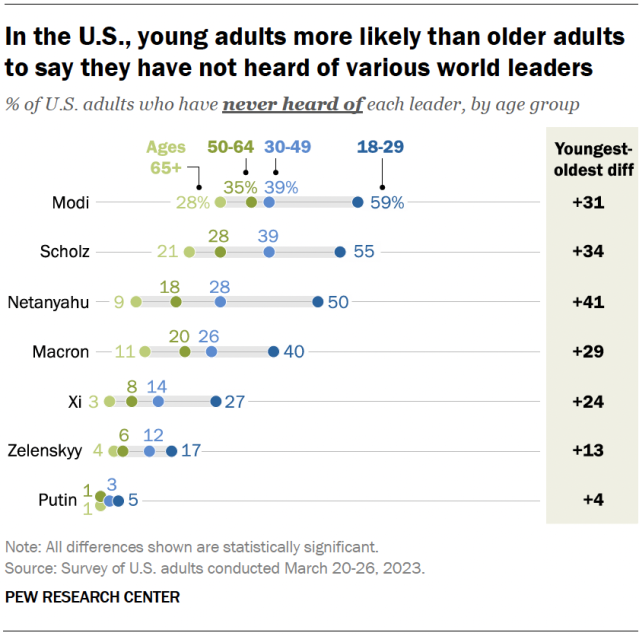
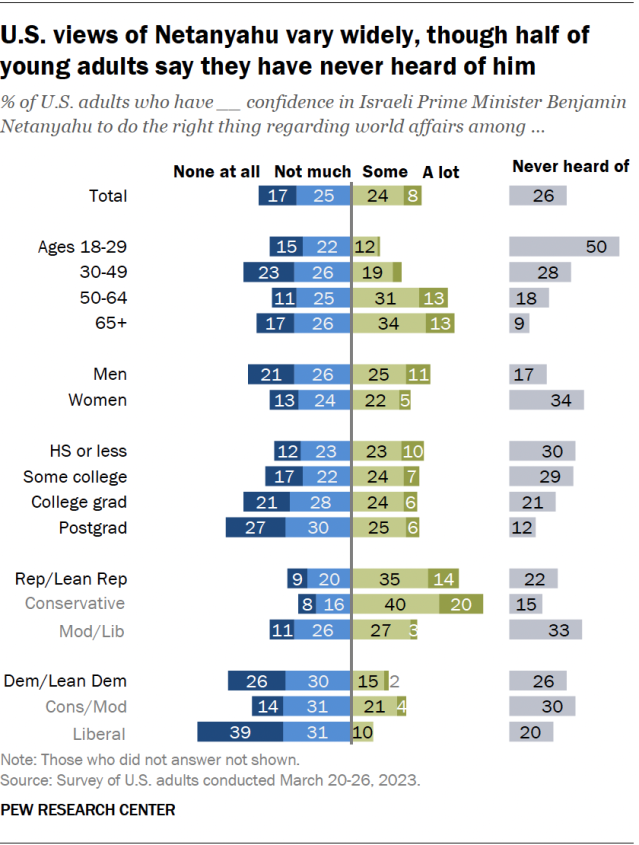
Americans’ awareness of foreign leaders varies greatly by age. Adults under 30 are much less likely than those ages 65 and older to be familiar with every leader included in the Center’s new survey – with the exception of Putin, who is known to the vast majority of the public.
For example, nearly six-in-ten Americans ages 18 to 29 say they have never heard of Modi, compared with 28% of those 65 and older. Large age differences also appear for Scholz, Netanyahu and Macron.
There are also consistent gaps in awareness by other demographic factors. Men, for instance, are more likely than women to offer an opinion on various world leaders and less likely to say they have never heard of them. The same is true of more educated Americans relative to those with less formal education. This tracks with past Center research on specific international knowledge among Americans.
Wednesday, September 14, 2022
Knowledge of Government
From the Annenberg Public Policy Center:
After two years of considerable improvement, Americans’ knowledge of some basic facts about their government has fallen to earlier levels, with less than half of those surveyed able to name the three branches of government for the 2022 Annenberg Constitution Day Civics Survey.
The Annenberg Public Policy Center’s annual, nationally representative survey showed notable increases in 2020 and 2021 after tumultuous years that put the role of government and the three branches under a media spotlight. In those two years, the survey was run amid a pandemic and government health restrictions, two impeachment inquiries, a presidential election, an attempt to disrupt congressional certification of the electoral vote, criminal trials of the individuals charged in the assault on the U.S. Capitol, and waves of social justice protests, among other events.
The current survey, released for Constitution Day (Sept. 17), found the first drop in six years among those who could identify all three branches of government, and declines among those who could name the First Amendment rights, though knowledge remained high on some other questions. Additional findings on the Supreme Court will be released next month.
“When it comes to civics, knowledge is power,” said Kathleen Hall Jamieson, director of the Annenberg Public Policy Center of the University of Pennsylvania. “It’s troubling that so few know what rights we’re guaranteed by the First Amendment. We are unlikely to cherish, protect, and exercise rights if we don’t know that we have them.”
Highlights
- Less than half of U.S. adults (47%) could name all three branches of government, down from 56% in 2021 and the first decline on this question since 2016.
- The number of respondents who could, unprompted, name each of the five freedoms guaranteed by the First Amendment also declined, sharply in some cases. For example, less than 1 in 4 people (24%) could name freedom of religion, down from 56% in 2021.
- Over half of Americans (51%) continue to assert incorrectly that Facebook is required to let all Americans express themselves freely on its platform under the First Amendment.
- But large numbers recognize other rights in the Bill of Rights and the veto process.
The Annenberg Constitution Day Civics Survey is a nationally representative survey conducted annually in advance of Constitution Day by the Annenberg Public Policy Center (APPC) of the University of Pennsylvania. This year’s survey of 1,113 U.S. adults was conducted by phone for APPC by independent research company SSRS on August 2-13, 2022. It has a margin of error of ± 3.6 percentage points at the 95% confidence level. The year-to-year changes reported here are statistically significant unless noted otherwise. For the questions and additional data, see the appendix and the methodology statement.
Saturday, May 28, 2022

Friday, April 1, 2022
Knowledge of Issues and Events -- Including The Slap
Many posts have discussed public knowledge of issues and events.
88% of Americans have seen, read or heard about Will Smith slapping Chris Rock at the Oscars— on par with the general awareness of Russia’s invasion of Ukraine, and well ahead of other major news events. https://t.co/GLz8apXW1R pic.twitter.com/vLqdQiOjpE
— Morning Consult (@MorningConsult) April 1, 2022
Friday, March 18, 2022
Estimating the Size of Groups
Taylor Orth at YouGov:
When it comes to estimating the size of demographic groups, Americans rarely get it right. In two recent YouGov polls, we asked respondents to guess the percentage (ranging from 0% to 100%) of American adults who are members of 43 different groups, including racial and religious groups, as well as other less frequently studied groups, such as pet owners and those who are left-handed.
When people’s average perceptions of group sizes are compared to actual population estimates, an intriguing pattern emerges: Amercians tend to vastly overestimate the size of minority groups. This holds for sexual minorities, including the proportion of gays and lesbians (estimate: 30%, true: 3%), bisexuals (estimate: 29%, true: 4%), and people who are transgender (estimate: 21%, true: 0.6%).
It also applies to religious minorities, such as Muslim Americans (estimate: 27%, true: 1%) and Jewish Americans (estimate: 30%, true: 2%). And we find the same sorts of overestimates for racial and ethnic minorities, such as Native Americans (estimate: 27%, true: 1%), Asian Americans (estimate: 29%, true: 6%), and Black Americans (estimate: 41%, true: 12%).
A parallel pattern emerges when we look at estimates of majority groups: People tend to underestimate rather than overestimate their size relative to their actual share of the adult population. For instance, we find that people underestimate the proportion of American adults who are Christian (estimate: 58%, true: 70%) and the proportion who have at least a high school degree (estimate: 65%, true: 89%).
The most accurate estimates involved groups whose real proportion fell right around 50%, including the percentage of American adults who are married (estimate: 55%, true: 51%) and have at least one child (estimate: 58%, true: 57%).
Misperceptions of the size of minority groups have been identified in prior surveys, which observers have often attributed to social causes: fear of out-groups, lack of personal exposure, or portrayals in the media. Yet consistent with prior research, we find that the tendency to misestimate the size of demographic groups is actually one instance of a broader tendency to overestimate small proportions and underestimate large ones, regardless of the topic.
Subscribe to:
Comments (Atom)