Search This Blog

Showing posts with label Islam. Show all posts

Friday, March 18, 2022

Estimating the Size of Groups

Taylor Orth at YouGov:
When it comes to estimating the size of demographic groups, Americans rarely get it right. In two recent YouGov polls, we asked respondents to guess the percentage (ranging from 0% to 100%) of American adults who are members of 43 different groups, including racial and religious groups, as well as other less frequently studied groups, such as pet owners and those who are left-handed.

When people’s average perceptions of group sizes are compared to actual population estimates, an intriguing pattern emerges: Amercians tend to vastly overestimate the size of minority groups. This holds for sexual minorities, including the proportion of gays and lesbians (estimate: 30%, true: 3%), bisexuals (estimate: 29%, true: 4%), and people who are transgender (estimate: 21%, true: 0.6%).

It also applies to religious minorities, such as Muslim Americans (estimate: 27%, true: 1%) and Jewish Americans (estimate: 30%, true: 2%). And we find the same sorts of overestimates for racial and ethnic minorities, such as Native Americans (estimate: 27%, true: 1%), Asian Americans (estimate: 29%, true: 6%), and Black Americans (estimate: 41%, true: 12%).
A parallel pattern emerges when we look at estimates of majority groups: People tend to underestimate rather than overestimate their size relative to their actual share of the adult population. For instance, we find that people underestimate the proportion of American adults who are Christian (estimate: 58%, true: 70%) and the proportion who have at least a high school degree (estimate: 65%, true: 89%).

The most accurate estimates involved groups whose real proportion fell right around 50%, including the percentage of American adults who are married (estimate: 55%, true: 51%) and have at least one child (estimate: 58%, true: 57%).

Misperceptions of the size of minority groups have been identified in prior surveys, which observers have often attributed to social causes: fear of out-groups, lack of personal exposure, or portrayals in the media. Yet consistent with prior research, we find that the tendency to misestimate the size of demographic groups is actually one instance of a broader tendency to overestimate small proportions and underestimate large ones, regardless of the topic.


Monday, April 26, 2021

Demographics and Core Social Networks

 Daniel A. Cox at the Survey Center on American Life:

In 2020, we conducted a survey that examined Americans’ core social networks. These findings reveal that exceedingly few Americans who are not part of a racial, ethnic, or religious minority count members of these groups as part of their inner circle. Only three percent of non-Jewish Americans have a Jewish person as part of their core social network. The findings are nearly identical for Muslims. Only one percent of non-Muslim Americans have someone who is Muslim as a member of their core network.

When it comes to race, the pattern is discouragingly similar. Only seven percent of Americans who are not black have a member of their core network who is. Similarly, only eight percent of non-Hispanic Americans count someone who is Hispanic as a close personal connection. Finally, four percent of non-Asian Americans report that someone in their core social network is Asian or Pacific Islander. Although these groups represent 13 percent, 19 percent, and 6 percent of the US population, respectively, remarkably few Americans who are not part of these communities have a close personal connection to someone who is.

Monday, August 10, 2020

Bush, Reagan, Discrimination, Founding Principles

 Farhat Popal and Christopher Walsh at the George W. Bush Presidential Center:
Attacks against Asian Americans and Pacific Islanders grew so bad in the early days of the coronavirus that the Asian Pacific Policy & Planning Council launched a website to track them. In its first two weeks, the STOP AAPI HATE website received over 1,100 reports of physical assault, verbal harassment, and shunning of Asian Americans...
Current events highlight the pitfalls of sacrificing precision in order to create “bumper sticker” talking points that crudely shape public perception for political purposes. Sadly, this is a tactic used across the political spectrum, but that doesn’t excuse it. The American people should hold their leaders accountable on such issues, regardless of political affiliation, and not allow “whataboutism” to compromise principles. And while it’s unrealistic to attribute a single cause to any rise in discrimination related to the global pandemic, having clear, consistent, empathetic, and trusted leadership is a factor.
While such leadership qualities foster stability in any time, their importance increases in a crisis because societal tensions are higher. Used together, they steer frightened and frustrated people away from fear, suspicion, and paranoia.
Look at the example of President George W. Bush following the Sept. 11, 2001 attacks. Angry people were channeling their rage through unacceptable violence against Muslim-Americans. Six days after 9/11, President Bush appeared at the Islamic Center of Washington, D.C., flanked by Muslim American religious leaders, and offered a strong rebuke of this persecution.
In doing so, President Bush stripped away any cloak of “patriotism” that some individuals might have used to justify bigotry and violence, stating, “Those who feel like they can intimidate our fellow citizens to take out their anger don't represent the best of America, they represent the worst of humankind, and they should be ashamed of that kind of behavior.”
Those who feel like they can intimidate our fellow citizens to take out their anger don't represent the best of America, they represent the worst of humankind, and they should be ashamed of that kind of behavior.President George W. Bush, September 17, 2001
Unfortunately, leaders aren’t always quick to acknowledge and repudiate violations of our founding principles.
More than 40 years after Japanese Americans – having been stripped of their dignity and rights as citizens – were released from World War II-era internment camps, President Reagan offered reparations from an ashamed nation. He stated: “We gather here today to right a grave wrong… 120,000 persons of Japanese ancestry living in the United States were forcibly removed from their homes and placed in makeshift internment camps. This action was taken without trial, without jury. It was based solely on race...”

Saturday, August 10, 2019

Knowledge of Religion

Most Americans are familiar with some of the basics of Christianity and the Bible, and even a few facts about Islam. But far fewer U.S. adults are able to correctly answer factual questions about Judaism, Buddhism and Hinduism, and most do not know what the U.S. Constitution says about religion as it relates to elected officials. In addition, large majorities of Americans are unsure (or incorrect) about the share of the U.S. public that is Muslim or Jewish, according to a new Pew Research Center survey that quizzed nearly 11,000 U.S. adults on a variety of religious topics.
...
Many Americans also struggle to answer some questions about the size of religious minorities in the U.S. and about religion’s role in American government. For instance, most U.S. adults overestimate the shares of Jews and Muslims in the U.S. or are unaware that Jews and Muslims each account for less than 5% of the population.3 And when asked what the U.S. Constitution says about religion as it relates to federal officeholders, just one-quarter (27%) correctly answer that it says “no religious test” shall be a qualification for holding office; 15% incorrectly believe the Constitution requires federal officeholders to affirm that all men are endowed by their Creator with certain unalienable rights, 12% think the Constitution requires elected officials to be sworn in using the Bible, 13% think the Constitution is silent on this issue, and 31% say they are not sure.

Tuesday, April 2, 2019

Doubt, God, and Polarization

Daniel A. Cox at AEI:
  • Most Americans believe in God, but doubts are more common than is often reported. Nearly half (46 percent) of the public express some amount of uncertainty about the existence of God.
  • Nonbelievers have doubts about God too. More than one-quarter of atheists report that they are not completely certain that God does not exist. Atheists express greater doubts about the existence of God than white evangelical Protestants do. 
  • Religious doubting is particularly common among young adults. About only one-third (34 percent) of young people believe in God and are certain about their beliefs. Nearly 6 in 10 young adults express some degree of uncertainty about God’s existence
...
Americans of differing political perspectives have sharply varying views about God. Political conservatives express much greater certainty about their belief in God than do liberals. In fact, the more conservative one is, the greater certainty their religious beliefs. More than 6 in 10 political conservatives and over three-quarters of Americans who  identify as very conservative believe in God without any doubts. Liberals, by contrast, express considerable doubts about God. Only 21 percent of Americans who are very liberal are completely certain in their belief that God exists. (See Figure 5.) Roughly as many (24 percent) are completely certain that God does not exist, while a majority (55 percent) of Americans entertain some degree of doubt about God’s existence, including 14 percent who are completely uncertain
Reis Thebault at WP:
State Rep. Stephanie Borowicz was on the ninth “Jesus” of her opening prayer in the Pennsylvania statehouse when other lawmakers started to look uncomfortable.
Speaker Mike Turzai, a fellow Republican, glanced up — but Borowicz carried on, delivering a 100-second ceremonial invocation that some of her colleagues decried as an offensive, divisive and Islamophobic display shortly before the legislature swore in its first Muslim woman.
“God forgive us — Jesus — we’ve lost sight of you, we’ve forgotten you, God, in our country, and we’re asking you to forgive us,” Borowicz said, followed by a quote from the Bible’s second book of Chronicles that implores God’s followers to “turn from their wicked ways.”
...
By the time she said “Amen,” Borowicz had invoked Jesus 13 times, deploying the name between prayerful clauses as though it were a comma. She mentioned “Lord” and “God” another six times each and referenced “The Great I Am” and “the one who’s coming back again, the one who came, died and rose again on the third day.”
As the prayer reached a crescendo, at least one member shouted objections. Turzai, standing behind her, looked up again and nudged her elbow, prompting her to quickly conclude the address. Afterward, the protests only grew louder.
“It blatantly represented the Islamophobia that exists among some leaders — leaders that are supposed to represent the people,” Rep. Movita Johnson-Harrell, the newly sworn-in Democrat who is Muslim, told the Pennsylvania Capital-Star on Monday. “I came to the Capitol to help build bipartisanship and collaborations regardless of race or religion to enhance the quality of life for everyone in the Commonwealth.”

Saturday, January 5, 2019

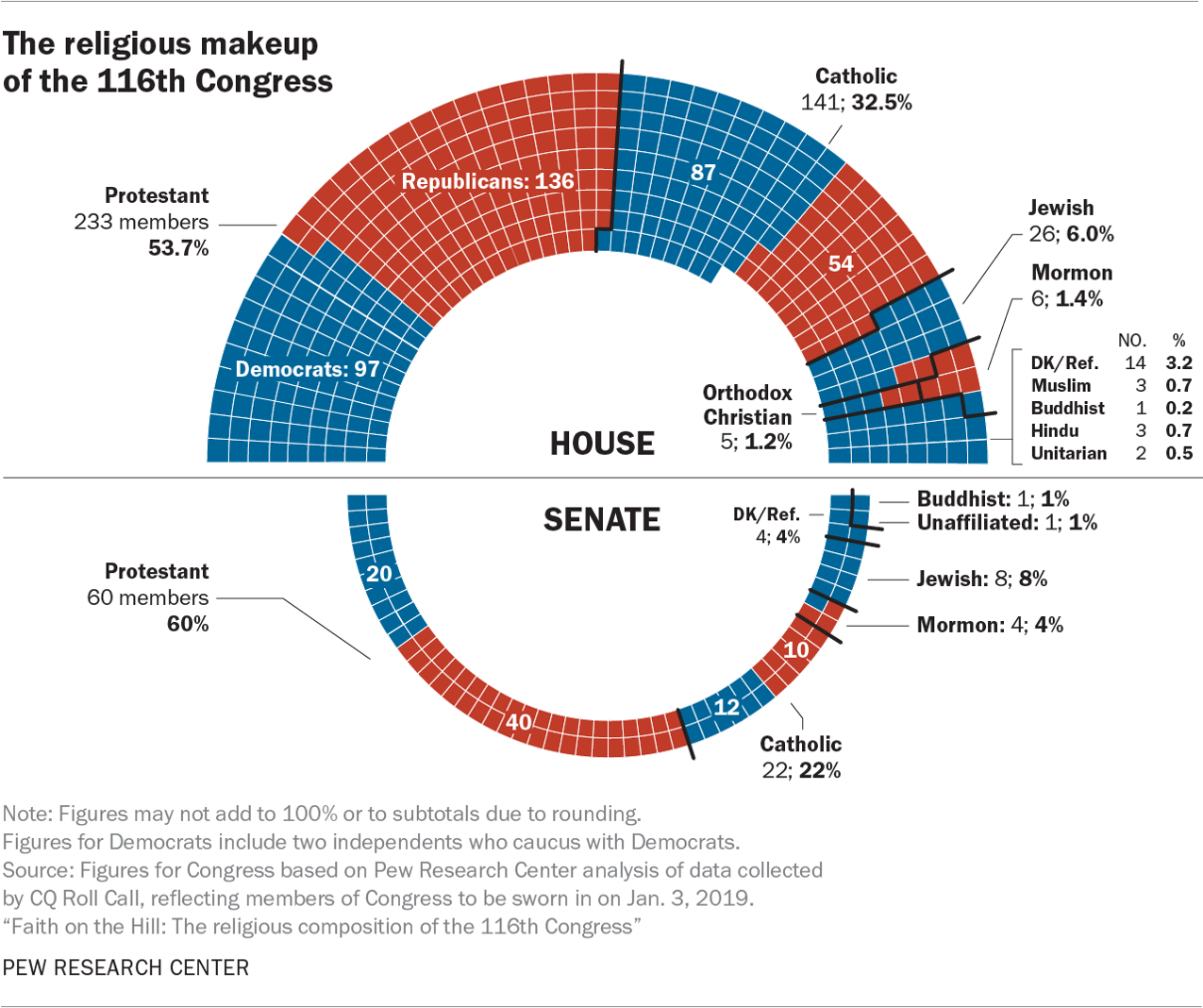
Religion in the 116th Congress

From Pew:
The new, 116th Congress includes the first two Muslim women ever to serve in the House of Representatives, and is, overall, slightly more religiously diverse than the prior Congress.1
...
While the number of self-identified Christians in Congress has ticked down, Christians as a whole – and especially Protestants and Catholics – are still overrepresented in proportion to their share in the general public. Indeed, the religious makeup of the new, 116th Congress is very different from that of the United States population.
...
[By] far the largest difference between the U.S. public and Congress is in the share who are unaffiliated with a religious group. In the general public, 23% say they are atheist, agnostic or “nothing in particular.” In Congress, just one person – Sen. Kyrsten Sinema, D-Ariz., who was recently elected to the Senate after three terms in the House – says she is religiously unaffiliated, making the share of “nones” in Congress 0.2%.
...
In the 116th Congress, just two of the 252 GOP members do not identify as Christian: Reps. Lee Zeldin, R-N.Y., and David Kustoff, R-Tenn., are Jewish.7
By contrast, 61 of the 282 Democrats do not identify as Christian. More than half of the 61 are Jewish (32), and 18 decline to specify a religious affiliation. Congressional Democrats also include Hindus (3), Muslims (3), Buddhists (2), Unitarian Universalists (2) and one religiously unaffiliated member. 8

 The religious makeup of the 116th Congress

Friday, January 4, 2019

Israel and the New Congress

Before it folded last month, The Weekly Standard editorialized:
Representative-elect Rashida Tlaib (D-Mich.) said she won’t attend a freshman congressional trip to Israel, and instead will lead a delegation to the West Bank. Tlaib alternately expresses support for a “two-state solution” and a “one-state-solution”—the latter being code for the obliteration of the Jewish state. Representative-elect Ilhan Omar (D-Minn.) will join her. Omar, who regularly refers to the Israeli state’s policy of “apartheid,” famously remarked on Twitter that Israel has “hypnotized the world.” Representative-elect Alexandria Ocasio-Cortez (D-NY), similarly, announced yesterday that she also won’t participate in the trip to Israel, which is sponsored by a non-profit.

From the Jewish News Syndicate:


Even before she was sworn in on Thursday—the ceremony of which was attended by Women’s March leader and anti-Israel activist Linda Sarsour, who has been criticized for not condemning her ties with anti-Semitic Nation of Islam leader Louis Farrakhan—Tlaib endorsed the BDS movement..[Boycott, Divestment, and Sanctions]
On Wednesday, Yair Rosenberg wrote at WP that Tlaib would be taking the oath of office on Jefferson's Koran.
One of the country’s first two Muslim congresswomen elected, both elected in November, Tlaib said she hoped to make a critical point with the choice of tome. “It’s important to me because a lot of Americans have this kind of feeling that Islam is somehow foreign to American history,” she told the Detroit Free Press. "Muslims were there at the beginning.”
Longtime Congress watchers will recall Rep. Keith Ellison (D-Minn.), America’s first Muslim member of the body, also used Jefferson’s Koran for his 2007 swearing-in. "It demonstrates that from the very beginning of our country, we had people who were visionary, who were religiously tolerant, who believed that knowledge and wisdom could be gleaned from any number of sources, including the Koran,” Ellison told the Associated Press at the time.

These are worthy sentiments. But they are also not the whole story. That is because Jefferson’s 1734 translation of the Koran was not produced out of a special love for Islam, but rather to further Christian missionary efforts in Muslim lands. As translator George Sale wrote in his introduction to the reader, “Whatever use an impartial version of the Korân may be of in other respects, it is absolutely necessary to undeceive those who, from the ignorant or unfair translations which have appeared, have entertained too favourable an opinion of the original, and also to enable us effectually to expose the imposture.”

Sunday, January 21, 2018

A Bad Year for Democracy

The US standing in the world in decline. 

The president is an inspiration to dictators.

Americans don't think life has gotten better.

Michael J. Abramowitz and Wendell L. Willkie II at Freedom House:
Democracy’s adversaries are on the march worldwide, exporting authoritarian misrule and spreading instability across national borders. But as free societies face their most serious global challenge since the end of the Cold War, the United States is abdicating its traditional leadership role, exacerbating the crisis.

This week Freedom House has published its annual survey on the state of global democracy, and the results make for grim reading. 2017 marked the 12th consecutive year in which democracy has declined around the world: Those countries experiencing setbacks in political rights and civil liberties far outnumber those showing improvements.

Many of the declines are occurring in pivotal countries. Venezuela, once a democracy, has become a collapsing military dictatorship. President Recep Tayyip Erdogan has transformed Turkey from a promising majority-Muslim democracy into a tyranny where thousands of his real or imagined opponents have been imprisoned on political charges. Hungary and Poland, previously exemplars of successful post-Communist transition, have moved into the camp of illiberal states that treat the rule of law with disdain and view press freedom with suspicion. Thailand’s military further entrenched its role as the guiding political force during 2017. In Mexico, the rule of law has eroded due to corruption in places high and low.

In themselves, the setbacks to date are alarming, but not catastrophic. Most of the countries that embraced democracy during the past century remain democratic today. Polling consistently shows strong global support for democracy, and even those living in authoritarian settings — most recently in Iran — have made it clear that they want governments to deliver on core democratic values, such as open elections, press freedom, official accountability and equality before the law.

But the retreat of the United States from global leadership, coupled with the Trump administration’s weak and ambiguous commitment to democratic values at home, raises serious concerns about the near future. As democracy is undermined, the world inevitably becomes a more dangerous place.

In practice, President Trump has largely discarded the principles that formed the basis for American leadership over the previous seven decades. His animating slogan, America First, harks back to the United States’ dangerous flirtation with isolationism in the period leading up to World War II. While he has correctly invoked human rights to criticize a handful of countries such as Iran, Cuba and Venezuela, in general the president has showered his most lavish praise on noxious strongmen and autocrats. Trump continues to offer accolades to Russian President Vladimir Putin, a brutal dictator who represses dissent and seeks to disrupt democracy in the United States and Europe, and he commended President Rodrigo Duterte of the Philippines on his anti-drug efforts, which have featured a campaign of extrajudicial killings.

Also concerning is the administration’s silence in the face of renewed repression in China. Any independent speech on sensitive issues is now subject to severe punishment. The Internet, which had begun to facilitate the development of an independent civil society, has been transformed into an instrument of state control. Beijing has indicated that it will continue to develop its system of repression by incorporating the latest innovations in surveillance technology and artificial intelligence. China has already shared its existing techniques with other regimes; we should assume that any new methods will also be available for export.

The Trump administration’s disdain for the standards of democratic government within the United States will further undermine American interests abroad. A U.S. government that violates its own ethical norms will have little success preaching the virtues of transparency to other countries. A president who rejects verifiable facts, zealously attacks the judiciary and media, and seems to condemn Muslims and other minorities simply because of their faith or ethnicity will have little credibility when pressing rival states to drop disinformation efforts and respect their own people’s rights.

There is, of course, serious controversy about the wisdom, justice and effectiveness of certain American foreign policy initiatives over the years. But since the end of World War II, the United States has been seen rightly as the world’s foremost defender of democracy. Some administrations were more idealistic in tone, and others more “realist.” Yet all post-World War II presidents recognized that, in the long term, the United States should be identified with the global cause of freedom. The Trump administration’s approach represents an abandonment of the bipartisan postwar consensus that the United States’ values and its national interests are both best served by dedication to this cause.

Democracy’s enemies are gaining strength as the U.S. government disengages from the struggle. It is far from clear how freedom-loving peoples around the world will face the new threat with democracy’s strongest champion sitting on the sidelines.

Friday, January 19, 2018

Racist Appointee


Trump administration appointee Carl Higbie resigned Thursday as chief of external affairs for the federal government's volunteer service organization after a CNN KFile review of racist, sexist, anti-Muslim and anti-LGBT comments he made on the radio.
...
Higbie, a former Navy SEAL and conservative media personality, was a surrogate for Trump during the 2016 presidential campaign, appearing on cable news and serving as the spokesman for the Trump-aligned Great America PAC. He was appointed to the Corporation for National and Community Service (CNCS) in 2017 to direct the public image and messaging of the federal department that manages millions of Americans in volunteer services like AmeriCorps and Senior Corps.
...
Speaking on 'Sound of Freedom' in December 2013, Higbie, while recounting a time he placed an advertisement to give away free firewood, said "the black race" had "lax" morals. He added that black women think "breeding is a form of government employment."
"Only one person was actually cordial to me," Higbie said. "Every other black person was rude. They wanted me to either load the wood, completely split it for them or some sort of you know assistance in labor. Now, mind you the ad was for free firewood, come take it all you want. And I believe that this translates directly into the culture that is breeding this welfare and the high percentage of people on welfare in the black race. It's a lax of morality."
...
Speaking on "Sound of Freedom" in June 2013, Higbie said he didn't like Muslims because he hated their religious ideology.
"Go back to your Muslim shithole and go crap in your hands and bang little boys on Thursday nights," Higbie said. "I just don't like Muslim people. People always rip me a new one for that. Carl, you're racist, you can't, you're sexist. I'm like Jesus Christ. I just don't like Muslim people because their ideology sucks."
Eli Rosenberg at WP:
In November, the Department of Homeland Security’s Jamie Johnson, another Trump appointee, resigned after comments he made that linked blacks to “laziness” and “promiscuity” came to light. Last week, Pete Hoekstra, the new U.S. ambassador to the Netherlands and a former Republican congressman, apologized after uproar over baseless anti-Muslim theories he had spread numerous times in past

Thursday, January 4, 2018

Muslim Population of the United States

From Pew:
Recent political debates over Muslim immigration and related issues have prompted many people to ask how many Muslims actually live in the United States. But coming up with an answer is not easy, in part because the U.S. Census Bureau does not ask questions about religion, meaning there is no official government count of the U.S. Muslim population.
Still, based on our own survey and demographic research, as well as outside sources, Pew Research Center estimates that there were about 3.45 million Muslims of all ages living in the U.S. in 2017, and that Muslims made up about 1.1% of the total U.S. population.

Thursday, November 16, 2017

Hate Crimes and Jews and Muslims

From Pew:
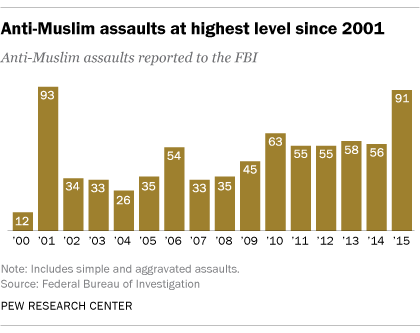
The number of assaults against Muslims in the United States rose significantly between 2015 and 2016, easily surpassing the modern peak reached in 2001, the year of the September 11 terrorist attacks, according to a Pew Research Center analysis of new hate crimes statistics from the FBI. In 2016, there were 127 reported victims of aggravated or simple assault, compared with 91 the year before and 93 in 2001.
...
Overall, there were 307 incidents of anti-Muslim hate crimes in 2016, marking a 19% increase from the previous year. This rise in hate crimes builds on an even sharper increase the year before, when the total number of anti-Muslim incidents rose 67%, from 154 in 2014 to 257 in 2015.
From the report:

Of the 1,584 victims of anti-religious hate crimes:
  • 54.4 percent were victims of crimes motivated by their offenders’ anti-Jewish bias.
  • 24.5 percent were victims of anti-Islamic (Muslim) bias.

Monday, July 31, 2017

Muslim Americans Are Patriotic

Pew reports:
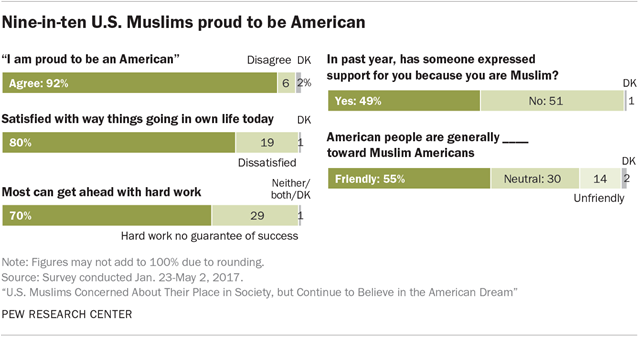
Despite the concerns and perceived challenges they face, 89% of Muslims say they are both proud to be American and proud to be Muslim. Fully eight-in-ten say they are satisfied with the way things are going in their lives. And a large majority of U.S. Muslims continue to profess faith in the American dream, with 70% saying that most people who want to get ahead can make it in America if they are willing to work hard.

These are among the key findings of Pew Research Center’s new survey of U.S. Muslims, conducted Jan. 23 to May 2, 2017, on landlines and cellphones, among a representative sample of 1,001 Muslim adults living in the United States. This is the third time Pew Research Center has conducted a comprehensive survey of U.S. Muslims. The Center’s initial survey of Muslim Americans was conducted in 2007; the second survey took place in 2011.

Friday, May 26, 2017

Trump's ban "drips with religious intolerance, animus, and discrimination."

The question for this Court, distilled to its essential form, is whether the Constitution, as the Supreme Court declared in Ex parte Milligan, 71 U.S. (4 Wall.) 2, 120 (1866), remains “a law for rulers and people, equally in war and in peace.” And if so, whether it protects Plaintiffs’ right to challenge an Executive Order that in text speaks with vague words of national security, but in context drips with religious intolerance, animus, and discrimination. Surely the Establishment Clause of the First Amendment yet stands as an untiring sentinel for the protection of one of our most cherished founding principles—that government shall not establish any religious orthodoxy, or favor or disfavor one religion over another. Congress granted the President broad power to deny entry to aliens, but that power is not absolute. It cannot go unchecked when, as here, the President wields it through an executive edict that stands to cause irreparable harm to individuals across this nation. Therefore, for the reasons that follow, we affirm in substantial part the district court’s issuance of a nationwide preliminary injunction as to Section 2(c) of the challenged Executive Order.

Thursday, March 16, 2017

Trump's Own Words Hinder His Travel Ban

A federal judge in Hawaii issued a worldwide restraining order against enforcement of key parts of President Donald Trump’s revised travel ban executive order just hours before the directive was set to kick in, backed up by a second federal judge in Maryland who put out his own ruling blocking parts of the order. 
U.S. District Court Judge Derrick Watson ruled Wednesday that the state of Hawaii and a local Muslim leader had “a strong likelihood of success on their claim” that Trump’s order intentionally targets Muslims and therefore violates the Constitution’s guarantee against establishment of religion.
The illogic of the Government’s contentions is palpable. The notion that one can demonstrate animus toward any group of people only by targeting all of them at once is fundamentally flawed. The Court declines to relegate its Establishment Clause analysis to a purely mathematical exercise. See Aziz, 2017 WL 580855, at *9 (rejecting the argument that “the Court cannot infer an anti-Muslim animus because [Executive Order No. 13,769] does not affect all, or even most, Muslims,” because “the Supreme Court has never reduced its Establishment Clause jurisprudence to a mathematical exercise. It is a discriminatory purpose that matters, no matter how inefficient the execution” (citation omitted)). Equally flawed is the notion that the Executive Order cannot be found to have targeted Islam because it applies to all individuals in the six referenced countries. It is undisputed, using the primary source upon which the Government itself relies, that these six countries have overwhelmingly Muslim populations that range from 90.7% to 99.8%. It would therefore be no paradigmatic leap to conclude that targeting these countries likewise targets Islam. Certainly, it would be inappropriate to conclude, as the  Government does, that it does not.

...
A review of the historical background here makes plain why the Government wishes to focus on the Executive Order’s text, rather than its context. The record before this Court is unique. It includes significant and unrebutted evidence of religious animus driving the promulgation of the Executive Order and its related predecessor. For example—
In March 2016, Mr. Trump said, during an interview, “I think Islam hates us.” Mr. Trump was asked, “Is there a war between the West and radical Islam, or between the West and Islam itself?” He replied: “It’s very hard to separate. Because you don’t know who’s who.”
SAC ¶ 41 (citing Anderson Cooper 360 Degrees: Exclusive Interview With Donald Trump (CNN television broadcast Mar. 9, 2016, 8:00 PM ET), transcript available at https://goo.gl/y7s2kQ)). In that same interview, Mr. Trump stated: “But there’s a tremendous hatred. And we have to be very vigilant. We have to be very careful. And we can’t allow people coming into this country who have this hatred of the United States. . . [a]nd of people that are not Muslim.”
At The New York Times, Michael Shear explains that Trump is digging himself a deeper hole:
“Let me tell you something,” Mr. Trump told his enthusiastic supporters, echoing the simpler days of the campaign, when courts did not get in the way. “I think we ought to go back to the first one and go all the way. The danger is clear, the law is clear, the need for my executive order is clear.”
And yet, even now, the president may not fully appreciate the power — and the implications — of his words.
At the rally, Mr. Trump offered more verbal ammunition to support the critiques of the travel ban. The president called his latest effort to restrict entry merely “a watered-down version” of his first attempt, which was also blocked by the courts.
Those words could easily serve to undermine his own lawyers, who have argued strenuously that Version 2.0 of the travel ban is different enough that it should pass legal muster.
In the near future, the president may find an appeals court judge once again citing his words in support of a ruling that he doesn’t like.

Thursday, February 16, 2017

Warmth and Religion

On the heels of a contentious election year in which partisan politics increasingly divided Americans, a new Pew Research Center survey finds that when it comes to religion, Americans generally express more positive feelings toward various religious groups today than they did just a few years ago. Asked to rate a variety of groups on a “feeling thermometer” ranging from 0 to 100, U.S. adults give nearly all groups warmer ratings than they did in a June 2014 Pew Research Center survey.
While Americans still feel coolest toward Muslims and atheists, mean ratings for these two groups increased from a somewhat chilly 40 and 41 degrees, respectively, to more neutral ratings of 48 and 50. Jews and Catholics continue to be among the groups that receive the warmest ratings – even warmer than in 2014.
Evangelical Christians, rated relatively warmly at 61 degrees, are the only group for which the mean rating did not change since the question was last asked in 2014. Americans’ feelings toward Mormons and Hindus have shifted from relatively neutral places on the thermometer to somewhat warmer ratings of 54 and 58, respectively. Ratings of Buddhists rose from 53 to 60. And mainline Protestants, whom respondents were not asked to rate in 2014, receive a warm rating of 65 in the new survey.
...
However, the mean ratings given to particular religious groups still vary widely depending on who is being asked. For example, young adults – those ages 18 to 29 – express warmer feelings toward Muslims than older Americans do. Moreover, young adults rate all of the groups in the study within a relatively tight range, from 54 degrees for Mormons to 66 for Buddhists. By contrast, older Americans (ages 65 and older) rate some religious groups, such as mainline Protestants (75) and Jews (74), very warmly, and others, such as Muslims and atheists (44 degrees each), much more coolly.

Friday, December 23, 2016

Trump, Nukes,Terror

In his final radio address to the nation, President Reagan said: ". We're prayerful and hopeful—hopeful that the next generation of Americans will not have to contend as we did with the nightmares of nuclear terror and totalitarian expansionism."

Madeline Conway reports at Politico:
In a series of impromptu statements about nuclear weapons, Donald Trump is threatening to upend longstanding U.S. nonproliferation policy, even as his advisers contradict him and muddy his intentions.
The president-elect had alarmed and perplexed some experts and others in Washington when he pronounced, without offering more details, via Twitter on Thursday that the U.S. “must greatly strengthen and expand its nuclear capability until such time as the world comes to its senses regarding nukes.”

He further escalated his call on Friday, telling the MSNBC program “Morning Joe” that he is fine with the country taking part in an “arms race” if it puts the U.S. in a stronger position against foreign adversaries.
Let it be an arms race … we will outmatch them at every pass and outlast them all,” Trump told MSNBC’s “Morning Joe” during an off-air conversation on Friday.
After the remark was reported on MSNBC, though, incoming Trump press secretary Sean Spicer pushed back and insisted that the remarks came from a “private conversation” with “Morning Joe” host Mika Brzezinski. While he told the “Today” Show’s Matt Lauer that “there is not going to be” an arms race, he told CNN that Trump is not going to “take anything off the table,” either.

Abby Phillip and Abigail Hauslohner report at The Washington Post:
President-elect Donald Trump on Wednesday appeared to stand by his plans to establish a registry for Muslims and temporarily ban Muslim immigrants from the United States.

Speaking outside his Mar-a-Lago resort in Florida, Trump did not walk back the proposals after he was asked by a reporter whether he was rethinking or reevaluating them in the wake of a fresh terrorist attack in Berlin.

“You know my plans all along,” Trump said.

He went on to add that the attack on a Berlin Christmas market, which was claimed by the Islamic State, had vindicated him. German authorities are seeking a 24-year-old Tunisian migrant, who they say has ties to Islamist extremists, in connection with the attack, which killed 12 people and injured dozens.

“I’ve been proven to be right. One-hundred-percent correct,” Trump said. “What’s happening is disgraceful.”
The proposed Muslim ban is still on his website. 

Monday, November 21, 2016

Hate Crimes Against Muslims

Pew reports:
The number of physical assaults against Muslims in the United States reached 9/11-era levels last year, according to a Pew Research Center analysis of new hate crimes statisticsfrom the FBI. There were 91 reported aggravated or simple assaults motivated by anti-Muslim bias in 2015, just two shy of the 93 reported in 2001.

Separately, the number of anti-Muslim intimidation crimes – defined as threatening bodily harm — also rose in 2015, with 120 reported to the FBI. Again, this was the most anti-Muslim intimidation crimes reported in any year since 2001, when there were 296.
Overall, the FBI reported 257 incidents of anti-Muslim hate crimes in 2015, a 67% increase from the previous year. These incidents included 301 individual crimes, 71% of which were crimes against people, as opposed to property. (Incidents can encompass more than one crime.) By contrast, crimes perpetrated against other religious groups more often involved property offenses, such as vandalism or theft. For example, 64% of anti-Jewish and 51% of anti-Catholic offenses in 2015 involved vandalism, compared with just 23% of anti-Muslim offenses.
Why might prejudice against Muslims be on the upswing? Perhaps some people are listening to this guy:


Tuesday, August 2, 2016

Military Parents

Susan Kristol, whose son served as a Marine in Afghanistan, writes at The Federalist:
When your son or daughter is in a combat zone, you do not sleep except with a telephone next to the pillow. You can’t decide if you should obsessively follow the news or avoid watching it. You break into sobs while driving down the highway. You can’t listen to country music songs about Arlington Cemetery, you have unaccountable fits of anger when a well-intentioned person asks if the troops get to come home for the holidays, and you hear your child’s voice via a static-filled satellite phone line only once in eight months. You know someone in the battalion has been killed when all outgoing emails are shut down so the bereaved family can be notified, and you swing between sadness for them and terrible relief that it’s not your child.

The Khan parents were making the point that Muslims do serve honorably and courageously in the American military, and that Trump was wrong to disparage every person of their faith and question their patriotism in such a blanket manner. It was a dramatic moment. I am no legal scholar, and Khan may or may not be correct about whether Trump’s immigration proposals are constitutional—hard to judge because the wording of the proposals changes so often—but those Trump supporters who are now debating the legal or constitutional points Khan was making are merely trying to deflect attention from the shocking lack of compassion their candidate displayed after that speech.
...
It is time instead to reflect for a moment on sacrifice in battle. We have a special term, really a euphemism, for members of the military who fall in battle. We say they “made the ultimate sacrifice.” The word “sacrifice” is from the Latin, “to make sacred.” We citizens must make the death sacred, otherwise it’s just a meaningless, unhappy occurrence somewhere far away. Our nation needs to elevate the deaths of those who die in uniform, serving us. For the most part, it does a good job.

Saturday, June 4, 2016

Muhammad Ali and the Supreme Court

Muhammad Ali, perhaps the greatest boxer ever, has died.  He was the central figure in a 1971 Supreme Court case, Clay v. United States. (His birth name was Cassius Clay, which he changed when he converted to Islam).  The syllabus:
Petitioner appealed his local draft board's rejection of his application for conscientious objector classification. The Justice Department, in response to the State Appeal Board's referral for an advisory recommendation, concluded, contrary to a hearing officer's recommendation, that petitioner's claim should be denied, and wrote that board that petitioner did not meet any of the three basic tests for conscientious objector status. The Appeal Board then denied petitioner's claim, but without stating its reasons. Petitioner refused to report for induction, for which he was thereafter tried and convicted. The Court of Appeals affirmed. In this Court, the Government has rightly conceded the invalidity of two of the grounds for denial of petitioner's claim given in its letter to the Appeal Board, but argues that there was factual support for the third ground.

Held: Since the Appeal Board gave no reason for the denial of a conscientious objector exemption to petitioner, and it is impossible to determine on which of the three grounds offered in the Justice Department's letter that board relied, petitioner's conviction must be reversed. Sicurella v. United States, 348 U. S. 385.
At Yahoo several years ago, Scott Bomboy wrote:
In the book The Brethern: Inside The Supreme Court, Bob Woodward (of Watergate fame) and Scott Armstrong detailed how the eight justices hearing Ali’s case about his draft stratus changed the verdict after their initial conference. (Thurgood Marshall recused himself from the case due to his prior role as Solicitor General.)
...
Initially, Woodward and Armstrong said the Supreme Court justices ruled 5-3 against Ali during a conference.
Then the justice assigned to write the majority decision, John M. Harlan, changed his vote after a clerk gave him a book to read that made Ali’s religious convictions clear.

The book was reportedly The Autobiography Of Malcolm X, and Harlan realized Ali had deep-seated religious convictions that made him a true conscientious objector.

But that left the court divided at 4-4, and since Ali had lost his lower court appeal, he would lose the Supreme Court case. And the court’s rules would also leave Ali without an explanation for the court’s decision.

....

Woodward and Armstrong said it was Justice Potter Stewart who looked at the case and convinced the other justices that the lower courts never explained why they turned down Ali’s appeals.

Wednesday, January 6, 2016

The Muslim Population of the United States

Pew reports:
Pew Research Center estimates that there were about 3.3 million Muslims of all ages living in the United States in 2015. This means that Muslims made up about 1% of the total U.S. population (about 322 million people in 2015), and we estimate that that share will double by 2050.
Our new estimate of Muslims and other faiths is based on a demographic projectionthat models growth in the American Muslim population since our 2011 estimate and includes both adults and children. The projection uses data on age, fertility, mortality, migration and religious switching drawn from multiple sources, including the 2011 survey of Muslim Americans.
According to our current estimate, there are fewer Muslims of all ages in the U.S. than there are Jews by religion (5.7 million) but more than there are Hindus (2.1 million) and many more than there are Sikhs.
In some cities Muslims comprise significantly more than 1% of the community. And even at the state level Muslims are not evenly distributed: Certain states, such as New Jersey, have two or three times as many Muslim adults per capita as the national average.