Many posts have discussed confidence in institutions.


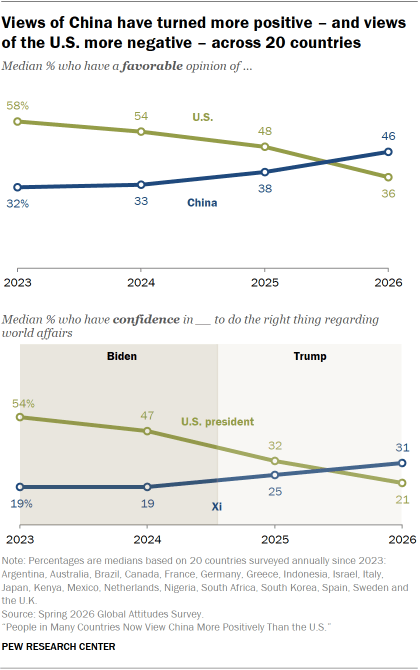
Global views of the United States worsened last year as President Donald Trump’s second term began, though most people still had a more positive opinion of the U.S. than China. This year, that is no longer the case.
Views of China have improved in recent years while opinions of the U.S. have worsened, to the point where China is now seen more positively than the U.S. in most of 36 countries surveyed.
Confidence in these countries’ respective leaders to do the right thing regarding world affairs has followed a similar pattern. In the latter half of Joe Biden’s presidency, confidence in him was higher than confidence in Chinese President Xi Jinping across most countries surveyed, though Biden’s rating declined in many places from 2023 to 2024.
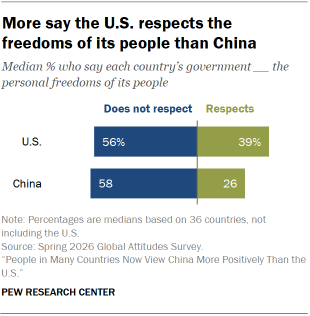
During the first two years of Trump’s second term, ratings of the U.S. president worsened significantly. While many people still lack confidence in Xi, positive views of him have become more widespread, and more overall now say they have confidence in Xi than in Trump.One area where the U.S. still gets higher ratings than China has to do with personal freedoms: More say the U.S. government respects the personal freedoms of its people than say the same of the Chinese government. Still, the gap has been narrowing – driven by large drops in the shares saying the U.S. government respects personal freedoms.


Many posts have discussed confidence in institutions and partisan polarization.
Americans’ confidence in U.S. institutions remains historically low, as reflected in their average view of 14 institutions measured each year since 1993. Currently, 27% of Americans express “a great deal” or “quite a lot” of confidence in these core institutions, one percentage point above the record-low average in 2023.
When limited to the nine institutions measured about annually since 1979, average confidence is also 27%, reflecting the broader similarity of the two trends. Both lists include a mix of government and private sector institutions, making either version appropriate for use as a barometer of national confidence.
Americans’ average confidence in institutions has been trending downward since 1979 — not gradually, but rather driven by several steep drops. Confidence fell sharply in the early 1980s and again in the early 1990s, each time quickly followed by partial recoveries. An even sharper decline in the mid-2000s associated with the onset of the Great Recession proved more resistant, with confidence remaining at the 2007 low point and sinking even further over the next nine years. Confidence finally showed significant improvement in 2020, at the start of the COVID-19 pandemic, due to heightened public trust in several institutions most affected by that crisis — particularly the medical system and public schools. However, average confidence quickly reverted and sunk further to 27% in 2022.
...
Partisan differences in confidence were modest through much of the 1980s and early 1990s, with Republicans and Democrats expressing similar levels of confidence regardless of which party controlled the White House. The gap first widened during Bill Clinton's presidency in Democrats' favor before reversing under George W. Bush. It narrowed somewhat during Barack Obama's administration before swinging back toward Republicans during Donald Trump's first term and then toward Democrats during Joe Biden's presidency.
The gap has widened during Trump’s second term, with Republicans now 13 points more confident in U.S. institutions than Democrats are, similar to last year’s 11-point gap. This is due to Democrats, for the first time, showing less confidence in an incoming Republican president at the same time Republicans’ confidence has surged. The finding echoes Democrats’ historically negative outlook on national conditions during Trump’s second term that Gallup reported earlier this year.
If some obstacle blocks the public road halting the circulation of traffic, the neighbors at once form a deliberative body; this improvised assembly produces an executive authority which remedies the trouble before anyone has thought of the possibility of some previously constituted authority beyond that of those concerned. Where enjoyment is concerned, people associate to make the festivities grander and more orderly.
Being out and about is a good way to meet your neighbors. One of the strongest predictors of neighborly interaction is also the most obvious: spending time in the neighborhood. Americans who report that they take walks or run through their neighborhood are much more likely to converse with neighbors. A majority (55 percent) of Americans who walk around their neighborhood at least once a week say they talk to their neighbors at least a few times a week. Americans who walk less often report much less neighborly interaction. The share of Americans who talk with their neighbors at least weekly is only 29 percent among those who walk only once or a few times a year and 19 percent among those who do not walk around their neighborhood at all.
Dog ownership is also associated with increased social engagement with neighbors, but only for those who walk their dog. Half of Americans who own a dog and walk it regularly report that they talk with their neighbors at least a few times a week. In contrast, only 33 percent of dog owners who do not walk their pets say they talk to neighbors this often.
Many posts have discussed patriotism and American exceptionalism.
As the United States marks its 250th anniversary, 33% of U.S. adults say they are “extremely proud” to be an American, the lowest reading in Gallup's trend dating back to 2001. Another 20% say they are “very proud,” which means just over half of Americans express high levels of pride in their country.
The remaining shares say they are “moderately proud” (22%), “only a little proud” (15%) or “not at all proud” (9%).
...
The current 56-point gap between Republicans’ and Democrats’ reported extreme pride is similar to last year’s 57-point difference, the highest on record.

As the United States approaches its 250th anniversary, just 19% of Americans say the signers of the Declaration of Independence would be pleased with how the country has turned out.
Just over three in four Americans (77%) now say the founders would be disappointed, compared with 71% in 2013 and 42% in 2001. The latest findings come from a May 2026 Gallup survey.


Many.posts have dealt with international views of the United States. They have taken a negative turn.
Richard Wike, Laura Silver, Moira Fagan and Jonathan Schulman at Pew:
A new Pew Research Center survey finds negative – and often overwhelmingly negative – views of U.S. President Donald Trump in regions around the globe.
Across 36 nations polled, a median of 23% of adults express confidence in his leadership of world affairs. In many countries, confidence in Trump has slipped since last year.
Overall ratings for the United States are also largely negative. Favorable views of the country have declined in many places over the past year, including double-digit drops in Indonesia, Italy, Nigeria, South Africa, South Korea and Turkey.
There are seven nations in the study where a majority of adults rate the U.S. positively. The highest rating (81% favorable) comes from Israel. Some of the lowest ratings are from predominantly Muslim publics, such as Malaysians, Pakistanis, Turks, and Palestinians in the West Bank and East Jerusalem. (We were unable to survey in Gaza.)
Pew took the poll before the US-Iran memorandum of understanding, which has cratered Trump's standing in Israel.


Many posts have discussed the problems of surveying public opinion in the 21st century.
At Strength in Numbers, G. Elliott Morris discusses polling averages:
In our 50+1 generic ballot average, the published Democratic margin across polls read about D+7 a couple of weeks ago and reads D+5 today — a paper loss of two points that reader Tyler was asking about. But take the raw numbers for the parties (Democrats at 48.9% and Republicans at 43.4; a change from 49.1 and 42.4 two weeks ago), and the drop is only from D+6.7 to D+5.49 — a drop of about one point, not two.
Unfortunately, this incident of exaggeration is inherent to a tradeoff we made when deciding how to present the data. The general practice in polling analysis is not to show decimals on differences between percentages, because a number like “D+5.4” implies a precision the polls just don’t offer (see: 2024, 2020, 2016, etc). Or, if you’re going to publish decimals, you should include a margin of error either visually it in the text.
The tradeoff is that a small move in the margin between the parties sometimes looks bigger than it is, which is exactly what caught Tyler’s eye here. A 1-point change became 2.
...
But much of that 1-point decline is likely mechanical — a product of what data is available for the average. Over the last 2 weeks, new polls have tended to come from firms that lean to the right and produce numbers that are typically on the lower end for Democrats — Quantus Insights, McLaughlin & Associates (Trump’s pollster), and Morning Consult are a few examples. The average I publish for 50+1 tries to account for some of this availability bias (see my methodology) but there is only so much you can do if your trend is being bogged down by biased data. The high-quality New York Times/Siena poll that had Democrats up 10 points is now over a month old.
This is a dynamic of poll-aggregation that people often miss or ignore. A smart polling average can remove a lot of noise from polling data, but the tool inherently still wiggles around from sampling error and house effects even when the “truth” of public opinion is stable. A poll of 1,000 people has a margin of error of roughly three points — and you’re blending at best half a dozen of those from the last week, and usually less.
This doesn’t mean polls are useless — they are still the best tool we have for predicting elections, and the only one we have for directly measuring how people feel about public life. But it does mean that averages tend to move around somewhat predictably. So how much movement is worth paying attention to? Let’s boot up the historical polling averages and take a look.
Many.posts have dealt with international perspectives.
Jonathan Schulman and Richard Wike at Pew:
Around seven-in-ten U.S. adults (69%) say they are dissatisfied with the way democracy is working in their country. This share is higher than in most other high-income countries surveyed by Pew Research Center this spring.

Many posts have discussed patriotism and American exceptionalism.
GARY FIELDS, LINLEY SANDERS and NICHOLAS RICCARDI at AP:The survey from The Associated Press-NORC Center for Public Affairs Research highlights many Americans’ feeling of unease over the future of its representative government — particularly among young people. It presents a jarring contrast as communities around the country commemorate the nation’s 250th anniversary.
Only about one-quarter of Americans say the U.S. stands above all other countries in the world, the new poll found, while 44% say it’s one of the greatest countries in the world, along with some others. About 3 in 10 say there are better countries than the U.S., an increase from 19% in an AP-NORC poll conducted in June 2016.
Americans remain divided about whether diversity is an essential feature of the U.S.'s identity, and agreement about other aspects of the country’s underlying character appears to be eroding, the survey found. Americans are less likely to see a democratically elected government as “extremely” or “very” important to the United States’ identity as a nation than they were just a few years ago. About two-thirds of U.S. adults now say a democratically elected government is highly important to the U.S.’s identity as a nation, down from 80% in 2021.
...
Toung adults are much less likely than older Americans to believe the U.S. is special, compared with other nations, the poll found.About 4 in 10, 44%, of U.S. adults under 30 say there are other countries better than the U.S., compared with 22% of U.S. adults ages 60 and older.Fewer, too, see democracy as a key element of the U.S.’s identity. Only about half of Americans under 30 believe this, compared with 81% of those 60 and older.
Ahead of what the White House is calling a “large-scale revival” meeting on the National Mall devoted to “rededicating our country as One Nation under God,” a new Pew Research Center survey shows that a growing minority of U.S. adults say religion is gaining influence in American life. And more than half say religion plays a positive role in society.
At the same time, most people want churches and other houses of worship to stay out of day-to-day politics and not endorse candidates.
The new survey also finds growing familiarity with the term “Christian nationalism.” Most Americans surveyed now say they have heard at least a little about it.
Support for ideas that are sometimes associated with Christian nationalism is mostly unchanged in recent years. For example, there has been no growth in the shares of Americans who want the government to stop enforcing separation of church and state or who believe that God favors the United States over all countries.
There has, however, been a small uptick in the share of U.S. adults who say the federal government should declare Christianity the nation’s official religion: 17% now say this, up from 13% in 2024.
On many of these issues, there are sharp partisan divides. For example, Republicans are considerably more likely than Democrats to say religion has a positive influence on American life and to support religion having a prominent role in government and lawmaking.

Many posts have discussed freedom of the press.
As the world marks World Press Freedom Day this weekend, perceptions of media freedom worldwide show little movement, remaining near the levels recorded each year since 2010. Overall, a median of 64% of adults across 131 countries in 2025 said they believe the media in their country have a lot of freedom, while 30% disagreed.
...
Three in four U.S. adults (75%) in 2025 think the U.S. media have a lot of freedom, among the lowest totals measured in the past 15 years and statistically tied with the other low point of 78% in 2023. This year also marks one of the few times the U.S. has been statistically tied with, rather than ahead of, the Organisation for Economic Co-operation and Development in these perceptions.
Since 2022, Americans’ perceptions that the press in their country has a lot of freedom have fallen 11 points (from 86%), compared with a one-point decline in the median among OECD countries. While this decline has been uneven — the measure rebounded slightly in 2024 before dipping again in 2025 — only three other countries have seen larger absolute declines in perceived media freedom than the U.S. since 2022: Ukraine (-18 pts.), Pakistan (-18 pts.) and Morocco (-15 pts.).

Many posts have dealt with media problems.
A release from the Northwestern University Medill School of Journalism:
Americans’ relationships with news are rapidly evolving, with teenagers and adults navigating a far more complex and fragmented media environment than ever before, according to a new national study from the Media Insight Project, a collaboration of The Associated Press-NORC Center for Public Affairs Research, the American Press Institute, Northwestern University Medill School of Journalism, Media, Integrated Marketing Communications and the Local News Network at the University of Maryland’s Philip Merrill College of Journalism.
Influencers and independent creators have emerged as a significant — and growing — source of news and information across all generations, especially among teens and younger adults. More than half of Americans ages 13 and older (57%) say they get news and information from influencers or independent creators at least sometimes. Among teenagers ages 13-17, that share rises to 81%, signaling a shift in how younger Americans engage with the information ecosystem. Despite concerns about misinformation, most say influencers do at least somewhat well at verifying facts, being transparent, and offering different viewpoints.
...
Local news continues to play an essential role in community life and remains the most trusted sector of the news ecosystem, even as its financial future in smaller markets remains uncertain. Americans ages 13 and older view local news largely positively, with 76% getting information from local news sources often or sometimes. Across age groups, local news outlets rank highest for trust, including for verifying facts, covering important issues, and providing useful information. While teens 13-17 are more likely to encounter local information via social media or local independent creators, older adults are more likely to get their local news from traditional outlets like television and radio — pointing to a generational shift in how communities stay informed.
...
The study also reveals widespread skepticism toward artificial intelligence as a source of news and information. Only about one in ten teens and adults say AI chatbots are more trustworthy than other sources, though two-thirds of Americans say they never use AI for news at all, suggesting low trust may be tied to limited exposure.
Beyond questions of trust and platforms, the findings underscore growing stress and fatigue in Americans’ relationship with news. While most feel confident in their ability to find reliable information, only 10% say news gives them a hopeful view of the world. Many actively avoid specific topics — particularly celebrity and political news. Rather than rejecting news altogether, people are managing their exposure by setting boundaries around their time online.
Politicians and social media companies are seen as the biggest sources of misinformation. Americans point to politicians (66%), social media companies (55%), and social media users (54%) as the primary drivers of misinformation. Clear partisan differences emerge here, with Democrats more likely than Republicans to assign responsibility to these actors (75% vs. 65% for politicians, 64% vs. 53% for social media companies). Local news outlets receive the least blame, which may help explain why trust in local journalism remains comparatively resilient even amid declining confidence in the media more broadly.
...
Together, these findings suggest that journalism’s influence is no longer defined solely by legacy institutions, but by a comparative, choice-driven environment in which audiences weigh multiple sources against one another. The findings offer a nuanced portrait of the public navigating an increasingly crowded media landscape — one in which attention is fragmented but demand for reliable information remains strong.
Many.posts have dealt with international views of the United States. They have taken a negative turn.
Julie Ray and Anita Pugliese at Gallup:
The U.S. remains the most desired destination for people who would like to leave their own countries permanently, but Gallup's latest data show it is less attractive than it once was.
In 2025, 15% of adults worldwide who say they would like to move permanently to another country name the U.S. as their preferred destination, the lowest level recorded in nearly two decades of Gallup research. From 2007 to 2009, 24% of would-be migrants named the U.S. as their top choice, and that figure remained near 20% through 2016. Since 2017, it has been at or below 18%.
The rank order of the countries attracting the most interest from potential migrants has seen little change since Gallup’s first measure. Canada ranks second, as it has for several years, with 9% of potential migrants mentioning the U.S. neighbor. The appeal of these desired destinations did not change in 2025, even as the U.S. became less desirable.

New polls have revealed that Melania Trump is the least popular First Lady ever, with her popularity ratings described as “historically awful.”
Analysis by CNN shows that FLOTUS currently has an approval rating of -12, having dropped from a rating of plus three just over a year ago in January 2025.
Results of the poll came out before Melania delivered a remarkable White House address to the nation on Thursday, in which she denied any connections to disgraced sex offender Jeffrey Epstein. The polling numbers are not related to her statement or Epstein.
“I would say that the American people really don’t care for Melania Trump,” CNN Senior data analyst Harry Enten said, speaking on CNN News Central before her surprising statement was made.
“This is the worst at this point in a presidency as well. Melania Trump breaking records in the way that you don’t want to break records. Historically awful… The American people really don’t care for her.”
In recordings and videos, Melania's mask has often slipped.

While neither country commands broad support, China surpassed the United States in global approval ratings in 2025, with a median of 36% approving of China’s leadership, compared with 31% for the U.S. China’s five-percentage-point advantage over the U.S. is the widest Gallup has recorded in China’s favor in nearly 20 years.
The recent shift reflects a decline in U.S. ratings alongside an increase for China. Median approval of U.S. leadership fell from 39% in 2024 to 31% in 2025, returning to earlier lows, while China’s approval rose from 32% to 36%.
At the same time, disapproval of U.S. leadership rose to a record-high 48%, while China’s disapproval rating remained flat at 37%.
...
Approval of U.S. leadership declined by 10 points or more in 44 countries between 2024 and 2025, while it increased by a similar amount in only seven. The declines were concentrated among U.S. allies, including many NATO partners.
Germany led the world in declines; its approval of U.S. leadership fell by 39 points, followed closely by Portugal (down 38 points). Several other long-standing U.S. partners — including Canada, the United Kingdom and Italy — also showed substantial decreases.
U.S. standing improved by more than 10 points among Israelis, marking an exception among U.S. allies. Approval of U.S. leadership in Israel, which surged after the October 2023 Hamas attack and then fell sharply in 2024, rebounded to 76% in 2025 after Trump’s return to the White House — a 13-point increase, among the highest levels globally.
Many posts have discussed the role of religion in American life.
I've got brand new data about American religion that was collected in October of 2025.
— Ryan Burge 📊 (@ryanburge) March 26, 2026
And, folks...
The share of Americans who are non-religious has dropped for the third year in a row.
Atheists and agnostics are down to 5% each.
Those are 2014 levels. pic.twitter.com/SDe2VXYFUx
Many.posts have dealt with international perspectives.
Americans are more likely than people in other countries surveyed in 2025 to question the morality of their fellow countrymen, according to Pew Research Center surveys in 25 countries.
We asked people around the world to rate the morality and ethics of others in their country.
In nearly all countries surveyed, more people say that others in their country have somewhat or very good morals than say their compatriots display somewhat or very bad levels of morality.
The United States is the only place we surveyed where more adults (ages 18 and older) describe the morality and ethics of others living in the country as bad (53%) than as good (47%).


The U.S. and Israel launched strikes on Iran on Saturday, as President Donald Trump vowed to eliminate Tehran’s missiles and nuclear program and fuel a change in government. “I want a safe nation, and that’s what we’re going to have,” Trump told The Washington Post after announcing the start of “major combat operations.” Israeli Prime Minister Benjamin Netanyahu said the joint attack would last “as long as needed,” unleashing a conflict that threatens to engulf the region. As explosions rocked Tehran and other cities, Iran pledged a “crushing” retaliation, lobbing missiles toward Israel and targeting U.S. military bases in the Gulf.In the past, the public might have had a predisposition to approve joint military action with Israel. A new Gallup survey rasies doubts.
Forty-one percent of Americans now say they sympathize more with the Palestinians in the Middle East situation, while 36% sympathize more with the Israelis. The five-percentage-point difference is not statistically significant, but it contrasts with a clear lead for the Israelis only a year ago (46% vs. 33%) and larger leads over the prior 24 years.
From 2001 to 2025, Israelis consistently held double-digit leads in Americans’ Middle East sympathies, with the gap averaging 43 points between 2001 and 2018. However, public opinion began narrowing in 2019, several years before the Oct. 7, 2023, Hamas attack on Israel and the subsequent war in Gaza. The cumulative effect of gradual changes in U.S. attitudes since then has led to the Israelis no longer being viewed more sympathetically.
For the first time on record, as many independents hold a very or mostly favorable view of the Palestinian Territories as they do of Israel (both 41%). Over the past year, independents’ favorability toward Israel has declined six points, while their favorability toward the Palestinian Territories has risen by 10. Looking at a longer time frame, however, the shift is more pronounced on the Israel side. Since February 2023 — the last measurement before the Oct. 7 attacks — independents’ favorability toward Israel has dropped 26 points, compared with a 12-point increase in their favorability toward the Palestinian Territories.
Among Democrats, the Palestinian Territories have held an edge in favorability since 2025. This year, 48% of Democrats view the Palestinian Territories favorably, compared with 34% for Israel, broadly in line with last year. Republicans remain the most pro-Israel partisan group, with 69% holding a favorable view, though that figure has fallen 15 points from 2025 to its lowest level in over two decades. Meanwhile, a steady 18% of Republicans view the Palestinian Territories favorably, recovering from a record low of 5% in 2024.


