Search This Blog

Showing posts with label china. Show all posts

Monday, August 7, 2023

Chinese Propagandist


Mara Hvistendahl et al. at NYT:
On the surface, No Cold War is a loose collective run mostly by American and British activists who say the West’s rhetoric against China has distracted from issues like climate change and racial injustice.

In fact, a New York Times investigation found, it is part of a lavishly funded influence campaign that defends China and pushes its propaganda. At the center is a charismatic American millionaire, Neville Roy Singham, who is known as a socialist benefactor of far-left causes.
What is less known, and is hidden amid a tangle of nonprofit groups and shell companies, is that Mr. Singham works closely with the Chinese government media machine and is financing its propaganda worldwide.

From a think tank in Massachusetts to an event space in Manhattan, from a political party in South Africa to news organizations in India and Brazil, The Times tracked hundreds of millions of dollars to groups linked to Mr. Singham that mix progressive advocacy with Chinese government talking points.

Some, like No Cold War, popped up in recent years. Others, like the American antiwar group Code Pink, have morphed over time. Code Pink once criticized China’s rights record but now defends its internment of the predominantly Muslim Uyghurs, which human rights experts have labeled a crime against humanity.

Tuesday, May 23, 2023

TikTok, Montana, and the Dormant Commerce Clause

 Montana has banned TikTok, which is suing.

119. The Commerce Clause of the U.S. Constitution grants Congress the power to regulate commerce with foreign Nations, and among the several States. U.S. Const. art. 1, § 8, cl. 3. While the Commerce Clause is framed by its text [as] an affirmative grant ofpower to Congress , the so-called Dormant component of the Clause has long been recognized as a self-executing limitation ofthe States to enact laws imposing substantial burdens on [interstate] commerce ." South-Central Timber Dev.,Inc. v.Wunnicke ,467 U.S.82 ,87 (1984).

 120. The TikTok Ban imposes substantial burdens on interstate commerce inviolation of the Commerce Clause and other structural provisions ofthe Constitution by prohibiting Plaintiff from operating TikTok in Montana and penalizing Plaintiff any time a user in Montana accesses TikTok or is offered the ability to access or download TikTok in the State . The TikTok Ban is not limited to Montana residents ; it applies to anyone in the State ,including those visiting or merely passing through for work.

121. Substantial burdens on interstate commerce generally result from inconsistent regulation ofactivities that are inherently national or require a uniform system of regulation. Bernstein v.Virgin Am.,Inc.,3 F.4th 1127, 1135 (9th Cir. 2021) (quoting Nat'lAss'n of Optometrists & Opticians v. Harris,682 F.3d 1144, 1148 (9th Cir.2012)).

122. Plaintiff's operation of TikTok ,an application used by over 150million users in the United States ,including in every State, is inherently national in scope and requires a uniform system of regulation, not one subject to the policy decisions offifty separate States.


Thursday, May 18, 2023

Chinese Billionaire Gets Writers to Front Ghosted Op-Eds

Walker Bragman at OptOut:
Operatives representing rightwing Chinese billionaire Guo Wengui, who was charged in March for orchestrating a vast financial fraud scheme, have been secretly recruiting prominent conservatives—including the head of the New York Young Republicans Club—to write opinion pieces on his behalf in order to bolster his image as a dissident, according to an investigation by Important Context and the OptOut Media Foundation. Many of the pieces were published in high-traffic rightwing outlets.

Once a powerful businessman, Guo has been a prominent critic of the Chinese Communist Party since fleeing his home country in 2014 after being accused of bribery, rape, kidnapping, and other charges. Guo’s vocal advocacy has earned him a devoted following among the Chinese diaspora and made him a favorite of the American right as it postures against the rising eastern power. Guo is perhaps best known as the longtime business partner of Steve Bannon, a rightwing extremist and former top aide to Donald Trump, with whom Guo has launched multiple ventures purportedly aimed at overthrowing the Chinese Communist Party.

Guo’s collaboration with established rightwing figures in the U.S. was aimed at manipulating the media to bolster his credibility. A source with knowledge of the Guo network’s operations, speaking on the condition of anonymity to protect their livelihood, outlined to Important Context/OptOut how representatives working on behalf of Guo would recruit the writers to place their names on opinion pieces that spoke glowingly of him and his efforts while criticizing his adversaries.

The writers would take prompts as well as pre-prepared drafts, which they could then edit. The pieces were distributed to various media outlets, including far-right Newsmax, Gateway Pundit, Townhall, The Washington Times, and Headline USA, under the conservative writers’ bylines.

Important Context/OptOut obtained and reviewed documentation showing that writers involved in the arrangement included New York Young Republicans Club President Gavin Wax, Bannon’s War Room co-host Natalie Winters, podcaster Kelly Walker, and former Trump aide and congressional candidate Karoline Leavitt. (None of the four writers, nor any of the outlets—Newsmax, Gateway Pundit, Townhall, The Washington Times, and Headline USA—responded to our requests for comment.)

Friday, April 28, 2023

Chinese Influence Ops

Many posts have discussed the political influence of China.

 Danielle Pletka at Foreign Policy:

Everyone recalls, of course, the infamous Chinese spy balloon that collected critical military intelligence as it drifted across the United States, to the consternation of the Biden administration. Chinese cyberattacks have also been responsible for some of the most intrusive breaches of U.S. government websites, including a hack into the personnel files of millions of government employees in the Office of Personnel Management.

Yet even these well-publicized incidents are only the tip of the iceberg. Many of China’s spying and influence operations are much more pervasive, stealthy, and insidious than commonly understood. While there is a growing recognition that apps such as TikTok are potential Chinese government tools of influence and espionage—with the ability to track keystrokes, use your phone as a surveillance device, and collect biometric data including faceprints and voiceprints—there’s less awareness of the other tools at the regime’s disposal. Beijing is also establishing cultural associations, dominating Chinese language instruction programs, buying private secondary education institutions, purchasing land near military installations, taking over Chinese community organizations, and eating up local Chinese-language media.

Friday, March 3, 2023

One Bipartisan Committee

Dana Milbank at WP:
Ask Mike Gallagher. The Wisconsin Republican has been put in charge of the new House select committee on the Chinese Communist Party — and the chairman so far is turning his panel into everything the covid committee isn’t: bipartisan, serious and productive.

“This is an existential struggle over what life will look like in the 21st century, and the most fundamental freedoms are at stake,” he said in opening the panel’s prime-time hearing Tuesday — the same day the covid committee held its frivolous forum. “Time is not on our side. Just because this Congress is divided, we cannot afford to waste the next two years lingering in legislative limbo or pandering to the press.”

He took no partisan shots, and he screened “a joint video that the ranking member and I put together to help set the stage for the hearing.” That ranking Democrat, Rep. Raja Krishnamoorthi (Ill.), reciprocated by acknowledging that “both Democrats and Republicans underestimated the CCP” and praising the bipartisanship and “our unity as Americans.”

The witnesses (including two former Trump advisers) and other lawmakers maintained the feel-good sentiment, what Rep. Darin LaHood (R-Ill.) described as “Republicans and Democrats working together to expose the malign activities of the CCP.”

The only dissent in the room came from a pair of hecklers from the far-left group Code Pink, waving signs that said “China is not our enemy” and “Stop Asian Hate.”

Gallagher waited patiently for them to be removed. “Your sign is upside down,” he told the “Stop Asian Hate” guy, who then righted his poster.

A couple of the Democrats obliquely referenced the racist remarks of Rep. Lance Gooden (R-Texas), who (on Fox News, naturally) challenged the loyalty to the United States of Rep. Judy Chu (D-Calif.), who is Chinese American. But Gallagher had already called that “out of bounds” during a joint interview with Krishnamoorthi on CBS’s “Face the Nation” — one of multiple joint appearances and statements by the pair.

Gallagher is exactly the sort of person you’d want in the role as China’s growing aggression pushes us toward a new cold war. A 39-year-old Princeton graduate and former Marine captain with a PhD in international relations, he noted with satisfaction this week that his panel has “no bomb throwers.”

Gallagher, by Krishnamoorthi’s account, worked closely with Democrats to draft a rules package that will guide the panel over the next two years — “a bipartisan agreement that has my full support.” It passed Tuesday without debate, amendment, or a single dissenting vote.

That’s what happens when a leader puts country before party.

Monday, December 19, 2022

Language Use in the US

 Sandy Dietrich and Erik Hernandez at the US Census Bureau:

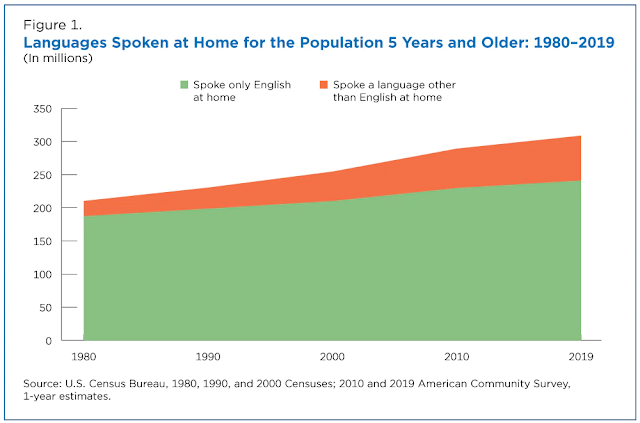
The number of people in the United States who spoke a language other than English at home nearly tripled from 23.1 million (about 1 in 10) in 1980 to 67.8 million (almost 1 in 5) in 2019, according to a recent U.S. Census Bureau report.

At the same time, the number of people who spoke only English also increased, growing by approximately one-fourth from 187.2 million in 1980 to 241 million in 2019 (Figure 1).

The report, Language Use in the United States: 2019, uses American Community Survey (ACS) data to highlight trends and characteristics of the different languages spoken in the United States over the past four decades.

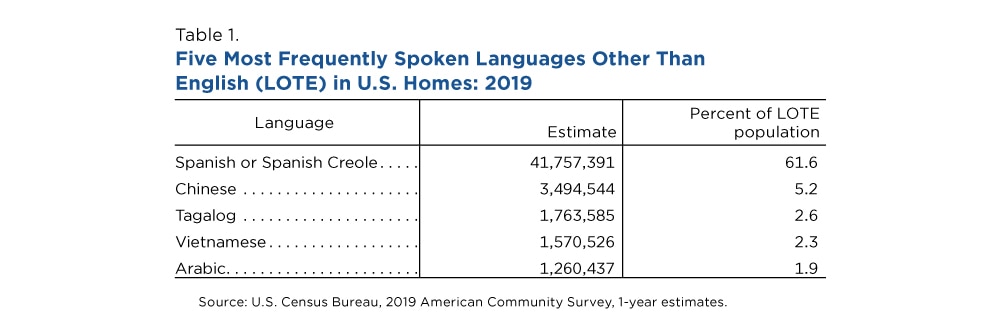
The Hispanic population is the largest minority group in the United States. So it is not surprising Spanish was the most common non-English language spoken in U.S. homes (62%) in 2019 – 12 times greater than the next four most common languages.
Table 1. Five Most Frequently Spoken Languages Other Than English (LOTE) in U.S. Homes: 2019

Wednesday, July 27, 2022

Origins of COVID

Michael Worobey and colleagues have an article in Science titled: "The Huanan Seafood Wholesale Market in Wuhan was the early epicenter of the COVID-19 pandemic." The abstract:

Understanding how severe acute respiratory syndrome coronavirus 2 (SARS-CoV-2) emerged in 2019 is critical to preventing zoonotic outbreaks before they become the next pandemic. The Huanan Seafood Wholesale Market in Wuhan, China, was identified as a likely source of cases in early reports but later this conclusion became controversial. We show the earliest known COVID-19 cases from December 2019, including those without reported direct links, were geographically centered on this market. We report that live SARS-CoV-2 susceptible mammals were sold at the market in late 2019 and, within the market, SARS-CoV-2-positive environmental samples were spatially associated with vendors selling live mammals. While there is insufficient evidence to define upstream events, and exact circumstances remain obscure, our analyses indicate that the emergence of SARS-CoV-2 occurred via the live wildlife trade in China, and show that the Huanan market was the epicenter of the COVID-19 pandemic.

Monday, March 14, 2022

Assassination


 Many Americans want to assassinate Putin.  At Politico, Steven Kinzer writes:

We’ve tried it repeatedly. Often we have failed, but even when we seem to have succeeded, the long-term consequences have been terrible. An order from the Oval Office to assassinate a foreign leader would not break a taboo. It would only be the latest in a series of self-defeating blunders.

So far as is known, Dwight Eisenhower was the first president to order such assassinations. He began by targeting Premier Zhou Enlai of China. During the 1950s, Eisenhower and nearly every other policymaker in Washington considered the “Red Chinese” to be maniacal fanatics bent on world conquest. When Zhou announced in 1955 that he would travel to Bandung, Indonesia, for a momentous conference of Asian and African leaders, the CIA saw a chance to kill him. Zhou chartered an Air India jet for his flight to Bandung. It exploded in midair, killing 16 passengers. But Zhou had not boarded. China called it “murder by the special service organizations of the United States.”

... 

Americans are impatient by nature. We want quick solutions, even to complex problems. That makes killing a foreign leader seem like a good way to end a war. Every time we have tried it, though, we’ve failed — whether or not the target falls. Morality and legality aside, it doesn’t work. Castro thrived on his ability to survive American plots. In the Congo, almost everything that has happened since Lumumba’s murder has been awful.


Tuesday, January 18, 2022

International Drop in Trust

Diana Marszalek at Reuters:
The 2022 Edelman Trust Barometer finds faith in government and media continues to drop, perpetuating a cycle of distrust that “threatens societal stability.”

The survey of 36,000 consumers in 28 countries found 48% of respondents view government and 46% view media as divisive forces today, versus business and NGOs which fared better with 31% and 29% respectively.

On top of that, government leaders (42%) and journalists (46%) are the least trusted societal leaders, whereas people have the most confidence in coworkers (74%) and scientists (75%). Most respondents also believe that the government (66%, up nine points) and journalists (67%, up 8 points) are lying to them.

The numbers show a precipitous fall from grace for government, which was the most trusted institution in May 2020 but has dropped 13 points (from 65% to 52%) to third behind business (61%) and NGOs (59%). Only the media (50%) fared worse.

“Government is seen as less competent than business, and we are in a whole new game,” said Edelman CEO Richard Edelman. “We have very big problems and government isn’t seen as able to manage them.”

The collapse in government trust was particularly acute in developed democracies (not one reached a 60-point score), largely pinned to respondents in every one of those countries believing they will be worse off financially in five years — and 85% fear they will lose their jobs to factors including automation. The US ranks 43 in the trust index (a 10-point drop since 2017), 40 points lower than China, at 83.

Monday, October 18, 2021

Russian Influence Spending

Many posts have analyzed how foreign governments try to influence American politics and policy. Russia and China are prominent influencers.

Anna Massoglia at Open Secrets:

Russian media outlets reported spending more than $146 million on foreign influence operations and propaganda in the U.S. since 2016, with over $16 million on propaganda targeting the U.S. in 2021, OpenSecrets’ analysis of new Foreign Agents Registration Act records shows.

And that’s just the spending that Russian foreign agents have disclosed to the Justice Department under FARA.

The U.S. government has identified multiple online media sites that are directed by Russian intelligence services and not disclosed through FARA, spreading disinformation to undermine COVID-19 vaccines produced outside Russia. Social media platforms have also become a breeding ground for even more Russian propaganda campaigns that are often not disclosed in FARA filings.

Faced with rising concerns about Russian interference in U.S. elections and foreign influence more generally, the Justice Department has compelled multiple broadcasters and other middlemen helping Russian propaganda efforts targeting the U.S. to register as foreign agents.

During the 2020 presidential election, the Kremlin poured money into TV and media outlets aimed at influencing voters while tensions rose between the two countries. During the 2016 presidential election, the Russian government interfered to boost former President Donald Trump. Russia’s top media spenders include RIA Novosti and Rossiya Segodnya, government entities that administer global broadcasts of Russian state-funded networks RT and Sputnik.

In August 2020, Rossiya Segodnya contracted with Ghebi LLC, a Washington, D.C.-based production company incorporated by the editor-in-chief of a U.S. production company working for the Russian media entity called RIA Global. Since then, the LLC has reported more than $2.7 million in payments from the Russian government’s media entity that administers Sputnik.

The Russian government’s propaganda spending is rivaled most intensely by China, which spent more than any other country in 2020.

Chinese foreign agents reported about $67.2 million in total 2020 lobbying and influence spending. More than 80% of China’s foreign influence spending in the U.S. came from Chinese state-owned media outlet CGTN TV and the CCP’s English-language newspaper, China Daily.

Tuesday, May 25, 2021

Nuclear War and the 1958 Taiwan Strait Crisis

Charlie Savage at NYT:
When Communist Chinese forces began shelling islands controlled by Taiwan in 1958, the United States rushed to back up its ally with military force — including drawing up plans to carry out nuclear strikes on mainland China, according to an apparently still-classified document that sheds new light on how dangerous that crisis was.

American military leaders pushed for a first-use nuclear strike on China, accepting the risk that the Soviet Union would retaliate in kind on behalf of its ally and millions of people would die, dozens of pages from a classified 1966 study of the confrontation show. The government censored those pages when it declassified the study for public release.

The document was disclosed by Daniel Ellsberg, who leaked a classified history of the Vietnam War, known as the Pentagon Papers, 50 years ago. Mr. Ellsberg said he had copied the top secret study about the Taiwan Strait crisis at the same time but did not disclose it then. He is now highlighting it amid new tensions between the United States and China over Taiwan.
...

Mr. Ellsberg quietly posted the full study online in 2017, when he published a book, “Doomsday Machine: Confessions of a Nuclear War Planner.” One of its footnotes mentions in passing that passages and pages omitted from the study are available on his website.

Thursday, March 4, 2021

Democratic Decline

As a lethal pandemic, economic and physical insecurity, and violent conflict ravaged the world in 2020, democracy’s defenders sustained heavy new losses in their struggle against authoritarian foes, shifting the international balance in favor of tyranny. Incumbent leaders increasingly used force to crush opponents and settle scores, sometimes in the name of public health, while beleaguered activists—lacking effective international support—faced heavy jail sentences, torture, or murder in many settings.

These withering blows marked the 15th consecutive year of decline in global freedom. The countries experiencing deterioration outnumbered those with improvements by the largest margin recorded since the negative trend began in 2006. The long democratic recession is deepening.

The impact of the long-term democratic decline has become increasingly global in nature, broad enough to be felt by those living under the cruelest dictatorships, as well as by citizens of long-standing democracies. Nearly 75 percent of the world’s population lived in a country that faced deterioration last year. The ongoing decline has given rise to claims of democracy’s inherent inferiority. Proponents of this idea include official Chinese and Russian commentators seeking to strengthen their international influence while escaping accountability for abuses, as well as antidemocratic actors within democratic states who see an opportunity to consolidate power. They are both cheering the breakdown of democracy and exacerbating it, pitting themselves against the brave groups and individuals who have set out to reverse the damage.

...


Wednesday, February 24, 2021

Inflation Ahead?

Many posts have discussed the deficit and the debtPolicymakers and the general public have tended to ignore these problems in recent years, in part because of low inflation and interest rates.  But this settting could change.

 James Pethokoukis at The Week:

One plausible scenario for a big change in America's economic climate — as well as those in other rich economies — is laid out in the 2020 book The Great Demographic Reversal: Aging Societies, Waning Inequality, and an Inflation Revival. Economists Charles Goodhart and Manoj Pradhan make the case that the current macroeconomic situation of persistently low interest rates and low inflation was created by a particular set of historical economic circumstances. Demographics and globalization are key here. The late 20th century saw a flood of workers into labor markets across the world thanks to the baby boomers, as well as the addition of workers from China and Eastern Europe once the Soviet Union dissolved. This labor-supply shock, according to Goodhart and Pradhan, had the tendency to push down inflation — particularly as seen in wage growth — and interest rates. And thus create a world where it's been easy for government and business to borrow.

But now those demographic and globalization shocks are reversing. Working-age populations are peaking or even shrinking around the world. And rising worker wages in China means sending jobs there isn't the bargain for Western companies that it used to be. As a result, Goodhart and Pradhan conclude, bargaining power will shift back to domestic workers and away from employers, pushing up wage inflation. And at the same time the number of old people, who consume rather than produce, will continue to increase. That means more demand for goods and services — and, again, more inflation. "The great demographic reversal and the retreat from globalization will bring back stronger inflationary pressures — this is our highest conviction view," Goodhart and Pradhan wrote in a 2020 essay.

So a world of higher inflation, higher interest rates, and greater fiscal challenges for Washington — a world few policymakers seem to be considering or even imagining as possible. Yet the pandemic and the tsunami of money being spent to fight it should encourage Washington to think harder about just such a possibility.


Monday, January 25, 2021

Distrust

 A release from Edelman:

– The 2021 Edelman Trust Barometer reveals that people don’t know where or who to turn to for reliable information. A majority of respondents believe that government leaders (57 percent), business leaders (56 percent), and journalists (59 percent) are purposely trying to mislead people by saying things they know are false. The global infodemic has driven trust in all news sources to record lows with social media (35 percent) and owned media (41 percent) the least trusted; traditional media (53 percent) saw the largest drop in trust at eight points. 

... 

“This is the era of information bankruptcy,” said Richard Edelman, CEO of Edelman. “We’ve been lied to by those in charge, and media sources are seen as politicized and bias. The result is a lack of quality information and increased divisiveness. Fifty-seven percent of Americans find the political and ideological polarization so extreme that they believe the U.S. is in the midst of a cold civil war. The violent storming of the U.S. Capitol last week and the fact that only one-third of people are willing to get a Covid vaccine as soon as possible crystalize the dangers of misinformation.”

Business (61 percent) has emerged as the most trusted institution, replacing government (53 percent), which fell substantially since its 11-point surge in our mid-year update last May. Business is the only institution deemed ethical and competent; business outscores government by 48 points on competency and is approaching NGOs in ethics. Over the last five months, business seized the high ground of trust by proactively developing vaccines in record time and finding new ways to work. Trust continues to move local, with respondents placing even higher reliance on ‘my employer’ at 76 percent, and ‘my employer CEO’ at 63 percent.

The stark, but radically different realities of escalating stock prices and Great Recession-like unemployment levels have helped trigger a record trust gap of 16 points (informed public at 68 percent, mass population at 52 percent). There are double-digit trust gaps in 25 of 28 markets, versus seven in 21 markets just a decade ago.

This year’s report reveals that the biggest opportunity to earn business trust is guarding information quality. Fifty-three percent of respondents believe corporations need to fill the information void when the news media is absent. Communications from ‘my employer’ is the most trusted source of information (61 percent), beating out national government (58 percent), traditional media (57 percent), and social media (39 percent).

...
Trust dropped precipitously in the two largest economies. Respondents deeply distrust the U.S. (40 percent) and Chinese (30 percent) governments from the 26 other markets surveyed. Trust among Chinese citizens in the country’s institutions fell 18 points in the last six months to 72 percent. The U.S., in the bottom quartile of countries as of November, dropped a further 5 points post-election (43 percent), a score which would place it ahead of only Japan and Russia.

Given the new expectations of business, there are now new demands of CEOs: Over 8 in 10 want CEO’s to speak out on important social issues, such as the pandemic’s impact, job automation and societal problems. More than two-thirds expect them to step in when the government does not fix societal problems, and ‘my employer CEO’ is the only societal leader trusted by both Trump voters (61 percent) and Biden voters (68 percent).
...

Other key findings from the 2021 Edelman Trust Barometer include:
  • Only one in four respondents practice good information hygiene; news engagement; avoid echo chambers; verify information; and do not amplify unvetted information.
  • Among those who practice poor information hygiene there is substantially less willingness to get the vaccine within the first year of its availability (59 percent versus 70 percent for people with good information hygiene). There is even greater hesitancy about the vaccine among Blacks in the U.S., based on past and present medical inequities and mistreatment.
  • 56 percent believe the pandemic will accelerate the rate at which companies replace human workers with AI and robots.
  • 52 percent of respondents that have a choice to work from home or their workplace choose to work at home and 58 percent of those cite the risk of contracting Covid-19 while commuting or being in the office as the reason.
  • Academic experts (59 percent) and company technical experts (59 percent) remain the most credible spokespeople but experienced an 8-point and 10-point drop, respectively. The largest drop was among regular employees (down 14 points to 40 percent) and a person like yourself (down 7 points to 53 percent).

Tuesday, December 8, 2020

Covert Chinese Influence

Many posts have discussed the efforts of China to influence American politics.

 Bethany Allen-Ebrahimian and Zach Dorfman at Axios:

A suspected Chinese intelligence operative developed extensive ties with local and national politicians, including a U.S. congressman, in what U.S. officials believe was a political intelligence operation run by China’s main civilian spy agency between 2011 and 2015, Axios found in a yearlong investigation.
...

The woman at the center of the operation, a Chinese national named Fang Fang or Christine Fang, targeted up-and-coming local politicians in the Bay Area and across the country who had the potential to make it big on the national stage.
  • Through campaign fundraising, extensive networking, personal charisma, and romantic or sexual relationships with at least two Midwestern mayors, Fang was able to gain proximity to political power, according to current and former U.S. intelligence officials and one former elected official.
  • Even though U.S. officials do not believe Fang received or passed on classified information, the case "was a big deal, because there were some really, really sensitive people that were caught up" in the intelligence network, a current senior U.S. intelligence official said.
  • Private but unclassified information about government officials — such as their habits, preferences, schedules, social networks, and even rumors about them — is a form of political intelligence. Collecting such information is a key part of what foreign intelligence agencies do.
...

What happened: Amid a widening counterintelligence probe, federal investigators became so alarmed by Fang's behavior and activities that around 2015 they alerted [Rep. Eric] Swalwell to their concerns — giving him what is known as a defensive briefing.
  • Swalwell immediately cut off all ties to Fang, according to a current U.S. intelligence official, and he has not been accused of any wrongdoing.
  • Fang left the country unexpectedly in mid-2015 amid the investigation. She did not respond to multiple attempts by Axios to reach her by email and Facebook.

Between the lines: The case demonstrates China’s strategy of cultivating relationships that may take years or even decades to bear fruit. The Chinese Communist Party knows that today’s mayors and city council members are tomorrow’s governors and members of Congress.

Sunday, October 25, 2020

Foreign Policy: Experts and the Public

Foreign policy might not be the primary issue of the 2020 presidential election campaign, but Americans have clear ideas on the various threats facing the United States. Recent Pew Research Center surveys find that Americans are especially concerned about the spread of infectious diseases and are more likely than not to blame China for its role in the current COVID-19 pandemic.

But foreign policy experts have distinctly different perspectives. A September survey of 706 international relations scholars in the U.S. as part of the College of William & Mary’s Teaching, Research and International Policy (TRIP) poll found that their assessment of the current crises facing America and the world are often at odds with those of the U.S. general public.
These experts are less concerned about terrorism, more concerned about climate change and much more positive about China’s response to the coronavirus outbreak, even as they are harshly critical of the U.S. response. However, scholars and the American people do agree that U.S. policy should work to promote human rights in China, even at the expense of economic relations.

Saturday, October 24, 2020

Right-Wing Media

The Epoch Times is a right-wing newspaper affiliated with the secretive Chinese spiritual movement Falun Gong, Kevin Roose at NYT:

The publication and its affiliates employed a novel strategy that involved creating dozens of Facebook pages, filling them with feel-good videos and viral clickbait, and using them to sell subscriptions and drive traffic back to its partisan news coverage.

In an April 2017 email to the staff obtained by The New York Times, the paper’s leadership envisioned that the Facebook strategy could help turn The Epoch Times into “the world’s largest and most authoritative media.” It could also introduce millions of people to the teachings of Falun Gong, fulfilling the group’s mission of “saving sentient beings.”

Today, The Epoch Times and its affiliates are a force in right-wing media, with tens of millions of social media followers spread across dozens of pages and an online audience that rivals those of The Daily Caller and Breitbart News, and with a similar willingness to feed the online fever swamps of the far right.

...

 It is a remarkable success story for Falun Gong, which has long struggled to establish its bona fides against Beijing’s efforts to demonize it as an “evil cult,” partly because its strident accounts of persecution in China can sometimes be difficult to substantiate or veer into exaggeration. In 2006, an Epoch Times reporter disrupted a White House visit by the Chinese president by shouting, “Evil people will die early.”

Stephen K. Bannon... former chairman of Breitbart, said in an interview in July that The Epoch Times’s fast growth had impressed him.

“They’ll be the top conservative news site in two years,” said Mr. Bannon, who was arrested on fraud charges in August. “They punch way above their weight, they have the readers, and they’re going to be a force to be reckoned with.”

Justin Baragona at The Daily Beast:

It seems Newsmax TV—the decade-old, also-ran, right-wing cable channel hoping to compete with Fox News—may have finally found a way to boost its dismal ratings.

In recent months, Newsmax chief Chris Ruddy has gone on a hiring spree, snapping up a bevy of former Fox News personalities ... and right-wing media hangers-on to reshape and fill out the channel’s lineup. Furthermore, the network has made it a point to embrace disgraced TV hosts or heretofore unemployable pundits mired in scandal.
...

Benny Johnson, a serial plagiarist who abandoned his notorious career as a clickbait writer to become a “meme lord” for right-wing student group TPUSA, now hosts a Saturday program titled The Benny Report. Johnson’s most recent prior media gig was as a writer for The Daily Caller, where he landed after being fired by BuzzFeed over at least 40 instances of plagiarism and then ousted from conservative news site Independent Journal Review following a series of incidents including publishing baseless conspiracies and, naturally, more plagiarism.

...

And then there’s Michelle Malkin. Once a right-wing media superstar and a fixture on Fox News for more than a decade before she leaned hard into supporting the “groyper” movement and white nationalists last year, she now hosts a Saturday evening show for Newsmax. The program’s title, Sovereign Nation, underscores how Malkin, always an anti-immigration hardliner, has repositioned herself as a leading voice of the xenophobic fever swamp. (She was fired from the Young America’s Foundation in Nov. 2019 over her support for Holocaust denier and anti-Semitic internet personality Nick Fuentes.)

Tuesday, September 1, 2020

De Facto Chinese Censorship of US Films

Bethany Allen-Ebrahimian at Axios:
China's box office is projected to soon surpass the U.S. as the largest film market in the world.
  • "Access to that market can make or break the success of a major Hollywood film," said James Tager, the author of a recent PEN America report about how the Chinese government censors the U.S. film industry, and how the industry responds by self-censoring.
  • But the Chinese government tightly controls access to the market, excluding films that include content it dislikes, and blacklisting individual actors or film studios that have previously participated in activities the Chinese Communist Party doesn't like.
...

Movies also have an almost unmatched ability to instill widespread public sympathy for vulnerable groups and to prolong remembrance of crimes against humanity, such as the Rwandan genocide, depicted in "Hotel Rwanda."
  • But the last time a major Hollywood studio made a movie that presented a vulnerable group as the victim of Chinese government aggression was in 1997 with "Seven Years in Tibet" starring Brad Pitt.
  • The Chinese government responded by slapping a five-year ban on Columbia TriStar, the production company that made the film — a response that cast a chill over the U.S. movie industry.
The result: Film studios now go out of their way to ensure their movies avoid topics or depictions of China that might fall foul of China's censors.
  • "The most significant effect of this censorship and self-censorship is completely invisible, because it involves the movies that are never made," said Tager. "What major Hollywood studio would make a movie about what is happening in Xinjiang, with the internment of over a million Muslims?"
  • “For 10 years, you haven’t seen any bad Chinese guys,” said Schuyler Moore, a partner at Greenberg Glusker. “If I saw a script with an anti-Chinese theme, I would advise my client that that film would never be released in China.”

Sunday, May 3, 2020

International Ph.D. Students in STEM

From the Congressional Research Service:
According to the National Science Foundation’s 2017 survey of STEM doctorate recipients from U.S. IHEs, 72% of foreign doctorate recipients were still in the United States 10 years after receiving their degrees. This percentage varied by country of origin; for example, STEM graduates from China (90%) and India (83%) stayed at higher rates than European students (69%). There are several avenues—both temporary and permanent—by which foreign students may remain in the United States after graduation (see “Selected Options” in the text box), but some categories have annual numerical limits (“caps”). Practical training programs that give U.S. work authorization to students to be employed in their field while enrolled in school or after graduation do not have caps and have seen a steady increase (see Figure 4). These programs also allow foreign students to remain in the United States legally while they pursue longer-term options, such as H-1B or LPR status

Saturday, May 2, 2020

Missed Opportunities to Slow the Spread

Anne Schuchat has an article at MMWR titled  "Public Health Response to the Initiation and Spread of Pandemic COVID-19 in the United States, February 24–April 21, 2020."  The author is Principal Deputy Director of the Centers for Disease Control and Prevention.
What is already known about this topic?

The first confirmed coronavirus disease 2019 (COVID-19) case in the United States was reported on January 21, 2020. The outbreak appeared contained through February, and then accelerated rapidly.

What is added by this report?

Various factors contributed to accelerated spread during February–March 2020, including continued travel-associated importations, large gatherings, introductions into high-risk workplaces and densely populated areas, and cryptic transmission resulting from limited testing and asymptomatic and presymptomatic spread. Targeted and communitywide mitigation efforts were needed to slow transmission.

What are the implications for public health practice?

Factors that amplified the March acceleration and associated mitigation strategies that were implemented can inform public health decisions as the United States prepares for potential re-emergences.
...
Continued introductions of SARS-CoV-2 from outside the United States contributed to the initiation and acceleration of domestic COVID-19 cases in March. After Chinese authorities halted travel from Wuhan and other cities in Hubei Province on January 23, followed by U.S. restrictions on non-U.S. travelers from China issued on January 31 (effective February 2), air passenger journeys from China decreased 86%, from 505,560 in January to 70,072 in February. However, during February, 139,305 travelers arrived from Italy and 1.74 million from all Schengen countries,* where the outbreak was spreading widely and rapidly. Travelers from Italy and all Schengen countries decreased 74% to 35,877 and 50% to 862,432, respectively, in March.† Genomic analysis of outbreak strains suggested an introduction from China to the state of Washington around February 1.§ However, examination of strains collected from northern California during early February to mid-March indicated multiple introductions resulting from international travel (from China and Europe) as well as from interstate travel.¶ Sequencing of strains collected in the New York metropolitan area in March also suggested origins in Europe and other U.S. regions.** Returning cruise ship travelers also contributed to amplification during this time (3). Persons from many countries are in close contact on cruises, and crew members continue to work on ships for multiple voyages. As a result, passengers returning from cruises contributed to the early acceleration phase. For example, 101 persons who had been on nine separate Nile River cruises during February 11–March 5 returned to 18 states and had a positive test result for SARS-CoV-2, nearly doubling the total number of known COVID-19 cases in the United States at that time (Figure 2).
“The extensive travel from Europe, once Europe was having outbreaks, really accelerated our importations and the rapid spread,” Dr. Schuchat told the AP. ”I think the timing of our travel alerts should have been earlier.”