Search This Blog

Showing posts with label Europe. Show all posts

Sunday, May 10, 2026

Regulating the Internet

 Bruce Mehlman:

National governments are also considering AI oversight and regulation, but the past three decades of internet policy have shown profoundly different goals & approaches. The U.S. has prioritized innovation, the EU consumer protection, China governmental control. As a result, America has enjoyed the most tech entrepreneurship by a wide margin, but we lack many rules to protect children, contain misinformation or fight fraud
.

Tuesday, February 3, 2026

US as Adversary

Many posts have discussed foreign policywar powers and the US military.

Mike Allen at Axios: 

Imagine a world where ties to the U.S. feel like a burden, not a benefit to free society."How America First Risks Becoming America Alone," an essay in this weekend's Wall Street Journal, says American allies — soured by President Trump's treatment — are "searching for alternatives to what increasingly feels like an abusive relationship."

  • 📊 Positive views of the U.S. are declining worldwide, the essay notes:Brits who view the U.S. unfavorably doubled in the past two years to 64%. (YouGov)
  • In Germany, 71% view the U.S. as an "adversary." (German polling firm Forsa)
  • Across Europe, just 16% view the U.S. as an ally. (European Council on Foreign Relations)
  • Nearly two-thirds of Canadians, Mexicans and Brazilians hold unfavorable views of the U.S., "and view their neighbor as a bigger threat than China."


Data: European Council on Foreign Relations. Chart: Axios Visuals

Tuesday, May 20, 2025

Religion and Education in Europe and the United States

Many posts have discussed the role of religion in American life.

Ryan Burge:

If there’s anything I know will get a lot of engagement on social media it’s the simple relationship between education and religious attendance. I think that the assumption that most people have is that educated people tend to be less religious. Which is a viewpoint that I have thought about a lot over the last couple of years. I’m really fascinated by where that whole understanding came from. I think it may be the ghost of Karl Marx haunting us. That famous quote from the Communist Manifesto about how religion is “the opiate of the masses” has seemed to soak into the groundwater of the United States. I also think it was accelerated by the emergence of the New Atheist movement which energized a whole generation of young very online white males to refer to God as “skydaddy” and say that they “don’t need to believe in fairytales to get through life.”

Well, the understanding that American churches, synagogues, and mosques are filled with people who barely managed to finish high school is just empirically, demonstrably false. There’s no simpler way to say it than that. I have looked at almost every survey that contains a component about religion and analyzed the relationship between educational attainment and religious attendance and it’s never a negative relationship. Sometimes the slope of the line is basically flat, but more often than not - the trend line points upward.

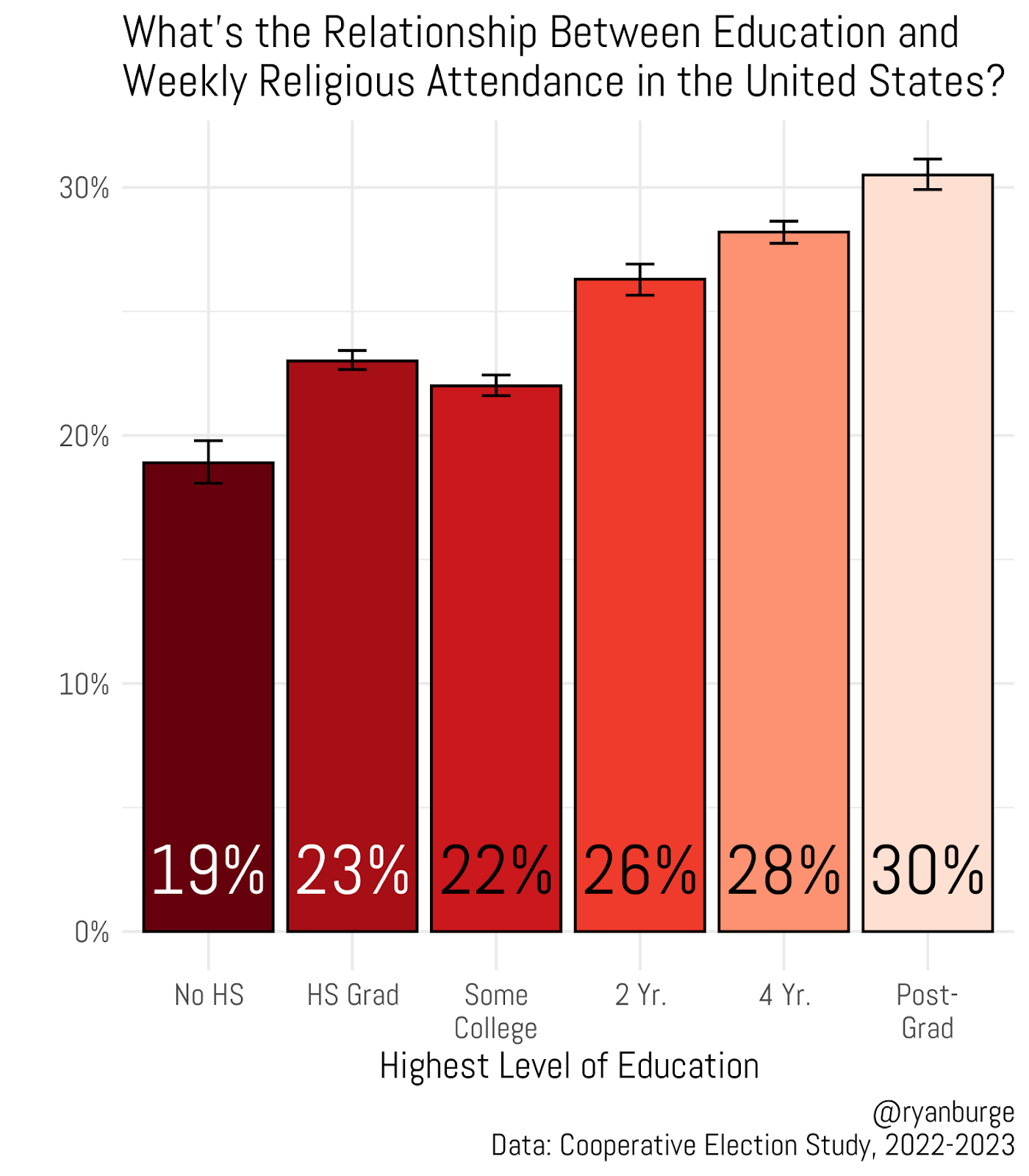
For example, this is data from the 2022 and 2023 Cooperative Election Study, which represents a sample of almost 85,000 people.
As you can plainly see, the relationship between weekly church attendance and education is a positive one. Among those with a high school diploma, only 23% indicate they attend church regularly. For those who have an associate’s degree, it’s 26%. It’s two points higher for people who completed a four year program and among those who went beyond an undergraduate education, 30% are weekly attenders.

...

But here’s a question that I wanted to answer in this post - does that same relationship exist in Europe? I’ve never tested it, but data from the European Social Survey makes it possible to do this type of analysis pretty easily. Their sample is from 24 European countries and the total number of respondents is about 40,000. I am looking at Wave 11, which is data collected in 2023 and 2024.

Obviously, the educational system in Denmark is not the same as Croatia, but the ESS offers a ‘unified’ education variable that seems to create a fairly standardized way to put people into consistent educational attainment categories.
Okay, well, this is different. Actually it’s almost the mirrored opposite of what we saw in the first graph from the United States. In this analysis the group of folks who were the most likely to be weekly religious attenders were people who had no formal education or stopped at primary school. Then the next most likely group to attend regularly were those who went to lower secondary school at 17%. And for those who stopped with upper secondary school it was three points lower than that.


Wednesday, June 19, 2024

Russian Disinformation: Operation Overload

Many posts have analyzed how foreign governments try to influence American politics and policy.  The Russians target other Western countries, too.

James Thomas at Yahoo:
Pro-Russian actors are purposefully barraging journalists with fake news in an effort to spread verification resources thin and amplify the reach of disinformation, according to a new study.

Dubbed “Operation Overload” by Finnish software and methodologies company Check First, which published the report, the ongoing scheme involves anonymous pro-Russian actors who contact journalists in a coordinated campaign to have them verify suspected fake news.

The ploy relies on the simple principle that “all publicity is good publicity”.

The verification requests usually target Ukraine, France and Germany and take the form of emails and social media mentions.

Operation Overload has targeted more than 800 news organisations in Europe and beyond so far, hitting them with around 2,400 tweets and more than 200 emails.

Telegram has also played a significant role, with most of the links sent to journalists taking them to the messaging app.

Check First found that more than 250 fact-checks mentioning the false narratives created for Operation Overload have been published in the past few months.

For example, the sender of one email cited in the report poses as a concerned citizen who has supposedly seen suspicious claims in Russian media and asks journalists to take a look.

In another, the author makes it clear they want any fact-checks to be shared widely so they can be seen by as many people as possible.

This proves Operation Overload’s goal to reach wider audiences, whether the story is debunked or not, according to Check First.

Sunday, May 28, 2023

Religiosity in Europe and the United States

Many posts have discussed the role of religion in American life.  

Ryan Burge:

The purpose of this post is to give readers some data visualizations at just how the religiosity of Europe compares to the United States. The best data I can find about what’s going on across the pond is the European Social Survey. It’s a great resource, but it’s only been around for about twenty years, so it can’t be used for really long-term trends. For comparison the General Social Survey in the United States have been collecting data since 1972.
...

Poland has a higher level of religious attendance than any state in the United States at 44% attending weekly. The closest state is Utah, where 41% attend weekly. Slovakia is as religious as Arkansas. Then there’s a big gap of just states in the U.S.

The closest comparison for Ireland, Italy, and Portugal is Virginia, Maryland, and Illinois. In each case, about a quarter are weekly attenders. But, at the end of the day, Europe is much less religious. There are two countries in Europe that have lower attendance rates than any state in the United States.

Overall, about a quarter of Americans indicate on surveys that they attend religious services weekly. That’s eleven percentage points higher than their European counterparts. There are only two states in the United States where attendance is lower than the European average: Maine at 13% and New Hampshire at 12%.

Monday, July 27, 2020

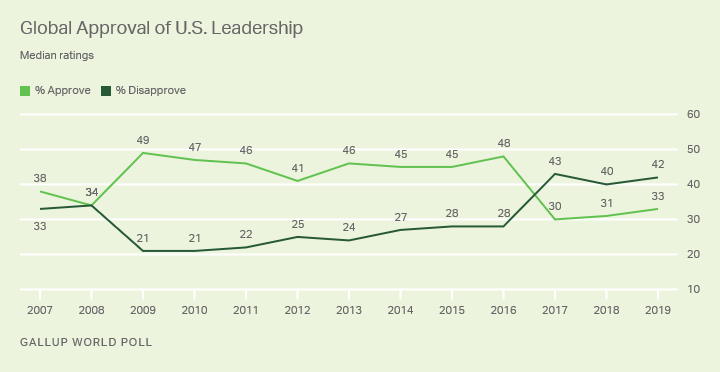
Global Approval of US Leadership


GlobalLeadership

For the second consecutive year, approval ratings of U.S. leadership increased in more countries than where they declined -- helping to nudge global numbers upward. Out of the 135 countries and areas, approval ratings declined by 10 points or more in just five countries - Lebanon, Iraq, Italy, Sierra Leone and Zambia.
Ratings improved by at least this much in 12 countries or areas that span the globe, but notably, there were few free, democratic countries on the list and few long-time allies. Worldwide, approval ratings of the U.S. improved most in Turkmenistan, rising 32 points from 30% in 2018 to 62% in 2019.
The image of U.S. leadership fared worst in Europe, where people remain as disenchanted with U.S. leadership as they were in 2017. The 24% median approval rating in 2019 was unchanged from 2018 and essentially the same as the 25% rating in 2017. However, the median 61% who disapproved of U.S. leadership was a new high.
The U.S attained majority approval in three countries or areas in Europe: Kosovo at 82%, Albania at 67% and Poland at 59%.

Saturday, May 2, 2020

Missed Opportunities to Slow the Spread

Anne Schuchat has an article at MMWR titled  "Public Health Response to the Initiation and Spread of Pandemic COVID-19 in the United States, February 24–April 21, 2020."  The author is Principal Deputy Director of the Centers for Disease Control and Prevention.
What is already known about this topic?

The first confirmed coronavirus disease 2019 (COVID-19) case in the United States was reported on January 21, 2020. The outbreak appeared contained through February, and then accelerated rapidly.

What is added by this report?

Various factors contributed to accelerated spread during February–March 2020, including continued travel-associated importations, large gatherings, introductions into high-risk workplaces and densely populated areas, and cryptic transmission resulting from limited testing and asymptomatic and presymptomatic spread. Targeted and communitywide mitigation efforts were needed to slow transmission.

What are the implications for public health practice?

Factors that amplified the March acceleration and associated mitigation strategies that were implemented can inform public health decisions as the United States prepares for potential re-emergences.
...
Continued introductions of SARS-CoV-2 from outside the United States contributed to the initiation and acceleration of domestic COVID-19 cases in March. After Chinese authorities halted travel from Wuhan and other cities in Hubei Province on January 23, followed by U.S. restrictions on non-U.S. travelers from China issued on January 31 (effective February 2), air passenger journeys from China decreased 86%, from 505,560 in January to 70,072 in February. However, during February, 139,305 travelers arrived from Italy and 1.74 million from all Schengen countries,* where the outbreak was spreading widely and rapidly. Travelers from Italy and all Schengen countries decreased 74% to 35,877 and 50% to 862,432, respectively, in March.† Genomic analysis of outbreak strains suggested an introduction from China to the state of Washington around February 1.§ However, examination of strains collected from northern California during early February to mid-March indicated multiple introductions resulting from international travel (from China and Europe) as well as from interstate travel.¶ Sequencing of strains collected in the New York metropolitan area in March also suggested origins in Europe and other U.S. regions.** Returning cruise ship travelers also contributed to amplification during this time (3). Persons from many countries are in close contact on cruises, and crew members continue to work on ships for multiple voyages. As a result, passengers returning from cruises contributed to the early acceleration phase. For example, 101 persons who had been on nine separate Nile River cruises during February 11–March 5 returned to 18 states and had a positive test result for SARS-CoV-2, nearly doubling the total number of known COVID-19 cases in the United States at that time (Figure 2).
“The extensive travel from Europe, once Europe was having outbreaks, really accelerated our importations and the rapid spread,” Dr. Schuchat told the AP. ”I think the timing of our travel alerts should have been earlier.”

Wednesday, October 16, 2019

American and European Attitudes

Laura Silver at Pew:
Americans (47%) say religion is very important in their daily lives, which is significantly higher than the median of 22% of Western Europeans or 19% of Central and Eastern Europeans who say the same. Outside of Greece (50%), no public comes close to Americans in terms of the importance they place on religion in their daily lives; rather, a quarter or fewer in every other EU member state surveyed say religion is very important to them. Americans stand out once again when it comes to how important people say it is to be able to practice religion freely in their country. Nearly nine-in-ten Americans (86%) see free religious expression as very important for the country, which is much higher than almost any European public surveyed, though around three-quarters or more Greeks (83%), Britons (75%) and Germans (72%) do say the same.
...
In every EU member state surveyed, roughly four-in-ten or more say that success in life is pretty much determined by forces outside their control. A median of 53% in Western Europe and 58% in Central and Eastern Europe say this, but only 31% of Americans agree.

Sunday, November 25, 2018

Leaders and Children

Every president since bachelor James Buchanan has had children. (Harding never acknowledged having children, but he had at least one out of wedlock.) In fact, two of John Tyler's grandchildren are alive today.

The contrast with European leaders is notable, as Ted Malloch suggests at Intellectual Takeout:
Emmanuel Macron, the newly elected French president, has no children; German chancellor Angela Merkel has no children.
British prime minister, Theresa May has no children; Italian prime minister Paolo Gentiloni has no children; Holland’s prime minister, Mark Rutte, Sweden’s Stefan Löfven, Luxembourg’s Xavier Bettel, and Scotland’s, first minster Nicola Sturgeon — all have no children.
The list goes on… Latvia’s childless president is Raimonds VÄ“jonis, Lithuania’s childless president is Dalia GrybauskaitÄ—, and Romania’s childless president is Klaus Werner Iohannis. And, Jean-Claude Juncker, president of the European Commission too, has no children and is family-less.
So to put it rather bluntly: a grossly disproportionate number of the people making serious decisions about Europe’s future have no direct personal sibling, child or grandchildren’s interests at stake in that future. They are not part of a family and have come to see all their attention focused on one dominant and all-powerful social unit to which they pay obeisance and give their complete and devoted attention: The State.
The demographics look problematic. Among native Europeans, the birthrate is currently between 0.2 and 1.1. Europe is not replicating itself and will, if trends are extrapolated—cease to exist.

Thursday, August 9, 2018

Income Inequality: US and Western Europe

The World Inequality Report 2018 shows that income distribution in the United States has become much more unequal, especially in comparison to Western Europe.

Friday, December 29, 2017

Bilateral Trump

At NYT Mark Landler writes that Trump has had a difficult relationship with Angela Merkel.  In an early phone call, she had to explain Ukraine to him, which annoyed White House officials.
Later, he told Ms. Merkel that he wanted to negotiate a new bilateral trade agreement with Germany. The problem with this idea was that Germany, as a member of the European Union, could not negotiate its own agreement with the United States 
Rather than exposing Mr. Trump’s ignorance, Ms. Merkel said the United States could, of course, negotiate a bilateral agreement, but that it would have to be with Germany and the other 27 members of the union because Brussels conducted such negotiations on behalf of its members 
“So it could be bilateral?” Mr. Trump asked Ms. Merkel, according to several people in the room. The chancellor nodded 
“That’s great,” Mr. Trump replied before turning to his commerce secretary, Wilbur Ross, and telling him, “Wilbur, we’ll negotiate a bilateral trade deal with Europe. 
Afterward, German officials expressed relief among themselves that Ms. Merkel had managed to get through the exchange without embarrassing the president or appearing to lecture him. Some White House officials, however, said they found the episode humiliating.