Search This Blog

Showing posts with label presidents. Show all posts

Sunday, February 6, 2022

The Presidential Records Act


Ashley Parker, Josh Dawsey, Tom Hamburger, and Jacqueline Alemany at WP:
President Donald Trump tore up briefings and schedules, articles and letters, memos both sensitive and mundane.
He ripped paper into quarters with two big, clean strokes — or occasionally more vigorously, into smaller scraps.

He left the detritus on his desk in the Oval Office, in the trash can of his private West Wing study and on the floor aboard Air Force One, among many other places.

And he did it all in violation of the Presidential Records Act, despite being urged by at least two chiefs of staff and the White House counsel to follow the law on preserving documents.

“It is absolutely a violation of the act,” said Courtney Chartier, president of the Society of American Archivists. “There is no ignorance of these laws. There are White House manuals about the maintenance of these records.”

Although glimpses of Trump’s penchant for ripping were reported earlier in his presidency — by Politico in 2018 — the House select committee’s investigation into the Jan. 6 insurrection has shined a new spotlight on the practice. The Washington Post reported that some of the White House records the National Archives and Records Administration turned over to the committee appeared to have been torn apart and then taped back together.


From the National Archives:

The Presidential Records Act (PRA) of 1978, 44 U.S.C. ß2201-2209, governs the official records of Presidents and Vice Presidents that were created or received after January 20, 1981 (i.e., beginning with the Reagan Administration). The PRA changed the legal ownership of the official records of the President from private to public, and established a new statutory structure under which Presidents, and subsequently NARA, must manage the records of their Administrations. The PRA was amended in 2014, which established several new provisions.
Specifically, the PRA:
  • Establishes public ownership of all Presidential records and defines the term Presidential records.
  • Requires that Vice-Presidential records be treated in the same way as Presidential records.
  • Places the responsibility for the custody and management of incumbent Presidential records with the President.
  • Requires that the President and his staff take all practical steps to file personal records separately from Presidential records.
  • Allows the incumbent President to dispose of records that no longer have administrative, historical, informational, or evidentiary value, once the views of the Archivist of the United States on the proposed disposal have been obtained in writing.
  • Establishes in law that any incumbent Presidential records (whether textual or electronic) held on courtesy storage by the Archivist remain in the exclusive legal custody of the President and that any request or order for access to such records must be made to the President, not NARA.
  • Establishes that Presidential records automatically transfer into the legal custody of the Archivist as soon as the President leaves office.
  • Establishes a process by which the President may restrict and the public may obtain access to these records after the President leaves office; specifically, the PRA allows for public access to Presidential records through the Freedom of Information Act (FOIA) beginning five years after the end of the Administration, but allows the President to invoke as many as six specific restrictions to public access for up to twelve years.
  • Codifies the process by which former and incumbent Presidents conduct reviews for executive privilege prior to public release of records by NARA (which had formerly been governed by Executive order 13489).
  • Establishes procedures for Congress, courts, and subsequent Administrations to obtain “special access” to records from NARA that remain closed to the public, following a privilege review period by the former and incumbent Presidents; the procedures governing such special access requests continue to be governed by the relevant provisions of E.O. 13489.
  • Establishes preservation requirements for official business conducted using non-official electronic messaging accounts: any individual creating Presidential records must not use non-official electronic messaging accounts unless that individual copies an official account as the message is created or forwards a complete copy of the record to an official messaging account. (A similar provision in the Federal Records Act applies to federal agencies.)
  • Prevents an individual who has been convicted of a crime related to the review, retention, removal, or destruction of records from being given access to any original records.

Friday, October 1, 2021

Cotton, Milley, and the Role of the Military

Sen. Tom Cotton (R-Ark.) and Chairman of the Joint Chiefs of Staff Gen. Mark Milley at a Senate Armed Services Committee hearing on Afghanistan on Tuesday:

TOM COTTON: All right. I just got one final question. General Milley, I can only conclude that your advice about staying in Afghanistan was rejected. I'm shocked to learn that your advice wasn't sought until August 25th on staying past the August 31 deadline. I understand that you're the principal military adviser, but you advise, you don't decide. The president decides. But if all this is true, General Milley, why haven't you resigned?

MARK MILLEY: Senator, as a senior military officer, resigning is a really serious thing, and it's a political act if I'm resigning in protest. My job is to provide advice. My statutory responsibility is to provide legal advice or best military advice to the president, and that's my legal requirement. That's what the law is. The president doesn't have to agree with that advice.

He doesn't have to make those decisions just because we're generals. And it would be an incredible act of political defiance for a commissioned officer to just resign because my advice was not taken. This country doesn't want generals figuring out what orders we are going to accept and do or not. That's not our job.

The principles being controlled in the military is absolute, it's critical to this republic. In addition to that, just from a personal standpoint, you know, my dad didn't get a choice to resign at Iwo Jima, and those kids that were at Abbey Gate, they don't get a choice to resign. And I'm not going to turn my back on them.

I'm not going to -- they can't resign, so I'm not going to resign. There's no way. If the orders are illegal, we're in a different place. But if the orders are legal from civilian authority, I intend to carry them out.

Thursday, July 29, 2021

The People Rate the Presidents

 Matthew Smith at YouGov:

The respective excellence of US presidents is always being debated. Many academics have put together rankings over the years to demonstrate who they think is best, and in one famous case the features of one person’s top four have been carved into a mountain.

But how do the leaders of the nation rank in terms of public opinion? A new YouGov poll has asked Americans their view on the 45 men who have served as president to date.

Topping the list is Abraham Lincoln. Eight in ten Americans (80%) have a favorable view of the president who freed the slaves and won the Civil War, including 56% who have a “very favorable” view of him.

In a perhaps surprise second place – if going by combined very+somewhat favorable ratings – is John F. Kennedy, whom 73% of Americans have a favorable view opinion of. This puts him three points ahead of the more traditional runner-up George Washington (70%), who places third on this measure (although the scores are within the margin of error). It is worth noting that fewer people have a “very” favorable view of Kennedy: 35% to Washington’s 44%.

Theodore Roosevelt and Thomas Jefferson complete the top five, both being seen favorably by 62% of Americans.

...

 There are only two presidents who are currently seen unfavorably by a majority of Americans: Richard Nixon (56%) and Donald Trump (54%). More Americans take a “very” negative view of Trump (47% to Nixon’s 34%), although he is also popular among a wider group: 39% like Donald Trump compared to 27% for Nixon.

Saturday, June 13, 2020

U.S. Grant on the Confederacy

As he was dying in a house near Saratoga Springs, NY (my hometown), U.S. Grant wrote the final pages of his memoirs.

He recalled Appomattox and the cause of the Civil War:
What General Lee's feelings were I do not know. As he was a man of much dignity, with an impassible face, it was impossible to say whether he felt inwardly glad that the end had finally come, or felt sad over the result, and was too manly to show it. Whatever his feelings, they were entirely concealed from my observation; but my own feelings, which had been quite jubilant on the receipt of his letter, were sad and depressed. I felt like anything rather than rejoicing at the downfall of a foe who had fought so long and valiantly, and had suffered so much for a cause, though that cause was, I believe, one of the worst for which a people ever fought, and one for which there was the least excuse. I do not question, however, the sincerity of the great mass of those who were opposed to us.
...
The cause of the great War of the Rebellion against the United States will have to be attributed to slavery. For some years before the war began it was a trite saying among some politicians that "A state half slave and half free cannot exist." All must become slave or all free, or the state will go down. I took no part myself in any such view of the case at the time, but since the war is over, reviewing the whole question, I have come to the conclusion that the saying is quite true.

Monday, May 20, 2019

Ancient Origins of Advice and Consent

Allan Matkins at The National Law Review:
The United States Constitution vests the executive power of the federal government in the president, but his or her power is not entirely autonomous. Notably, Article II, Section 2 notably endows the president with the power to make treaties with the "advice and consent" of the Senate. While the president has unilateral power to nominate ambassadors, judges and other officers of the United States, actual appointments may only be made with the "advice and consent" of the Senate.
The concept of advice and consent is an ancient one. It may have begun with the Etruscans, a people who preceded the Romans on the Italian peninsula. Like the Greeks and Romans, the Etruscans worshipped a pantheon of deities having one king or chief god. For the Greeks, this was Ζεύς (Zeus), for the Romans in was Jupiter, and for the Etruscans it was Tinia. Like his Greek and Roman counterparts, Tinia could hurl thunderbolts. Unlike Zeus and Jupiter, however, Tinia was required to consult with, and obtain the consent of, the other principal gods before throwing a destructive thunderbolt.

This idea of advice and consent became a central feature of the Roman government. Unlike the United States Senate, the Roman senate was not a legislative body. It was a deliberative body whose consent was required to legitimize executive and administrative actions. This consultative role gave it indirect executive power.
The founding fathers of the American republic may not have been thinking of Tinia when they wrote the advice and consent requirement into the Constitution. There can be no doubt, however, that they were familiar with, and borrowed from, precedents from the Roman republic that had their origins in Etruscan theology.

Friday, December 7, 2018

Bush's Leadership

Former Secretary of State James A. Baker eulogizes his old friend George H.W. Bush:
He was not considered a skilled speaker, but his deeds were quite eloquent. And he demonstrated their eloquence by carving them into the hard granite of history. They expressed his moral character, and they reflected his decency, his boundless kindness and consideration of others, his determination always to do the right thing, and always to do that to the very best of his ability. They testify to a life nobly lived. He possessed the classic virtues of our civilization and of his faith. The same virtues that express what is really best about this country. The same ideals were known to and shared by our founding fathers. George Bush was temperate in thought, in word, and in deed. He considered his choices and then he chose wisely.

The Berlin Wall fell in November 1989, less than one year into his presidency. It was a remarkable triumph for American foreign policy. As joyous east and west Germans danced on the remains of that hated wall, George Bush could have joined them metaphorically, and claimed victory for the west, for America, and frankly, for himself.

But he did not. He knew better. He understood that humility toward and not humiliation of a fallen adversary was the very best path to peace and reconciliation, and so he was able to unify Germany as a member of the North Atlantic Treaty Organization, not withstanding the initial reservations of France, the United Kingdom, and the Soviet Union.

Thus, the Cold War ended, not with a bang but with the sound of a halliard rattling through a pulley over the Kremlin on a cool night in December 1991 as the flag of the Soviet Union was lowered for the very last time. Need we ask about George Bush's courage? During World War II, he risked his life in defense of something greater than himself. Decades later, when Saddam Hussein invaded Kuwait in August 1990 and began to brutalize Kuwaitis, George Bush never wavered.
Peggy Noonan at WSJ:
Here’s a theory: Bush’s achievement wasn’t seen for what it was, in part because America in those days was still going forward in the world with its old mystique. Its ultimate grace and constructiveness were a given. It had gallantly saved its friends in the First World War, and again in the Second; it had led the West’s resistance to communism. It was expected to do good.
Having won the war, of course it would win the peace. It seemed unremarkable that George Bush, and Brent Scowcroft, and a host of others did just that.
Bush was the last president to serve under—and add to—that American mystique. It has dissipated in the past few decades through pratfalls, errors and carelessness, with unwon wars and the economic crisis of 2008. The great foreign-affairs challenge now is to go forward in the world successfully while knowing the mystique has been lessened, and doing everything possible to win it back.

Wednesday, December 5, 2018

Saving Lieutenant Bush

Jon Meacham's eulogy for President George H.W. Bush, December 5, 2018:

The story was almost over even before it had fully begun. Shortly after dawn on Saturday, September 2, 1944, Lieutenant Junior Grade George Herbert Walker Bush, joined by two crew mates, took off from the USS San Jacinto to attack a radio tower on Chichijima. As they approached the target, the air was heavy with flack. The plane was hit. Smoke filled the cockpit; flames raced across the wings. "My god," Lieutenant Bush thought, "this thing's gonna go down." Yet he kept the plane in its 35-degree dive, dropped his bombs, and then roared off out to sea, telling his crew mates to hit the silk. Following protocol, Lieutenant Bush turned the plane so they could bail out.

Only then did Bush parachute from the cockpit. The wind propelled him backward, and he gashed his head on the tail of the plane as he flew through the sky. He plunged deep into the ocean, bobbed to the surface, and flopped onto a tiny raft. His head bleeding, his eyes burning, his mouth and throat raw from salt water, the future 41st President of the United States was alone. Sensing that his men had not made it, he was overcome. He felt the weight of responsibility as a nearly physical burden. And he wept. Then, at four minutes shy of noon, a submarine emerged to rescue the downed pilot. George Herbert Walker Bush was safe. The story, his story and ours, would go on by God's grace.

Through the ensuing decades, President Bush would frequently ask, nearly daily, he'd ask himself, "why me? Why was I spared?" And in a sense, the rest of his life was a perennial effort to prove himself worthy of his salvation on that distant morning. To him, his life was no longer his own. There were always more missions to undertake, more lives to touch, and more love to give. And what a headlong race he made of it all. He never slowed down.

On the primary campaign trail in New Hampshire once, he grabbed the hand of a department store mannequin, asking for votes. When he realized his mistake, he said, "Never know. Gotta ask." You can hear the voice, can't you? As Dana Carvey said, the key to a Bush 41 impersonation is Mr. Rogers trying to be John Wayne.

George Herbert Walker Bush was America’s last great soldier-statesman, a 20th century founding father. He governed with virtues that most closely resemble those of Washington and of Adams, of TR and of FDR, of Truman and of Eisenhower, of men who believed in causes larger than themselves. Six-foot-two, handsome, dominant in person, President Bush spoke with those big strong hands, making fists to underscore points.

A master of what Franklin Roosevelt called the science of human relationships, he believed that to whom much was given, much is expected. And because life gave him so much, he gave back again and again and again. He stood in the breach in the Cold War against totalitarianism. He stood in the breach in Washington against unthinking partisanship. He stood in the breach against tyranny and discrimination. And on his watch, a wall fell in Berlin, a dictator's aggression did not stand, and doors across America opened to those with disabilities.

And in his personal life, he stood in the breach against heartbreak and hurt, always offering an outstretched hand, a warm word, a sympathetic tear. If you were down, he would rush to lift you up. And if you were soaring, he would rush to savor your success. Strong and gracious, comforting and charming, loving and loyal, he was our shield in danger's hour.

Now, of course, there was ambition, too. Loads of that. To serve, he had to succeed. To preside, he had to prevail. Politics, he once admitted, isn't a pure undertaking; not if you want to win, it's not. An imperfect man, he left us a more perfect union.

It must be said that for a keenly intelligent statesman of stirring, almost unparalleled, private eloquence, public speaking was not exactly a strong suit. “Fluency in English,” President Bush once remarked, “is something that I’m often not accused of.” Looking ahead to the ’88 election, he observed inarguably, “it’s no exaggeration to say that the undecideds could go one way or the other.” And late in his presidency, he allowed that “we are enjoying sluggish times, but we are not enjoying them very much.”

His tongue may have run amok at moments, but his heart was steadfast. His life code, as he said, was “Tell the truth. Don’t blame people. Be strong. Do your best. Try hard. Forgive. Stay the course.” And that was and is the most American of creeds. Abraham Lincoln’s “better angels of our nature” and George H.W. Bush’s “thousand points of light” are companion verses in America’s national hymn. For Lincoln and Bush both called on us to choose the right over the convenient, to hope rather than to fear, and to heed not our worst impulses, but our best instincts.

In this work, he had the most wonderful of allies in Barbara Pierce Bush, his wife of 73 years. He called her "Barb," "the silver fox"—and when the situation warranted—"the enforcer." He was the only boy she ever kissed. Her children, Mrs. Bush liked to say, always wanted to throw up when they heard that. In a letter to Barbara during the war, young George H.W. Bush had written, "I love you, precious, with all my heart, and to know that you love me means my life. How lucky our children will be to have a mother like you." And as they will tell you, they surely were.

As Vice President, Bush once visited a children's Leukemia ward in Krakow. Thirty-five years before, he and Barbara had lost a daughter, Robin, to the disease. In Krakow, a small boy wanted to greet the American Vice President. Learning that the child was sick with the cancer that had taken Robin, Bush began to cry.

To his diary later that day, the Vice President said this: "My eyes flooded with tears. And behind me was a bank of television cameras. And I thought, 'I can't turn around. I can't dissolve because of personal tragedy in the face of the nurses that give of themselves every day.' So I stood there looking at this little guy, tears running down my cheek, hoping he wouldn't see. But if he did, hoping he'd feel that I loved him."

That was the real George H.W. Bush, a loving man with a big, vibrant, all-enveloping heart. And so we ask, as we commend his soul to God, and as he did, "Why him? Why was he spared?" The workings of providence are mysterious, but this much is clear: that George Herbert Walker Bush, who survived that fiery fall into the waters of the Pacific three quarters of a century ago, made our lives and the lives of nations freer, better, warmer, and nobler.

That was his mission. That was his heart beat. And if we listen closely enough, we can hear that heartbeat even now. For it’s the heartbeat of a lion, a lion who not only led us, but who loved us. That’s why him. That’s why he was spared.

Sunday, November 25, 2018

Leaders and Children

Every president since bachelor James Buchanan has had children. (Harding never acknowledged having children, but he had at least one out of wedlock.) In fact, two of John Tyler's grandchildren are alive today.

The contrast with European leaders is notable, as Ted Malloch suggests at Intellectual Takeout:
Emmanuel Macron, the newly elected French president, has no children; German chancellor Angela Merkel has no children.
British prime minister, Theresa May has no children; Italian prime minister Paolo Gentiloni has no children; Holland’s prime minister, Mark Rutte, Sweden’s Stefan Löfven, Luxembourg’s Xavier Bettel, and Scotland’s, first minster Nicola Sturgeon — all have no children.
The list goes on… Latvia’s childless president is Raimonds Vējonis, Lithuania’s childless president is Dalia Grybauskaitė, and Romania’s childless president is Klaus Werner Iohannis. And, Jean-Claude Juncker, president of the European Commission too, has no children and is family-less.
So to put it rather bluntly: a grossly disproportionate number of the people making serious decisions about Europe’s future have no direct personal sibling, child or grandchildren’s interests at stake in that future. They are not part of a family and have come to see all their attention focused on one dominant and all-powerful social unit to which they pay obeisance and give their complete and devoted attention: The State.
The demographics look problematic. Among native Europeans, the birthrate is currently between 0.2 and 1.1. Europe is not replicating itself and will, if trends are extrapolated—cease to exist.

Monday, May 14, 2018

Why They Leak

At Axios, Jonathan Swan quotes some Trump leakers:
  • "To be honest, it probably falls into a couple of categories,” one current White House official tells me. "The first is personal vendettas. And two is to make sure there's an accurate record of what's really going on in the White House."
  • "To cover my tracks, I usually pay attention to other staffers' idioms and use that in my background quotes. That throws the scent off me," the current White House official added.
  • "The most common substantive leaks are the result of someone losing an internal policy debate," a current senior administration official told me. "By leaking the decision, the loser gets one last chance to kill it with blowback from the public, Congress or even the President."
  • "Otherwise," the official added, "you have to realize that working here is kind of like being in a never-ending 'Mexican Standoff.' Everyone has guns (leaks) pointed at each other and it's only a matter of time before someone shoots. There's rarely a peaceful conclusion so you might as well shoot first."

Wednesday, September 23, 2015

In Honor of the Late Yogi Berra: Fake Quotations on Social Media

The great Yogi Berra has passed.  As Ralph Keyes writes in The Quote Verifier, "it is safe to assume that most of the most popular sayings attributed to Yogi Berra are spurious."

Spurious quotations of other historical figures have been much in circulation on Facebook and Twitter.  A sampler:


From George Washington's Mount Vernon:

"This quote is partially accurate as the beginning section is taken from Washington's First Annual Message to Congress on the State of the Union. However, the quote is then manipulated into a differing context and the remaining text is inaccurate. Here is the actual text from Washington's speech:

`A free people ought not only to be armed, but disciplined; to which end a uniform and well-digested plan is requisite; and their safety and interest require that they should promote such manufactories as tend to render them independent of others for essential, particularly military, supplies.'"


The "Positive Atheism" site lists this line on its list of "Phony James Madison Quotations"

But here is something he actually did say:

"Who does not see that the same authority which can establish Christianity, in exclusion of all other Religions, may establish with the same ease any particular sect of Christians, in exclusion of all other Sects? that the same authority which can force a citizen to contribute three pence only of his property for the support of any one establishment, may force him to conform to any other establishment in all cases whatsoever?"


Embedded image permalink

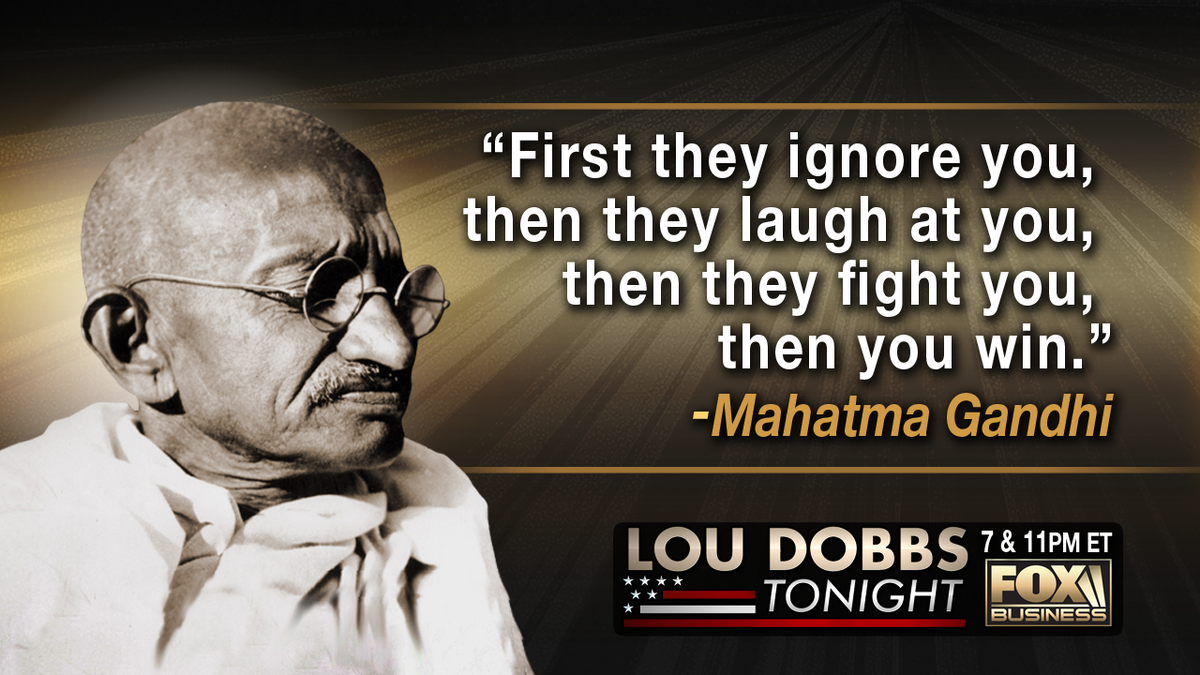
Eoin O'Connor writes at The Christian Science Monitor:
"This line is probably the best summary of Gandhi's philosophy of satyagraha as you can get in 16 words. But there's no evidence that the Great Soul ever said this."


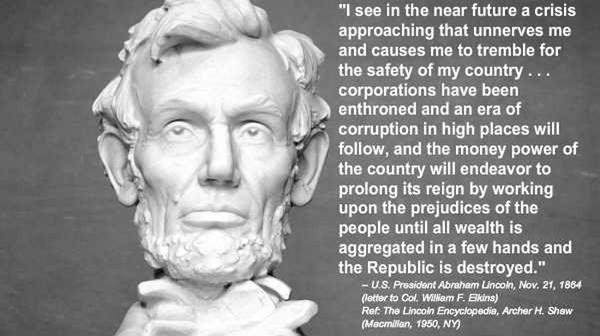
Embedded image permalink As mentioned before, Populists 
concocted this one, and Lincoln's private aide called it a "bald, unblushing forgery."  Not only did Lincoln never say these words, they were at odds with his thinking, as Andrew Ferguson explained : "A corporate lawyer whose long and cunning labor on behalf of the railroads earned him a comfortable income, Lincoln was a vigorous champion of market capitalism, even when it drifted (as it tends to do) toward large  concentrations of wealth."


TOCQUEVILLE NEVER SAID ANY SUCH THING!


Monday, February 21, 2011

Now Let Us Praise Chester Arthur

On this Presidents' Day, it it worth remembering that some chief executives were obscure but worthy. Case in point: Chester Alan Arthur.

With the assassination of James A. Garfield in 1881, Vice President Arthur became president. Before his brief tenure in the second slot, he had been Collector of the Port of New York, where he dispensed patronage on behalf of New York's Republican machine. As chief executive, however, he became a born-again reformer. He signed the Pendleton Act, which established federal merit hiring. (It was the statute to which Vice President Al Gore was alluding in 1997, when he said that "no controlling legal authority" forbade him to make fundraising calls from the White House.)

Publisher Alexander K. McClure wrote of Arthur, "No man ever entered the Presidency so profoundly and widely distrusted, and no one ever retired from that highest civil trust of the world more generally respected, alike by political friend and foe."

Tuesday, February 9, 2010

Momentum

In our chapter on campaigns and elections, we discuss the dynamics of presidential races. A candidate may gather momentum, getting stronger and stronger as the opponent gets weaker and weaker. In an article in Polity, R. Lawrence Butler writes:
Money could also lead to increased capacity for momentum to be a factor in future general elections. Before 2008, both major party candidates accepted public funding and had an equal amount to spend. One of the important mechanisms of momentum involves the ability of the candidate perceived to be winning to increase his fund-raising, whereas the loser’s money dries up. Public financing eliminated this possibility. Momentum would, therefore, have to be created by free media coverage and the energizing of volunteer networks. Now, as future candidates are unlikely to accept public financing, momentum could become a greater factor in the general election.

Monday, November 9, 2009

President Obama and the Pardon Power

In chapter 14, we discuss presidential powers, including the ability to issue pardons. The Chicago Tribune reports that President Obama has been sparing in his use of this power:
A lot of things have moved pretty quickly in the Obama administration. Presidential pardons are not among them.

In two and a quarter centuries, only four presidents have been slower than President Barack Obama in exercising their authority of executive clemency -- granting either pardons or commutations of sentences to the convicted -- with thousands of applications pending at the Justice Department.

By the count of pardon expert P.S. Ruckman Jr., associate professor of political science at Rock Valley College in Rockford, Obama early this month passed Richard Nixon, moving into fifth place, and could overtake John Adams for fourth about 250 days from now.

George Washington was by far the stingiest with the power -- it took him more than 1,800 days to grant his first pardon.
More at http://pardonpower.com/