Search This Blog

Showing posts with label Afghanistan. Show all posts

Sunday, August 27, 2023

Fox Strikes Again


The Marine Corps worked behind the scenes last month in an attempt to convince Fox News to retract its false story claiming a Gold Star family was forced to pay $60,000 to ship the remains of a Marine killed in Afghanistan, according to emails obtained by Military.com.

A service spokesman notified the news network that it was pushing an incorrect story and accused it of using the grief of fallen Marine Sgt. Nicole Gee's family to draw in readers, the email exchanges, released through a Freedom of Information Act (FOIA) Request, show. Fox News eventually deleted the story with no correction, and it never reached out to the Gee family with an apology as the Marine Corps requested, the family said.

The Fox News story came from Republican Rep. Cory Mills, a freshman congressman from Florida, who claimed Gee's next of kin were strapped with the $60,000 charge after a meeting with the families of Abbey Gate bombing victims, a suicide attack where 13 service members were killed outside of the Kabul airport in 2021.

Gee's family never paid a dollar to transport her remains, and the Marine Corps let Fox News know -- in no uncertain terms -- that the July 25 story was false in a series of emails over the following days.

"This headline correction is still misleading and your story is still false," Maj. James Stenger, the lead spokesperson for the Marine Corps, wrote to Fox News in an email after the publication changed the headline and body of the story in an attempt to soften the accusation.

"Using the grief of a family member of a fallen Marine to score cheap clickbait points is disgusting," Stenger wrote. The spokesman was one of several military officials frustrated with the story, according to the documents.

Oliver Darcy at CNN:
Fox News apologized Saturday to a Gold Star family for publishing a false story last month claiming that the family had to pay $60,000 to ship the remains of their fallen relative back from Afghanistan because the Pentagon refused to pay.

“The now unpublished story has been addressed internally and we sincerely apologize to the Gee family,” a Fox News spokesperson said in a statement, referencing the family of fallen Marine Sgt. Nicole Gee, who was one of 13 service members killed in a terror attack at the Kabul airport in 2021 while assisting with US withdrawal efforts.

...

Deleting an entire story is exceedingly rare in news media and is seen as a last-ditch measure if the entire premise of the article is incorrect. Deleting a story without offering readers an explanation or correction is widely considered to be unethical.

Monday, April 10, 2023

Afghanistan Withdrawal: The View from the Biden White House

From the White House:

President Biden’s choices for how to execute a withdrawal from Afghanistan were severely constrained by conditions created by his predecessor. When President Trump took office in 2017, there were more than 10,000 troops in Afghanistan. Eighteen months later, after introducing more than 3,000 additional troops just to maintain the stalemate, President Trump ordered direct talks with the Taliban without consulting with our allies and partners or allowing the Afghan government at the negotiating table. In September 2019, President Trump emboldened the Taliban by publicly considering inviting them to Camp David on the anniversary of 9/11. In February 2020, the United States and the Taliban reached a deal, known as the Doha Agreement, under which the United States agreed to withdraw all U.S. forces from Afghanistan by May 2021. In return, the Taliban agreed to participate in a peace process and refrain from attacking U.S. troops and threatening Afghanistan’s major cities—but only as long as the United States remained committed to withdraw by the agreement’s deadline. As part of the deal, President Trump also pressured the Afghan government to release 5,000 Taliban fighters from prison, including senior war commanders, without securing the release of the only American hostage known to be held by the Taliban. 

Over his last 11 months in office, President Trump ordered a series of drawdowns of U.S. troops. By June 2020, President Trump reduced U.S. troops in Afghanistan to 8,600. In September 2020, he directed a further draw down to 4,500. A month later, President Trump tweeted, to the surprise of military advisors, that the remaining U.S. troops in Afghanistan should be “home by Christmas!” On September 28, 2021, Chairman of the Joint Chiefs of Staff Milley testified that, on November 11, he had received an unclassified signed order directing the U.S. military to withdraw all forces from Afghanistan no later than January 15, 2021. One week later, that order was rescinded and replaced with one to draw down to 2,500 troops by the same date. During the transition from the Trump Administration to the Biden Administration, the 2 outgoing Administration provided no plans for how to conduct the final withdrawal or to evacuate Americans and Afghan allies. Indeed, there were no such plans in place when President Biden came into office, even with the agreed upon full withdrawal just over three months away. 

As a result, when President Biden took office on January 20, 2021, the Taliban were in the strongest military position that they had been in since 2001, controlling or contesting nearly half of the country. At the same time, the United States had only 2,500 troops on the ground—the lowest number of troops in Afghanistan since 2001—and President Biden was facing President Trump’s near-term deadline to withdraw all U.S. forces from Afghanistan by May 2021, or the Taliban would resume its attacks on U.S. and allied troops. Secretary of Defense Austin testified on September 28, 2021, “the intelligence was clear that if we did not leave in accordance with that agreement, the Taliban would recommence attacks on our forces.” This experience underscores the critical importance of detailed and effective transition coordination, especially when it comes to complex military operations for which decisions and execution pass from one administration to the next, and consequential deals struck late in the outgoing administration whose implementation will fall largely to the incoming administration. 

Tuesday, August 2, 2022

Blade

NDTV:
Al Qaeda chief Ayman al-Zawahiri was killed by the US forces in a drone strike in Afghanistan capital Kabul. Announcing his death in a televised address, US President Joe Biden said no civilian casualties were reported in the operation that was conducted over the weekend.

A senior official in the Biden administration was quoted as saying by news agency AFP that Zawahiri was on the balcony of a house in Kabul when he was targeted with two Hellfire missiles, an hour after sunrise on July 31.

According to the official's account, Mr Biden gave his green light for the strike on July 25 - as he was recovering in isolation from Covid-19.

However, pictures from the Kabul home where Zawahiri was living showed no signs of an explosion, pointing to the use again by the US of the macabre Hellfire R9X.

Also called the "ninja bomb," the missile has become the US weapon of choice for killing leaders of extremist groups while avoiding civilian casualties.

The missile is fired from a Predator drone. It has no warhead, but deploys six blades which fly in at high speed, crush and slice the targeted person.

This is the reason why it's called the "flying ginsu", after the 1980 TV commercial for Japanese kitchen knives that would cut cleanly through aluminum cans and remain perfectly sharp.

Some pictures posted online show the impact of these missiles. One of these old photos on Twitter claims to show a car destroyed by Hellfire R9X in Idlib, Syria.

Pentagon and CIA - the two agencies which undertake targeted assassinations - have never acknowledged the use of the Hellfire R9X missile.

Friday, October 1, 2021

Cotton, Milley, and the Role of the Military

Sen. Tom Cotton (R-Ark.) and Chairman of the Joint Chiefs of Staff Gen. Mark Milley at a Senate Armed Services Committee hearing on Afghanistan on Tuesday:

TOM COTTON: All right. I just got one final question. General Milley, I can only conclude that your advice about staying in Afghanistan was rejected. I'm shocked to learn that your advice wasn't sought until August 25th on staying past the August 31 deadline. I understand that you're the principal military adviser, but you advise, you don't decide. The president decides. But if all this is true, General Milley, why haven't you resigned?

MARK MILLEY: Senator, as a senior military officer, resigning is a really serious thing, and it's a political act if I'm resigning in protest. My job is to provide advice. My statutory responsibility is to provide legal advice or best military advice to the president, and that's my legal requirement. That's what the law is. The president doesn't have to agree with that advice.

He doesn't have to make those decisions just because we're generals. And it would be an incredible act of political defiance for a commissioned officer to just resign because my advice was not taken. This country doesn't want generals figuring out what orders we are going to accept and do or not. That's not our job.

The principles being controlled in the military is absolute, it's critical to this republic. In addition to that, just from a personal standpoint, you know, my dad didn't get a choice to resign at Iwo Jima, and those kids that were at Abbey Gate, they don't get a choice to resign. And I'm not going to turn my back on them.

I'm not going to -- they can't resign, so I'm not going to resign. There's no way. If the orders are illegal, we're in a different place. But if the orders are legal from civilian authority, I intend to carry them out.

Sunday, August 15, 2021

Afghanistan and Public Opinion


Dina Smeltz and Emily Sullivan at the Chicago Council on Global Affairs:
The Taliban’s recent advances in Afghanistan, capturing six provincial capitals in less than a week, have highlighted the impact of the US military withdrawal there and have thrown the future of the country into question. While several outspoken critics have objected to President Biden’s decision to withdraw all troops from Afghanistan, the just-completed 2021 Chicago Council Survey, fielded July 7-26, shows that seven in ten Americans continue to back this decision.

When asked whether they support or oppose the decision to withdraw US forces from Afghanistan by September 11, 2021, the 2021 Chicago Council Survey finds that 70 percent of Americans support it (29% oppose). This support spans partisan affiliations, though larger majorities of Democrats (77%) and Independents (73%) than Republicans (56%) agree.

Eli Stokols, Tracy Wilkinson, and Janet Hook at LAT:

Recent polling has also revealed new public skepticism about the origins of the war launched by President George W. Bush. Now a growing number of Democrats and independents have come to view the war itself, long seen as defensible in comparison with the conflict in Iraq, as a mistake.

“That’s a big reason why I would not expect this decision [to withdraw], even with the visuals of the Taliban taking over, to have a big effect on Biden’s approval rating,” said Frank Newport, a senior pollster at Gallup.

Thursday, October 15, 2015

The Longest War

The president will keep troops in Afghanistan through the end of his administration.

Molly O'Toole writes at Defense One:
The president’s pledges to end the costly and grueling wars in Iraq and Afghanistan have foundered. In 2013, Obama declared an end to the Afghanistan war, America’s longest. But the country has since seen a prolonged spike in violence, infiltration by new groups such as the Islamic State, and the Taliban’s widest reach since the war began in 2001, according to the United Nations. These setbacks, combined with what [Ashton] Carter called a “mistaken attack” by the U.S. military on a Doctors Without Borders hospital after the Taliban took the city of Kunduz in northern Afghanistan — and domestic criticism of the Obama administration’s plans for withdrawing U.S. troops — led the White House to rethink the drawdown.

Sunday, June 1, 2014

Disregarding a Law

Karen Tumulty writes at The Washington Post that some are questioning the swap of five Taliban for Army Sergeant Bowe Bergdahl:
Top Republicans on the Senate and House armed services committees went so far as to accuse President Obama of having broken the law, which requires the administration to notify Congress before any transfers from Guantanamo are carried out.
“Trading five senior Taliban leaders from detention in Guantanamo Bay for Bergdahl’s release may have consequences for the rest of our forces and all Americans. Our terrorist adversaries now have a strong incentive to capture Americans. That incentive will put our forces in Afghanistan and around the world at even greater risk,” House Armed Services Committee Chairman Howard P. McKeon (R-Calif.) and the ranking Republican on the Senate Armed Services Committee, James M. Inhofe (Okla.), said in a joint statement.
Lawmakers were not notified of the Guantanamo detainees’ transfer until after it occurred.
The law requires the defense secretary to notify relevant congressional committees at least 30 days before making any transfers of prisoners, to explain the reason and to provide assurances that those released would not be in a position to reengage in activities that could threaten the United States or its interests.
Before the current law was enacted at the end of last year, the conditions were even more stringent. However, the administration and some Democrats had pressed for them to be loosened, in part to give them more flexibility to negotiate for Bergdahl’s release.
A senior administration official, agreeing to speak on the condition of anonymity to explain the timing of the congressional notification, acknowledged that the law was not followed. When he signed the law last year, Obama issued a signing statement contending that the notification requirement was an unconstitutional infringement on his powers as commander in chief and that he therefore could override it.
Here is the relevant passage from the signing statement:
For the past several years, the Congress has enacted unwarranted and burdensome restrictions that have impeded my ability to transfer detainees from Guantanamo. Earlier this year I again called upon the Congress to lift these restrictions and, in this bill, the Congress has taken a positive step in that direction. Section 1035 of this Act gives the Administration additional flexibility to transfer detainees abroad by easing rigid restrictions that have hindered negotiations with foreign countries and interfered with executive branch determinations about how and where to transfer detainees. Section 1035 does not, however, eliminate all of the unwarranted limitations on foreign transfers and, in certain circumstances, would violate constitutional separation of powers principles. The executive branch must have the flexibility, among other things, to act swiftly in conducting negotiations with foreign countries regarding the circumstances of detainee transfers. Of course, even in the absence of any statutory restrictions, my Administration would transfer a detainee only if the threat the detainee may pose can be sufficiently mitigated and only when consistent with our humane treatment policy. Section 1035 nevertheless represents an improvement over current law and is a welcome step toward closing the facility.
On December 20, 2007, he said: "I will not use signing statements to nullify or undermine congressional instructions as enacted into law."

Friday, September 6, 2013

Opinion and Syria

Gallup reports:
Americans' support for the United States' taking military action against the Syrian government for its suspected use of chemical weapons is on track to be among the lowest for any intervention Gallup has asked about in the last 20 years. Thirty-six percent of Americans favor the U.S. taking military action in order to reduce Syria's ability to use chemical weapons. The majority -- 51% -- oppose such action, while 13% are unsure.
 Views on Proposed U.S. Military Actions Before Commencement of Such Actions

Thursday, January 17, 2013

Lawmakers, Demographics, and Veterans

The 113th Congress is in session. But, who are they?
Lawyers, mostly. How do we know? A terrific chart from Businessweek that breaks down all of the professions of the new Congress. There are 128 lawyers in the House and another 45 in the Senate. Somewhat remarkably, there only 55 career politicians in the House and another nine in the Senate. (The Fix would have bet the “over” on both of those numbers.) There’s also one microbiologist, one carpenter and one physicist.
In comparison to the 112th Congress, there are six less veterans in the House and six less in the Senate as well — the latest evidence of the steady decline in those who have served in the military in Congress. (New Jersey Sen. Frank Lautenberg is the only member of the Senate who served in World War II.)
Previous posts have discussed veterans in CongressThe New York Times notes that 16 lawmakers served in Iraq or Afghanistan, including nine new members.
But the number of veterans joining Congress continued a four-decade long slide, dropping to 106 in the 113th Congress, according to data from CQ Roll Call.
The Senate will have 18 veterans, down from a peak of 81 in 1977 and the lowest since at least World War II, according to data from the Senate Historical Office. The House will have 88 veterans, down from a peak of 347 in 1977, according to the Military Officers Association of America.
...
The new crop of veterans includes the first two female combat veterans to serve in Congress, Tammy Duckworth of Illinois and Tulsi Gabbard of Hawaii, both Democrats.

Tuesday, January 15, 2013

Taking the Citizenship Oath in Afghanistan

-Patriotism means many things to different people. In fact, it has even taken on a political connotation during the past few years. For service members deployed to Afghanistan in support of Operation Enduring Freedom, it means a long journey has finally come to fruition.
Thirty one service members from 19 different countries became naturalized U.S. citizens in a ceremony at Bagram Airfield, Afghanistan, Nov. 2. The service members' ceremony was presided over by Elvis Quiles, the U.S. Citizenship and Immigration Service's overseas adjudications officer for Bangkok, Thailand. The Oath of Allegiance was administered by Pius Bannis, the USCIS district director for Bangkok.
Coming from countries as far away as Norway, Jamaica, Laos, Kenya, Japan and Moldova, the service members were very diverse in their heritage. One common denominator they all shared though, was their desire to become U.S. citizens.

Sgt. Grena Kirk, an aircraft electrician with Bravo Company, 209th Aviation Support Battalion, 25th Infantry Division, stationed at Schofield Barracks, Hawaii, was one of the proud new U.S. citizens. Kirk is originally from the Philippines and has been serving in the U.S Army as a legal resident.

Currently assigned to Kandahar Airfield in support of Operation Enduring Freedom, Kirk traveled to BAF to participate in the naturalization ceremony.
"Becoming a U.S. citizen offers me more freedom. I can actually vote now," said Kirk. "Being in the military, I can now look for different [jobs] which require a security clearance. Becoming a citizen just opens up more doors and offers me more opportunities."

Becoming a naturalized citizen is a method for people who were not born in the U.S. to become citizens. Naturalized citizens swear by oath "to renounce and abjure their allegiance to any foreign prince, potentate, state or sovereignty and swear to support and defend the Constitution and laws of the United States of America against all enemies, foreign and domestic."
In attendance at the ceremony was recently appointed U.S. Ambassador to Afghanistan, James B. Cunningham, who greeted each service member personally with a congratulatory handshake and encouraging words.

"Today is a great recognition, these are always very impressive ceremonies to welcome new citizens into the family of America," said Cunningham. "To see their desire to become U.S. citizens is always a wonderful thing."

"The fact that they joined up to serve my country, which will now become their country, before they were citizens is a demonstration of their commitment to the United States and their desire to be part of the American family," added Cunningham.

Another servic emember being naturalized was U.S. Marine Corps Lance Cpl. Valentin Straticiuc, who is originally from Odessa, Ukraine. Straticiuc, now referring to New York as his home, is an infantry rifleman with 3rd Battalion, 3rd Marine Regiment, stationed at Camp Lejeune, N.C.
Making the journey from Forward Operating Base Geronimo, Helmand Province, Afghanistan, to BAF, Straticiuc was ecstatic to become a U.S. citizen.
"Becoming a U.S. citizen means everything to me," said Straticiuc. "It means I'm fighting for the country that has given me more than I believe any other country would have."
"In my home country I could have dreamed of goals and died with those dreams," added Straticiuc. "In this country though, I can make those goals happen."

Tuesday, December 11, 2012

Prayer in Combat

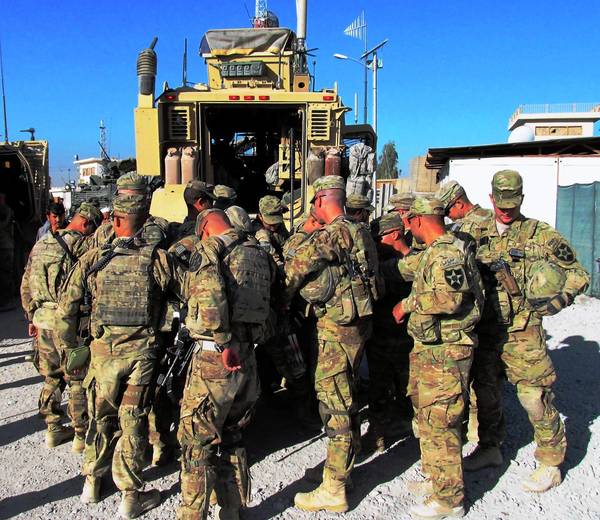
Prayer and combat have always gone together.   (See, for instance, 1 Kings 8:44.)  At The Los Angeles Times, David S. Cloud begins an article on the war in Afghanistan with a description of a prayer:
Fifteen U.S. soldiers huddle in a circle. A blue Toyota packed with explosives has been reported somewhere in the city. The troops bow their heads and clasp hands.
"Dear Lord, protect us and protect those entrusted to us as we help the Afghans protect themselves," says Lt. Col. Patrick Michaelis, their gangly 41-year-old commander.
"Amen," say his men.
Every trip outside the wire begins the same way: a quick check of the latest intelligence, then the prayer, which never varies. When Michaelis forgets, someone stops him: Sir, the prayer.
In America's longest war after a dozen years, a yearning for peace comes wrapped in a prayer for survival. Both are unfulfilled, incomplete.

Troops say a prayer in Afghanistan

Saturday, September 22, 2012

An Overlooked Disaster

Our chapters on mass media and national security point out that American news organizations have drastically curtailed their international reporting staffs.  One result is that many events overseas -- even those involving Americans -- get only the most superficial coverage.  At The Atlantic, John Hudson writes:
The Taliban attack on an air base in southern Afghanistan on Friday [9/14] drew coverage for the way the insurgents cloaked themselves in U.S. army uniforms to gain a tactical advantage, but few have taken note of the historical proportions of the damage inflicted. John Gresham, at the Defense Media Network, has published a detailed account of the attack on Camp Bastion, in which two Marines were killed, six U.S. Marine Corps jet fighters were destroyed, and two more  "significantly" damaged. Those facts were all carried in most reports, but if that just sounds like a typical damage report from a decade-long war, you're wrong. Gresham explains the devastating damage done to VMA-211, the name of the Marine Corps attack squadron that was most affected last week, noting that it is "arguably the worst day in [U.S. Marine Corps] aviation history since the Tet Offensive of 1968." Or you could go back even further. "The last time VMA-211 was combat ineffective was in December 1941, when the squadron was wiped out during the 13-day defense of Wake Island against the Japanese."

Wednesday, August 22, 2012

Two Thousand US Deaths in Afghanistan

The New York Times reports:
Nearly nine years passed before American forces reached their first 1,000 dead in the war. The second 1,000 came just 27 months later, a testament to the intensity of fighting prompted by President Obama’s decision to send 33,000 additional troops to Afghanistan in 2010, a policy known as the surge.
In more ways than his family might have imagined, Lance Corporal Buckley, who had just turned 21 when he died, typified the troops in that second wave of 1,000. According to the Times analysis, three out of four were white, 9 out of 10 were enlisted service members, and one out of two died in either Kandahar Province or Helmand Province in Taliban-dominated southern Afghanistan. Their average age was 26.
The dead were also disproportionately Marines like Lance Corporal Buckley. Though the Army over all has suffered more dead in the war, the Marine Corps, with fewer troops, has had a higher casualty rate: At the height of fighting in late 2010, 2 out of every 1,000 Marines in Afghanistan were dying, twice the rate of the Army. Marine units accounted for three of the five units hardest hit during the surge.
AP reports:
Public opinion remains largely negative toward the war, with 66 percent opposed to it and just 27 percent in favor in a May AP-GfK poll. More recently, a Quinnipiac University poll found that 60 percent of registered voters felt the U.S. should no longer be involved in Afghanistan. Just 31 percent said the U.S. is doing the right thing by fighting there now.
Not since the Korean War of the early 1950s — a much shorter but more intense fight — has an armed conflict involving America's sons and daughters captured so little public attention.
"We're bored with it," said Matthew Farwell, who served in the U.S. Army for five years including 16 months in eastern Afghanistan, where he sometimes received letters from grade school students addressed to the brave Marines in Iraq — the wrong war.
A poll in late May asked Americans to name the most important issue facing the country.  Just three percent chose Afghanistan. No wonder: a study by the Project for Excellence in Journalism found that Afghanistan has seldom gotten heavy news coverage in recent years:

Wednesday, May 2, 2012

POTUS in Afghanistan

Our chapter on the presidency discusses executive agreements.  An example came yesterday in Afghanistan, as a White House fact sheet explains:
In May 2010, in Washington, DC, President Obama and President Karzai committed our two countries to negotiate and conclude a strategic partnership that would provide a framework for our future relationship. On May 1, 2012, President Obama and President Karzai signed the Enduring Strategic Partnership Agreement between the Islamic Republic of Afghanistan and the United States of America.
The Strategic Partnership Agreement (SPA) is a legally binding executive agreement, undertaken between two sovereign nations. The President’s goal in negotiating such an agreement has been to define with the Afghan Government what's on the other side of Transition and the completed drawdown of U.S. forces. The agreement the President signed today will detail how the partnership between the United States and Afghanistan will be normalized as we look beyond a responsible end to the war. Through this Agreement, we seek to cement an enduring partnership with Afghanistan that strengthens Afghan sovereignty, stability and prosperity, and that contributes to our shared goal of defeating Al Qaeda and its extremist affiliates.
At The Washington Post, Dan Balz provides some political background:
Rarely has a president blended the role of commander in chief with that of campaigner in chief quite as vividly as President Obama has done in the days surrounding the first anniversary of Osama bin Laden’s death.
Five days ago, his reelection campaign triggered a partisan debate over whether he had unduly politicized bin Laden’s killing by releasing an advertisement that not only trumpeted that achievement but also pointedly questioned whether presumed Republican nominee Mitt Romne ould have had the courage to make the same decision.
As that debate raged, the president, acting as commander in chief, landed in Afghanistan on Tuesday afternoon for an unannounced visit to the war zone. There, he signed a new security agreement with President Hamid Karzai that outlines a partnership between the two countries that will continue after U.S. combat forces end their mission in 2014.

Thursday, April 19, 2012

Publishing Grisly Photos

Our chapter on foreign policy and national security notes that photos of prisoner abuse at Abu Ghraib prison intensified opposition to the Iraq War.  A comparable incident has come of the war in Afghanistan, as The New York Times reports:
The grisly photographs of American soldiers posing with the body parts of Afghan insurgents during a 2010 deployment in Afghanistan were the source of a dispute between The Los Angeles Times and the Pentagon lasting weeks.
Two of the 18 photographs given to the paper were published Wednesday by The Times over fierce objections by military officials who said that the photographs could incite violence. The officials had asked The Times not to publish any of the photographs, a fact that the defense secretary, Leon E. Panetta, reiterated on Wednesday as the images spread across the Internet.
“The reason for that is those kinds of photos are used by the enemy to incite violence, and lives have been lost as the result of the publication of similar photos,” Mr. Panetta said at a news conference.

But the newspaper’s editors said that the photographs were newsworthy. “We considered this very carefully,” the newspaper’s editor, Davan Maharaj, said in a Web chat with readers. “At the end of the day, our job is to publish information that our readers need to make informed decisions. We have a particular duty to report vigorously and impartially on all aspects of the American mission in Afghanistan. On balance, in this case, we felt that the public interest here was served by publishing a limited, but representative sample of these photos, along with a story explaining the circumstances under which they were taken.”
Here is LA Times online discussion, along with Twitter responses.

The LA Times adds:
There were no immediate reports of violence in Afghanistan in response to the photos. ManyAfghans, especially those in rural areas, do not have Internet access or electricity. The country's main evening news broadcasts did not show the photos.

Monday, March 19, 2012

The Toll

Battle Deaths in American Wars

Revolutionary War 4,435
War of 1812 2,260
Mexican American War 1,733
Civil War 140,414
Spanish American War 385
World War I 53,402
World War II 291,557
Korean War  33,739
Vietnam War 47,434
Gulf War 147
Iraq War 3,479
Afghanistan War 1,488

Sources: Anne Leland and Mari-Jana "M-J" Oboroceanu, "American War and Military Operations
Casualties: Lists and Statistics" (Washington: Congressional Research Service, February 26, 2010); DOD casualty data as of March 19, 2012.

Wednesday, June 22, 2011

"Surge"

In his remarks on Afghanistan, the president spoke of a "surge" in troops:

For this reason, in one of the most difficult decisions that I’ve made as President, I ordered an additional 30,000 American troops into Afghanistan. When I announced this surge at West Point, we set clear objectives: to refocus on al Qaeda; reverse the Taliban’s momentum; and train Afghan Security Forces to defend their own country. I also made it clear that our commitment would not be open-ended, and that we would begin to drawdown our forces this July.

On April 2, 2009, Peter Baker reported in The New York Times:
When President Obama briefed Congressional leaders at the White House last week on his plans to send more troops to Afghanistan, Senator Harry Reid offered some advice: Whatever you do, he told the president, don’t call it a “surge.”

Not to worry. Mr. Obama didn’t and wouldn’t. The exchange, confirmed by people briefed on the discussion, underscored the sensitivity about language in the new era. Mr. Obama and his team are busily scrubbing President George W. Bush’s national security lexicon, if not necessarily all of his policies.

But the "surge" language crept back into presidential documents. A December 1, 2009 White House fact sheet began:

The President’s speech reaffirms the March 2009 core goal: to disrupt, dismantle, and eventually defeat al Qaeda and to prevent their return to either Afghanistan or Pakistan. To do so, we and our allies will surge our forces, targeting elements of the insurgency and securing key population centers, training Afghan forces, transferring responsibility to a capable Afghan partner, and increasing our partnership with Pakistanis who are facing the same threats.

Still, in his West Point address on December 1, 2009 -- his most important previous statement on the topic -- the president avoided calling the military buildup a "surge," instead using the word only for a "civilian surge that reinforces positive action."

Saturday, June 18, 2011

Isolationism?

The Pew Research Center reports:

In their first major presidential debate June 13, the Republican candidates sketched out a cautious approach to U.S. global engagement that would represent a departure from the policies of the Bush administration. Yet their ideas are very much in tune with the evolving views of the GOP base.

In the Pew Research Center’s political typology survey, released May 4, majorities in every partisan group –including 55% of conservative Republicans – said the U.S. “should pay less attention to problems overseas and concentrate on problems here at home.”

In December 2004, conservative Republicans had been the only group in which a majority had expressed the opposing view – 58% said “it is best for the future of our country to be active in world affairs.”

The proportion of conservative Republicans supporting U.S. activism in world affairs has fallen by 19 points to 39%. Since 2004, liberal Democrats and independents also have become less supportive of U.S. global engagement, but the change has been most dramatic among conservatives.

...

Republicans have become less supportive of U.S. global engagement, but they continue to favor a muscular approach to national security. In the political typology survey, half of Republicans (50%) supported the Reagan-era concept of “peace through strength,” while 38% said “good diplomacy is the best way to ensure peace.”

By comparison, just 29% of independents and 22% of Democrats said peace is best ensured through military strength. These views are little changed from recent years.


Q36 The President has announced that he plans to begin reducing American troop levels in Afghanistan in July 2011. Which of these statements comes closest to your point of view on this? (ROTATE TOP-TO-BOTTOM,
BOTTOM-TO-TOP)
Statement A: The troops should be removed now.
Statement B: The troops should be removed on the timetable of July 2011.
Statement C: The troops should be removed depending upon the military conditions in July 2011.
Statement D: The troops should only be removed after the Afghan government has stabilized and the Taliban has been defeated.
................................................................................................6/11 1/11 8/26-30/10

A/Removed now ..................................................................... 23...... 23......... 18
B/Removed on this timetable .................................................. 24 .......21........16
C/Removed depending on military conditions ........................ 37........34........ 37
D/Removed after gov’t stabilized and Taliban defeated.... ........15 ....... 21........ 25
Not sure .......................................................................... ........1.......... 1.......... 4

In August 2010, the statement read “…depending upon the military conditions in 2011”

Again, my objection is solely to the word “isolationist.” ...[T]he term is loaded with baggage, hence it tends to distort debates rather than edify them.

For instance, there were far more liberal isolationists than liberal historians and pundits would have people think. They included John Dewey, Charles Beard, Joseph Kennedy and his sons, various writers for the liberal New Republic, et al. Meanwhile many of the most famous “isolationists” were far more willing to engage the world than the term suggests. Henry Cabot Lodge and the Republicans who rejected the Treaty of Versailles were not remotely isolationist (I could go into all that, but it gets complicated). Ron Paul likes to invoke Senator Robert Taft’s opposition to NATO as proof of a longstanding tradition of isolationism in the GOP. He always leaves out the fact that Taft supported the Truman Doctrine and the Marshall Plan, promised “100 percent support for the Chinese National government on Formosa,” and favored keeping six divisions in Europe, at least until the Europeans could defend themselves. That’s not exactly Fortress America talk.

Using the term isolationist as if it didn’t conjure these old debates and battles is a mistake. It offends those who simply disagree with specific policies while it encourages those who would like to claim that Isolationism—with a capital I—is once again a thriving or at least viable political movement. Do we really want Pat Buchanan out there using these polls as proof that it’s time for him to revive his America First schtick?

The American people may be wrong in their priorities, it’s happened before. And Mitt Romney and others may be wrong in theirs. But wrong is not synonymous with isolationism.


Wednesday, June 8, 2011

Where Is the Protest?

Although the United States has ended its direct combat role in Iraq, it maintains thousands of troops there, and a Monday rocket attack killed five of them. Americans are fighting in Afghanistan. And the United States is taking part in NATO operations against Libya, despite serious legal questions.

Our chapter on interest groups includes a discussion of protest as a political tactic. Although the Iraq War triggered protest activity between 2003 and 2008, it has tapered off. Why? In "The Partisan Dynamics Of Contention: Demobilization of The Antiwar Movement In The United States, 2007-2009," Michael T. Heaney and Fabio Rojas report:

Changes in threats perceived by activists, partisan identification, and coalition brokerage are three mechanisms that help to explain the demobilization of the antiwar movement in the United States from 2007 to 2009. Drawing upon 5,398 surveys of demonstrators at antiwar protests, interviews with movement leaders, and ethnographic observation, this article argues that the antiwar movement demobilized as Democrats, who had been motivated to participate by anti-Republican sentiments, withdrew from antiwar protests when the Democratic Party achieved electoral success, if not policy success in ending the wars in Iraq and Afghanistan. The withdrawal of Democratic activists changed the character of the antiwar movement by undermining broad coalitions in the movement and encouraging the formation of smaller, more radical coalitions. While the election of Barack Obama had been heralded as a victory for the antiwar movement, Obama’s election, in fact, thwarted the ability of the movement to achieve critical mass.

Saturday, October 9, 2010

"Obama's Wars"

Obama's Wars, a new book from Washington Post journalist Bob Woodward, offers insights into the administration's deliberative process about Afghanistan.

One passage deals with the size of the troop surge:

Later that same day, Obama held his regular weekly meeting with Gates in the Oval Office. The room is so well lit, bright with no shadows, that it has a stark feeling. It is assuredly a setting for business.

Jones was also there; Mullen was traveling, so Cartwright attended in his place.

Under the redefined mission, Obama told Gates, the best I can do is 30,000. "This is what I'm willing to take on, politically," the president said.

Gates had worked for seven other presidents. Each had his own decision-making style. They often floated assertions and conclusions, sometimes emphatically, sometimes tentatively. It wasn't always evident what they meant.

"I've got a request for 4,500 enablers sitting on my desk," Gates said. "And I'd like to have another 10 percent that I can send in, enablers or forces, if I need them."

"Bob," Obama said, "30,000 plus 4,500 plus 10 percent of 30,000 is" - he had already done the math - "37,500." Sounding like an auctioneer, he added, "I'm at 30,000."

Obama had never been quite so definitive or abrupt with Gates.

"I will give you some latitude within your 10 percentage points," Obama said, but under exceptional circumstances only.

"Can you support this?" Obama asked Gates. "Because if the answer is no, I understand it and I'll be happy to just authorize another 10,000 troops, and we can continue to go as we are and train the Afghan national force and just hope for the best."

"Hope for the best." The condescending words hung in the air.

Yesterday, National Security Adviser Jim Jones resigned. His deputy, Tom Donilon, succeeded him. Another passage deals with the relationship between Donilon and Secretary of Defense Gates:

The Pentagon also had concerns about Donilon. When criticism of Jones had reached a high-water mark the previous year, Gates had decided to publicly embrace him. "I think of Jim as the glue that holds this team together," Gates told The Washington Post's David Ignatius, whose "Jim Jones's Team" ran prominently on the op-ed page.

Gates did this in part, he told an aide, because he did not think Donilon would work out as Jones's successor. Gates felt that Donilon did not understand the military or treat its senior leadership with sufficient respect. The secretary later told Jones that Donilon would be a "disaster" as Obama's national security adviser.

ABC reports on damage control efforts:

A defense source tells ABC News that Secretary of Defense Robert Gates no longer feels that Tom Donilon would be a “disaster” as National Security Adviser, as Gates is quoted telling National Security Adviser Gen. Jim Jones (ret.) in Bob Woodward’s “Obama’s Wars.”

“They had some issues during the Af/Pak review, which everyone knows got contentious at times,” the defense source says. “But since then, they have addressed and overcome those issues and now enjoy a good working relationship.”