Search This Blog

Showing posts with label Marines. Show all posts

Monday, October 23, 2023

Beirut Bombing, 40 Years Ago Today

Recent posts have discussed the Hamas terror attack on Israel. American officials fear that the conflict could spread to Lebanon.  Today we observe a grim anniversary. 

Saturday, May 15, 2021

An Active-Duty Marine and the Insurrection

From the US Justice Department:

 An active duty U.S. Marine Corps commissioned officer stationed at the Marine Corps Base Quantico was arrested today in Virginia and charged with crimes related to the breach of the U.S. Capitol on Jan. 6, which disrupted a joint session of the U.S. Congress in the process of ascertaining and counting the electoral votes related to the presidential election. 

Security camera footage screenshot


Major Christopher Warnagiris, 40, of Woodbridge, is charged with federal offenses that include assaulting, resisting or impeding certain officers; obstruction of law enforcement during civil disorder; and obstruction of justice, among other charges. Warnagiris will make his initial court appearance today at 2:00 p.m. in the Eastern District of Virginia. Public access to the hearing is available via: 1-877-336-1828, with an access code of 8977102.

According to court documents and security camera footage, Warnagiris violently entered the Capitol on Jan. 6, after pushing through a line of police officers guarding the East Rotunda doors. Once inside, Warnagiris positioned himself in the corner of the doorway, using his body to keep the door open and pull others inside. When a U.S. Capitol Police (USCP) officer tried to pull the doors shut, Warnagiris refused and continued pushing it open. Warnagiris can be seen pushing the officer in an effort to maintain his position in the open door in security camera footage and publicly available video footage captured shortly after 2:25 p.m.
Camera footage screenshot


The case is being prosecuted by the U.S. Attorney’s Office for the District of Columbia and the Department of Justice National Security Division’s Counterterrorism Section. Valuable assistance was provided by the U.S. Attorney’s Office for the Eastern District of Virginia.

The case is being investigated by the FBI’s Washington Field Office, who identified Warnagiris as #241 in their seeking information photos.

In the first 120 days after Jan. 6, approximately 440 individuals have been arrested on charges related to the Jan. 6 Capitol breach, including over 125 individuals charged with assaulting or impeding law enforcement. The investigation remains ongoing.

 
Note: A full copy of the charging documents can be viewed here.

Monday, February 3, 2020

Military Demographics

From the Department of Defense:
The total number of military personnel is almost 3.5 million strong, including DoD Active Duty military personnel (1,304,418); DHS’s Active Duty Coast Guard members (41,132); DoD Ready Reserve and DHS Coast Guard Reserve members (1,039,398); members of the Retired Reserve (208,032) and Standby Reserve (11,391); and DoD Appropriated and Non-Appropriated Funds civilian personnel (883,398). DoD’s Active Duty and DHS’s Coast Guard Active Duty members comprise the largest portion of the military force (38.6%), followed by Ready Reserve members (29.8%) and DoD civilian personnel (25.3%).
Active Duty Member Highlights
  • Service Branches. The Army has the largest number of Active Duty members (471,990) followed by the Navy (325,395), the Air Force (321,618), and the Marine Corps (185,415). At a total of 1,304,418 DoD Active Duty members, the military force of 2018 is 4.8 percent smaller than it was in 2000, when there were 1,370,678 Active Duty members. From 2000 to 2018, the Army (-1.5%), Air Force (-8.5%), and Navy (-11.4%) all experienced a decrease in the number of members while the Marine Corps experienced an increase (+7.2%).
  • Ratio of Ranks. The DoD Active Duty force is composed of 82.3 percent enlisted personnel (1,073,394) and 17.7 percent officers (231,024). Overall, the Active Duty force has 4.6 enlisted personnel for every one officer. In comparison, the Army and the Air Force have one officer for every 4.1 enlisted personnel, the Navy has one officer for every 4.9 enlisted personnel, and the Marine Corps has one officer for every 7.7 enlisted personnel.
  • Gender. Women, who number 215,834, comprise 16.5 percent of the DoD Active Duty force, while 1,088,584 men comprise 83.5 percent of the DoD Active Duty force. Compared to 2000, the percentage of both Active Duty enlisted members and officers who are women has increased (from 14.7% and 14.4%, respectively, in 2000 to 16.2% and 18.0%, respectively, in 2018). Overall, the number and ratio of female enlisted members (174,331) to female officers (41,503) is 4.2 female enlisted members for every one female officer, while the number and ratio of male enlisted members (899,063) to male officers (189,521) is 4.7 male enlisted members for every one male officer.
  • Race/Ethnicity. Nearly one-third (31.0%) or 404,851 of Active Duty members identify themselves as a racial minority (i.e., Black or African American, Asian, American Indian or Alaska Native, Native Hawaiian or Other Pacific Islander, Multi-racial, or Other/Unknown). As compared to 2010, the percentage of Active Duty members who identify themselves as a racial minority is higher in 2018 (31.4% of enlisted members and 22.7% of officers in 2010, to 32.7% of enlisted members and 23.5% of officers in 2018). The overall ratio of racial minority enlisted personnel (350,495) to racial minority officers (54,356) is 6.4 racial minority enlisted personnel for every one racial minority officer. To conform to the latest Office of Management and Budget (OMB) directives, Hispanic is not considered a minority race designation and only Active Duty members’ race was used to determine racial minority status. Regarding ethnicity, 16.1 percent of Active Duty members identify themselves as being of Hispanic or Latino ethnicity.
  • Geographic Location. While the Active Duty population is located throughout the world, the three primary areas in which Active Duty members are assigned are the United States and its territories (87.3%), East Asia (6.4%), and Europe (5.0%). The ten states with the highest Active Duty military populations are California (153,505), Virginia (122,314), Texas (117,844), North Carolina (99,193), Georgia (65,371), Florida (60,251), Washington (58,115), Hawaii (41,803), South Carolina (39,237), and Colorado (35,012). Active Duty members in these ten states comprise 70.0 percent of the Active Duty personnel stationed in the United States.
  • Age. Over half (52.3%) of Active Duty enlisted personnel are 25 years of age or younger, with the next largest age group being 26 to 30 years (20.7%), followed by 31 to 35 years (13.5%), 36 to 40 years (8.9%), and those 41 years or older (4.6%). Almost one-quarter (23.7%) of Active Duty officers are 41 years of age or older, with the next largest age group being 26 to 30 years (22.9%), followed by 31 to 35 years (21.1%), 36 to 40 years (17.7%), and those 25 years or younger (14.5%). Overall, the average age of the Active Duty force is 28.2 years. The average age for Active Duty enlisted personnel is 26.9 years, and the average age for Active Duty officers is 34.4 years.
  • Education Level. Most enlisted members (80.5%) have a high school diploma and/or some college experience, while fewer have an Associate’s degree (10.5%) or a Bachelor’s degree or higher (8.4%). Most officers have a Bachelor’s degree or higher (84.8%). Compared to 2010, the percentage of total Active Duty members who have a Bachelor’s and/or an advanced degree increased for enlisted personnel (from 4.8% in 2010 to 8.4% in 2018) and officers (from 82.7% in 2010, to 84.8% in 2018).
  • Marital Status. Just over half (51.5%) of Active Duty military members are married, which is lower than the percentage that were married in 2000 (53.1%). In 2018, almost half (48.0%) of enlisted members and a majority (67.5%) of officers report themselves as married. Over half (52.8%) of Active Duty males and nearly half (44.8%) of Active Duty females are married. In addition, 6.7 percent of DoD’s Active Duty members are in dual-military marriages.2 In 2018, 3.4 percent of enlisted personnel and 1.5 percent of officers are estimated to have divorced.

Saturday, August 31, 2019

More Advice from General Mattis

Mattis’s drive, born of his devotion to the Corps, is his most telling trait. He works insanely hard, propels himself extremely quickly, making himself, every day, a better Marine. Much of the work is intellectual. He thought the second Iraq war was a crazy idea, but when he was ordered to command part of it, he started reading Xenophon and ancient books about warfare in Mesopotamia.
If you haven’t read hundreds of books, you are functionally illiterate, and you will be incompetent, because your personal experiences alone aren’t broad enough to sustain you,” Mattis and West write.
...

In Mattis’s career you see something one saw in the great George Marshall’s career: That you need to work within a structure to be creative. Both generals were total company men, dedicated to their service, yet they were constantly trying to change its practices to keep up with the times.

Friday, May 23, 2014

Americans View the Military Services

Gallup reports:
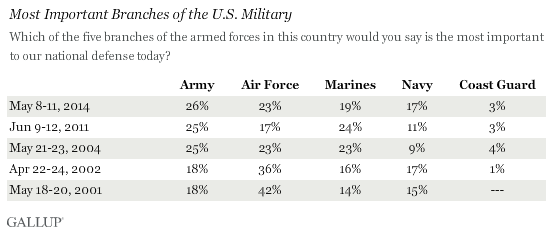
Americans believe that the U.S. Army is the most important service branch to national defense, followed closely by the Air Force. Fewer than one in five choose the Marine Corps or the Navy. The Army has edged out other military branches in Gallup surveys conducted throughout the last decade.
Trend: Most Important Branches of the U.S. Military
...
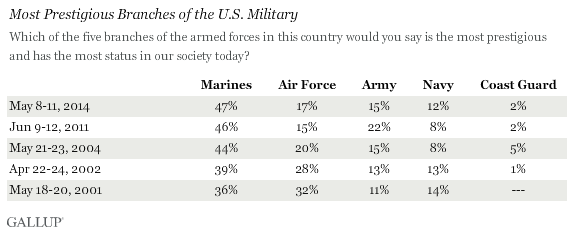
Importance does not necessarily equal prestige, however. While the Army has held a thin lead in perceived importance to the United States' national defense over the last decade, the Marine Corps has consistently been considered the nation's most prestigious military branch, widening its lead over the Air Force and Army during the same period. Currently, nearly half of Americans (47%) say the Marines are the most prestigious, with the Air Force a distant second, at 17%.
Trend: Most Prestigious Branches of the U.S. Military

Wednesday, October 24, 2012

Bayonets

ABC News reports:
The most memorable line of Monday night’s debate was President Obama’s pointed “horses and bayonets” jab at Mitt Romney for questioning what Romney said was a shrinking U.S. Navy.
Obama responded that Romney “hasn’t spent enough time looking at how our military works. ” He added, “You mentioned the Navy, for example, and that we have fewer ships than we did in 1916. Well, governor, we also have fewer horses and bayonets, because the nature of our military’s changed.”
Horses and bayonets quickly became a Twitter punchline, but while they may no longer be needed for bayonet charges, it turns out the Pentagon still owns a hefty arsenal of bayonets.
The Army said today it has 419,155 bayonets in its inventory. The Marine Corps has another 195,334 bayonets that it bought in 2004 and it plans on buying 175,061 more bayonets this year. A Marine official says it’s not accurate to add the two totals together as the new ones will include replacements for ones already in service as well as additional stocks.
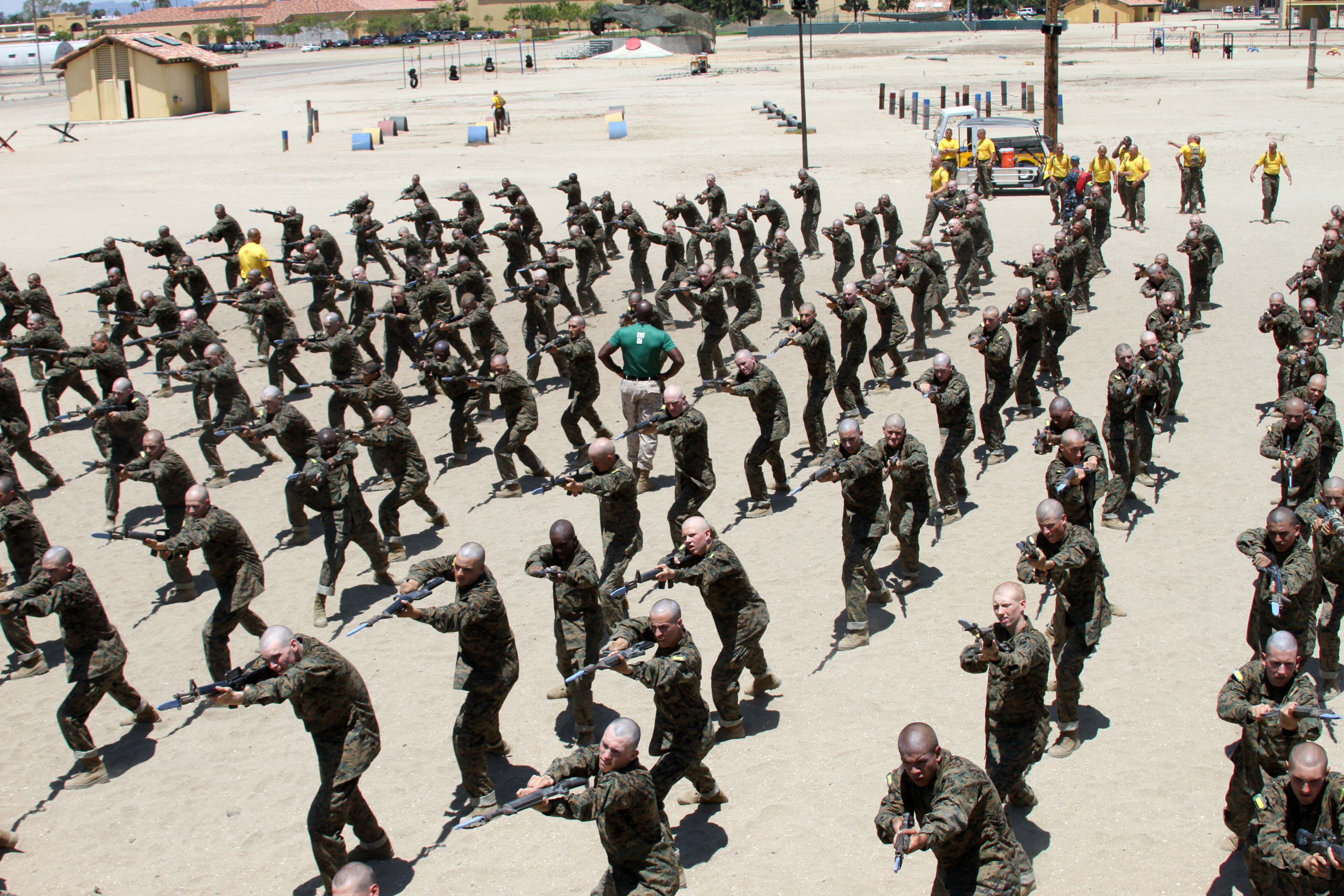
Aboard Marine Corps Recruit Depot San Diego, Staff Sgt. Leon S. Parker tells recruits how to use bayonets,  July 24, 2012:


At The Wall Street Journal, Julian E. Barnes writes:  "In 1916, Army and Marine Corps forces were relatively small, the World War I buildup having not begun. There were about 200,000 active duty Army soldiers and about 14,000 Marines, making it unlikely that there were more than the approximately 614,000 bayonets in the inventory today."

Saturday, September 22, 2012

An Overlooked Disaster

Our chapters on mass media and national security point out that American news organizations have drastically curtailed their international reporting staffs.  One result is that many events overseas -- even those involving Americans -- get only the most superficial coverage.  At The Atlantic, John Hudson writes:
The Taliban attack on an air base in southern Afghanistan on Friday [9/14] drew coverage for the way the insurgents cloaked themselves in U.S. army uniforms to gain a tactical advantage, but few have taken note of the historical proportions of the damage inflicted. John Gresham, at the Defense Media Network, has published a detailed account of the attack on Camp Bastion, in which two Marines were killed, six U.S. Marine Corps jet fighters were destroyed, and two more  "significantly" damaged. Those facts were all carried in most reports, but if that just sounds like a typical damage report from a decade-long war, you're wrong. Gresham explains the devastating damage done to VMA-211, the name of the Marine Corps attack squadron that was most affected last week, noting that it is "arguably the worst day in [U.S. Marine Corps] aviation history since the Tet Offensive of 1968." Or you could go back even further. "The last time VMA-211 was combat ineffective was in December 1941, when the squadron was wiped out during the 13-day defense of Wake Island against the Japanese."

Wednesday, August 22, 2012

Two Thousand US Deaths in Afghanistan

The New York Times reports:
Nearly nine years passed before American forces reached their first 1,000 dead in the war. The second 1,000 came just 27 months later, a testament to the intensity of fighting prompted by President Obama’s decision to send 33,000 additional troops to Afghanistan in 2010, a policy known as the surge.
In more ways than his family might have imagined, Lance Corporal Buckley, who had just turned 21 when he died, typified the troops in that second wave of 1,000. According to the Times analysis, three out of four were white, 9 out of 10 were enlisted service members, and one out of two died in either Kandahar Province or Helmand Province in Taliban-dominated southern Afghanistan. Their average age was 26.
The dead were also disproportionately Marines like Lance Corporal Buckley. Though the Army over all has suffered more dead in the war, the Marine Corps, with fewer troops, has had a higher casualty rate: At the height of fighting in late 2010, 2 out of every 1,000 Marines in Afghanistan were dying, twice the rate of the Army. Marine units accounted for three of the five units hardest hit during the surge.
AP reports:
Public opinion remains largely negative toward the war, with 66 percent opposed to it and just 27 percent in favor in a May AP-GfK poll. More recently, a Quinnipiac University poll found that 60 percent of registered voters felt the U.S. should no longer be involved in Afghanistan. Just 31 percent said the U.S. is doing the right thing by fighting there now.
Not since the Korean War of the early 1950s — a much shorter but more intense fight — has an armed conflict involving America's sons and daughters captured so little public attention.
"We're bored with it," said Matthew Farwell, who served in the U.S. Army for five years including 16 months in eastern Afghanistan, where he sometimes received letters from grade school students addressed to the brave Marines in Iraq — the wrong war.
A poll in late May asked Americans to name the most important issue facing the country.  Just three percent chose Afghanistan. No wonder: a study by the Project for Excellence in Journalism found that Afghanistan has seldom gotten heavy news coverage in recent years:

Tuesday, May 29, 2012

The Young Marines

Daniel de Vise writes at The Washington Post:
Bob Nobles and Cornell Wright might not have a chance to serve their country when they are adults. No matter: They are serving it now.
“Good morning, Young Marines,” barked 1st Sgt. Vivian Price-Butler, greeting Bob and Cornell and eight other boys Friday morning in her small classroom at Kennedy Krieger High School.

“Good morning, First Sergeant,” they replied in unison, standing straight and still.
The Young Marines is an education and service program reaching 10,000 youths around the nation and overseas. Of its more than 300 units, only one is dedicated to students with special needs.
Founded in 1993, the Kennedy Krieger program serves 24 students at a high school for children who cannot be accommodated in traditional schools. Bob, a 16-year-old sophomore from New Windsor, has autism. Cornell, a 17-year-old junior from Glendale, has an intellectual disability. Other students have cerebral palsy, Down syndrome or brain injuries.
Price-Butler, known affectionately as First Sergeant around the Baltimore school, is not a trained teacher. Yet, 10 or 20 years from now, she is the Kennedy Krieger educator most likely to be getting e-mails and baby pictures from Bob and Cornell and the other Young Marines.