Anyone with eyes could tell you the ex-Qatari plane lacks the same countermeasures, as I explained in this video for @Independent https://t.co/sAhaeNuWRi pic.twitter.com/UQLjZygSjg
— Andrew Feinberg (@AndrewFeinberg) July 11, 2026
Anyone with eyes could tell you the ex-Qatari plane lacks the same countermeasures, as I explained in this video for @Independent https://t.co/sAhaeNuWRi pic.twitter.com/UQLjZygSjg
— Andrew Feinberg (@AndrewFeinberg) July 11, 2026


Those are F/A-18 Hornets flown by the Navy and Marine Corps pic.twitter.com/a11RblZcVQ
— Dave Brown (@dave_brown24) September 18, 2025
Rep. Nancy Mace is on a roll today. After her official account posted photos of Navy fighter jets to celebrate the Air Force's birthday, her private account has posted photos from the Swedish Air Force pic.twitter.com/m0VH3FfRl4
— Dave Brown (@dave_brown24)Those are the Blue Angels, flown by the Navy pic.twitter.com/RFplykXqmJ
— Dave Brown (@dave_brown24) September 18, 2025
Rep. Nancy Mace is on a roll today. After her official account posted photos of Navy fighter jets to celebrate the Air Force's birthday, her private account has posted photos from the Swedish Air Force pic.twitter.com/m0VH3FfRl4
— Dave Brown (@dave_brown24) September 18, 2025
Many posts have discussed the US military.
Mission
The B-2 Spirit is a multi-role bomber capable of delivering both conventional and nuclear munitions. A dramatic leap forward in technology, the bomber represents a major milestone in the U.S. bomber modernization program. The B-2 brings massive firepower to bear, in a short time, anywhere on the globe through previously impenetrable defenses.
Features
The B-2 provides the penetrating flexibility and effectiveness inherent in manned bombers. Its low-observable, or "stealth," characteristics give it the unique ability to penetrate an enemy's most sophisticated defenses and threaten its most valued, and heavily defended, targets. Its capability to penetrate air defenses and threaten effective retaliation provides a strong, effective deterrent and combat force well into the 21st century.
The revolutionary blending of low-observable technologies with high aerodynamic efficiency and large payload gives the B-2 important advantages over existing bombers. Its low-observability provides it greater freedom of action at high altitudes, thus increasing its range and a better field of view for the aircraft's sensors. Its unrefueled range is approximately 6,000 nautical miles (9,600 kilometers).
The B-2's low observability is derived from a combination of reduced infrared, acoustic, electromagnetic, visual and radar signatures. These signatures make it difficult for the sophisticated defensive systems to detect, track and engage the B-2. Many aspects of the low-observability process remain classified; however, the B-2's composite materials, special coatings and flying-wing design all contribute to its "stealthiness."
The attacks on Iran "were a remarkable feat. Seven vast, space-age style aircraft, each 170 feet wide, flew 7,000 miles nonstop from their airbase near Kansas City to targets in central Iran, undetected by enemy radar. They refueled mid-air, multiple times. They each dropped their 15-ton bombs with extraordinary precision. And then they flew straight home again, only touching back down in Missouri on Sunday afternoon. (Watch the vid here of their return.)"
"Yes, B-2 bombers have toilets on board. Yes, their crews take turns to cook microwave meals, and eat, and nap. (This Defense News interview with B-2 bomber pilots from 2019 answers a lot of questions about what it’s actually like on board ... and The Atlantic did a great profile of a long-range B-2 bombing raid back in 2018.)"
Many posts have discussed the US military.
As of the end of March, the U.S. military had 1.32 million active-duty members, according to DMDC figures. This is an increase of 1.5% over the year prior, when there were about 1.30 million. (Active-duty military are those who work for the military full time. They do not include personnel in the Reserve or National Guard.)
Nearly 450,000 active-duty military members serve in the Army, the most of any military branch. The Navy has the second-largest number of active-duty members (about 334,000), followed by the Air Force and Marine Corps. The Coast Guard and Space Force are much smaller, with fewer than 50,000 active-duty members each.
All branches of the military have gained active-duty members in the past year. The Navy has gained the most in overall numbers (about 7,300). The Space Force and the Coast Guard have grown the most in percentage terms (6.1% and 3.4%, respectively).
Active-duty military members are assigned to work in every state and internationally, according to DMDC data. A large majority (86%) are stationed domestically, while 14% are stationed internationally.
The number of active-duty military working in each state varies greatly, based partly on the locations of military bases. California has the most active-duty military, with about 157,500. Virginia and Texas also have more than 100,000.
Six states have fewer than 1,000 active-duty military, and Vermont has the fewest of all with 128.
Some branches of the military have an especially large footprint in certain states:Texas has about 65,400 active-duty Army members, about 16,000 more than any other state. There are five Army bases there, the second-most of any state after Virginia.
Virginia (73,500) and California (72,500) have by far the most active-duty Navy members. No other state has even half that many, even though states like Florida, Maryland and Washington have roughly similar numbers of naval bases.
Colorado has about 4,300 active-duty Space Force members, nearly three times more than any other state. Three of the nation’s six Space Force bases are in Colorado
Many posts have discussed the US military.
Brandon J. Weichert at The National Interest:
The B-52 Stratofortress, designed in 1948 and first flown in 1952, is a durable and highly effective long-range bomber that has served the U.S. Air Force for over 70 years. Some say it might be the best bomber ever to fly.
Despite lacking modern stealth capabilities, it has played a crucial role in every U.S. conflict since World War II, from Vietnam to the fight against ISIS.
Powered by eight Pratt & Whitney turbofan engines and capable of carrying a 70,000-pound payload, the B-52 remains a reliable and cost-effective asset. Its longevity highlights both its robust design and the contrast with today’s often over-complicated and expensive military acquisition programs.
...
It cannot fly at supersonic speeds, but it does fly at 50,000 feet, and it can even help the U.S. Navy with anti-ship and mine-laying missions.
More than anything, the B-52 is durable. With just a few augmentations to the plane here and there each generation, the B-52 flies on, and it will continue to fly until it just about reaches its centennial.
Think about that. The B-52 Stratofortress was designed and deployed at a time when Harry S. Truman was president. Yet it remains the primary strategic bomber of the U.S. Air Force to this day.
That’s an incredible feat.
The total number of military personnel is almost 3.5 million strong, including DoD Active Duty military personnel (1,304,418); DHS’s Active Duty Coast Guard members (41,132); DoD Ready Reserve and DHS Coast Guard Reserve members (1,039,398); members of the Retired Reserve (208,032) and Standby Reserve (11,391); and DoD Appropriated and Non-Appropriated Funds civilian personnel (883,398). DoD’s Active Duty and DHS’s Coast Guard Active Duty members comprise the largest portion of the military force (38.6%), followed by Ready Reserve members (29.8%) and DoD civilian personnel (25.3%).
Active Duty Member Highlights
- Service Branches. The Army has the largest number of Active Duty members (471,990) followed by the Navy (325,395), the Air Force (321,618), and the Marine Corps (185,415). At a total of 1,304,418 DoD Active Duty members, the military force of 2018 is 4.8 percent smaller than it was in 2000, when there were 1,370,678 Active Duty members. From 2000 to 2018, the Army (-1.5%), Air Force (-8.5%), and Navy (-11.4%) all experienced a decrease in the number of members while the Marine Corps experienced an increase (+7.2%).
- Ratio of Ranks. The DoD Active Duty force is composed of 82.3 percent enlisted personnel (1,073,394) and 17.7 percent officers (231,024). Overall, the Active Duty force has 4.6 enlisted personnel for every one officer. In comparison, the Army and the Air Force have one officer for every 4.1 enlisted personnel, the Navy has one officer for every 4.9 enlisted personnel, and the Marine Corps has one officer for every 7.7 enlisted personnel.
- Gender. Women, who number 215,834, comprise 16.5 percent of the DoD Active Duty force, while 1,088,584 men comprise 83.5 percent of the DoD Active Duty force. Compared to 2000, the percentage of both Active Duty enlisted members and officers who are women has increased (from 14.7% and 14.4%, respectively, in 2000 to 16.2% and 18.0%, respectively, in 2018). Overall, the number and ratio of female enlisted members (174,331) to female officers (41,503) is 4.2 female enlisted members for every one female officer, while the number and ratio of male enlisted members (899,063) to male officers (189,521) is 4.7 male enlisted members for every one male officer.
- Race/Ethnicity. Nearly one-third (31.0%) or 404,851 of Active Duty members identify themselves as a racial minority (i.e., Black or African American, Asian, American Indian or Alaska Native, Native Hawaiian or Other Pacific Islander, Multi-racial, or Other/Unknown). As compared to 2010, the percentage of Active Duty members who identify themselves as a racial minority is higher in 2018 (31.4% of enlisted members and 22.7% of officers in 2010, to 32.7% of enlisted members and 23.5% of officers in 2018). The overall ratio of racial minority enlisted personnel (350,495) to racial minority officers (54,356) is 6.4 racial minority enlisted personnel for every one racial minority officer. To conform to the latest Office of Management and Budget (OMB) directives, Hispanic is not considered a minority race designation and only Active Duty members’ race was used to determine racial minority status. Regarding ethnicity, 16.1 percent of Active Duty members identify themselves as being of Hispanic or Latino ethnicity.
- Geographic Location. While the Active Duty population is located throughout the world, the three primary areas in which Active Duty members are assigned are the United States and its territories (87.3%), East Asia (6.4%), and Europe (5.0%). The ten states with the highest Active Duty military populations are California (153,505), Virginia (122,314), Texas (117,844), North Carolina (99,193), Georgia (65,371), Florida (60,251), Washington (58,115), Hawaii (41,803), South Carolina (39,237), and Colorado (35,012). Active Duty members in these ten states comprise 70.0 percent of the Active Duty personnel stationed in the United States.
- Age. Over half (52.3%) of Active Duty enlisted personnel are 25 years of age or younger, with the next largest age group being 26 to 30 years (20.7%), followed by 31 to 35 years (13.5%), 36 to 40 years (8.9%), and those 41 years or older (4.6%). Almost one-quarter (23.7%) of Active Duty officers are 41 years of age or older, with the next largest age group being 26 to 30 years (22.9%), followed by 31 to 35 years (21.1%), 36 to 40 years (17.7%), and those 25 years or younger (14.5%). Overall, the average age of the Active Duty force is 28.2 years. The average age for Active Duty enlisted personnel is 26.9 years, and the average age for Active Duty officers is 34.4 years.
- Education Level. Most enlisted members (80.5%) have a high school diploma and/or some college experience, while fewer have an Associate’s degree (10.5%) or a Bachelor’s degree or higher (8.4%). Most officers have a Bachelor’s degree or higher (84.8%). Compared to 2010, the percentage of total Active Duty members who have a Bachelor’s and/or an advanced degree increased for enlisted personnel (from 4.8% in 2010 to 8.4% in 2018) and officers (from 82.7% in 2010, to 84.8% in 2018).
- Marital Status. Just over half (51.5%) of Active Duty military members are married, which is lower than the percentage that were married in 2000 (53.1%). In 2018, almost half (48.0%) of enlisted members and a majority (67.5%) of officers report themselves as married. Over half (52.8%) of Active Duty males and nearly half (44.8%) of Active Duty females are married. In addition, 6.7 percent of DoD’s Active Duty members are in dual-military marriages.2 In 2018, 3.4 percent of enlisted personnel and 1.5 percent of officers are estimated to have divorced.
Americans believe that the U.S. Army is the most important service branch to national defense, followed closely by the Air Force. Fewer than one in five choose the Marine Corps or the Navy. The Army has edged out other military branches in Gallup surveys conducted throughout the last decade.
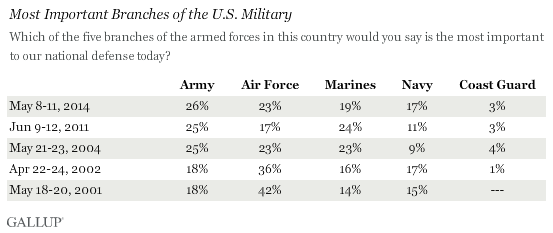
...
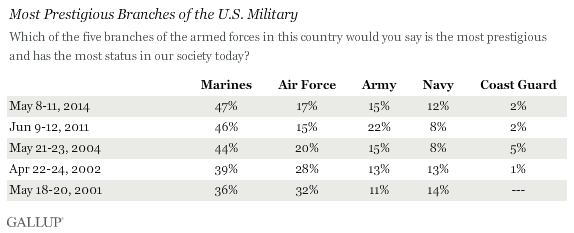
Importance does not necessarily equal prestige, however. While the Army has held a thin lead in perceived importance to the United States' national defense over the last decade, the Marine Corps has consistently been considered the nation's most prestigious military branch, widening its lead over the Air Force and Army during the same period. Currently, nearly half of Americans (47%) say the Marines are the most prestigious, with the Air Force a distant second, at 17%.
It is time for the private sector to aid in the search for potentially city-destroying asteroids and meteors, lawmakers said during a hearing Wednesday.
The House Committee on Science, Space and Technology made the call while hearing from NASA scientists and private-sector asteroid hunters during a hearing titled "Threats from Space," with both groups agreeing that something more needs to be done.
"Detecting asteroids should not be the primary mission of NASA," Rep. Lamar Smith, R-Texas, chairman of the House Committee on Science, Space and Technology, said at the hearing. "No doubt the private sector will play an important role as well. We must better recognize what the private sector can do to aid our efforts to protect the world."
The meeting Wednesday was the second of three aimed at understanding the threat to Earth posed by asteroids in space. The first hearing took place in late March, and addressed the ways governmental entities, such as NASA and the Air Force, are mitigating the risks posed by close-flying space rocks. The meetings were scheduled in response to a surprise meteor explosion over Russia and the close flyby of asteroid 2012 DA14 — both of which occurred on Feb. 15