Bessette/Pitney’s AMERICAN GOVERNMENT AND POLITICS: DELIBERATION, DEMOCRACY AND CITIZENSHIP reviews the idea of "deliberative democracy." Building on the book, this blog offers insights, analysis, and facts about recent events.
American teenagers spend hours online each day, with apps such as YouTube and TikTok dominating their attention. Thirty-five percent spend at least four hours a day on social media or playing video games. The amount of time teens spend engaged in these activities varies across households. The survey finds that teen girls raised by parents without college degrees are on more social media apps, spend more hours using them, and are less inclined to cut back than girls whose parents went to college, while among boys, the same divide emerges in the hours spent gaming.
The class divide in social media use may exacerbate existing inequalities instead of reducing them. Among teen girls, more active social media engagement is associated with negative personal outcomes, including less sleep, lower rates of reading, and lower feelings of personal satisfaction.
The majority of teenagers are spending multiple hours on social media every day. About four in 10 (39 percent) spend three or more hours of their day online. YouTube and TikTok are the most popular social media platforms teens visit. More than seven in 10 (72 percent) spend time on YouTube every week, while six in 10 say the same of TikTok. Gaming also eats up a significant portion of teens’ free time, although less so than social media. More than four in 10 (44 percent) teens spend at least an hour gaming every day.
Teen girls raised in less educated households are more likely to use Instagram (66 percent vs. 57 percent), Snapchat (49 percent vs. 44 percent), Facebook (31 percent vs. 15 percent), and X (12 percent vs. 6 percent). The education gap is largest in TikTok use. Nearly three-quarters (73 percent) of teen girls raised by parents without college degrees spend time on the app, compared with only about half (53 percent) of teen girls whose parents have college degrees. There is also a significant difference in the number of apps they use.[v] Forty-one percent of teen girls with non-college-educated parents report using at least four different social media apps, compared with 25 percent of teen girls raised by college-educated parents.
This same gap is also evident in the amount of time teen girls spend on social media. About one in five (21 percent) say they spend between one and two hours on social media every day. Thirty-nine percent of teens report they spend less than an hour a day or do not use social media at all. Teen girls whose parents did not go to college, however, log more hours on social media than any of their peers. Nearly half (49 percent) of teen girls raised by parents without a college degree report spending three or more hours a day using social media, compared with 36 percent of teen girls with college-educated parents.
Parental education is also correlated with teens’ efforts to reduce their screen time. Among girls, those raised in households with parents of higher education levels are more likely to report attempting to reduce their time spent online. Nearly six in 10 (58 percent) teen girls raised by college-educated parents say they have tried to reduce their social media activity in the past 12 months. In contrast, only 40 percent of teen girls who have non-college-educated parents report attempts to lessen their social media activity.
There is no evidence of the same divide among teen boys; they report similar social media usage patterns regardless of parental education. More evident education divides show up in boys’ gaming habits. Teen boys raised by parents without college degrees spend substantially more time gaming. Nearly three in 10 (28 percent) teen boys raised by parents without college degrees say they spend an average of four or more hours a day playing video games. Among teen boys with college-educated parents, only 19 percent play video games this often. Among teen girls, it’s only 7 percent.
Inequalities feed on one another. Kids from noncollege families engage in fewer extracurriculars,which in turn hurts their chances at getting into good colleges and getting good jobs.
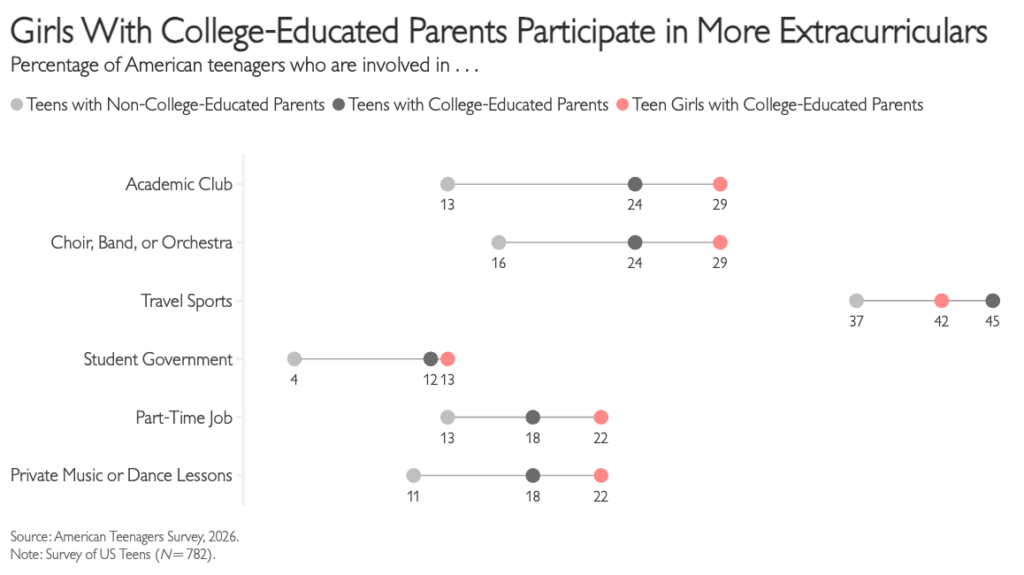
In addition to age, parental education levels shape how teens engage in extracurricular activities. Teens with college-educated parents tend to participate in a greater range of activities than those whose parents do not have a four-year college degree do. For instance, nearly one in four teens—including 29 percent of teen girls—with college-educated parents report participating in an academic club, compared with 13 percent of teens whose parents did not graduate from college. Teens with college-educated parents are also three times as likely to participate in student government or debate as those with less educated parents (12 percent vs. 4 percent).
With an expanding list of extracurriculars to participate in, teens live more scheduled lives now than ever before. Only 28 percent of teens say that they get at least eight hours of sleep every night. Forty-one percent say they get this much sleep a few times a week. Three in 10 teenagers report getting eight hours of sleep no more than once per week.
The survey from The Associated Press-NORC Center for Public Affairs Research highlights many Americans’ feeling of unease over the future of its representative government — particularly among young people. It presents a jarring contrast as communities around the country commemorate the nation’s 250th anniversary.
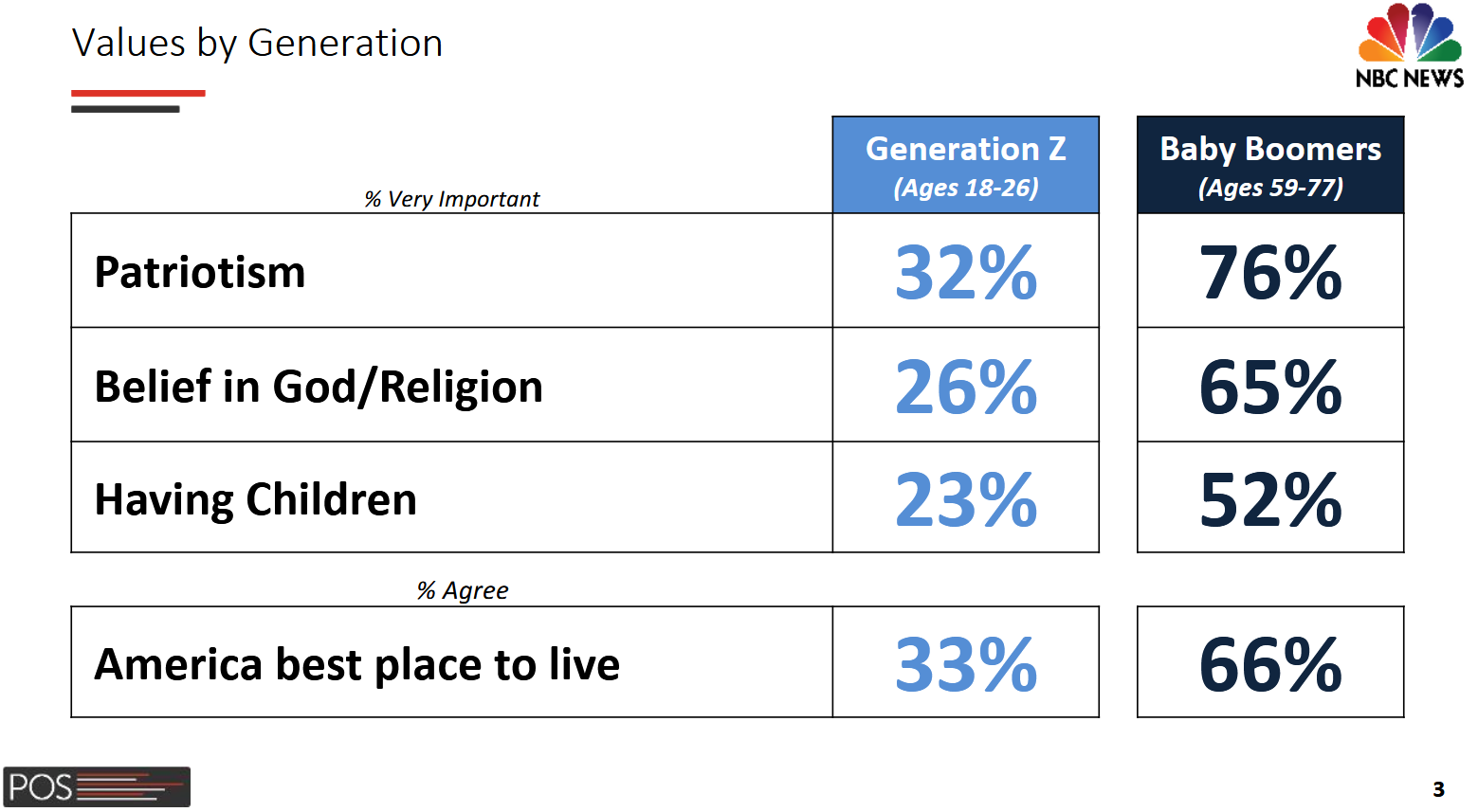
Only about one-quarter of Americans say the U.S. stands above all other countries in the world, the new poll found, while 44% say it’s one of the greatest countries in the world, along with some others. About 3 in 10 say there are better countries than the U.S., an increase from 19% in an AP-NORC poll conducted in June 2016.
Americans remain divided about whether diversity is an essential feature of the U.S.'s identity, and agreement about other aspects of the country’s underlying character appears to be eroding, the survey found. Americans are less likely to see a democratically elected government as “extremely” or “very” important to the United States’ identity as a nation than they were just a few years ago. About two-thirds of U.S. adults now say a democratically elected government is highly important to the U.S.’s identity as a nation, down from 80% in 2021.
...
Toung adults are much less likely than older Americans to believe the U.S. is special, compared with other nations, the poll found.
About 4 in 10, 44%, of U.S. adults under 30 say there are other countries better than the U.S., compared with 22% of U.S. adults ages 60 and older.
Fewer, too, see democracy as a key element of the U.S.’s identity. Only about half of Americans under 30 believe this, compared with 81% of those 60 and older.
Since 2012, the percentage of young adults who talk to their neighbors at least a few times per week dropped from 51 percent to 25 percent. Among seniors, the decline was only seven points (63 percent to 56 percent).
Compared with Americans without a degree, college-educated Americans are more likely to have worked with their neighbors to improve a condition in their community (46 percent vs. 34 percent), spent a social evening with a neighbor (58 percent vs. 46 percent), and exchanged texts or emails with a neighbor (65 percent vs. 45 percent).
Forty-nine percent of Americans who attend religious services weekly talk to their neighbors regularly, compared with only 31 percent of Americans who never attend religious services.
Executive Summary
The 2025 American Neighbor Survey explores the various ways in which Americans are—and are not—interacting with the people in their immediate communities. In the past decade, the frequency of neighborly interactions has plummeted. This withdrawal has been particularly prevalent among young adults, while seniors have remained more consistently in touch with their neighbors. College-educated Americans also experience stronger neighborhood ties. Compared with Americans who have a high school degree or less, college graduates are more trusting of their neighbors, socialize with them more frequently, and are quicker to rely on them for help in times of need. The report also examines the association between attending religious services and the health of neighborhood ties, finding that more frequent attendees are more engaged neighbors.
Americans’ relationships with news are rapidly evolving, with teenagers and adults navigating a far more complex and fragmented media environment than ever before, according to a new national study from the Media Insight Project, a collaboration of The Associated Press-NORC Center for Public Affairs Research, the American Press Institute, Northwestern University Medill School of Journalism, Media, Integrated Marketing Communications and the Local News Network at the University of Maryland’s Philip Merrill College of Journalism.
Influencers and independent creators have emerged as a significant — and growing — source of news and information across all generations, especially among teens and younger adults. More than half of Americans ages 13 and older (57%) say they get news and information from influencers or independent creators at least sometimes. Among teenagers ages 13-17, that share rises to 81%, signaling a shift in how younger Americans engage with the information ecosystem. Despite concerns about misinformation, most say influencers do at least somewhat well at verifying facts, being transparent, and offering different viewpoints.
... Local news continues to play an essential role in community life and remains the most trusted sector of the news ecosystem, even as its financial future in smaller markets remains uncertain. Americans ages 13 and older view local news largely positively, with 76% getting information from local news sources often or sometimes. Across age groups, local news outlets rank highest for trust, including for verifying facts, covering important issues, and providing useful information. While teens 13-17 are more likely to encounter local information via social media or local independent creators, older adults are more likely to get their local news from traditional outlets like television and radio — pointing to a generational shift in how communities stay informed.
...
The study also reveals widespread skepticism toward artificial intelligence as a source of news and information. Only about one in ten teens and adults say AI chatbots are more trustworthy than other sources, though two-thirds of Americans say they never use AI for news at all, suggesting low trust may be tied to limited exposure.
Beyond questions of trust and platforms, the findings underscore growing stress and fatigue in Americans’ relationship with news. While most feel confident in their ability to find reliable information, only 10% say news gives them a hopeful view of the world. Many actively avoid specific topics — particularly celebrity and political news. Rather than rejecting news altogether, people are managing their exposure by setting boundaries around their time online.
Politicians and social media companies are seen as the biggest sources of misinformation. Americans point to politicians (66%), social media companies (55%), and social media users (54%) as the primary drivers of misinformation. Clear partisan differences emerge here, with Democrats more likely than Republicans to assign responsibility to these actors (75% vs. 65% for politicians, 64% vs. 53% for social media companies). Local news outlets receive the least blame, which may help explain why trust in local journalism remains comparatively resilient even amid declining confidence in the media more broadly.
... Together, these findings suggest that journalism’s influence is no longer defined solely by legacy institutions, but by a comparative, choice-driven environment in which audiences weigh multiple sources against one another. The findings offer a nuanced portrait of the public navigating an increasingly crowded media landscape — one in which attention is fragmented but demand for reliable information remains strong.
In Fiscal Year 2025, federal outlays totaled over $7 trillion across 52 general spending categories. Within each of these categories, we trace spending at the line item and subcategory level to assign a total of $4.4 trillion in spending across three age groups: retirees; working-age adults; children and young adults. We classify the remaining $2.6 trillion as “all ages” because they finance broad public goods.
Retirees (ages 65 and older) receive $2.7 trillion, or 62 percent of the $4.4 trillion in age-assignable federal outlays, driven mainly by Social Security and Medicare.
Working-age adults (ages 26–64) receive $1.2 trillion, or 28 percent of age-assignable outlays, spread across Medicaid, Social Security disability benefits, veterans benefits, and Marketplace subsidies.
Children and young adults (under age 26) receive $449 billion, or 10 percent of age-assignable outlays, concentrated in Medicaid, SNAP, child nutrition, and education programs.
The heavy expenditure share on retirees is consistent with a voting model from the field of political economy. The retiree share is predicted to increase even more with an aging population and fiscal strain.
To repeat the obvious: correlation is not causation. Perhaps service does improve career readiness. But there is a very plausible alternative explanation for these correlations. Bright, ambitious kids know that service looks good on a college application or a resume. That is, they serve because they are primed to succeed, not the other way around.
A nationally representative survey of more than 3,000 U.S. youth ages 12-25, conducted by The Allstate Foundation and Gallup, finds that youth service is linked to positive outcomes in the areas of career readiness, connection and resilience.
Eighty-two percent of youth say they have participated in at least some form of service. Youth who serve report feeling prepared for a future career, connected to their community and able to handle whatever comes their way, with the greatest benefits seen among those who engage deeply or take on leadership roles.
The study also outlines practical steps for expanding opportunities and impact. The findings are based on a Gallup Panel web study conducted Nov. 17–Dec. 1, 2025, with a margin of error of ±2.5 percentage points.
Engaging in service is linked to greater reported benefits in the areas of career readiness, connection and resilience. Key examples include:
Career readiness: Half of young people (52%) report that service activities had a somewhat (38%) or very (14%) positive impact on feeling prepared for a future career.
Connection: Seventy-nine percent of young people report that service activities had a somewhat (47%) or very (32%) positive impact on feeling connected to their community.
Resilience: Youth with service experience are more likely to say they can handle whatever comes their way (66% vs. 52%).
So, what is happening with religion among young adults today? Some media reports have suggested there may be a religious revival taking place among young adults, especially young men, in the U.S. But our recent polls, along with other high-quality surveys we have analyzed, show no clear evidence that this kind of nationwide religious resurgence is underway.
On average, young adults remain much less religious than older Americans. Today’s young adults also are less religious than young people were a decade ago. And there is no indication that young men are converting to Christianity in large numbers.
For the second straight year, about one in five Americans say they would like to leave the U.S. and move permanently to another country if they could. This heightened desire to migrate is driven primarily by younger women.
In 2025, 40% of women aged 15 to 44 say they would move abroad permanently if they had the opportunity. The current figure is four times higher than the 10% who shared this desire in 2014, when it was generally in line with other age and gender groups.
The percentage of younger women wanting to move to another country first rose decisively in 2016, the final year of President Barack Obama's second term. That year, Gallup surveyed the U.S. in June and July, after both parties’ presumptive nominees were set for the November election, which Donald Trump went on to win. Desire to migrate continued to climb afterward, hitting 44% in President Joe Biden’s last year in office and remaining near that level in 2025. This suggests a broader shift in opinion among younger women, rather than a solely partisan one.
About one-in-five U.S. adults (21%) say they regularly get news from news influencers on social media, identical to when we first asked this in 2024.
The term news influencers was defined in the survey as “individuals who have a large following on social media and often post about news or political or social issues.”
Younger adults are especially likely to get news from news influencers, with 38% of those ages 18 to 29 saying they regularly do this – more than four times the share of those 65 and older (8%). There is virtually no difference between Republicans and Democrats in the share who say they regularly get news from news influencers (21% and 22%, respectively, including those who lean to each party).
Digital sources have become an important part of Americans’ news diets – with social media playing a crucial role, particularly for younger adults. Overall, about half of U.S. adults (53%) say they at least sometimes get news from social media, roughly stable over the last few years.
Covid was a top issue in 2020 exit polls, with 52% of voters saying controlling the virus itself was more important than rebuilding the post-pandemic economy.That mindset shifted over the next four years, as closed schools, inflation and isolation frustrated voters — and changed many of their votes.
"Younger voters are in the process of understanding who they are and what their values are, and that was disproportionately shaped by Covid," says John Della Volpe, director of polling at the Harvard Kennedy School Institute of Politics. "It intensified economic anxiety and created this survivalist mindset.""Democrats helped create this vacuum, which was filled by Trump and Trump-aligned podcasters and influencers."
Case in point: In 2020, voters under 30 broke for Joe Biden by 24 points, but in 2020, Kamala Harris only won the youth vote by 4 points, The Atlantic reports.
And many parents in deep blue cities and towns flipped their politics after seeing the effect of school closures and Covid isolation on their kids.
...
Those who experience these events from the ages of 18 to 25 are more likely to develop a lasting lack of trust in political institutions and leaders, according to a study from the Systemic Risk Center at the London School of Economics.
"You can think of epidemics as somewhat of a stress test for governments. Leaders have to respond fast and with the right policies," says Orkun Saka, the study's author. "There is almost no way to get it completely right. When you get it especially wrong, there is a deep scar in the eyes of the young generation."
Studyafterstudyafterstudyhas confirmed what everyone I know has expressed: that the pandemicaltered our sense of time, whichhas in turn warpedour memory. Onestudyfrom a year into the pandemic asked participants to describe their experience of time and then sorted their responses into formal-sounding but utterly familiar categories, such as “temporal rift” (“Everything that happened before the pandemic feels like it happened in some distant era, in the ‘Before Times’’’) and “temporal vertigo” (“The pandemic itself seems to be going on for both 10 years, and two weeks”).
The covid-19 pandemic, which to date has killed between 7 million and 20 million people worldwide, including more than 1.2 million Americans, is almost perfectly designed to be forgotten.
For starters, it had two modes, both of which resist memory. One mode was horrific. People saw loved ones die struggling for breath — or couldn’t see them at all because of safety protocols. Front-line health workers risked their lives and witnessed horrors in understaffed, underequipped hospitals. For those who experienced the pandemic as extreme trauma, memories of specific events are often too painful to revisit — and acute stress can make retrieving those memories more difficult.
The other pandemic mode was humdrum. Most of us who were spared life-and-death trauma probably experienced the pandemic as featureless tedium: day after day in the same place with the same people and no present or future events to divide the calendar into little memorable bites. “Gone are the rehearsals that made Sundays Sunday, the town board meetings that made Wednesdays Wednesday,” I wrote at the time, in a column about why my family of nonbelievers decided to hold a Zoom Shabbat (essentially, to make a Friday feel like Friday). “Time stretches out, unmarked, unshaped and, therefore, incomprehensible.”
In fact, starting in the past decade, the share of “kinless” prime-aged (18-55) adults — defined here as those who are never married and have no children in the home — exceeded the share of Americans who are married with children for the first time in our nation’s history.
This trend is an indication of what we have called “the closing of the American heart,” as fewer young adults take the plunge, get married and start a family. Among the many reasons for the decline in marriage is that more and more young men and women are prioritizing a “Midas Mindset” over a “Marriage Mindset” — that is, focusing on education and work like Taylor did, rather than on love and marriage. Consequently, a growing share of young women and men are slated to never marry. In fact, demographers project that a staggering share of today’s young adults — one in three — will never marry, as the Institute for Family Studies reported.
This decline in marriage is linked to the growing share of Americans who do not have children: in fact, more than 1 in 5 American 50-something adults have never had kids, according to Pew Research Center. Moreover, the share of younger Americans who don’t think they will ever be parents is growing. As Pew reports, “the share of U.S. adults younger than 50 without children who say they are unlikely to ever have kids rose 10 percentage points between 2018 and 2023 (from 37% to 47%).”
Demographer Lyman Stone projects that a record share of today’s young adults will never have children — probably about 1 in 4 men and women in their twenties now will go through life without ever having children.
The repercussions of a kinless future for more American adults extend far beyond a lonely holiday season for the growing share of women and men who have no immediate kin. As the family falls, loneliness rises, deaths of despair surge and the “pursuit of happiness” becomes more unattainable not just for individuals but communities across the nation. That’s because both marriage and parenthood are linked with increased mental and emotional well-being and better overall physical health for both men and women. And while many people today wrongly believe that a satisfying career and a good income are the keys to happiness, the No. 1 predictor of overall life satisfaction is how satisfied people are in their marriage. In fact, as “Get Married” notes, men and women who are happy in their marriages are 545% more likely to be happy in their lives than those who are unhappily married or those who are unmarried.
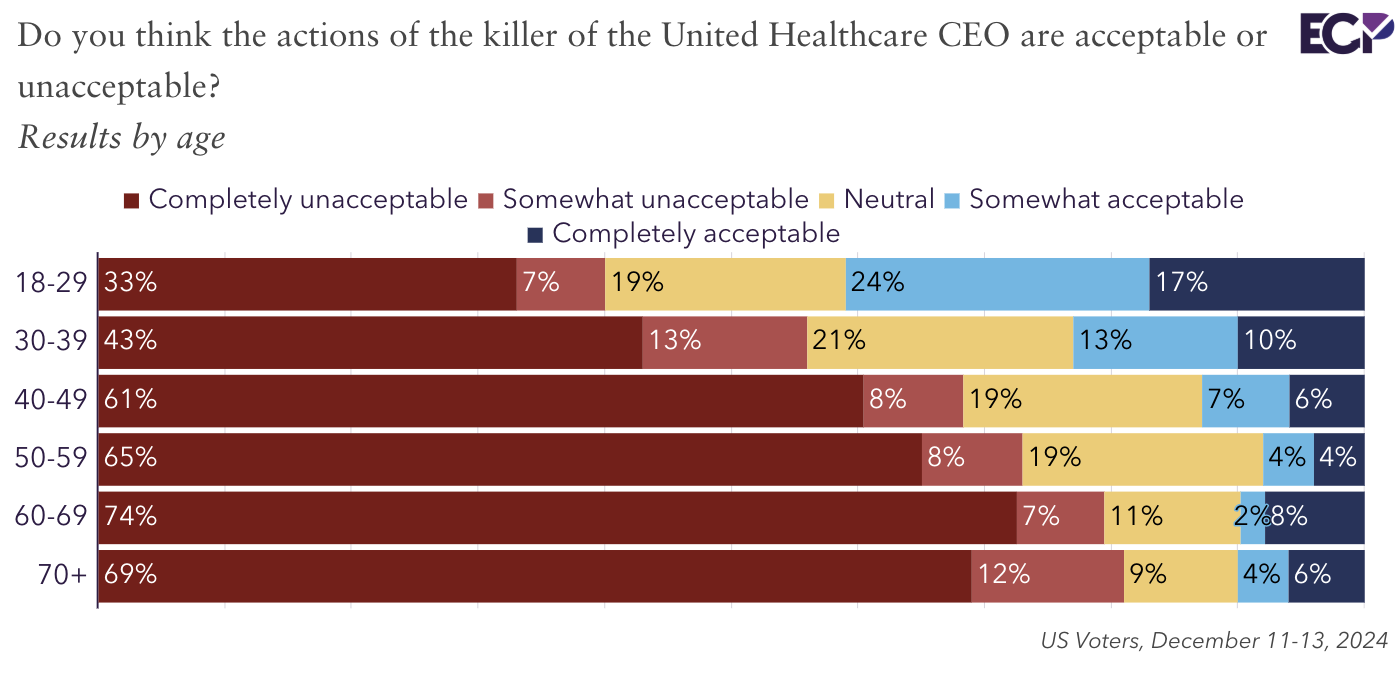
A majority of voters (68%) think the actions of the killer of the United Healthcare CEO, Brian Thompson, are unacceptable. Seventeen percent find the actions acceptable, while 16% are unsure.
“While 68% of voters overall reject the killer’s actions, younger voters and Democrats are more split — 41% of voters aged 18-29 find the killer’s actions acceptable (24% somewhat acceptable and 17% completely acceptable), while 40% find them unacceptable; 22% of Democrats find them acceptable, while 59% find them unacceptable, this compares to 12% of Republicans and 16% of independents who find the actions acceptable, underscoring shifting societal attitudes among the youngest electorate and within party lines,” [Emerson poll director Spencer] Kimball said.
Men were slightly more inclined to find the actions acceptable compared to women: 19% said the actions were acceptable compared to 14% of women.
But in the wake of this election, most students say they don’t feel like their vote matters.
A November Student Voice survey by Inside Higher Ed and College Pulse found 57 percent of college students feel like their voice/vote makes a difference not much or not at all following the outcome of the 2024 presidential election. Only 14 percent of respondents said they strongly agree that their vote makes a difference, and the remaining 29 percent believe their vote matters somewhat.
Voter apathy is not unique to college students. Approximately one in three Americans said they felt exhausted with politics after the election. But campus leaders are hoping to keep young voters engaged in the democratic process, not seeing voting as the end goal but one piece of the puzzle.
If you’re reading this memo, you probably know what the filibuster is. But it turns out that a plurality of Americans don’t!
The good news is that voters do know which parties control which branches of the federal government. A majority of voters overall (and a plurality of young voters) were able to correctly identify that Republicans currently control the House of Representatives and Democrats currently control the Senate. Large majorities of both voters overall and voters under 30 correctly identified Republicans as the party that has appointed a majority of sitting Supreme Court justices.
But when asked to identify the correct description of each process out of a list of three (including two incorrect options), there was a substantial age gap: young voters were much less likely than voters overall to identify the correct description of how the Supreme Court appointment, Electoral College, and constitutional amendment processes work. They were also less likely to identify the correct definition of “gerrymandering” than voters overall. A plurality of both young voters (48.4%) and voters overall (40.3%) said that they did not know which description of the Senate filibuster was most accurate.