Search This Blog

Showing posts with label social security. Show all posts

Friday, October 16, 2026

Approaching the Cliff on Social Security and Medicare

 Many posts have discussed Social Security and Medicare.

Jessica Riedl at Brookings:

Social Security and Medicare finances are headed for a reckoning. Social Security has run an annual deficit since 2010, and its trust fund is projected to become insolvent by 2032.1 The Medicare Part A trust fund is projected to follow in 2033.2 Trust fund accounting may sound like a green eyeshade technicality, but it is only one symptom of the broader unsustainability of both programs.

Consider that:
  • Far from paying for themselves through payroll taxes and premiums, Social Security and Medicare are running a combined $847 billion cash shortfall in 2026—comprising roughly half of the entire federal budget deficit. 
  • Their combined shortfall is projected to reach $2.7 trillion a year within a decade, becoming the overwhelming driver of rising federal budget deficits.4
  • Over the following three decades, the two programs are projected to run a cumulative cash shortfall of $157 trillion, with the annual gap reaching 12.4% of GDP by 2056.5
  • All told, these shortfalls will account for nearly 80% of all federal budget deficits projected over the next three decades.
Clearly, something has to give—before these shortfalls drive the federal debt to a projected 240% of GDP within thirty years and push interest costs high enough to consume a majority of annual tax revenue.6 Both parties created this unsustainable path, repeatedly expanding Social Security and Medicare benefits well beyond available revenues while failing to account for longer lifespans, fewer workers per retiree, and rising health care costs.

Nor has either party offered a solution. Republican lawmakers take new taxes off the table, while President Trump opposes any benefit reductions. Democratic leaders take benefit changes off the table while pledging to limit new taxes to the wealthiest families and corporations. Neither side will admit that reining in these costs will require both reductions in scheduled benefits and new broad-based taxes.

This report aims to show that Social Security and Medicare sustainability reforms can be designed within progressive principles of protecting low-income seniors and promoting income redistribution down the income ladder. Specifically, it shows that:
A) While benefits for the poorest seniors must be protected, a growing share of today’s Social Security and Medicare spending redistributes income upward—from working families to millions of wealthier seniors whose benefits often far exceed their lifetime contributions to the system. This includes close to $5.6 trillion in benefits set to be paid over the next decade to seniors with pre-benefit incomes over $100,000 (in 2026 dollars), including $2.0 trillion to those above the $200,000 threshold.
B) The soaring cost of these benefits threatens to absorb every plausible tax increase on the wealthy, and even on the non-wealthy, leaving little or no room to fund other progressive priorities such as education, health care, climate, and childcare.
C) Because sharp tax increases face broad opposition, escalating Social Security and Medicare costs are already squeezing spending on other progressive programs—a trend likely to accelerate.
While the “just tax the rich” approach remains popular among progressives, the notion that it alone can close all or even most of a thirty-year, $157 trillion shortfall collapses under scrutiny. Mathematically, even seizing every dollar of billionaire wealth or taxing millionaires at 100% tax rates would fall short.7 Economically, marginal rates on top earners can rise only so far before the resulting economic and incentive effects begin to erode revenue. And politically, for nearly a century even unified Democratic governments have proven unable to enact substantial upper-income tax increases outside of major wars—a constraint likely to persist as Democrats increasingly represent the highest-earning regions, such as California and New York. Taxing the rich belongs in any sustainability plan, but it cannot spare middle-class taxpayers or other spending programs from bearing much of the cost.

Given these constraints, continuing to give retirement benefits for (often wealthy) seniors the first claim on federal revenue will force other priorities—poverty relief, education, health care, climate, childcare, family leave, and infrastructure—to compete for a shrinking pot of remaining tax dollars. Progressives can instead protect the poorest seniors, rein in benefits for wealthier ones, and reserve most new tax increases for those other priorities.


Thursday, September 10, 2026

Republicans for a Social Security Tax Hike?

 Many posts have discussed Social Security and Medicare.

Steve Thompson at WP:
For decades, Washington has replayed the same fight over taming the soaring national debt: Democrats cite a need for more taxes. Republicans refuse. And anyone who suggests cutting the biggest source of spending — federal retirement benefits — gets attacked.

But a coming crisis in Social Security appears to be pushing at least a few Republicans off the GOP’s long-standing pledge never to raise taxes.

This summer, Sen. Bernie Moreno (R-Ohio) joined Sen. Elizabeth Warren (D-Massachusetts) in proposing to raise the payroll tax cap so people with higher incomes pay more into the program. Now the idea is emerging as an acceptable fix among other GOP lawmakers, including Rep. Tom Cole (Oklahoma), the influential chair of the House Appropriations Committee.

“We’ve got too many people who say, ‘Well, we have to stay within the current income level or stay at the current tax rate,’” Cole said in an interview. “I’m willing to look at the tax rate. I am willing to raise the amount of income through tax.”

The rare GOP concessions on taxes come as lawmakers begin to confront a Social Security shortfall so large and so imminent that the party’s traditional demand for curtailing benefits is unlikely to suffice. In just six years, millions of Social Security recipients will absorb a 22 percent cut in benefits unless lawmakers provide an immediate infusion of nearly $500 billion.

“Twenty or thirty years ago,” when the shortfall was far in the future, “you could come up with a straight-faced solution” that solved the problem entirely by cutting future benefits, said Charles Blahous, a senior research strategist at George Mason University’s Mercatus Center who served from 2010 to 2015 as the Republican public trustee for Social Security.

Now the problem is so big and urgent, Blahous said, “I don’t think you can look at it with a straight face and not do all of the above.”

Grover Norquist, founder of Americans for Tax Reform and the longtime enforcer of Republican anti-tax orthodoxy, dismissed the crack in party discipline, arguing that Republicans should stick to demanding spending cuts. Otherwise, he said, they risk infuriating voters already angry about the high cost of living.

“When Republicans say no to tax increases, they win. When they say yes to tax increases, they lose,” Norquist said. “They don’t get spending cuts — at all. And, they get smeared in the next election.”

Saturday, August 22, 2026

Ticking Debt Bomb

 Many posts have discussed federal deficits and the federal debt.

Zachary Basu at Axios:

Zoom in: President Trump said in 2016 that he could eliminate what was then roughly $19 trillion in national debt within eight years. On Tuesday, the debt crossed $40 trillion, after growing by $3 trillion in the past year alone.About $32 trillion is owed to investors and other outside holders. The rest is debt the government owes to its own accounts, including Social Security and other federal trust funds.

Treasury must refinance $9.7 trillion in debt coming due this fiscal year while covering a deficit the Congressional Budget Office now projects at roughly $2.1 trillion.

That creates a punishing cycle: Old debt comes due, Washington replaces it with more expensive debt, and the resulting interest bill feeds future deficits.CBO projects annual deficits will average $2.4 trillion through 2036, pushing debt held by the public to 120% of GDP — above the record set after World War II.
...

The big picture: America's debt burden is approaching the point where it starts reshaping household finances, presidential politics and the country's economic choices.Long-term Treasury yields have climbed to their highest levels since 2007, raising borrowing costs across the economy — from mortgages to business loans — and making Washington's own debt more expensive to refinance.
Social Security's retirement trust fund is projected to run dry in late 2032, during the final months of the next president's first term.

Medicare's hospital trust fund follows in the second quarter of 2033.

Between the lines: Trump and Elon Musk promised to break Washington's addiction to debt without forcing Americans to swallow painful sacrifices.Musk launched DOGE with ambitions of cutting as much as $2 trillion from federal spending. Its final public tally claimed just $215 billion in savings — barely a tenth of that goal.

A federal audit released this month found billions in unsupported or inaccurate savings claims, including $27.4 billion tied to contracts that were still active.


Wednesday, August 12, 2026

Saving Social Security: Lotsa Luck

 Many posts have discussed Social Security and Medicare.

Jeff Stein at NOTUS:

A group of eight centrist senators is attempting to compel Congress to revamp Social Security, in what many in Washington see as the first real effort at overhauling the government’s biggest program in more than a decade.

The push, led by retiring Sens. Dick Durbin (D-Illinois) and Bill Cassidy (R-Louisiana), sets the stage for a major confrontation later this year with potential consequences for the 59 million seniors who currently receive benefits.

Their bill, the PROMISE Act, does not directly cut Social Security benefits or raise taxes to avert the program’s approaching budget shortfall. Rather, it would task a bipartisan board with writing a plan to keep the pension system funded for another 50 years, likely through trillions of dollars in tax hikes and benefit cuts. The legislation would also establish parliamentary rules aimed at pushing Congress to act on the board’s proposal.

...

AARP — the roughly 40-million-members-strong seniors’ organization — has begun urging lawmakers to reject the bill, highlighting polling that suggests 85% of Americans support maintaining or increasing benefits. Sen. Bernie Sanders (I-Vermont) has begun calling for Senate Democrats to reject benefit cuts and instead stand behind financing Social Security by repealing the existing limit on payroll taxes for those earning more than $184,500 per year, arguing “the Democratic Party is ever to regain the faith of ordinary Americans it must stand firm on the issue of Social Security.”

Even conservatives who have long called for Social Security reform are mobilizing against it. Grover Norquist, the antitax crusader who leads the conservative Americans for Tax Reform, said in an interview that he has begun lobbying congressional Republican leadership to oppose the bill. Norquist called the legislation a “very real effort by the left” to convince Republicans to support tax hikes.

One Senate Democratic aide, granted anonymity to candidly assess legislative dynamics, said, “I will eat my shoe” if the bill passes this year.

Durbin acknowledged those odds: “Miracles do occur,” he said.

In another potential sign of the legislation’s radioactivity, half of its original sponsors — Cassidy, Durbin, Tillis and Republican John Cornyn of Texas — are leaving the Senate at the end of this year. (Cassidy and Cornyn lost their primaries against Trump-backed challengers.)

Tuesday, July 7, 2026

Saving Social Security

Many posts have discussed Social Security and Medicare.

 Jessica Riedl at The Atlantic:

Since the mid-1990s, Social Security trustees have warned lawmakers that insolvency was coming in the 2030s. Why are lawmakers seemingly content to wait until we reach that cliff, now projected for 2032? Because so many voters misunderstand how the system works and steadfastly refuse to accept the changes needed to fix it. Interest groups have capitalized on those fears, savaging any politician who dares to touch senior benefits or taxes. When House Republican Leader Paul Ryan proposed reforming Medicare, opponents ran a television ad portraying him pushing an elderly woman in a wheelchair off a cliff.

 As policy, Social Security is not complicated. Closing the gap between revenues and benefits involves three broad levers: raising payroll taxes, hiking the eligibility age, and trimming benefit formulas for wealthier seniors. Fixing Social Security is a matter of negotiating how far to pull each lever. I’ve attended policy dinners where Republican and Democratic lawmakers quietly outlined, with relative ease, a plausible deal that would gradually raise the normal eligibility age from 67 to about 69, trim benefits for higher earners, and raise the annual earnings limit for the Social Security payroll tax to somewhere between $250,000 and $300,000.

...

Social Security actuaries calculate that eliminating the wage cap (without those taxes accruing additional benefits) would keep the system out of deficit for just three years and close only about half of its long-term shortfall. So additional major solvency reforms are still necessary.

...

Even liberal economists estimate that additional tax revenues begin leveling off as marginal tax rates reach the high 50s, and they begin losing money at rates somewhere between 60 and 73 percent. This leaves room to raise marginal tax rates on high earners by perhaps 6 to 12 percentage points. Raising the rich’s rates past that point may provide spiteful satisfaction but could reduce tax revenues, as high earners either stop earning additional wages or shift their compensation to lower-taxed investments or foreign jurisdictions.

...


Wednesday, June 10, 2026

Depletion Day


Lorie Konish at CNBC:
A Social Security trust fund used to pay retirement benefits may run out in late 2032, three months earlier than what had been projected last June, according to the new Social Security Administration annual trustees report released Tuesday.

Social Security uses incoming revenue from payroll taxes to pay benefits. When benefit payments exceed payroll tax income, the program relies on the trust funds to help make up the shortfall.

The report said that if the fund is depleted as projected, Social Security will only be able to pay 78% of retirement benefits.

The new projected depletion date follows the enactment of President Donald Trump’s “big beautiful” tax law, which Social Security’s chief actuary said in an August letter would have “material effects” on the financial status of the trust funds because it impacts income taxation of Social Security benefits. At that point, they estimated late 2032 for the retirement fund depletion date, pushed up from the 2025 trustees report estimate of the first quarter of 2033.

The OASI trust fund — formally known as Old-Age and Survivors Insurance, or OASI — if combined with the disability insurance trust fund, may be able to pay full benefits until the third quarter of 2034, when 83% of benefits will be payable, according to the new report. That estimate is unchanged from the prior trustees report.

The actuary's letter explained:

Because the revenue from income taxation of Social Security benefits is directed to the Social Security and Medicare trust funds, implementation of the OBBBA will have material effects on the financial status of the Social Security trust funds.  


Saturday, April 4, 2026

Federal Spending By Age

Many posts have discussed Social Security and Medicare.

Penn Wharton Budget Model:

  • In Fiscal Year 2025, federal outlays totaled over $7 trillion across 52 general spending categories. Within each of these categories, we trace spending at the line item and subcategory level to assign a total of $4.4 trillion in spending across three age groups: retirees; working-age adults; children and young adults. We classify the remaining $2.6 trillion as “all ages” because they finance broad public goods.
  • Retirees (ages 65 and older) receive $2.7 trillion, or 62 percent of the $4.4 trillion in age-assignable federal outlays, driven mainly by Social Security and Medicare.
  • Working-age adults (ages 26–64) receive $1.2 trillion, or 28 percent of age-assignable outlays, spread across Medicaid, Social Security disability benefits, veterans benefits, and Marketplace subsidies.
  • Children and young adults (under age 26) receive $449 billion, or 10 percent of age-assignable outlays, concentrated in Medicaid, SNAP, child nutrition, and education programs.
  • The heavy expenditure share on retirees is consistent with a voting model from the field of political economy. The retiree share is predicted to increase even more with an aging population and fiscal strain.

Tuesday, February 17, 2026

Immigrants, the Budget, and Social Security

Many posts have discussed immigration.

  David J. Bier, Michael Howard, and Julián Salazar at Cato:

This paper updates a model of these effects first developed by the National Academies of Sciences, Engineering, and Medicine (NASEM) to shed light on how immigrants, both legal and illegal, and their children affect government budgets. This analysis is the first to estimate the cumulative fiscal effect of immigrants on federal, state, and local budgets over 30 years.

The government first began gathering detailed information on benefits use by citizenship status in 1994. \
  • The data show:For each year from 1994 to 2023, the US immigrant population generated more in taxes than they received in benefits from all levels of government.
  • Over that period, immigrants created a cumulative fiscal surplus of $14.5 trillion in real 2024 US dollars, including $3.9 trillion in savings on interest on the debt.
  • Without immigrants, US government public debt at all levels would be at least 205 percent of gross domestic product (GDP)—nearly twice its 2023 level.
These results, which do not account for any of immigration’s indirect, tax-revenue-boosting effects on economic growth, represent the lower bound of the positive fiscal effects. Even by this conservative analysis, immigrants may have already prevented a fiscal crisis.

....

 Immigrants cost less as retirees: First, the savings on old-age benefits are not because immigrants are significantly less likely to retire. Instead, it is because they are far less likely to receive a government pension, since they were less likely to have government jobs and thus less likely to receive expensive government pensions. The main reason, though, is that they were simply barred from applying for Social Security and Medicare because they either arrived too late in life to earn the necessary qualifying work history, or they are here illegally or in a temporary status and ineligible for that reason.

A 2024 ITEP report by  Carl Davis, Marco Guzman, Emma Sifre:

  • Undocumented immigrants paid $96.7 billion in federal, state, and local taxes in 2022. Most of that amount, $59.4 billion, was paid to the federal government while the remaining $37.3 billion was paid to state and local governments.
  • Undocumented immigrants paid federal, state, and local taxes of $8,889 per person in 2022. In other words, for every 1 million undocumented immigrants who reside in the country, public services receive $8.9 billion in additional tax revenue.
  • More than a third of the tax dollars paid by undocumented immigrants go toward payroll taxes dedicated to funding programs that these workers are barred from accessing. Undocumented immigrants paid $25.7 billion in Social Security taxes, $6.4 billion in Medicare taxes, and $1.8 billion in unemployment insurance taxes in 2022.


Sunday, February 8, 2026

Social Security Trust Fund Runs Empty IN JUST SIX YEARS

Many posts have discussed Social Security and Medicare.

Mark J. Warshawsky at AEI:

Despite repeated warnings over the last three decades from the Trustees, the Congressional Budget Office, and others of the projected exhaustion of the Social Security Retirement Trust Fund in the mid-2030s, and the need to change the retirement program to make it sustainable, Congress and most Presidential administrations of both political parties have ignored the problem. Similarly, attempts to simplify and modernize the vocational standards for disability benefits have gone nowhere for two decades owing to opposition. Worse still, advocates, analysts and politicians have demagogued these issues, preventing reasonable discussions and compromise. This is despite the fast approach of the exhaustion date of the retirement fund and the context of increasing budget deficits, growing debt, and long-term interest rates higher than economic growth rates. It is becoming clear that this deep-seated reluctance to deal with difficult issues will postpone any action until right up to and perhaps even after the time of fund exhaustion, like recently experienced federal government shutdowns.
   Warshawsky notes some analysts have proposed fixes but adds:

Other analysts, perhaps more jaded, have claimed that even these second-best and third best actions will not be needed, because Congress will simply decide to maintain current benefit levels and continue to increase federal borrowing and fill in the growing Social Security funding gap with general revenues when exhaustion occurs.  Indeed, it has been implicitly doing this since the cash flow to the Trust Fund turned negative in 2010.  The counterargument to this view is that the resource needs for full Social Security benefits will continue to grow, and at the same time the Social Security fund is exhausted, so too will be the Medicare fund, and the costs for Medicaid, veterans, insurance exchange subsidies, and other health programs from rising health care costs and the demographic pressures of an aging population will explode the budget.  Other budget pressures come from national security needs in a competitive, even hostile, global scene, along with rising interest rates and inflation.  Moreover, there may be political resistance in some quarters of both parties to explicitly turn Social Security into a welfare program, dependent on general revenues and the annual budget process, away from its self-contained and stable revenue sources and long-term promised benefits.  These pressures and considerations can be expected to f inally warrant some policy seriousness, albeit with much angst. 


...


Saturday, December 20, 2025

Mitt Romney: Curb Spending and Raise Taxes

Many posts have discussed federal deficits and the federal debt.

Mitt Romney at NYT:
In 2012, political ads suggested that some of my policy proposals, if enacted, would amount to pushing grandma off a cliff. Actually, my proposals were intended to prevent that very thing from happening.

Today, all of us, including our grandmas, truly are headed for a cliff: If, as projected, the Social Security Trust Fund runs out in the 2034 fiscal year, benefits will be cut by about 23 percent. The government will need trillions of dollars to make up the shortfall. When lenders refuse to loan the money unless they are paid much higher interest rates, economic calamity will almost certainly ensue. Alternatively, the government could print more money, inducing hyperinflation that devalues the national debt — along with your savings.

Typically, Democrats insist on higher taxes, and Republicans insist on lower spending. But given the magnitude of our national debt as well as the proximity of the cliff, both are necessary. DOGE took a slash-and-burn approach to budget cutting and failed spectacularly. Europe demonstrates that exorbitant taxes without spending restraint crushes economic vitality and thus speeds how fast the cliff arrives.
And on the tax front, it’s time for rich people like me to pay more.

Wednesday, December 17, 2025

Social Security, Early and Late

Many posts have discussed Social Security and Medicare.

Brian O'Connor at NYT:
The amount of money you get from Social Security each month depends on when you start receiving benefits.

If you were born after Jan. 1, 1960, your full retirement age is 67. Wait longer, and your benefit rises by 8 percent a year until age 70.

But if you claim Social Security “early,” or before your full retirement age, your payment is reduced, often drastically. Claiming at 62 results in your payment being slashed by as much as 30 percent from the full retirement age benefit. The reduction shrinks each year until your full retirement age. Claiming early also means that any income you earn above a set limit results in part of your benefits being temporarily withheld until you reach full retirement age. While there are limited options to withdraw or pause to reset your benefits, you should consider your initial choice to be permanent.

There are understandable reasons people cannot wait. Ruth Finkelstein, executive director of the Brookdale Center for Healthy Aging at Hunter College, said many people who claim benefits at 62 have been out of work or underemployed for years.

“The mass of people who ‘retire’ between 50 and 62 were pushed out of the workplace or had to leave because of someone in the family with health concerns,” Ms. Finkelstein said. “They’ve been holding on until 62.”


About 40 percent of retirees get more than half of their retirement income from Social Security, according to the National Bureau of Economic Research. About 13 percent depend entirely on their benefits.

And there’s a fear factor: According to Schroders’ 2025 U.S. Retirement Survey, more than one-third of non-retired Americans say they worry that the Social Security program will run out of money. That worry is based on federal estimates that by 2033, the program trust fund can afford to pay only 77 percent of all scheduled benefits.

Monday, December 1, 2025

Silver Tsunami

 Many posts have discussed demographic trends, especially the decline of births and the aging of the population.

Emily Peck at Axios:

A silver tsunami is washing across our shores, as record numbers of Americans start hitting retirement age. The U.S. isn't ready.

...
About 45% of Americans will experience retirement-funding shortfalls if they retire at 65, according to Morningstar's projections from last year.
...
.Out-of-pocket medical expenses are escalating, the cost of in-home care is growing more than three times faster than inflation, and an increasing share of the elderly are spending more than a third of their income on real estate too.

...
Only about 14% of Generation X (those ages 45-60) have a pension plan, according to the National Institute on Retirement Security.

...
.On paper, retirement accounts might make older Americans appear wealthy. There are an increasing number of 401(k) millionaires, after all.

But with costs and debts rising — and lifespans lengthening — older Americans might run out of money, she says, or be forced to severely cut back spending. "We have shades of the retirement crisis right now."

Between the lines: There's massive inequality when it comes to retirement readiness — workers earning more than $150,000 a year contribute nearly 13 times more toward retirement than those earning under $50,000, a report out in November found.
...
...
About 56 million Americans age 65 and older receive Social Security benefits, per federal data.
The lowest-earning workers rely on it. Social Security is the primary source of income for retirees with household incomes below $50,000, according to Transamerica's 2025 retirement survey.

A cut of 20% to 25% in Social Security benefits would have a devastating impact on retirees who rely heavily or solely on those payments," said Kristi Martin Rodriguez, who leads the Nationwide Retirement Institute. "61% of current recipients say missing even half of a payment would leave them unable to survive financially."


Thursday, July 17, 2025

Demographics, Inflation, Social Security, and Medicare

Many posts have discussed Social Security and Medicare.

James C. Capretta at AEI:

During the raucous debate surrounding the GOP-sponsored reconciliation bill, the trustees for Social Security and Medicare rather quietly released their annual reports on the status of the programs’ respective trust funds. Their projections once again show that it will not be easy to stabilize the fiscal outlook without closing the widening gap between how much is spent on these entitlement programs compared to the dedicated taxes and premiums collected to pay for them.

The core problem is a transformative demographic shift that was not anticipated when the programs were established. In 1935, when Congress approved the original Social Security law, and again in 1965, when Medicare was created, the expectation was that birth rates would remain close to their historical levels. That proved to be a costly misjudgment as family sizes began to fall sharply starting in the early 1960s and then continued to decline in the succeeding decades.

Further, while there was an expectation of improvement in average lifespans, the progress has been more rapid than anticipated.

Finally, with Medicare and Medicaid providing insurance coverage starting in the 1960s, demand for services rose precipitously, as did the prices charged by hospitals and doctors. With few exceptions, annual spending on health care has been rising more rapidly than incomes for most of the last half-century.


Monday, June 16, 2025

Social Security Misinformation

Americans vastly overestimate the amount of waste in the budget

Alexandra Berzon,Nicholas Nehamas, and Tara Siegel Bernard at NYT:
Elon Musk stood before a giant American flag at a Wisconsin political rally in March and rolled out an eye-popping allegation of rampant fraud at the Social Security Administration. Scammers, he said, were making 40 percent of all calls to the agency’s customer service line.

Social Security employees knew the billionaire’s claim had no basis in fact. After journalists followed up, staff members began drafting a response correcting the record.

That’s when Leland Dudek — plucked from a midlevel job only six weeks earlier to run Social Security because of his willingness to cooperate with Mr. Musk’s Department of Government Efficiency — got an angry call from the White House, according to several people familiar with the exchange.

...

The numbers were accurate: Millions of people who had died before modern-day record keeping made it easy to verify deaths were listed as still being alive, experts said. But the agency automatically stops payments going to people listed as older than 115, except in rare circumstances.

One audit from 2015 found only 13 people older than 112 still receiving benefits. Other audits found payments being sent to an estimated 24,000 people who generally died more recently — a sign of Social Security needing tighter controls and monitoring — but not the millions Mr. Musk claimed.

Monday, October 28, 2024

Wealth and Inequality

Many posts have discussed the inequality of wealth in the United States.

 CBO:

In this report, the Congressional Budget Office examines changes in the distribution of family wealth (a family’s assets minus its debts) from 1989 to 2022. Building on earlier work, CBO used an expanded measure of wealth that includes families’ projected Social Security retirement and disability benefits.

  • Total Wealth. Adjusted for inflation, the wealth held by families in the United States almost quadrupled between 1989 and 2022, rising from $52 trillion (in 2022 dollars) to $199 trillion, at an average rate of about 4 percent per year. In 2022, retirement assets and accrued Social Security benefits made up about 40 percent of wealth. Nonretirement financial assets, home equity, and other assets made up the rest.
  • Concentration of Wealth. Over that 33-year period, family wealth was unevenly distributed, and that inequality increased. In 2022, families in the top 10 percent of the distribution held 60 percent of all wealth, up from 56 percent in 1989, and families in the top 1 percent of the distribution held 27 percent, up from 23 percent in 1989. The share of wealth held by the rest of the families in the top half of the distribution shrank from 37 percent to 33 percent over the same period. Families in the bottom half of the distribution held 6 percent of all wealth in both 1989 and 2022.
  • Value of Accrued Social Security Wealth. In 2022, accrued Social Security wealth accounted for 20 percent of families’ total wealth—up from 17 percent in 1989. Together, defined contribution and defined benefit pension plans accounted for a similar share, 21 percent. Throughout the period, Social Security wealth accounted for a larger portion of assets among families who had less wealth.
  • Changes in Wealth During the Coronavirus Pandemic. From 2019 to 2022, total family wealth increased by 17 percent, from $170 trillion to $199 trillion (in 2022 dollars), and median family wealth increased by 8 percent, from $466,500 to $504,000. Wealth inequality changed little during the pandemic: Throughout that period, the share of wealth held by families in the top 1 percent of the distribution remained at 27 percent.
  • Differences From CBO’s Previous Studies of Family Wealth. In 2016, CBO published a report that defined family wealth as a family’s marketable wealth—that is, its easily tradable assets minus its debts—and in 2022, CBO published a report that defined family wealth as the sum of a family’s marketable wealth and its promised income from defined benefit pension plans. This report updates those prior analyses with more recent data and expands the measure of wealth to account for future streams of income from Social Security benefits.


Tuesday, October 1, 2024

Reliance on Government Support

Aaron Zitner, Jon Kamp and Brian McGill at WSJ:

Americans’ reliance on government support is soaring, driven by programs such as Social Security, Medicare and Medicaid.

That support is especially critical in economically stressed communities throughout the U.S., many of which lean Republican and are concentrated in swing states crucial in deciding the presidential election. Neither party has much incentive to dial back the spending.
The big reasons for this dramatic growth: A much larger share of Americans are seniors, and their healthcare costs have risen. At the same time, many communities have suffered from economic decline because of challenges including the loss of manufacturing, leaving government money as a larger share of people’s income in such places.

For its analysis of government spending, EIG used a government definition of income that includes spending on programs that Americans pay into, such as Medicare and Social Security. Another major government health program—Medicaid—is also counted.

The analysis also includes unemployment insurance, food stamps, the earned income tax credit, veterans benefits, Pell grants, Covid-era payments and other income support. States help pay for some of these programs, such as Medicaid, but the federal government covers roughly 70% of the total cost.


Saturday, July 20, 2024

The Politics of the Federal Debt

Many posts have discussed federal deficits and the federal debt.

Brian Riedl nails it at Reason:

Paradoxically, the faster government debt escalates toward an inevitable debt crisis, the less politicians and voters seem to care. In the 1980s and 1990s, more modest deficits dominated economic policy debates and prompted six major deficit reduction deals that balanced the budget from 1998 through 2001. That era is long gone. In the past eight years, President Donald Trump and then Biden enacted $12 trillion in deficit-expanding legislation even as Social Security and Medicare shortfalls drove baseline deficits higher. When even liberal economists warned politicians that the post-pandemic economy faced a modest degree of rising inflation and interest rates—and that a federal spending spree would pour gasoline on that fire—lawmakers responded by enacting the $2 trillion American Rescue Plan. When inflation and mortgage rates resultantly surged to 9.1 percent and 7.8 percent, respectively, lawmakers brazenly continued the inflationary spending spree.

Why are we no longer responding to soaring debt and its economic consequences? While there are many factors, the three most important are these: 1) We've convinced ourselves that deficits do not matter; 2) partisan politics and the collapse of lawmaking have turned deficits into a weapon to be politicized rather than a problem to be solved; and 3) few of us are willing to face the unpopular reality that this issue cannot be resolved without fundamentally reforming Social Security, Medicare, and middle-class taxes.


Friday, June 28, 2024

Support for Social Security and Healthcare Coverage

Many posts have discussed Social Security and health care.

Pew:

A large majority of voters (80%) – including 82% of Biden supporters and 78% of Trump supporters – say that in thinking about the long-term future of Social Security, benefits should not be reduced in any way.

However, Biden supporters are more likely than Trump supporters to say Social Security should cover more people with greater benefits.46% of Biden supporters favor expanding Social Security coverage and benefits, compared with 28% of Trump supporters.

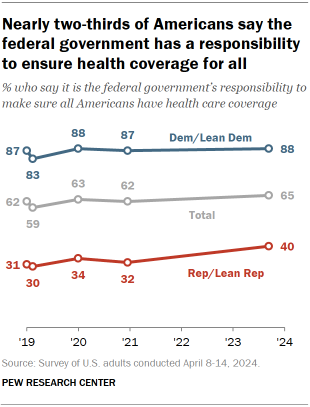
Most Americans (65%) continue to say the federal government has a responsibility to make sure all Americans have health care coverage.

Democrats overwhelmingly (88%) say the federal government has this responsibility, compared with 40% of Republicans,

.

The share of Republicans who say the government has a responsibility to provide health coverage has increased 8 percentage points since 2021, from 32% to 40%.

There are wide income differences among Republicans in opinions about the government’s role in health care:56% of Republicans with lower family incomes say the government has a responsibility to provide health coverage for all, compared with 36% of those with middle incomes and 29% of higher-income Republicans.

When asked how the government should provide health coverage, 36% of Americans say it should be provided through a single national program, while 28% say it should be through a mix of government and private programs. These views have changed little in recent years.

Democrats continue to be more likely than Republicans to favor a “single payer” government health insurance program (53% vs. 18%).

Tuesday, June 25, 2024

Immigration and Social Security

Many posts have discussed Social Security.

Tara Watson at Brookings:

The Social Security system faces a solvency crisis. It is mostly a “pay-as-you-go” system in that payroll taxes from current workers support current retirees. There is also a trust fund to finance the Social Security benefits of the unusually large cohort of retirees in the Baby Boomer generation (born 1946-1964, who turn 62—the earliest claiming age for those without disabilities—between 2008-2026). The Old-Age, Survivors, and Disability Insurance (OASDI) trust fund is expected to deplete in 2034, at which point there will only be enough funds coming into the system to cover about 75% of promised benefits. Over the 75-year projection window, the Social Security actuaries project a shortfall of 3.61% of taxable payroll, and the CBO suggests a deficit of 5.1% . To square the circle, more revenues need to be raised or benefits need to be cut. Similarly, the 2023 Medicare report suggests that the hospital insurance(HI) trust fund will be depleted in 2031 and the 75-year actuarial deficit is 0.62% of taxable payroll.

Immigrants contribute to both systems. Immigrants with permanent status and dual intent temporary visas are subject to the payroll tax which finances Social Security and Medicare. In addition, some undocumented immigrants work in formal sector jobs using a false Social Security Number; in 2013 it was estimated that the contributions to the Social Security system without a corresponding beneficiary totaled $13 billion. Temporary immigrants without a pathway to permanent status, such as seasonal workers, do not pay into the system.

Of course, many long-term immigrants are recipients of Social Security after they have contributed. On net, however, immigration is a fiscal positive for the Social Security system over a 75-year horizon. In their 2023 report, the Social Security Trustees estimate a 75-year Social Security shortfall of 3.61% of taxable payroll under their midline immigration assumptions. But that number fluctuates from a 3.21% with a high immigration scenario to a 4.02% deficit in the low immigration scenario

Sunday, June 9, 2024

Social Security: Be Afraid, Be Very Afraid


Dan Witters at Gallup
Seventy-three percent of U.S. adults under the age of 65 report that they are “worried” (41%) or “extremely worried” (32%) that Medicare will not be available when they are eligible to receive it, a six-percentage-point jump since 2022, according to a new study by West Health and Gallup. The increase in concern is sharpest among those aged 50 to 64 (up 13 points to 74%) and 40 to 49 (up nine points to 83%, the highest level of all age groups).

Worries over Social Security are even higher and have also grown significantly -- 80% of respondents report that they are worried (33%) or extremely worried (47%), compared with 75% in 2022. Among those aged 50 to 61 -- the group closest to being eligible for Social Security -- 81% are now worried, compared with 72% in 2022, a nine-point increase.

The Social Security trust fund will run out in just nine years.