Search This Blog

Showing posts with label Donald Trump. Show all posts

Sunday, October 18, 2026

Russia, Russia, Russia

 Many posts have analyzed how foreign governments try to influence American politics and policy. Russia and China are  prominent influencers.

Julian E. Barnes, Dustin Volz and Steven Lee Myers at NYT:
Less than three weeks from elections that could shift the balance of power in Congress, more signs are emerging that Russia and other foreign governments are once again seeking to influence American voters.

An online influence operation backed by the Russian government has been stepping up its attempts to sow division in the United States and inflame tensions around Israel as a political wedge issue, according to a new study by an independent company that tracks digital threats and foreign propaganda campaigns.

The influence operation known as Doppelgänger has created a flood of social media posts pushing themes of how bipartisan support for Israel is collapsing, according to Alethea, the threat intelligence company.

Doppelgänger is run by Russia’s Social Design Agency, a public relations firm. Both the U.S. government and the European Union have imposed punitive sanctions upon it.

On Wednesday, X, the social media platform, announced it had banned 13,000 accounts linked to three separate influence operations connected to Iran, Russia and China. The platform said the fake accounts amplified “content about U.S. politics, targeting candidates and public figures across the political spectrum.”

Michael Sinkewicz FOXBusiness:

President Donald Trump's decision to waive new sanctions on Russia is drawing sharp criticism from Republicans and Democrats alike, with several prominent GOP figures warning that the move could embolden Russian President Vladimir Putin as Moscow continues its war against Ukraine.

Trump signed an executive order Friday waiving key Russia-related sanctions and tariffs under the Graham Act, legislation he signed into law last month aimed at increasing economic pressure on Moscow.

The law, backed by the late Sen. Lindsey Graham, R-S.C., authorized tariffs of up to 100% on certain goods imported into the United States from major buyers of Russian oil and gas.

Former U.N. Ambassador Nikki Haley reposted FOX Business' reporting on Trump's executive order, calling the president's decision a potentially defining moment.

Monday, October 5, 2026

Killing Off Disability Data

"Every record has been destroyed or falsified, every book has been rewritten, every picture has been repainted, every statue and street and building has been renamed, every date has been altered. And that process is continuing day by day and minute by minute."   -- George Orwell, 1984


The administration is also stopping the collection of key statistics.

 Michelle Diament at Disability Scoop:

A proposed revamp of a key federal survey could lead to a drastic undercount of Americans with developmental disabilities, advocates warn.

The U.S. Centers for Disease Control and Prevention is calling for major changes to the 2028 version of the National Health Interview Survey. The annual questionnaire asks about 27,000 adults about their experiences with illness, chronic conditions, injuries, health access and more.

The current iteration includes 49 questions related to disabilities and functioning, according to Lindsay DuBois, a research associate at the nonprofit Human Services Research Institute, which published guidance for disability organizations and other stakeholders on the proposal. Under the new plan, she said that number would drop to 15.

Importantly, advocates say the revisions would leave out a question about whether a person’s difficulties with cognition, communication, mobility or other issues originated before the age of 22 as well as questions about challenges learning or completing everyday tasks, all of which were specifically designed to improve identification of people with developmental disabilities.

“The bottom line: The proposed revisions will make it harder to identify in the data people with disabilities — especially people with intellectual and developmental disabilities,” DuBois said.


Sunday, September 27, 2026

Fraud and Funny Numbers

Many posts have discussed federal deficits and the federal debt. Like previous efforts to reduce the deficit by cutting "waste, fraud, and abuse," DOGE was a failure.

Linda Qiu at NYT:
Since the White House formed a task force in March intended to combat fraud, top administration officials have repeatedly heralded its work, pointing to huge amounts of recovered payments and graft stopped in its tracks.

“We found $250 billion of fraud just since the president made me the fraud czar,” Vice President JD Vance, who leads the task force, said in a speech this month at the Republican midterm convention.

Yet some of the numbers Mr. Vance and his task force have promoted are overstated or lack specificity, and rely on temporary pauses in funding as well as cases and actions that long predated President Trump’s second term, according to a New York Times analysis of documents released by the administration. The task force also appears to be relying on claims of fraud that could not be verified or leaning on allegations of fraud that are being prematurely included.

In August, the White House published a so-called fraud ledger chronicling its work. It singled out three categories of fraud identified and eliminated since January 2025 — not, as Mr. Vance said, since this March, when the task force was established. As of Wednesday afternoon, the task force asserted it had found, or “uncovered,” $245.7 billion in fraud through data analysis, “stopped” $62.9 billion annually through actions like suspending providers and enacting rule changes, and “enforced” $59.1 billion through indictments, settlements and financial fines.

It is difficult to verify those figures because there is no publicly available breakdown of the total. A senior White House official said the task force chose not to itemize fraud schemes and actions to avoid compromising current law enforcement investigations.
The task force ledger’s chronology and a White House news release from August offer some details about $47 billion of the more than $300 billion the task force asserts it has identified or eliminated. But even that information falls short, leaving unclear how that amount is spread across the three categories.

Undoubtedly, the federal government loses vast amounts of money to fraud: $233 billion to $521 billion annually, equal to about 3 to 7 percent of federal spending, according to one estimate from the Government Accountability Office, an independent, nonpartisan agency that has scrutinized how the government spends taxpayer funds for more than a century.

Mr. Vance and his task force have ferreted out real cases of fraud, and their efforts to draw attention to the problem and recover taxpayer funds are laudable, experts said. But the task force’s unverifiable claims may undermine efforts at transparency and obscure the actual scale of the work it is performing.


Friday, September 25, 2026

Funny Numbers from the Census

"Every record has been destroyed or falsified, every book has been rewritten, every picture has been repainted, every statue and street and building has been renamed, every date has been altered. And that process is continuing day by day and minute by minute."   -- George Orwell, 1984


 Michael Strain at AEI:

Unfortunately, Trump’s attacks on the integrity of official statistics have continued. Last month, the US Census Bureau published an official brief that claims to have “readily determined with high confidence” that, of the 160 million voters in the 2020 presidential election, more than 128 million were citizens and more than 24,000 were noncitizens. “Over 32 million voter records remain to be analyzed.”

This report clearly falls short of the Census Bureau’s own standards of quality, integrity, and accountability. For example, it does not name its authors or provide relevant contact information for members of the public interested in asking questions about the report. Examining these unusual omissions, NPR reports that “the analysis was not conducted by career civil servants at the Census Bureau,” but by individuals affiliated with the Trump-aligned America First Policy Institute.

Then there is the fact that the brief’s subject matter is nakedly political. Illegal voting is a topic that the bureau previously would have bent over backward to avoid, lest it be accused of engaging in partisan politics. Not any longer. On the day the report appeared, Trump himself posted about it on social media, highlighting the 24,000 illegal vote figure and claiming that “The Census Bureau is going to analyze the next 32,000,000 Voters, and this number will explode. I WON THE ELECTION!”

The report’s analysis links a variety of databases together in an effort to determine if all the people who voted in the 2020 election were citizens. One is a private-sector database of voter registration and turnout records, which was used here to figure out who voted in the election. The authors then linked this database to internal government databases with the goal of determining the citizenship status of the individuals in the private-sector data on voter records.

This type of analysis is challenging for several reasons. Large private-sector databases of the type used by the brief’s authors often contain missing values for key variables (including home address, birth date, and name) that one would use to ensure that the same individual is being observed across multiple data sources. Normally, a study relying on this sort of data linking would provide extensive, detailed, and assessable information about the challenges the researchers faced and how they overcame them. That is how one convinces professional statisticians, economists, and demographers that one’s conclusions are credible. (Indeed, the bureau has reporting requirements to this effect, which the authors of this brief seem to have violated.)


Saturday, September 19, 2026

Trump Attacks the First Amendment

Many posts have discussed freedom of the press.  Trump is attacking it.

Jim Rutenberg and Maggie Haberman at NYT:
The Justice Department has sent F.B.I. agents to reporters’ homes to serve subpoenas and, in at least one case, flashed a warrant to seize devices. The Pentagon has fired the editor and publisher of its traditionally independent newspaper, Stars and Stripes, and blocked access to other journalists who refused to sign pledges that would limit their reporting.

Regulatory agencies are using their powers to pressure media organizations over their content. The administration has stripped funding from public television and radio. Angry over stories he does not like, President Trump has sued major news organizations and the White House has taken control of the previously independent press pool that tracks the president, deciding which outlets can participate.

Almost 20 months into Mr. Trump’s second term, his long-running media clashes have grown into a sweeping campaign to control speech in America that stands out for applying so many levers, so fast, all at once.

Yesterday, Trump banned CNN, MS Now, and  POLITICO from the White House. He said:

I mean, there’s something wrong with a country that can allow people to write purposely negative — now if they want to write them, that’s fine, but I don’t have to let them into the people’s house.

Wednesday, September 16, 2026

Russian Foots Don Jr's Bill


Justin Elliott, Brett Murphy, Joshua Kaplan and Alex Mierjeski at Pro Publica;
On May 24, Donald Trump Jr. was celebrating in the Bahamas, as scantily clad dancers in stilettos and sailor caps performed for him and his guests. It was the last night of his wedding, a lavish, three-day party held across a pair of ultra-exclusive private islands. A five-tier funfetti cake had been airlifted in from Florida, and helicopters and seaplanes descended on the islands before guests settled into their oceanfront villas. That night on the beach, Trump Jr. lifted his bride into the air while fireworks launched from a barge over the sea.

“It was everything we dreamed of and more,” his wife later wrote on Instagram.

That dream was heavily funded by a secret benefactor: Umar Kremlev, a Russian oligarch close to President Vladimir Putin.

Kremlev footed the bill for hundreds of thousands of dollars of wedding expenses, according to records reviewed by ProPublica and interviews with three people familiar with the event. The oligarch paid to rent out one of the private islands, where a reception was held and where guests slept. He also covered other big-ticket items, like the fireworks show, and his team helped plan the event. Kremlev is the head of the International Boxing Association, a scandal-plagued sports group that has been financed by the Russian state-owned energy giant Gazprom. The wedding payments came from an IBA-affiliated entity in Dubai that the boxing association uses for financial transactions.

In 2017 Andrew Rafferty reported at NBC:

Donald Trump Jr. met with a Russian lawyer who he believed had damaging information about Hillary Clinton in the midst of the 2016 election — and wrote "I love it" about the prospect of getting his hands on the material, according to emails released Tuesday by the president's eldest son.

The email exchange shows an acquaintance with ties to Russia, music publicist Rob Goldstone, told the son of then-candidate Donald Trump last year that the attorney has "information that would incriminate Hillary and her dealings with Russia and would be very useful to your father."

Although it was clear that Trump Jr. was told by Goldstone he would be meeting with a "Russian government attorney" and that the information was "part of Russia and its government's support for Mr. Trump," Trump Jr. expressed no hesitation in the email chain and, in fact, appeared enthusiastic.

Wednesday, August 26, 2026

Noncitizen Voting?

 Many posts have discussed immigration. Illegal voting by noncitizens is rare.

Jude Joffe-Block and Miles Parks at NPR:

In a call with Nevada state election officials earlier this month, the Trump administration's point person on noncitizen voting insisted her team was working "in good faith."

"We are an open book here," said Heather Honey, an official at the Department of Homeland Security, who previously worked to push election falsehoods before her current post. "We are acting in very good faith. And we just want to help you."

But more than a month after President Trump touted in a primetime address that his administration had found more than 250,000 noncitizens on the voter rolls of Nevada and just three other states, those states are still asking for proof or even a complete list of the voters federal officials say should be investigated.

In the Nevada call, federal officials did more to detail how they arrived at their numbers, but their statements also undermined the broader claim that American elections are rife with noncitizen voters.

DHS initially announced it had found close to 16,000 noncitizens on Nevada's voter list. But a DHS official acknowledged in the meeting with Nevada officials that number was "the ceiling" and each voter still had to be manually reviewed. Then, a day later, DHS provided the state with a list of 185 ID numbers pertaining to voters the agency said it was confident were noncitizens. NPR acquired records and a recording of the video call, first reported by The New York Times, via a public record request.

Nevada asked for more information on that smaller group of 185 voters, and the data points used to match them to noncitizens. DHS declined to provide that. The agency did say it still had more than 14,000 Nevada voters that "need additional review," and it also provided the state with a list of more than 6,000 voter IDs the agency said were "higher confidence" matches but had yet to be reviewed.


Tuesday, August 18, 2026

"Government Censorship Is Deeply Un-American"

Complaint by ABC et al. against FCC: 

1. Government censorship is deeply un-American.  That fundamental principle predates the Republic, with our Founders recognizing that “the freedom of the press is one of the great[est] bulwarks of liberty.”1  And it is no less true today, as the Supreme Court unanimously 1Va. Declaration of Rights § 12 (adopted unanimously by the Virginia Convention of Delegates, Williamsburg, Va., June 12, 1776). 1 Case 1:26-cv-02902     Document 1     Filed 08/18/26     Page 3 of 46 reaffirmed only two years ago: the government may not “use the power of the State to punish or suppress disfavored expression.”  Nat’l Rifle Ass’n v. Vullo, 602 U.S. 175, 188 (2024).   

2. This case concerns the Administration’s sustained effort to do just that.  Acting through the Federal Communications Commission, the Administration has waged a retaliatory campaign against ABC for a single reason: it disapproves of what ABC broadcasts.  

3. That campaign began in this Administration’s earliest days and has only intensified since.  Again and again, the Administration has attacked ABC’s speech—the stories its journalists report and the viewpoints its network programs air.  Over time, those attacks have escalated into express demands that ABC be stripped of its broadcast licenses because of its speech. 2   

4. In prosecuting the Administration’s campaign against free speech on network television, the Commission fights on several fronts using its expansive regulatory powers.  What has unfolded, in the words of sitting FCC Commissioner Anna Gomez, is “a sustained, coordinated campaign of censorship and control, carried out through the weaponization of the FCC’s authority as a federal regulator and aimed at pressuring a free and independent press and all media into submission.”3   

5. The Administration has not been shy about openly coercing ABC into changing its programming.  For example, in response to on-air comments by ABC’s late-night host Jimmy Kimmel, the FCC’s Chairman issued an ultimatum to Plaintiffs: “We can do this the easy way or 5. The Administration has not been shy about openly coercing ABC into changing its programming.  For example, in response to on-air comments by ABC’s late-night host Jimmy Kimmel, the FCC’s Chairman issued an ultimatum to Plaintiffs: “We can do this the easy way or the hard way.  These companies can find ways . . . to take action . . . on Kimmel, or there is going to be additional work for the FCC ahead.”4   

 6. For months, the Administration has steadily increased the pressure on ABC, culminating in the present threat to the broadcasting licenses of the eight ABC Owned Stations (“the Stations”).  The day after the President objected to additional on-air comments by Mr. Kimmel, the Commission issued an unprecedented order requiring the Stations to file early applications to renew their licenses—years before any of their licenses would have come up for renewal in the ordinary course and allowing only thirty days to file applications which ordinarily take months to prepare.  Until the day before that order issued, the Commission had not called for a renewal application ahead of schedule in more than half a century.  Nor had it ever demanded simultaneous early renewal applications from a group of stations commonly owned with a single broadcast network—much less stations with the record of public service and award-winning journalism like these Stations.  In a contemporaneous interview, the Chairman did not mince words when explaining the Commission’s decision to ramp up its pressure on ABC: “If you didn’t take us seriously, now you should.”5   7. The Commission has demanded a review of the Stations’ licenses extraordinarily early.  For all but two of the Stations, this early review comes before their current license terms have even reached the halfway point, and years before the Commission is statutorily authorized to grant renewal.  That timing underscores the Commission’s true purpose: coercing and retaliating against a network that refuses to bow to the Administration’s demands.

Sunday, August 16, 2026

Viral Disinformation About Iran Nukes

Our most recent book is The Comeback: The 2024 Elections and American Politics. The first year of the second Trump administration has been full of ominous developments. 

War and economic woes will hurt the GOP in November.  The only question is how much.

Trump's war drove gas prices up.  Now Vance says that the war's purpose is to lower gas prices.  Incoherent.


Steven Lee Myers, Ronen Bergman, and Farnaz Fassihi at NYT:
On the morning of Aug. 5, an anonymous account on X in India posted seemingly sensational news. The commander of Iran’s Islamic Revolutionary Guards Corps had vowed that his country would never give up its nuclear weapon ambitions as long as Israel and the United States possessed those weapons, the account said.

It was not true, and there’s no evidence that the commander made the remark or that Iran has developed nuclear weapons. The claim soon caromed around the internet anyway.

The quotation appeared on Israeli accounts, and then a television channel there posted it, calling it the first public declaration that Iran was working to build a nuclear bomb. That evening, it made its way into remarks that Prime Minister Benjamin Netanyahu delivered at Mount Herzl in Jerusalem, the country’s national cemetery.

In the United States, Mike Waltz, the Trump administration’s ambassador to the United Nations, reposted the quotation, as did Senator Rick Scott of Florida, a Republican. Fox News also reported the claim, as anchors and guests cited it as evidence of Iran’s duplicity.

The quotation, attributed to Brig. Gen. Ahmad Vahidi, was part of a campaign that succeeded in misleading politicians and news organizations around the world, according to a review by The New York Times. The claim’s spread showed how easily viral disinformation can twist the public debate over matters as serious as war and peace.

It is unclear who fabricated the quotation. However, it appeared intended to bolster Mr. Netanyahu’s longstanding claim that Iran is determined to build a nuclear weapon and that war against Iran was necessary.

President Trump, who had tried to justify the war by citing Iran’s nuclear ambitions, has been searching for a way out of it, and the quotation went viral three days after he said he was halting all attacks on Iran to give peace negotiations a chance.

“This quote was clearly crafted to drive a wedge into peace negotiations,” said Darren L. Linvill of the Media Forensics Hub at Clemson University, who tracks how disinformation and propaganda spread on social media.

Saturday, August 15, 2026

Deleting Data -- Update

"Every record has been destroyed or falsified, every book has been rewritten, every picture has been repainted, every statue and street and building has been renamed, every date has been altered. And that process is continuing day by day and minute by minute."   -- George Orwell, 1984


Scott McCain at TechTimes:
Treasury's own 2026 National Money Laundering Risk Assessment documented active cases of drug traffickers, cybercriminals, and fraudsters laundering proceeds through anonymous U.S. shell companies — and then, three months later, the agency permanently eliminated the only federal database designed to expose who owns them.


FinCEN issued a final rule on August 11, 2026, permanently removing the requirement for U.S. companies and U.S. persons to disclose beneficial ownership information — the identities of the individuals who actually control a business — to its national database under the Corporate Transparency Act (CTA). The rule took effect upon publication in the Federal Register on August 12. FinCEN simultaneously pledged to delete every record previously submitted by U.S. persons — names, addresses, and identity documents collected throughout 2024 when the law was briefly operative.
JP Alegre at The Deep Dive:
A machine-learning project a Canadian university student built in high school has become the basis for the most complete public archive of a quarter-century of USAID program evaluations, after the Trump administration took the original database offline last year.

USAID’s Development Experience Clearinghouse dates back to 1975 and has grown to include more than 168,000 documents on the agency’s foreign aid work. Its website went dark in early 2025 without warning as Elon Musk’s Department of Government Efficiency moved through the agency, and workers reportedly hauled its servers entirely away.

Musk wrote on X at the time that he had “spent the weekend feeding USAID into the wood chipper.”

...

Ketevan Gallagher had no connection to that fight when she downloaded more than 4,000 evaluation PDFs from the DEC in 2024, for a senior research project using machine learning to analyze the reports. She’s now studying computer engineering at the University of Toronto. She reached out to AidData, a development research lab at William & Mary, when the DEC went offline the following year, to see if it could preserve her collection.

AidData published the archive this month at usaid-archive.aiddata.org, describing Gallagher’s organized dataset as “a unique solution for those searching for lessons learned” from decades of US foreign aid work. It now holds roughly 4,500 evaluations spanning 2000 to 2023, a subset of the original collection. Gallagher said she was “very grateful that AidData was able to preserve this data.”

Friday, August 14, 2026

Party and Patriotism


Ruy Teixeira and Karlyn Bowman at AEI:
The reasons why our politics has been a cold shower for Americans’ patriotism are not hard to discern. One of them is the president. Donald Trump won the Republican nomination in 2016 by framing the U.S. as a nation in terminal decline, and he has frequently drawn a moral equivalence between the actions of foreign dictators and America’s own foreign policy. In the period since Trump overtook the Republican Party, right-wingers have become much more critical about America as it actually exists. And though Trump regularly expresses patriotism, his pageantry and truculent manner have been more polarizing than unifying. He seems to miss no opportunity to associate love of country with his own personal MAGA brand.

But it’s by no means just the fault of Trump and his party. Democrats have long practiced what we might call a “yes, but” approach to patriotism. The general idea is that patriotism is kind of okay but only if it’s immediately linked to the terrible things that America has done in the past and the injustices that still exist today. Simply being patriotic, full stop, is viewed with suspicion if not outright hostility. And on the party’s ascendant far left, the Democratic Socialists of America—which stands to see a number of their members elected to Congress in November—recently released a platform that called for getting rid of the Constitution altogether.

But you don’t just need to look at the radical left to find Democratic objections to patriotism. Just this week, Fox News reported that Christina Bohannan, an Iowa Democrat trying to swing a critical House seat, called patriotism “sensitive and controversial” in a statement she issued in 2021. And last month, moderate Democratic representative Tom Suozzi of New York bemoaned his party’s aversion to patriotism. “The choice Democrats face is clear,” he wrote in The Wall Street Journal. “We can allow patriotism to become a partisan label, or we can reclaim a tradition that rightly belongs to every American.”

Sunday, August 9, 2026

GAO Confirms That DOGE Was Sketchy

Many posts have discussed federal deficits and the federal debt. Like previous efforts to reduce the deficit by cutting "waste, fraud, and abuse," DOGE was a failure.

DOGE Wall of Receipts: More Transparency Needed on How Savings Are Derived from Contract, Grant, and Lease Terminations GAO-26-108615 Published: Aug 06, 2026. Publicly Released: Aug 06, 2026.

The Department of Government Efficiency (DOGE) began posting its estimated savings on a web page known as the Wall of Receipts on February 17, 2025. As of July 7, 2026, the Wall of Receipts reported savings of $110 billion across contracts, grants, and leases, but some savings estimates are incorrect or lack supporting evidence. While DOGE provided some information about estimated savings, several issues limit the transparency and reliability of these reported savings.

  • DOGE was not transparent regarding methodologies used to calculate savings. Specifically, DOGE did not use its stated methodology to calculate the majority of savings associated with the contracts reported as terminated. For grants, DOGE did not provide sufficient information to verify the method used to calculate 96 percent of DOGE-reported savings. Similarly, the Wall of Receipts does not include an explanation of how the savings from terminated leases were calculated.
  • The Wall of Receipts includes leases identified for termination before DOGE was established. Specifically,108 of the 264 leases identified for termination on the Wall of Receipts, about $15.3 million of the total $53.5 million in savings, were already in process for termination when DOGE was established.
  • GAO’s review of selected contracts identified potential cost savings, but the basis for some reported savings is unknown. For example, DOGE reported $1.7 billion in savings on the Department of Defense’s Defense Health Agency contract for IT services at more than 700 military treatment facilities worldwide. While DOGE initially identified the contract for termination, in the end, no action was taken to terminate the contract, or to reduce scope, value, or funding. Thus, no savings were achieved.

While the Wall of Receipts includes some information about the data and sources underlying reported savings, it does not sufficiently disclose limitations affecting data quality. GAO’s key practices for transparently reporting government information state that federal government websites should disclose known data quality issues and limitations.

DOGE launched the initial iteration of the Wall of Receipts in February 2025 less than a month after the entity was established in January 2025. Since the initial launch, there have been no updates on the site to shed additional light on the cost savings methodology or to disclose any data limitations. As of July 7, 2026, the web page remains live. Because U.S. DOGE Service officials did not respond to requests for information, GAO could not determine the reasons why DOGE did not disclose data quality issues and limitations when the website first went live or at any time since then. Publicly reporting government data, such as on the Wall of Receipts, can have significant value. However, conveying the methodologies used to calculate savings, as well as any data limitations on the Wall of Receipts, would provide policymakers and the public with the needed caveats to better interpret and use the information.

Thursday, August 6, 2026

Government Ownership of the Means of Production, Continued

The proletariat will use its political supremacy to wrest, by degree, all capital from the bourgeoisie, to centralize all instruments of production in the hands of the state..."-- Karl Marx and Friedrich Engels, The Communist Manifesto

Jonathan Hillman at the Council on Foreign Relations:

Washington’s latest and boldest experiment in industrial policy is a renewed willingness to take equity stakes. Since January 2025, the U.S. government has announced investments worth $27.6 billion across thirty-seven deals involving direct ownership, broadening a toolkit that has traditionally focused on grants, loans, and tax incentives. The Department of Commerce leads the way with twenty four announced deals, including taking a 10 percent stake in Intel. The Development Finance Corporation, the United States’ development bank, has pledged six equity transactions in critical minerals, energy, and infrastructure. The Department of Defense has disclosed seven deals, and the Department of Energy has participated in two.

Return to this page for the Government Deal Tracker. 

Kit Pulliam at Moneywise:

The government owning equity in private companies is unusual, to say the least. And experts say that the way the Trump administration is approaching equity could be easy to abuse.

"The federal government has powers no private shareholder possesses," said Tad DeHaven, policy analyst at the Cato Institute, in an email to Moneywise. "A government that owns the players cannot be trusted to call the game fairly."

...

While it is unusual, the U.S. government holding equity in private companies has occurred before. But there's one big difference in past ownership deals compared to these new ones.

"It hasn't been normal for Washington to accumulate stakes in otherwise private companies as a routine economic policy tool," DeHaven said. He says that several administrations — including the Carter, Bush, and Obama administrations — have accumulated stakes in companies during emergencies, such as during the Great Recession or after 9/11.

"Whatever one thinks of those interventions, they were justified as emergency stabilization measures and generally intended to be unwound," DeHaven said. "The second Trump administration is doing something quite different."


Friday, July 24, 2026

No Tribute, No Pardon

 Many posts have addressed the president's pardon power.

A pardon industry has arisen during the Trump years.

But not all can afford to pay.

 Kenneth P. Vogel and Alan Feuer at NYT:
President Trump quietly denied nearly 6,000 clemency applications this month from people who mostly lacked political connections and had waited patiently in a queue while he awarded pardons and commutations to allies who had skipped the line.

The denials came after his administration had raised hopes that he might mark the country’s semiquincentennial by granting clemency to as many as 250 people.

That raft of clemency grants did not materialize. Instead, Mr. Trump doled out fewer than 20 pardons on July 3 to Clean Air Act scofflaws along with a political donor.

Thousands of other petitioners were left waiting.

The denials were announced inside the Justice Department in a July 14 letter from Ed Martin, the U.S. pardon attorney, to United States attorneys across the country.

Friday, July 17, 2026

Noncitizens on the Voter Rolls?

Many posts have discussed immigration. Illegal voting by noncitizens is rare.

 Last night, Trump claimed there were 278,000 noncitizens who had registered to vote.  At PolitiFact, Louis Jacobson provides reasons for skepticism.

Experts cited several reasons to be cautious about the headline number and how Trump and Mullin framed it.

For starters, Homeland Security’s letters to state officials used more cautious language — glossed over in public remarks by Trump and Mullin — that called it a "preliminary review" and said that there "may be as many as" the number of noncitizens they found on the voter rolls.

At his press conference, Mullin did not identify the individuals as potential noncitizens; he simply called them "noncitizens."

Another reason for caution is history.

In the past, when government officials have announced initial numbers of noncitizens on voter rolls, those figures have dropped dramatically after months of vetting by state and local officials and the media.

In 2012, then-Florida Gov. Rick Scott ordered state officials to clear the rolls of noncitizen voters ahead of the election.

Florida initially assembled a list of about 180,000 potential noncitizens. With more scrutiny, however, officials whittled the count to about 2,600 names, then 198, then 85. The initial list was rife with errors, even flagging a Brooklyn-born World War II veteran.

Thursday, July 16, 2026

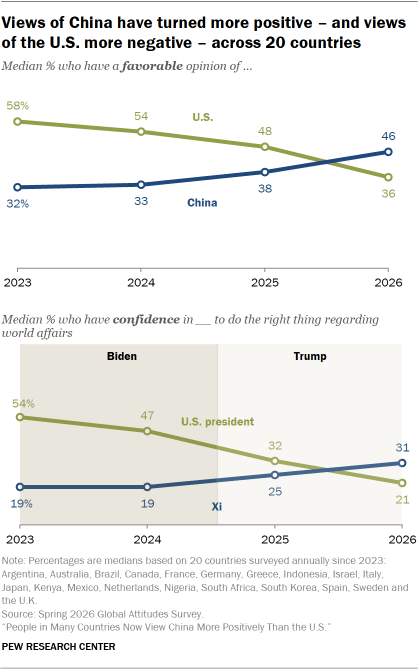
In Global Public Opinion, the US is Losing to China


Global views of the United States worsened last year as President Donald Trump’s second term began, though most people still had a more positive opinion of the U.S. than China. This year, that is no longer the case.

Views of China have improved in recent years while opinions of the U.S. have worsened, to the point where China is now seen more positively than the U.S. in most of 36 countries surveyed.

Confidence in these countries’ respective leaders to do the right thing regarding world affairs has followed a similar pattern. In the latter half of Joe Biden’s presidency, confidence in him was higher than confidence in Chinese President Xi Jinping across most countries surveyed, though Biden’s rating declined in many places from 2023 to 2024.

During the first two years of Trump’s second term, ratings of the U.S. president worsened significantly. While many people still lack confidence in Xi, positive views of him have become more widespread, and more overall now say they have confidence in Xi than in Trump.

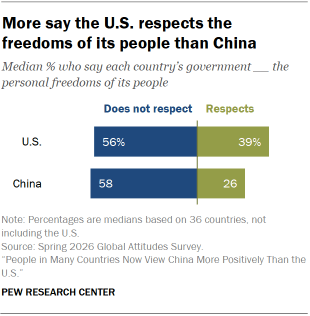
One area where the U.S. still gets higher ratings than China has to do with personal freedoms: More say the U.S. government respects the personal freedoms of its people than say the same of the Chinese government. Still, the gap has been narrowing – driven by large drops in the shares saying the U.S.  government respects personal freedoms.


Monday, July 13, 2026

Grievances

 Many posts have discussed the Founding.

Ryan Goodman, Jack Palmer-Coole, Siven Watt and Simone Lipkind at Just Security:

Americans commemorate the 250th anniversary of the signing of the Declaration of Independence this year. As many in the United States and around the world reflect on the words in the solemn document, it will be readily apparent how the actions of the monarch that prompted the “grievances” of the settlers are echoed by the actions taken by the current presidential administration in its first year and a half. 

We believe there is an important history lesson in simply reading, and rereading, the Declaration and reflecting on the current times in the United States. In the passages below, the text of the Declaration is annotated with the words of federal judges in 52 court cases involving the current administration. We have identified 17 of the 27 grievances with a contemporary analog.

Over the past months, different studies published at Just Security have closely documented how the federal courts have adjudicated Americans’ attempts to vindicate their rights against administration policies. The gravity of the judges’ conclusions are sobering. Indeed, reading the Declaration and their words side-by-side shows how much the very fabric of the American social contract is being tested. Today’s federal judiciary, no less than the signatories of the Declaration 250 years ago, is speaking to the current generation about the foundational needs of a functional and representative American democracy, with meaningful checks and balances, and above all, a commitment to the rule of law.

....

Grievance 16: For cutting off our Trade with all parts of the world:
Grievance 17: For imposing Taxes on us without our Consent:

Historical grievance: The Boston Port Act (1774) shut down Boston Harbor, the Restraining Acts (1775) barred New England from trading outside the British Empire, and the Prohibitory Act (1775) prohibited American trade altogether (Grievance 16). The Sugar Act (1764), Stamp Act (1765), and Townshend Acts (1767) imposed direct taxation on the colonies without their consent or representation in Parliament (Grievance 17).
Contemporary translation: Executive restriction of international trade (Grievance 16); and executive imposition of tariffs (considered a tax by the Supreme Court) without congressional authorization (Grievance 17).
Strength of contemporary analog: Strong.
“Based on two words separated by 16 others in Section 1702(a)(1)(B) of IEEPA — ‘regulate’ and ‘importation’ — the President asserts the independent power to impose tariffs on imports from any country, of any product, at any rate, for any amount of time. Those words cannot bear such weight.

Article I, Section 8, of the Constitution sets forth the powers of the Legislative Branch. The first Clause of that provision specifies that ‘The Congress shall have Power To lay and collect Taxes, Duties, Imposts and Excises.’ It is no accident that this power appears first. The power to tax was, Alexander Hamilton explained, ‘the most important of the authorities proposed to be conferred upon the Union.’ It is both a ‘power to destroy’ and a power ‘necessary to the existence and prosperity of a nation’ — ‘the one great power upon which the whole national fabric is based.‘
The power to impose tariffs is ‘very clear[ly] … a branch of the taxing power.’ ‘A tariff,’ after all, ‘is a tax levied on imported goods and services.’ And tariffs ‘raise[] revenue’ — the defining feature of a tax
…
Recognizing the taxing power’s unique importance, and having just fought a revolution motivated in large part by ‘taxation without representation,’ the Framers gave Congress ‘alone … access to the pockets of the people.’ see also Declaration of Independence ¶19[sic]. … They did not vest any part of the taxing power in the Executive Branch.”

“We are therefore skeptical that in IEEPA — and IEEPA alone — Congress hid a delegation of its birth-right power to tax within the quotidian power to ‘regulate.'”

— Chief Justice John G. Roberts Jr. (W. Bush appointee) — IEEPA as a basis for presidential tariff power (link to Supreme Court opinion)


Saturday, July 11, 2026

Air Force One


Wednesday, July 1, 2026

SCOTUS Upholds Birthright Citizenship

 Amy Howe at SCOTUSblog:

The Supreme Court on Tuesday struck down President Donald Trump’s executive order seeking to end birthright citizenship – the guarantee of citizenship to virtually everyone born in the United States. In a decision by Chief Justice John Roberts, in Trump v. Barbara, the justices agreed with the challengers, as well as all of the lower courts around the country that have considered the issue, that Trump’s order cannot be reconciled with the 14th Amendment to the Constitution, which confers citizenship on anyone “born … in the United States, and subject to the jurisdiction thereof.”

Writing for the majority, Roberts emphasized that the “children born of parents unlawfully or temporarily present in the United States” “satisfy both elements of the Citizenship Clause.” “Under the Constitution,” he concluded, “they are citizens at birth.”

In a dissenting opinion, Justice Samuel Alito called the ruling both “one of the most important decisions in the history of the Court” and “a serious mistake.” “Careful analysis of the text of the Fourteenth Amendment and the process that led to its adoption,” Alito argued, “shows that it does not degrade the concept of United States citizenship in this way. Instead,” he contended, “the Fourteenth Amendment confers citizenship on only those children who, at birth, owe allegiance solely to this country.”

Trump issued the executive order at the center of the case on Jan. 20, 2025, shortly after he was sworn into office for a second term. It provided that babies who are born in the United States to parents who are in this country either illegally or temporarily are not automatically entitled to citizenship.

Sunday, June 28, 2026

Justice Kagan Notes Trump's Racism

Many posts have discussed immigration and asylum.

Justice Kagan's dissent in Mullin v. Doe (25-1083)

The Haiti plaintiffs have yet another claim that is likely to succeed: that race entered into the decision to terminate Haiti’s TPS designation, in violation of equal protection.

 ...

It is more than plausible: Even putting the clear-error standard aside, the Haiti plaintiffs have carried their burden. The evidence they have offered includes statements by the President so repellent and racially inflected that the majority declines to put them in print.  (Indeed, one measure of the President’s way of speaking about Haitians is to compare it with the majority’s, which is unfailingly respectful.4) So here are some of those statements. Haitians are “eating the dogs . . . . They’re eating the cats. They’re eating—they’re eating the pets of the people that live [in Springfield, Ohio].” 2 App. 802; see id., at 644.  And: Haitians are also eating “other things too that they’re not supposed to be.” Id., at 698–699.  And: Haitians in the United States “probably have AIDS.”  Id., at 698. And: Haiti is a “shithole country,” which is “filthy, dirty, [and] disgusting.” Id., at 698–699. And: Haitian immigration is “like a death wish for our country.”  Id., at 698. And: Haitians, along with some others, are “poisoning the blood” of our country. Id., at 698.  And: “Why is it we only take people from shithole countries” like “Haiti [and] Somalia”? “Why cannot we have some people from Norway [and] Sweden?” Id., at 699. The majority briefly replies that those remarks are not “overtly racial,” ante, at 21, but it is hard to know what that means. Haitians are Black.  (Norwegians and Swedes not so much.)  The references—of filth, disease, and primitiveness—are shot through with racial stereotypes and tropes. It is hard to imagine the statements being made today of any White community.  No very “sensitive inquiry,” of the kind Arlington Heights compels, is needed to see them for what they are, 429 U. S., at 266; judges, as we often say, are “not required to exhibit a naiveté from which ordinary citizens are free,” Department of Commerce, 588 U. S., at 785.  The statements fairly shout, in their racial undertones and overtones alike, that race entered into the President’s resolve to remove Haitians from this country.

\