Search This Blog

Showing posts with label authoritarian. Show all posts

Sunday, September 20, 2026

Erick Erickson on the Right Rot

A number of posts have discussed the conservative movement.  In the past decade, it has taken a bad turn.

Conservative Erick Erickson bravely takes on the rot on his own side of the spectrum:

A group of white guys have subtly inserted themselves into conservative institutions and church organizations. They all embrace racial grievances. To varying degrees, they embrace white nationalism, antisemitism, and even Nazi sympathies. They are getting added to conservative institutional boards, attempting to purge churches, and are desperate to indoctrinate young conservatives into fascist ideology. They even surround the Vice President of the United States. Some of them believe the United States is at a tipping point, and they want to push it over the edge and rebuild it in their image. You might think it does not affect you, but, in time, you will see their efforts in your church pews, in your kids’ brains, and in your politicians’ mouths. It begins with shampoo.

Charles Haywood made his fortune selling shampoo. He sold his Indianapolis hair care company in 2020, and he has spent the years since writing out, at length and under his own name, what he would like to do with your country. Rod Dreher, who is no man of the left, read Haywood’s online ramblings and described Haywood as pouring out vile from “deep in his Midwestern Führerbunker”.

In a document he calls the Foundationalist Manifesto, Haywood explained that his preferred government “will not be democratic.” The state “will have unlimited means,” because “properly viewed, the state is not constrained externally.” Women “will not be permitted to choose career over family.” Men “will not be permitted to choose not to have a family.” The state will seize the assets of “any citizen who views himself as a global citizen.”

That is not my characterization of his politics. Those are his words, from the manifesto that earned him a friendly sit-down with Tucker Carlson in September 2022.

Elsewhere he has speculated about serving as a “warlord” at the head of an “armed patronage network,” a model he says he drew from the groups of white settler farmers formed in southern African countries and colonies while black Africans were fighting for majority rule. Reviewing a biography of Spanish dictator Francisco Franco, he wrote that his already favorable impression of the Spanish dictator had become positively glowing. He is not alone in that fixation. MAGA gadfly Jack Posobiec wrote a book called Unhumans, which Vice President JD Vance blurbed and which claims Franco and Chilean dictator Augusto Pinochet are models for handling the American left. Josh Abbotoy, the executive director of American Reformer, has written that America is going to need a Protestant Franco. It is not a coincidence, but an attempt to shift the Overton window toward dictatorship.

A crank with a blog is a crank with a blog. The problem is that Charles Haywood is not on the outside of the conservative movement. He has used his wealth to get inside it and reshape longtime institutions that build the future of the right, pushing those institutions toward his vision of pushing our constitutional republic to its breaking point so they can rebuild it the way they want.

Saturday, September 19, 2026

Trump Attacks the First Amendment

Many posts have discussed freedom of the press.  Trump is attacking it.

Jim Rutenberg and Maggie Haberman at NYT:
The Justice Department has sent F.B.I. agents to reporters’ homes to serve subpoenas and, in at least one case, flashed a warrant to seize devices. The Pentagon has fired the editor and publisher of its traditionally independent newspaper, Stars and Stripes, and blocked access to other journalists who refused to sign pledges that would limit their reporting.

Regulatory agencies are using their powers to pressure media organizations over their content. The administration has stripped funding from public television and radio. Angry over stories he does not like, President Trump has sued major news organizations and the White House has taken control of the previously independent press pool that tracks the president, deciding which outlets can participate.

Almost 20 months into Mr. Trump’s second term, his long-running media clashes have grown into a sweeping campaign to control speech in America that stands out for applying so many levers, so fast, all at once.

Yesterday, Trump banned CNN, MS Now, and  POLITICO from the White House. He said:

I mean, there’s something wrong with a country that can allow people to write purposely negative — now if they want to write them, that’s fine, but I don’t have to let them into the people’s house.

Monday, March 23, 2026

Democratic Backsliding

Previous posts have discussed authoritarian moves by the executive branch.

V-Dem  Institute:

Democratic backsliding is now happening in well-established democracies. Democracy in the USA is deteriorating at unprecedented speed, and media and journalists are increasingly targeted across the world. This, and more, is reported in the latest Democracy Report from the V-Dem Institute at the University of Gothenburg.

Nearly a quarter of the world’s nations are going through democratic backsliding, or autocratization, in 2025, and six out of the ten new autocratizing countries identified in the 2026 Democracy Report are in Europe and North America. Among them are large and influential countries like Italy, the United Kingdom, and the USA, according to the report authored by a team led by Professor Staffan I Lindberg at the V-Dem Institute, University of Gothenburg.

“The fact that many populous and economically powerful countries are autocratizing is especially worrying. Several of these countries have the economic and political weight to reshape international organizations, norms, and trade, effectively reshaping the global order. I think we are already seeing the effect of that,” says Staffan I Lindberg.
Three major trends in democratic backsliding

The report finds three clear patterns in the current trend of democratic backsliding. The first one is the democratic backsliding in some traditionally stable democracies; the second is significant reversals and often breakdown of democracy in countries that successfully democratized during the late 20th and early 21st centuries; and thirdly, the deepening of autocracy in already autocratic states.

Freedom of Expression, a core aspect of democracy, shows the most drastic global decline, and is the most common target among autocratizing leaders over the past 25 years.

“The second most common target are the liberal aspects of democracy, like rule of law, and checks and balances that prevent the abuse of powers, which are deteriorating in a worrying number of countries. For example, rule of law is deteriorating in 22 countries, including the USA,” says Staffan I Lindberg.
Democracy in the USA deteriorating at unprecedented scale and speed

The U.S. democracy is currently in a much faster deterioration process than any other democracy in modern times. Within only one year, the USA’s score on the V-Dem Liberal Democracy index has declined by 24 percent, while its world rank dropped from 20th to 51st place out of 179 nations.

The liberal aspects of democracy show the largest decline in the U.S. President Donald Trump’s second term can be summarized as a rapid concentration of powers in the presidency, according to the report.

“The current U.S. administration has been undercutting institutionalized checks and balances, politicizing civil service and oversight bodies, and intimidating the judiciary, alongside attacks on the press, academia, civil liberties, and dissenting voices ”says Staffan I Lindberg.


Since election specific indicators are only evaluated during national election years, there has not been a change in those indicators in 2025 for the U.S.

“The 2026 American midterm elections will be a critical test for the quality of elections, and democracy, in the United States. If election indicators also decline, the U.S. will fall even further,” says Staffan I Lindberg.
The democratizers

On a more positive note, the report shows that 18 nations worldwide (10 percent) are currently democratizing, with large countries such as Brazil and Poland continuing their democratization processes. In the majority of these countries, media freedom is improved. Botswana, Guatemala, and Mauritius are the three new democratizing countries identified in the 2025 data.


Download the V-Dem Institute Democracy Report 2026: “Unraveling the Democratic Era?”

Contact Lead author: Professor Staffan I. Lindberg, sil@v-dem.net.

Saturday, May 24, 2025

Higher Education Fights Back


Over the course of the past week, the federal government has taken several actions following Harvard’s refusal to comply with its illegal demands. Although some members of the administration have said their April 11 letter was sent by mistake, other statements and their actions suggest otherwise. Doubling down on the letter’s sweeping and intrusive demands—which would impose unprecedented and improper control over the University—the government has, in addition to the initial freeze of $2.2 billion in funding, considered taking steps to freeze an additional $1 billion in grants, initiated numerous investigations of Harvard’s operations, threatened the education of international students, and announced that it is considering a revocation of Harvard’s 501(c)(3) tax-exempt status. These actions have stark real-life consequences for patients, students, faculty, staff, researchers, and the standing of American higher education in the world.

Moments ago, we filed a lawsuit to halt the funding freeze because it is unlawful and beyond the government’s authority. I encourage you to read our complaint.
Yale President Maurie McInnis:
Earlier today, the U.S. House of Representatives passed legislation that proposes to raise the tax on the investment income of Yale and a number of other universities from 1.4% to 21%. Each year, this increased endowment tax would strip from Yale’s budget hundreds of millions of dollars that currently fund financial aid, research, scholarship, and teaching.

This legislation presents a greater threat to Yale than any other bill in memory. Today, I ask you to join me in defending the research that saves lives and keeps America competitive, the faculty who enrich minds and help us make sense of our complex world, and the students who keep our future bright. What is at stake is Yale’s ability to offer financial aid, to contribute to the vitality of our nation’s culture and civic life, and to introduce discoveries and innovations that transform the world.
A federal judge on Thursday blocked the Trump administration’s wide-reaching effort to detain and deport international students, barring the federal government from arresting those students or revoking their visas while the case plays out in court.

Judge Jeffrey S. White of the Northern District of California, who was appointed to the court by President George W. Bush, granted a temporary injunction protecting international students who were among the thousands whose visas were revoked earlier this year without clear justification, writing that government officials had “uniformly wreaked havoc” and “likely exceeded their authority and acted arbitrarily and capriciously” by the mass revocation of students’ immigration status.

“The relief the court grants provides plaintiffs with a measure of stability and certainty,” Judge White wrote in the 21-page order. “That they will be able to continue their studies or their employment without the threat of re-termination hanging over their heads.”

It's not just the "woke" Ivy League.  CAITLIN OPRYSKO at POLITICO:

Hillsdale College has become an exemplar for higher education on the right, even partnering with the White House last month. But the conservative Christian school located in Michigan has turned to K Street in an effort to avoid being swept up in congressional Republicans’ efforts to crack down on “woke, elite universities,” according to a disclosure filing.

Hillsdale last month retained Williams and Jensen to lobby on “specific threats to the institutional and financial independence of the college, primarily related to the higher education endowment tax,” the filing shows. The team of lobbyists working on the account includes Dan Ziegler, who served as House Speaker Mike Johnson’s top policy aide before returning to the firm in March.

— Wealthy universities were first hit with a 1.4 percent excise tax on their endowments in the 2017 GOP tax law. But the reconciliation package approved last week by the House Ways and Means Committee calls for a tiered endowment tax that would see some schools’ rate soar as high as 21 percent.

— Hillsdale dodged an endowment tax once before. During Senate debate on the 2017 tax bill, four Republicans sided with all Democrats to strip out language that would have exempted schools that don’t accept federal financial aid — a provision lawmakers said would have only applied to Hillsdale. But the size of Hillsdale’s endowment, when adjusted for the number of students, fell below the threshold included in the final bill, sparing the college.

— That’s no longer the case. Under the House bill, Hillsdale would be eligible for the lowest rate of 1.4 percent. The bill includes a provision that would exempt certain religious institutions from the endowment tax, though it’s unclear if that would apply to Hillsdale. Hillsdale did not respond to a request for comment.

— The school’s president, Larry Arnn, ripped the House proposal in an op-ed last week that called the changes “not merely bad policy,” but “a profound inversion of the American idea.”

— Arnn argued the bill, as approved by the Ways and Means Committee, “penalizes most severely those institutions that have chosen the harder path of independence,” by refusing federal funds, while leaving “untouched the vast web of colleges and universities sustained by taxpayer dollars, often bloated with bureaucracies committed to fashionable ideas, far removed from the purposes of education.”

— “Worse still,” he continued, “this tax turns the incentives backward; it rewards dependence and punishes self-reliance. It encourages institutions to seek the shelter of government aid, where subsidies can offset tax burdens.”

Saturday, March 29, 2025

Rendering Innocent People


 The Trump administration is snatching people without due process.

Mother Jones reporter Noah Lanard spoke with families of those detained in a Salvadorian prison. In one case, the Trump administration accused their loved one of having a gang tattoo. The family says it’s a tattoo for autism awareness.


Saturday, December 14, 2024

Suspend the Constitution and Laws? Republicans say Meh!

Most Democrats and independents would be upset if President-elect Donald Trump suspended laws and constitutional provisions to go after his political enemies. However, few Republicans say this would bother them a lot, although most see his statements about doing this as overstated. The Monmouth (“Mon-muth”) University Poll finds that most Americans feel the country has become more divided during President Joe Biden’s term, but only Republicans think it will become more united after Trump takes office again. In other results, more Americans believe the 2024 presidential results were fair than said the same about the 2020 outcome, mainly due to the steadfast refusal of most Republicans to acknowledge the validity of Biden’s win.

Trump suggested during the presidential campaign that he could suspend some laws and constitutional provisions to go after political enemies in his second term. The public is divided on whether this is something he will seriously do (48%) or if it is more of an exaggeration (47%). Most Democrats take these statements seriously (77%) while most Republicans tend to see them as an exaggeration (71%). Republicans are somewhat less likely to takes these statements seriously now (21%) then they were six months ago (33% in June).

If Trump did suspend some laws and constitutional provisions, 52% of the public would be bothered a lot by this. This number is down from 65% who felt this way in June. Those who say they would be bothered a lot by this ranges from 77% of Democrats (down from 86% in June) to 55% of independents (down from 68%) and just 23% of Republicans (down from 41%).

Monday, December 2, 2024

The Term of the FBI DIrector


Andrew Kent, Susan Hennessey, Matthew Kahn
Section 203 of the Crime Control Act of 1976 restricts the FBI director to a single ten-year term and prohibits the reappointment of an incumbent. Below is an examination of what the legislative history and political context reveal about Congress’ motives in passing that law. It is clear that Congress viewed the operation of the statute as both a ceiling and a floor: a limit on the president and a limit on the director. It’s also clear that Congress viewed political influence on specific FBI investigations as violative of important norms developed to prevent the recurrence of dangerous abuses.

Congress first considered a law to require Senate confirmation and term limits for an FBI director in the closing years of J. Edgar Hoover’s directorship. Hoover was the FBI’s first director and was appointed by the Attorney General and not the president. He served 48 years until his death in 1972. Congress approached the issue in the context of Hoover’s extraordinarily long tenure, during which he consolidated control of the FBI and carried out substantial abuses of power.

In one sense, limiting an FBI director’s tenure to a single ten-year term should be understood as a check on the director’s power. Congress’ was concerned with the rise of another unscrupulous and excessively powerful director, and term limits were one way to prevent that. There is simply less one can do in ten years than in forty-eight, be it amassing influence or violating civil liberties.

In another sense, the term limit acts as a check on presidential power. Congress passed the ten-year term limit in the shadow of the abuses of President Richard Nixon and White House aides. The Senate Judiciary Committee held hearing on FBI oversight and a bill to establish a ten-year term in March 1974, the same month a federal grand jury indicted the “Watergate Seven” and named Nixon an unindicted co-conspirator. Nixon’s acting FBI Director and nominee for the permanent post, L. Patrick Gray, had resigned in 1973 after it was revealed that he was giving the White House daily briefings on the FBI’s Watergate investigation and that he destroyed documents relevant to the inquiry.

Congress wanted to address the Scylla and Charybdis of Nixon and Hoover: the risk of political interference in FBI investigations, and use of the Bureau for political purposes, on the one hand, and on the other, the danger of an imperial FBI director whose long tenure–and the secrets and political chits accumulated during that tenure–allows him to act without accountability.

When recommending enactment of the ten-year term, the Senate Judiciary Committee wrote a comprehensive report of its rationale, including:
The purpose of this bill is to achieve two complementary objectives. The first is to insulate the Director of the Federal Bureau of Investigation from undue pressure being exerted upon him from superiors in the Executive Branch. The second is to protect against an FBI Director becoming too independent and unresponsive.

Also from the report:

It is the great value of the FBI as a criminal investigative agency, as well as its dangerous potential for infringing individual rights and serving partisan or personal ambitions, that makes the office of FBI Director unique....The position is not an ordinary Cabinet appointmentvwhich is usually considered a politically oriented member of the President's "team."


Saturday, November 30, 2024

Sobering Words from George Orwell

George Orwell, "Looking Back on the Spanish Civil War," 1942:
I know it is the fashion to say that most of recorded history is lies anyway. I am willing to believe that history is for the most part inaccurate and biased, but what is peculiar to our own age is the abandonment of the idea that history could be truthfully written. In the past people deliberately lied, or they unconsciously coloured what they wrote, or they struggled after the truth, well knowing that they must make many mistakes; but in each case they believed that ‘the facts’ existed and were more or less discoverable. And in practice there was always a considerable body of fact which would have been agreed to by almost everyone. If you look up the history of the last war in, for instance, the Encyclopaedia Britannica, you will find that a respectable amount of the material is drawn from German sources. A British and a German historian would disagree deeply on many things, even on fundamentals, but there would still be that body of, as it were, neutral fact on which neither would seriously challenge the other. It is just this common basis of agreement, with its implication that human beings are all one species of animal, that totalitarianism destroys. Nazi theory indeed specifically denies that such a thing as ‘the truth’ exists. There is, for instance, no such thing as ‘science’. There is only ‘German science’, ‘Jewish science’ etc. The implied objective of this line of thought is a nightmare world in which the Leader, or some ruling clique, controls not only the future but the past. If the Leader says of such and such an event, ‘It never happened’ – well, it never happened. If he says that two and two are five – well, two and two are five. This prospect frightens me much more than bombs – and after our experiences of the last few years that is not a frivolous statement.

But is it perhaps childish or morbid to terrify oneself with visions of a totalitarian future? Before writing off the totalitarian world as a nightmare that can’t come true, just remember that in 1925 the world of today would have seemed a nightmare that couldn’t come true. Against that shifting phantasmagoric world in which black may be white tomorrow and yesterday’s weather can be changed by decree, there are in reality only two safeguards. One is that however much you deny the truth, the truth goes on existing, as it were, behind your back, and you consequently can’t violate it in ways that impair military efficiency. The other is that so long as some parts of the earth remain unconquered, the liberal tradition can be kept alive. Let Fascism, or possibly even a combination of several Fascisms, conquer the whole world, and those two conditions no longer exist. We in England underrate the danger of this kind of thing, because our traditions and our past security have given us a sentimental belief that it all comes right in the end and the thing you most fear never really happens. Nourished for hundreds of years on a literature in which Right invariably triumphs in the last chapter, we believe half-instinctively that evil always defeats itself in the long run. Pacifism, for instance, is founded largely on this belief. Don’t resist evil, and it will somehow destroy itself. But why should it? What evidence is there that it does? And what instance is there of a modern industrialized state collapsing unless conquered from the outside by military force?


Tuesday, September 10, 2024

Authoritarianism 2024

A number of posts have discussed support for authoritarianism and political violence in the United States.

One poll suggested Americans support checks and balances, but for the other party.

A more recent poll confirms that support for authoritarianism is strong among certain segments of the public.

Public Religion Research Institute:

Growing concerns about the appeal of an authoritarian leader in the United States led PRRI to conduct a new survey of more than 5,000 Americans that revisits long-established measures of authoritarianism and their relationships to Christian nationalism, examines Americans’ commitment to democratic values and willingness to accept political violence, and explores how authoritarian attitudes are linked to views about immigrants and immigration, cultural change, gender roles, and patriarchy.

Relying on two classic approaches to measure authoritarianism, PRRI finds that most Americans do not hold highly authoritarian views.

  • Revisiting work first developed in The Authoritarian Personality (1950) and later adapted into the Right-Wing Authoritarianism Scale (RWAS), PRRI finds that 43% of Americans score high on the RWAS, compared with 37% who score low; two in ten Americans qualify as having mixed opinions (20%).
  • Around four in ten Americans (41%) score high on an alternative measure of authoritarianism (CRAS) that relies on child-rearing preferences and is less closely associated with conservative political ideology. This is a drop from 57% of Americans who scored high on the CRAS in a previous 2016 PRRI national survey. 

Right-wing authoritarian views are more prevalent among Republicans, particularly those who hold favorable views of Trump, white evangelical Protestants, and weekly churchgoers.

  • Two-thirds of Republicans score high on the RWAS (67%), compared with 35% of independents, and 28% of Democrats.
  • Republicans who hold favorable views of Trump are 36 percentage points more likely than those with unfavorable views of Trump to score high on the RWAS (75% vs. 39%).
  • White evangelical Protestants (64%) are the religious group most likely to score high on the RWAS, followed by slim majorities of other Protestants of color (55%), Hispanic Protestants (54%), and white Catholics (54%). A majority of weekly churchgoers (55%) score high on the RWAS, compared with 44% of Americans who attend church a few times a year and 38% of those who never attend church services.

Republicans score high on the Child-Rearing Authoritarianism Scale (CRAS), as do a majority of Black Protestants; church attendance and less formal education are also linked to higher scores.

  • A majority of Republicans (54%) score high on the CRAS, compared with one-third of independents (34%) and Democrats (32%).
  • Republicans who hold favorable views of Trump are more likely than those with unfavorable views to score high on the CRAS (57% vs. 41%).
  • The majority of Black Protestants (57%), other Protestants of color (55%), and white evangelical Protestants (54%), as well as Americans who attend religious services at least once a week (51%), score high on the CRAS.
  • Less education is correlated with higher CRAS scores: nearly half of Americans who have not graduated from college (47%) score high on the CRAS, compared with 29% of college graduates.

There is strong overlap among Americans who hold Christian nationalist and authoritarian views.

  • Similar to earlier PRRI studies, three in ten Americans identify as either Christian nationalism Adherents (10%) or Sympathizers (20%).
  • Strong majorities of Christian nationalism supporters (Adherents and Sympathizers) score high on both the RWAS (74%) and CRAS (61%), more than double the rates of Christian nationalism Skeptics and Rejecters (30% and 31%, respectively).
  • Among those who score high on the RWAS, the majority qualify as Christian nationalism supporters (51%) or score high on the CRAS (56%). By contrast, among those with low RWAS scores, just 7% are Christian nationalism supporters and 21% score high on the CRAS.
  • Among those with high CRAS scores, 44% qualify as Christian nationalism supporters and 59% score high on the RWAS. By contrast, among those who score low on the CRAS, 14% qualify as Christian nationalism supporters and 25% score high on the CRAS.

Tuesday, April 9, 2024

Authoritarian Opinion?

A number of posts have discussed support for authoritarianism and political violence in the United States.

A recent poll suggested Americans support checks and balances, but for the other party.

Aaron Blake at WP:

While 39 percent of Democrats said working around Congress and the courts was a good thing if the president were named Biden, 57 percent of Republicans said it would be a good thing if the president were named Trump.

While an isolated poll, the results are very much in line with other surveys on the subject, including, from recent weeks:
  • A Reuters-Ipsos poll last month, which showed that 52 percent of Republicans agreed that the country needs “a strong president who should be allowed to rule without too much interference from courts and Congress.” Just 29 percent of Democrats agreed with that statement.
  • A February poll from the University of Massachusetts at Amherst, which found that 74 percent of Republicans would support Trump being a “dictator for a day,” an idea he once broached.
  • An NPR-PBS-Marist College poll last week, which asked whether people agreed that things are so bad that “we need a leader who is willing to break some rules to set things right.” Republicans (56 percent) were twice as likely to agree with that statement as Democrats (28 percent). While Republicans agreed with the statement by a 13-point margin, Democrats disagreed by a 44-point margin.
  • A December Fox News poll, which went a step further, asking whether we need a president who will break some “rules and laws” — basically taking illegal action. Trump 2020 voters (30 percent) were twice as likely to support that as Biden 2020 voters (15 percent).
It’s important not to oversell these data.

The percentage of Republicans who appear to be truly pining for a strongman is significantly shy of a majority. For instance, in the NPR-PBS Marist College poll, just 23 percent “strongly” agreed that we need someone willing to break the rules. Similarly, Republicans who want a president who is willing to break the law were still outnumbered about 2-to-1.
But those are also significant numbers of Republicans — often the noisiest ones. And what we also see in these data is a distinct lack of countervailing concern about an all-powerful executive.

Saturday, April 6, 2024

Consitutional Checks for Thee But Not for Me

A new poll from The Associated Press-NORC Center for Public Opinion Research[:] Though Americans say don’t want a president to have too much power, that view shifts if the candidate of their party wins the presidency. It’s a view held by members of both parties, though it’s especially common among Republicans.

Overall, only about 2 in 10 Americans say it would be “a good thing” for the next president to be able to change policy without waiting on Congress or the courts. But nearly 6 in 10 Republicans say it would be good for a future President Donald Trump to take unilateral action, while about 4 in 10 Democrats say the same if Biden is reelected.

The sentiment comes amid escalating polarization and is a sign of the public’s willingness to push the boundaries of the political framework that has kept the U.S. a stable democracy for more than two centuries. In the poll, only 9% of Americans say the nation’s system of checks and balances is working extremely or very well. It also follows promises by Trump to “act as a dictator” on day one of a new administration to secure the border and expand oil and gas drilling.


Thursday, February 29, 2024

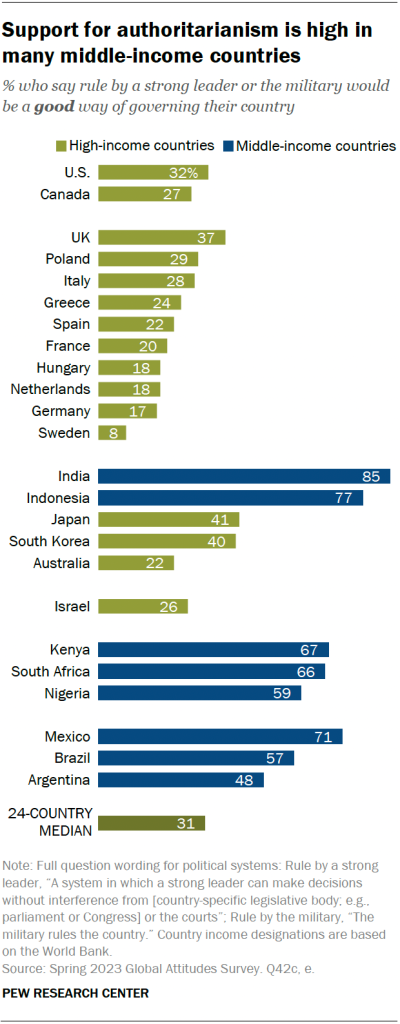
Support for Authoritarian Government


Laura Silver and Janell Fetterolf at Pew:
While most people see representative democracy as a good way to govern their country, large shares of the public in many countries are open to nondemocratic alternatives.

Indeed, a median of 31% across 24 nations are supportive of authoritarian systems, according to a recent Pew Research Center survey. The survey asked about two authoritarian models of government: a system in which a strong leader can make decisions without interference from parliament or the courts (“authoritarian leader”) and a system in which the military rules the country (“military rule”).