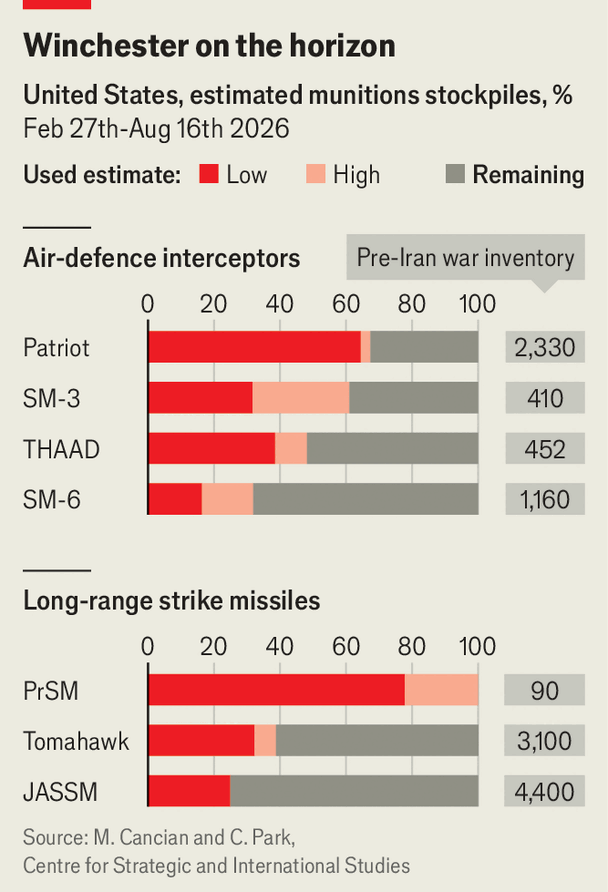
Many posts have discussed war powers and the US military. The Iran War has been a disaster. We are running low on munitions.

Fall Question: Can America rearm faster, smarter & in time to deter?

Many posts have discussed war powers and the US military. The Iran War has been a disaster. We are running low on munitions.


The U.S. has rushed so many munitions to the Middle East to fight Iran that military planners are concerned the loss of firepower is diminishing America’s ability to defend against potential threats from China and Russia, said U.S. officials.
The cuts have been so deep that the U.S. inventories in Europe of PAC-3 Patriot air defense interceptors and Atacms surface-to-surface missiles are deemed to be “beyond critical,” some of the officials said.
The U.S. and Iran have mostly halted direct attacks in recent weeks. But refilling weapons stocks moved from countries like Japan, South Korea and Germany could take years, leaving soft spots in the U.S. global military posture even as Western military officials don’t assess that full-scale attacks by China and Russia are imminent, officials said.
In addition to Patriot interceptors, other European-based weapons have been drawn down to extremely low levels, including precision-strike missiles and guided rockets, officials added. Thaad antimissile interceptors and Merops counterdrone systems have also been sent from Europe to the Middle East, further diminishing supplies on the continent.
The shrinking inventories have led the U.S. European Command to adjust its operational plans, officials said. They have also increasingly led administration officials to assess that America couldn’t fully execute contingency plans to defend Taiwan from a Chinese invasion if it occurred in the near term, The Wall Street Journal has previously reported.
Several U.S. military leaders have advised Defense Secretary Pete Hegseth that prolonging large-scale operations against Iran is unsustainable and risks weakening their ability to confront threats elsewhere, including the U.S. homeland, according to people familiar with a recent assessment prepared for the Pentagon chief.
The warnings — detailed for Hegseth by the heads of the Army, Navy and Air Force and the four-star commanders overseeing U.S. operations throughout Europe, Asia and Latin America — appear in the Aug. 14 edition of the Secretary of Defense Orders Book (SDOB), these people said. They described the assessment to The Washington Post on the condition of anonymity because the document is classified.
As President Donald Trump has pressured Tehran to reopen the Strait of Hormuz and accept several U.S. provisions for ending the stalemated conflict, he has been adamant that all options remain available to him — including further military action. Consequently, U.S. Central Command, the headquarters responsible for prosecuting the Iran war, has kept a force of more than 50,000 troops on alert for months in case the president orders additional attacks.
The Aug. 14 orders book directs some troops deployed in the Middle East to remain there through September and some others into 2027, said those familiar with the document. The prospect of extending those forces further compelled military leaders to voice their concern, these people said.
Leaders of the U.S. European Command, the U.S. Pacific Command and the U.S. Southern Command, along with the Navy’s top admiral, responded with what is characterized in the SDOB as a “non-concur,” those familiar with the assessment said — meaning they disagree with the secretary’s order to extend their forces but will execute it nevertheless.
Our most recent book is The Comeback: The 2024 Elections and American Politics. The first year of the second Trump administration has been full of ominous developments.
War and economic woes will hurt the GOP in November. The only question is how much.
Trump's war drove gas prices up. Now Vance says that the war's purpose is to lower gas prices. Incoherent.
On the morning of Aug. 5, an anonymous account on X in India posted seemingly sensational news. The commander of Iran’s Islamic Revolutionary Guards Corps had vowed that his country would never give up its nuclear weapon ambitions as long as Israel and the United States possessed those weapons, the account said.
It was not true, and there’s no evidence that the commander made the remark or that Iran has developed nuclear weapons. The claim soon caromed around the internet anyway.
The quotation appeared on Israeli accounts, and then a television channel there posted it, calling it the first public declaration that Iran was working to build a nuclear bomb. That evening, it made its way into remarks that Prime Minister Benjamin Netanyahu delivered at Mount Herzl in Jerusalem, the country’s national cemetery.
In the United States, Mike Waltz, the Trump administration’s ambassador to the United Nations, reposted the quotation, as did Senator Rick Scott of Florida, a Republican. Fox News also reported the claim, as anchors and guests cited it as evidence of Iran’s duplicity.
The quotation, attributed to Brig. Gen. Ahmad Vahidi, was part of a campaign that succeeded in misleading politicians and news organizations around the world, according to a review by The New York Times. The claim’s spread showed how easily viral disinformation can twist the public debate over matters as serious as war and peace.
It is unclear who fabricated the quotation. However, it appeared intended to bolster Mr. Netanyahu’s longstanding claim that Iran is determined to build a nuclear weapon and that war against Iran was necessary.
President Trump, who had tried to justify the war by citing Iran’s nuclear ambitions, has been searching for a way out of it, and the quotation went viral three days after he said he was halting all attacks on Iran to give peace negotiations a chance.
“This quote was clearly crafted to drive a wedge into peace negotiations,” said Darren L. Linvill of the Media Forensics Hub at Clemson University, who tracks how disinformation and propaganda spread on social media.
Many.posts have dealt with international views of the United States. They have taken a negative turn.
Richard Wike, Laura Silver, Moira Fagan and Jonathan Schulman at Pew:
A new Pew Research Center survey finds negative – and often overwhelmingly negative – views of U.S. President Donald Trump in regions around the globe.
Across 36 nations polled, a median of 23% of adults express confidence in his leadership of world affairs. In many countries, confidence in Trump has slipped since last year.
Overall ratings for the United States are also largely negative. Favorable views of the country have declined in many places over the past year, including double-digit drops in Indonesia, Italy, Nigeria, South Africa, South Korea and Turkey.
There are seven nations in the study where a majority of adults rate the U.S. positively. The highest rating (81% favorable) comes from Israel. Some of the lowest ratings are from predominantly Muslim publics, such as Malaysians, Pakistanis, Turks, and Palestinians in the West Bank and East Jerusalem. (We were unable to survey in Gaza.)
Pew took the poll before the US-Iran memorandum of understanding, which has cratered Trump's standing in Israel.


For U.S. taxpayers and consumers, the cost of the war is at least $132 billion, according to Moody’s Analytics. That factors in military spending, rising energy and commodity prices and interest rates, said Mark Zandi, the company’s chief economist.
A top Pentagon official told Congress last month that the cost had risen to around $29 billion for the military. That estimate did not include the price of repairing about a dozen U.S. bases in the region damaged by Iranian attacks.
The costs of repair and maintenance, as well as keeping carrier strike groups at sea, also need to be factored in. “It costs a lot of money to just keep everyone and all this apparatus deployed there,” said Linda Bilmes, a public finance expert and senior lecturer at the Harvard Kennedy School. She added that the replacement costs of the enormous number of munitions that the U.S. military has expended will be much higher than the original purchasing costs.
Iran also severely damaged other U.S. assets in the region, including a valuable military radar jet on a tarmac in Saudi Arabia and the U.S. Embassy compound in Riyadh.
Many posts have discussed war powers and the US military
"There will be no deal with Iran except UNCONDITIONAL SURRENDER!... IRAN WILL HAVE A GREAT FUTURE. 'MAKE IRAN GREAT AGAIN (MIGA!).'” - President Donald J. Trump 🇺🇸 pic.twitter.com/H2HKkBVkww
— The White House (@WhiteHouse) March 6, 2026
Despite the brilliant performance of the US military in the war against Iran, Trump signed a memorandum of understanding that amounts to a surrender ... by the United States.
Finally, and shamefully, the agreement puts a final nail in the coffin of the Iranian people’s hopes that the United States would support their cries for freedom. “The Islamic Republic of Iran and the United States undertake to respect each other’s sovereignty and territorial integrity, and to refrain from interfering in each other’s internal affairs.” A conflict that started with the hopeful protests of a people pushing back against almost five decades of oppression ends with the country meant to be the beacon of freedom agreeing to turn a blind eye to the slaughter of 30,000 Iranians, or the inevitable continued crackdowns, executions, and repression. No matter how he wishes to run from it now, we should never forget the president’s undeniably clear messages to the Iranian people when he thought this would be easy—“help is on the way,” “the hour of your liberation is at hand.” Vance, already having shown his callous disregard for the deaths of Ukrainians, adds the Iranian people to the mix in his attempt to carry his boss’s water, “if the Iranian people want to rise up, great. That's their business. That's between them and their government.”
The conflict ends with a seeming disregard for the disposition of uranium we said we were fighting to secure, for the arsenal of missiles we said we were seeking to destroy, and for the oppressed Iranians we promised we were going to help. The war ends with nothing of value to show for it. We will have killed thousands of Iranians, destroyed hundreds of missile launchers and air defense systems, but to what end? For the privilege of achieving nothing quantifiable, we have provided Iran with proof of a strategic deterrent it can exercise at any time, provided the regime with access to a massive cash influx, rebuilt its relationship with proxies that was damaged after October 7, damaged our alliances and relationships, spent billions of dollars, expended a large percentage of our critically short precision munitions, and lost 13 American lives, to say nothing of the hundreds of wounded. As with so many of his missteps or failures, President Trump will likely try to categorize this as a win, shift the way it is remembered with the passage of time, blame someone else, or just hope it fades from memory as he moves on to what he deems truly important business, like ballrooms and reflecting pools. But this will likely be the largest and costliest error of his presidency, and one for which he deserves permanent shame.
My view, as discussed last week, is that presidential warmaking is an almost wholly political issue, rather than a legal one. No court is going to stop a war.
That said, I think may people hear "wholly political" and just assume that the president has a free hand to do whatever he/she wants. I completely disagree. In fact, presidents are incredibly constrained by politics when it comes to war.
Take Trump and Iran. What are some of the major political constraints:
The first two---military capacity and ally cooperation---are straightforward; they are essentially supply-side constraints. Presidents can only go to war with the military Congress provides. Ditto with allies; absent the ability to use airspace and foreign bases, some operations become impossible. And it's always better to have a coalition of nations fighting the war than going it alone.
- Military capacity
- Cooperation of allies
- Reaction of foreign adversaries
- Reaction of markets
- Congressional opinion
- American public opinion
- Partisan/base opinion
The third and fourth items on the list---foreign and market reactions---are constraints because they create immediate negative feedback, political and economic. Trump can't just nuke Tehran because that could easily trigger an escalation to global war, and WW3 with China is a bad outcome. Similarly, now that Iran has closed the strait and oil prices are spiking, the economic costs of the war may soon exceed the benefits, encouraging the president to seek a diplomatic off-ramp.
The final three items---opinions in Congress, the public, and the president's party---are the most purely political. These matter because the president has goals other than the objectives of the war, and negative opinions about the war will inevitably spill over to future political goals, whether they are policy, electoral, or egoist.
LOBBYING ON THE FRONT LINES: The Trump administration’s military actions in Iran and Venezuela sparked lobbying activity from 54 companies and organizations in the first quarter of 2026, collectively spending $13.3 million, an analysis of lobbying disclosure data by our colleagues Paroma Soni and Catherine Allen found. Most of these came from political advocacy-focused groups or the energy industry.
— The biggest private sector represented was, unsurprisingly, oil and gas. Chevron spent $1.6 million on all lobbying activity in Q1 and listed sanctions on Venezuela and energy access as specific lobbying issues. Shell, which spent $1.4 million, lobbied to advance its role in the commercial development of natural gas in one of Venezuela’s largest offshore gas fields. BP lobbied on the Treasury’s Office of Foreign Assets Control, which handles sanctions for Venezuelan energy activity and Iran-linked projects such as the Shah Deniz gas corridor.
...
— Several advocacy groups also lobbied on pending legislation related to Iran and Venezuela, particularly on the congressional war powers resolutions to disapprove of military action. They ranged from the American Civil Liberties Union to the Quaker-aligned Friends Committee on National Legislation to the American Federation of Teachers. The pro-Israel group American Israel Public Affairs Committee lobbied on increased sanctions against Iran and U.S. military assistance to Israel, as did the “pro-Israel, pro-peace” J Street group.

Many posts have discussed war powers and the US military.
CENTCOM has clarified that the U.S. blockade targets Iranian ports along the Arabian Gulf and Gulf of Oman — not the Strait itself. That distinction matters legally, but the blockade remains an act of war. Further, CENTCOM stated that “forces will not impede freedom of navigation for vessels transiting the Strait of Hormuz to and from non-Iranian ports.” CENTCOM’s clarification appears to supersede President Trump’s earlier social media post announcing a blockade of the Strait itself. The blockade announced in specific terms by CENTCOM ratchets up pressure on Iran while creating enormous operational risks.
For a blockade to be legally valid, it must meet certain criteria.
First, the blockade can be established only by the government of a belligerent State. Blockade is not a peacetime operation. By establishing the blockade, the United States is exercising a belligerent right under the laws of war, effectively ending the ceasefire.
Second, it is customary for the State establishing the blockade to notify all affected States of its imposition. The form of the notification is not material, so long as it is effective. CENTCOM has announced the blockade via social media and has stated that “[a]dditional information will be provided to commercial mariners through a formal notice before the start of the blockade.”
Third, to be valid, the blockade must be effective. This means that blockading forces must exert force to render ingress or egress of the blockaded area dangerous. While the Commander’s Handbook on Naval Warfare states that “effectiveness does not require every possible avenue of approach to the blockaded area be covered,” an ineffective blockade is an illegal blockade under the law of naval warfare and the San Remo Manual. This will be challenging. This blockade is a massive undertaking for the U.S. Navy, which appears to be operating without naval partners. After all, the Iranian coastline stretches roughly the coastal distance from Boston to Savannah —about 1,100 miles.
At the time President Trump’s version of the blockade had been announced (not the modified CENTCOM version), Admiral James Stavridis, former head of European Command, estimated that an effective blockade would require two full aircraft carrier strike groups as well as a dozen destroyers. That would represent a substantial commitment of naval firepower, and even then, effectiveness would not be guaranteed — a threshold that matters legally, not just operationally. It’s fair to assume the scope of the blockade announced by CENTCOM will also require a very substantial force. These operational realities bear directly on whether the blockade can satisfy the legal effectiveness requirement under the law of naval warfare — a threshold that, if not met, renders the blockade itself unlawful.
Further complicating matters, warships may have to position themselves along the Iranian coastline. If so, that will require several ships to navigate the Strait of Hormuz itself, a risky proposition made even riskier with the ceasefire ending and unaccounted-for mines lurking about.
Fourth, a blockade must be applied impartially to the vessels and aircraft of all States.
Finally, the blockade must not bar access to or departure from neutral ports and coasts. This requirement may become salient if the blockade has the practical effect of restricting neutral access to regional ports.

This is the recurring illusion of overequipped leaders: Because they can map the battle space, they think they understand the war. But war is never merely a technical contest. It is shaped by grievance, sacred narrative, the memory of past humiliations and the desire for revenge. Those are not atmospheric complications added to an otherwise technical enterprise. They are what the war is about.
So the familiar errors appear. The war planners imagine that a regime can be decapitated into collapse, whereas external attack often does the opposite — binding a battered state more tightly to a society newly united by injury, humiliation and rage. They imagine that destroying conventional assets would settle the matter, as if legitimacy, wounded sovereignty and collective anger were secondary rather than the war’s actual terrain. Planners who took their adversary’s self-understanding seriously — rather than discounting it as propaganda — might have anticipated that an attack would not weaken the regime’s narrative but instead fulfill it. They might also have foreseen the paradox that systematic decapitation does not produce negotiators. It removes them.
The military theorist Carl von Clausewitz long ago recognized the delusion of reducing war to a kind of algebra. War, as he understood it, is never merely calculation. It is saturated with passion, uncertainty and political purpose. The algebra has grown more sophisticated. But the delusion is just as dangerous today as it was in the 19th century.
What this war exposes, then, is a failure not only of strategy but of literacy. Literature and history, at their most serious, train precisely the faculties these leaders lack: the capacity to grant that other minds are not transparent to us, and are governed by purposes not our own. A mind tutored by history and literature knows that actors in the grip of a sacred cause tend to mean what they say — and that bombing a founding myth is more likely to consecrate it than to dissolve it.Cultural knowledge, of course, rarely prevents the catastrophes of war.
Athens at the height of its golden age sailed for Syracuse and lost an empire. Thucydides spent the rest of his life explaining why. The generals of 1914 were cultivated, well-read men, but those qualities did not save Europe. What has changed is not that culture once prevented blindness and no longer does. It is that culture has increasingly ceded authority to systems that mistake information for understanding and speed for judgment.
Now, officials are urgently discussing whether Tomahawk missiles in other theaters, like the Indo-Pacific, may need to be shipped to the Middle East as the US continues its offensive against the Islamic Republic. Tomahawk cruise missiles have been a staple of American military might since they were first used in the Gulf War by George H W Bush. But the widespread usage of the bespoke military tech in the US war in Iran has rattled some Pentagon officials who are now sounding the alarm about the depleted Tomahawk stockpiles. The Pentagon hit back against the unnamed officials' concern in a statement to the Daily Mail.
The parallels to the present are uncomfortable. After the Cold War, the Pentagon actively encouraged the consolidation of the defense industry. In 1993, Secretary of Defense Les Aspin and his deputy, William Perry, hosted a now-infamous dinner with the heads of the major defense contractors and told them bluntly that the post–Cold War budget would not sustain them all. The message was clear: Merge or be left behind. The industry obliged. Dozens of firms collapsed into a handful of prime contractors. The dinner became known as “the Last Supper,” and its legacy is the narrow, concentrated industrial base the United States is now trying to surge in wartime. Then came the Budget Control Act of 2011, which imposed automatic spending caps on the federal budget, resulting in defense cuts, as part of a deficit-reduction deal in Congress. Even after the caps were partially lifted in subsequent years, the damage to procurement pipelines, production lines, and inventory depth persisted. The combination of industrial consolidation and fiscal austerity produced the same trade-off the Truman-era Pentagon had made: fewer, more expensive systems and the assumption that wars would be short enough that depth would not matter. Now, as in 1950, a real war is exposing the consequences.
The logic behind that trade-off was not irrational. Precision, stealth, networking, and cutting-edge technology give the American military decisive advantages in short campaigns. The assumption was that the United States would fight brief wars, dominate quickly, and rely on technological overmatch to compensate for smaller inventories. But high-end capability without industrial depth is a fragile foundation for fighting an actual war. When a single interceptor costs millions of dollars and requires long lead times to produce, replenishment becomes a multiyear effort. When cruise missiles are built in limited quantities optimized for peacetime budgets rather than wartime demand, stockpiles evaporate quickly under sustained fire. When the industrial base has consolidated to a handful of suppliers with narrow surge capacity, scaling production becomes an exercise in wishful thinking.
The war with Iran is demonstrating that quantity and attrition still matter. Adversaries understand this well. Iran’s strategy is not to outmatch the United States technologically. It is to impose costs, stretch supplies, and exhaust American magazines beyond our ability to reconstitute them. In a broader strategic sense, China’s military modernization emphasizes mass production of missiles and drones precisely because China understands that sustained combat favors the side that can regenerate combat power quickly. Ukraine and Russia have learned the same lesson in their own war: Modern conflict demands weapons built at the nexus of quality and quantity. The United States must internalize this reality.
President Trump’s threat to “obliterate” power stations in Iran if its leaders failed to open the Strait of Hormuz suggests that the United States is willing to violate international humanitarian law as part of its military campaign, according to current and former human rights officials.
“If Iran doesn’t FULLY OPEN, WITHOUT THREAT, the Strait of Hormuz, within 48 HOURS from this exact point in time, the United States of America will hit and obliterate their various POWER PLANTS, STARTING WITH THE BIGGEST ONE FIRST!” Mr. Trump wrote on social media on Saturday.
He later extended the deadline to Friday.
The president’s threat appears to be part of his erratic messaging campaign, which is often construed as bluster or misdirection.
“Trump is openly threatening a war crime,” said Kenneth Roth, a former executive director of Human Rights Watch. “And people aren’t saying anything because they’re numb to it.”
By threatening to attack civilian infrastructure, Mr. Trump has once again pushed the United States into territory more familiar to its enemies than its allies.
In 2024, the International Criminal Court issued four arrest warrants to Russian military officers and officials charging them with war crimes for attacking “Ukrainian electric infrastructure.”
International law, specifically Article 52 of the first additional protocol of the Geneva Conventions, prohibits attacks on civilian objects. These laws are meant to protect civilians and those who can no longer fight, such as wounded soldiers, from the “barbarity of war.”
María Teresita Armstrong-Matta at Raw Story:
Defense Secretary Pete Hegseth's offhand remark that the U.S. would show "no quarter, no mercy for our enemies," in Iran. In military context, "no quarter" means killing enemy combatants without allowing surrender.
This alarmed legal experts, who warned the statement could constitute a war crime. Even just saying it could count as a violation of international law and U.S. military code, they added.
Wall Street Journal national security reporter Alex Ward flagged the comment as violating international humanitarian law under the Geneva Convention.
Claremont McKenna College professor Jack Pitney cited the Defense Department's own Law of War Manual, which explicitly forbids declaring no quarter will be given. International Crisis Group senior adviser Brian Finucane, a former U.S. government war crimes lawyer, stated that even declaring no quarter constitutes a war crime punishable by up to life imprisonment under the DoD Manual for Military Commissions.
Stanford law professor Tom Dannenbaum confirmed declaring no quarter is prohibited under international humanitarian law and itself amounts to a war crime.
Watch the video below.
It violates international law. \
It violates the DOD manual on the law of war.
At Just Security, Daniel Mauer offers the Secretary of Defense some hypothetical legal advice:
. War Crime liability under 18 U.S.C. 2441:
a. The U.S. War Crimes statute makes it a federal offense to commit a “war crime,” subject to being “fined … or imprisoned for life or any term of years, or both, and if death results to the victim, shall also be subject to the penalty of death.”
b. The statute defines “war crime” by incorporating those offenses described as “grave breaches” of the Geneva Conventions or its additional protocols and acts specifically “prohibited by Article 23, 25, 27, or 28 of the Annex to the Hague Convention IV.”
c. As stated above, Article 23(d) in that Annex is unambiguous: “it is especially forbidden . . . [t]o declare that no quarter will be given.”
d. In describing ongoing and future combat operations in the current international armed conflict between the United States and Iran, your statement “no quarter, no mercy for our enemies” likely violates Art. 23(d) of the Annex to Hague IV and thereby violates 18 U.S.C. § 2441. This interpretation is reinforced when your remarks are considered alongside your previous public comments about the Rules of Engagement, “maximum lethality, not tepid legality,” and the laws of armed conflict noted above in para. 2.b.
e. An intention to merely cause panic and terror within the Iranian armed forces is not a defense because Article 23(d) prohibits the “declar[ation] that no quarter will be given.” It is a speech offense; under normal principles of criminal law, a command to unlawfully kill another person, even if never performed, is still prohibited (“Whoever commits an offense against the United States or aids, abets, counsels, commands, induces or procures its commission, is punishable as a principal” – see 18 U.S.C. § 2). Whether the order is ever consummated by your subordinates is immaterial to your criminal exposure under 18 U.S.C. § 2441.
f. Any U.S. servicemember who interprets your comments as an order and who subsequently commands, directs, orders, or gives “no quarter” to Iranian forces will be exposed to criminal liability under Article 118, UCMJ, for murder (a premeditated killing of another with no legal justification or excuse). Such an order is “patently” or “manifestly” unlawful; therefore, a servicemember accused of murder for ordering or giving “no quarter” cannot raise an “obedience to orders” defense in their court-martial. Alternatively, servicemembers would also be exposed to prosecution in U.S. district court for violation of 18 U.S.C. § 2441.
Many posts have discussed war powers and the US military.
President Trump likes to assert that he has accomplished things no other president has. With the opening of his military assault against Iran, he has achieved another distinction: He is the first president in the era of modern polling to take the United States to war without the support of the public.
Traditionally, Americans stand behind their president when he first orders troops into battle, generally sticking with him unless it drags on, casualties mount and victory seems increasingly elusive. With Mr. Trump’s war against Iran, the public has skipped the rally-around-the-president phase this time.
Support for his ferocious bombardment of Iran has ranged from 27 percent in a Reuters/Ipsos poll to 41 percent in a CNN survey, far below the level of public backing that Mr. Trump’s predecessors initially enjoyed when they used force overseas. Given that wars tend to grow less popular over time, the initial negative response portends political challenges for Mr. Trump and his fellow Republicans the longer the fighting continues.
The opposition is revealing about this particular moment in American history. A country already tired of decades of combat in the Middle East has shown little appetite for yet another adventure abroad. And the deep polarization of American politics only makes it harder to build support across lines. Even some Americans sympathetic to the goal of toppling the repressive, terrorist-sponsoring government in Tehran find it difficult to embrace Mr. Trump as commander in chief.
Many posts have discussed war powers and the US military.
Natalie Jackson at National Journal:
Afghanistan was retaliation for 9/11, and was therefore extremely popular. Americans’ desire to avenge the attacks translated to more than 90 percent support for military action. More than 6 in 10 supported a long-term war. Eighteen months later when we went into Iraq, sentiment was still fairly unified and supportive of going after foreign enemies—two-thirds of voters supported military intervention to take out Saddam Hussein, including a majority of Democrats.
It also helped that the international order supported both wars in the beginning. The world was fairly easily convinced—incorrectly, as it turned out—that Iraq was making nuclear weapons. That fear was accompanied by humanitarian concerns and Iraq's alleged terrorist ties.
Both wars ultimately became unpopular and untenable. The eventual wind-down in Afghanistan was chaotic and unpopular, and in mid-2021 more than 6 in 10 Americans said it hadn’t even been worth fighting. In 2019, 62 percent of Americans and 59 percent of Iraq and Afghanistan veterans said the Iraq war had not been worth fighting. There were two big wins: taking Saddam Hussein out of power and killing Osama bin Laden. But for most, there was little point in continuing the wars after those wins.
Americans have become increasingly isolationist in the last 15 years. Donald Trump campaigned on that isolationism, only to turn toward military action and regime change once he returned to office. That the administration is working closely with Israel also colors the reaction to attacking Iran. The American public has grown substantially less favorable toward Israel over the last few years.
We’ve been involved in periodic conflicts with Iran since the late Ayatollah Khomeini took over in 1979, particularly in trying to keep the ultra-religious regime that chants “death to America” from getting nuclear weapons. But without a huge provocation from Iran, a preemptive strike was always going to be unpopular. Combine that with the recent history of U.S. wars in the region, and you see that public reactions go far deeper than partisanship.
Many posts have discussed war powers and the US military.
Jack Goldsmith at Executive Functions:
We’re already seeing a debate about the legality of President Trump’s use of force in Iran. I’ve grown cynical about these debates. Law is the language we use when criticizing presidential war powers—and it has been since the beginning of the nation. But the truth is that there are only political constraints.
As I’ve been saying for a while, there are no effective legal limitations within the executive branch. And courts have never gotten involved in articulating constraints in this context. That leaves Congress and the American people. They have occasionally risen up to constrain the president’s deployment of troops and uses of force—for example, in Vietnam, and in Lebanon in 1983, and in Somalia in 1993. But those actions are rare and tend only to happen once there is disaster.
Last year, Tom Nichols wrote of an earlier Israeli attack on Iran:
But calling this a “preemptive” strike is questionable. The Israelis, from what we know so far, are engaged in a preventive war: They are removing the source of a threat by surprise, on their own timetable and on terms they find favorable. They may be justified in doing so, but such actions carry great moral and practical risks.
Preemptive attacks, in both international law and the historical traditions of war, are spoiling attacks, meant to thwart an imminent attack. In both tradition and law, this form of self-defense is perfectly defensible, similar to the principle in domestic law that when a person cocks a fist or pulls a gun, the intended victim does not need to stand there and wait to get punched or shot.
Preventive attacks, however, have long been viewed in the international community as both illegal and immoral. History is full of ill-advised preventive actions, including the Spartan invasion of Athens in the fifth century B.C.E., the Japanese attack on Pearl Harbor, and the American war on Iraq in 2003. Sometimes, such wars are the product of hubris, miscalculation, or plain fear, but they all share the common trait that a choice was made to go to war based on a threat that was real, but not imminent.
The Israelis, ironically, are in the case books as the clearest example of a legitimate preemptive attack. In 1967, Israel got the jump on an Arab coalition that had been so obvious in its march to war that it was literally broadcasting its intention to destroy Israel while its troops massed for an offensive. Indeed, international-law experts have noted that the 1967 war is so clear that it is not much use as a precedent, because most enemies are not blockheaded enough to assemble an army and declare their intention to invade. (Of course, the Israelis could argue that they are already at war with Iran, a country that has launched many missiles at them and directed years of proxy attacks on their people and their military, which would be a far stronger case.)
The U.S. and Israel launched strikes on Iran on Saturday, as President Donald Trump vowed to eliminate Tehran’s missiles and nuclear program and fuel a change in government. “I want a safe nation, and that’s what we’re going to have,” Trump told The Washington Post after announcing the start of “major combat operations.” Israeli Prime Minister Benjamin Netanyahu said the joint attack would last “as long as needed,” unleashing a conflict that threatens to engulf the region. As explosions rocked Tehran and other cities, Iran pledged a “crushing” retaliation, lobbing missiles toward Israel and targeting U.S. military bases in the Gulf.In the past, the public might have had a predisposition to approve joint military action with Israel. A new Gallup survey rasies doubts.
Forty-one percent of Americans now say they sympathize more with the Palestinians in the Middle East situation, while 36% sympathize more with the Israelis. The five-percentage-point difference is not statistically significant, but it contrasts with a clear lead for the Israelis only a year ago (46% vs. 33%) and larger leads over the prior 24 years.
From 2001 to 2025, Israelis consistently held double-digit leads in Americans’ Middle East sympathies, with the gap averaging 43 points between 2001 and 2018. However, public opinion began narrowing in 2019, several years before the Oct. 7, 2023, Hamas attack on Israel and the subsequent war in Gaza. The cumulative effect of gradual changes in U.S. attitudes since then has led to the Israelis no longer being viewed more sympathetically.
For the first time on record, as many independents hold a very or mostly favorable view of the Palestinian Territories as they do of Israel (both 41%). Over the past year, independents’ favorability toward Israel has declined six points, while their favorability toward the Palestinian Territories has risen by 10. Looking at a longer time frame, however, the shift is more pronounced on the Israel side. Since February 2023 — the last measurement before the Oct. 7 attacks — independents’ favorability toward Israel has dropped 26 points, compared with a 12-point increase in their favorability toward the Palestinian Territories.
Among Democrats, the Palestinian Territories have held an edge in favorability since 2025. This year, 48% of Democrats view the Palestinian Territories favorably, compared with 34% for Israel, broadly in line with last year. Republicans remain the most pro-Israel partisan group, with 69% holding a favorable view, though that figure has fallen 15 points from 2025 to its lowest level in over two decades. Meanwhile, a steady 18% of Republicans view the Palestinian Territories favorably, recovering from a record low of 5% in 2024.
