Search This Blog

Showing posts with label Iraq. Show all posts

Wednesday, March 4, 2026

Iran and the Shadow of Previous Wars

Many posts have discussed war powers and the US military.

 Natalie Jackson at National Journal:

Afghanistan was retaliation for 9/11, and was therefore extremely popular. Americans’ desire to avenge the attacks translated to more than 90 percent support for military action. More than 6 in 10 supported a long-term war. Eighteen months later when we went into Iraq, sentiment was still fairly unified and supportive of going after foreign enemies—two-thirds of voters supported military intervention to take out Saddam Hussein, including a majority of Democrats.

It also helped that the international order supported both wars in the beginning. The world was fairly easily convinced—incorrectly, as it turned out—that Iraq was making nuclear weapons. That fear was accompanied by humanitarian concerns and Iraq's alleged terrorist ties.

Both wars ultimately became unpopular and untenable. The eventual wind-down in Afghanistan was chaotic and unpopular, and in mid-2021 more than 6 in 10 Americans said it hadn’t even been worth fighting. In 2019, 62 percent of Americans and 59 percent of Iraq and Afghanistan veterans said the Iraq war had not been worth fighting. There were two big wins: taking Saddam Hussein out of power and killing Osama bin Laden. But for most, there was little point in continuing the wars after those wins.

Americans have become increasingly isolationist in the last 15 years. Donald Trump campaigned on that isolationism, only to turn toward military action and regime change once he returned to office. That the administration is working closely with Israel also colors the reaction to attacking Iran. The American public has grown substantially less favorable toward Israel over the last few years.

We’ve been involved in periodic conflicts with Iran since the late Ayatollah Khomeini took over in 1979, particularly in trying to keep the ultra-religious regime that chants “death to America” from getting nuclear weapons. But without a huge provocation from Iran, a preemptive strike was always going to be unpopular. Combine that with the recent history of U.S. wars in the region, and you see that public reactions go far deeper than partisanship.

Saturday, June 8, 2024

Public Opinion on Wars


Wednesday, November 11, 2020

Veterans Day 2020

 From the Census Bureau:

• The number of veterans in the United States declined by a third, from 26.4 million to 18.0 million between 2000 and 2018.

• There are fewer than 500,000 World War II veterans alive today, down from 5.7 million in 2000.

• Women make up a growing share of veterans. Today, about 9 percent of veterans—or 1.7 million— are women. By 2040, that number is projected to rise to 17 percent.

• The largest cohort of veterans alive today served during the Vietnam Era (6.4 million), which lasted from 1964 to 1975. The second largest cohort of veterans served during peacetime only (4.0 million).

• The median age of veterans today is 65 years. By service period, Post-9/11 veterans are the youngest with a median age of about 37, Vietnam Era veterans have a median age of about 71, and World War II veterans are the oldest with a median age of about 93. 

• Veterans from more recent service periods have the highest levels of education. More than three-quarters of Post-9/11 and Gulf War veterans have at least some college experience, and more than one third of Gulf War veterans have a college degree.

• Post-9/11 veterans had a 43 percent chance of having a service-connected disability, after accounting for differences in demographic and social characteristics among veterans—significantly higher than veterans from other periods.

• Among veterans who had a service-connected disability, Post-9/11 veterans had a 39 percent chance of having a disability rating of 70 percent or more—significantly higherthan veterans from other any other periods.


Sunday, November 15, 2015

Americans and ISIS

In light of the discussions following the Paris attacks, it is important to remember this piece from Justin McCarthy at Gallup:
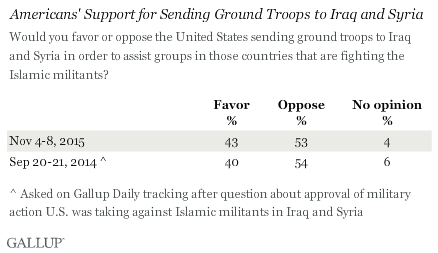
As the U.S. intensifies its airstrikes against Islamic State militants in Syria and Iraq, Americans are more likely to oppose (53%) than support (43%) sending U.S. ground troops to these countries to help groups there fight the militants. These figures haven't changed significantly since September 2014 after President Barack Obama launched airstrikes against the Islamic State group and other militant groups.
Trend: Americans' Support for Sending Ground Troops to Iraq and Syria
On November 12, CBS reported:
Americans' evaluations of how the U.S. fight against ISIS in Iraq and Syria is going are now at their worst level since the question was first asked in this poll about one year ago. Seventy-two percent now say that fight is going badly, up from 64 percent in August. Only 21 percent of Americans say it is going well, down from 28 percent.

Wednesday, August 5, 2015

No Authorization for the Use of Military Force

James Arkin reports at RealClearPolitics:
The war against ISIS began with airstrikes a year ago this week and lawmakers have spent significant time in the last 12 months debating the strategy and, in many cases, criticizing the way the Obama administration is conducting the fight. But one thing members of Congress have yet to do is have a vote – or even a substantive debate – over authorizing the military campaign.
Instead, President Obama has relied on past authorizations for the use of military force (AUMFs) against al-Qaeda in 2001 and in Iraq in 2002 as the legal justification for the current campaign against the terrorist organization operating mostly in Iraq and Syria. Despite the White House’s insistence, lawmakers are split on whether they agree. Some believe the president is operating within a legitimate legal framework. Others don’t.
...
Boehner, who has been a harsh critic of Obama’s strategy in fighting ISIS, was also staunchly against the president’s submission of a force authorization to Congress in February. In May, he called on Obama to “start over” and submit another draft to Congress.

The speaker’s argument is that the February draft is too narrow, restricting the commander-in-chief’s ability to wage the fight. Cory Fritz, a spokesman for Boehner, told RCP, “We have only one commander-in-chief at a time. It is unconscionable that he has offered up a plan that undermines America's ability to win his fight.”

Ultimately, most parties agreed it’s unlikely this issue will be hashed out, either in the near future because of the Iran nuclear debate or into the fall because of continuing divisions and calendar issues. But whether or not progress is made, don’t expect the group of lawmakers pushing for this debate to shy away from it.

Tuesday, March 10, 2015

Senators and Foreign Policy, Then and Now

Julie Hirschfeld Davis reports at The New York Times:
The White House has berated Senate Republicans for writing to Iran’s leaders warning them against a nuclear agreement with President Obama, saying their letter skirts the Constitution and sends a dangerous and conflicting message.
In a lengthy and harshly worded statement released late Monday, Vice President Joseph R. Biden Jr., a Senate veteran of more than three decades and a former chairman of the Foreign Relations Committee, said he could recall no other instance in which senators had written to the leaders of another country, “much less a foreign adversary,” to say the president had no authority to strike a deal with them
On June 16, 2008, Jeff Zeleny reported at The New York Times:
As Mr. Obama arrived in Michigan for a campaign stop on the economy, he shared details of his morning telephone call with Iraqi Foreign Minister Hoshyar Zebari. On Sunday, Mr. Zebari had a face-to-face meeting with Senator John McCain of Arizona, the presumptive Republican nominee.

Among the issues being discussed with the two presidential candidates is the long-term security accord between Iraq and the United States. While the Bush administration would like to see an agreement reached before the summer’s political conventions, Mr. Obama said today that he opposed such a timetable.

“My concern is that the Bush administration, in a weakened state politically, ends up trying to rush an agreement that in some ways might be binding to the next administration, whether it’s my administration or Senator McCain’s administration,” Mr. Obama said. “The foreign minister agreed that the next administration should not be bound by an agreement that’s currently made.”

Saturday, February 14, 2015

Planning for War, Planning for Victory

General Paul Vallely (ret.) tells Newsmax that the United States has erred by fighting wars without a plan for victory.
"We have seen a lack of leadership in the White House and a really stand up position of our Joint Chiefs of Staff in the military to make sure, if we're going to put our assets in jeopardy, our personnel, then we have to go in with a plan and a victory plan and end war as soon as possible," he said.

"We've got to go back to the basics of strategy, victory, and how we win wars when we put our Armed Forces out there.

"If we don't have a sound plan for victory," Vallely said, "I would not shed one more ounce of human blood in the Middle East."
In 2006, Senator Barack Obama said something similar:
[In] any conflict, it is not enough to simply plan for war; you must also plan for success. Much has been written about how the military invasion of Iraq was planned without any thought to what political situation we would find after Baghdad fell. Such lack of foresight is simply inexcusable. If we commit our troops anywhere in the world, it is our solemn responsibility to define their mission and formulate a viable plan to fulfill that mission and bring our troops home.

Friday, February 13, 2015

AUMF Against ISIS

The president is asking Congress for authorization to use military force.  Note that no president has ever acknowledged the constitutionality of the War Powers Resolution or declared that such AUMFs
TO THE CONGRESS OF THE UNITED STATES:
The so-called Islamic State of Iraq and the Levant (ISIL) poses a threat to the people and stability of Iraq, Syria, and the broader Middle East, and to U.S. national security. It threatens American personnel and facilities located in the region and is responsible for the deaths of U.S. citizens James Foley, Steven Sotloff, Abdul-Rahman Peter Kassig, and Kayla Mueller. If left unchecked, ISIL will pose a threat beyond the Middle East, including to the United States homeland.
I have directed a comprehensive and sustained strategy to degrade and defeat ISIL. As part of this strategy, U.S. military forces are conducting a systematic campaign of airstrikes against ISIL in Iraq and Syria. Although existing statutes provide me with the authority I need to take these actions, I have repeatedly expressed my commitment to working with the Congress to pass a bipartisan authorization for the use of military force (AUMF) against ISIL. Consistent with this commitment, I am submitting a draft AUMF that would authorize the continued use of military force to degrade and defeat ISIL.
My Administration's draft AUMF would not authorize long‑term, large-scale ground combat operations like those our Nation conducted in Iraq and Afghanistan. Local forces, rather than U.S. military forces, should be deployed to conduct such operations. The authorization I propose would provide the flexibility to conduct ground combat operations in other, more limited circumstances, such as rescue operations involving U.S. or coalition personnel or the use of special operations forces to take military action against ISIL leadership. It would also authorize the use of U.S. forces in situations where ground combat operations are not expected or intended, such as intelligence collection and sharing, missions to enable kinetic strikes, or the provision of operational planning and other forms of advice and assistance to partner forces.
Although my proposed AUMF does not address the 2001 AUMF, I remain committed to working with the Congress and the American people to refine, and ultimately repeal, the 2001 AUMF. Enacting an AUMF that is specific to the threat posed by ISIL could serve as a model for how we can work together to tailor the authorities granted by the 2001 AUMF.
I can think of no better way for the Congress to join me in supporting our Nation's security than by enacting this legislation, which would show the world we are united in our resolve to counter the threat posed by ISIL.
BARACK OBAMA
THE WHITE HOUSE,
February 11, 2015.
John Yoo disagrees:
[A] closer reading of the Obama proposal reveals severe flaws that undermine this purpose. First, and most glaring, the authorization will have only a three-year lifespan, after which Congress would have to pass a new law to resurrect the war. No important declaration of war or authorization to use force has ever had such a sunset, because no armed conflict will ever obey an arbitrary deadline. Even the Framers, removed by centuries from our modern battlefield with its non-state enemies and asymmetric tactics, understood this. Alexander Hamilton argued against critics of the Constitution who wanted to impose similar limits on the government’s war powers (such as forcing armies to disband every year): Because the “circumstances that endanger the safety of nations are infinite,” he wrote in Federalist 23, “no constitutional shackles can wisely be imposed on the power.”
Hamilton and our Constitution’s Framers understood that war was so unpredictable that it could not be dictated by rules beforehand. But this is exactly the course on which the White House’s Authorization for Use of Military Force (AUMF) would set the nation. It makes little sense to announce to your enemies in advance when you will stop fighting. A three-year deadline will have the same harmful effects that Obama’s arbitrary withdrawal dates in Iraq and Afghanistan did. Groups and nations opposed to the United States, such as the Taliban in Afghanistan, ISIS in Syria and Iraq, and Iran in the Middle East, will simply wait us out. Or they may employ destructive delaying tactics in the hopes that war-weariness will lead a small minority in Congress to block a reauthorization in 2018. Try to imagine that, on December 8, 1941, President Franklin D. Roosevelt had asked Congress for a declaration of war that would last only three years. It is impossible, because FDR took war seriously and understood that our enemies fight not according to our plans, but according to their own.

Thursday, February 5, 2015

Brian Williams's Tall Tale

Lloyd Grove reports at The Daily Beast:
The Brian Williams Apology Tour has begun—and who knows where it will end?
The NBC Nightly News anchor publicly apologized three times Wednesday—during his regular broadcast, in a Facebook post, and in Stars and Stripes—after the military-focused newspaper published a damning story that Williams and NBC have been claiming falsely “for years” that during the 2003 Iraq invasion, he was aboard a U.S. Army helicopter that was hit and forced down by rocket-propelled grenades.
“The story actually started with a terrible moment a dozen years back during the invasion of Iraq,” Williams told viewers during last Friday’s broadcast of the top-rated NBC Nightly News, “when the helicopter we were traveling in was forced down after being hit by an RPG.” Video accompanying the story showed a severely damaged helicopter, its skin pierced by an RPG, and strongly suggested that Williams had been a passenger on the combat-hobbled aircraft.
Williams has told the story of being hit by enemy fire at least twice on national television, most recently during Friday’s Nightly News segment about a retired Army sergeant who protected him and his NBC colleagues in the war zone. ButStars and Stripes reported that contrary to Williams’s tall tale, his Chinook helicopter was miles away when an entirely different chopper took enemy fire.
...
Unfortunately for Williams, this is not the first time he has made “this mistake” on network television. On the March, 26, 2013 episode of CBS’s Late Show With David Letterman, he told the host (at the 3-minute, 50-second mark): “Two of our four helicopters were hit by ground fire, including the one I was in.”

Thursday, September 11, 2014

The President, ISIS, and War Powers

President Obama says that he has authority to act against ISIS because of the War Powers Act and the congressional authorization for the Iraq War. Andrew Rudelevige writes at The Washington Post  that neither rationale holds up.
First, the Obama administration has not actually filed any reports under the War Powers Act (or rather Resolution — thus, the “WPR”). The president has indeed sent a number of letters to Congress about the Islamic State and Iraq since June — the latest such is dated September 8 — but these are simply to keep Congress “fully informed.” Doing so is “consistent with the War Powers Resolution” (my emphasis) — but the president never says he is reporting “pursuant to” the WPR, as a consequence of that statute, as required by section 4(a)(1). The “consistent with” is boilerplate language that far predates Obama — presidents have rarely admitted that the WPR is binding or even constitutional — but the letters do not concede that the WPR limits his authority in any way. Indeed, in each letter Obama claims that he is acting “pursuant to my constitutional authority to conduct U.S. foreign relations and as Commander in Chief and Chief Executive.”
...
How about the authorization to use force in Iraq (P.L. 107-243), passed nearly 12 years ago? Is that a “specific statutory authorization” for the present circumstance? Had the Bush administration’s preferred text been adopted in 2002, Congress would have given the president power “to use all means” to “restore international peace and security in the region,” i.e., the entire Middle East, and Obama would have a great case. But the actual resolution states:
The President is authorized to use the Armed Forces of the United States as he determines to be necessary and appropriate in order to -- (1) defend the national security of the United States against the continuing threat posed by Iraq; and (2) enforce all relevant United Nations Security Council resolutions regarding Iraq.
Thus the authorization is for the use of force against (the state of) Iraq, rather than in Iraq. The Security Council resolutions referred to deal with weapons of mass destruction; with “repression of its civilian population”; and with “threatening its neighbors.” The Islamic State may be doing some of these things, but Iraq itself is not; indeed, the threat to the United States from Iraq’s government seems to be from the latter’s incompetence. Potential attacks within Syria’s borders seem even more removed from the authorization’s intent.

Monday, August 11, 2014

Iraq and War Powers


If the President plans to engage in military operations in Iraq for “months” (and almost certainly longer) in an effort to address the militant threat posed over the long term there, then the case for doing so in reliance solely on his inherent Article II self-defense power just grew weaker, legally and especially politically, and the case for seeking authorization from Congress for the military strikes just grew stronger. As I noted yesterday, the case for seeking congressional authorization in this context was made forcefully and persuasively less than a year ago by President Obama himself, when he explained why he was seeking congressional authorization prior to military strikes in Syria.
In January 2007, candidate Obama said:
 What we're saying is that if we can begin a phased withdrawal and give the Iraqi government a sense that we are not engaging in an open-ended commitment, we're not going to babysit a civil war and we're not going to continue to throw American troops at the problem, that they will actually arrive at the sort of political solution that's necessary.
A few weeks later, his then-rival and future secretary of state cribbed his line, as The New York Times reported:
On Sunday, Mrs. Clinton for the first time on the campaign trail used the phrase “civil war” to describe the violence in Iraq. Speaking about building coalitions with Middle Eastern nations, she said she would take a new approach: “I would say ‘I’m sorry, it’s over. We are not going to baby-sit a civil war.’ ”

Friday, June 13, 2014

Another Intelligence Failure

Shane Harris writes at Foreign Policy:
United States intelligence agencies were caught by surprise when fighters from the Islamic State of Iraq and al-Sham (ISIS) seized two major Iraqi cities this week and sent Iraqi defense forces fleeing, current and former U.S. officials said Thursday. With U.S. troops long gone from the country, Washington didn't have the spies on the ground or the surveillance gear in the skies necessary to predict when and where the jihadist group would strike.
The speed and ease with which well-armed and highly trained ISIS fighters took over Mosul, Iraq's second-largest city, and Tikrit, the birthplace of former Iraqi ruler Saddam Hussein, have raised significant doubts about the ability of American intelligence agencies to know when ISIS might strike next, a troubling sign as the Islamist group advances steadily closer to Baghdad. And it harkened back to another recent intelligence miscue, in February, when U.S. spy agencies failed to predict the Russian invasion of Crimea. Both events are likely to raise questions about whether the tens of billions of dollars spent every year on monitoring the world's hot spots is paying off -- and what else the spies might be missing.
The CIA maintains a presence at the U.S. Embassy in Baghdad, but the agency has largely stopped running networks of spies inside the country since U.S. forces left Iraq in December 2011, current and former U.S. officials said. That's in part because the military's secretive Joint Special Operations Command had actually taken the lead on hunting down Iraq's militants. With the JSOC commandos gone, the intelligence agencies have been forced to try to track groups like ISIS through satellite imagery and communications intercepts -- methods that have proven practically useless because the militants relay messages using human couriers, rather than phone and email conversations, and move around in such small groups that they easily blend into the civilian population.

Monday, January 20, 2014

Bush 41 and Iraq

Today is the 25th anniversary of George H.W. Bush's inauguration.  The key event of his presidency was the 1991 Gulf War.  After the war, some criticized him for not occupying all of Iraq.  In a book with national security adviser Brent Scowcroft, he responded:
Trying to eliminate Saddam, extending the ground war into an occupation of Iraq, would have violated our guideline about not changing objectives in midstream, engaging in "mission creep," and would have incurred incalculable human and political costs. Apprehending him was probably impossible. We had been unable to find Noriega in Panama, which we knew intimately. We would have been forced to occupy Baghdad and, in effect, rule Iraq. The coalition would instantly have collapsed, the Arabs deserting it in anger and other allies pulling out as well. Under those circumstances, there was no viable "exit strategy" we could see, violating another of our principles. Furthermore, we had been self-consciously trying to set a pattern for handling aggression in the post-Cold War world. Going in and occupying Iraq, thus unilaterally exceeding the United Nations' mandate, would have destroyed the precedent of international response to aggression that we hoped to establish. Had we gone the invasion route, the United States could conceivably still be an occupying power in a bitterly hostile land. It would have been a dramatically different--and perhaps barren--outcome.

Saturday, September 7, 2013

President Obama's 2002 Iraq Speech

Barack Obama, then a little-known state senator in Illinois, gave a speech against the Iraq War on October 2, 2002.  Years later, that speech enabled him to say that he had opposed the war while many other leading Democrats had supported it.  As Congress debates the wisdom of intervention in Syria, it is worth quoting at length:
What I am opposed to is a dumb war. What I am opposed to is a rash war. What I am opposed to is the cynical attempt by Richard Perle and Paul Wolfowitz and other armchair, weekend warriors in this administration to shove their own ideological agendas down our throats, irrespective of the costs in lives lost and in hardships borne.

What I am opposed to is the attempt by political hacks like Karl Rove to distract us from a rise in the uninsured, a rise in the poverty rate, a drop in the median income — to distract us from corporate scandals and a stock market that has just gone through the worst month since the Great Depression. That's what I'm opposed to. A dumb war. A rash war. A war based not on reason but on passion, not on principle but on politics. Now let me be clear — I suffer no illusions about Saddam Hussein. He is a brutal man. A ruthless man. A man who butchers his own people to secure his own power. He has repeatedly defied UN resolutions, thwarted UN inspection teams, developed chemical and biological weapons, and coveted nuclear capacity. He's a bad guy. The world, and the Iraqi people, would be better off without him.

But I also know that Saddam poses no imminent and direct threat to the United States or to his neighbors, that the Iraqi economy is in shambles, that the Iraqi military a fraction of its former strength, and that in concert with the international community he can be contained until, in the way of all petty dictators, he falls away into the dustbin of history. I know that even a successful war against Iraq will require a U.S. occupation of undetermined length, at undetermined cost, with undetermined consequences. I know that an invasion of Iraq without a clear rationale and without strong international support will only fan the flames of the Middle East, and encourage the worst, rather than best, impulses of the Arab world, and strengthen the recruitment arm of al-Qaida. I am not opposed to all wars. I'm opposed to dumb wars.
Surprisingly, Organizing for Action still posts a video about the 2002 speech:

Friday, September 6, 2013

Opinion and Syria

Gallup reports:
Americans' support for the United States' taking military action against the Syrian government for its suspected use of chemical weapons is on track to be among the lowest for any intervention Gallup has asked about in the last 20 years. Thirty-six percent of Americans favor the U.S. taking military action in order to reduce Syria's ability to use chemical weapons. The majority -- 51% -- oppose such action, while 13% are unsure.
 Views on Proposed U.S. Military Actions Before Commencement of Such Actions

Saturday, June 29, 2013

National Pride

A recent post mentioned a poll on national pride by the Public Religion Research Institute.  Here is the full release:
As the nation prepares to celebrate the July 4th holiday, a vast majority (82 percent) of Americans say they are generally proud to be an American, citing a range of reasons for their feelings of pride, a survey finds. Roughly less than one-third (31 percent) of Americans say there has ever been a time when they were not proud to be an American. The survey also finds that more than half of Americans (53 percent) plan to attend a July 4th celebration this year.
The new PRRI/RNS Religion News Survey, conducted by Public Religion Research Institute in partnership with Religion News Service, finds that about eight-in-ten Americans report that they are extremely (51 percent) or very (31 percent) proud to be American. Republicans (68 percent) are more likely to report being extremely proud than Democrats (49 percent) or independents (47 percent), though majorities of all political groups say they are extremely or very proud.
“America’s military achievements and the willingness of Americans to serve their country in the military stand out as a source of pride for many Americans,” said Dr. Robert P. Jones, CEO of Public Religion Research Institute. “But among those who report ever feeling not proud to be an American, military actions and wars, particularly those in Vietnam and Iraq, were also the most frequently mentioned events.”
The most frequently cited reasons cited for being proud to be an American are military service and achievements (17 percent), the response to the September
By contrast, the most frequently cited reasons for ever not being proud to be an American are wars such as Vietnam and Iraq (29 percent) and the treatment of minority groups or racism (14 percent).
“American patriotism is particularly evident in the way Americans compare themselves to the rest of the world,” said Daniel Cox, PRRI Research Director. “Most Americans believe that the world would be better off if America could export its values and way of life to other countries. However, strong religious divisions exist, with three-quarters of white evangelicals and Catholics embracing this notion, compared to less than half of religiously unaffiliated Americans.”
Americans hold strongly positive views about America’s role in history and in the world today. Nearly 8-in-10 (79 percent) say America has always been a force for good in the world, and almost two-thirds believe God has granted America a special role in human history (64 percent) and that the world would be much better off if more countries adopted America’s values and way of life (63 percent). Conservatives are more likely than liberals to believe the world would be better off if more countries adopted America’s values and way of life (74 percent vs. 52 percent).
Among the Findings:
Eight-in-ten Americans report that they are extremely (51 percent) or very (31 percent) proud to be American. Roughly 1-in-10 (12 percent) say they are moderately proud, and 4 percent say they are only a little proud or not proud.
  • Republicans (68 percent) are also more likely to report being extremely proud than Democrats (49 percent) or independents (47 percent), though majorities of all political groups say they are extremely or very proud.
  • White evangelicals also report stronger feelings of pride than other religious groups. More than two-thirds (68 percent) of white evangelicals say they are extremely proud to be American, compared to 56 percent of white mainline Protestants, 49 percent of minority Christians, 48 percent of Catholics, and 39 percent of religiously unaffiliated Americans.
  • Nearly two-thirds of seniors (age 65 and over) report being extremely proud to be American, compared to 39 percent of younger adults (age 18 to 29).
Americans give a wide range of reasons for their feelings of pride about America. Roughly 1-in-5 (17 percent) say their military service or American military achievements — including the capture and killing of Osama bin Laden — have made them most proud to be American. Fourteen percent cite the response to the September 11th terrorist attacks, and 12 percent cite freedom in American society as things about which they feel most proud. Smaller numbers mention humanitarian assistance and disaster response (8 percent), personal experience or success (7 percent), the values of equality and opportunity (6 percent), Obama’s election (6 percent), or the moon landing (5 percent) as things that make them most proud to be an American.
  • Democrats and Republicans differ significantly in the reasons they provide for being proud to be an American. Democrats are more likely than Republicans to cite Obama’s election (15 percent vs. 1 percent) or the values of equality and opportunity (9 percent vs. 1 percent).
  • Republicans are more likely than Democrats to cite American symbols such as the Constitution or major political figures such as Ronald Reagan (9 percent vs. 0 percent).
  • Republicans and Democrats are about equally as likely to cite freedom as the thing that makes them most proud to be American (13 percent vs. 17 percent).
Roughly one-third (31 percent) of Americans say there has been a time when they were not proud to be an American.
  • Democrats (36 percent) and independents (30 percent) are more likely than Republicans (23 percent) to report that there was a time when they were not proud to be an American.
Americans who say there was a time when they were not proud to be American also cite a wide range of reasons. The most frequently mentioned reasons for not being proud to be an American are the wars in Iraq and Vietnam (29 percent) and the treatment of minority groups or racism (14 percent). Roughly 1-in-10 Americans cite some aspect of American culture (e.g. gun violence, the acceptance of gay and lesbian rights) (11 percent), the election of Barack Obama (11 percent), the election of George W. Bush (10 percent), or the role of America in the world (9 percent) as reasons they do not feel proud to be an American.
A majority of Americans report they are very likely to engage in the following activities related to patriotism: thanking members of the military for their service (81 percent), singing the national anthem (69 percent), displaying an American flag at their home or on their car (59 percent), attending a July 4th celebration this year (53 percent), or making a special effort to buy American-made products (50 percent).
  • Republicans are significantly more likely than Democrats to report engaging in a range of patriotic activities, including singing the national anthem (83 percent of Republicans vs. 66 percent of Democrats), displaying an American flag at their home or car (76 percent of Republicans vs. 48 percent of Democrats), or making a special effort to buy American made products even if they cost more (55 percent of Republicans vs. 44 percent of Democrats).
  • Roughly 6-in-10 white evangelical Protestants (62 percent) and white mainline Protestants (57 percent) report that they are very likely to attend a July 4th celebration, compared to less than half of Catholics (49 percent) and the religiously unaffiliated (48 percent). 
  • White Americans (66 percent) are more likely than Hispanic Americans (50 percent) or black Americans (40 percent) to report being very likely to display an American flag.
 Americans hold largely positive views about America’s role in history and in the world today. Nearly 8-in-10 (79 percent) say America has always been a force for good in the world, and nearly two-thirds (64 percent) believe God has granted America a special role in human history. More than 6-in-10 (63 percent) say if more countries adopted America’s values and way of life, the world would be much better off.
  • Conservatives are more likely than liberals to believe the world would be better off if more countries adopted America’s values and way of life (74 percent vs. 52 percent).
  • More than 8-in-10 white evangelicals agree that God has granted America a special role in human history, compared to 40 percent of religiously unaffiliated Americans.
  • Roughly three-quarters of white evangelical Protestants (74 percent) and Catholics (76 percent) believe that the world would be better off if more countries adopted America’s values and way of life. Less than half (49 percent) of religiously unaffiliated Americans agree.
More than 7-in-10 Americans think of themselves as a “typical American,” while 1-in-4 (25 percent) say they are very different from a typical American. Americans who are white and older are more likely than others to think of themselves as a typical American.
The survey was designed and conducted by Public Religion Research Institute in partnership with Religion News Service. Results of the survey were based on bilingual (Spanish and English) RDD telephone interviews conducted between June 5, 2013 and June 9, 2013 by professional interviewers under the direction of Social Science Research Solutions (SSRS). Interviews were conducted among a random sample of 1,007 adults 18 years of age or older in the continental United States (402 respondents were interviewed on a cell phone). The margin of error for the survey is +/- 3.1 percentage points at the 95% level of confidence.

Friday, April 5, 2013

Conspiracy Theories

Public opinion often suffers from misinformation, and nonattitudes. If you ask a crazy question, you are likely to get a crazy answer.  Public Policy Polling reveals the results of a survey on conspiracy theories:
PPP’s latest national poll finds the American public differing along party lines on many conspiracy theories involving issues like global warming and the Iraq War, although some of the more bizarre ideas merit bipartisan skepticism.
The poll finds 28% of voters believe that a secretive power elite with a globalist agenda is conspiring to eventually rule the world through an authoritarian world government, or New World Order. 34% of Republicans and 35% of independents believe in the New World Order threat compared to just 15% of Democrats.
44% of voters believe the Bush administration intentionally misled the public about weapons of mass destruction to promote the Iraq War, while 45% disagree. 72% of Democrats believed the statement while 73% of Republicans did not. 22% of Democrats, 33% of Republicans and 28% of independents believe Saddam Hussein was involved in the 9/11 terrorist attacks. Just 6% of voters think Osama bin Laden is still alive.
There is an intense partisan divide on whether or not global warming is a hoax: 58% of Republicans agree that it is a conspiracy, while 77% of Democrats disagree. 20% of Republicans believe that President Obama is the Anti-Christ, compared to 13% of independents and 6% of Democrats who agree. 51% of Americans believe there was a larger conspiracy at work in the JFK assassination, while 25% think Lee Harvey Oswald acted alone. 29% believe aliens exist and 21% believe a UFO crashed at Roswell in 1947.
“Even crazy conspiracy theories are subject to partisan polarization, especially when there are political overtones involved,” said Dean Debnam, President of Public Policy Polling. “But most Americans reject the wackier ideas out there about fake moon landings and shape-shifting lizards.”
5% of respondents believe that Paul McCartney died and was secretly replaced in the Beatles in 1966, and just 4% believe shape-shifting reptilian people control our world by taking on human form and gaining power. 7% of voters think the moon landing was fake.

Thursday, January 17, 2013

Lawmakers, Demographics, and Veterans

The 113th Congress is in session. But, who are they?
Lawyers, mostly. How do we know? A terrific chart from Businessweek that breaks down all of the professions of the new Congress. There are 128 lawyers in the House and another 45 in the Senate. Somewhat remarkably, there only 55 career politicians in the House and another nine in the Senate. (The Fix would have bet the “over” on both of those numbers.) There’s also one microbiologist, one carpenter and one physicist.
In comparison to the 112th Congress, there are six less veterans in the House and six less in the Senate as well — the latest evidence of the steady decline in those who have served in the military in Congress. (New Jersey Sen. Frank Lautenberg is the only member of the Senate who served in World War II.)
Previous posts have discussed veterans in Congress. The New York Times notes that 16 lawmakers served in Iraq or Afghanistan, including nine new members.
But the number of veterans joining Congress continued a four-decade long slide, dropping to 106 in the 113th Congress, according to data from CQ Roll Call.
The Senate will have 18 veterans, down from a peak of 81 in 1977 and the lowest since at least World War II, according to data from the Senate Historical Office. The House will have 88 veterans, down from a peak of 347 in 1977, according to the Military Officers Association of America.
...
The new crop of veterans includes the first two female combat veterans to serve in Congress, Tammy Duckworth of Illinois and Tulsi Gabbard of Hawaii, both Democrats.

Monday, March 19, 2012

The Toll

Battle Deaths in American Wars

Revolutionary War 4,435
War of 1812 2,260
Mexican American War 1,733
Civil War 140,414
Spanish American War 385
World War I 53,402
World War II 291,557
Korean War  33,739
Vietnam War 47,434
Gulf War 147
Iraq War 3,479
Afghanistan War 1,488

Sources: Anne Leland and Mari-Jana "M-J" Oboroceanu, "American War and Military Operations
Casualties: Lists and Statistics" (Washington: Congressional Research Service, February 26, 2010); DOD casualty data as of March 19, 2012.

Wednesday, June 8, 2011

Where Is the Protest?

Although the United States has ended its direct combat role in Iraq, it maintains thousands of troops there, and a Monday rocket attack killed five of them. Americans are fighting in Afghanistan. And the United States is taking part in NATO operations against Libya, despite serious legal questions.

Our chapter on interest groups includes a discussion of protest as a political tactic. Although the Iraq War triggered protest activity between 2003 and 2008, it has tapered off. Why? In "The Partisan Dynamics Of Contention: Demobilization of The Antiwar Movement In The United States, 2007-2009," Michael T. Heaney and Fabio Rojas report:

Changes in threats perceived by activists, partisan identification, and coalition brokerage are three mechanisms that help to explain the demobilization of the antiwar movement in the United States from 2007 to 2009. Drawing upon 5,398 surveys of demonstrators at antiwar protests, interviews with movement leaders, and ethnographic observation, this article argues that the antiwar movement demobilized as Democrats, who had been motivated to participate by anti-Republican sentiments, withdrew from antiwar protests when the Democratic Party achieved electoral success, if not policy success in ending the wars in Iraq and Afghanistan. The withdrawal of Democratic activists changed the character of the antiwar movement by undermining broad coalitions in the movement and encouraging the formation of smaller, more radical coalitions. While the election of Barack Obama had been heralded as a victory for the antiwar movement, Obama’s election, in fact, thwarted the ability of the movement to achieve critical mass.