Search This Blog

Showing posts with label protest. Show all posts

Saturday, August 12, 2023

Sixty Years after The March

 Juliana Menasce Horowitz at Pew:

For this report, we surveyed 5,073 U.S. adults from April 10 to April 16, 2023, using Pew Research Center’s American Trends Panel.1...
  • Most Americans say King has had a positive impact on the country, with 47% saying he has had a very positive impact. Fewer (38%) say their own views on racial equality have been influenced by King’s legacy a great deal or a fair amount.
  • 60% of Americans say they have heard or read a great deal or a fair amount about King’s “I Have a Dream” speech. Black adults are the most likely to say this at 80%, compared with 60% of White adults, 49% of Hispanic adults and 41% of Asian adults.
  • 52% of Americans say there has been a great deal or a fair amount of progress on racial equality in the last 60 years. A third say there’s been some progress and 15% say there has been not much or no progress at all. Still, more say efforts to ensure equality for all, regardless of race or ethnicity, haven’t gone far enough (52%) than say they have gone too far (20%) or been about right (27%).
  • A majority (58%) of those who say efforts to ensure equality haven’t gone far enough think it’s unlikely that there will be racial equality in their lifetime. Those who say efforts have been about right are more optimistic: Within this group, 39% say racial equality is extremely or very likely in their lifetime, while 36% say it is somewhat likely and 24% say it’s not too or not at all likely.
  • Many people who say efforts to ensure racial equality haven’t gone far enough say several systems need to be completely rebuilt to ensure equality. The prison system is at the top of the list, with 44% in this group saying it needs to be completely rebuilt. More than a third say the same about policing (38%) and the political system (37%).
  • 70% of Americans say marches and demonstrations that don’t disrupt everyday life are always or often acceptable ways to protest racial inequality. And 59% say the same about boycotts. Fewer than half (39%) see sit-ins as an acceptable form of protest. And much smaller shares say the same about activities that disrupt everyday life, such as shutting down streets or traffic (13%) and actions that result in damage to public or private property (5%).

Demographic and partisan differences
These survey findings often differ by race, ethnicity and partisanship – and in some cases also by age and education.
  • Some examples:59% of Black Americans say their personal views on racial equality have been influenced by Martin Luther King Jr. a great deal or a fair amount. Smaller shares of Hispanic (38%), White (34%) and Asian (34%) Americans say the same.
  • Adults ages 65 and older and those with at least a bachelor’s degree are more likely than younger adults and those with less education to be highly familiar with King’s “I Have a Dream” speech.
  • 58% of White adults say there has been a great deal or a fair amount of progress on racial equality in the last 60 years. This compares with 47% of Asian adults, 45% of Hispanic adults and 30% of Black adults. Republicans and those who lean Republican (67%) are more likely than Democrats and Democratic leaners (38%) to say this.
  • 83% of Black adults say efforts to ensure equality for all, regardless of race and ethnicity, haven’t gone far enough. This is larger than the shares of Hispanic (58%), Asian (55%) and White (44%) adults who say the same. Most Democrats (78%) say these efforts haven’t gone far enough, compared with 24% of Republicans. Some 37% of Republicans say these efforts have gone too far.
  • Black Americans, Democrats and adults younger than 30 who say efforts to ensure racial equality haven’t gone far enough are among the most likely to say several systems, ranging from the economic system to the prison system, need to be completely rebuilt to ensure equality.

Wednesday, August 3, 2022

Issues, Abortion, and Protest

 Megan Brenan at Gallup:

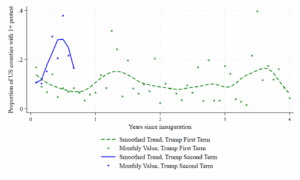
Nearly four in 10 Americans, 39%, say they have felt the urge to organize or join a public demonstration. This is statistically similar to the previous 36% reading in 2018 but much higher than the 10% who said the same in 1965. The reasons behind Americans' desire to protest today are markedly different than four years ago.

In the wake of the U.S. Supreme Court's decision eliminating abortion as a constitutional right and returning abortion policy decisions to individual state governments, 31% of those who have expressed a desire to protest name the abortion issue as their greatest motivation to do so.

Beyond abortion, the issues now mentioned most as reasons to demonstrate are law enforcement or Black Lives Matter (22%), women's rights (19%), civil or equal rights (11%), and government or political issues (10%).

In 2018, no single issue dominated Americans' protest motivations, although the women's movement led with 17% amid the "Me too" movement, similar to the percentage this year, while 6% cited abortion. Immigration, another high-ranking issue four years ago during the Trump administration's controversial policy changes, is barely on protestors' radar this year. Gun control, which was tied with immigration in 2018, is currently mentioned by 8% of U.S. adults.

Thursday, April 1, 2021

Protest Impact

 Samuel Abrams at The Hill:

Now, with the rise of the Black Likes Matter movement and civil disturbances popping up around the country in protest of police action, my students want to know if these latest demonstrations have changed public opinion. Thanks to new data from a poll by the Los Angeles Times and Reality Check Insights, I tell them that the reaction from the nation to these protests vary widely by demographics and may not have had the impact that they had hoped; the BLM related protests did not shift the majority of Americans’ views on race in the nation.

A national sample of over 1,400 Americans were asked after the election if the protests in many cities across the U.S. over the killing of George Floyd and others by police changed the way you think about racial justice in America. The answer may not be as encouraging to my students as they would have hoped: just a third (32 percent) of Americans said that the protest helped them think “a lot” about racial justice in America, and 41 percent said the protests did not change their views whatsoever.

The protests had very different levels of impact along racial lines. Among Blacks, 52 percent believed that the protests changed their thinking on race and this was appreciably higher than the quarter of Whites (27 percent) who felt the same way. About a third of Blacks (32 percent) stated that the protests did not change their thinking about race compared to 45 percent of Whites.

Among Hispanics, about a third believed that the protests changed their views and another third found that the protests did nothing at all. The reactions here are remarkably inconsistent across the nation and it is clear that Americans did not overwhelmingly or uniformly accept the ideas behind the various protests, calling into serious question the efficacy of the actions themselves.

The protests also failed to shift attitudes outside of the youngest generations of Americans. While 85 percent of Gen Z and 69 percent of Millennials report that the movement impacted their thinking on race to some degree, less than a quarter of “Boomers” said the protests made them think “a lot” about the issues at hand. Younger Americans connected with the movement but older Americans did not


Saturday, September 19, 2020

"Autocratization"

From the V-Dem Institute:
AUTOCRATIZATION SURGES
• For the first time since 2001, autocracies are in the majority: 92 countries – home to 54% of the global population.
• Almost 35% of the world’s population live in autocratizing nations – 2.6 billion people.
• The EU has its first non-democracy as a member: Hungary is now classified as an electoral authoritarian regime.
Major G20 nations and all regions of the world are part of the “third wave of autocratization”:
Autocratization is affecting Brazil, India, the United States of America, and Turkey, which are major economies with sizeable populations, exercising substantial global military, economic, and political influence.
• Latin America is back to a level last recorded in the early 1990s while Eastern Europe and Central Asia are at post-Soviet Union lows.
• India is on the verge of losing its status as a democracy due to the severely shrinking of space for the media, civil society, and the opposition under Prime Minister Modi’s government.
Attacks on freedom of expression and the media intensify across the world, and the quality of elections begins to deteriorate:
• Attacks on freedom of expression and media freedom are now affecting 31 countries, compared to 19 two years ago.
• The Clean Elections Index fell significantly in 16 nations while improving in only twelve.
• Media censorship and the repression of civil society have intensified in a record 37 countries – eleven more than the 26 states currently affected by severe autocratization. Since these indicators are typically the first to move in a gradual process of autocratization, this development is an early warning signal for what might be yet to come.
New V-Dem indicators on Civic and Academic Space show that autocratization taints the whole society:
• Academic freedom has registered a conspicuous average decline of 13% in autocratizing countries over the last 10 years.
• The right to peaceful assembly and protest has declined by 14% on average in  autocratizing countries.
• Toxic polarization, pro-autocracy mass protests, and political violence rise in many autocratizing countries, such as in Brazil and Poland. 
New V-Dem data on pro-democracy mass mobilization reveals all-time highs in 2019:
• The share of countries with substantial pro-democracy mass protests rose from 27% in 2009 to 44% in 2019.
• Citizens are taking to the streets in order to defend civil liberties and the rule of law, and to fight for clean elections and political freedom.
• The unprecedented degree of mobilization for democracy in light of deepening autocratization is a sign of hope. While pro-autocracy rulers attempt to curtail the space for civil society, millions of citizens have demonstrated their commitment to democracy.
Protesters in democracies resist the dismantling of democracy while their counterparts in
autocracies are demanding more democracy:
• During 2019, citizens in 29 democracies mobilized against autocratization, such as in Bolivia, Poland, and Malawi.
• Citizens staged mass protests in 34 autocracies, among them Algeria, Hong Kong, and Sudan.
• In several cases such as in Sudan, citizens successfully achieved breakthroughs for freedom and democracy.
Democratization continues to progress around the world:
• In 22 countries, pro-democracy mass protests have been followed by substantial democratization during the last ten years.
• Armenia, The Gambia, Sri Lanka, and Tunisia are the four countries achieving the greatest democratic gains.
• Ecuador shows that while autocratization can be turned around, it is difficult to return to a stable democracy

Friday, September 4, 2020

The Public Assesses the State of Democracy

Pew Research:
In assessing the state of U.S. democracy, Americans continue to give their country negative ratings for living up to several key democratic ideals and principles. And in some cases, these assessments have turned less positive since 2018
.Notably, the share of Americans who say the phrase “people are free to peacefully protest” describes the United States very or somewhat well has fallen from 73% t0 60%, with the decline coming almost entirely among Democrats.
As was the case in Pew Research Center’s 2018 study of U.S. democracy, large majorities of Americans agree on the importance of a number of democratic principles – including that the rights and freedoms of all people are respected, that elected officials face serious consequences for misconduct and that everyone has an equal opportunity to succeed.
However, there continue to be sizable gaps between the shares of Americans who say these principles are very important and the shares saying the U.S. is doing well in living up to them. And fewer Americans see some principles as very important – notably, including the freedom to peaceful protest – than did so two years ago.

Monday, August 31, 2020

Russian Efforts to Divide Americans

Craig Timberg and  Isaac Stanley-Becker at WP:
Four years after Russian operatives used social media in a bid to exacerbate racial divisions in the United States and suppress Black voter turnout, such tactics have spread across a wide range of deceptive online campaigns operated from numerous nations — including from within the United States itself.

The potency and persistence of the racial playbook was highlighted this week when Twitter deleted an account featuring a profile photo of a young Black man claiming to be a former Black Lives Matter protester who switched his allegiance to the Republican Party.

The account, @WentDemtoRep, offered an online testimonial Sunday — the eve of a Republican convention featuring prominent African Americans challenging allegations of racism against President Trump — and was retweeted 22,000 times. Disinformation researcher Marc Owen Jones, of Hamad Bin Khalifa University in Qatar, found the tweet had 39,000 likes just 19 hours after it was posted.
On June 18, Jeff Seldin reported at VOA:
Russia appears to be intensifying its focus on police enforcement issues in the United States, using popular reactions to protests that have gripped the nation as part of a larger propaganda campaign to divide Americans ahead of the U.S. presidential election in November.
The death of African American George Floyd in police custody and the ensuing U.S. protests have for weeks dominated media coverage from Russian state-sponsored outlets like RT and Sputnik.
Only now, it seems that Russia, through the English-language RT in particular, is reaching out to U.S. police officers and union officials, in what some U.S. officials and lawmakers say is an effort to further inflame tensions.
...
Law enforcement officers and organizations who spoke with VOA about their interactions with RT described being caught off guard.
“We had no idea about the ties they have,” a representative for lawofficer.com, a website catering to law enforcement officers, told VOA about being approached by the Russian television news channel. “They actually told us they were out of Britain.”
RT contacted lawofficer.com seeking permission to republish an essay by Tulsa, Oklahoma Police Major Travis Yates about the frustration he and many of his police colleagues have been feeling as a result of the protests of police practices, titled, “America, We Are Leaving.
RT also booked Yates for an on-air interview through its London bureau.
“If I had any idea whatsoever, I obviously never would have done it,” Yates told VOA when asked if he knew about RT’s Russian connection.
Since Yates’ essay was first published, it has been shared thousands of times on social media and even helped get him an appearance on Fox News’
"Tucker Carlson Tonight."

Thursday, August 27, 2020

Opinion on Protest

Jeffrey M. Jones at Gallup:
U.S. adults are more likely today than three decades ago to view several forms of protest as potentially helpful for improving the situation of Black Americans. Since Gallup last polled on this subject in 1988, there have been meaningful increases in the percentages of Americans saying that nonviolent protest, violent protest and economic boycotts, in particular, can help. Opinions on the effectiveness of legal action are little changed.
Americans are still most likely to see nonviolent protest and legal action as being helpful, and least likely to say violent protest is.
...
 Whereas Americans in 1988 were split on the effectiveness of economic action such as boycotts, they are now much more inclined to say it would help (50%) rather than hurt (22%) Black Americans' situation. Many companies publicly affirmed their support of the Black community after Floyd's death, but advocates for the Black Lives Matter movement called for boycotts of companies that do not support BLM efforts.
...
Black adults tend to be more optimistic than White adults that the various citizen actions tested in the poll would help improve the situation for Black Americans.
The two racial groups differ most in their opinions about the effectiveness of boycotts -- 69% of Black adults and 48% of White adults say boycotts would help. But White respondents are twice as likely to say boycotts are helpful rather than harmful.
Black Americans are modestly more likely than White Americans to believe legal action (74% vs. 65%, respectively) and violent protest (21% vs. 9%) can help. But majorities of both groups view violent protest as hurting the cause.

Saturday, July 18, 2020

John Lewis at Selma

Rep. John Lewis (D-GA) died yesterday.  

From the National Archives:
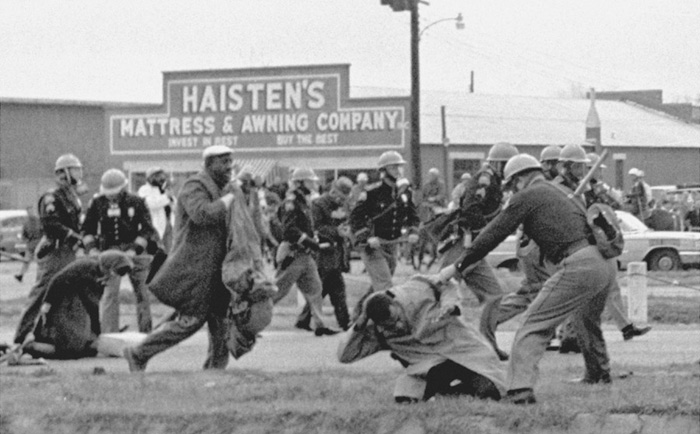
In 1965, at the height of the modern civil rights movement, activists organized a march for voting rights, from Selma, Alabama, to Montgomery, the state capital. On March 7, some 600 people assembled at a downtown church, knelt briefly in prayer, and began walking silently, two-by-two through the city streets.
With Hosea Williams of the Southern Christian Leadership Conference (SCLC) leading the demonstration, and John Lewis, Chairman of the Student Nonviolent Coordinating Committee (SNCC), at his side, the marchers were stopped as they were leaving Selma, at the end of the Edmund Pettus Bridge, by some 150 Alabama state troopers, sheriff ’s deputies, and possemen, who ordered the demonstrators to disperse.
One minute and five seconds after a two-minute warning was announced, the troops advanced, wielding clubs, bullwhips, and tear gas. John Lewis, who suffered a skull fracture, was one of fifty-eight people treated for injuries at the local hospital. The day is remembered in history as “Bloody Sunday.” Less than one week later, Lewis recounted the attack on the marchers during a Federal hearing at which the demonstrators sought protection for a full-scale march to Montgomery. A transcript of his testimony is presented in the following pages.
 Lewis: . . . a State Trooper made announcement on a bullhorn or megaphone, and he said, “This march will not continue.”
[Attorney Peter] Hall: What happened then; did the line stop?
Lewis: The line stopped at that time.
Hall: You stopped still?
Lewis: Yes, sir.
Hall: You didn’t advance any further?
Lewis: We stopped right then.
Hall: Then what happened?
Lewis: He said, “I am Major Cloud, and this is an unlawful assembly. This demonstration will not continue. You have been banned by the Governor. I am going to order you to disperse.”
Hall: What did you then do?
Lewis: Mr. Williams said, “Mr. Major, I would like to have a word, can we have a word?” And he said, “No, I will give you two minutes to leave.” And again Mr. Williams said, “Can I have a word?” He said, “There will be no word.” And about a minute or more Major Cloud ordered the Troopers to advance, and at that time the State Troopers took their position, I guess, and they moved forward with their clubs up over their—near their shoulder, the top part of the body; they came rushing in, knocking us down and pushing us.
Hall: And were you hit at that time?
Lewis: At that time I was hit and knocked down.
Hall: Where were you hit?
Lewis: I was hit on my head right here.
Hall: What were you hit with?
Lewis: I was hit with a billy club, and I saw the State Trooper that hit me.
Hall: How many times were you hit?
Lewis: I was hit twice, once when I was lying down and was attempting to get up.
Hall: Do we understand you to say were hit . . . and then attempted to get up
and were hit—and was hit again.
Lewis: Right.


At the end of the hearing, on March 17, Judge Frank Johnson, Jr., ruled that the demonstrators had a constitutional right to march; on March 21, under the protection of a Federalized National Guard, 3,200 demonstrators set out from Selma in a mass demonstration that became a turning point in the civil rights movement.

Wednesday, July 15, 2020

Online Activism

Brooke Auxier at Pew:
From global protests against racial injustice to the 2020 election, some Americans who use social media are taking to these platforms to mobilize others and show their support for causes or issues. But experiences and attitudes related to political activities on social media vary by race and ethnicity, age, and party, according to a Pew Research Center survey of U.S. adults conducted June 16-22, 2020.
People can be politically active on social media in many ways. This survey asked Americans about four different types of activities that they may have engaged in on these platforms. Overall, about one-third of social media users (36%) say they have used sites like Facebook, Twitter and others in the past month to post a picture to show their support for a cause, look up information about rallies or protests happening in their area (35%) or encourage others to take action on issues they regard as important (32%). A smaller share (18%) reports using a hashtag related to a political or social issue on social media during this time.

Hispanic and Black social media users (46% and 45%, respectively) are more likely than white users (29%) to say they have looked up information about protests and rallies in their area on social media in the past month.

But in certain activities, Black users stand out: 48% of Black social media users say they have posted a picture on social media to show their support for a cause in the past month, compared with 37% of Hispanic users and 33% of white users. Black adults who use social media (45%) are also more likely than their Hispanic (33%) or white (30%) counterparts to say that in the past month they’ve taken to social media to encourage others to take action on issues that are important to them.
...
 The share of 18- to 29-year-old social media users who say that these platforms are at least somewhat important to them for finding other people who share their views about important topics has risen from 47% in 2018 to 59% today. There have also been double-digit increases among younger users when it comes to getting involved with political or social issues and having a venue to express their opinions. By comparison, there has been little to no change on these questions for social media users ages 30 or older.

Thus social media perform the same function that Tocqueville ascribed to newspapers: "Then a newspaper gives publicity to the feeling or idea that had occurred to them all simultaneously but separately. They all at once aim toward that light, and these wandering spirits, long seeking each other in the dark, at last meet and unite. The newspaper brought them together and continues to be necessary to hold them together." (Democracy in America, Lawrence/Mayer ed., p. 518)

Saturday, July 11, 2020

BLM: Biggest Protest Ever

The recent Black Lives Matter protests peaked on June 6, when half a million people turned out in nearly 550 places across the United States. That was a single day in more than a month of protests that still continue to today.
Four recent polls — including one released this week by Civis Analytics, a data science firm that works with businesses and Democratic campaigns — suggest that about 15 million to 26 million people in the United States have participated in demonstrations over the death of George Floyd and others in recent weeks.
These figures would make the recent protests the largest movement in the country’s history, according to interviews with scholars and crowd-counting experts.
Number of people in U.S. who said they protested, according to polls
POLL PCT. WHO PROTESTED IMPLIED POPULATION POLLING PERIOD

Lara Putnam, Jeremy Pressman and Erica Chenoweth at WP:
The demonstrations after the killing of George Floyd have seen millions of Americans take to the streets on bicycles, horses, surfboards and boats, skateboards, in cars or on foot. It is the largest sustained mobilization in the United States in our lifetimes.

Data from the Crowd Counting Consortium gives a sense of the scale of these protests. So far, we’ve counted 5,000 individual anti-racism/anti-police-brutality protests nationwide since the end of May, involving millions of participants. In fact, data from Pennsylvania (which we have studied most intensively) suggest that our national count still underestimates the number of protests in small cities and towns. The real national total may be as high as 8,000.
...
Nearly half of the 10 percent of American adults who report attending a protest in support of Black Lives Matter last month identify as independents. That’s important because, in general, independents are less likely to be politically engaged or optimistic about politics or to vote. Yet the message that voting is necessary — if not sufficient — has rung out at protests. From Kansas City to Sacramento, protesters registered voters.

Everything we know about political engagement suggests that protest involvement builds new personal networks that make people more knowledgeable and engaged with politics — and more likely to vote.

Friday, June 12, 2020

Highways and Protests

Hadley Meares at LA Curbed:
When Angelenos gathered downtown to protest the murder of George Floyd, they started at City Hall and eventually made their way toward the 101. Pastor Stephen “Cue” Jn-Marie from the Row Church led the first group of protesters onto the freeway, which they occupied for roughly 30 minutes.
Ever since the murder of Trayvon Martin in 2012, uprisings protesting police brutality and racism have blocked freeways throughout America. The freeway and highway systems in the U.S. are part of “a long, long, long history of looting our communities, looting our lives,” Pastor Cue explains.
Nowhere is this truer than in Los Angeles, where several generations of Angelenos, mainly people of color, have been displaced or trapped by the construction of freeways in the name of progress and ease of movement for white residents, many of whom moved outward to the suburbs of L.A. and Orange counties as the postwar era dawned.
“Communities of color, or black folks, were not permitted to live in the suburbs through land covenants made between white homeowners, through racism, through redlining,” Pastor Cue says. “The whole narrative that black folks would bring down the value of the communities … that narrative is lingering in our society, even today.”

Though racially restrictive land covenants were struck down by the Supreme Court as unconstitutional in 1948, years of Jim Crow policies had already institutionalized racist housing practices that relegated black people and other people of color to certain neighborhoods — and labeled those neighborhoods as slums.
Those “slums” were the first places on the chopping block when freeways began to be routed across America in earnest in 1956, the year in which construction on 41,000 miles of interstate highways were authorized at a cost of $27 billion.
In 1957, one Urban Land Institute official celebrated that “inner belt expressways” would “inevitably slice through great areas of our nation’s worst slums,” writes UCLA professor Eric Avila, in Popular Culture in the Age of White Flight: Fear and Fantasy in Suburban Los Angeles.

Not just Los Angeles.  Alana Samuels at The Atlantic:
The urban planner Robert Moses was one of the first to propose the idea of using highways to “redeem” urban areas. In 1949, the commissioner of the Bureau of Public Roads, Thomas MacDonald, even tried to include the idea of highway construction as a technique for urban renewal in a national housing bill. (He was rebuffed.) But in cities across America, especially those that didn’t want to—or couldn’t—spend their own money for so-called urban renewal, the idea began to take hold. They could have their highways and they could get rid of their slums. With just one surgery, they could put in more arteries, and they could remove the city’s heart.

Wednesday, June 3, 2020

Journalists and Police Violence


Laura Hazard Owen at Nieman Lab:
As Black Lives Matter protests spread across the country one week after a white police officer allegedly murdered a black man, George Floyd, it’s becoming clear that attacks by police on journalists are becoming a widespread pattern, not one-off incidents. While violence against press-credentialed reporters covering the protests may still be dwarfed by violence against the American citizens who are protesting, incidents are piling up — and are getting more attention in part because the journalists being attacked include those from large mainstream news organizations.
A number of efforts are underway to try to track the attacks on journalists, which are often first documented on Twitter. Bellingcat senior investigator Nick Waters had documented 138 incidents by 12:20 PM ET on Wednesday afternoon (#101 occurred outside the White House, when federal law enforcement attacked a group of protestors and journalists with tear gas, allowing the president a clear path to walk to a photo opportunity in which he held a Bible in front of St. John’s Church.) ...
The U.S. Press Freedom Tracker counts 233 total press freedom violations, which it categorizes like this. Most of the documented violations have taken place in Minneapolis.
Scott Rosenberg at Axios:
In the 1960s, television news footage brought scenes of police turning dogs and water cannons on peaceful civil rights protesters in Birmingham and Selma, Alabama into viewers' living rooms.
  • The TV coverage was moving in both senses of the word.
In 1991, a camcorder tape shot by a Los Angeles plumber named George Holliday captured images of cops brutally beating Rodney King.
  • In the pre-internet era, it was only after the King tape was broadcast on TV that Americans could see it for themselves.
Over the past decade, smartphones have enabled witnesses and protesters to capture and distribute photos and videos of injustice quickly — sometimes, as it's happening.
  • This power helped catalyze the Black Lives Matter movement beginning in 2013 and has played a growing role in broader public awareness of police brutality.
Between the lines: For a brief moment mid-decade, some hoped that the combination of a public well-supplied with video recording devices and requirements that police wear bodycams would introduce a new level of accountability to law enforcement.

Monday, June 1, 2020

Protest During Pandemic

The mass protests stemming from the police killing of George Floyd could transmit coronavirus

Roni Caryn Rabin reports at NYT:
Dr. Howard Markel, a medical historian who studies pandemics, likened the protest crowds to the bond parades held in American cities like Philadelphia and Detroit in the midst of the 1918 influenza pandemic, which were often followed by spikes in influenza cases.
“Yes, the protests are outside, but they are all really close to each other, and in those cases, being outside doesn’t protect you nearly as much,” Dr. Markel said. “Public gatherings are public gatherings — it doesn’t matter what you’re protesting or cheering. That’s one reason we’re not having large baseball games and may not have college football this fall.”
Though many protesters were wearing masks, others were not. SARS-CoV-2, the virus that causes the Covid-19 disease, is mainly transmitted through respiratory droplets spread when people talk, cough or sneeze; screaming and shouting slogans during a protest can accelerate the spread, Dr. Markel said.
Tear gas and pepper spray, which police have used to disperse crowds, cause people to tear up and cough, and increase respiratory secretions from the eyes, nose and mouth, further enhancing the possibility of transmission. Police efforts to move crowds through tight urban areas can result in corralling people closer together, or end up penning people into tight spaces.
And emotions have been running high, Dr. Markel said. “People get lost in the moment, and they lose awareness of who is close to them, who’s not, who’s wearing a mask, who’s not,” he said.
The biggest concern is the one that has bedeviled infectious disease experts since the pandemic began, and it’s the coronavirus’s secret weapon: that it can be transmitted by people who don’t display any symptoms and feel healthy enough to participate in protests.

Monday, May 11, 2020

Anti-Shutdown Protests

Randall Chase and Emily Swanson at AP:
A majority of Americans disapprove of protests against restrictions aimed at preventing the spread the coronavirus, according to a new poll that also finds the still-expansive support for such limits — including restaurant closures and stay-at-home orders — has dipped in recent weeks.
The new survey from the University of Chicago Divinity School and The Associated Press-NORC Center for Public Affairs Research finds 55% of Americans disapprove of the protests that have popped up in some states as some Americans begin chafing at public health measures that have decimated the global economy. Thirty-one percent approve of the demonstrations.
Katie Orr at NPR:
Protests over stay-at-home orders because of COVID-19 have become more common across the country. In California, a surprising group is behind some of them: those who oppose mandatory vaccinations.
On Thursday, a mashup of people mingled on the sidewalk in front of California's state Capitol in Sacramento. There were Trump supporters wearing MAGA hats and waving American flags. There were Christians, singing along to religious rock songs and raising their hands in prayer. The event's emcee urged Gov. Gavin Newsom to tune into their event.
"Everybody up at the Capitol, tell Gavin Newsom [to tune in to] 107.9 FM, if he wants to hear what we have to say," the emcee told the crowd over loudspeakers. "It could be kind of good for him!"
There were also mothers with their children at the rally. Many people were not wearing face masks or observing social distancing protocols.
Hailey Branson-Potts and collegues at LAT:

The crowds protesting California’s stay-at-home orders aimed at stopping the spread of the novel coronavirus have a litany of grievances: Open the beaches. Free the churches. End the tyranny of a governor who has gone too far.
...
Despite their varied causes, the protesters have been almost entirely white — even in California, a state that mostly is not.
The raucous protests in wealthy, coastal Orange and San Diego counties and at the state Capitol in recent days have, for many, highlighted racial and class disparities amid a pandemic that has killed more than 2,500 Californians — a disproportionate number of whom are black, Latino and poor.
In Los Angeles County, where nearly half of the state’s more than 61,000 confirmed coronavirus cases are located, public health officials say residents of low-income communities are three times more likely to die of COVID-19 than those in wealthier neighborhoods. A Times data analysis found blacks and Latinos under 50 are dying of coronavirus in significantly greater numbers than other groups, including whites. Experts believe one reason is that many work in “essential” service jobs that require them to leave home, putting them at a higher risk of infection.
The overwhelmingly white makeup of the protests is not lost on people of color, some of whom see it as an overt display of privilege. This has been especially striking in California, where Latinos make up 40% of the population, outnumbering whites.

Thursday, January 16, 2020

Youth, Politics, Protest, and Community Service

Samuel J. Abrams at RealClearEducation writes that students have only modest interest in politics and protest.
Six decades of data from UCLA’s Higher Education Research Institute (HERI) supports this line of thinking.
HERI has regularly presented a list of “objectives” to be achieved in college to incoming students who were asked if they were “essential” or “very important.” When asked about “keeping up to date with political affairs,” for instance, 57% of students on average thought this was essential or very important throughout the 1960s. This figure dropped significantly in the 1970s to 46% and a few points lower to an average of 43% in the 1980s.
By the 1990s, interest in politics waned even more to 37% and from 2000 to the 2015, the number slipped a few points more to 35% – a figure 20 points lower than the 1960s. By 2015, the figure ticked up a bit with the generational change on campus, and by 2017, the figure climbed to 48%....
HERI went further and asked the same students about performing volunteer or community service work. This is, of course, a different way to have political influence and the data show that there has been a steady increase from 1990, when only 17% believed that there was a “very good chance’ that they will engage in service, compared to 37% in 2017 –an increase of almost 118%.
Finally, incoming students were also asked about whether they intended to “participate in student protests or demonstrations” between 1967 and 2015, and that number has remained low over the past five decades. Only about 6% of incoming students on average said that there is a “very good chance” that they will protest. This figure vacillated between about 3.5% and 8% – but never crossed the 9% line, revealing that incoming college students are not inclined to be as radically engaged as the media often portrays them – and they weren’t so inclined even in the 1960s when the U.S. was going through massive socio-political change. Moreover, these protest statistics have barely changed even when other measures of political and social engagement have significantly shifted over time.

Tuesday, October 23, 2018

Crowds on Demand

James Rufus Koren at the Los Angeles Times:
Paid protesters are a real thing.

Crowds on Demand, a Beverly Hills firm that’s an outspoken player in the business of hiring protesters, boasts on its website that it provides its clients with “protests, rallies, flash-mobs, paparazzi events and other inventive PR stunts.… We provide everything including the people, the materials and even the ideas.”

The company has hired actors to lobby the New Orleans City Council on behalf of a power plant operator, protest a Masons convention in San Francisco and act like supportive fans and paparazzi at an L.A. conference for life coaches.

But according to a lawsuit filed by a Czech investor, Crowds on Demand also takes on more sordid assignments. Zdenek Bakala claims the firm has been used to run an extortion campaign against him.

Bakala has accused Prague investment manager Pavol Krupa of hiring Crowds on Demand to pay protesters to march near his home in Hilton Head, S.C., and to call and send emails to the Aspen Institute and Dartmouth College, where Bakala serves on advisory boards, urging them to cut ties to him. Bakala alleges that Krupa has threatened to continue and expand the campaign unless Bakala pays him $23 million.

COMPANY WEBSITE 

A video from the Sac Bee:


Wednesday, July 11, 2018

Political Participation on Social Media

In the past year, 34% of Americans have taken part in a group on social media that shares an interest in an issue or cause, while a similar share (32%) says they have encouraged others to take action on an issue that is important to them. Smaller shares have used these platforms recently to find information about rallies or protests happening in their area, change their profile picture to show their support for a cause, or use hashtags related to a political or social issue. Taken together, 53% of U.S. adults have engaged in at least one of these activities on social media in the last year.

Sunday, July 1, 2018

Pop-Up Protests

Mike Allen at Axios:
Peter Dreier — who teaches politics and chairs the Urban & Environmental Policy department at Occidental College in Los Angeles — said the current movements unite the left's strands in a way we haven't seen in nearly a century:
  • During the Great Depression of the 1930s, people could see the system wasn't working, and so you saw similar protests by farmers, workers, consumers and college students.
  • But during the late 1960s, protests were very factionalized: Unions, women, environmentalists and civil rights advocates often worked in their own lanes.
  • Ever since, there's been a big inside-outside split on the left between electoral politics and protest politics.
  • Now, Dreier says: "The best thing Donald Trump has done has been to revive massive protest in America."
Elaine Weiss, author of "The Woman's Hour: The Great Fight to Win the Vote," told me that what's "different about the waves of demonstrations of the past 18 months is their spontaneity — made possible by new technology and mastery of social media."
  • "Suffrage marches took months to plan and organize in the early 20th century — by mail and phone; participation depended upon personal contact and connection, with printed announcements laboriously tacked to walls. They usually occurred in one city at a time."
  • "The Woman's March of January 2017 was organized within a matter of weeks — thanks to social media — with demonstrations taking place around the country and across the globe."
  • "The Never Again [gun control] rallies were arranged in an even shorter time — the younger the constituency, the more adept the social media organizing."
  • "And this weekend's immigration policy protests came together within a matter of days, and took place in almost every community in America. Power to the hashtag!"

Saturday, May 5, 2018

Stacking a Hearing with Actors

Last October, about 50 people in bright orange shirts filed into City Hall for a public hearing on Entergy’s request to build a $210 million power plant in eastern New Orleans. Their shirts read, “Clean Energy. Good Jobs. Reliable Power.”

The purpose of the hearing was to gauge community support for the power plant. But for some of those in the crowd, it was just another acting gig.

At least four of the people in orange shirts were professional actors. One actor said he recognized 10 to 15 others who work in the local film industry.

They were paid $60 each time they wore the orange shirts to meetings in October and February. Some got $200 for a “speaking role,” which required them to deliver a prewritten speech, according to interviews with the actors and screenshots of Facebook messages provided to The Lens.
...

They were asked to sign non-disclosure agreements and were instructed not to speak to the media or tell anyone they were being paid.
....
In a Facebook message, [organizer Garrett] Wilkerson indicated he was working with Crowds on Demand, a Los Angeles-based company that does exactly what its name suggests. “If you need speakers to present at a council meeting, we can provide talented and well-spoken individuals to advocate for the cause,” the company says on its website.
 "Astroturfing" is the name for fake grassroots lobbying

However, astroturfing may be more common than you think. Crowds on Demand is one of the only companies that advertises this kind of work. But UCLA professor Edward Walker, who wrote a book about the phenomenon called “Grassroots for Hire,” said many other crowd services operate under the radar.

“There are hundreds of such firms across the country,” he told CNN in January. “By my estimate, around 40 percent of the Fortune 500 appears on the client list of at least one such firm.”


Saturday, November 14, 2015

Blackshirts

Lately, campus protesters have taken to wearing black shirts.  They seem oblivious to the historical connotations of the practice.

From Encyclopaedia Britannica:
The first squads—each of which was called Squadre d’Azione (“Action Squad”)—were organized in March 1919 to destroy the political and economic organizations of socialists. By the end of 1920 the Blackshirts were attacking and destroying the organizations not only of socialists but also of communists, republicans, Catholics, trade unionists, and those in cooperatives, and hundreds of people were killed as the Fascist squads expanded in number. A Fascist convention in Naples on October 24, 1922, provided the pretext for the concentration of armed Blackshirts from all over the country for the famous March on Rome that put Mussolini into power.
Early the next year, on February 1, 1923, the private Blackshirts were officially transformed into a national militia, the Voluntary Fascist Militia for National Security. The black shirt was worn not only by these military Fascists but also by other Fascists and their sympathizers, especially on patriotic occasions. With the fall of Mussolini in 1943, however, the black shirt and the Blackshirts fell into disgrace.

Mussd.jpg