The health of America’s democracy declined in 2025, according to new evaluations from organizations that have long tracked how well democracies around the world are working.
The assessments come as most Americans say democracy in the United States used to be a good example for other countries to follow but has not been in recent years, according to a new Pew Research Center survey. And roughly seven-in-ten Americans are dissatisfied with the way their democracy is working. (Read more below.)
The new ratings of America’s democracy come from three organizations:The Varieties of Democracy (V-Dem) Institute surveys scholars and country experts to rate countries on elements of democracy including free and fair elections, checks and balances and civil rights.
Freedom House publishes the yearly Freedom in the World report, which rates countries on political rights and civil liberties and is based on the views of local experts.
The Economist Intelligence Unit (EIU) publishes the annual Democracy Index, which rates countries on electoral processes, governance, civil liberties, political participation and political culture.
Bessette/Pitney’s AMERICAN GOVERNMENT AND POLITICS: DELIBERATION, DEMOCRACY AND CITIZENSHIP reviews the idea of "deliberative democracy." Building on the book, this blog offers insights, analysis, and facts about recent events.
Search This Blog
Friday, April 17, 2026
Democratic Decline in 2025
Tuesday, November 4, 2025
Dick Cheney in Congress
Some of the literature tries to reduce legislative leadership to institutional context. That is, leaders are purportedly just the creatures of procedures, colleagues, and parties in the electorate. Watching Cheney reminded us that there is more to leadership than followership. When Cheney spoke, people listened. What the press now calls his “gravitas” caused other House Republicans to heed him. He was both a creature and creator of his context.
The Civil War historian Douglas Southall Freeman once explained a source of gravitas: “First, know your stuff. Know your stuff, just that. Know -- know your own branch, know the related arms of the service; you can't know too much if you are going to be a successful leader. And know the yesterdays” (Freeman 1979, 4). Colleagues deferred to Cheney because he knew his stuff. His executive experience gave him a profound understanding of “the related arms of the service.” He knew policy. And from his academic background and research on the speakership, he knew “the yesterdays.” Cheney’s example offers evidence that knowledge is power on Capitol Hill.
...
Cheney was no “pander bear.” At different times, we both traveled with him to Wyoming, and heard him tell constituents what they did not want to hear. Pitney watched him explain to people in the small town of Rawlins that he opposed federal subsidies for rail service to southern Wyoming. Connelly saw him take on a bunch of angry ranchers who were losing grazing land to DOD needs. In a conversation with Connelly, Cheney manifested his familiarity with political science, explaining why he was not acting as a single-minded seeker of re-election. He said he did not want the job if it entailed pandering.
He also noted that Wyomingites respect independence, something both of us witnessed. They respected him even when -- and perhaps because -- he did not pander to them. Clearly Congressman Cheney was a “trustee,” not merely an “agent” for constituent interests. He was more than willing to engage in blunt talk with constituents and colleagues alike. Economic theories of legislative behavior fail to capture such leadership. As James Q. Wilson noted, “whereas economics is based on the assumption that preferences are given, politics must take into account the efforts made to change preferences” (Wilson 1980, 363).
Friday, October 24, 2025
Pardon Lobbying
TRUMP PARDONS BINANCE FOUNDER: President Donald Trump has pardoned Changpeng Zhao, founder of the cryptocurrency exchange Binance, POLITICO’s Declan Harty reported this afternoon, confirming a scoop first reported by The Wall Street Journal.
— The pardon comes after nearly a year of effort by Zhao and Binance to lobby Trump for clemency and marks a big win for Checkmate Government Relations and its founder Ches McDowell, who was hired by Binance in September. Binance paid the firm $450,000 in the third quarter for work on policy issues related to cryptocurrencies and “executive relief,” according to a disclosure report.
— Lobbying for Zhao in his personal capacity was BakerHostetler’s Teresa Goody Guillén, a leading crypto lawyer who Trump once reportedly considered to lead the SEC. Zhao hired Goody Guillén in February to work exclusively on his pardon effort, according to disclosure reports, but she appears to have played a limited role in recent months, reporting no activity on Zhao’s behalf in the third quarter. In addition to her pardon work for Zhao, Goody Guillén is part of a BakerHostetler team lobbying on Binance’s behalf — a team that includes former U.S. Rep. Peter Roskam (R-Ill.) and former House Financial Services Committee chief counsel Kevin Edgar.
— Zhao served four months in prison last year after pleading guilty to charges that he intentionally ignored anti-money laundering laws and allowed Binance to be used by criminals looking to turn illicit crypto assets into clean cash. As part of the plea agreement, Zhao stepped down from his position as CEO of Binance and agreed to pay a $50 million fine. The company was separately fined $4 billion and has since been subject to compliance monitoring by the Justice and Treasury departments.
— Binance has an on and off history of lobbying in Washington. The company’s U.S. subsidiary, Binance.US, signed its first contracts with Ice Miller Strategies and Hogan Lovells in late 2021 and went on to spend more than $1 million on lobbying in 2022. In the first nine months of 2023, as Zhao and Binance negotiated their futures with federal prosecutors, the company spent nearly $1.2 million on lobbying.
— Following the guilty pleas, Binance’s lobbying spending plummeted to zero for the remainder of 2023. Neither Zhao nor the company reported spending a dime on lobbying in 2024. But Trump’s inauguration jolted the company’s lobbying effort back to life. So far in 2025, Binance has reported spending $860,000 on lobbyists, putting it on track to equal or beat its 2023 peak spend.
Wednesday, May 7, 2025
Fentanyl Madness
Many posts have discussed myths and misinformation. Some whoppers involve drugs.
In recent months, federal prosecutors indicted a Georgia man for “possessing enough fentanyl to kill up to 500,000 individuals.” A sheriff in South Carolina announced the seizure of fentanyl that “had the potential to kill more than 800,000 people.” Perhaps most impressively, California Highway Patrol officers estimated they seized enough of the opioid to kill “a quarter of the population” of the entire state — some 10 million people.
Last week, however, Attorney General Pam Bondi put other law enforcement to shame with a staggering new claim: that drug busts during the first 100 days of the Trump administration had saved 119 million lives. (She soon issued a correction, announcing at last week’s Cabinet meeting that the true figure was more than twice as high: 258 million.)
The claim is implausible on many levels. Nowhere near 258 million Americans use drugs that could even potentially contain fentanyl. The large majority of fentanyl is consumed by a tiny subset of Americans with vastly higher tolerances than the 2-milligram dose that officials say could cause an overdose in unwitting users. Even when overdoses do occur, many can be reversed using naloxone and other techniques. And by Bondi’s logic, if law enforcement continued to seize fentanyl at the same rate for another month or so, the Trump administration could claim credit for saving every single American from a fatal drug overdose.
...
In the 1930s, the first commissioner of the Federal Bureau of Narcotics called marijuana “the most violence-causing drug in the history of mankind.” For decades, drug enforcement officials have warned of Halloween candy tainted with drugs, though no such occurrence has ever been documented. And in recent years, numerous police officers have claimed to experience opioid “overdoses” during routine interactions — despite the de facto impossibility of breathing in fentanyl or absorbing it through skin.
Monday, September 4, 2023
Support for Unions
Lydia Saad at Gallup:
Labor unions continue to enjoy high support in the U.S., with 67% of Americans approving of them, similar to the elevated level seen in recent years after more than a decade of rising support. Mirroring this trend, Americans have gradually become more likely than a decade ago to want unions’ influence to strengthen and to believe unions benefit various aspects of business and the economy.
In contrast to the incremental changes seen in U.S. adults’ support of unions over time, the new poll documents an unprecedented uptick since the prior measure, in 2018, in perceptions that unions in the country will become stronger in the future than they are today. A third of Americans (34%) believe this today, compared with 19% five years ago and no more than 25% at any time in the trend since 1999.
More than two-thirds of Americans support unions, according to new polling data the AFL-CIO released Tuesday.
Union support is particularly high among young Americans: 88 percent of Americans younger than 30, according to AFL-CIO data.
The public opinion research firm GBAO surveyed 1,200 registered voters between Aug. 1-8 on behalf of the AFL-CIO. Demographics were weighted and balanced to match the estimated voter registration population, with young voters, AAPI voters and union members oversampled.
The pollster reported a 2.8 percent margin of error and a 95 percent confidence level in their findings.
“Do you know how hard it is to get two-thirds of Americans to agree on anything? Let me put it another way: More Americans believe in unions than like chocolate ice cream,” AFL-CIO President Liz Shuler told union organizers and members during the organization’s inaugural “State of the Unions” address.
There have been more than 200 strikes so far in 2023, 10 times more than there were two years ago, said Shuler. She attributed the uptick in part to “corporate greed and inequality.”
The average CEO made 272 times what the average worker made in 2022, the AFL-CIO’s “Executive Paywatch” found. CEOs of S&P 500 companies received an average of $16.7 million last year, the second-highest level in history.
Saturday, August 12, 2023
Sixty Years after The March
Juliana Menasce Horowitz at Pew:
For this report, we surveyed 5,073 U.S. adults from April 10 to April 16, 2023, using Pew Research Center’s American Trends Panel.1...
- Most Americans say King has had a positive impact on the country, with 47% saying he has had a very positive impact. Fewer (38%) say their own views on racial equality have been influenced by King’s legacy a great deal or a fair amount.
- 60% of Americans say they have heard or read a great deal or a fair amount about King’s “I Have a Dream” speech. Black adults are the most likely to say this at 80%, compared with 60% of White adults, 49% of Hispanic adults and 41% of Asian adults.
- 52% of Americans say there has been a great deal or a fair amount of progress on racial equality in the last 60 years. A third say there’s been some progress and 15% say there has been not much or no progress at all. Still, more say efforts to ensure equality for all, regardless of race or ethnicity, haven’t gone far enough (52%) than say they have gone too far (20%) or been about right (27%).
- A majority (58%) of those who say efforts to ensure equality haven’t gone far enough think it’s unlikely that there will be racial equality in their lifetime. Those who say efforts have been about right are more optimistic: Within this group, 39% say racial equality is extremely or very likely in their lifetime, while 36% say it is somewhat likely and 24% say it’s not too or not at all likely.
- Many people who say efforts to ensure racial equality haven’t gone far enough say several systems need to be completely rebuilt to ensure equality. The prison system is at the top of the list, with 44% in this group saying it needs to be completely rebuilt. More than a third say the same about policing (38%) and the political system (37%).
- 70% of Americans say marches and demonstrations that don’t disrupt everyday life are always or often acceptable ways to protest racial inequality. And 59% say the same about boycotts. Fewer than half (39%) see sit-ins as an acceptable form of protest. And much smaller shares say the same about activities that disrupt everyday life, such as shutting down streets or traffic (13%) and actions that result in damage to public or private property (5%).
Demographic and partisan differences
These survey findings often differ by race, ethnicity and partisanship – and in some cases also by age and education.
- Some examples:59% of Black Americans say their personal views on racial equality have been influenced by Martin Luther King Jr. a great deal or a fair amount. Smaller shares of Hispanic (38%), White (34%) and Asian (34%) Americans say the same.
- Adults ages 65 and older and those with at least a bachelor’s degree are more likely than younger adults and those with less education to be highly familiar with King’s “I Have a Dream” speech.
- 58% of White adults say there has been a great deal or a fair amount of progress on racial equality in the last 60 years. This compares with 47% of Asian adults, 45% of Hispanic adults and 30% of Black adults. Republicans and those who lean Republican (67%) are more likely than Democrats and Democratic leaners (38%) to say this.
- 83% of Black adults say efforts to ensure equality for all, regardless of race and ethnicity, haven’t gone far enough. This is larger than the shares of Hispanic (58%), Asian (55%) and White (44%) adults who say the same. Most Democrats (78%) say these efforts haven’t gone far enough, compared with 24% of Republicans. Some 37% of Republicans say these efforts have gone too far.
- Black Americans, Democrats and adults younger than 30 who say efforts to ensure racial equality haven’t gone far enough are among the most likely to say several systems, ranging from the economic system to the prison system, need to be completely rebuilt to ensure equality.
Monday, April 10, 2023
Afghanistan Withdrawal: The View from the Biden White House
President Biden’s choices for how to execute a withdrawal from Afghanistan were severely constrained by conditions created by his predecessor. When President Trump took office in 2017, there were more than 10,000 troops in Afghanistan. Eighteen months later, after introducing more than 3,000 additional troops just to maintain the stalemate, President Trump ordered direct talks with the Taliban without consulting with our allies and partners or allowing the Afghan government at the negotiating table. In September 2019, President Trump emboldened the Taliban by publicly considering inviting them to Camp David on the anniversary of 9/11. In February 2020, the United States and the Taliban reached a deal, known as the Doha Agreement, under which the United States agreed to withdraw all U.S. forces from Afghanistan by May 2021. In return, the Taliban agreed to participate in a peace process and refrain from attacking U.S. troops and threatening Afghanistan’s major cities—but only as long as the United States remained committed to withdraw by the agreement’s deadline. As part of the deal, President Trump also pressured the Afghan government to release 5,000 Taliban fighters from prison, including senior war commanders, without securing the release of the only American hostage known to be held by the Taliban.
Over his last 11 months in office, President Trump ordered a series of drawdowns of U.S. troops. By June 2020, President Trump reduced U.S. troops in Afghanistan to 8,600. In September 2020, he directed a further draw down to 4,500. A month later, President Trump tweeted, to the surprise of military advisors, that the remaining U.S. troops in Afghanistan should be “home by Christmas!” On September 28, 2021, Chairman of the Joint Chiefs of Staff Milley testified that, on November 11, he had received an unclassified signed order directing the U.S. military to withdraw all forces from Afghanistan no later than January 15, 2021. One week later, that order was rescinded and replaced with one to draw down to 2,500 troops by the same date. During the transition from the Trump Administration to the Biden Administration, the 2 outgoing Administration provided no plans for how to conduct the final withdrawal or to evacuate Americans and Afghan allies. Indeed, there were no such plans in place when President Biden came into office, even with the agreed upon full withdrawal just over three months away.
As a result, when President Biden took office on January 20, 2021, the Taliban were in the strongest military position that they had been in since 2001, controlling or contesting nearly half of the country. At the same time, the United States had only 2,500 troops on the ground—the lowest number of troops in Afghanistan since 2001—and President Biden was facing President Trump’s near-term deadline to withdraw all U.S. forces from Afghanistan by May 2021, or the Taliban would resume its attacks on U.S. and allied troops. Secretary of Defense Austin testified on September 28, 2021, “the intelligence was clear that if we did not leave in accordance with that agreement, the Taliban would recommence attacks on our forces.” This experience underscores the critical importance of detailed and effective transition coordination, especially when it comes to complex military operations for which decisions and execution pass from one administration to the next, and consequential deals struck late in the outgoing administration whose implementation will fall largely to the incoming administration.
Monday, December 19, 2022
Language Use in the US
Sandy Dietrich and Erik Hernandez at the US Census Bureau:
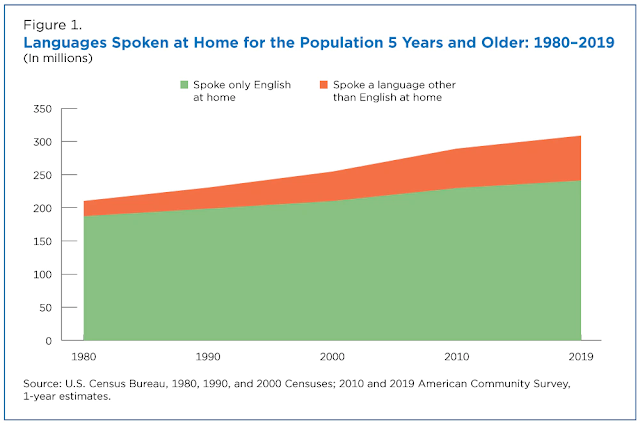
The number of people in the United States who spoke a language other than English at home nearly tripled from 23.1 million (about 1 in 10) in 1980 to 67.8 million (almost 1 in 5) in 2019, according to a recent U.S. Census Bureau report.
At the same time, the number of people who spoke only English also increased, growing by approximately one-fourth from 187.2 million in 1980 to 241 million in 2019 (Figure 1).
The report, Language Use in the United States: 2019, uses American Community Survey (ACS) data to highlight trends and characteristics of the different languages spoken in the United States over the past four decades.
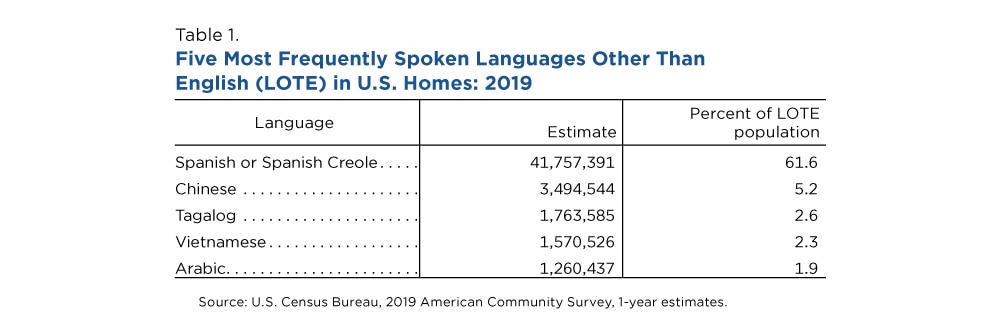
The Hispanic population is the largest minority group in the United States. So it is not surprising Spanish was the most common non-English language spoken in U.S. homes (62%) in 2019 – 12 times greater than the next four most common languages.
Saturday, December 17, 2022
Electing the Speaker of the house
Kyle Stewart and Scott Wong at MSNBC:I've been talking to a lot of reporters about the procedures for electing the Speaker. I thought people might like to see the notes I use as my cheat sheet while on the phone. Full notes, including scraps and tables and photos of precedents at the link.https://t.co/P1xIyKNcSX pic.twitter.com/4Our7nLv7H
— Matt Glassman (@MattGlassman312) December 16, 2022
When the House gathered on Dec. 4, 1923, Frederick Gillett sought re-election as speaker. The Republican from Massachusetts had served in the role since 1919 and his party had maintained control of the chamber.
But after the first ballot, Gillett did not have the votes needed. Three more votes were held and each time enough Progressive Republicans supported other candidates, blocking Gillett from regaining the gavel.
“Mr. Clerk, it seems entirely evident that no good purpose can be served by having another ballot tonight,” Republican leader Nicholas Longworth said on the floor before the chamber adjourned that night.
At issue were rule changes that Progressive Republicans wanted. For two days, the group refused to budge and on a few ballots, the Democrats’ nominee even led in the tally.
Longworth eventually struck a deal with the progressives and on the ninth ballot, Gillett was re-elected speaker.
There have only been 14 instances in congressional history where it took more than two ballots for a nominee to get a majority. The first 13 happened before the Civil War.
Sunday, February 14, 2021
Deficit and Debt: 2021 and Beyond
From the Congressional Budget Office:
Deficits
CBO projects a federal budget deficit of $2.3 trillion in 2021, nearly $900 billion less than the shortfall recorded in 2020. At 10.3 percent of gross domestic product (GDP), the deficit in 2021 would be the second largest since 1945, exceeded only by the 14.9 percent shortfall recorded last year. Those deficits, which were already projected to be large by historical standards before the onset of the 2020–2021 coronavirus pandemic, have widened significantly as a result of the economic disruption caused by the pandemic and the enactment of legislation in response.
In CBO’s projections, annual deficits average $1.2 trillion a year from 2022 to 2031 and exceed their 50-year average of 3.3 percent of GDP in each of those years. They decline to 4.0 percent of GDP or less from 2023 to 2027 before increasing again, reaching 5.7 percent of GDP in 2031. By the end of the period, both primary deficits (which exclude net outlays for interest) and interest outlays are rising.
Debt
Federal debt held by the public—which stood at 100 percent of GDP at the end of fiscal year 2020—is projected to reach 102 percent of GDP at the end of 2021, dip slightly for a few years, and then rise further. By 2031, debt would equal 107 percent of GDP, the highest in the nation’s history.
Sunday, January 17, 2021
Women in Congress
Counting both the House of Representatives and the Senate, 144 of 539 seats – or 27% – are held by women. That represents a 50% increase from the 96 women who were serving in the 112th Congress a decade ago, though it remains far below the female share of the overall U.S. population. A record 120 women are serving in the newly elected House, accounting for 27% of the total. In the Senate, women hold 24 of 100 seats, one fewer than the record number of seats they held in the last Congress.
This analysis counts voting as well as nonvoting members of Congress. Figures for the 117th Congress exclude two House seats that were vacant as of early January. It also excludes Sens. Kamala Harris, who is expected to resign her seat ahead of her inauguration as vice president on Jan. 20, and Kelly Loeffler, who lost a runoff election in Georgia earlier this month. Both are set to be replaced by men.
How we did this
Women make up a much bigger share of congressional Democrats (38%) than Republicans (14%). Across both chambers, there are 106 Democratic women and 38 Republican women in the new Congress. Women account for 40% of House Democrats and 32% of Senate Democrats, compared with 14% of House Republicans and 16% of Senate Republicans.
The 2020 general election sent just one new congresswoman to the Senate, Republican Cynthia Lummis of Wyoming, making her the first female senator to represent that state.
Republican women made significant gains in the House in the most recent election cycle. Of the 27 newly elected representatives who are women, two-thirds (18) are Republicans. Between the 115th and 116th Congresses, the number of GOP women in the House fell from 25 to 15. That number doubled this year to 30, the highest total ever.
California Rep. Nancy Pelosi, a Democrat and the first female speaker of the House, is serving her fourth term as speaker after being reelected earlier this month.
The partisan gender division hasn’t always looked this way. Until the 1929 stock market crash, most of the dozen women elected to the House were Republicans, and for several decades afterward the two parties were generally close in numbers in that chamber. But the gap widened in the 1970s and has persisted, despite a temporary narrowing during the Reagan-Bush 1980s. Of the 232 women elected to the House in 1992 or later, 157 (68%) have been Democrats, as have 27 of the 42 women (64%) who have served in the Senate since 1992.
Thursday, October 11, 2018
Openness to Foreigners
For a large majority of Americans, the country’s openness to people from around the world “is essential to who we are as a nation.” In a new Pew Research Center survey, 68% say America’s openness to foreigners is a defining characteristic of the nation, while just 26% say “if America is too open to people from all over the world, we risk losing our identity as a nation.”
The belief that openness to people from around the world is essential is widely shared across most demographic groups. However, Democrats and younger people are considerably more likely than others to hold this view, according to the national survey, conducted Sept. 18-24 among 1,754 adults.
Among Democrats and Democratic-leaning independents, an overwhelming share (85%) thinks America’s openness is essential to who we are as a nation. Republicans and Republican leaners are divided: 47% say America’s openness is essential, while 44% say being too open carries with it the risk of losing our identity as a nation. These views are virtually unchanged from the last time the Center asked this question in summer 2017.
Wednesday, September 12, 2018
The Disasters of 2017
BREAKING: What may be millions of water bottles. meant for victims of Hurricane Maria, have been sitting on a runway in Ceiba, Puerto Rico, since last year, according to @FEMA, which confirmed the news to me, late tonight, after pictures, posted today on social media, went viral. pic.twitter.com/jidGJAvCyJ— David Begnaud (@DavidBegnaud) September 12, 2018
From the Government Accountability Office:
The federal government provided significant support to Puerto Rico and the U.S. Virgin Islands in response to Hurricanes Irma and Maria, but faced numerous challenges that complicated response efforts. FEMA efforts in Puerto Rico alone were the largest and longest single response in the agency's history. As of April 2018, FEMA had obligated over $12 billion for response and recovery for Hurricane Maria (see figure below) reflecting the scale and complexity of efforts given the widespread damage. FEMA tasked federal agencies with over 1,000 response mission assignments for Hurricanes Maria and Irma in the territories at a cost of over $5 billion, compared to about 400 such assignments for Hurricanes Harvey and Irma and the California wildfires combined. For example, FEMA assigned the U.S. Army Corps of Engineers the mission to install over 1,700 emergency electricity generators in Puerto Rico, compared to the 310 for the response to Hurricane Katrina.
Nevertheless, GAO found that FEMA faced a number of challenges that slowed and complicated its response efforts to Hurricane Maria, particularly in Puerto Rico. Many of these challenges were also highlighted in FEMA's own 2017 hurricane after action report, including:
- the sequential and overlapping timing of the three hurricanes—with Maria being the last of the three—caused staffing shortages and required FEMA to shift staff to the territories that were already deployed to other disasters;
- logistical challenges complicated efforts to deploy federal resources and personnel quickly given the remote distance of both territories; and
The 2017 hurricanes and wildfires highlighted some longstanding issues and revealed other emerging response and recovery challenges. For example, the concurrent timing and scale of the disaster damages nationwide caused shortages in available debris removal contractors and delays in removing disaster debris—a key first step in recovery. In addition, FEMA's available workforce was overwhelmed by the response needs. For example, at the height of FEMA workforce deployments in October 2017, 54 percent of staff were serving in a capacity in which they did not hold the title of “Qualified”—according to FEMA's qualification system standards—a past challenge GAO has identified. FEMA officials noted that staff shortages, and lack of trained personnel with program expertise led to complications in its response efforts, particularly after Hurricane Maria.
- limited preparedness by the U.S. Virgin Islands and Puerto Rico for a Category 5 hurricane and incapacitation of local response functions due to widespread devastation and loss of power and communications led FEMA to assume response functions that territories would usually perform themselves.