Search This Blog

Showing posts with label Osama bin Laden. Show all posts

Friday, April 5, 2013

Conspiracy Theories

Public opinion often suffers from misinformation, and nonattitudesIf you ask a crazy question, you are likely to get a crazy answer.  Public Policy Polling reveals the results of a survey on conspiracy theories:
PPP’s latest national poll finds the American public differing along party lines on many conspiracy theories involving issues like global warming and the Iraq War, although some of the more bizarre ideas merit bipartisan skepticism.
The poll finds 28% of voters believe that a secretive power elite with a globalist agenda is conspiring to eventually rule the world through an authoritarian world government, or New World Order. 34% of Republicans and 35% of independents believe in the New World Order threat compared to just 15% of Democrats.
44% of voters believe the Bush administration intentionally misled the public about weapons of mass destruction to promote the Iraq War, while 45% disagree. 72% of Democrats believed the statement while 73% of Republicans did not. 22% of Democrats, 33% of Republicans and 28% of independents believe Saddam Hussein was involved in the 9/11 terrorist attacks. Just 6% of voters think Osama bin Laden is still alive.
There is an intense partisan divide on whether or not global warming is a hoax: 58% of Republicans agree that it is a conspiracy, while 77% of Democrats disagree. 20% of Republicans believe that President Obama is the Anti-Christ, compared to 13% of independents and 6% of Democrats who agree. 51% of Americans believe there was a larger conspiracy at work in the JFK assassination, while 25% think Lee Harvey Oswald acted alone. 29% believe aliens exist and 21% believe a UFO crashed at Roswell in 1947.
“Even crazy conspiracy theories are subject to partisan polarization, especially when there are political overtones involved,” said Dean Debnam, President of Public Policy Polling. “But most Americans reject the wackier ideas out there about fake moon landings and shape-shifting lizards.”
5% of respondents believe that Paul McCartney died and was secretly replaced in the Beatles in 1966, and just 4% believe shape-shifting reptilian people control our world by taking on human form and gaining power. 7% of voters think the moon landing was fake.

Sunday, January 13, 2013

Political Pressure and "Zero Dark Thirty"

Focusing on a CIA analyst, "Zero Dark Thirty" tells how the United States got Osama bin Laden.  Despite near-universal acclaim, director Kathryn Bigelow did not get an Oscar nomination this week.  At The Los Angeles Times, Kenneth Turan has a theory:
Back on Dec. 19, Sens. Dianne Feinstein (D-Calif.), Carl Levin (D-Mich.) and John McCain (R-Ariz.) wrote an open letter to "express our deep disappointment with 'Zero Dark Thirty.' We believe the film is grossly inaccurate and misleading in its suggestion that torture resulted in information that led to the location of Usama Bin Laden."
To anyone who knows the academy's traditional aversion to controversy (for example, disagreement dogged "The People vs. Larry Flynt" and the highly regarded "The Hurricane" ended up with only one nomination, for star Denzel Washington, after questions were raised about its accuracy) knew that letter meant Oscar trouble for "Zero." It's not even that surprising that it was the directors who caved in to the drumbeat of condemnation. As one of the smaller voting branches of the academy, it is more susceptible to the vagaries of outside pressure.
...
The senators are within their constitutional rights to insist that "Zero" says that torture led the CIA directly to Bin Laden, but that is not the film I saw. Of the two key prisoners who are tortured on camera, one flat out lies to the interrogators and the other never says anything no matter what is done to him. Hardly a ringing endorsement of enhanced interrogation techniques.
The CIA does get a piece of information from that recalcitrant man, but it is the guile of interrogators employed well after the torture that does the trick. If "Zero Dark Thirty" has any message about what led to Bin Laden's location, it's that, rather than torture, it was the slow, meticulous, painstaking gathering of information over nearly a decade by Chastain's character Maya that did the job.
The Huffington Post reports:
As recent as this week, the debate about whether "Zero Dark Thirty" is pro-torture remained in play. As TheWrap notes, Academy of Motion Picture Arts & Sciences member David Clennon said he would not vote for the film in any Oscar category because of its content. "Zero Dark Thirty" scored a nomination for Best Picture, but Bigelow was snubbed in the Best Director category at the Academy Awards, putting the overall awards picture of the film in heavy doubt. (The 1989 film "Driving Miss Daisy" was the last Best Picture winner to capture the award without a corresponding Best Director nomination.) It's worth noting, however, that Boal did receive a nomination for Best Original Screenplay.
“Torture is an appalling crime under any circumstances,” Clennon wrote in a blog post. "'Zero' never acknowledges that torture is immoral and criminal. It does portray torture as getting results.”
"We are outraged that any responsible member of the Academy would use their voting status in AMPAS as a platform to advance their own political agenda," [Sony co-chair Amy] Pascal Pascal said in her statement. "This film should be judged free of partisanship. To punish an Artist's right of expression is abhorrent. This community, more than any other, should know how reprehensible that is. While we fully respect everyone’s right to express their opinion, this activity is really an affront to the Academy and artistic creative freedom."

Monday, October 15, 2012

Cuban Missile Crisis: October 15, 1962

Our chapter on national security and foreign policy mentions that a number of organizations make up the intelligence community.  One is the The National Geospatial-Intelligence Agency.  If you haven't heard of it, don't feel bad.  At one point, President Obama was unfamiliar with it, as Mark Ambinder reported last year:
President Obama's first brush with the National Geospatial-Intelligence Agency was ignominious. Out for lunch in May 2009, at a Five Guys burger franchise in Washington, the new President started to shake the hands of other customers, TV cameras in tow. Then he turned to men with government ID badges.
"So what do you?" the president asked. "I work for at NGA, National Geospatial-Intelligence Agency," one said.
"Outstanding. How long have you been doing that?" Obama wondered. "Six years." Obama then asked: "So, explain to me exactly what this National Geospatial..." His voice trailed off. "Uh, we work with, uh, satellite imagery." Obama: "Sounds like good work." The response is obscured by the audio.
Suffice it to say: Obama knows what the NGA does today.
Any number of officials and agencies have been in the limelight since the raid on Osama bin Laden, including the CIA and the Defense Department. But the little-known and little-heralded work of the National Geospatial-Intelligence Agency, often called the NGA, was central to the demise of the terrorist leader.

The NGA integrates several core intelligence functions. It makes maps and interprets imagery from satellites and drones; it also exploits the electromagnetic spectrum to track terrorists and decipher signatures off of enemy radar. 
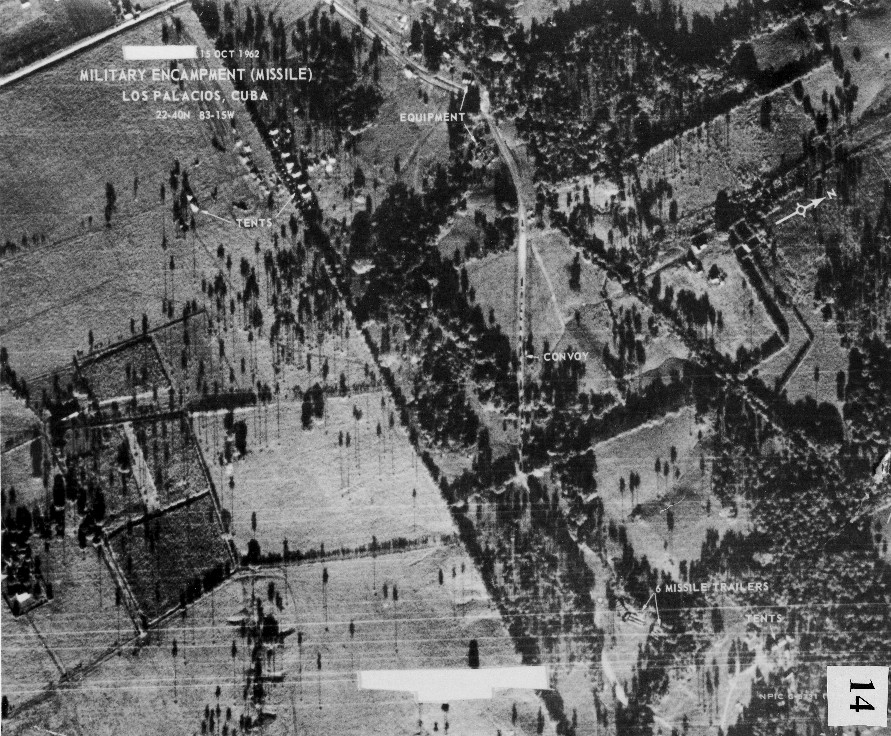
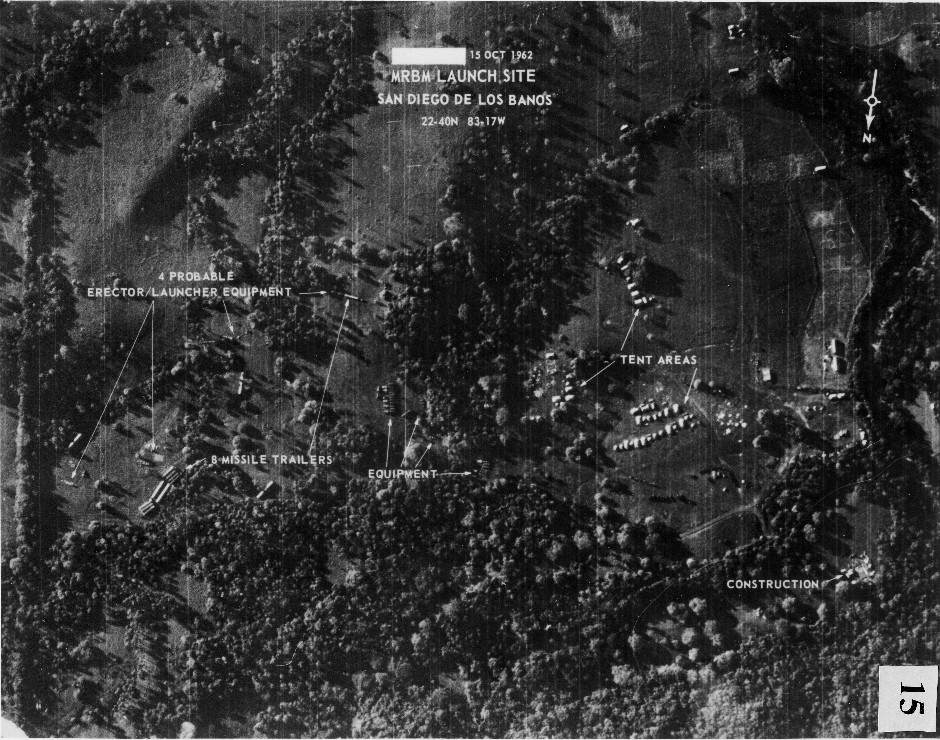
Fifty years ago today, its predecessor organization, the National Photographic Interpretation Center, played a major part in the Cuban Missile Crisis.  It analyzed U-2 images from the day before, concluding that the Soviet Union had placed offensive missiles in Cuba.  NGA picks up the story:
This imagery was key to understanding that the Soviet intentions in Cuba were more threatening than previously assessed. Until these images, captured by Air Force U-2 high altitude and U.S. Navy low altitude photo reconnaissance aircraft, only defensive weapons – surface-to-air missiles – had been detected by U.S. intelligence, which seemed to support statements made by Khrushchev.
A team of imagery analysts under the leadership of National Photographic Interpretation Center founding director Arthur P. Lundahl pored over these images, quickly realizing the gravity of their discovery and the risk they posed to upsetting the balance of power between the U.S. and the Soviet Union. Analysts Dino Brugioni, James Holmes, Vincent DiRenzo Dick Reninger and Joseph Sullivan worked to prepare Lundahl to brief then-President John F. Kennedy the next day, leading to the crisis.
From the National Security Archive at George Washington University:
October 14, 1962: U-2 photograph of a truck convoy approaching a deployment of Soviet MRBMs near Los Palacios at San Cristobal.  This photograph was the first one identified by NPIC on 15 October as showing Soviet medium-range ballistic missiles in Cuba.


October 14, 1962: U-2 photograph of MRBM site two nautical miles away from the Los Palacios deployment – the second set of MRBMs found in Cuba.  This site was subsequently named San Cristobal no. 1 (the photo is labeled 15 October for the day it was analyzed and printed).

Monday, September 10, 2012

Anti-Terrorism

Tomorrow is the 11th anniversary of the 9/11 attacks. The Los Angeles Times reports on a unique way in which citizens are aiding the war on terror:
Working from a beige house at the end of a dirt road, Jeff Bardin switches on a laptop, boots up a program that obscures his location, and pecks in a passkey to an Internet forum run by an Iraqi branch of Al Qaeda.

Soon the screen displays battle flags and AK-47 rifles, plus palm-lined beaches to conjure up a martyr's paradise.

"I do believe we are in," says Bardin, a stout, 54-year-old computer security consultant.

Barefoot in his bedroom, Bardin pretends to be a 20-something Canadian who wants to train in a militant camp in Pakistan. With a few keystrokes, he begins uploading an Arabic-language manual for hand-to-hand combat to the site.

"You have to look and smell like them," he explains. "You have to contribute to the cause so there's trust built."

Bardin, a former Air Force linguist who is fluent in Arabic, is part of a loose network of citizen "hacktivists" who secretly spy on Al Qaeda and its allies. Using two dozen aliases, he has penetrated chat rooms, social networking accounts and other sites where extremists seek recruits and discuss sowing mayhem.

Over the last seven years, Bardin has given the FBI and U.S. military hundreds of phone numbers and other data that he found by hacking jihadist websites. A federal law enforcement official confirmed that Bardin and a handful of other computer-savvy citizens have provided helpful information.

At CBS, 60 Minutes interviewed a member of the SEAL team that killed bin Laden.  A clip:

Tuesday, May 3, 2011

Fakery Follows the bin Laden Killing

One of the boxed features in our book is "Myths and Misinformation," a category that includes fake or misattributed quotations. As a previous post noted, many credit Martin Luther King for saying "The arc of the moral universe is long, but it bends toward justice," even though the line belonged to Theodore Parker. At The Atlantic (h/t Tina Nguyen), Megan McArdle spots another fake King quotation:

Shortly after I posted my piece on feeling curiously un-thrilled about Bin Laden's death, the following quote came across my twitter feed:

"I mourn the loss of thousands of precious lives, but I will not rejoice in the death of one, not even an enemy." - Martin Luther King, Jr
I admire the sentiment. But something about it just strikes me as off, like that great Marx quote about the housing bubble that didn't appear anywhere in Das Kapital.

Owners of capital will stimulate the working class to buy more and more of expensive goods, houses and technology, pushing them to take more and more expensive credits, until their debt becomes unbearable. The unpaid debt will lead to bankruptcy of banks, which will have to be nationalised, and the State will have to take the road which will eventually lead to communism. Karl Marx, Das Kapital, 1867
Like the Marx quote, it's a bit too a propos. What "thousands" would King have been talking about? In which enemy's death was he supposed to be rejoicing?

A quick Google search turns up lots of tweets, all of them from today. Searching Martin Luther King Jr. quote pages for the word "enemy" does not turn up this quote, only things that probably wouldn't go over nearly so well, like "Love is the only force capable of transforming an enemy to a friend." I'm pretty sure that this quote, too, is fake.
At Scripps-Howard, P.J. O'Keefe writes:

The news isn't yet two days old, but email hoaxes and scams related to Osama bin Laden's death are making their way around the Internet Tuesday.

The biggest hoax among them is the photo to the left. It claims to show bin Laden's dead body, but it is in fact a fake.

The website Scam Sniper shows how it was Photoshopped from the original image on the right. We have blurred the photo due to its graphic nature.

Scam Sniper says any photo of bin Laden's corpse found on Facebook should be considered fake.


We've seen scams using Osama bin Laden's death in other places and of course they made it onto Facebook as well. Here is the first example talking about a video:

When clicking on the link the user is taken to a page on Facebook asking them to copy/paste the code into the browser's address bar so that they can watch the video:

All you do is to help spread the message so don't do this.

Monday, May 2, 2011

Survey Data on Osama bin Laden

The Council on Foreign Relations represents the nation's foreign policy elite: its 4,300 members include government officials, scholars, business leaders, journalists, prominent attorneys, and a nonprofit professionals. A 2009 survey by the Pew Research Center found that members of the group did not think that killing bin Laden would transform Afghanistan: "Of the factors asked about, the one seen as least important to the effort to stabilize the nation is capturing or killing Osama bin Laden. Just 14% say this is a very important step to take, and 31% say it is somewhat important. Half of CFR members (50%) say capturing or killing bin Laden is not too or not at all important."

In a 2006 Gallup poll, however, 64 percent of the general public deemed it "extremely" or "very" important to the United States to capture or kill bin Laden. An equal percentage thought it was "very" or "somewhat" likely to happen.

Also according to Gallup, 69 percent of Americans believe in Hell.