American teenagers spend hours online each day, with apps such as YouTube and TikTok dominating their attention. Thirty-five percent spend at least four hours a day on social media or playing video games. The amount of time teens spend engaged in these activities varies across households. The survey finds that teen girls raised by parents without college degrees are on more social media apps, spend more hours using them, and are less inclined to cut back than girls whose parents went to college, while among boys, the same divide emerges in the hours spent gaming.
The class divide in social media use may exacerbate existing inequalities instead of reducing them. Among teen girls, more active social media engagement is associated with negative personal outcomes, including less sleep, lower rates of reading, and lower feelings of personal satisfaction.
The majority of teenagers are spending multiple hours on social media every day. About four in 10 (39 percent) spend three or more hours of their day online. YouTube and TikTok are the most popular social media platforms teens visit. More than seven in 10 (72 percent) spend time on YouTube every week, while six in 10 say the same of TikTok. Gaming also eats up a significant portion of teens’ free time, although less so than social media. More than four in 10 (44 percent) teens spend at least an hour gaming every day.
Teen girls raised in less educated households are more likely to use Instagram (66 percent vs. 57 percent), Snapchat (49 percent vs. 44 percent), Facebook (31 percent vs. 15 percent), and X (12 percent vs. 6 percent). The education gap is largest in TikTok use. Nearly three-quarters (73 percent) of teen girls raised by parents without college degrees spend time on the app, compared with only about half (53 percent) of teen girls whose parents have college degrees. There is also a significant difference in the number of apps they use.[v] Forty-one percent of teen girls with non-college-educated parents report using at least four different social media apps, compared with 25 percent of teen girls raised by college-educated parents.
This same gap is also evident in the amount of time teen girls spend on social media. About one in five (21 percent) say they spend between one and two hours on social media every day. Thirty-nine percent of teens report they spend less than an hour a day or do not use social media at all. Teen girls whose parents did not go to college, however, log more hours on social media than any of their peers. Nearly half (49 percent) of teen girls raised by parents without a college degree report spending three or more hours a day using social media, compared with 36 percent of teen girls with college-educated parents.
Parental education is also correlated with teens’ efforts to reduce their screen time. Among girls, those raised in households with parents of higher education levels are more likely to report attempting to reduce their time spent online. Nearly six in 10 (58 percent) teen girls raised by college-educated parents say they have tried to reduce their social media activity in the past 12 months. In contrast, only 40 percent of teen girls who have non-college-educated parents report attempts to lessen their social media activity.
There is no evidence of the same divide among teen boys; they report similar social media usage patterns regardless of parental education. More evident education divides show up in boys’ gaming habits. Teen boys raised by parents without college degrees spend substantially more time gaming. Nearly three in 10 (28 percent) teen boys raised by parents without college degrees say they spend an average of four or more hours a day playing video games. Among teen boys with college-educated parents, only 19 percent play video games this often. Among teen girls, it’s only 7 percent.
Showing posts with label YouTube. Show all posts
Showing posts with label YouTube. Show all posts
Wednesday, July 29, 2026
Inequality and Teen Social Media Use


Thursday, November 20, 2025
Social Media Use 2025
Many posts have discussed social media.
Jeffrey Gottfried and Eugenie Park at Pew:
YouTube and Facebook remain the most widely used online platforms. The vast majority of U.S. adults (84%) say they ever use YouTube. Most Americans (71%) also report using Facebook. These findings are according to a Pew Research Center survey of 5,022 U.S. adults conducted Feb. 5-June 18, 2025.
Half of adults say they use Instagram, making it the only other platform in our survey used by at least 50% of Americans.
Smaller shares use the other sites and apps we asked about, such as TikTok (37%) and WhatsApp (32%). Somewhat fewer say the same of Reddit, Snapchat and X (formerly Twitter).
This year we also asked about three platforms that are used by about one-in-ten or fewer U.S. adults: Threads, Bluesky, and Truth Social.
Center studies also find that YouTube is the most widely used online platform among U.S. teens, like it is among U.S. adults.
Thursday, September 25, 2025
News from Social Media
From Pew:
Digital sources have become an important part of Americans’ news diets – with social media playing a crucial role, particularly for younger adults. Overall, about half of U.S. adults (53%) say they at least sometimes get news from social media, roughly stable over the last few years.

Monday, March 3, 2025
YouTube
More U.S. adults use YouTube than any other online platform we’ve asked about. As of 2024, 85% of adults say they ever use YouTube. That exceeds the share who say they ever use Facebook (70%), Instagram (50%) and other social media sites and apps.
...
Around a third of U.S. adults say they regularly get news from YouTube. The share of Americans who get news on YouTube has risen in recent years, from 23% in 2020 to 32% in 2024.
In 2020, news consumers were more likely to regularly get news from Facebook (36%) than YouTube (23%). But as of 2024, U.S. adults are just as likely to get news from YouTube (32%) as they are from Facebook (33%).
And news consumption differs by gender. News consumers on YouTube are more likely to be men than women (57% vs. 42%).
...
Around a quarter of adult YouTube users in the U.S. (24%) say they regularly get news from news influencers on any social media site. A recent Pew Research Center analysis of news influencers found that 44% of those in our sample are on YouTube, though most news influencers on YouTube also have a presence on several other sites.
Monday, June 3, 2024
American Defector and Russian Disinformation
Many posts have discussed myths and misinformation.
More than 150 fake local news websites pushing Russian propaganda to U.S. audiences are connected to John Mark Dougan, an American former law enforcement officer living in Moscow, according to a research report published Wednesday by NewsGuard, a firm that monitors misinformation.
The websites, with names like DC Weekly, New York News Daily and Boston Times, look similar to those of legitimate local news outlets and have already succeeded in spreading a number of false stories surrounding the war in Ukraine. Experts warn they could be used to launder disinformation about the 2024 election.
In an interview over WhatsApp, Dougan denied involvement with the websites. “Never heard of them,” he said.
Dougan, a former Marine and police officer, fled his home in Florida in 2016 to evade criminal charges related to a massive doxxing campaign he was accused of launching against public officials and was given asylum by the Russian government. Most recently, Dougan has posed as a journalist in Ukraine’s Donbas region, testifying at Russian public hearings and making frequent appearances on Russian state TV.
He’s now part of a small club of Western expats who have become purveyors of English-language propaganda for Russia. Researchers and cybersecurity companies had previously linked Dougan to the sites. The NewsGuard report published Wednesday is the latest to implicate him in the fake news ring.
Academic research from Clemson University linked Dougan to the network of fake news websites last year after one of them was found to share an IP address with other sites he ran, including his personal website.
In an interview, Darren Linvill, co-director of the Watt Family Innovation Center Media Forensics Hub at Clemson, called Dougan “a tool of the broader Russian disinformation machine” whose websites “are just one of several mechanisms by which these narratives are distributed.”
McKenzie Sadeghi at NewsGuard:
This is an inside, yet almost accidental, story about how an American fugitive who sought asylum in Moscow has become a key player in Russia’s global disinformation network. It starts with a NewsGuard analyst happening upon what appeared to be a fledgling Washington D.C.-based news site promoting Russian propaganda. Unbeknownst to her, this was six months after her boss and his family had been threatened in a YouTube video that included an aerial shot of his home and calls to his unlisted phone number by a Russian disinformation operative working from a studio in Moscow. It turns out that this D.C. website, those threats to NewsGuard’s co-CEO, and what NewsGuard discovered were dozens of similar hostile information operations — including a “documentary” that the Russians used as an excuse to invade Ukraine — were all orchestrated by the same man — John Mark Dougan, a former Florida deputy sheriff who fled to Moscow after being investigated for computer hacking and extortion.
As of this writing, NewsGuard has discovered 167 Russian disinformation websites that appear to be part of Dougan’s network of websites masquerading as independent local news publishers in the U.S. and 15 films on Dougan’s since-removed YouTube channel. Ranging from Ukrainian President Volodymyr Zelensky siphoning off money meant to aid the war against Russia so he could buy an estate in England owned by King Charles, to a non-existent U.S. bioweapons lab in Ukraine being the reason the Russians had to invade that country, these concocted stories have been amplified on social media accounts to reach a broad global audience of more than 37 million views—including 1,300,000 views of just the narrative about Zelensky buying the king’s estate.
What follows—including multiple conversations with the Russian operative and an excerpt from NewsGuard co-CEO Steven Brill’s upcoming book, “The Death of Truth,” recounting Brill’s harrowing experience with the same man—is the story of how NewsGuard connected the dots, shining light on a sophisticated multi-media global disinformation operation.
Wednesday, January 31, 2024
Friday, September 30, 2022
Tuesday, June 28, 2022
Social Media Use: Journalists and Normals
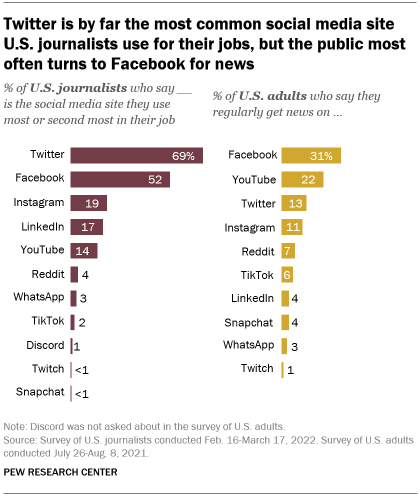
More than nine-in-ten journalists in the United States (94%) use social media for their jobs, according to a recent Pew Research Center survey of reporters, editors and others working in the news industry. But the sites that journalists use most frequently differ from those that the public turns to for news.
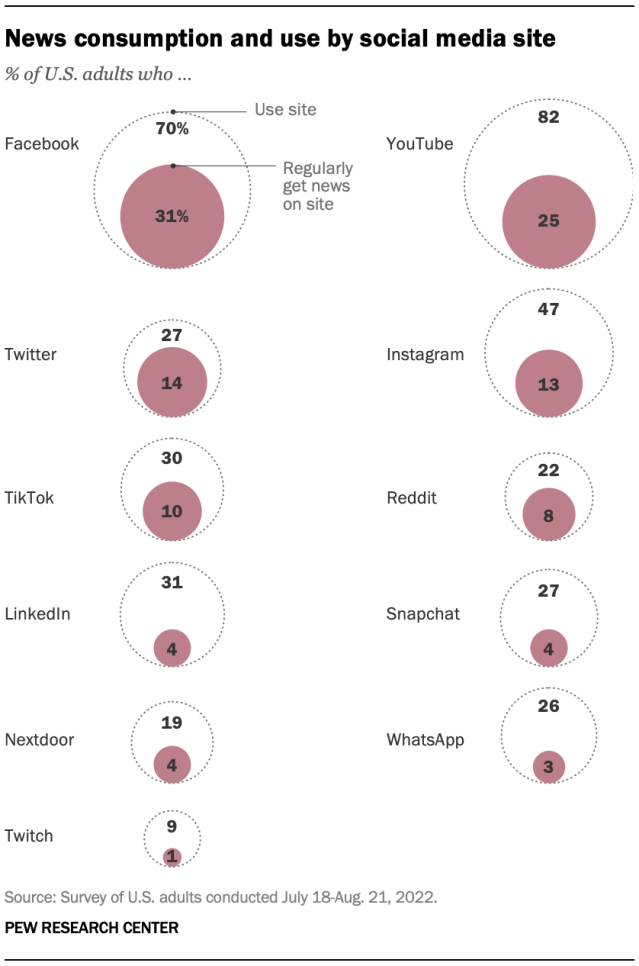
Among journalists, Twitter clearly ranks at the top of the list for work-related tasks. Around seven-in-ten U.S. journalists (69%) say it is the social media site they use most or second most for their job. Twitter is followed by Facebook at 52% and, far lower on the list, by Instagram (19%), LinkedIn (17%) and YouTube (14%). None of the other sites asked about in the survey – Reddit, WhatsApp, TikTok, Discord, Twitch and Snapchat – were named by more than 4% of the journalists surveyed.
A different lineup emerges for the public. Among Americans overall, Facebook is the most widely used social media site for news, with 31% of U.S. adults saying they go there regularly for news. YouTube is the second-most frequently used site, with 22% of the public regularly getting news there. Fewer adults (13%) say they regularly get news on Twitter, despite the platform’s widespread use among journalists. Overall, a little under half of U.S. adults (48%) say they often or sometimes get news from social media sites.
Tuesday, July 6, 2021
Insurrection, Six Months Later
Alanna Durkin Richer and Michael Kunzelman at Associated Press:
The first waves of arrests in the deadly siege at the U.S. Capitol focused on the easy targets. Dozens in the pro-Trump mob openly bragged about their actions on Jan. 6 on social media and were captured in shocking footage broadcast live by national news outlets.
But six months after the insurrection, the Justice Department is still hunting for scores of rioters, even as the first of more than 500 people already arrested have pleaded guilty. The struggle reflects the massive scale of the investigation and the grueling work still ahead for authorities in the face of an increasing effort by some Republican lawmakers to rewrite what happened that day.
Among those who still haven’t been caught: the person who planted two pipe bombs outside the offices of the Republican and Democratic national committees the night before the melee, as well as many people accused of attacks on law enforcement officers or violence and threats against journalists. The FBI website seeking information about those involved in the Capitol violence includes more than 900 pictures of roughly 300 people labeled “unidentified.”
Ryan J. Reilly at Huffington Post:
They call themselves sedition hunters, and they have receipts. They’re members of a loosely affiliated network of motivated individuals and pop-up volunteer organizations with names like Deep State Dogs and Capitol Terrorists Exposers that developed after the Jan. 6 attack to identify the Trump supporters who organized the Capitol riot and brutalized the law enforcement officers protecting the building.
The sedition hunters scour the web for any and all photographs, videos and posts from people at the Capitol during the Jan. 6 attack across well-known websites like Facebook, YouTube and Twitter along with lesser-used sites and apps like Rumble, Gab and Telegram. They’ve got spreadsheets, Google Docs, links, bookmarks, unlisted YouTube backups, group chats and screenshots, as Joan puts it, “coming out the rear end.” They can uncover new evidence of conduct that’ll elevate a misdemeanor trespassing case into something much more serious; find the highest-quality image of a suspect that could generate new leads through facial recognition; and compile multimedia databases that turn the Jan. 6 attack into an interactive, high-stakes and soul-crushing edition of Where’s Waldo.
Friday, April 9, 2021
Social Media Use
Brooke Auxier and Monica Anderson at Pew:
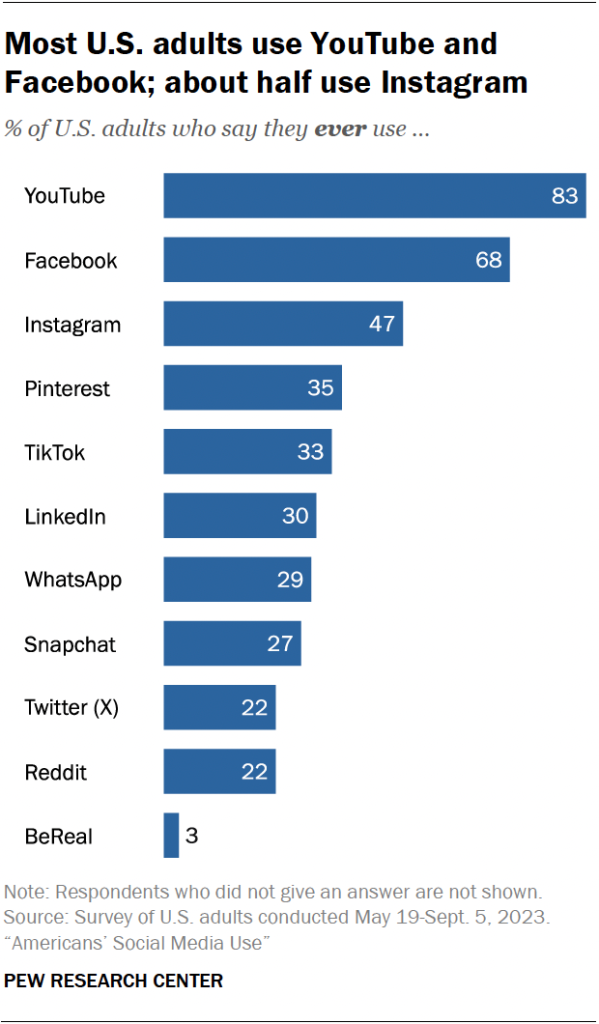
Despite a string of controversies and the public’s relatively negative sentiments about aspects of social media, roughly seven-in-ten Americans say they ever use any kind of social media site – a share that has remained relatively stable over the past five years, according to a new Pew Research Center survey of U.S. adults.
Beyond the general question of overall social media use, the survey also covers use of individual sites and apps. YouTube and Facebook continue to dominate the online landscape, with 81% and 69%, respectively, reporting ever using these sites. And YouTube and Reddit were the only two platforms measured that saw statistically significant growth since 2019, when the Center last polled on this topic via a phone survey
...
In a pattern consistent with past Center studies on social media use, there are some stark age differences. Some 84% of adults ages 18 to 29 say they ever use any social media sites, which is similar to the share of those ages 30 to 49 who say this (81%). By comparison, a somewhat smaller share of those ages 50 to 64 (73%) say they use social media sites, while fewer than half of those 65 and older (45%) report doing this.
These age differences generally extend to use of specific platforms, with younger Americans being more likely than their older counterparts to use these sites – though the gaps between younger and older Americans vary across platforms.
Majorities of 18- to 29-year-olds say they use Instagram or Snapchat and about half say they use TikTok, with those on the younger end of this cohort – ages 18 to 24 – being especially likely to report using Instagram (76%), Snapchat (75%) or TikTok (55%).1 These shares stand in stark contrast to those in older age groups. For instance, while 65% of adults ages 18 to 29 say they use Snapchat, just 2% of those 65 and older report using the app – a difference of 63 percentage points.
Additionally, a vast majority of adults under the age of 65 say they use YouTube. Fully 95% of those 18 to 29 say they use the platform, along with 91% of those 30 to 49 and 83% of adults 50 to 64. However, this share drops substantially – to 49% – among those 65 and older.
By comparison, age gaps between the youngest and oldest Americans are narrower for Facebook. Fully 70% of those ages 18 to 29 say they use the platform, and those shares are statistically the same for those ages 30 to 49 (77%) or ages 50 to 64 (73%). Half of those 65 and older say they use the site – making Facebook and YouTube the two most used platforms among this older population.
...
YouTube is used daily by 54% if its users, with 36% saying they visit the site several times a day. By comparison, Twitter is used less frequently, with fewer than half of its users (46%) saying they visit the site daily.
Saturday, December 21, 2019
"Payload Content" on YouTube
At Lawfare, Lisa Kaplan reports on TheSoul, a mysterious social media operation that seems to be emulating the "payload content" strategy of the Internet Research Agency.
Most of TheSoul’s videos are clickbait with instructions for do-it-yourself projects, and TheSoul’s channels range in success. Some are less active than others. Of the 35 channels I examined, nine have stopped posting in the past year, and a handful (5-Minute Workouts, Health Is Wealth, Health Digest, Dark Side and Zodiac Maniac) have not posted new content in the past 11 months. You’re Gorgeous, The Story Behind and Stickman have all stopped posting new content within the past six months. However, the most popular channels—Bright Side and 5-Minute Crafts—appear to be active and growing. From August 2019 to December 2019, according to examinations of the data in both periods, Bright Side gained nearly 3.5 million subscribers and 1 billion views, and 5-Minute Crafts gained more than 3 million subscribers and 1.5 billion views.
The vast majority of the company’s content is apolitical—and that is certainly the way the company portrays itself. A spokesperson for TheSoul Publishing commented that “[w]e are very proud of our highly popular videos enjoyed by millions around the world. From do-it-yourself craft to charming animation to riddle and puzzle videos, TheSoul Publishing showcases a portfolio of lighthearted content watched across major social platforms.”
But here’s the thing: TheSoul Publishing also posts history videos with a strong political tinge. Many of these videos are overtly pro-Russian. One video posted on Feb. 17, 2019, on the channel Smart Banana, which typically posts listicles and history videos, claims that Ukraine is part of Russia. The video opens:
Mr. Banana wants to know what you think about when you hear the word Russia. Do you think of a bear with a bottle of vodka and a balalaika in his paw, or maybe you think about President Putin and the Red Square in Moscow. Let’s have a look at the history of the biggest country in the world.At one point, the video gives a heavily sanitized version of Josef Stalin’s time in power and, bizarrely, suggests that Alaska was given to the United States by Soviet leader Nikita Khruschev:
The second leader after Lenin’s death was Josef Stalin. He started to recover the country after the revolution. Josef reformed the country. He took the wealth from rich people and the property from the middle class and united all of these people with poor ones in the collective farm and the collective property. Russian Robin Hood—bang! Hitler attacked the Soviet Union in June of 1941. It was the beginning of the second World War. Russia was not ready for any wars at the moment, so Hitler hoped to conquer Russia in four months. As naive as Napoleon. The USSR joined the allies. The Soviet Union militaries came to Berlin and beat it. The facism of Hitler was defeated on the second of May 1945 during four years of war, the Soviet Union officially lost twenty-seven million people. Many cities were destroyed. Recovery from the war was very difficult for both people and the country. By 1960, the Soviet Union succeeded, in 1957 the rent of Alaska was over and the country’s leader at the time, Nikita Khrushchev, gifted Alaska to the USA. That’s when Alaska became the 49th state of the US.
Monday, December 17, 2018
Russian Interference
AT WP, Craig Timberg and Tony Romm write that reports for the Senate Intelligence Committee analyze Russian interference in American politics.
The research -- by Oxford University’s Computational Propaganda Project and Graphika, a network analysis firm -- offers new details on how Russians working at the Internet Research Agency, which U.S. officials have charged with criminal offenses for meddling in the 2016 campaign, sliced Americans into key interest groups for targeted messaging. These efforts shifted over time, peaking at key political moments, such as presidential debates or party conventions, the report found.
...
The Russians aimed particular energy at activating conservatives on issues such as gun rights and immigration, while sapping the political clout of left-leaning African American voters by undermining their faith in elections and spreading misleading information about how to vote. Many other groups -- Latinos, Muslims, Christians, gay men and women, liberals, Southerners, veterans -- got at least some attention from Russians operating thousands of social media accounts.
The report also offered some of the first detailed analyses of the role played by YouTube, a subsidiary of Google, and Instagram, owned by Facebook, in the Russian campaign, as well as anecdotes about how Russians used other social media platforms -- Google+, Tumblr and Pinterest -- that have gotten relatively little scrutiny. The Russian effort also used email accounts from Yahoo, Microsoft’s Hotmail service and Google’s Gmail.
Saturday, March 3, 2018
Social Media Use
Pew reports:
A new Pew Research Center survey of U.S. adults finds that the social media landscape in early 2018 is defined by a mix of long-standing trends and newly emerging narratives.
Facebook and YouTube dominate this landscape, as notable majorities of U.S. adults use each of these sites. At the same time, younger Americans (especially those ages 18 to 24) stand out for embracing a variety of platforms and using them frequently. Some 78% of 18- to 24-year-olds use Snapchat, and a sizeable majority of these users (71%) visit the platform multiple times per day. Similarly, 71% of Americans in this age group now use Instagram and close to half (45%) are Twitter users.
As has been the case since the Center began surveying about the use of different social media in 2012, Facebook remains the primary platform for most Americans. Roughly two-thirds of U.S. adults (68%) now report that they are Facebook users, and roughly three-quarters of those users access Facebook on a daily basis. With the exception of those 65 and older, a majority of Americans across a wide range of demographic groups now use Facebook.
Wednesday, June 28, 2017
Alt-Right YouTube
From The Shorenstein Center:
A new paper by Zack Exley, Joan Shorenstein Fellow (spring 2017), organizer and author dives into a little-known part of the alt-right media landscape, revealing its influence and worldview.
Exley writes that political channels on YouTube are currently dominated by the right wing. Although often overlooked by mainstream society, these channels receive millions of views, espousing recycled National Socialist and white nationalist ideologies with a modern twist. The alt-right uses these channels to build influence and spread its ideas among its audience, much as right-wing talk radio has for decades. Exley examines the content of one of these channels, “Black Pigeon Speaks,” uncovering the worldview put forth by the channel’s host, wherein Jewish bankers are ensnaring the world in debt slavery fueled by Muslim migrants, and women, who by their “biological nature,” are destroying civilization.
Monday, May 15, 2017
Combating Fake News
At the Shorenstein Center of the Harvard Kennedy School, David Lazer and colleagues write:
Recent shifts in the media ecosystem raise new concerns about the vulnerability of democratic societies to fake news and the public’s limited ability to contain it. Fake news as a form of misinformation benefits from the fast pace that information travels in today’s media ecosystem, in particular across social media platforms. An abundance of information sources online leads individuals to rely heavily on heuristics and social cues in order to determine the credibility of information and to shape their beliefs, which are in turn extremely difficult to correct or change. The relatively small, but constantly changing, number of sources that produce misinformation on social media offers both a challenge for real-time detection algorithms and a promise for more targeted socio-technical interventions.
There are some possible pathways for reducing fake news, including:
(1) offering feedback to users that particular news may be fake (which seems to depress overall sharing from those individuals); (2) providing ideologically compatible sources that confirm that particular news is fake; (3) detecting information that is being promoted by bots and “cyborg” accounts and tuning algorithms to not respond to those manipulations; and (4) because a few sources may be the origin of most fake news, identifying those sources and reducing promotion (by the platforms) of information from those sources.
As a research community, we identified three courses of action that can be taken in the immediate future: involving more conservatives in the discussion of misinformation in politics, collaborating more closely with journalists in order to make the truth “louder,” and developing multidisciplinary community-wide shared resources for conducting academic research on the presence and dissemination of misinformation on social media platforms.
Moving forward, we must expand the study of social and cognitive interventions that minimize the effects of misinformation on individuals and communities, as well as of how socio-technical systems such as Google, YouTube, Facebook, and Twitter currently facilitate the spread of misinformation and what internal policies might reduce those effects. More broadly, we must investigate what the necessary ingredients are for information systems that encourage a culture of truth.
Friday, May 27, 2016
News and Social Media
Pew reports:
A majority of U.S. adults – 62% – get news on social media, and 18% do so often, according to a new survey by Pew Research Center, conducted in association with the John S. and James L. Knight Foundation. In 2012, based on a slightly different question, 49% of U.S. adults reported seeing news on social media.1
...
It is also useful to see how, when combined with the sites’ total reach, the proportion of users who gets news on each site translates to U.S. adults overall. Facebook is by far the largest social networking site, reaching 67% of U.S. adults. The two-thirds of Facebook users who get news there, then, amount to 44% of the general population. YouTube has the next greatest reach in terms of general usage, at 48% of U.S. adults. But only about a fifth of its users get news there, which amounts to 10% of the adult population. That puts it on par with Twitter, which has a smaller user base (16% of U.S. adults) but a larger portion getting news there.
Wednesday, October 1, 2014
Hollywood, Education Reform, and a State Election
In our textbook, we mention the political role of the entertainment media, the politics of education reform, and the significance of state elections. This item, from The San Francisco Chronicle, touches on all three:
Hollywood isn’t shy about putting its star status and cash behind big-deal political candidates.
But candidates running for the wonky state superintendent of public instruction job doesn’t usually draw A-list interest.
Until now.
Marshall Tuck, who is running against incumbent Tom Torlakson, has released a video featuring Joel McHale (“Community”); Adam Scott (“Parks and Recreation”); Dax Shepard (“Parenthood”); and Kristen Bell (“House of Lies”
The ad features Tuck at a kitchen table with McHale, Shepard and Bell, who are grilling him about public education in California. They ultimately throw their support behind Tuck, with Scott joining them between bites of pizza.John Hrabe writes at CalNewsroom.com:
Election Day is still a month away, but Marshall Tuck’s campaign for State Superintendent of Public Instruction has already delivered the best ad of the 2014 cycle.
With the perfect blend of facts and humor, “Tuck Gets New Consultants” explains why the education reformer and charter school executive is qualified to oversee California’s public school system. In the ad, actors Joel McHale, Dax Shepard, Kristen Bell and Adam Scott grill Tuck about his background and California’s under-performing schools, which rank 45th in math and reading.
There’s so much to love about this ad: It’s funny. It uses celebrities in a constructive way. It educates the public about California’s failing education system. It informs voters about Tuck’s background. It corrects the misconception that he’s the private school candidate. And it includes a dig on the San Francisco Chronicle.
“You’ve been endorsed by The San Francisco Chronicle. Who gives a (BLEEP)?” Shepard says.
Saturday, March 1, 2014
Bootleg Video of the Supreme Court
AP reports:
A protest group has posted what appears to be the first video of the Supreme Court taken inside the courtroom with the court in session.
The Supreme Court forbids cameras and all other electronic devices, but members of the protest group 99Rise appear to have shot video on two separate occasions since October.
The more recent footage, posted on YouTube, captures a courtroom protest on Wednesday by a man the court identified as Noah Newkirk of Los Angeles. A 99Rise news release posted online says group co-founder Kai Newkirk was the person who called on the court to overturn its 2010 Citizens United decision. Police hustled him out of the courtroom and charged him with disturbing the proceedings.
The protest was the first to disrupt an argument session in more than seven years, since the court heard an abortion dispute in late 2006.
Wednesday, January 1, 2014
Unlobbyists
Many posts have discussed non-lobbying lobbying, or unlobbying. Thomas Edsall writes at The New York Times:
If you look at the numbers, it may seem that lobbying is in decline, but it isn’t; it’s just taking different forms. What was once straightforward lobbying has become, in effect, a full service PR-advertising-social media operation, very little of which is covered by federal regulation.
In a field buffeted by the economic meltdown of 2008, the current legislative standstill on Capitol Hill, the emergence of high-tech competitors and the passage of the Honest Leadership and Open Government Act of 2007 (which subjects registered lobbyists to a stringent regulatory regime including the threat of criminal sanctions and prison time), this shift in the influence industry poses a broader question. Are the days of the glad-handing lobbyist, carrying an envelope of PAC checks and the proposed wording of a client’s legislative amendment, numbered?
Carter Eskew, a founding partner of the Glover Park Group, which lobbies and provides a host of other services to clients, raised this question in a conversation with me.
Looking to future sources of new revenue, Eskew has concluded that “ ‘relationship lobbying’ is dead, or at least not where the growth will be.” The traditional lobbyist, he argues, is no longer the éminence grise of days past but instead has been reduced to serving as a conduit for campaign contributions from corporate and trade association PACs to candidates.These comments overstate the case. On many low-profile or technical issues, traditional lobbying is essential. Lobbyists spend a great deal of time dealing with staffers or executive-branch officials about the fine print of obscure laws or rules. These efforts usually do not involve PR campaigns but instead depend on the knowledge and expertise of the lobbyists.
Still, the article makes good points about the new world of public affairs, which now encompasses social media.
Ed Rogers, who worked on the presidential campaigns of Ronald Reagan and George H.W. Bush, is currently a registered lobbyist and chairman of the BGR Group (formerly Barbour Griffith & Rogers). BGR, in addition to straightforward lobbying, has a web-based practice and a public relations arm. Rogers noted in an interview that the Internet is changing the nature of lobbying. Now “it’s essential to manage the Google hole, what’s Google got about you, you have to inject content, enhance the good and dilute the bad.” The same assertive approach, Rogers argues, applies to YouTube videos and Wikipedia entries.
Friday, November 2, 2012
Political Videos Online
Political videos are big this year, as Pew reports:
55% of registered voters have watched political videos online this election season. We asked about six different types of political videos and found that, among registered voters who use the internet:We also find that political videos are highly social. Some 52% of registered voters say that other people have recommended political videos for them to watch this election season, with social networking sites playing a prominent role in this process. In addition, 19% of registered voters have recommended online political videos for other people to watch.
- 48% watch video news reports about the election or politics
- 40% watch previously recorded videos of candidate speeches, press conferences, or debates
- 39% watch informational videos online that explain a political issue
- 37% watch humorous or parody videos dealing with political issues
- 36% watch political advertisements online
- 28% watch live videos of candidate speeches, press conferences, or debates
Subscribe to:
Posts (Atom)