Search This Blog

Showing posts with label family. Show all posts

Monday, October 9, 2023

The Two-Parent Edge

Many posts have discussed marriage and family.

W. Bradford Wilcox, Wendy Wang,  Spencer James, Thomas Murray, "Do Two Parents Matter More Than Ever?" Institute for Family Studies, September 20, 2023

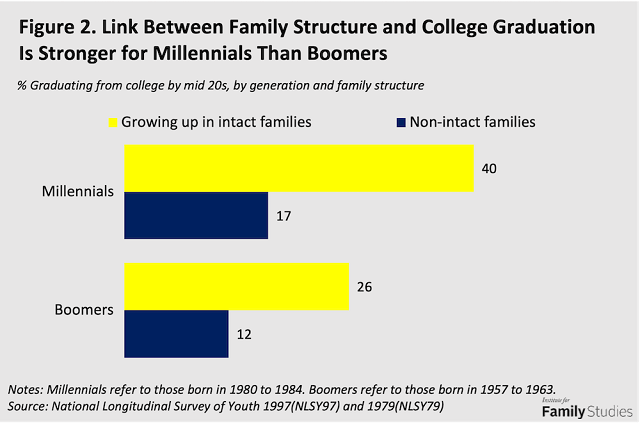
  • College graduation and economic success are more common for young adults from intact families.
  • Children who have the benefit of two parents are comparatively more advantaged today than they were in previous decades.
  • The relationship between family structure and college graduation is stronger today than it was for Boomers.


Sunday, August 13, 2023

Why Are Young People Leaving Religion


Daniel Cox, at The Survey Center on American Life:
The question remains: what is the reason so many young people are leaving religion? There’s no single answer, but the most compelling explanation is that changes in American family life precipitated this national decline. American families have changed dramatically over the past few decades and many churches have been slow to respond. Americans raised in blended families, interfaith families or single-parent families are far less likely to have participated in religion growing up. And these types of family arrangements have become far more common today than they once were. The family explanation is compelling for a few reasons: 
  1. Young people today are leaving much earlier than those of previous generations. Seventy percent of young adults who have disaffiliated shed their formative religious identities during their teen years.
  2. The Americans most likely to “leave” religion are those with the weakest formative attachments. Compared to previous generations, Generation Z reports having a less robust religious experience during their childhood.
  3. Most Americans who disaffiliate say they “drifted away” from religion rather than experiencing a singular negative or traumatic event that pushed them out. To put it another way, they quiet quit.
  4. A wealth of research has shown that religious socialization in the family is a key component of the transmission of religious values, identity, and beliefs across generations.

Friday, June 16, 2023

Belonging

 Daniel Stid at The Art of Association:

Where are we now? One early, powerful, and distressing set of signals came in March with a report from Over Zero and the American Immigration Council. Entitled The Belonging Barometer: The State of Belonging in America, it introduces a compelling new indicator of belonging, which it defines as follows: 

“Belonging is an innate motivational drive–underpinned by our ancestral origins–to form and maintain positive emotional bonds with others. Our need for belonging is so great that it permeates our thoughts, feelings, and behaviors and is integrally connected to how we perceive and pursue our life goals.”

The report goes on to convey new survey research about the extent to which Americans feel they belong in five different life settings. These include their family, friendships, workplace, local community, and the nation. Belonging, the report notes, “is not a switch but a scale,” at the opposite end of which lies exclusion, with increasingly painful levels of ambiguity in between. 

The data presented in the report are sobering. A majority of Americans report experiencing non-belonging (exclusion or ambiguity) in one or more life settings. Nearly 1 in 5 Americans report non-belonging in all five life settings. As we might expect, once we get beyond our family and friends, where 60% and 57% of us experience belonging, respectfully, feelings of ambiguity or exclusion become more common. Survey respondents reported non-belonging rates of 64% in their workplace, 68% in the nation, and 74% in their local community.


Tuesday, April 25, 2023

Ethnicity and Married Birth Parents

 Data Tools 6. The Geography of Traditional Families in America Charles Murray American Enterprise Institute April 2023

The ethnic differences in the prevalence of traditional marriage are huge. Among the nearly five million children in the ACS from 2014 to 2021, these were the percentages of children living with married birth parents broken down by the child’s ethnicity: 

Child’s Ethnicity Married Birth Parents 

Asian ............................82% 

White ............................62%

 Other or Mixed ,,,,,,,,,,,,50% 

Latino ,,,,,,,,,,,,,,,,,,,,,,,,,,,,43%

 Black ............................23% 

Asian children and black children effectively live in different familial worlds. The difference in living situations between white and black children is less dramatic but still extremely large.

Monday, March 6, 2023

Lauren Underwood: The Personal Cost of Public Service

 At WP, Ruby Cramer has a remarkable portrait of Rep. Lauren Underwood  (D-IL):   (h/t Cheryl Bonner)

Was this what she signed up for?

Not exactly. But Lauren Underwood was here to do the job, and today, on a Friday at 11 p.m., the job was to sit in the House chamber and to wait, alert, present, attentive, for her name to be called near the end of the alphabet. So that’s what she did. She had her navy-blue blanket draped over her legs. She had cough drops and hard candy in her bag. Underwood came 405th in line, about 40 minutes into each roll call, after four Johnsons, four Smiths, three Thompsons and two Torreses. Fourteen rounds of votes and still no speaker of the House. Four days of anxiety and confusion, waiting to be sworn in. It occurred to her early on that week that the world was watching, and that Congress was not exactly putting its best foot forward. There was a grimness haunting the place. It was not a happy scene. Underwood scrolled through text messages on her phone. Across the aisle sat the new Republican majority. She heard murmurs. Then she heard yelling. The word “combustible” came to mind. She turned and saw two colleagues about to lay hands on one another — an almost-fight breaking out in the House chamber. Was she surprised? After four years in this job, no, not really. She looked back down at her phone and fired off a skull emoji to her sister. One more vote and then she could begin her third term in Congress.

...

 But she was 36 years old now. She was single. She wanted kids. She dated, but life with a member of Congress, she knew, was “not for everyone.” Like a lot of women, she had mapped out what it would mean to raise a child on her own. She had researched the costs of fertility treatments, the timeline she’d need to follow, the financial reality of paying for full-time child care on top of not just one home, in Illinois, but also an apartment in Washington, on a salary of $174,000. Like a lot of women her age, Underwood said, she had health complications that put her “firmly, permanently,” in a “high, high, high risk category” for pregnancy. She knew all the data, all the risks, in part because she had made Black maternal health her signature legislation in Congress. Like a lot of women, Underwood had made sacrifices for her work.

Saturday, February 25, 2023

Marriage Rates

Many posts have discussed marriage and family.

Erica Pandey at Axios:
Americans are increasingly forgoing or delaying marriage — a dramatic shift from societal norms a generation ago.

By the numbers: Over the last 50 years, the marriage rate in the U.S. has dropped by nearly 60%.

What's happening: Taxes and some other legal structures still give an advantage to married couples, but the formal benefits of marriage are diminishing, said Andrew Cherlin, a sociologist at Johns Hopkins. And the societal pressure to marry has eroded dramatically. "Life is still a bit easier if you're married," he said. But many of the life events we link to marriage, such as cohabitating or having kids, are increasingly occurring outside of marriage.

Reality check: Even as the marriage rate is falling, the institution still holds value in the U.S., said Susan Brown, co-director of the National Center for Family & Marriage Research.Case in point: High school seniors' attitudes toward marriage have remained relatively stable over the past several decades.
In 1976, 74% of seniors said they expected to get married, and in 2020, 71% said so, according to an ongoing University of Michigan study.

Saturday, December 10, 2022

Life Experience and Politics

 Erick Erickson:

Last week, an urban planning warrior denounced the need for in-unit washers and dryers. He insisted no one ever needed to do laundry every day and once a week or two at a laundromat should be fine. He is a single childless twenty-something. He has no lived experience.

I do not think one must be in a demographic to opine on that demographic. A man should be as able to discuss issues related to women as women can with men. Civilians should be able to make informed opinions and policy decisions about the military, even with a lack of service. But credentials also should not be substituted for a lived life.

Like with the left, parts of the right are increasingly being held captive to the voices and opinions of spectacularly unaccomplished young men and women with brash Twitter personalities hiding their lack of lived lives. We probably should not be trying to set policies related to the working class based on the musings of a pampered progressive brat or of a pampered right-winger subsidized by dad. Nor should we set public policy by people who have only ever lived a political life. Unfortunately, both sides are more and more catering to the least accomplished, loudest voices whose only work experience is a political cause.

Sunday, November 27, 2022

Alone

 Dana Goldstein and Robert Gebeloff at NYT:
In 1960, just 13 percent of American households had a single occupant. But that figure has risen steadily, and today it is approaching 30 percent. For households headed by someone 50 or older, that figure is 36 percent.

Nearly 26 million Americans 50 or older now live alone, up from 15 million in 2000. Older people have always been more likely than others to live by themselves, and now that age group — baby boomers and Gen Xers — makes up a bigger share of the population than at any time in the nation’s history.

The trend has also been driven by deep changes in attitudes surrounding gender and marriage. People 50-plus today are more likely than earlier generations to be divorced, separated or never married.
...
But while many people in their 50s and 60s thrive living solo, research is unequivocal that people aging alone experience worse physical and mental health outcomes and shorter life spans.
...
Compounding the challenge of living solo, a growing share of older adults — about 1 in 6 Americans 55 and older — do not have children, raising questions about how elder care will be managed in the coming decades.

Bryce Ward at WP:

According to the Census Bureau’s American Time Use Survey, the amount of time the average American spent with friends was stable, at 6½ hours per week, between 2010 and 2013. Then, in 2014, time spent with friends began to decline.
By 2019, the average American was spending only four hours per week with friends (a sharp, 37 percent decline from five years before). Social media, political polarization and new technologies all played a role in the drop. (It is notable that market penetration for smartphones crossed 50 percent in 2014.)

Covid then deepened this trend. During the pandemic, time with friends fell further — in 2021, the average American spent only two hours and 45 minutes a week with close friends (a 58 percent decline relative to 2010-2013).

Similar declines can be seen even when the definition of “friends” is expanded to include neighbors, co-workers and clients. The average American spent 15 hours per week with this broader group of friends a decade ago, 12 hours per week in 2019 and only 10 hours a week in 2021.


Tuesday, November 8, 2022

Family Dinner and Inequality

Many posts have discussed economic and educational inequality. The effects of inequality reach many corners of American life.

Daniel A. Cox at the Survey Center on American Life:
The family dinner was once a ubiquitous feature of American life, an experience shared across cultural, religious, and class lines, but it has disappeared in many households. Far fewer Americans report having regular meals with their family during their formative years. Baby Boomers were far more likely to have grown up having meals with their families than Millennials and Gen Zers. Only 38 percent of Gen Zers who are now adults report that their family ate together regularly growing up.

The disappearance of family dinner is not simply a function of generational changes in values and priorities. Increasingly, family dinners reflect the growing class divide in American society. In Our Kids: The American Dream in Crisis, Robert Putnam documents how the class divide in family dinners emerged during the 1990s and has expanded since. Today, college educated Americans are far more likely than those without a college education to have been raised in homes where family dinners were the norm. This wasn’t always the case.
Older Americans, regardless of educational background, report having eaten dinner as a family regularly during childhood. Nearly three-quarters (74 percent) of Americans age 50 or older without any college education report that they had family meals every day during childhood, roughly as many (79 percent) Americans that age with a post-graduate education who say the same.

For younger Americans, the story is entirely different. Among Americans under the age of 50, education now strongly predicts whether one had regular family meals growing up. Only 38 percent of younger Americans without a college education were raised in homes that shared meals every day. In contrast, more than six in ten (61 percent) younger Americans with a post-graduate education say their family ate together regularly.

Sunday, June 26, 2022

Fathers

At AEI, W. Bradford Wilcox and colleagues write:
The decline of marriage and the rise of fatherlessness in America remain at the center of some of the biggest problems facing the nation: crime and violence, school failure, deaths of despair, and children in poverty.

The predicament of the American male is of particular importance here. The percentage of boys living apart from their biological father has almost doubled since 1960—from about 17% to 32% today; now, an estimated 12 million boys are growing up in families without their biological father.1 Specifically, approximately 62.5% of boys under 18 are living in an intact-biological family, 1.7% are living in a step-family with their biological father and step- or adoptive mother, 4.2% are living with their single, biological father, and 31.5% are living in a home without their biological father.2

Lacking the day-to-day involvement, guidance, and positive example of their father in the home, and the financial advantages associated with having him in the household, these boys are more likely to act up, lash out, flounder in school, and fail at work as they move into adolescence and adulthood. Even though not all fathers play a positive role in their children’s lives, on average, boys benefit from having a present and involved father.


 1. Numbers are calculated based on the 2019 American Community Survey, and Lydia R. Anderson, Paul F. Hemez, and Rose M. Kreider, “Living Arrangements of Children: 2019,” Current Population Reports, P70-174, U.S. Census Bureau, Washington, DC, 2021.

2. Ibid.


Saturday, May 14, 2022

Tariffs and Regs Helped Create the Baby Formula Shortage

 WSJ Editorial:

Last year Abbott accounted for 42% of the U.S. formula market, about 95% of which is produced domestically. There are only four major manufacturers of formula in the U.S. today: Mead Johnson, Abbott, Nestle, and Perrigo. One reason the market is so concentrated is tariffs up to 17.5% on imports, which protect domestic producers from foreign competition. Non-trade barriers such as FDA labeling and ingredient requirements also limit imports even during shortages.

Canada’s strong dairy industry has attracted investment in formula production. But the Trump Administration sought to protect domestic producers by imposing quotas and tariffs on Canadian imports in the USMCA trade deal. The FDA can inspect foreign plants so the U.S. import restrictions aren’t essential for product safety. They merely raise prices for consumers and limit choice.

Further limiting competition is the Special Supplemental Nutrition Program for Women, Infants, and Children (WIC) for low-income mothers. By the Department of Agriculture’s estimate, WIC accounted for between 57% and 68% of all infant formula sold in the U.S. Under the welfare program, each state awards an exclusive formula contract to a manufacturer.

Companies compete for the contracts by offering states huge rebates on the formula women can buy. The rebates equal about 85% of the wholesale cost, according to a 2011 USDA study. Women can only use WIC vouchers to purchase formula from the winning manufacturer. These rebates reduce state spending, but there’s no such thing as free baby formula.

Why would manufacturers give states an enormous discount? Because the contracts effectively give them a state monopoly. Stores give WIC brands more shelf space. Physicians may also be more likely to recommend WIC brands. After 30 states switched their WIC contracts between 2005 and 2008, the new provider’s market share increased on average by 84 percentage points.


Sunday, May 8, 2022

Mother's Day in Law

36 U.S. Code § 117
(a)Designation.—
The second Sunday in May is Mother’s Day.
(b)Proclamation.—
The President is requested to issue a proclamation calling on United States Government officials to display the flag of the United States on all Government buildings, and on the people of the United States to display the flag at their homes or other suitable places, on Mother’s Day as a public expression of love and reverence for the mothers of the United States.
(Pub. L. 105–225, Aug. 12, 1998, 112 Stat. 1258.)

Sunday, March 13, 2022

Infant Formula

 Helena Bottemiller Evich at Politico:

A sweeping recall of some of the biggest names in baby formula — including Similac — has been tied to a handful of hospitalizations, including two infant deaths. As POLITICO first reported, FDA, CDC and formula-maker Abbott were told in September about the first baby who got sick from Cronobacter sakazakii, a rare bacteria — several months before the massive product recall in mid-February. Lawmakers have begun to ask questions about the timeline of the recall.
...

In more than a decade covering food policy, I have covered countless outbreaks. I have never seen so many anecdotal and unconfirmed reports of illness that are not officially tied to the outbreak come out of the woodwork. It’s incredibly puzzling. Are parents wrongly blaming formula because they saw the recall? Or is the public health system missing cases? I am continuing to press health officials for answers.

It’s important to note that Abbott Nutrition, the formula maker, has maintained that its product has not been found to contain this rare bacteria as part of this outbreak: “The cases are under investigation and at this time the cause of the infants’ infections have not been determined,” the company said in a statement to POLITICO last week. “All infant formula products are tested for Cronobacter sakazakii, Salmonella and other pathogens and they must test negative before any product is released.” (FDA did find the bacteria in the Sturgis plant, however.)

This whole ordeal has me and a whole bunch of researchers revisiting a policy question that’s been kicked around in food safety circles for a long time: Should the government use social media as a tool to help detect or even solve foodborne illness outbreaks like this? Currently, CDC doesn’t, a spokesperson confirmed, but some local health departments have dabbled with using Yelp reviews, for example, to help detect outbreaks.

Friday, February 11, 2022

Attitudes Toward Marriage and Society

Daniel A. Cox at the Survey Center on American Life:
Although most Americans have a positive view about marriage, there is considerable skepticism about the societal benefits that marriage and parenthood confer. Overall, roughly six in 10 (62 percent) Americans believe society is just as well off if people have priorities other than getting married and having children. Thirty-seven percent say society benefits when people make marriage and child-rearing priorities.

Younger Americans are least likely to see the societal value in marriage and parenthood. Forty-four percent of seniors (age 65 or older) say a society that prioritizes marriage and child-rearing is better off, while only one-quarter (25 percent) of young adults (age 18 to 29) say the same. Roughly three-quarters (74 percent) of young adults believe society is just as well off if people have other goals.

The generation gap is even larger among men. Senior men are about twice as likely as young men to say that society is better off when marriage and child-rearing are priorities (51 percent vs. 26 percent).

Liberals and conservatives are sharply at odds over the societal importance of family formation. A majority (57 percent) of conservatives believe society is better off when marriage and child-rearing are priorities, a view shared by only 19 percent of liberals.

The generational shift in attitudes cuts across ideology but is far larger among conservatives. Older liberals are somewhat more likely than young liberals to embrace the notion that society benefits when getting married and having children are priorities (23 percent vs. 15 percent). Large majorities of both age groups reject this idea. In contrast, older conservatives are far more likely than young conservatives to believe in the societal benefit of people prioritizing marriage and children (64 percent vs. 37 percent).


Wednesday, February 9, 2022

Politically Mixed Marriages

Daniel A. Cox at the Survey Center on American Life:
While interfaith marriages in the United States are on the rise, politically mixed marriages remain uncommon. One in five (20 percent) Americans have a spouse whose political affiliation differs from their own.[11] The vast majority (80 percent) of Americans are married to people who share their same basic political orientation.

The degree of political diversity in marriages is nearly identical among Democrats and Republicans. Only 17 percent of Democrats and 16 percent of Republicans report having a spouse who has a political identity different from their own. In contrast, about four in 10 (39 percent) political independents say their spouse has a political identity different from theirs.

Americans who identify as politically moderate are also more likely to have marriages that cross the political aisle. Moderates (28 percent) are twice as likely as both liberals (14 percent) and conservatives (14 percent) to report their spouse’s political identity is distinct.

Unlike interfaith marriages, which have become more common in recent years, the prevalence of politically mixed marriages is more stable. Thirteen percent of couples married before 1972 have dissimilar political affiliations, compared to 21 percent of those married in the past decade.

Having a spouse who does not share the same political orientation may lead to somewhat reduced feelings of relationship satisfaction. Republicans in mixed marriages are less likely to be very or completely satisfied in their relationship than are those married to people aligned with their politics (86 percent vs. 75 percent). There is a more pronounced gap in feeling completely satisfied. Republicans married to politically similar spouses are much more likely than those in politically mixed marriages to say they feel completely satisfied with their relationship (49 percent vs. 34 percent). Democrats married to someone who shares their politics also report greater relationship satisfaction; 74 percent of Democrats whose spouse has similar political views say they are very or completely satisfied, compared to 67 percent in politically mixed marriages.

Being in a politically mixed marriage is associated with having less extreme political views and partisan hostility. Two-thirds (66 percent) of Democrats with a Democratic spouse say they have a very unfavorable view of the Republican Party, compared to 34 percent of Democrats in mixed marriages. Similarly, three-quarters (73 percent) of Republicans in politically homogenous marriages say they have a very unfavorable view of the Democratic Party, while less than half (46 percent) of those who have a spouse who does not share the same politics have a very negative view of the Democratic Party.

Politically mixed marriages may also soften Republicans’ views of opposing party leadership. Republicans married to other Republicans express a much more negative opinion of Joe Biden than those whose spouses have somewhat different political views (82 percent vs. 54 percent, respectively). Notably, for Democrats, negative views of Donald Trump appear to transcend marital influence. Democrats in mixed marriages are not much less likely than those in politically aligned marriages to say they have a very unfavorable view of Trump (73 percent vs. 87 percent).

Thursday, January 20, 2022

Hispanic Views of USA

 Mark Hugo Lopez and (CMC alum) Mohamad Moslimani at Pew:
For many Latinos, the United States offers a chance at a better life than the place their Latino ancestors came from in several ways. A strong majority say the U.S. provides more opportunities to get ahead than their ancestors’ place of origin. Majorities also say the U.S. has better conditions for raising kids, access to health care and treatment of the poor, according to a Pew Research Center national survey of 3,375 Latino adults conducted in March 2021.

Hispanics hold these positive views of the U.S. whether they were born in Puerto Rico, in another country, or in the 50 states or the District of Columbia.

However, Latinos do not see the U.S. as better on all measures. About half of Latino adults (48%) see family ties as better in the origin place of their ancestors (Puerto Rico or another country) than in the United States. About another quarter (27%) say the strength of family ties is about the same in both places, while 22% say family ties are better in the U.S.

Hispanics are split on whether the U.S. or the origin place of their Hispanic ancestors treats immigrants better. About one-third (34%) say immigrants are treated better in the U.S., while 38% say there is no difference between the treatment of immigrants in the U.S. and their treatment in Puerto Rico or another country. Another quarter (25%) of Hispanics say immigrants are treated better in the place of their Hispanic ancestors.

Tuesday, November 30, 2021

Living Arrangements

From the Census Bureau:
The percentage of adults living with a spouse decreased from 52% to 50% over the past decade, according to newly released estimates from the U.S. Census Bureau’s annual America’s Families and Living Arrangements table package.

At the same time, living alone became slightly more common: 37 million (15%) adults age 18 and over lived alone in early 2021, up from 33 million (14%) in 2011. The percentage of adults living with an unmarried partner also inched up over the past decade, from 7% to 8%.

These statistics come from the 2021 Current Population Survey’s Annual Social and Economic Supplement (ASEC), which collects labor force data as well as data on a variety of characteristics of households, living arrangements, married/unmarried couples and children. The ASEC has been conducted for more than 60 years and so allows for an examination of trends in families and living arrangements.

Other Highlights

Households and Families
  • There were 37 million one-person households in 2021, or 28% of all U.S. households. In 1960, single-person households represented only 13% of all households.
  • The number of families with their own children under age 18 in the household declined over the last two decades. In 2021, 40% of all U.S. families lived with their own children, compared to 44% in 2011 and 48% in 2001.
Marriage
  • In 2021, 34% of adults age 15 and over had never been married, up from 23% in 1950.
  • The estimated median age to marry for the first time was 30.4 for men and 28.6 for women in early 2021, up from ages 23.7 and 20.5, respectively, in 1947.
  • In 2021, less than one-quarter (24%) of children under age 15 living in married-couple families had a stay-at-home mother, compared to 1% with a stay-at-home father.
Living Arrangements
  • Some living arrangements differed by sex and age group in 2021. The percentage of men and women ages 18 to 24 that lived alone, about 5% each, did not significantly differ. More women than men in this age group lived with a spouse, 7% and 4%, respectively. The percentage of men ages 18 to 24 living alone was not significantly different from the percentage of men who lived with a spouse. A greater share of women (12%) than men (7%) this age also lived with an unmarried partner.
  • Men and women ages 25 to 34 were more likely than their younger peers to live with a spouse or unmarried partner: one-third (33%) of men and 42% of women lived with a spouse in early 2021. But about the same share (17%) of both men and women of these ages lived with an unmarried partner. These patterns were likely related to the lower median age of women (28.6) than men (30.4) at first marriage.
  • In 2021, more than one-half (58%) of adults ages 18 to 24 lived in their parental home, compared to 17% of adults ages 25 to 34.
For more data on families and living arrangements, visit Families and Living Arrangements at <www.census.gov>.

Friday, October 29, 2021

American Family Survey

Karlyn Bowman at Forbes:

The American Family Survey* is now in its seventh year. The poll is sponsored by the Deseret News and the Center for the Study of Elections and Democracy at Brigham Young University. YouGov fielded the online survey to 3,000 American adults. The researchers have asked many identical questions over the seven-year time span and added new ones each year to understand particular experiences of the modern family. In 2020, the polling team looked at family life during the first year of the pandemic. In the new 2021 survey, they took a deeper dive into how Americans are coping with the pandemic, their views of the government’s response to it, and Americans’ interactions across racial lines. They also looked at how Americans feel about the teaching of subjects such as racism and racial progress in schools.

We see substantial continuity across the yearly AFS surveys. People continue to say their own marriages and families are doing well. Yet, the survey hints at a slight softening in positive views about the institution. The percentage believing that marriage is needed to create strong families has dropped 10 points in seven years — from 62% in 2015 to 52% today. The number saying that marriage is old-fashioned and out of date has risen from 12% to 19%. Given these responses, it will be important to watch what people say in the future. Just as in each of the earlier surveys, this one shows people are less confident about marriage and families in general, but are more optimistic about their own.

The researchers note that racial and economic disadvantage predate the pandemic, but they still pointed to the significant hardship COVID created for some groups. More Hispanics, for example, reported a death in their immediate or extended family (21%) than did African Americans (16%) or Whites (9%). Forty percent of low-income families compared to 12% of high-income ones reported experiencing an economic crisis in the past year. Majorities of all income categories said their financial circumstances had not changed since March 2020, but 28% of low-income families compared to 14% of high-income families said their situations had gotten worse. Single-parent households have been hit especially hard with 27% reporting their finances have gotten worse during the pandemic.

Saturday, October 23, 2021

Polarized Attitudes on Family Formation

W Bradford Wilcox and colleagues at AEI have a report titled "The divided state of our unions
Where is the American family headed as COVID-19 finally seems o be abating? Focusing on family formation in the United States, this report considers three possibilities: (a) the “decadence-deepens scenario,” where marriage and fertility fall further in the wake of the pandemic; (b) the “renaissance scenario,” where men and women turn towards family formation in response to the existential questions and loneliness raised by the last year-and-a-half; and (c) the “family polarization scenario,” where economic, religious, and partisan divides in family formation deepen in post-COVID America.

Based on two new YouGov surveys by the Institute for Family Studies (IFS) and the Wheatley Institution, this report finds the most consistent evidence for the “family polarization scenario.” The “desire to marry” since the onset of COVID-19 ticked slightly upwards, by 2 percentage points overall, whereas the desire “to have a child” among all Americans ages 18-55 moved downwards, with just 10% reporting an increased desire for children, compared to 17% indicating a decreased desire. However, beyond these global shifts in family formation attitudes, which do not tell a consistent story in favor of either of the first two scenarios, there is marked polarization in desires related to marriage and childbearing by income, religious attendance, and partisanship as COVID-19 abates.

That’s because in a pandemic-haunted world where both marriage and fertility seem especially daunting or optional, three ingredients have emerged as signally important for family formation in the United States: money, hope, and a deep dedication to family. And the rich, the religious, and Republicans are generally more likely to possess one or more of these ingredients, compared to their lower-income, secular, and Democrat/Independent-affiliated fellow citizens. The family polarization documented here is especially striking because it augments fissures in American family life that have been growing over the last half century.

Wednesday, October 13, 2021

COVID and Caregiving

Tina Reed at Axios Vitals:

American families shouldered an enormous burden caring for family members even before the pandemic, and a shortage of professional caregivers now is only likely to make that burden heavier.

The big picture: Nursing homes and other long-term care settings have seen a staff exodus both during and after the pandemic, especially when they've imposed vaccine mandates — poking new holes in a system that was already full of them.

"We have this terrible tradeoff right in a lot of parts of the country where we can either have staff working who aren't vaccinated and put our older adults at risk, or we can be short-staffed and that also puts older adults at risk," David Grabowski, a health policy professor at Harvard, told Axios.

By the numbers: Health care employment is down by 524,000 jobs since February 2020. Nursing and residential care facilities account for about 80% of the losses. Last week's jobs report showed another 38,000-job decline in nursing and residential care.
  • "We are losing more people than we can recruit," Gayle Kvenvold, CEO of industry trade group LeadingAge Minnesota told the Minneapolis Star Tribune about concerns in her state. Seven in 10 nursing homes and 29% of assisted-living facilities have limited new admissions as a result.
Between the lines: The kind of care delivered in nursing homes and assisted-living facilities has long been a patchwork in the U.S.
  • It's expensive, it's hard for all but the poorest patients to get insurance coverage for it, and facilities offer widely differing levels of care. It's mostly been family members that have filled in the gaps.
  • Unpaid caregiving is a burden that has traditionally fallen disproportionately on women — as has child care, which is facing its own pandemic crunch.