Creating America wasn’t easy, and the fulfillment of our founding documents still demands much. But we make a grave mistake if we think this nation is only for what some call “heritage Americans,” whose forebears—specifically Anglo and Scots-Irish Protestants—fought in the Revolution or Civil War.
This notion that there is a select subset of “real” Americans is being pushed by, among others, Vice President JD Vance. He says that “America is not just an idea” but “a particular place, with a particular people.” Our country is more than an idea, but it began as one. Our people are particular, yet it makes no difference whether your forebear wintered at Valley Forge or fought at Gettysburg. What matters is living up to the Declaration’s promises.
It is ironic that Mr. Vance, a Catholic convert, would advocate “heritage Americans.” In the past, such movements routinely declared Catholics unacceptable members of our national family. One of the largest such groups was the American Protective Association, an anti-immigrant organization in the Gilded Age. It claimed 2.5 million adherents at its height. Its members swore an oath denouncing the pope and “the diabolical work of the Roman Catholic Church.” The APA was particularly strong in Mr. Vance’s home state of Ohio.
This notion of “heritage Americans” is at odds with the Declaration. America’s birth didn’t include a new aristocracy based on inherited valor.
Consider some Americans without Revolution or Civil War forebears: Elon Musk, Google CEO Sundar Pichai, Nvidia co-founder Jensen Huang, Arnold Schwarzenegger, Charlize Theron, Hakeem Olajuwon, former Pepsi CEO Indra Nooyi, Albert Einstein, Nikola Tesla, Salma Hayek, Henry Kissinger, Oracle’s Safra Catz, Bob Hope, Irving Berlin, Interactive Brokers’ founder Thomas Peterffy, Yo-Yo Ma, Alex Trebek and at least 40 winners of the Nobel Prize for Medicine.
Showing posts with label Catholic. Show all posts
Showing posts with label Catholic. Show all posts
Saturday, July 18, 2026
"Heritage Americans"


Wednesday, May 27, 2026
The Pope on Slavery
The first American Pope is very much aware of it.
ENCYCLICAL LETTER
OF HIS HOLINESS
POPE LEO XIV
ON SAFEGUARDING THE HUMAN PERSON
IN THE TIME OF ARTIFICIAL INTELLIGENCE
176. In the development of her doctrine, the Church has gradually come to a deeper awareness of the gravity of these issues. It is true that past events cannot be judged anachronistically, as though the moral criteria that matured over time had always been available. Yet neither can we deny or diminish the delay with which both society and the Church came to denounce the scourge of slavery. In antiquity and the Middle Ages many individuals and even ecclesiastical institutions had slaves. Already in the early modern period, the Apostolic See of Rome, responding to requests from Sovereigns, intervened several times in order to regulate and legitimize forms of subjugation, and, in certain cases, the enslavement of “infidels.” [174] It was only in the nineteenth century that a formal, absolute and universal condemnation of slavery was clearly articulated, notably under Pope Leo XIII. [175] This development offers a clear example of the Church’s growth in understanding the perennial truths of Revelation that she safeguards. Although there was not always consistency in practice — given that slavery was long tolerated before being unequivocally condemned — there has been a continuous affirmation throughout history of the dignity of every human being, created in the image of God, even if it took eighteen centuries for its full incompatibility with slavery to be explicitly recognized. This constitutes a wound in Christian memory, one from which we cannot consider ourselves detached. [176] It is impossible not to feel deep sorrow when contemplating the immense suffering and humiliation endured by so many in stark contrast to their immeasurable dignity as persons infinitely loved by the Lord. For this, in the name of the Church, I sincerely ask for pardon.
Thursday, May 7, 2026
The Vatican and the US Government
For decades, the Vatican has been a unique partner in U.S. foreign policy. From mediating negotiations with hostile countries like Cuba to coordinating global efforts on combating hunger, the Vatican regularly taps into its singular status as both church and state to help U.S. objectives abroad. The relationship hasn’t always been seamless — past popes have spoken out about American policy — but the alignment on human rights usually overcame any disagreements.
Which makes the latest row between President Donald Trump and Pope Leo XIV all the more extraordinary. The president has ferociously criticized the pope this week, saying the pontiff should stay out of politics. He accused Leo of “endangering a lot of Catholics” for his criticisms of the U.S.-Israeli strikes on Iran, saying the pope would permit Iran to obtain nuclear weapons. Vice President JD Vance has also said the pope should “be careful” in opining on theology when critiquing U.S. foreign policy.
Leo denied that he or the church have ever promoted nuclear weapons and that “should anyone want to criticize me for proclaiming the Gospel, they should do so with the truth.”
The back and forth has led to the lowest point in U.S.-Vatican relations since the two states established formal diplomatic relations in 1984, Vatican officials told our colleague Anthony Faiola. Secretary of State Marco Rubio, who is Catholic, met with the pope in Vatican City today in what Rubio described as a preplanned meeting that wasn’t driven by the latest rift between the two leaders. But the tension is certain to loom in the background. Anthony and Stefano Pitrelli have more on Rubio’s visit here.
“It’s extraordinary,” Margaret Susan Thompson, a professor of history and political science at Syracuse University, told us of the administration’s rhetoric toward the pope. “To have [Vance] speak out and say, in effect, the pope should mind his own business, and the pope should learn Catholic doctrine, and other members of the administration saying things like, the pope should read the Bible — these are kind of odd statements.”
Sunday, April 5, 2026
The Pope, the War, and Hegseth
Pope Leo XIV announced Sunday that he will lead a prayer vigil for peace on April 11 at St. Peter’s Basilica, using his first Easter Urbi et Orbi message to make a forceful appeal for an end to war and a renewed embrace of dialogue. https://t.co/crCqJdAzxd
— Catholic News Agency (@cnalive) April 5, 2026
Pete Hegseth, the U.S. defense secretary, has asked the American people to pray “every day, on bended knee” for a military victory in the Middle East “in the name of Jesus Christ.”
Pope Leo XIV, the first U.S.-born pontiff, has a starkly different take on what should be done in Jesus’ name.
In a homily during a Mass on Thursday morning before Easter, the pope said that the Christian mission had often been “distorted by a desire for domination, entirely foreign to the way of Jesus Christ.”
Since the United States and Israel began bombing Iran in late February, the pope has consistently called for an end to the violence and a return to dialogue to resolve the conflict. But without naming Mr. Hegseth, he has also pointed out the ways in which Christianity has been marshaled for purposes that the pope says do not align with Catholic teaching.
“We tend to consider ourselves powerful when we dominate, victorious when we destroy our equals, great when we are feared,” the pope said in a homily during a Holy Thursday rite at the Basilica of St. John Lateran, the cathedral of the bishop of Rome. “God has given us an example — not of how to dominate, but of how to liberate; not of how to destroy life, but of how to give it.”
In late March the pope warned against invoking the name of Jesus for battle, saying in a Sunday homily that Jesus “does not listen to the prayers of those who wage war, but rejects them.”
Monday, March 30, 2026
War and God
Every month at the Pentagon, Hegseth hosts evangelical worship services that legal experts say are unprecedented. His social media profile and public comments routinely espouse his understanding of Christianity, which is one that would dominate American life and cast those who disagree with him as God’s enemies. He has brought clergy from his small Christian denomination to preach at the Pentagon, including a prominent pastor who says women shouldn’t have the right to vote.
And in recent weeks, the war with Muslim-majority Iran has only made Hegseth’s approach more stark.
On Wednesday at the Pentagon, Hegseth prayed for U.S. troops to inflict “overwhelming violence of action against those who deserve no mercy … We ask these things with bold confidence in the mighty and powerful name of Jesus Christ.” Later that day, his department announced military chaplains would no longer wear their rank on their uniform and instead would wear religious insignia.
A gentleman from Chicago has a different point of view:
This is our God: Jesus, King of Peace, who rejects war, whom no one can use to justify war. He does not listen to the prayers of those who wage war, but rejects them, saying: “Even though you make many prayers, I will not listen: your hands are full of blood” (Is 1:15).
— Pope Leo XIV (@Pontifex) March 29, 2026
Sunday, January 11, 2026
Pope Leo on the Meaning of Words
The purpose of multilateralism, then, is to provide a place where people can meet and talk, modeled on the ancient Roman Forum or the medieval square. At the same time, in order to engage in dialogue, there needs to be agreement on the words and concepts that are used. Rediscovering the meaning of words is perhaps one of the primary challenges of our time. When words lose their connection to reality, and reality itself becomes debatable and ultimately incommunicable, we become like the two people to whom Saint Augustine refers, who are forced to stay together without either of them knowing the other’s language. He observes that, “Dumb animals, even those of different species, understand each other more easily than these two individuals. For even though they are both human beings, their common nature is no help to friendliness when they are prevented by diversity of language from conveying their sentiments to one another; so that a man would more readily converse with his dog than with a foreigner!” [6]
Today, the meaning of words is ever more fluid, and the concepts they represent are increasingly ambiguous. Language is no longer the preferred means by which human beings come to know and encounter one another. Moreover, in the contortions of semantic ambiguity, language is becoming more and more a weapon with which to deceive, or to strike and offend opponents. We need words once again to express distinct and clear realities unequivocally. Only in this way can authentic dialogue resume without misunderstandings. This should happen in our homes and public spaces, in politics, in the media and on social media. It should likewise occur in the context of international relations and multilateralism, so that the latter can regain the strength needed for undertaking its role of encounter and mediation. This is indeed necessary for preventing conflicts, and for ensuring that no one is tempted to prevail over others with the mindset of force, whether verbal, physical or military.
We should also note the paradox that this weakening of language is often invoked in the name the freedom of expression itself. However, on closer inspection, the opposite is true, for freedom of speech and expression is guaranteed precisely by the certainty of language and the fact that every term is anchored in the truth. It is painful to see how, especially in the West, the space for genuine freedom of expression is rapidly shrinking. At the same time, a new Orwellian-style language is developing which, in an attempt to be increasingly inclusive, ends up excluding those who do not conform to the ideologies that are fueling it.
Unfortunately, this leads to other consequences that end up restricting fundamental human rights, starting with the freedom of conscience. In this regard, conscientious objection allows individuals to refuse legal or professional obligations that conflict with moral, ethical or religious principles deeply rooted in their personal lives. This may be the refusal of military service in the name of non-violence, or the refusal on the part of doctors and healthcare professionals to engage in practices such as abortion or euthanasia. Conscientious objection is not rebellion, but an act of fidelity to oneself. At this moment in history, freedom of conscience seems increasingly to be questioned by States, even those that claim to be based on democracy and human rights. This freedom, however, establishes a balance between the collective interest and individual dignity. It also emphasizes that a truly free society does not impose uniformity but protects the diversity of consciences, preventing authoritarian tendencies and promoting an ethical dialogue that enriches the social fabric.
Monday, October 13, 2025
Confession
Many posts have discussed the role of religion in American life.
Daniel Payne at Catholic News Agency:
Officials in Washington state have agreed to back off a controversial effort to force priests there to violate the seal of confession as part of a mandatory abuse reporting law.
A motion filed in federal district court on Oct. 10 affirmed that state and local governments would stop attempting to require priests to report child abuse learned during the sacrament of reconciliation.
The state attorney general’s office on Oct. 10 said in a press release that clergy would remain mandatory reporters under state law, but prosecutors would agree “not to enforce reporting requirements for information clergy learn solely through confession or its equivalent in other faiths.”
The agreement brings an end to a high-profile and controversial effort by Washington government leaders to violate one of the Catholic Church’s most sacred and inviolable directives, one that requires priests to maintain absolute secrecy over what they learn during confession or else face excommunication.
Washington’s revised mandatory reporting law, passed by the state Legislature earlier this year and signed by Gov. Robert Ferguson, added clergy to the list of mandatory abuse reporters in the state. But it didn’t include an exemption for information learned in the confessional, explicitly leaving priests out of a “privileged communication” exception afforded to other professionals.
The state’s bishops successfully blocked the law in federal court in July, though the threat of the statute still loomed if the state government was successful at appeal.
In the July ruling, District Judge David Estudillo said there was “no question” that the law burdened the free exercise of religion.
...
Well ahead of the law’s passage, Spokane Bishop Thomas Daly had promised Catholics in the state that priests would face prison time rather than violate the seal of confession. “I want to assure you that your shepherds, bishop and priests, are committed to keeping the seal of confession — even to the point of going to jail,” Daly told the faithful in April 2023.
The Washington bishops, meanwhile, noted on Oct. 10 that the Catholic Church has upheld the sanctity of confession “for centuries.”
“Priests have been imprisoned, tortured, and even killed for upholding the seal of confession,” the state Catholic conference said. “Penitents today need the same assurance that their participation in a holy sacrament will remain free from government interference.”
Wednesday, October 1, 2025
The Pope Comments on US Politics
Pope Leo XIV responded to controversy over the Chicago cardinal’s plans to honor a Catholic U.S. senator who supports legalized abortion, saying that the senator’s record should be considered in its totality and that Americans should search together for the truth on ethical issues.
Several U.S. bishops condemned Chicago Cardinal Blase Cupich’s plans to honor U.S. Sen. Richard Durbin, D-Illinois, with a “lifetime achievement award” for his work surrounding immigration policy despite his pro-abortion voting record.
“I am not terribly familiar with the particular case. I think it’s important to look at the overall work that a senator has done during, if I’m not mistaken, in 40 years of service in the United States Senate,” the pope told reporters on Tuesday in response to a question from EWTN News.
He said: “I understand the difficulty and the tensions. But I think as I myself have spoken in the past, it’s important to look at many issues that are related to the teachings of the Church.”
“Someone who says I’m against abortion but is in favor of the death penalty is not really pro-life,” the pope explained. “Someone who says I’m against abortion but I’m in agreement with the inhuman treatment of immigrants in the United States, I don’t know if that’s pro life.”
“So they are very complex issues and I don’t know if anyone has all the truth on them,” he continued, “but I would ask first and foremost that they would have respect for one another and that we search together both as human beings and in that case as American citizens and citizens of the state of Illinois, as well as Catholics, to say that we need to be close to all of these ethical issues. And to find the way forward as a Church. The Church teaching on each one of those issues is very clear.”
The number of U.S. bishops who have condemned Cupich’s decision to honor Durbin with a “lifetime achievement award” has risen to 10, including two bishops emeritus.
Tuesday, June 17, 2025
Catholic Ties
Many posts have discussed the role of religion in American life.
Patricia Tevington and Gregory A. Smith at Pew:
Catholicism’s roots in the United States run deep. Nearly half of U.S. adults (47%) claim some connection to the Catholic faith. A new Pew Research Center survey finds that:
- 20% of U.S. adults are Catholics: They say they are Catholic when asked about their present religion.
- 9% of U.S adults are “cultural Catholics”: They don’t identify with Catholicism religiously, but they say “yes” when asked whether “aside from religion” they consider themselves Catholic in any way (for example, ethnically, culturally, or because of their family background).
- 9% are former Catholics: They neither identify as Catholic religiously nor consider themselves culturally Catholic, but they say they were raised in the Catholic faith.
- 9% are connected to Catholicism in other ways: They are not Catholic, culturally Catholic or formerly Catholic, but they have a Catholic parent, spouse or partner or they say “yes” when asked if they ever attend Catholic Mass.1
Wednesday, June 4, 2025
Education and Parental Rights
Many posts have discussed education.
Robert P. George at AEI:
Robert P. George at AEI:
The progressive approach’s concrete implications—and perhaps indicative of the true intentions all along of some of those seeking to curtail parental rights—can be observed in recent efforts by progressive activists to erode parents’ control over children’s education in order to convert their children to social progressivism. Consider, for example, the recently argued US Supreme Court case Mahmoud v. Taylor, in which progressive activists asked the Court to uphold a decision by Montgomery County, Maryland’s public school system banning parents from opting their children out of programs promoting LGBTQ ideology at the pre-K and elementary school level....
The Supreme Court is, I believe, likely to side with the parents in Mahmoud and reaffirm that our Constitution protects not only the free-exercise rights of parents and their children, but also, and relatedly, the fundamental right of parents to direct the upbringing and education of their children. This is because the United States has a long tradition of articulating and upholding the natural law account of parental rights within our constitutional order. Indeed, beginning with the landmark case Pierce v. Society of Sisters, whose one-hundredth anniversary we celebrate this year, we can trace in our constitutional order an essentially unbroken line of efforts to uphold the natural law account of parental rights against myriad efforts to undermine it.
Pierce concerned a statute enacted by Oregon that sought to compel all children, including those enrolled in what had been state-recognized private schools, to attend public schools. The bill was aggressively promoted by the Ku Klux Klan. Its principal targets were Catholic parochial schools—many supporters of the law, such as Oregon’s Democratic governor Walter Pierce, hoped to see Catholic schools shut down and the children who would have attended those schools, many of them immigrants themselves or from immigrant families, incorporated into the dominant Anglo-Protestant culture through compulsory public education. Writing for a unanimous court, Justice James Clark McReynolds held that the law “unreasonably interfere[d] with the liberty of parents and guardians to direct the upbringing and education of children,” adding that “The child is not the mere creature of the State.”
Monday, January 13, 2025
Catholics and America
Many posts have discussed patriotism and the role of religion in American life.
With the breadth of Catholic history and teaching in mind, let us return to the underlying question with which we began: What should Catholic parents and teachers be imparting to children about our country and their role as citizens of this nation?
The answer is clear: American Catholics must teach our children to understand our country’s history, cherish and maintain its founding principles, and recognize that when we have gone wrong as a nation, it has been on those occasions when we have acted in defiance of those principles or failed to honor them.
We should teach young Catholic men and women to value our Constitution because the freedoms it protects allow us to pursue truth and goodness; they nurture and sustain our families, our communities, and our country’s civic order. And we must affirm to our children and our students that there is no reason to feel they must choose between being faithful Catholics and being patriotic Americans.
The Church does not teach that democracy is always required, or that it is the highest or best form of government. In fact, it does not pronounce any single best form of government, though it emphatically rejects certain types of government, especially totalitarian political systems such as fascism and communism. But democracy at its best does give expression — perhaps unique expression — to the principle of equal human dignity that the Church always and everywhere proclaims. Pope St. John Paul II referred to this inviolable human dignity during his visit to the United States in 1995:
Catholics of America! Always be guided by the truth — by the truth about God who created and redeemed us, and by the truth about the human person, made in the image and likeness of God and destined for a glorious fulfillment in the Kingdom to come. Always be convincing witnesses to the truth. “Stir into a flame the gift of God” that has been bestowed upon you in Baptism. Light your nation — light the world — with the power of that flame!
As John Paul also noted, “the continuing success of American democracy depends on the degree to which each new generation, native-born and immigrant, makes its own the moral truths on which the Founding Fathers staked the future of your Republic.” If this nation “under God,” as Abraham Lincoln put it in his Gettysburg Address, is to endure, we must continuously pray and work to ensure that our laws and our leaders truly honor that North Star principle — the ur-principle, as I sometimes describe it — of all sound morality: that of the profound, inherent, and equal dignity of each and every member of the human family.
Sunday, December 1, 2024
Clergy and Laity
We use data from the new and nationally representative National Survey of Religious Leaders, supplemented with the 2018 General Social Survey, to examine the extent to which clergy are politically aligned with people in their congregations. Two assessments of alignment—clergy reports of how their political views compare to the political views held by most people in their congregations, and comparisons between clergy and lay voting preferences in the 2016 election—yield the same findings. Clergy in Black Protestant and predominantly white evangelical churches are much more likely to be politically aligned with their people than are Catholic or, especially, white mainline Protestant clergy, who often are more liberal than their people. Contrary to media reports suggesting that evangelical clergy are now likely to be less conservative than their people, the vast majority are either politically aligned with, or more conservative than, their members.
Monday, September 2, 2024
Religion and Party
Many posts have discussed the role of religion in American life.
2023 PRRI Census of American Religion: County-Level Data on Religious Identity and Diversity
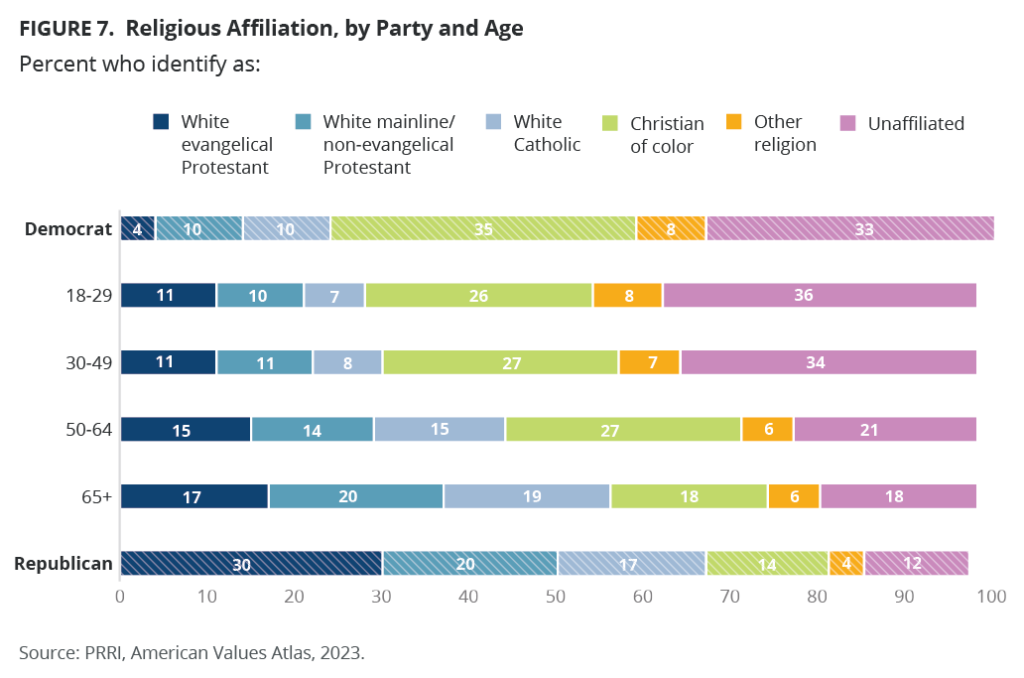
The majority of both major political parties identify as Christian. However, Republicans (84%) are 25 percentage points more likely than Democrats (59%) to do so. The biggest difference in the religious makeup of self-identified Republicans and Democrats is the proportion of white Christians, compared with Christians of color and the religiously unaffiliated. Seven in ten Republicans (70%) identify as white and Christian, compared with just 24% of Democrats. Among Republicans, 30% are white evangelical Protestants, 20% are white mainline/non-evangelical Protestants, and 17% are white Catholics. Among Democrats, those numbers fall to 4%, 10%, and 10%, respectively.
By contrast, 16% of Democrats are Black Protestants and 11% are Hispanic Catholics, compared with just 1% and 5%, respectively, among Republicans. Similar shares of Republicans (4%) and Democrats (3%) identify as Hispanic Protestant. Democrats (33%) are nearly three times as likely as Republicans (12%) to identify as religiously unaffiliated.
The religious makeup of Democrats generally resembles that of younger Americans ages 18–29. Three in ten young Americans ages 18-29 identify as white Christian (30%), 26% as Christians of color, 8% as another religion, and 36% as religiously unaffiliated. Similar shares of Americans ages 30–49 also identify as white Christian (32%), Christian of color (27%), another religion (7%), and unaffiliated (34%). About half of Americans ages 50-64 identify as white Christian (46%), 27% as Christian of color, 6% as another religion, and 21% as religiously unaffiliated. The Republican religious breakdown is more akin to the religious makeup of senior Americans over 65, whose majority identify as white Christian (58%), 18% as Christian of color, 6% as another religion, and 18% as unaffiliated. Notably, no age group is as white and Christian as Republicans.
Democrats have seen a more dramatic decrease in the share of Christians and an increase in unaffiliated since 2013, though Republicans have also seen this shift. Among both Democrats and Republicans, most of their decline in Christian affiliation is among white evangelical Protestants, who have declined by 4 percentage points among Republicans (from 34% in 2013 to 30% in 2023) and by 5 percentage points among Democrats (from 9% in 2013 to 4% in 2023). The share of the religiously unaffiliated has increased by 11 percentage points among Democrats (from 22% in 2013 to 33% in 2023) and remained relatively steady among Republicans.
Saturday, July 6, 2024
Excommunication
The Vatican on Friday informed a Donald Trump-supporting archbishop that he is being excommunicated for refusing to recognize Pope Francis' authority after years of outspoken public attacks.
Carlo Maria Vigano, an ultra-conservative who served as the Vatican’s diplomat to Washington, D.C. between 2011 and 2016, was formally accused last month of schism, which is one of the most serious offenses in canon law. Schism is “the refusal of submission to the Supreme Pontiff or of communion with the members of the Church subject to him,” according to the Vatican.
...
Vigano thereafter made increasingly baroque attacks on Francis while also drifting into conspiracy theories, backing bogus claims about COVID vaccines and making proclamations about the evils of the “deep state.” This week, he shared an X post from Rep. Marjorie Taylor Greene in which the MAGA congresswoman asserted: “The Covid vaccines are killing people.”
He’s also won the praise of Donald Trump. In 2020, Vigano wrote a letter to the then-president in which he linked COVID restrictions and Black Lives Matter protests as the work of “the children of darkness.” “It is quite clear that the use of street protests is instrumental to the purposes of those who would like to see someone elected in the upcoming presidential elections who embodies the goals of the deep state,” Vigano wrote.
“So honored by Archbishop Vigano’s incredible letter to me,” Trump wrote in a tweet sharing a link to the crazed prose. “I hope everyone, religious or not, reads it!”
In 1962, New Orleans Archbishop Joseph Rummel excommunicated three Louisiana Catholics who opposed his efforts to desegregate Catholic schools.
Friday, June 21, 2024
Ten Commandments and Denominational Differences
Posting the Ten Commandments is an essentially religious act — not only because it favors religion over non-religion, but also because it invariably favors one faith tradition over others.
The Louisiana statute requires a distinctly Protestant text, with Elizabethan language based on the King James Bible, which differs significantly from the versions used by Catholics, Jews and others. Some differences are inconsequential, but others have deep theological implications.
The Ten Commandments first appear in Exodus, and again in Deuteronomy. Although it is clear that God gave Moses a covenant of Ten Commandments, the relevant Exodus chapter comprises 17 verses, with no instructions for numbering or organizing them into 10 laws.
It is an act of interpretation to reduce the 17 verses to 10 poster-sized commandments, omitting some while abbreviating or combining others. Thus, any specific text always denotes a choice for one tradition or another.
The first commandment for Jews is “I am the Lord your God, who brought you out of the land of Egypt, out of the house of bondage.” This commandment is missing from Christian texts, as it is from the Louisiana statute, likely because it is not considered an imperative (the Hebrew speaks of 10 d’varim, or words, rather than commandments.)
The Jewish second commandment — “You shall have no other gods before me”– is where Christians begin, as does the Louisiana legislature (using King James’s “thou” and “shalt”), with numerical adjustments down the line.
Theological disputes then arise, as the leading Christian texts diverge. For Protestants, the second commandment is a variation on “Thou shalt not make for yourself a graven image,” which is also used in the Louisiana statute.
This commandment, however, is found nowhere in standard Catholic iterations, which instead divide the erstwhile 10th Commandment — against coveting — in two.
Friday, May 3, 2024
Religion and Abortion Opinion
Majorities across most religious traditions say that abortion should be legal in all or most cases, including Unitarian Universalists (93%), Jewish Americans (81%), Buddhists (79%), other Catholics of color (73%), Black Protestants (71%), white mainline/non-evangelical Protestants (68%), white Catholics (62%), Muslims (60%), Hispanic Catholics (57%), and other Protestants of color (52%). By contrast, Jehovah’s Witnesses (25%), white evangelical Protestants (27%), Latter-day Saints (30%), and Hispanic Protestants (40%) are the only major religious groups in which less than half of adherents support the legality of abortion. Among religiously unaffiliated Americans, 87% say that abortion should be legal in most or all cases.
Monday, March 25, 2024
Worship Attendance Is Low
Many posts have discussed the role of religion in American life.
As Americans observe Ramadan and prepare to celebrate Easter and Passover, the percentage of adults who report regularly attending religious services remains low. Three in 10 Americans say they attend religious services every week (21%) or almost every week (9%), while 11% report attending about once a month and 56% seldom (25%) or never (31%) attend.
Among major U.S. religious groups, members of The Church of Jesus Christ of Latter-day Saints, also widely known as the Mormon Church, are the most observant, with two-thirds attending church weekly or nearly weekly. Protestants (including nondenominational Christians) rank second, with 44% attending services regularly, followed by Muslims (38%) and Catholics (33%).
...
On any given weekend, about three in 10 U.S. adults attend religious services, down from 42% two decades ago. Church attendance will likely continue to decline in the future, given younger Americans’ weaker attachments to religion.
Specifically, more 18- to 29-year-olds, 35%, say they have no religious preference than identify with any specific faith, such as Protestant/nondenominational Christian (32%) or Catholic (19%). Additionally, young adults, both those with and without a religious preference, are much less likely to attend religious services -- 22% attend regularly, eight points below the national average.
These trends are consistent with other Gallup indicators of religious beliefs and practices, including the importance of religion to Americans and formal membership in churches and other houses of worship.
Saturday, August 19, 2023
Catholic Schools
Last October Kathleen Porter-Magee wrote at WSJ:
Today, the The Nation’s Report Card is out, and it is dismal. The 2022 National Assessment of Educational Progress, released Monday found that achievement in reading and math among fourth- and eighth-graders has dropped since 2019 in nearly every state.
To the extent that anyone could deny it before, the results settle the debate: America’s response to the pandemic set a generation of students back. But amid the bad news, Catholic schools were a bright spot, reflecting how these schools are making a difference in students’ lives.divergence between Catholic schools and public ones is so great that if all U.S. Catholic schools were a state, their 1.6 million students would rank first in the nation across the NAEP reading and math tests for fourth and eighth graders.
...
Catholic-school students now boast the nation’s highest scale scores on all four NAEP tests. The average score among fourth-graders in Catholic schools was 233, 17 points higher than the national public-school average, or about 1½ grade levels ahead. In eighth-grade reading, the average score for Catholic school students was 279, 20 points higher than the national public-school average, or about two grade levels ahead.
When disaggregated by race, Catholic schools showed significant gains since 2019. In particular, achievement among black students enrolled in Catholic schools increased by 10 points (about an extra year’s worth of learning), while black students in public schools lost 5 points and black students in charter schools lost 8 points. Similarly, on the eighth-grade reading test, Hispanic students in Catholic schools gained 7 points while Hispanic students in public schools lost 1 point and Hispanic students in charter schools lost 2 points.
Catholic schools lead the nation for Hispanic achievement on each of the four tests, and lead the nation in black student achievement on three of the four. They also rank first in eighth-grade reading and third in both fourth-grade reading and fourth-grade math for students who qualify for free and reduced-price lunch.
Sunday, April 16, 2023
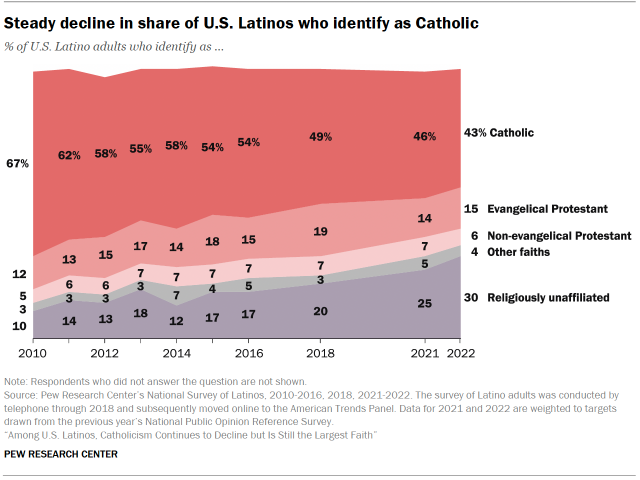
Catholicism Declining Among Hispanics
Many posts have discussed the role of religion in American life. Recent studies suggest that religious affiliation is on the decline in the United States.
Subscribe to:
Posts (Atom)