More than four-fifths of Mississippi’s legislative candidates will have no major-party opposition in the Nov. 7 general election. And more than half of this year’s winners will have faced no other Republicans or Democrats in either the primary or the general election.
...
Though Mississippi represents an extreme example, it highlights a national decline in competition for state legislative seats. New research suggests the reasons are more complex than mere voter satisfaction with incumbents. It also raises questions about the ability of American voters to hold their elected representatives accountable.
In some states, “there’s so many uncontested seats that one party wins the chamber before an election takes place,” said Steven Rogers, a political scientist at Saint Louis University who focuses on state legislatures.
A democracy “relies on this notion that the people will have some sort of choice,” Rogers added. But “without someone running for office, there isn’t really a choice.”
In Mississippi, the percentage of legislative seats with no major-party opposition in the general election has risen steadily from 63% in 2011 to 85% this year. The percentage with no Republican or Democratic challengers in either the primary or the general election has grown from 45% to 57% over that same time, according to data compiled for The Associated Press by Ballotpedia, a nonprofit organization that tracks elections.
Bessette/Pitney’s AMERICAN GOVERNMENT AND POLITICS: DELIBERATION, DEMOCRACY AND CITIZENSHIP reviews the idea of "deliberative democracy." Building on the book, this blog offers insights, analysis, and facts about recent events.
Search This Blog
Thursday, November 2, 2023
The Decline of Electoral Competition
Sunday, March 26, 2023
Crime Pushes SF Asian American Voters to the Center
Asian Americans to Democrats: "we want safe streets, good schools and less progressive ideology." That's the message and 2024 warning from San Francisco. Footnote about our unfortunate experience at the end. @OutFrontCNN story features @JoelEngardio. Producer: @jasonkCNN pic.twitter.com/6Up96sGD5H
— Kyung Lah (@KyungLahCNN) March 23, 2023
Thursday, November 10, 2022
Being a Good Member of Society
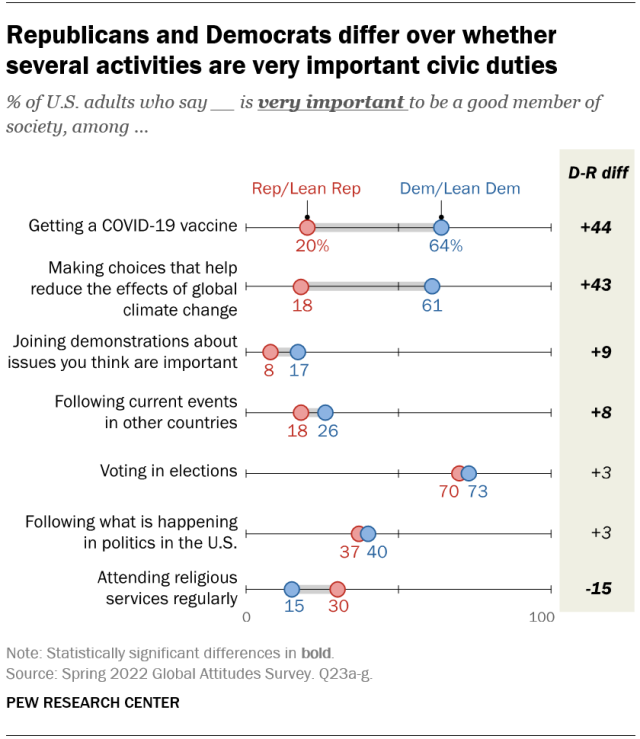
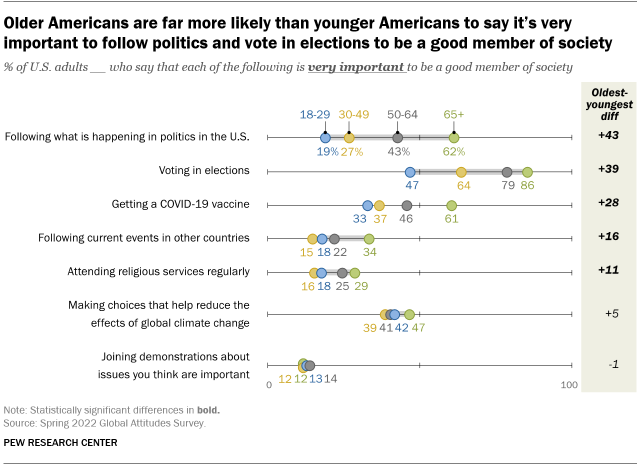
Around seven-in-ten U.S. adults (69%) say it’s very important to vote in elections to be a good member of society – more than say the same about any of the other activities included in a Pew Research Center survey conducted earlier this year.

Sunday, September 18, 2022
Threats to Democracy
“There is the possibility, for the first time in American history, that a legitimately elected president will not be able to take office,” said Yascha Mounk, a political scientist at Johns Hopkins University who studies democracy.
The second threat to democracy is chronic but also growing: The power to set government policy is becoming increasingly disconnected from public opinion.
The run of recent Supreme Court decisions — both sweeping and, according to polls, unpopular — highlight this disconnect. Although the Democratic Party has won the popular vote in seven of the past eight presidential elections, a Supreme Court dominated by Republican appointees seems poised to shape American politics for years, if not decades. And the court is only one of the means through which policy outcomes are becoming less closely tied to the popular will.
Two of the past four presidents have taken office despite losing the popular vote. Senators representing a majority of Americans are often unable to pass bills, partly because of the increasing use of the filibuster. Even the House, intended as the branch of the government that most reflects the popular will, does not always do so, because of the way districts are drawn.
“We are far and away the most countermajoritarian democracy in the world,” said Steven Levitsky, a professor of government at Harvard University and a co-author of the book “How Democracies Die,” with Daniel Ziblatt.
Sunday, January 16, 2022
Exit Polls
Many posts have discussed issues with survey research.
AEI interviewed Joe Lenski, who conduct the National Election Pool:
AEI: How many people worked on the exit poll in 2020?
Joe Lenski: For presidential general elections or midterms, we typically have people at 700 to 1,000 precinct locations. In 2020, we also had people at 200 early voting centers around the country. We interviewed about 30,000 people by telephone before Election Day to identify by mail and early voters. Every survey you saw in 2020 was some mix of these three modes. Seventy percent of the vote in 2020 was early or by mail. So we increased the number of telephone interviews of by-mail voters and increased the number of early voter locations where we interview people in person. The techniques are the same as an exit poll. We interview people right after they cast their ballot, but now it is during the weeks leading up to the election at early voting centers. So in every survey you see some mix of those three modes.
AEI: How does the process of writing the questionnaire unfold?
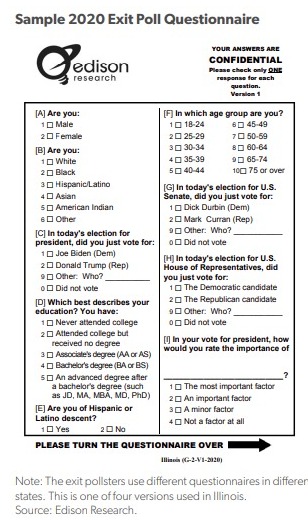
Joe Lenski: The exit poll questionnaire is written by a committee made up of the polling directors at the news organizations of the NEP. Three of the four members have to agree to put a question onto the questionnaire. There is usually consensus. The real issue is that you have a limited amount of space on a self-administered questionnaire. Typically, it is a 5.5 by 8.5 piece of paper. It usually fits 18–20 questions. If there is a sufficient sample size, we have multiple versions of the questionnaire. In most states in 2020, we used two versions of the questionnaire. There were four national versions. The questionnaire is basically the same for Election Day voters, for mail and early voters, and for telephone surveys with some adaptations. (See page 3.)
Sample 2020 Exit Poll Questionnaire Note: The exit pollsters use different questionnaires in different states. This is one of four versions used in Illinois. Source: Edison Research.
Monday, January 4, 2021
Defense Secretaries Speak Out
As former secretaries of defense, we hold a common view of the solemn obligations of the U.S. armed forces and the Defense Department. Each of us swore an oath to support and defend the Constitution against all enemies, foreign and domestic. We did not swear it to an individual or a party.
American elections and the peaceful transfers of power that result are hallmarks of our democracy. With one singular and tragic exception that cost the lives of more Americans than all of our other wars combined, the United States has had an unbroken record of such transitions since 1789, including in times of partisan strife, war, epidemics and economic depression. This year should be no exception.
Our elections have occurred. Recounts and audits have been conducted. Appropriate challenges have been addressed by the courts. Governors have certified the results. And the electoral college has voted. The time for questioning the results has passed; the time for the formal counting of the electoral college votes, as prescribed in the Constitution and statute, has arrived.
As senior Defense Department leaders have noted, “there’s no role for the U.S. military in determining the outcome of a U.S. election.” Efforts to involve the U.S. armed forces in resolving election disputes would take us into dangerous, unlawful and unconstitutional territory. Civilian and military officials who direct or carry out such measures would be accountable, including potentially facing criminal penalties, for the grave consequences of their actions on our republic.
Transitions, which all of us have experienced, are a crucial part of the successful transfer of power. They often occur at times of international uncertainty about U.S. national security policy and posture. They can be a moment when the nation is vulnerable to actions by adversaries seeking to take advantage of the situation.
Given these factors, particularly at a time when U.S. forces are engaged in active operations around the world, it is all the more imperative that the transition at the Defense Department be carried out fully, cooperatively and transparently. Acting defense secretary Christopher C. Miller and his subordinates — political appointees, officers and civil servants — are each bound by oath, law and precedent to facilitate the entry into office of the incoming administration, and to do so wholeheartedly. They must also refrain from any political actions that undermine the results of the election or hinder the success of the new team.
We call upon them, in the strongest terms, to do as so many generations of Americans have done before them. This final action is in keeping with the highest traditions and professionalism of the U.S. armed forces, and the history of democratic transition in our great country.
Saturday, March 21, 2020
Cancel or Postpone?
So many people are wondering: could a president remain in power by unilaterally canceling or postponing a general election?
NOPE: the Constitution sets strict expiration dates for terms of office, with no exceptions.
- 20th Amendment: "The terms of the President and Vice President shall end at noon on the 20th day of January, and the terms of Senators and Representatives at noon on the 3d day of January, of the years in which such terms would have ended if this article had not been ratified; and the terms of their successors shall then begin."
- Article II, section 1: "The Congress may determine the time of choosing the electors, and the day on which they shall give their votes; which day shall be the same throughout the United States."
- Article I, section 4: "The Times, Places and Manner of holding Elections for Senators and Representatives, shall be prescribed in each State by the Legislature thereof; but the Congress may at any time by Law make or alter such Regulations, except as to the Places of chusing Senators."
Friday, March 13, 2020
Americans Want to End the Electoral College
A majority of U.S. adults (58%) say the Constitution should be amended so the presidential candidate who receives the most votes nationwide wins, while 40% prefer to keep the current system in which the candidate who receives the most Electoral College vote wins the election.
Support for amending the Constitution has increased slightly since the period immediately following the 2016 election. In a November 2016 CNN/ORC survey, roughly half of adults (51%) favored amending the Constitution to eliminate the Electoral College. And in a March 2018 Pew Research Center survey, 55% favored taking this step.
Monday, March 9, 2020
Early Voting, Mail Voting, and Coronavirus

Early voting does have disadvantages, especially in nomination contests where candidates may drop out between the printing of ballots and the casting of votes. But it also has advantages.
Stephen Wolf at Daily Kos:
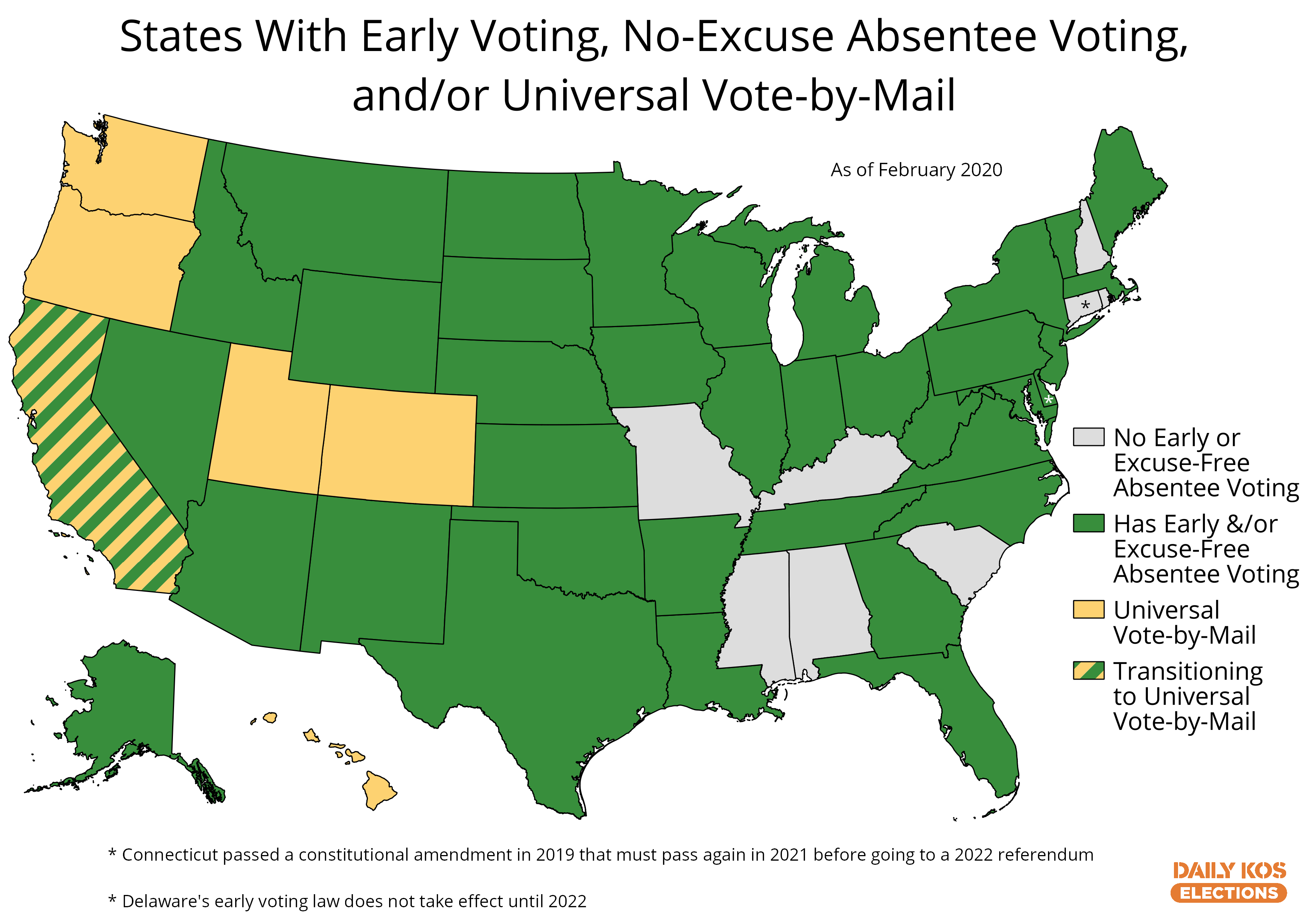
As shown on the map at the top of this post (see here for a larger version), Colorado, Hawaii, Oregon, Utah, and Washington have already transitioned to universal voting by mail ahead of November's elections, and states such as California and Arizona have seen a majority of voters cast their ballots by mail in recent years. Furthermore, states such as Michigan, Pennsylvania, and Virginia have made it considerably easier to vote absentee by mail since the last election. But a large number of states still don’t even allow absentee mail voting without an excuse, let alone mail every registered voter a ballot as the default voting method.
Adopting universal voting by mail is imperative as the coronavirus threatens to become a pandemic. As governments urge citizens to avoid crowded public spaces and to vigilantly wash their hands, having millions of people stand in lines on Election Day and use the same voting machines or even the same pens to fill out paper ballots threatens public health and could dampen voter turnout. Furthermore, because poll workers are very disproportionately the same elderly Americans who are most at risk in a flu pandemic, states and localities may have trouble finding enough poll workers, and those who do show up will be at greater risk of catching or spreading the disease.
These problems should be largely avoidable with universal voting by mail, since it almost entirely eliminates in-person voting and the public gatherings that go with it. Furthermore, vote-by-mail is a cost-saving measure that frees up resources for other things because governments have to operate far fewer in-person polling places. It also has a long track record of increasing voter turnout in the states that have adopted it thanks to the ease of voting that way, especially with prepaid postage negating the need for voters to go to the post office.
Sunday, February 23, 2020
Views of Russia
- Around seven-in-ten Americans (72%) say it is very or somewhat likely that Russia or other foreign governments will try to influence the November 2020 election. Far more Democrats and Democratic-leaning independents (84%) than Republicans and Republicans leaners (59%) expect foreign interference in the election. Among those who see interference as likely, 82% of Democrats say it is a major problem; only 39% of Republicans say the same.
- The share of Americans with a positive view of Russia is at its lowest point in a decade. Just 18% have a favorable impression, far lower than the 44% who viewed Russia positively in 2007, when the question was first asked.
- Just 20% of the U.S. public has confidence in Putin to do the right thing regarding world affairs; 73% have no confidence. While Putin engenders relatively low confidence among members of both parties, a larger share of Republicans (31%) than Democrats (10%) express confidence in him. The partisan gap in views of Putin is now the largest measured by Pew Research Center.
- Last year, half of Americans said that Russia’s power and influence posed a major threat to the well-being of the U.S. These opinions, like many about Russia, also were sharply divided along partisan lines. Nearly two-thirds of Democrats (65%) said Russia was a major threat, compared with 35% of Republicans.
Tuesday, February 11, 2020
Would Vote For...
More than nine in 10 Americans say they would vote for a presidential candidate nominated by their party who happened to be black, Catholic, Hispanic, Jewish or a woman. Such willingness drops to eight in 10 for candidates who are evangelical Christians or are gays or lesbians. Between six and seven in 10 would vote for someone who is under 40 years of age, over 70, a Muslim or an atheist.
Just one group tested -- socialists -- receives majority opposition. Less than half of Americans, 45%, say they would vote for a socialist for president, while 53% say they would not.
Monday, February 10, 2020
Election Security and Human Error
While problems with voting technology can bedevil any election — as was amply illustrated by the chaos surrounding this week’s Iowa Democratic caucuses — human error is a major vulnerability in any voting system. Tales of worker error in elections range from optical scanners left unplugged to distribution of ballots to the wrong precinct. One study of poll workers in California reported several such breaches of standard operating procedures, including leaving a memory card with vote totals at the polling site at the end of the day and leaving the door to a ballot box unlocked.
A majority of poll workers are older than 60, which is unsurprising given that most people under that age are too busy with work or school to take off the time. And without proper training, many older poll workers lack an adept understanding of technology and cybersecurity. This leads to an insecure voting environment.
Additional training may sound discouraging to counties that already struggle to recruit poll workers, and local governments may feel that additional time commitments will only exacerbate that problem and increase their financial burdens. This could explain why election officials in Arizona, Michigan and Pennsylvania told NBC that they never received cybersecurity training.Also, the U S election system is decentralized -- which is both an asset and a liability. On the one hand, it would be impossible to mount a simultaneous national attack on such a fragmented system. On the other hand, standards and capabilities vary widely.
Friday, July 26, 2019
Federalism and Russian Election Interference
The Senate Intelligence Committee has issued a heavily-redacted report on Russian interference in the 2016 election. Though it did not discover any evidence that the Russians changed any election tallies, it found that the Russians targeted every state.
Russian efforts exploited the seams between federal authorities and capabilities, and
protections for the states. The U.S. intelligence apparatus is, by design, foreign-facing,
with limited domestic cybersccurity authorities except where the Federal Bureau of
Investigation (FBI) and the Department of Homeland Security (DHS) can work with state and local partners. State election officials, who have primacy in running elections, were not sufficiently warned or prepared to handle an attack from a hostile nation-state actor.
...
In an August 15, 2016, conference call with state election officials, then-Secretary [of Homeland Security Jeh] Johnson told states, "we're in a sort of a heightened state of alertness; it behooves everyone to do everything you can for your own cybersecurity leading up to the election." He also said that there was "no specific or credible threat known around the election system itself. I do not recall—I don't think, but I do not recall, that we knew about [State 4] and Illinois at that point."-- The Committee notes that this call was two months after State 4's system was breached, and more than a month after Illinois was breached and the state shut down its systems to contain the problem. During this call, Secretary Johnson also broached the idea of designating election systems as critical infrastructure.
A number of state officials reacted negatively to the call. Secretary Johnson said he
was "surprised/disappointed that there was a certain level of pushback from at least those who spoke up.... The pushback was: This is our—I'm paraphrasing here: This is our responsibility and there should not be a federal takeover of the election system."
Thursday, April 4, 2019
FEC Troubles
The May 2018 fracas, described in interviews and a series of internal emails obtained by the Center for Public Integrity, is but one of several stumbles that have helped render the FEC’s inspector general office effectively nonfunctional since November, when the lone deputy inspector general quit.
This matters because the inspector general office investigates waste, fraud and abuse at the FEC, including accusations against commissioners. The bipartisan FEC is itself responsible for enforcing and regulating national campaign finance laws but has long been hamstrung by ideological divisions, low staff morale and other long-standing vacancies, including two of six FEC commissioner slots.
So the lack of an inspector general means no one is watching the election watchdog — at a time when few feel the FEC is functioning effectively, even as its missions are evermore important. The FEC’s struggles are set against the backdrop of an accelerating chase for presidential campaign cash and prominent political money scandals — alleged porn actress hush-money payments and foreign infiltration among them.
Scammers are also increasingly preying on vulnerable Americans who are misled into believing they are supporting a candidate or cause — an issue the FEC has struggled to address.
Sunday, February 10, 2019
Most Expensive Midterm
It’s official: the 2018 election was the most expensive midterm ever by a large margin, with total spending surpassing $5.7 billion, according to data compiled by the Center for Responsive Politics.
The final tally surpasses the conservative $5.2 billion projection the Center released in October.
With more than $5.7 billion shelled out by candidates, parties, committees, PACs and outside groups, the 2018 midterm leapfrogs even the then-record breaking 2008 presidential election which saw nearly $5.3 billion in total spending. It also smashes the previous midterm spending record of $3.8 billion in 2014.
“Just as the 2018 elections brought historic wins for a more diverse group of candidates, they also saw greater spending than we’ve ever seen or anticipated for a midterm election, capitalizing on years of loosened campaign finance regulation and oversight,” said Sheila Krumholz, executive director of the Center for Responsive Politics.
Wednesday, January 30, 2019
The Threat to Elections
Our adversaries and strategic competitors probably already are looking to the 2020 US elections as an opportunity to advance their interests. More broadly, US adversaries and strategic competitors almost certainly will use online influence operations to try to weaken democratic institutions, undermine US alliances and partnerships, and shape policy outcomes in the United States and elsewhere. We expect our adversaries and strategic competitors to refine their capabilities and add new tactics as they learn from each other’s experiences, suggesting the threat landscape could look very different in 2020 and future elections.
- Russia’s social media efforts will continue to focus on aggravating social and racial tensions, undermining trust in authorities, and criticizing perceived anti-Russia politicians. Moscow may employ additional influence toolkits—such as spreading disinformation, conducting hack-andleak operations, or manipulating data—in a more targeted fashion to influence US policy, actions, and elections.
- Beijing already controls the information environment inside China, and it is expanding its ability to shape information and discourse relating to China abroad, especially on issues that Beijing views as core to party legitimacy, such as Taiwan, Tibet, and human rights. China will continue to use legal, political, and economic levers—such as the lure of Chinese markets —to shape the information environment. It is also capable of using cyber attacks against systems in the United States to censor or suppress viewpoints it deems politically sensitive.
- Iran, which has used social media campaigns to target audiences in both the United States and allied nations with messages aligned with Iranian interests, will continue to use online influence operations to try to advance its interests.
- Adversaries and strategic competitors probably will attempt to use deep fakes or similar machine-learning technologies to create convincing—but false—image, audio, and video files to augment influence campaigns directed against the United States and our allies and partners.
Adversaries and strategic competitors also may seek to use cyber means to directly manipulate or disrupt election systems—such as by tampering with voter registration or disrupting the vote tallying process—either to alter data or to call into question our voting process. Russia in 2016 and unidentified actors as recently as 2018 have already conducted cyber activity that has targeted US election infrastructure, but we do not have any intelligence reporting to indicate any compromise of our nation’s election infrastructure that would have prevented voting, changed vote counts, or disrupted the ability to tally votes.
Friday, January 11, 2019
Old People Share Fake News
The abstract:
So-called “fake news” has renewed concerns about the prevalence and effects of misinformation in political campaigns. Given the potential for widespread dissemination of this material, we examine the individual-level characteristics associated with sharing false articles during the 2016 U.S. presidential campaign. To do so, we uniquely link an original survey with respondents’ sharing activity as recorded in Facebook profile data. First and foremost, we find that sharing this content was a relatively rare activity. Conservatives were more likely to share articles from fake news domains, which in 2016 were largely pro-Trump in orientation, than liberals or moderates. We also find a strong age effect, which persists after controlling for partisanship and ideology: On average, users over 65 shared nearly seven times as many articles from fake news domains as the youngest age group.
Tuesday, December 4, 2018
The Magnitude of Bush's Victory
Wednesday, October 31, 2018
The Trench Between Republicans and Democrats
Most immediately, it means that Democrats, while still favored by most analysts to win control of the House, are operating with relatively little room for error because they are trying to gain the 23 seats they need predominantly on one part of the playing field: well-educated suburban seats. Even if they do reach a majority next week, its likely the Democratic hold on the House will be precarious and very slim unless they can also capture a respectable number of the small-town and blue-collar seats now considered toss-ups.
The longer-term implication is that this election now seems highly likely to widen the trench between a Democratic Party that increasingly controls the major metropolitan areas largely skeptical of Trump and a GOP whose dominance is barely dented in the rural and exurban areas where he remains strong.
Already, the CNN analysis shows, about two-thirds of House Republicans represent districts where the education level lags the national average and nearly three-fifths hold seats where the median income is lower as well. By contrast, about 53% of Democrats hold seats where the education level and median income exceed the national average. If Democratic gains next month are concentrated mostly in white-collar seats, the Republican caucus will tilt ever further toward lower-education and modest-income seats while the Democrats will bend further toward the opposite -- expanding the distance between the two sides and making compromise between them even more difficult.
Monday, May 21, 2018
Voter Turnout: International Data
One of political science’s better-established findings is that “the frequency of elections has a strongly negative influence on turnout,” as Arend Lijphart of the University of California at San Diego put it in a 1997 article.
Yet in the United States, we constantly hold elections: Every two years, we elect a new Congress and, in many states, a new legislature. Every four years, that’s combined with a presidential election. Some jurisdictions squeeze local balloting — for sheriff, school board, judge, coroner, you name it — into the years between midterm congressional and presidential elections. Of course, these are often twice-a-year exercises, since a primary precedes the general election. Sometimes primaries have runoffs!
...
In practice, it’s costly — in time, effort and, indeed, money — to stay politically informed and active.
Those costs must be weighed against the potential benefits of participating in an election whose results might last no more than a couple of years, to the extent they affect you personally at all. Frequent elections therefore bring on what Lijphart calls “voter fatigue.”
In a famous paper nearly 30 years ago, Richard W. Boyd of Wesleyan University found that the introduction of presidential primaries in northern states after 1968 accounted for a 10 percentage-point drop in those states’ general-election voter turnout by 1980.
Fro Pew: