Search This Blog

Showing posts with label local government. Show all posts

Saturday, October 14, 2023

Trust in Institutions 2023

Jerry M. Jones at Gallup:
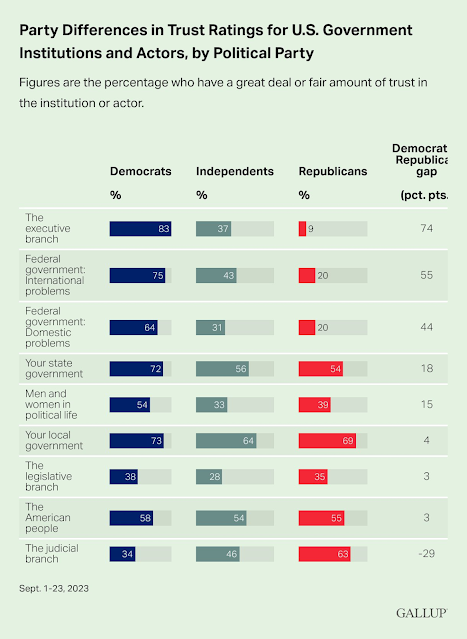
Gallup’s annual update on trust in government institutions and actors finds Americans have the most faith in local government (67%) and the least faith in the legislative branch of the federal government, or Congress (32%). Between these two extremes, majorities express trust in state government and the American people, while less than half are confident in the executive and judicial branches of the federal government, elected officials and candidates for office, and in the federal government’s ability to handle both domestic and international problems.

These data are from Gallup’s annual Governance survey, conducted Sept. 1-23. The poll finished just before Congress averted a possible government shutdown at the start of the new fiscal year by temporarily extending federal funding until mid-November. The vote to remove Speaker of the House Kevin McCarthy -- a first in U.S. history -- also occurred after the poll was completed.
Trust in each institution or actor is statistically similar to a year ago, except for Congress, which saw a drop of six percentage points, from 38% expressing a great deal or fair amount of trust in it last year to 32% this year.

However, all institutions have below-average trust levels compared with historical Gallup norms dating back to the early 1970s. Most of these -- all but state and local governments -- have trust scores more than 10 points below the historical average for that institution. Trust in the judicial branch, usually one of the most trusted branches (averaging 66%), is furthest from its historical average, with its current 49% confidence rating 17 points below its typical rating since 1972.


Thursday, September 14, 2023

School Choice Redux

At Vox, Andrew Prokop explains why the school choice movement is making progress with education savings accounts:
Universal voucher bills had long failed because most parents didn’t want radical disruption of the public school status quo. The pandemic brought this radical disruption. Polarizing battles unfolded over school closures, mask and vaccine requirements, and (after reopening) how long kids should be kept home if classmates tested positive.

Then the culture war that erupted over race, gender, and sexuality teaching in schools in 2020 and beyond ensured that things never entirely returned to “normal.” Activists like Christopher Rufo argued that “critical race theory” concepts were pervading teaching about race, Twitter accounts like Libs of TikTok spread videos of educators discussing gender identity, and such matters became omnipresent on Fox News and in conservative media.

In the right’s narrative, parents reasonably recoiled against the incompetence or ideological extremism of educators. In the left’s narrative, conservatives targeted the public school system with a strategic and unrelenting campaign of vilification, laden with exaggeration and moral panic. “The overriding message has been to drive a wedge between parents and public schools,” Polikoff said.

Conservative activists saw opportunity. “It is time for the school choice movement to embrace the culture war,” the Heritage Foundation’s Jay Greene and James Paul wrote in 2022.

In a 2019 survey, 31 percent of Republican respondents said they had very little or no confidence in public schools; in a 2022 survey, that number had risen to 50 percent. Democratic and independent voters, in contrast, remained roughly as confident in the public school system as before the pandemic.

But the drop in Republican support shifted the previous political status quo, especially in red states, making rank-and-file GOP voters less hostile about proposals to shake up the system.

Sunday, January 29, 2023

Police Unions and Civilian Oversight

Organized labor in general has fallen on hard times.  But in many places, public-employee unions retain enormous power.

Jamiles Lartey at the Marhsall Project:
If you heard about a group called “Voters for Oversight and Police Accountability,” who would you guess is funding and coordinating its efforts? Progressive activists? Civic-minded community members?

How about a police union?

That’s the situation in Austin, Texas, where this fall, canvassers for “VOPA” appear to have amassed the 25,000 signatures needed to get a referendum on the so-called “Austin Police Oversight Act” into the city’s May 6 election.

The thing is, there was already an “Austin Police Oversight Act” on the ballot. The duplicate effort, funded by the Austin Police Association, is similar — but seriously watered down, when compared with the original promoted by the progressive political action committee Equity Action. That original proposal seeks to open up public access to police records, and give the city’s office of police oversight the ability to participate in investigations of officer conduct.

By contrast, the police union-funded ballot initiative would keep certain misconduct records hidden from the public and leave the board with a more passive role in investigations.

Reporting late last year found that the police union was running VOPA’s website, and this week, a reporter with the Austin Chronicle uncovered that the union had contributed virtually every penny of the nearly $300,000 raised for the campaign. The union did not respond to a request for comment from The Marshall Project, and has not responded to a request from the local Fox affiliate.

The effort appears to be a brazen version of something police unions have attempted in numerous cities recently: to derail and disempower civilian oversight groups tasked with monitoring and reviewing police conduct.

Friday, January 20, 2023

Lowest Unionization Rate on Record

 From BLS:

The union membership rate--the percent of wage and salary workers who were members of unions--was 10.1 percent in 2022, down from 10.3 percent in 2021, the U.S. Bureau of Labor Statistics reported today. The number of wage and salary workers belonging to unions, at 14.3 million in 2022, increased by 273,000, or 1.9 percent, from 2021. However, the total number of wage and salary workers grew by 5.3 million (mostly among nonunion workers), or 3.9 percent. This disproportionately large increase in the number of total wage and salary employment compared with the increase in the number of union members led to a decrease in the union membership rate. The 2022 unionization rate (10.1 percent) is the lowest on record. In 1983, the first year where comparable union data are available, the union membership rate was 20.1 percent and there were 17.7 million union workers.

... 

In 2022, 7.1 million employees in the public sector belonged to unions, about the same as in the private sector (7.2 million). (See table 3.)
Union membership was little changed over the year (+80,000) in the public sector, after a decline the prior year (-191,000). The public-sector union membership rate continued to decline in 2022; the rate went down by 0.8 percentage point to 33.1 percent. In 2022, the union membership rate continued to be highest in local government (38.8 percent), which employs many workers in heavily unionized occupations, such as police officers, firefighters, and teachers.
The number of union workers employed in the private sector increased by 193,000 to 7.2 million over the year. The private-sector unionization rate edged down by 0.1 percentage point in 2022 to 6.0 percent. Industries with high unionization rates included utilities (19.6 percent), motion pictures and sound recording industries (17.3 percent), and transportation and warehousing (14.5 percent). Low unionization rates occurred in insurance (1.2 percent), finance (1.3 percent), professional and technical services (1.3 percent), and food services and drinking places (1.4 percent).


Wednesday, January 4, 2023

Coroners

Samantha Young at KHN:
When a group of physicians gathered in Washington state for an annual meeting, one made a startling revelation: If you ever want to know when, how — and where — to kill someone, I can tell you, and you’ll get away with it. No problem.

That’s because the expertise and availability of coroners, who determine cause of death in criminal and unexplained cases, vary widely across Washington, as they do in many other parts of the country.

“A coroner doesn’t have to ever have taken a science class in their life,” said Nancy Belcher, chief executive officer of the King County Medical Society, the group that met that day.

Her colleague’s startling comment launched her on a four-year journey to improve the state’s archaic death investigation system, she said. “These are the people that go in, look at a homicide scene or death, and say whether there needs to be an autopsy. They’re the ultimate decision-maker,” Belcher added.

Each state has its own laws governing the investigation of violent and unexplained deaths, and most delegate the task to cities, counties, and regional districts. The job can be held by an elected coroner as young as 18 or a highly trained physician appointed as medical examiner. Some death investigators work for elected sheriffs who try to avoid controversy or owe political favors. Others own funeral homes and direct bodies to their private businesses.

Overall, it’s a disjointed and chronically underfunded system — with more than 2,000 offices across the country that determine the cause of death in about 600,000 cases a year.

“There are some really egregious conflicts of interest that can arise with coroners,” said Justin Feldman, a visiting professor at Harvard University’s FXB Center for Health and Human Rights.
...
The various titles used by death investigators don’t distinguish the discrepancies in their credentials. Some communities rely on coroners, who may be elected or appointed to their offices, and may — or may not — have medical training. Medical examiners, on the other hand, are typically doctors who have completed residencies in forensic pathology.

In 2009, the National Research Council recommended that states replace coroners with medical examiners, describing a system “in need of significant improvement.”

Massachusetts was the first state to replace coroners with medical examiners statewide in 1877. As of 2019, 22 states and the District of Columbia had only medical examiners, 14 states had only coroners, and 14 had a mix, according to the Centers for Disease Control and Prevention.

Monday, November 28, 2022

Black Mayors

Brakkton Booker at Politico:
When Karen Bass is sworn in as Los Angeles mayor next month, she’ll be making history in more ways than one.

Not only will she be the first woman to lead LA, Bass will complete a rare tetrafecta of sorts: Black mayors will be running the nation’s four largest cities, with the congresswoman joining Eric Adams of New York, Lori Lightfoot of Chicago and Sylvester Turner of Houston.

“Anytime we get a new mayor, it’s exciting,” Frank Scott, the Democratic mayor of Little Rock, Ark., said in a phone interview. “But to have another mayor, a Black woman, who’s going to lead one of our nation’s major cities? That’s a big deal.”

This marks the first time these major metropolises will simultaneously be led by African Americans — and it may be for just a brief period. The leadership acumen of big city mayors is being tested now in how they address issues ranging from upticks in crime, to a sagging economy and high inflation, to housing affordability and homelessness.

And this is all taking place as the cities undergo seismic demographic shifts. All four are “majority minority” cities and these Black mayors are governing municipalities where Latinos, not Black residents, make up the largest non-white ethnic group.

Hispanics accounted for more than half of the growth in the U.S. population, according to the 2020 Census. Meanwhile, New York, Chicago, Los Angeles and other big cities have seen their Black populations shrink in recent years in something of a reversal of what happened in the 1970s. These new migration patterns are altering political dynamics as Latinos consolidate power.

Friday, July 15, 2022

Public Opinion and Federalism

 Frank Newport at Gallup:

There is some evidence speaking to Americans' preference for state versus federal control of government. In 2016, Gallup asked Americans, "Which theory of government do you favor: concentration of power in the state government or concentration of power in the federal government?" This was an update of a question included in one of Gallup's earliest surveys in 1936. At that point, in the middle of the Great Depression and President Franklin Roosevelt's massive mobilization of the federal government in the New Deal program, 56% of those interviewed favored the federal government approach. By the time Gallup asked the question again in 1981, in Ronald Reagan's first year in office, the public had flipped, favoring the state power alternative by 56% to 28%. The most recent results from 2016 showed a similar response, with 55% choosing the state government alternative and 37% choosing the federal government.

Political identity is highly related to preferences for state versus federal power. Remarkably, this partisan difference has persisted over the past eight decades. In 1936, 72% of Democrats favored the federal government theory of government, compared with 35% of Republicans. In 2016, 80 years later, 62% of Democrats favored the federal government, compared with 17% of Republicans.

More generally, a good deal of data show that the American public is more confident in their state government than in the federal government. This reflects the truism that Americans are, in general, more positive about government the more local it is. State governments routinely inspire more confidence than the federal government. And local governments inspire more confidence than state governments. As a September 2021 Deloitte Insights review pointed out, "Distant government tends to be distrusted government."

Gallup's most recent Governance poll, conducted in September 2021, showed that 37% of Americans have a great deal or fair amount of confidence in the legislative branch of government, 44% of Americans have confidence in the executive branch and 54% have confidence in the judicial branch. Americans' confidence in their state government is at the 57% level (a great deal or fair amount) and faith in local government is at 66%.

A Pew Research survey conducted April 25-May 1 of this year showed similarly that 32% of Americans have a favorable opinion of the "federal government in Washington," 54% have a favorable opinion of "your state government" and 66% a favorable opinion of "your local government." Last August, as another example, a Gallup survey showed that Americans gave the federal government the lowest positive image rating of any of 25 business and industry sectors tested.

In summary, we have a situation as far as public opinion is concerned in which Americans have for decades been more positive about their state government than the federal government, in which Americans hold the federal government in very low regard, and in which, when asked, Americans appear to tilt toward the idea that states should have more power than the federal government.


Sunday, May 29, 2022

State and Local Government Employment

From the Census:

 Education, hospitals, and police protection constitute the largest functional categories of state and local governments. In March 2021, 12.6 million people were employed on a full- or part-time basis in a capacity related to these functions. The remaining 6.2 million employees worked in other functional categories. Education, the single largest functional category for state and local government (which includes elementary and secondary, higher, and other education), employed 10.5 million people. Among those public education employees, 7.8 million worked at the local government level, primarily in elementary and secondary education. State governments employed another 2.7 million education employees, mostly in higher education. The next largest functional category, hospitals, employed 1.1 million state and local government employees. Of those employees, 0.7 million worked at the local government level, and 0.5 million worked at the state government level. Police protection, which includes people with power of arrest as well as other police support staff, accounted for 1.0 million workers for state and local governments. Local level governments employed 0.9 million of all police protection workers, and 0.1 million worked at the state government level. 


Friday, March 25, 2022

Local Deliberation

In 2010, an organization called Everyday Democracy (ED) organized the Strong Start for Children (SSFC) citizens’ deliberation to identify policies and practices that could be used to strengthen the quality of early childhood education. ED partnered with local community organizations, which recruited 290 community members from across Albuquerque to participate in small group deliberations called “dialogue circles.” Through these deliberations, they shared ideas with representatives who then raised the ideas at the 2011 SSFC Policy Forum in Santa Fe. The policy forum itself featured small group deliberations with community members and policymakers. As a result of SSFC, the University of New Mexico Family Development Program created an early childhood development and education resource directory. There was even healthy spillover, as the New Mexico state legislature went on to pass a tribal-language preservation bill.

Thursday, December 9, 2021

Black Population Outflow from Big Cities

Shia Kappos and colleagues at Politico:
Chicago — and neighborhoods like Englewood — offer perhaps the most extreme example of a demographic upheaval reshaping power in cities across the country. The 2020 census shows Black Americans moving, in huge numbers, out of their longtime homes in Northern and Western cities, and resettling in smaller cities, the suburbs and — in a twist on the Great Migration of the 20th century — the South. Nine of 10 of the cities with the largest numbers of African Americans saw significant declines in their Black populations over the past 20 years, according to census data compiled by POLITICO.

In sheer numbers, Chicago’s outflow has been particularly dramatic. In 1980, about 40 percent of the city’s total population was Black — one of the country’s most formidable concentrations of Black business and political power. Since then, that number has dropped to just under 29 percent. Only Detroit, a city with its share of troubles, has seen a bigger drop in Black residents.

Tuesday, December 7, 2021

Filling a State News Void

 Elahe Izadi at WP:

With funding from foundations and a variety of donors, States Newsroom formed two years ago to attempt to fill a void in what many government watchdogs and civil-society experts believe is one of the biggest manifestations of the local journalism crisis — the dire shortage of reporters covering state government.

On Monday, States Newsroom will announce plans to nearly double its presence, from its current 25 states to about 40 over the next two and a half years. It will open its next five outlets in Nebraska, Alaska, Arkansas, South Carolina and Kentucky. It’s also launching “News from the States,” a new online clearinghouse to showcase all their affiliates’ reporting.
...

The number of newspaper reporters dedicated to covering statehouses has been declining for decades, dropping by 35 percent between 2003 and 2014 and outpacing overall newspaper job losses over that time, according to Pew Research Center survey. And that was before the more recent blows to the newspaper industry, with nearly 6,000 journalism jobs and 300 newspapers vanishing between 2018 and early 2020, according to a University of North Carolina study, even before the pandemic worsened their economic picture.

Enterprising activists, interest groups, bloggers and trade publications have attempted to fill the gap by monitoring the machinations of lawmakers and regulatory agencies. Nonprofits have also increasingly stepped up, sometimes in collaboration with corporate media, such as the Associated Press’s partnership with Report For America, which partially funds salaries for reporters at local news organizations. ProPublica expanded its local reporting network to pay for journalists at seven organizations to focus squarely on state government.

Tuesday, November 9, 2021

Sheriffs

Kimberly Kindy at WP:
As Mark Lomax campaigns for the top law enforcement position in Bucks County, Pa., there’s one question some voters keep asking: Will he be a “constitutional sheriff”?

The 62-year-old former state trooper has largely avoided the polarizing label, which refers to a movement of sheriffs who argue that their power to interpret the law is above any state or federal authority — even the president.

Lomax embraces the unique powers of elected sheriffs, who report directly to voters, unlike police chiefs, who are generally hired and fired at will by city councils. “You pretty much have no authority above you government-wise; you answer to the voters,” Lomax said, adding that despite this freedom he plans to be “a sheriff who enforces the laws.”

In dozens of races around the nation, answering that question has become a key campaign topic, as the constitutional sheriffs movement has capitalized on anger at pandemic restrictions. While it’s unclear exactly how many law enforcement officials embrace the ideology, one group that promotes it claims up to a tenth of the nation’s sheriffs as dues-paying members, and numerous candidates for sheriff now on the ballot echo its rhetoric.

The stakes go beyond local policing issues, as sheriffs who follow the ideology have refused to enforce mask mandates and several have announced plans to resist President Biden’s impending rule that all businesses with 100 or more workers must be fully vaccinated against the coronavirus or face weekly testing.

“We will not become the mandate police,” Knox County Sheriff Tom Spangler said at a news conference in Tennessee as he discussed his Oct. 25 letter to Biden calling the vaccine mandate “unconstitutional” and “government overreach.”

Supporters of the movement see their elected sheriffs as the last line of defense against unwanted local, state and federal regulations.

“They are very much in this ‘don’t tread on me’ world that sees the federal government as a very threatening force,” said Michael Zoorob, a fellow at Northeastern University’s Boston Area Research Initiative who studies sheriffs. “They see themselves as an institution that can stand in the way of encroachment of the federal government against communities.”

The constitutional sheriffs movement has gained momentum at a time when sheriffs are playing an outsize political role as lawmakers debate bills to overhaul policing in the wake of George Floyd’s murder.

In several states, local and state sheriffs’ associations threatened to pull their support for policing bills if lawmakers didn’t remove provisions that called for banning qualified immunity, a legal defense that provides broad protections for officers in civil lawsuits. And in Congress, sheriffs — who number about 3,000, compared with 13,000 appointed police chiefs — were given significant negotiating power on the George Floyd Justice in Policing Act when Sen. Tim Scott (R-S.C.) said he would not sign off on legislation that was opposed by the National Sheriffs’ Association.
...
The power that sheriffs have been able to amass comes in part from their ability to hold onto their jobs.

Police chiefs’ average tenures are just three years. For sheriffs, the average tenure is 11 years, according to an analysis by Zoorob of sheriff elections from 1958 to 2018.

And most sheriffs are white males.


Tuesday, November 2, 2021

The Deadly Culture of Traffic Stops

 Mike McIntire and Michael H. Keller at NYT:

A hidden scaffolding of financial incentives underpins the policing of motorists in the United States, encouraging some communities to essentially repurpose armed officers as revenue agents searching for infractions largely unrelated to public safety. As a result, driving is one of the most common daily routines during which people have been shot, Tased, beaten or arrested after minor offenses.

Some of those encounters — like those with Sandra Bland, Walter Scott and Philando Castile — are now notorious and contributed to a national upheaval over race and policing. The New York Times has identified more than 400 others from the past five years in which officers killed unarmed civilians who had not been under pursuit for violent crimes.

Fueling the culture of traffic stops is the federal government, which issues over $600 million a year in highway safety grants that subsidize ticket writing. Although federal officials say they do not impose quotas, at least 20 states have evaluated police performance on the number of traffic stops per hour, which critics say contributes to overpolicing and erosion of public trust, particularly among members of certain racial groups.
Many municipalities across the country rely heavily on ticket revenue and court fees to pay for government services, and some maintain outsize police departments to help generate that money, according to a review of hundreds of municipal audit reports, town budgets, court files and state highway records.


Saturday, October 30, 2021

California's Corridor of Corruption


Dan Walters at CalMatters:
Campaign contributions are a semi-legal way for those who benefit from political decisions to express their gratitude, but they can backfire legally if there is some overt quid pro quo. During the Shrimpgate investigation, Capitol politicians were ensnared for demanding both campaign money and personal payoffs from undercover FBI agents seeking legislation to benefit a fictitious shrimp processing company.

So-called “behested” payments are another. Interest groups curry favor by making “contributions” to politicians’ favorite charities that sometimes employ the politicians’ relatives, as CalMatters writer Laurel Rosenhall has detailed. There are limits on direct campaign contributions, but none on behested payments. Belatedly, the Fair Political Practices Commission is promulgating new disclosure rules.

The federal indictment of Los Angeles City Councilman Mark Ridley-Thomas alleges another wrinkle in the corruption game. Ridley-Thomas, who has jumped from office to office for the last three decades, is accused of helping a University of Southern California administrator obtain hefty county contracts in return for getting his son, Sebastian, a no-cost graduate degree and a full-time faculty position.

...

Indictments of officials and political players in the small communities on the periphery of Los Angeles are so common that they scarcely raise an eyebrow. Assembly Speaker Anthony Rendon calls his Los Angeles County district a “corrridor of corruption.”

...

 It’s not uncommon for members of the public to declare that all politicians are crooks. They aren’t. Most are sincere and honest, whether or not one agrees with their actions.

However, there is corruption and it flourishes most often when there is no meaningful political competition, when politicians believe that they own their positions and are entitled to pieces of the action, and when the watchdogs are not watching closely enough

Wednesday, August 4, 2021

Public Meetings and Deliberation

 At APSR, Jonathan E. Collins has an article titled "Does the Meeting Style Matter? The Effects of Exposure to Participatory and Deliberative School Board Meetings." The abstract:

Would public meetings incite more civic engagement if they were structured in ways that are simply more engaging? I addressed this question by conducting an original survey with an oversample of racial and ethnic minorities and individuals from low-income households. The survey featured a randomized experiment in which each study participant was shown a short clip of an actual school board meeting that was (1) a standard meeting with no public participation, (2) a meeting with public participation, or (3) a meeting with deliberation (public participation followed by a reasoned response from the school board). The experience of viewing the more participatory and deliberative school board meetings led to increased trust in local officials and a stronger willingness to attend school board meetings in the future. This study has significant implications for civic engagement, local politics, and public school governance.

From the article:

Public meetings are a critical component of American democracy. Of the most used types of political participation, attending a public meeting is the only one that allows for citizens to have direct contact with policy makers in real time. As Brian Adams (2004, 43) states, public meetings “can facilitate citizen participation and the development of good policy by assisting citizens in achieving their political goals.” Public meetings create proverbial windows of transparency, which allow for citizen oversight of the legislative behavior of political elites. Despite the utility of these meetings to American democracy, public meeting attendance as a form of political participation is underutilized. Since 2000, in each year that the American National Election Study (ANES) has been administered, only 20% to 30% of Americans report having attended at least one meeting over the course of previous the year (see Figure 11). This means that, in a given year, over 70% of Americans never attend a public meeting at all. If federal elections experienced such consistently low levels of participation, we would consider American democracy.

The threat that low and uneven public meeting attendance creates for American democracy has long been a concern for political scientists. “The town meeting has certainly lost a great deal of the power it once had, and attendance has declined,” writes Jane Mansbridge (1980, 127). As such, the findings of this study have implications for how public meetings can generate more participation and help deepen trust in local institutions, especially school boards. The evidence presented above indicates that exposing individuals to public meetings that feature direct citizen participation and public deliberation, respectively, directly leads to increased trust in local officials and an increased willingness to attend public meetings in the future. The upshot here is that vibrant, engaging meetings can beget active, well-attended meetings.


Monday, May 10, 2021

US Policing: Decentralized and Mostly Small-Scale

At WP, Mark Berman reports that police reform is tough because policing is decentralized and most departments are small.
According to a federal survey in 2016, there are more than 12,200 local police departments nationwide, along with another 3,000 sheriff’s offices. And most of those don’t look like the New York Police Department, which employs more officers than Brooklyn Center, in suburban Minneapolis, has residents.

Nearly half of all local police departments have fewer than 10 officers. Three in 4 of the departments have no more than two dozen officers. And 9 in 10 employ fewer than 50 sworn officers. Brooklyn Center, which has 43 officers, and Windsor, which reported a seven-member force, fit comfortably in that majority.

Experts say that while smaller departments have their benefits, including being able to adapt to their communities and hire officers with local ties, these agencies also are typically able to avoid the accountability being sought as part of the national movement to restructure and improve policing. These departments’ often limited resources and the decentralized structure of American law enforcement complicate efforts to mandate widespread training and policy changes, experts say.

“You want to change American policing, figure out how to get to … the departments of 50 officers or less,” said Chuck Wexler, executive director of the Police Executive Research Forum, a Washington-based group that works with police departments. “How do you reach them? How do you get to them? … That’s what the American people keep wondering.”

Monday, October 19, 2020

Partisan Local News Sites

Davey Alba and Jack Nicas at NYT:
Maine Business Daily is part of a fast-growing network of nearly 1,300 websites that aim to fill a void left by vanishing local newspapers across the country. Yet the network, now in all 50 states, is built not on traditional journalism but on propaganda ordered up by dozens of conservative think tanks, political operatives, corporate executives and public-relations professionals, a Times investigation found.

The sites appear as ordinary local-news outlets, with names like Des Moines Sun, Ann Arbor Times and Empire State Today. They employ simple layouts and articles about local politics, community happenings and sometimes national issues, much like any local newspaper.

But behind the scenes, many of the stories are directed by political groups and corporate P.R. firms to promote a Republican candidate or a company, or to smear their rivals.
The network is largely overseen by Brian Timpone, a TV reporter turned internet entrepreneur who has sought to capitalize on the decline of local news organizations for nearly two decades. He has built the network with the help of several others, including a Texas brand-management consultant and a conservative Chicago radio personality.
The network is one of a proliferation of partisan local-news sites funded by political groups associated with both parties. Liberal donors have poured millions of dollars into operations like Courier, a network of eight sites that began covering local news in swing states last year. Conservative activists are running similar sites, like the Star News group in Tennessee, Virginia and Minnesota.

But those operations run just several sites each, while Mr. Timpone’s network has more than twice as many sites as the nation’s largest newspaper chain, Gannett. And while political groups have helped finance networks like Courier, investors in news operations typically don’t weigh in on specific articles.

The local sites include

 In July, Jessica Mahone and Philip Napoli reported at Nieman:

The growth of partisan media masquerading as state and local reporting is a troubling trend we’ve seen emerge amid the financial declines of local news organizations. But what do these outlets mean for journalism in American communities?

Using previous research and news reports as a guide, we’ve mapped the locations of more than 400 partisan media outlets — often funded and operated by government officials, political candidates, PACs, and political party operatives — and found, somewhat unsurprisingly, that these outlets are emerging most often in swing states, raising a concern about the ability of such organizations to fill community information needs while prioritizing the electoral value of an audience.

We found that while the (few) left-leaning sites prioritize statewide reporting, right-leaning sites are more focused on local reporting, suggesting different strategies for engaging with targeted audiences and indicating the potential for these sites to exacerbate polarization in local communities.

Here’s our map of how these sources are distributed across the U.S., along with their partisan orientation:

Sunday, January 19, 2020

Annexation and the Census

At NYT, Mitch Smith reports that Decatur, Illinois, and other cities are trying to give themselves a pre-census population boost by annexing surrounding areas.
Over the last year, the City Council pushed Decatur’s boundaries outward, annexing hundreds of properties despite vehement objections from new residents whose spacious houses and half-acre lots contrast sharply with the smaller, aging homes in neighborhoods closer to downtown.
The annexation drive in Decatur, where the population in the latest federal estimate was just over 71,000, down from 94,000 in 1980, is part of a once-a-decade land rush across the country. Ahead of a 2020 census that will shape government budgets for the next 10 years, officials in cities in Wyoming, Arizona, Alabama and elsewhere pitched plans to broaden their borders.
...
Anytime a city annexes land, it carries the fiscal promise of increasing the local tax base, along with the duty to provide services like street repairs and policing to a wider area. But annexation before the once-a-decade census offers an added prize: higher numbers for a count that is used to seal some state and federal funding for the decade ahead.

Sunday, September 15, 2019

Paying for Local News

Mason Walker at Pew:
Local newsrooms across the country are struggling financially amid declines in revenue and staffing, but the public is broadly unaware of these challenges. A majority of U.S. adults believe their local news media are doing well financially, even as only 14% say they have paid for local news themselves in the past year, either through subscribing, donating or becoming a member, according to a Pew Research Center survey conducted last fall.
...
U.S. adults who are more civically engaged – those who have participated in a political event in the past year or are currently active in or a member of a local group or organization in their community – are far more likely to pay for local news than those who are less engaged. Roughly three-in-ten (29%) of those who are highly active in their local community say they have paid for local news in the past year. That is almost twice the rate of those who are somewhat active (14%) and about five times the rate of those who are inactive in their community (6%).