Search This Blog

Showing posts with label law enforcement. Show all posts

Friday, March 31, 2023

Indicting Political Leaders

Richard Pérez-Peña at NYT:
In just the past 15 years, Nicolas Sarkozy and Jacques Chirac of France, Park Geun-hye and Lee Myung-bak of South Korea and Silvio Berlusconi of Italy have all been prosecuted for corruption and found guilty. The list of those criminally charged also includes former democratically elected leaders of Argentina, Brazil, Pakistan, Peru, South Africa and Taiwan.

In the 1980s, Kakuei Tanaka, a former prime minister of Japan, was convicted. And Prime Minister Benjamin Netanyahu of Israel is currently on trial on corruption charges.

“It’s always a big deal when a former president or prime minister is indicted, but in most democracies, it is normal when they’re credibly accused of serious crimes,” said Steven Levitsky, a professor of government at Harvard who has written about dozens of countries’ transition to democracy. The United States, he said, has been an outlier in its reluctance to charge a former leader.

“Political systems have to handle it,” he added. “They have to. Because the alternative — saying some people are above the law — is much worse.”

Monday, July 18, 2022

Three Hundred Seventy-Six Officers Failed to Stop the Uvalde Massacre

Law enforcement in the United States is decentralized and fragmented.  Sometimes the system works well. During the Uvalde Massacre, it did not.

INVESTIGATIVE COMMITTEE ON THE ROBB ELEMENTARY SHOOTING TEXAS HOUSE OF REPRESENTATIVES, INTERIM REPORT 2022 

In total, 376 law enforcement officers responded to the tragedy at Robb Elementary School. The breakdown of responders, by agency, is as follows.

  • 149 United States Border Patrol
  • 91 Texas Department of Public Safety
  • 25 Uvalde Police Department
  • 16 San Antonio Police Department (SWAT)
  • 16 Uvalde County Sheriff ’s Office
  • 14 Department of Homeland Security – HIS
  • 13 United States Marshals
  • 8 Drug Enforcement Agency
  • 7 Frio County Sheriff ’s Office
  • 5 Kinney County Sheriff ’s Office
  • 5 Uvalde Consolidated Independent School District
  • 4 Dilley Police Department
  • 4 Zavala County Sheriff ’s Office
  • 3 Medina County Sheriff ’s Office
  • 3 Sabinal Police Department
  • 2 City of Uvalde Fire Marshals
  • 2 Pearsall Police Department
  • 2 Texas Parks and Wildlife
  • 2 Uvalde County Constables
  • 2 Val Verde County Sheriff ’s Office
  • 1 Frio County Constables
  • 1 Southwest Texas Junior College
  • 1 Zavala County Constables 

Saturday, January 1, 2022

Militarization of Police

Connor Sheets and Robert J. Lopez at LAT:
Policing in Los Angeles changed forever on the morning of Feb. 28, 1997, when Americans watched on live TV as a 44-minute firefight unfolded between two heavily armed bank robbers and outgunned LAPD officers at a Bank of America in a bustling North Hollywood shopping district.

In the end, nearly 2,000 bullets were fired, the two robbers were killed, and multiple officers and civilians were injured in the now-infamous showdown, which helped usher in the modern era of militarized police.

Last week, another shocking incident just three blocks away offered a tragic postscript to the high-powered approach that police adopted after the bank shootout.

A Los Angeles police officer carrying an assault-style rifle rushed with several other officers into a Burlington department store after receiving reports that a man was attacking people inside. The officer charged ahead to confront a man who had attacked shoppers with a bike lock, firing three rounds and killing the man seconds after first laying eyes on him.

But those shots also killed 14-year-old Valentina Orellana-Peralta, who was hiding in a nearby changing room with her mother and was struck by one of the rounds after police say it ricocheted off the floor and pierced a wall.

Those two violent events — 24 years apart — demonstrate the pendulum swing in American law enforcement that has become a part of the outrage that followed Valentina’s killing.

After the shootout, the LAPD and law enforcement agencies across the country boosted their firepower, equipping officers with high-powered rifles and other weaponry. The LAPD also authorized its officers to carry high-caliber handguns, and Los Angeles passed a series of gun control measures.

The officer who killed Valentina fired a military-grade rifle.

Tuesday, November 9, 2021

Sheriffs

Kimberly Kindy at WP:
As Mark Lomax campaigns for the top law enforcement position in Bucks County, Pa., there’s one question some voters keep asking: Will he be a “constitutional sheriff”?

The 62-year-old former state trooper has largely avoided the polarizing label, which refers to a movement of sheriffs who argue that their power to interpret the law is above any state or federal authority — even the president.

Lomax embraces the unique powers of elected sheriffs, who report directly to voters, unlike police chiefs, who are generally hired and fired at will by city councils. “You pretty much have no authority above you government-wise; you answer to the voters,” Lomax said, adding that despite this freedom he plans to be “a sheriff who enforces the laws.”

In dozens of races around the nation, answering that question has become a key campaign topic, as the constitutional sheriffs movement has capitalized on anger at pandemic restrictions. While it’s unclear exactly how many law enforcement officials embrace the ideology, one group that promotes it claims up to a tenth of the nation’s sheriffs as dues-paying members, and numerous candidates for sheriff now on the ballot echo its rhetoric.

The stakes go beyond local policing issues, as sheriffs who follow the ideology have refused to enforce mask mandates and several have announced plans to resist President Biden’s impending rule that all businesses with 100 or more workers must be fully vaccinated against the coronavirus or face weekly testing.

“We will not become the mandate police,” Knox County Sheriff Tom Spangler said at a news conference in Tennessee as he discussed his Oct. 25 letter to Biden calling the vaccine mandate “unconstitutional” and “government overreach.”

Supporters of the movement see their elected sheriffs as the last line of defense against unwanted local, state and federal regulations.

“They are very much in this ‘don’t tread on me’ world that sees the federal government as a very threatening force,” said Michael Zoorob, a fellow at Northeastern University’s Boston Area Research Initiative who studies sheriffs. “They see themselves as an institution that can stand in the way of encroachment of the federal government against communities.”

The constitutional sheriffs movement has gained momentum at a time when sheriffs are playing an outsize political role as lawmakers debate bills to overhaul policing in the wake of George Floyd’s murder.

In several states, local and state sheriffs’ associations threatened to pull their support for policing bills if lawmakers didn’t remove provisions that called for banning qualified immunity, a legal defense that provides broad protections for officers in civil lawsuits. And in Congress, sheriffs — who number about 3,000, compared with 13,000 appointed police chiefs — were given significant negotiating power on the George Floyd Justice in Policing Act when Sen. Tim Scott (R-S.C.) said he would not sign off on legislation that was opposed by the National Sheriffs’ Association.
...
The power that sheriffs have been able to amass comes in part from their ability to hold onto their jobs.

Police chiefs’ average tenures are just three years. For sheriffs, the average tenure is 11 years, according to an analysis by Zoorob of sheriff elections from 1958 to 2018.

And most sheriffs are white males.


Saturday, October 2, 2021

Oath Breakers

 The Oath Keepers include current and former military and law enforcement personnel. They traffic in conspiracy theories and violence, including the Capitol insurrection. Will Carless, Grace Hauck, and Erin Mansfield at USA Today quote some members and disclose where the statements came from:

The statements are part of a massive trove of data hacked from the Oath Keepers website. The data, some of which the whistleblower group Distributed Denial of Secrets made available to journalists, includes a file that appears to provide names, addresses, phone numbers and email addresses of almost 40,000 members.

A search of that list revealed more than 200 people who identified themselves as active or retired law enforcement officers when signing up. USA TODAY confirmed 20 of them are still serving, from Alabama to California. Another 20 have retired since joining the Oath Keepers.

...

Founded after the election of Barack Obama in 2009 by Yale Law School graduate Stewart Rhodes, the Oath Keepers refuse to acknowledge the authority of the federal government. Members must abide by a declaration of conspiracy-laden orders they will refuse to enforce, including disarming the American people.

...

Just one Oath Keeper serving in a police or sheriff's department is too many, said Daryl Johnson, a security consultant and former senior analyst for domestic terrorism at the Department of Homeland Security.

...

More concerning is the fact that the Oath Keepers make their members swear an oath of allegiance, much like the police and military, Johnson said. That creates a dangerous conflict of interest.

“They look at the U.S. government as an enemy,” he said. “When it comes down to a crisis situation or an investigation involving other militias, where is this person’s allegiance? Most likely with the Oath Keepers and not the police department.”


Saturday, May 22, 2021

Opinion on Equal Justice

At Axios, David Nather reports on a new Ipsos poll:

By the numbers: Nearly six out of 10 respondents — 59% — disagreed with the statement "police treat all Americans equally," while 58% said the same about criminal justice courts and lawyers.
  • Black Americans gave the system an especially strong vote of no confidence, with 84% disagreeing that police treat people equally and 76% saying the same about the courts.
  • But 53% of white Americans, 62% of Hispanic Americans and 67% of Asian Americans also disagreed that police treat everyone equally, while 55% of white Americans and Asian Americans and 56% of Hispanic Americans voiced a lack of confidence in the courts.
  • That lack of faith extended across virtually all other groups, including by gender, age, region, urban/suburban/rural residency, and education and income levels.
  • The only hint of confidence in the police came from Republicans, with 51% saying police treat everyone equally (only 7% of Democrats and 18% of independents agreed). Just 42% of Republicans said the courts treat everyone equally.
Between the lines: Most Americans still have a positive view of the police, regardless of how they feel about equal justice. But that's not true of Black Americans — nearly six out of 10 (57%) said they have unfavorable views of the police and law enforcement.

...

When Americans face the courts, the poll found a large gap in their experiences, with Black and Hispanic Americans more likely to depend on court-ordered attorneys than other groups.
  • 43% of white Americans and 52% of Asian Americans said they've had their own attorneys when they or a family member has had to appear in court.
  • By contrast, just 29% of Black Americans and 39% of Hispanic Americans had their own lawyers, while 49% of Black Americans and 43% of Hispanic Americans had court-ordered attorneys.
  • That's important because public defenders are widely considered to be overworked and underfunded, and because researchers have become concerned in recent years that some public defenders might have their own forms of implicit bias.


Monday, April 12, 2021

Domestic Terrorism Data

 From the Center for Strategic & International Studies

U.S. active-duty military personnel and reservists have participated in a growing number of domestic terrorist plots and attacks, according to new data from CSIS. The percentage of all domestic terrorist incidents linked to active-duty and reserve personnel rose in 2020 to 6.4 percent, up from 1.5 percent in 2019 and none in 2018. Similarly, a growing number of current and former law enforcement officers have been involved in domestic terrorism in recent years. But domestic terrorism is a double-edged sword. In 2020, extremists from all sides of the ideological spectrum increasingly targeted the military, law enforcement, and other government actors—putting U.S. security agencies in the crosshairs of domestic terrorists.

... 

There is growing concern about the extent to which U.S. military and law enforcement personnel have perpetrated—and been victims of—domestic terrorism.1 In March 2021, the U.S. Department of Defense (DoD) sent a report to the House and Senate Armed Services Committees which concluded: “DoD is facing a threat from domestic extremists (DE), particularly those who espouse white supremacy or white nationalist ideologies.” It continued that some domestic extremist networks “(a) actively attempt to recruit military personnel into their group or cause, (b) encourage their members to join the military, or (c) join, themselves, for the purpose of acquiring combat and tactical experience.”2 In 2020, the FBI alerted the DoD that it had opened 143 criminal investigations involving current or former service members—of which nearly half (68) were related to domestic extremism. Most investigations apparently involved veterans, some of whom had unfavorable discharge records.3 The January 6, 2021, events at the U.S. Capitol raised additional concerns, since one reservist, one National Guard member, and at least 31 veterans were charged with conspiracy or other crimes.4 In addition, at least four police officers and three former officers faced federal charges for their involvement in storming the Capitol.5

Robert O'Harrow Jr., Andrew Ba Tran and Derek Hawkins at WP:

Domestic terrorism incidents have soared to new highs in the United States, driven chiefly by white-supremacist, anti-Muslim and anti-government extremists on the far right, according to a Washington Post analysis of data compiled by the Center for Strategic and International Studies.

The surge reflects a growing threat from homegrown terrorism not seen in a quarter-century, with right-wing extremist attacks and plots greatly eclipsing those from the far left and causing more deaths, the analysis shows.

The number of all domestic terrorism incidents in the data peaked in 2020.

Since 2015, right-wing extremists have been involved in 267 plots or attacks and 91 fatalities, the data shows. At the same time, attacks and plots ascribed to far-left views accounted for 66 incidents leading to 19 deaths.

Monday, March 22, 2021

Botched Response to the 2020 Riots

 Mike Allen at Axios:

More than a dozen after-action reports on police handling of last summer's racial-justice demonstrations provided "a damning indictment of police forces that were poorly trained, heavily militarized and stunningly unprepared," the N.Y. Times reports (subscription).
  • Why it matters: "[T]he problems highlighted in the reports are fundamental to modern American policing, a demonstration of the aggressive tactics that had infuriated ... protesters to begin with."

Go deeper: 115-page investigation of NYPD response ... 102-page investigation of LAPD response (both free).


Tuesday, June 11, 2019

Trials

John Gramlich at Pew:
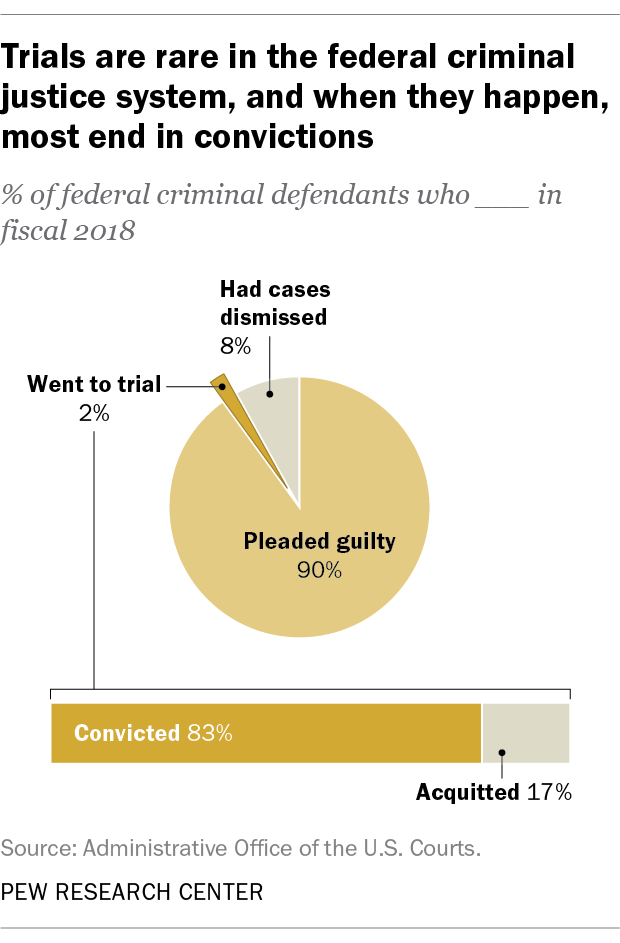
Trials are rare in the federal criminal justice system – and acquittals are even rarer.
Nearly 80,000 people were defendants in federal criminal cases in fiscal 2018, but just 2% of them went to trial. The overwhelming majority (90%) pleaded guilty instead, while the remaining 8% had their cases dismissed, according to a Pew Research Center analysis of data collected by the federal judiciary.
Most defendants who did go to trial, meanwhile, were found guilty, either by a jury or judge. (Defendants can waive their right to a jury trial if they wish.)
Put another way, only 320 of 79,704 total federal defendants – fewer than 1% – went to trial and won their cases, at least in the form of an acquittal, according to the Administrative Office of the U.S. Courts. These statistics include all defendants charged in U.S. district courts with felonies and serious misdemeanors, as well as some defendants charged with petty offenses. They do not include federal defendants whose cases were handled by magistrate judges, or the much broader universe of defendants in state courts. Defendants who enter pleas of “no contest” are also excluded.


Tuesday, May 8, 2018

The Federal Prosecutor

Attorney General Robert Jackson, December 1, 1940:
But outside of federal law each locality has the right under our system of government to fix its own standards of law enforcement and of morals. And the moral climate of the United States is as varied as its physical climate. For example, some states legalize and permit gambling, some states prohibit it legislatively and protect it administratively, and some try to prohibit it entirely. The same variation of attitudes towards other law-enforcement problems exists. The federal government could not enforce one kind of law in one place and another kind elsewhere. It could hardly adopt strict standards for loose states or loose standards for strict states without doing violence to local sentiment. In spite of the temptation to divert our power to local conditions where they have become offensive to our sense of decency, the only long-term policy that will save federal justice from being discredited by entanglements with local politics is that it confine itself to strict and impartial enforcement of federal law, letting the chips fall in the community where they may. Just as there should be no permitting of local considerations to stop federal enforcement, so there should be no striving to enlarge our power over local affairs and no use of federal prosecutions to exert an indirect influence that would be unlawful if exerted directly.

The qualities of a good prosecutor are as elusive and as impossible to define as those which mark a gentleman. And those who need to be told would not understand it anyway. A sensitiveness to fair play and sportsmanship is perhaps the best protection against the abuse of power, and the citizen's safety lies in the prosecutor who tempers zeal with human kindness, who seeks truth and not victims, who serves the law and not factional purposes, and who approaches his task with humility.

Saturday, May 20, 2017

The Oath and the FBI

Special Agent Jonathan Rudd writes at the FBI:
Early in the morning, on their first full day at the FBI Academy, 50 new-agent trainees, dressed in conservative suits and more than a little anxious about their new careers, stand as instructed by the assistant director of the FBI and raise their right hands. In unison, the trainees repeat the following words as they are sworn in as employees of the federal government:
I [name] do solemnly swear (or affirm) that I will support and defend the Constitution of the United States against all enemies, foreign and domestic; that I will bear true faith and allegiance to the same; that I take this obligation freely, without any mental reservation or purpose of evasion; and that I will well and faithfully discharge the duties of the office on which I am about to enter. So help me God.
At the end of their academy training, and as part of the official graduation ceremony, these same new-agent trainees once again will stand, raise their right hands, and repeat the same oath. This time, however, the oath will be administered by the director of the FBI, and the trainees will be sworn in as special agents of the Federal Bureau of Investigation.1 Similar types of ceremonies are conducted in every state, by every law enforcement agency, for every officer across the country. And, each officer promises to do one fundamentally important thing—support and defend the Constitution of the United States.
All too often in our culture, we participate in ceremonies and follow instructions without taking the time to contemplate and understand the meaning and significance of our actions. This article attempts to shed some light on the purpose and history of the oath and to further enhance our understanding of the Constitution that we as law enforcement officers solemnly swear to uphold.
...
Finally, the founding fathers built a system of checks and balances into the Constitution, whereby the executive, legislative, and judiciary would check and balance each other and state governments would balance the federal while it, in turn, would maintain a check on the states.35 When considering our system of checks and balances, obvious examples surface, such as when the president (executive) nominates judges to serve on the Supreme Court (judicial) with the advice and consent of the Senate (legislative). However, nowhere is the use and effect of checks and balances more poignantly illustrated than in the everyday lives of today’s law enforcement officers. For example, when officers determine that they have enough probable cause to search a home or make an arrest, barring special limited circumstances, they do not execute the search or arrest of their own accord and based on their singular authority as members of the executive branch. To the contrary, they seek the review and approval of a neutral and detached magistrate—a member of the judicial branch. Even though they may not realize it, every time officers prepare an affidavit and request approval of a warrant, they are engaging in the process of checks and balances so painstakingly advanced by our founding fathers over two centuries ago.

Friday, May 27, 2016

Don't Elect Tyrants

Benjamin Wittes writes at Lawfare:
John Adams's famous aspiration is not our reality: We live in a government of men, as well as laws.

One of those men, the most powerful of them all, may soon be Donald Trump.

So as the late Joan Rivers might have said, "Can we talk?"
The possibility of Trump's election warrants a serious conversation about the nature of the American presidency and what it would mean for someone of Trump's dubious mental health to occupy the office. I am not a clinician, but I think it's safe to say without fear of libeling the man that Trump's speeches reflect a degree of grandiosity, narcissicm, impulsivity, lack of self command, and instinct to attack political opponents that are unusual even within the end-of-the-bell-curve emotional zone reserved for politicians. This is a highly unusual man, one with a pronounced instinct to threaten and verbally attack those who disagree with him or whom he just dislikes. He goes after foreign countries, news reporters, opponents, and anyone else who criticizes him. When you're talking about putting such a man into a unique office with atypical powers to carry out threats, it is worth dwelling on the compatibility of the two.
...
The soft spot, the least tyrant-proof part of the government, is the U.S. Department of Justice and the larger law enforcement and regulatory apparatus of the United States government. The first reason you should fear a Donald Trump presidency is what he would do to the ordinary enforcement functions of the federal government, not the most extraordinary ones.
A prosecutor—and by extention, a tyrant president who directs that prosecutor—can harass or target almost anyone, and he can often do so without violating any law. He doesn't actually need to indict the person, though that can be fun. He needs only open an investigation; that alone can be ruinous. The standards for doing so, criminal predication, are not high. And the fabric of American federal law—criminal and civil law alike—is so vast that a huge number of people and institutions of consequence are ripe for some sort of meddling from authorities.
... 
 The presidency's very virtues as an office—relative unity and vertical integration—make it impossible to render abuse-proof. It is vested with a truly awesome thing:"the executive power" of the entire federal government. There are simply too many ways to abuse that power to imagine we can denude the office of the ability to behave tyranically.
There is, in fact, only one way to tyrant-proof the American presidency: Don't elect tyrants to it.
To a degree we don't choose to acknowledge, our system does rely on civic virtue and decency. Trump has campaigned against that decency. He has actively promised countless abuses of power. He has promised retaliations against his enemies. A country that, having been so clearly forewarned, nonetheless chooses to elect such a man cannot then treat his midconduct as indicating a deficiency in the office in which it knowingly installed him.

Sunday, April 5, 2015

Interest Group v. Interest Group

At the New York Times, Eric Lipton reports that the railroad industry paid for David Latimer, vice chairman of the National Troopers Coalition, to lobby against bigger trucks. Congress is about to consider enewal of the Highway Trust Fund.  The trucking industry wants to insert language allowing bigger trucks,while the railroad industry wants to block it. Both sides are having law enforcement officers front for them.
And those highly unusual tactics are already having consequences. After inquiries from The New York Times, Mr. Latimer was forced out from his post at the National Troopers Coalition.

But both sides are using tactics that could be seen as deceptive. The railroad industry, through an organization called Coalition Against Bigger Trucks, has paid the airfare and hotel bills for Mr. Latimer, a retired South Carolina state trooper, to come to Washington, and it has done the same for police chiefs, state troopers and sheriffs from states including Michigan, Ohio and Texas. It even put Mr. Latimer on its payroll, compensating him nearly $70,000 a year.
For its part, the trucking industry, which includes major carriers like FedEx and UPS, has paid a scholar at a university institute to produce a report, which found that trucks with twin, 33-foot trailers would be more stable than the twin, 28-foot trailers now allowed on federal roadways. But in a fact sheet the trucking industry group put out last month, it did not make it clear that this was an industry-funded report. And it has recruited its own law enforcement officers to counter the likes of Mr. Latimer. But one Montana state trooper said the trucking industry had falsely attributed quotations to him in a document it is circulating.
“It is the big boys fighting the big boys,” said Joan Claybrook, a former head of the National Highway Traffic Safety Administration, who has watched the campaigning escalate in the past month. “And it is utterly amazing how much money they will burn, and the tricks they will use on both sides to get their message to a key member of Congress.”
...
“Quite frankly, 95 percent of the members of Congress don’t want to hear from a lobbyist,” said Mr. Latimer, who still serves as the executive director of the South Carolina Troopers Association. “A sheriff, a trooper, a chief of police; if the message is coming from them, it makes it much more likely they will listen.”
At The Los Angeles Times, Emily Alpert Reyes reports on Airbnb, which matches travelers with homeowners willing to rent their homes.
Venture capitalists threw money its way, pushing its value toward $20 billion and inspiring a slew of imitators to jump into the water. As such websites have grown in popularity, some users have taken the "sharing" model to another level, operating entire homes and buildings much like hotels.

Not everyone is thrilled.

Housing activists say the phenomenon of offering whole apartments and houses has pushed affordable rentals off the already tight market.

Hotel employee unions warn that this new way for travelers to bypass traditional lodging could undermine hard-fought victories for the people who eke out a living by vacuuming hotel rooms or making up beds.

Neighborhood activists say the main thing being disrupted is their quality of life.

And both fans and foes are taking their fight into the arena of politics and PR.

Critics have banded together in such groups as Keep Neighborhoods First, a coalition that wants L.A. city agencies to crack down on "commercialized" rentals in banned areas.

Housing and neighborhood activists have found allies in labor groups worried about Airbnb rentals becoming an unregulated alternative to hotels where they have won victories.

Meanwhile, Airbnb alone spent more than $100,000 last year lobbying city officials.

Monday, July 25, 2011

The Danger of Vague Laws

In our chapter on bureaucracy, we quote James Madison's warning about "laws be so voluminous that they cannot be read, or so incoherent that they cannot be understood." Harvey Silvergate writes at Reason:

In the United States, we have legal safeguards against Soviet-style social controls, not least of which is the judicial branch’s ability to nullify laws so vague that they violate the right to due process. Yet far too many federal laws leave citizens unsure about the line between legal and illegal conduct, punishing incorrect guesses with imprisonment. The average working American adult, going about his or her normal life, commits several arguable federal felonies a day without even realizing it. Entire lives can change based on the attention of a creative federal prosecutor interpreting vague criminal laws.

Consider the federal prohibition of “mail fraud,” which mainly describes the means of a crime (“through the mails”) rather than the substantive acts that violate the law (“a scheme or artifice to defraud”). In 2004, Steven Kurtz, an art professor at the State University of New York in Buffalo, was indicted on mail fraud charges for what boiled down to a paperwork error. Federal agents, after learning that Kurtz was using bacteria in his artwork to critique genetic engineering, launched a full-scale bioterrorism investigation against him. Finding nothing pernicious about the harmless stomach flora, they resorted to a creative interpretation of the mail fraud statute. Because Kurtz had ordered the bacteria through a colleague at the University of Pittsburgh Human Genetics Laboratory, his “scheme” to “defraud” consisted of not properly indicating on the order form that the bacteria were meant for his own use.

Wednesday, October 20, 2010

Drug Cartels Enter the US

In our chapter on federalism, we discuss the relationship between federal and state law enforcement in the war on drugs. In our chapter on citizenship, we discuss border security. Both of these topics come up in this CBS report on how drug cartels enter the United States: