Search This Blog

Showing posts with label 2018 election. Show all posts

Thursday, September 19, 2019

Youth Turnout

Amy Gardner at WP:
College students across the United States more than doubled their rate of voting between the 2014 and 2018 midterm elections, according to a study published Thursday by Tufts University — a dramatic spike in political engagement that could draw unprecedented attention to these voters in next year’s presidential election.
The study found that 40 percent of students who are eligible to vote cast ballots last year, up from 19 percent in 2014.
Census Bureau data has shown that turnout rose in nearly all demographic groups between the two midterm cycles, but it rose most sharply among young adults. The Tufts study shows the turnout spike was particularly stark among college students — an extraordinary level of engagement for voters who typically stay home in nonpresidential elections.
Among all eligible voters, for instance, turnout reached 50 percent in 2018 — less than a 14-point jump since 2014, according to the United States Elections Project.

Thursday, May 2, 2019

High Turnout in 2018

From Pew:
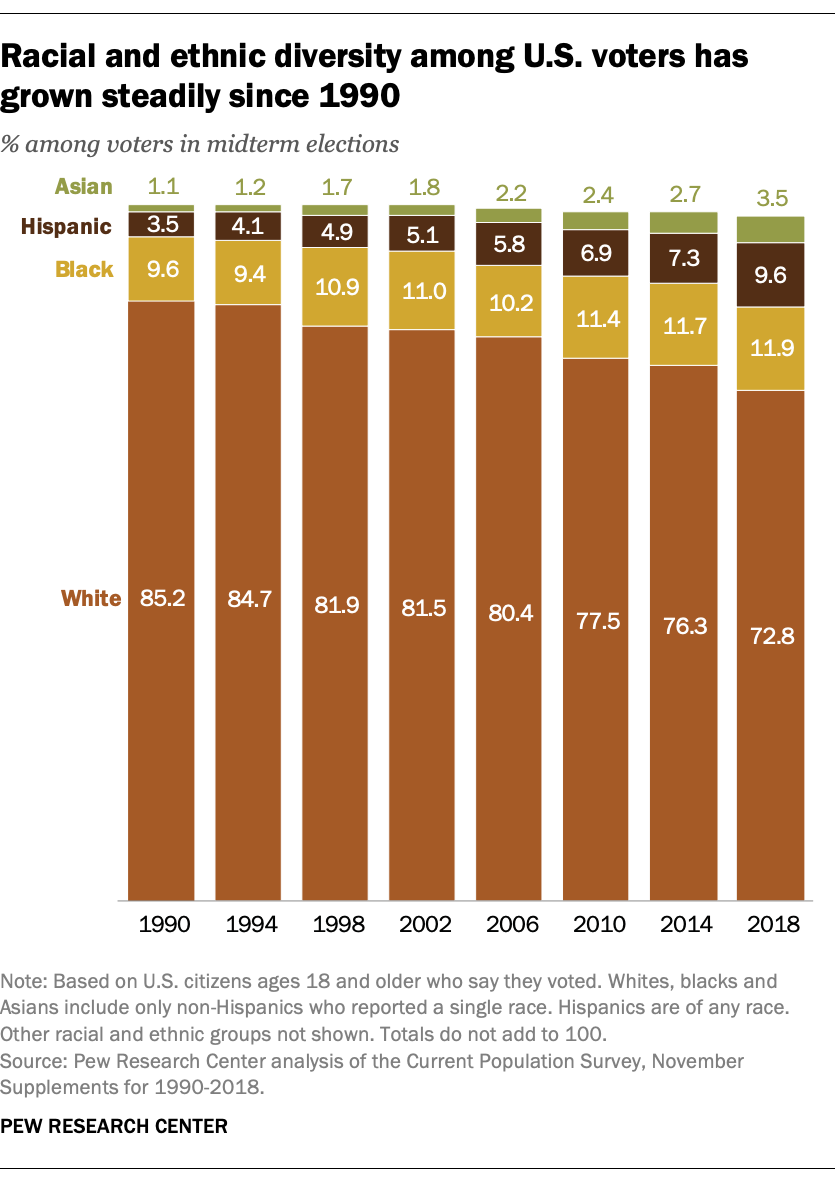
More than half of U.S. eligible voters cast a ballot in 2018, the highest turnout rate for a midterm election in recent history, according to a Pew Research Center analysis of newly released data from the U.S. Census Bureau. The increased turnout was particularly pronounced among Hispanics and Asians, making last year’s midterm voters the most racially and ethnically diverse ever.
With enthusiasm at a record high, more than 122 million people voted in the 2018 elections, the highest in a midterm election year since 1978. Last year also marked the first time since 1982 that the voter turnout rate in midterm elections surpassed 50%. This was a stark reversal from the previous midterm year, when turnout had decreased – from 45.5% in 2010 to 41.9% in 2014. (The voter turnout rate is the share who cast a ballot among eligible voters, defined as U.S. citizens ages 18 and older. Historical data in this analysis starts in 1978, the first year the Census Bureau gathered citizenship data for its survey of voters.)

 Racial and ethnic diversity among U.S. voters has grown steadily since 1990

Monday, April 29, 2019

Alternative Voting


Jordan Misra at the Census Bureau:
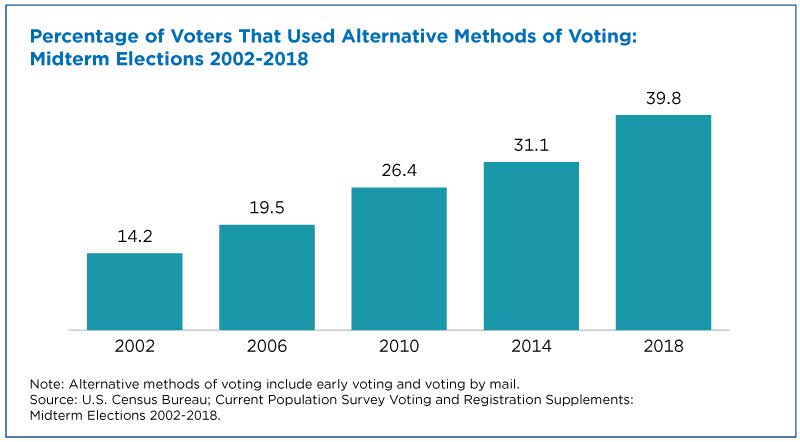
The availability of alternative voting methods continues to change how voters vote. Alternative voting methods include any method other than voting in person on Election Day, such as early voting and voting by mail.
In 2018, 40 percent of voters used an alternative voting method. The percentage of voters that cast their ballot early or by mail usually declines slightly in midterm elections relative to the preceding presidential election. However, the rate in 2018 was not significantly different from the 2016 presidential election.
behind-2018-united-states-midterm-election-turnout-figure-2

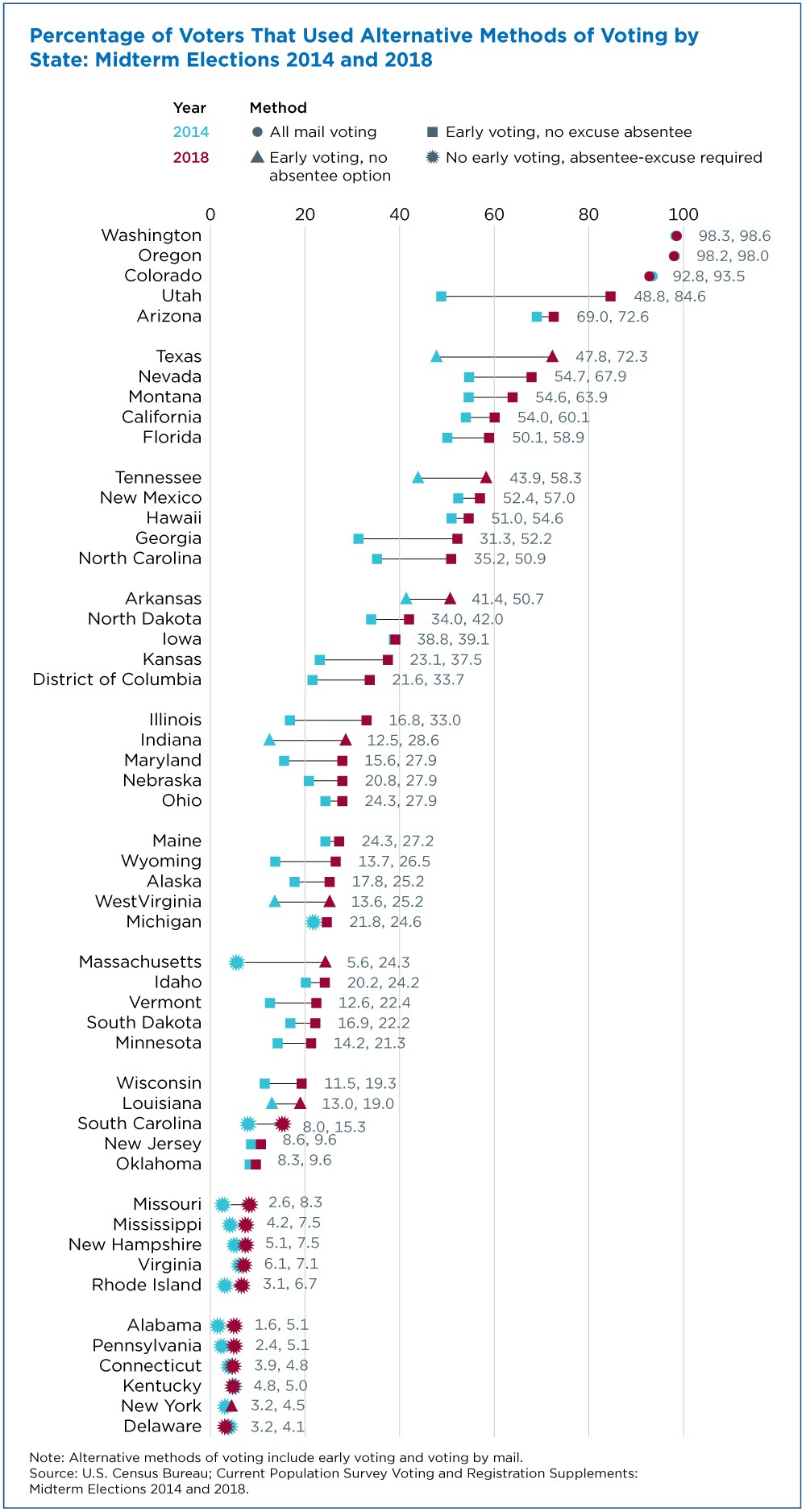
The use and availability of alternative voting methods varied by state. In the 2018 election, early voting was available in 39 states. Some states require that voters state a reason or excuse for mailing an absentee ballot, while others do not (no-excuse absentee voting). Three states (Washington, Oregon and Colorado) have all-mail voting systems.

The three states with the highest percentage point increases in alternative voting rates from 2014 were Utah, Texas and Georgia. Alternative voting increased by 36 percentage points in Utah, 25 points in Texas, and 21 points in Georgia.

This high increase in alternative voting in these states is likely the result of Utah’s ballot initiatives and expanded mail voting opportunities, and the high-profile elections in Texas and Georgia.

States without the option to vote early and those that require voters to provide an excuse for voting absentee, had some of the lowest alternative voting rates in the country.


behind-2018-united-states-midterm-election-turnout-figure-3


Saturday, April 27, 2019

Voter Turnout in 2018: Gender Gap

Jordan Misra at the Census Bureau:
A record number of women were elected to the House of Representatives in the November 2018 election. Additionally, women continued to vote at higher rates than men, just as they have in every midterm election since 1998.
In the 2018 midterm election, 55 percent of women voted compared with 52 percent of men, a 3 percentage point gap.
...
In 2018, among those age 65 and older, voter turnout was 65 percent for women and 68 percent for men. In contrast, 38 percent of women 18-29 years old voted and 33 percent of men of the same age group voted.
...
Voter turnout for non-Hispanic black women was 55 percent, compared with 47 percent for non-Hispanic black men, an 8 percentage point gap.
Hispanic women voted at higher rates than Hispanic men, with 2018 voter turnout rates of 43 percent and 37 percent, respectively.
..

In 2018, 49 percent of unemployed women and 40 percent of unemployed men voted, a 9 percentage point difference.
The gap between employed men and women is smaller than the gap between unemployed men and women. In 2018, 57 percent of employed women voted compared with 52 percent of employed men.
Among those who were not in the labor force, 53 percent of women voted compared with 51 percent of men.

Sunday, February 10, 2019

Most Expensive Midterm

From Open Secrets:
It’s official: the 2018 election was the most expensive midterm ever by a large margin, with total spending surpassing $5.7 billion, according to data compiled by the Center for Responsive Politics.
The final tally surpasses the conservative $5.2 billion projection the Center released in October.
With more than $5.7 billion shelled out by candidates, parties, committees, PACs and outside groups, the 2018 midterm leapfrogs even the then-record breaking 2008 presidential election which saw nearly $5.3 billion in total spending. It also smashes the previous midterm spending record of $3.8 billion in 2014.
“Just as the 2018 elections brought historic wins for a more diverse group of candidates, they also saw greater spending than we’ve ever seen or anticipated for a midterm election, capitalizing on years of loosened campaign finance regulation and oversight,” said Sheila Krumholz, executive director of the Center for Responsive Politics.


Wednesday, November 21, 2018

Veterans and the Midterm Election

Rebecca Burgess at AEI:

On Election Day 2018, 173 veterans remained on the ballots. At least 21 races became a veteran vs. veteran showdown, nearly guaranteeing that the total number of veterans in the 116th Congress would be fewer than the initial number of veterans serving in the 115th Congress. By the time November rolled around, the 115th Congress had dropped to fewer than 100 veterans (96), due to several veteran legislators taking up posts in the Trump administration, resigning, or passing away. However, even with several more veterans deciding not to pursue reelection, there should be at least 95 serving in the 116th Congress — 77 in the House, and 18 in the Senate (15 veteran Senators were not up for reelection this term). And while the numbers skew Republican as in the past, a little more than a third of veteran candidates ran as Democrats. Out of the 14 military women on ballots this November, the three who will be freshmen members in January are Democrats.

Thursday, November 8, 2018

Lobbying After the Midterm

The 2018 midterm election gave Democrats a majority in the House.  Interest groups are adapting.

Theodoric Meyer and Marianne Levine at Politico:
Washington offices of major corporations now are grappling with how to work a Democratic House full of newly elected members, many of whom ran on promises to resist special interests and who are generallyyounger and more diverse than the denizens of K Street.
“Who knows House leadership?” said Heather Podesta, a top Democratic lobbyist, describing the conversations in companies’ Washington offices right now. “Who knows Pelosi? Who is the Congressional Black Caucus lobbyist that we need to hire?”
Some lobbying firms — the biggest of which are typically bipartisan and pride themselves on their ability to thrive no matter which party is in power — and companies have already hired new Democratic lobbyists in anticipation the party might take back the House. The law and lobbying firm Brownstein Hyatt Farber Schreck over the summer hired Nadeam Elshami, a former chief of staff to House Minority Leader Nancy Pelosi, who’s poised to return to the speakership if she can survive a potential rebellion among her members.
“We’ve got a former chief of staff to Mitch McConnell and a former chief of staff to Nancy Pelosi,” said Marc Lampkin, a Republican and the managing partner of Brownstein Hyatt’s Washington office.
Others waited until after the election to see which way the winds blew, meaning the scramble to snap up Democratic Hill staffers and others with policy expertise is far from over, said Ivan Adler, a headhunter who specializes in the lobbying business.
“Either you have enough Democrats or don’t, and if you don’t, you’re playing catch-up,” Adler said.

Wednesday, August 2, 2017

Amy McGrath Ad -- Wow, Just Wow

Political candidates who can point to military service, point to triumph over personal obstacles, and invoke family values are in a good position.

Meet Amy McGrath in Kentucky.