Search This Blog

Showing posts with label Articles of Confederation. Show all posts

Tuesday, May 21, 2024

Wielding the Executive Power, 1775-1789

  Gary J. Schmitt and Joseph M. Bessette at AEI:

The practice of executive power from the early days of the Revolution to the Constitutional Convention was complicated by the division of governance between the central authority – first the Continental Congress and then the Congress under the Articles of Confederation – and the thirteen newly-independent states. Thus, the executive power was divided between the two: Congress assumed the authority over foreign and defense matters, while state governors were largely tied, at least formally (and in the absence of delegations of extraordinary authority), to administrating measures enacted by their legislatures. Hence, the various lessons learned about the practice of executive power from this decade-plus of self-government were themselves complex. 

At the level of the Union, the major takeaway was that executive power in the hands of a plural body—be it the Congress as a whole or one of its committees—was functionally inept when it came to dealing with the demands of the war and the diplomacy necessary to secure American independence. Nor was Congress adept at day-to-day administrative tasks. Too many hands on the tiller caused delays and the blurring of responsibility for decision-making. Gradually, members came to understand that giving charge of foreign, defense, and fiscal matters to single individuals promoted coherent and effective management. If the government was to possess the qualities of dispatch, decisiveness, and secrecy—let alone administrative efficiency—the executive authority would not only have to be unified but also enjoy some level of institutional independence from the legislature.

...

 In fine, the practice of republican rule in the decade following the Declaration of Independence had produced a new sense among many Americans on the need for, the advantages of, a firm and energetic executive power. That change had taken place at both the state and the national level, with different emphases arising from different circumstances and distinct governing tasks. Once the decision was made to jettison the Articles of Confederation, the challenge was how to incorporate in a coherent way the various lessons learned since independence so as to create an effective and safe executive in the new national, but still republican, government. Separation of powers provided a popularly accepted template for attempting to do so. But the devil would be in the details and, not surprisingly, this explains why deliberations about the executive went virtually the whole length of the Constitutional Convention.

Monday, September 21, 2009

The Constitution -- A First Cut


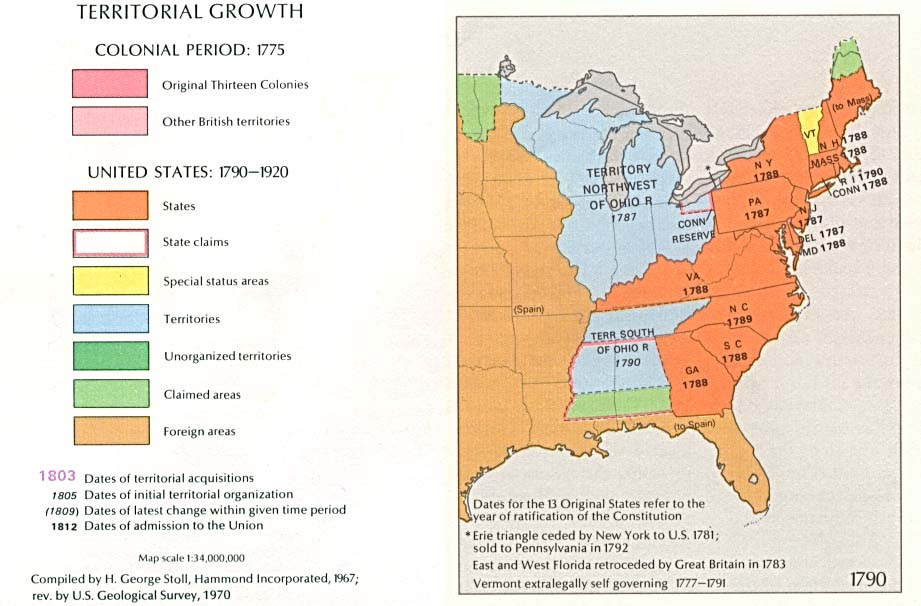
The map of the United States in 1790


The Great Compromise:

Read these provisions from an actual constitution. How would you appraise them?
ARTICLE 118. Citizens have the right to work, that is, are guaranteed the right to employment and payment for their work in accordance with its quantity and quality. ...

ARTICLE 119. Citizens have the right to rest and leisure. The right to rest and leisure is ensured by the reduction of the working day to seven hours for the overwhelming majority of the workers, the institution of annual vacations with full pay for workers and employees and the provision of a wide network of sanatoria, rest homes and clubs for the accommodation of the working people.

ARTICLE 120. Citizens have the right to maintenance in old age and also in case of sickness or loss of capacity to work. This right is ensured by the extensive development of social insurance of workers and employees at state expense, free medical service for the working people and the provision of a wide network of health resorts for the use of the working people.

ARTICLE 121. Citizens have the right to education. This right is ensured by universal, compulsory elementary education; by education, including higher education, being free of charge; by the system of state stipends for the overwhelming majority of students in the universities and colleges; by instruction in schools being conducted in the native language...

ARTICLE 122. Women are accorded equal rights with men in all spheres of economic, state, cultural, social and political life. The possibility of exercising these rights is ensured to women by granting them an equal right with men to work, payment for work, rest and leisure, social insurance and education, and by state protection of the interests of mother and child, prematernity and maternity leave with full pay, and the provision of a wide network of maternity homes, nurseries and kindergartens.

ARTICLE 123. Equality of rights of citizens irrespective of their nationality or race, in all spheres of economic, state, cultural, social and political life, is an indefeasible law. Any direct or indirect restriction of the rights of, or, conversely, any establishment of direct or indirect privileges for, citizens on account of their race or
nationality, as well as any advocacy of racial or national exclusiveness or hatred and contempt, is punishable by law.

ARTICLE 124. In order to ensure to citizens freedom of conscience, the church is separated from the state, and the school from the church. ...

ARTICLE 128. The inviolability of the homes of citizens and privacy of correspondence are protected by law.
Contrast the US Constitution with the Confederate Constitution.