Search This Blog

Showing posts with label confirmation hearings. Show all posts

Tuesday, November 26, 2024

Confirmation Delays and Recess Appointments

Previous posts have discussed recess appointments.

Bruce Mehlman:
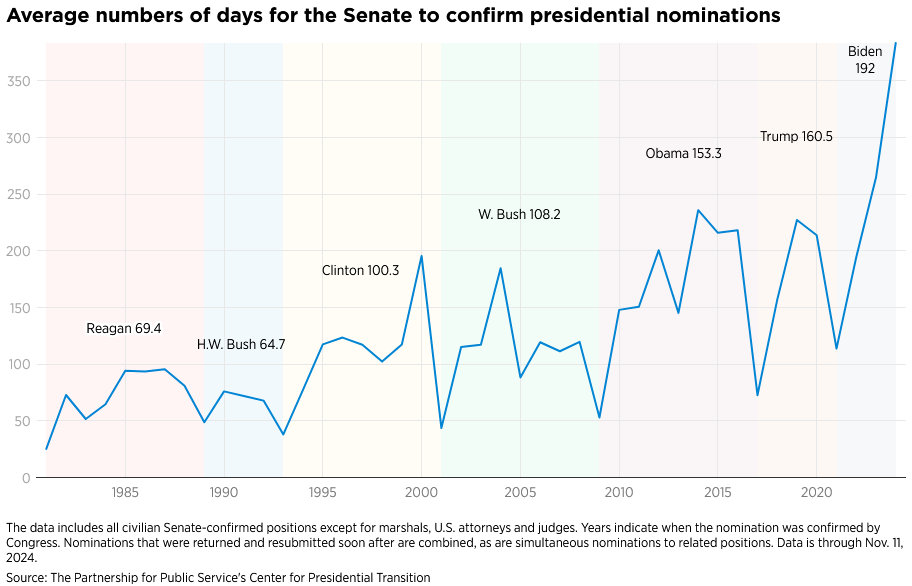
The Adjournment Clause: Article II, Section 3 of the U.S. Constitution says the President “may adjourn [Congress] to such Time as he shall think proper” if the House & Senate cannot agree on when to adjourn. When Congress is adjourned, Presidents can make recess appointments to fill jobs in the Executive Branch that otherwise require confirmation, as most modern Presidents did before Congress stopped formally adjourning (by maintaining pro forma sessions) to prevent it. Some fear the House may vote to adjourn in 2025 while the Senate declines, empowering President Trump to send them home and recess appoint whomever he wants, avoiding the increasingly time-consuming task of Senate confirmation (chart). Will the 119th Congress advise & consent or adjourn & relent? Stay tuned.


Tuesday, March 29, 2022

Congressional Hearings and Public Records

 Matt Glassman:

When you “build a public record” in a committee hearing, what you are trying to do is shape future political action and future political assessments. In a hearing about potential legislation, you are trying to build media coverage, raise public awareness, compel stakeholder or public official interest, and/or signal your intention to commit resources.

This is all done in order to affect future political action by others: to build your coalition of support, or maybe convince opponents to back down, or to try to put the issue onto the policy agenda of congressional leaders, force intervening action in the executive branch or private sphere, or setup issues for an election. Or all of the above. Ditto with an oversight or investigative hearing.

Even more importantly, you build a public record so that you shape the public understanding of what you are doing. Actions taken by public officials don’t occur in a vacuum: they occur in the public sphere. How the public comes to understand those actions has enormous political ramifications: for the parties, for individual members, and for public policy.

An action that would be controversial absent an explanation can become a good and reasonable thing to do; likewise, an action that would not be controversial can become a rash and dangerous thing. All depending on how the public comes to understand the action.

At it’s political core, the Judiciary committee confirmation hearing of Judge Brown Jackson isn’t about whether or not the Senate should confirm her to the Supreme Court. That’s pretty much been decided—the Senate will confirm her nomination.16 What is at stake in the hearing is the public understanding of what that confirmation means. You can’t think of a court confirmation as a black or white, confirm or reject. What is still up in the air is the ultimate public meaning of these events. That’s the fight.17

Saturday, October 10, 2020

Tracking Oversight

Molly E. Reynolds and Jackson Gode at Brookings:
Two of the most significant [congressional oversight] mechanisms include holding congressional hearings as well as sending letters to executive branch agencies and to individuals involved in executive branch operations.
Developed by Governance Studies, Brookings’s House Oversight Tracker monitors the actions being taken by House committees to conduct oversight of administration actions and policies since the 2016 election.

Search hearings or letters by clicking on the numbered icons below, or view all activity in a specific policy area by selecting one of the relevant boxes underneath. Click on any row to view additional information about each hearing/letter.

The data is updated frequently, and new oversight items will be added on a regular basis. For more information on the tracker, read Brookings’s methodology used to identify executive branch oversight in hearings and letters. For questions and feedback, please contact OversightTracker@brookings.edu

Tuesday, June 25, 2019

Hill Veterans Coach Members and Staff

Previous posts have discussed the congressional lobotomy:  the shrinkage of GAO and CRS, along with the defunding of OTA.

[Former congressional staffers Phil Schiliro and Phil Barnett] enlisted eight others with a combined 200 years of experience on Capitol Hill to form Co-Equal, a group intended to help Congress reassert itself as a force equivalent in power to the executive branch, not a subservient arm of it.
...

Among the resources the group has made available on its website, Co-Equal.org, is a guide to precedents showing how Congress has in the past pried documents from the White House and won the testimony of influential administration officials, including chiefs of staff, national security advisers and White House counsels.
“It is so that people have a factual resource to look at what has been done in the past so that when somebody makes these outrageous claims that their people should not have to testify you can say, ‘No, no, it is normal for people to have to testify before Congress,’” said Karen Lightfoot, a longtime congressional communications and policy expert who is part of the group.
Members of the group have also been providing training to lawmakers and staff members on that most essential of Capitol Hill skills: how to elicit meaningful information from well-coached hearing witnesses in five-minute rounds of questioning.
Mr. Schiliro noted that outside witnesses under scrutiny from Congress have most likely undergone hours of preparation by experienced lawyers and public relations experts — sometimes in faux hearing rooms to provide verisimilitude — while members of Congress might first be seeing their own questions prepared by staff as they take their seats at the hearing.

Saturday, December 16, 2017

Judicial Nominee Cannot Answer Basic Questions

In confirmation hearings this year, nominees to head CEQ and the Department of Education displayed lack of basic  knowledge.


Here comes the would-be judge.Derek Hawkins reports at WP:
Nomination hearings for U.S. district judges tend to be dry affairs that offer little in the way of mass entertainment — in other words, they’re not typically the stuff of viral videos.

But a clip of one of President Trump’s federal judicial nominees struggling to answer rudimentary questions about the law garnered well more than 1 million views in a matter of hours on Thursday night and stoked speculation that another of the president’s nominations might get derailed.

Sen. Sheldon Whitehouse (D-R.I.) shared footage of Matthew Petersen, a nominee for the U.S. District Court for the District of Columbia, getting quizzed by Sen. John Neely Kennedy (R-La.) on basic aspects of trial procedure during his appearance before the Senate Judiciary Committee on Wednesday.

For five painfully awkward minutes, Petersen, a member of the Federal Election Commission and a lawyer with no trial experience, fumbled with Kennedy’s questions, visibly uncomfortable as the lawmaker pressed him about how things work in a federal courtroom.
Josh Feldman at Mediaite:
 By now you may have seen the viral video of a Trump judicial nominee awkwardly not being able to answer some pretty basic questions. The senator grilling him was actually a Republican, Sen. John Kennedy, and he appeared on CNN tonight to talk about this viral moment.
Erin Burnett asked him, “What was going through your head during that questioning?”

Kennedy said he just did his job, and while he went out of his way to note his voting record with the President, he added, “I don’t think that the first time you’ve ever stepped foot in a federal courtroom ought to be as a federal judge.”

He said Matthew Petersen seems like a nice and honest man, but “experience matters, and my job under our separation of power doctrine inspired by Madison is to sort of be a check on nominees.”
 Jonah Engel Bromwich and Niraj Chokshi at NYT:
Mr. Petersen is not the first of Mr. Trump’s judicial nominees to face criticism for being poorly prepared for the bench. At least two other nominations stalled this week amid similar concerns.

One of those was the nomination of Brett Talley, a lawyer who was nominated for a lifetime federal district judgeship despite never having tried a case.

Mr. Talley was the fourth of Mr. Trump’s nominees to be rated “not qualified” by the American Bar Association and the second to have received the rating unanimously. Since 1989, only two other judicial nominees have been unanimously deemed “not qualified” by the group.

Mr. Talley failed to disclose that his wife is a senior lawyer in the office of the White House Counsel. And according to Slate, he may have written controversial posts on a message board for fans of the University of Alabama, including one that defended an early incarnation of the Ku Klux Klan.

Wednesday, February 15, 2017

Rejection Season

The Senate lists rejected and withdrawn Cabinet nominations.  At the bottom of this page are the seven that have failed during the past 30 years, and I add the reasons for the failure.  All involved questions of about ethics or personal misconduct.  (Kerik later went to prison on other charges.)

The list shows that the last four presidents -- George H.W. Bush, Bill Clinton, George W. Bush, and Barack Obama all lost a nominee in their first couple of months in office.

It seems very likely that Labor nominee Andrew Pudzer will be the latest entry.

Manu Raju reports at CNN:
Top Senate Republicans have urged the White House to withdraw the Andrew Puzder nomination for labor secretary, a senior GOP source said, adding there are four firm Republican no votes and possibly up to 12.
Puzder needs at least 50 votes to pass with the tie-breaking vote of Vice President Mike Pence, and Republicans only hold control of 52 seats.
Puzder, the CEO of the company that owns the Hardee's and Carl's Jr. fast food chains, has faced fierce opposition mostly from Democrats in part related to his position on labor issues as well as the fact that he employed an undocumented housekeeper.

=========================================================
Name: John G. Tower
Nominated by: George Bush
Nomination Position: Defense
Date Nominated: January 20, 1989
Date Rejected: March 9, 1989 Vote: 47-53
Reasons: drinking, conduct toward women, financial conflicts 

Name: Zoe E. Baird
Nominated by: William J. Clinton
Nomination Position: Attorney General
Date Nominated: January 21, 1993
Date Withdrawn: January 26, 1993
Reason:  Undocumented household employee
----------------------------------------------------------------------------------------
Name: Anthony Lake
Nominated by: William J. Clinton
Nomination Position: Director, CIA
Date Nominated: January 9, 1997
Date Withdrawn: April 18, 1997
Reasons: policy disputes, financial issues
----------------------------------------------------------------------------------------
Name: Hershel W. Gober
Nominated by: William J. Clinton
Nomination Position: Veterans Affairs
Date Nominated: July 31, 1997
Date Withdrawn: October 27, 1997
Reason: sexual misconduct allegations
----------------------------------------------------------------------------------------
Name: Linda Chavez
Nominated by: George W. Bush
Nomination Position: Labor
Date Nominated: January 3, 2001
Date Withdrawn: January 9, 2001
Reason: undocumented household employee
----------------------------------------------------------------------------------------
Name: Bernard Kerik
Nominated by: George W. Bush
Nomination Position: Homeland Security
Date Nominated: December 2, 2004
Date Withdrawn: December 10, 2004
Reason:  undocumented household employee
----------------------------------------------------------------------------------------
Name: Tom Daschle
Nominated by: Barack Obama
Nomination Position: Secretary of Health & Human Services
Date Nominated: December 11, 2008
Date Withdrawn: February 9, 2009
Reason: tax issues
Tuesday, January 10, 2017

Confirmation Hearings: Schumer Does Turnabout on McConnell

Many posts have discussed how politicians change positions on procedural issues depending on whether their party is in power. Senate Minority Leader Chuck Schumer provides an example:

Friday, February 1, 2013

Hagel's Bad Day

The Constitution empowers the Senate to confirm the president's nominees for Cabinet posts and other high office.  In all of US history, it has rejected just nine Cabinet nominees.  A dozen other nominees either withdrew or failed to get a floor vote.  Nevertheless, confirmation hearings can be contentious: senators can use them to gain publicity, score political points, or send policy messages to the administration.  Chuck Hagel, President Obama's nominee for Secretary of Defense, had a difficult time in his confirmation hearing yesterday. CNN reports:


Dana Bash also reports that John McCain (R-Arizona), who was very tough on Hagel, was once a close ally:


Lindsay Graham (R-SC), another senator who has been close to McCain, illustrates a point about political rhetoric:  when you make a categorical statement, you'd better be prepared for a particular kind of followup question:  "Name one."


Monday, June 28, 2010

Supreme Court Confirmation Hearings

Supreme Court confirmation hearings are not just theater. They play a major role in Senate deliberations. The New York Times reports:

Ever since nominees to the Supreme Court started to subject themselves to comprehensive grilling in 1939, their confirmation hearings have been dismissed by the legal elite as an empty charade.

A 35-year-old lawyer named William H. Rehnquist, who would go on to become chief justice of the United States, said as much in The Harvard Law Record in 1959. Four decades later, a 35-year-old law professor named Elena Kagan, whose confirmation hearings start Monday, agreed in The University of Chicago Law Review.

But a new study, based on an analysis of every question asked and every answer given at Supreme Court confirmation hearings in the last 70 years, shows that the hearings often address real substance, illuminate the spirit of their times and change with shifts in partisan alignments and the demographic characteristics of nominees.

Here is the abstract of the paper:

This paper examines the questions asked and answers given by every Supreme Court nominee who has appeared to testify before the Senate Judiciary Committee since 1939. In doing so, it uses a new dataset developed by the authors. This database, which provides a much-needed empirical foundation for scholarship in emerging areas of constitutional law and political science, captures all of the statements made at the hearings and codes these comments by issue area, subissue area, party of the appointing president, and party of the questioning senator. The dataset allows us to quantify for the fist time such things as which issues are most frequently discussed at the hearings, whether those issues have changed over time, and whether they vary depending on the party of the appointing president and the party of the questioning senator. We also investigate if questioning patterns differ depending on the race or gender of the nominee. Some of our results are unsurprising: for example, the hearings have become longer. Others, however, challenge conventional wisdom: the Bork hearing is less of an outlier in several ways than is frequently assumed, and abortion has not dominated the hearings. We also discover that there is issue area variation over time, and that there are notable disparities in the issues addressed by Democratic versus Republican senators. Finally, we find that female and minority nominees face a significantly different hearing environment than do white male nominees.