Bessette/Pitney’s AMERICAN GOVERNMENT AND POLITICS: DELIBERATION, DEMOCRACY AND CITIZENSHIP reviews the idea of "deliberative democracy." Building on the book, this blog offers insights, analysis, and facts about recent events.
Search This Blog
Showing posts with label recess appointments. Show all posts
Showing posts with label recess appointments. Show all posts
Trump’s stated reason for wishing to make recess appointments is that it would take too long for the Senate to confirm the nominations he makes. But that is not a serious concern. Thanks to changes in procedure made by the Senate over time, it is now easier than ever to overcome filibusters, whether actual or merely threatened, on nominations. In Trump’s first term, the Senate confirmed his major cabinet nominations within just a few weeks of his inauguration.
That leaves us with two reasons for which a president might wish to make recess appointments to the cabinet: either (1) to avoid subjecting the nominee to the Senate’s scrutiny, or (2) because the nomination does not have the support of a majority of the Senate.
Under these circumstances, Congress would not be voting for just an ordinary adjournment. Since Trump has overtly declared his wish to make recess appointments, lawmakers now know that a vote to allow the Senate to adjourn for ten days or more would be tantamount to a vote to allow him to make those appointments. If a senator is opposed to one of the nominations that Trump has preannounced, then it’s doubtful that he or she would go along with any proposal to facilitate recess appointments for those nominees.
In fact, we got a potential indication of this last week, when Matt Gaetz withdrew as Trump’s prospective nominee for attorney general, apparently because he was unlikely to be confirmed by the Senate. Rather than push for a recess to appoint Gaetz, Trump merely moved on to his next AG nominee.
In the end, Trump likely concluded that he would have had the same outcome if he forced the Senate to vote on Gaetz or pushed congressional Republicans to adjourn. A defeat was inevitable. It seems likely that Trump and his team will make the same calculations for controversial nominees going forward, too. Absent the pursuit of uncharted legal theories, if four Republican senators and all senators caucusing with the Democrats want a nominee defeated, then that nominee will likely end up defeated.
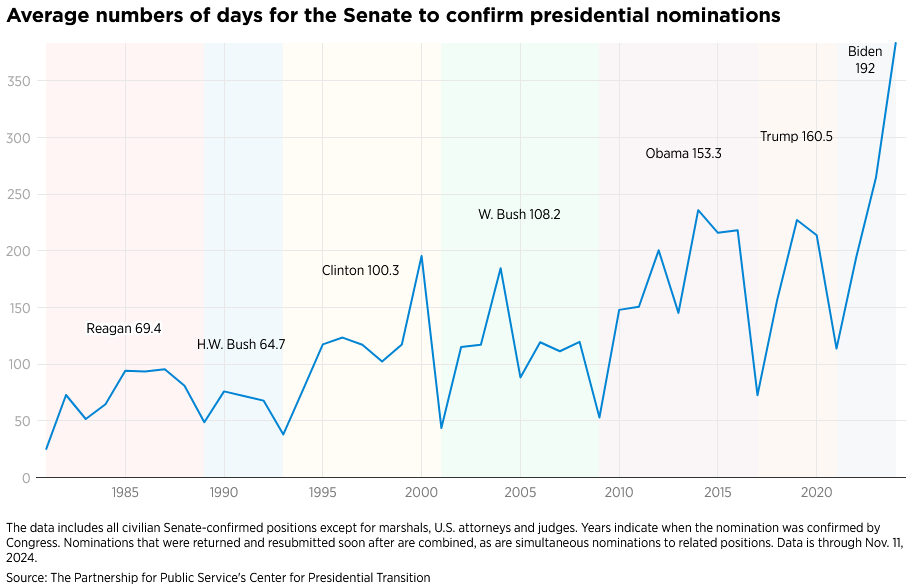
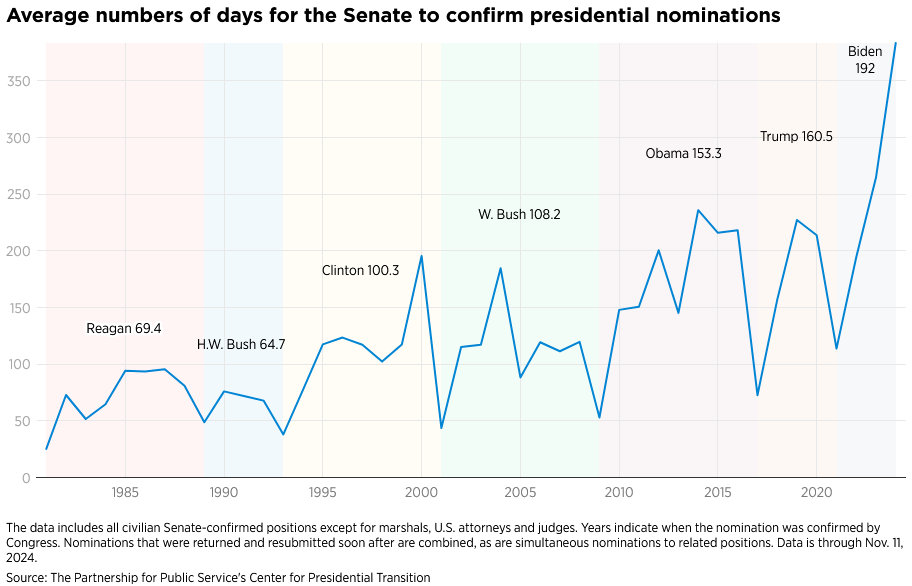
The Adjournment Clause: Article II, Section 3 of the U.S. Constitution says the President “may adjourn [Congress] to such Time as he shall think proper” if the House & Senate cannot agree on when to adjourn. When Congress is adjourned, Presidents can make recess appointments to fill jobs in the Executive Branch that otherwise require confirmation, as most modern Presidents did before Congress stopped formally adjourning (by maintaining pro forma sessions) to prevent it. Some fear the House may vote to adjourn in 2025 while the Senate declines, empowering President Trump to send them home and recess appoint whomever he wants, avoiding the increasingly time-consuming task of Senate confirmation (chart). Will the 119th Congress advise & consent or adjourn & relent? Stay tuned.
“Any Republican Senator seeking the coveted LEADERSHIP position in the United States Senate must agree to Recess Appointments,” Trump posted on his Truth Social platform, adding that he wants positions filled “IMMEDIATELY!”
What Trump’s asking is technically constitutional, experts say, but would be a stark abdication of powers on the part of the Senate. And it could be just the beginning of Trump’s effort to get what he wants out of a Republican Congress.
...
“What Trump is essentially doing is telling the Senate to give up one of its core constitutional roles,” said Sarah Binder, a constitutional expert at George Washington University. “The Senate’s role of advice and consent was to be a check on who the president wants to put in these positions."
In 2020, Trump threatened to force Congress to adjourn to make appointments without Senate approval.
That’s rare. Josh Chafetz, a constitutional law professor at Georgetown University, said members of Congress are usually loathe to give up their constitutional power, even for presidents of the same party. Sometimes Congress has stayed in office in what’s known as a perfunctory “pro forma” session, rather than recess in full, to prevent presidents from installing appointees.
This time, all three leading Republican contenders for the Senate majority leader seem open to it. “100% agree,” Sen. Rick Scott (Florida) replied to Trump on social media. “I will do whatever it takes to get your nominations through as quickly as possible.” Sen. John Thune (South Dakota) told Fox News Digital that “all options are on the table.” And Sen. John Cornyn (Texas) said on social media that the Constitution “expressly confers the power on the President to make recess appointments."
Notwithstanding the legal opinions and practices of the preceding decades, a Department of Justice legal opinion and two federal appeals court decisions related to four controversial recess appointments made by President Barack Obama on January 4, 2012, raised questions about what a “recess” is with regard to the recess appointment power. 16 In a June 26, 2014, opinion, the U.S. Supreme Court addressed these questions. It held that the President’s recess appointment power extends to both intersession and intrasession recesses. The Court also held that the President may use the recess appointment power essentially only during a recess of 10 days or longer. A Senate recess of 3 days “is not long enough to trigger the President’s recess appointment power,” and a recess of more than 3 days but less than 10 is “presumptively too short to fall within the Clause” but “leaves open the possibility that a very unusual circumstance could demand the exercise of the recess-appointment power during a shorter break.” The opinion gave as an example of an unusual circumstance an instance such as “a national catastrophe … that renders the Senate unavailable but calls for an urgent response.” The Court noted that “political opposition in the Senate would not qualify as an unusual circumstance.” 17 Furthermore, the Court concluded that, for purposes of the Recess Appointments Clause, “the Senate is in session when it says it is, provided that, under its own rules, it retains the capacity to transact Senate business.” 18 This implies that the Senate would also determine if and when it will adjourn for a recess of 10 days or longer and thus allow for the possibility of recess appointments. Under the Adjournments Clause of the Constitution, however, such a determination requires the consent of the House.19 Consequently, either the Senate or the House can unilaterally prevent a Senate adjournment of 10 days or longer that would permit the President to exercise his recess appointment authority.
The Supreme Court on Thursday curtailed the president's power to temporarily appoint individuals to government posts, delivering a blow to President Barack Obama and altering the balance of power between the executive and legislative branches.
"For purposes of the Recess Appointments Clause, the Senate is in session when it says that it is, provided that, under its own rules, it retains the capacity to transact Senate business," Breyer wrote, observing that the Senate does not define pro forma as a recess. "[W]e conclude that we must give great weight to the Senate’s own determination of when it is and when it is not in session. But our deference to the Senate cannot be absolute."
The majority opinion was joined by Justices Anthony Kennedy, Ruth Bader Ginsburg, Sonia Sotomayor and Elena Kagan. The ruling was relatively narrow and could have been much worse for the Obama administration. The other four justices wanted to go further in curtailing the recess appointment power.
In an extended argument that contained large doses of constitutional history and practical politics, the Supreme Court on Monday seemed skeptical of the Obama administration’s contention that it could bypass the Senate to appoint officials during short breaks in the Senate’s work.
Justices across the ideological spectrum appeared prepared to rein in the ability of presidents to make appointments without obtaining the Senate’s advice and consent by invoking the Constitution’s recess-appointments clause, which says “the president shall have power to fill up all vacancies that may happen during the recess of the Senate.” Justice Elena Kagan said the clause may be a “historic relic” from “the horse and buggy era,” when presidents needed the authority to fill vacancies because lawmakers were out of town and could not return on short notice. More recently, she said, presidents of both parties have used the appointment power “as a way to deal, not with congressional absence, but with congressional intransigence, with a Congress that simply does not want to approve appointments that the president thinks ought to be approved.”
She suggested that the new use of the clause was problematic.
Justice Stephen G. Breyer said he had scoured the historical and legal materials. “I can’t find anything,” he said, “that says the purpose of this clause has anything at all to do with political fights between Congress and the president.”
JUSTICE SCALIA: What do you do when there is a practice that --that flatly contradicts a clear text of the 10 Constitution? Which --which of the two prevails? GENERAL VERRILLI: Now, I think the practice has to prevail, Your Honor, but I do --and I JUSTICE SCALIA: So if you ignore the Constitution GENERAL VERRILLI: But I don't think JUSTICE SCALIA: --often enough, its meaning changes? GENERAL VERRILLI: But, Your Honor, of course, in this situation, the meaning of the clause with respect to the timing of --of the vacancy has been a matter of contention since the first days of the Republic. JUSTICE SCALIA: Now, you're --you're questioning my hypothesis. You have to accept my hypothesis.
President Barack Obama’s recess appointments to the U.S. National Labor Relations Board last year were “constitutionally invalid” because the Senate wasn’t in recess at the time, a federal appeals court ruled.
The U.S. Court of Appeals in Washington in a unanimous ruling today sided with Republican lawmakers and a canning company that challenged the appointments. The judges said the definition of “the Recess” in the Constitution’s Recess Appointments Clause is limited to the period between one Congress and the next, and that Congress had begun a new session at the time the president made the appointments.
“Considering the text, history and structure of the Constitution, these appointments were invalid from their inception,” U.S. Circuit Judge David Sentelle wrote.
The ruling today is the first substantive decision by a federal appeals court on several challenges to the president’s naming of the NLRB members on Jan. 4, 2012, while the Senate was holding so-called pro-forma sessions that sometimes involved a single senator appearing in the chamber every third day.
Noel Canning contends that the term “the Recess” in the Recess Appointments Clause refers to the intersession recess of the Senate, that is to say, the period between sessions of the Senate when the Senate is by definition not in session and therefore unavailable to receive and act upon nominations from the President. The Board’s position is much less clear. It argues that the alternative appointment procedure created by that Clause is available during intrasession “recesses,” or breaks in the Senate’s business when it is otherwise in a continuing session. The Board never states how short a break is too short, under its theory, to serve as a “recess” for purposes of the Recess Appointments Clause. This merely reflects the Board’s larger problem: it fails to differentiate between “recesses” and the actual constitutional language, “the Recess.”
Either the Senate is in session, or it is in the recess. If it has broken for three days within an ongoing session, it is not in “the Recess.” It is universally accepted that “Session” here refers to the usually two or sometimes three sessions per Congress. Therefore, “the Recess” should be taken to mean only times when the Senate is not in one of those sessions. Cf. Virginia v. Tennessee, 148 U.S. 503, 519 (1893) (interpreting terms “by reference to associated words”). Confirming this reciprocal meaning, the First Congress passed a compensation bill that provided the Senate’s engrossing clerk “two dollars per day during the session, with the like compensation to such clerk while he shall be necessarily employed in the recess.” Act of Sept. 22, 1789, ch. 17, § 4, 1 Stat. 70, 71.
Not only logic and language, but also constitutional history supports the interpretation advanced by Noel Canning, not that of the Board. When the Federalist Papers spoke of recess appointments, they referred to those commissions as expiring “at the end of the ensuing session.” The Federalist No. 67, at 408 (Clinton Rossiter ed., 2003). For there to be an “ensuing session,” it seems likely to the point of near certainty that recess appointments were being made at a time when the Senate was not in session — that is, when it was in “the Recess.” Thus, background documents to the Constitution, in addition to the language itself, suggest that “the Recess” refers to the period between sessions that would end with the ensuing session of the Senate.
Our chapter on the presidency describes the chief executive's power to make recess appointments, that is, to fill positions temporarily while the Senate is on recess. Controversy has sometimes surrounded recess appointments, as a current case illustrates.
President Obama touched off a fierce election-year confrontation with Congressional Republicans on Wednesday, defying their deep opposition to appoint Richard Cordray as director of a new consumer protection agency and fill three labor board vacancies.
The decision to install the four nominees without Senate approval under the constitutional provision for making appointments when lawmakers are in recess was a provocative opening salvo in Mr. Obama’s re-election strategy of demonizing Congress. It threatened to ignite a legal challenge and left Republicans fuming that the president was abusing the recess privilege.
All of Obama’s appointments yesterday are illegal under the Constitution. And, in addition, as too little noted by the media, his appointment of Richard Cordray to head the Consumer Financial Protection Bureau (CFPB) is legally futile. Under the plain language of the Dodd-Frank Act that created the CFPB, Cordray will have no authority whatsoever.
Yesterday, Professors John Yoo and Richard Epstein, writing separately, made it crystal clear that the president, under Article II, section 2, may make temporary recess appointments, but only when the Senate is in recess. Add in Article I, section 5, and it’s plain that the Senate is presently not in recess, just as it wasn’t under Senate Democrats when George W. Bush wanted to make recess appointments. The difference here is that Bush respected those constitutional provisions while Obama — never a constitutional law professor but only a part-time instructor – ignores them as politically inconvenient. Attempts by Obama’s apologists to say the Senate is not in session are pure sophistry and, in the case of Harry Reid, rank hypocrisy, as this morning’s Wall Street Journal brings out.
But clear beyond the slightest doubt is the language of the statute (itself unconstitutional on any number of grounds not relevant here). As my colleague Mark Calabria wrote yesterday, “authorities under the Act remain with the Treasury Secretary until the Director is ‘confirmed by the Senate.’” A recess appointment, even if it were constitutional, is not a Senate confirmation. There is simply no wiggle room in that language that gives Cordray any authority, as litigation will soon make plain.
The fact is, the President firmly believes he has the constitutional authority to act as he did. And they can make a lot of process arguments about it. We feel very strongly that the Constitution and the legal case is strongly on our side. But more importantly, this isn’t about process, this isn’t about whether or not Congress is in session. And if I could digress for a minute, I think all of you should run up to Capitol Hill, check out the House and Senate and see if you can find a single member of Congress, and then tell me on this working day for most Americans whether or not Congress is in session.
But what it’s really about is the absolute urgency to install Richard Cordray as our consumer watchdog so that he can get to work today, as the CFPB has already announced, protecting middle-class Americans, protecting seniors from dishonest non-bank mortgage brokers, the kind who took advantage of that elderly couple the President met with yesterday in Cleveland, or to help students not get taken advantage of when they’re dealing with their student loans, or folks who deal with payday lenders.
To the rest of the world, Congress appears in recess. There are no House members milling about the halls, their tiny badges of office glinting on their lapels, and no senators sitting stiffly on the miniature underground trains that shuttle them from their offices to the floor. Nary a staff member zips madly across the marble floors, eyes trained perilously on a BlackBerry, racing to another meeting.
But Congress is actually in pro forma session, so at least one member of each chamber must show up every three days, gavel the session in and, barring any bits of minor business, bang the gavel a few moments later and head back home.
According to the Constitution, neither chamber of Congress may adjourn for more than three days without permission of the other. Senator Harry Reid of Nevada, the majority leader, did not seek a resolution of adjournment this week, because he knew that the House would not go along, lest President Obama grab the opportunity for a recess appointment of any of the many nominees being blocked by Senate Republicans. (It is also likely that Mr. Reid felt no need to highlight his members’ desire to go home.)
“The use of pro forma sessions to block recess appointments is a very recent development,” said Katherine Scott, an assistant historian for the United States Senate Historical Office. “Republicans threatened it with President Clinton in the 1990s, but didn’t use it. Senator Reid was the first to declare, in 2007, that the Senate would hold pro forma sessions to block recess appointments.”
Here is Friday's entire Senate session, less than a minute long: