Search This Blog

Showing posts with label separation of powers. Show all posts

Sunday, November 8, 2026

Madison, Trump, and the 2026 Midterm

Many posts have discussed the Constitution. 

William F. Connelly Jr. at The Richmond Times-Dispatch  [links added]

Before the election, President Donald Trump seemed perplexed by his party’s looming loss in the November elections.

“I don’t understand it, nobody does, nobody’s been able to explain it … Whoever wins the presidency, Republican or Democrat, automatically does poorly in the midterms. I don’t know why…”

Maybe ask James Madison, Mr. President?

Madison, the Father of our Constitution, created a virtual constitutional constant: The party in the White House commonly loses seats in midterm elections. While there are rare exceptions to this rule, November 2026 was not one.

Like a pendulum, this constitutional constant applies especially to the second midterm election of a two-term president, often called the Six-Year-Itch. Political scientist Greg Weiner labels it “Madison’s Metronome,” just one of the many checks and balances in Madison’s complex separation of powers system.

Trump might understand if only he would read Federalist #10 and #51, Madison’s two most famous short essays promoting ratification of the Constitution. In Federalist #10 Madison all but predicted Trump: “Enlightened statesmen will not always be at the helm.” Consequently, in Federalist #51 Madison insisted: “Ambition must be made to counteract ambition. The interest of the man must be connected to the constitutional rights of the place.”

Madison understood that institutions matter. Institutions affect behavior, promoting institutional patriotism and responsibility by redefining the ambition and self-interest of politicians. Where you sit influences what you think. The competing branches, legislative chambers, and levels of government, naturally defend their institutional prerogatives. In this manner, our Madisonian institutions effectively regulate political behavior. Our constitutional system humbles and empowers Presidents and Congress, Republicans and Democrats, majority and minority parties. Constitutional analysis is critical to comprehending contemporary politics.

Why is Trump stunned when Supreme Court Justices with lifetime tenure dare to disagree with him? Why is he shocked that Congressional Republicans jump ship when their ambition demands it? Why is he surprised that states are pushing back? Frequent elections give voters the opportunity to voice their impatience with Washington.

Trump neither understands nor respects our Constitution and the institutions it creates. In 2022 he insisted we should terminate “all rules, regulations and articles, even those found in the Constitution” to return him to the White House, so he could be “dictator on Day 1.” Yet our Constitution does not look kindly on would-be dictators. Madison understood the danger of a demagogic politician employing the “vicious arts,” fomenting anger among citizens to advance self-serving ambition.

Trump’s first-term Vice President, Mike Pence, concluded, “Anyone who puts himself over the Constitution should never be president of the United States … President Trump demanded that I choose between him and the Constitution” on Jan. 6. Pence chose the Constitution because he had read it.

Today Trump may wish he was Putin, Xi or Kim Jong Un. But he’s not.

Instead, James Madison rules America, and the Constitution governs.

The Constitution governs in the commonplace sense that ours is a “government of laws not men.” No one person governs. Neither the President nor the Congress alone govern, and certainly neither political party is ever wholly the government. Even majorities do not govern. The separation of powers humbles all three branches, three levels of government, and both political parties. Madison masterfully manages ambition to limit government.

Donald Trump is not the government. But does he know this?

Our republican institutions defined by Madison’s separation of powers, checks and balances, bicameralism and federalism have successfully governed our politics for over two centuries; limiting and empowering, as needed, our three branches and three levels of government, all for the purpose of promoting ordered liberty. The November elections again advanced this purpose.

Meanwhile, Trump’s narcissism led him to compare himself to our greatest president, Abraham Lincoln. Yet the premise for Lincoln’s greatness was his admiration for the Constitution. Lincoln condemned ambitious politicians willing to stoke the “mobocratic spirit,” and “disregard for law.” Instead, Lincoln worked to promote, in his words, “a reverence for the Constitution and laws.” Lincoln grounded his own greatness on his veneration for the Constitution which he understood and perpetuated, thanks to his prudence and moderation.

Madison and Lincoln were great because they served a purpose greater than themselves, namely, founding and perpetuating our constitutional republic. Thanks to Madison and Lincoln, the Constitution governs even Trump.

Saturday, May 2, 2026

Defying the Courts

Many posts have discussed presidential power.

SUDHIN THANAWALA at AP:

The failure of Trump officials to follow court orders has been highlighted most notably in individual immigration cases. But a review of hundreds of pages of court records by The Associated Press also shows an extraordinary record of violations in lawsuits over policy changes and other moves.

In the second Trump administration’s first 15 months in office, district court judges ruled it was violating an order in at least 31 lawsuits over a wide range of issues, including mass layoffs, deportations, spending cuts and immigration practices, the AP’s review of court records found. That’s about one out of every eight lawsuits in which courts have at least temporarily blocked the administration’s actions.

The Republican administration’s power struggle with federal courts — which is testing basic tenets of U.S. democracy — reflects an expansive view of executive authority that has also challenged the independence of federal agencies, a president’s ethical obligations, and the U.S.’s role in the international order.

The Trump administration violations in the 31 lawsuits are in addition to more than 250 instances of noncompliance judges have recently highlighted in individual immigration petitions — from failing to return property to keeping immigrants locked up past court-ordered release dates.

Legal scholars and former federal judges said they could recall at most a few violations of court rulings over the full four-year terms of other recent presidential administrations, including Trump’s first time in office. They also noted previous administrations were generally apologetic when confronted by judges; the Trump administration’s Justice Department has been outright combative in some cases.
...

The AP’s review also found that higher courts, including the Supreme Court, overruled the district courts and sided with the White House in nearly half of the 31 cases. Critics say those decisions are emboldening the administration to ignore judges’ orders.

Wednesday, April 22, 2026

Federal Boards and Commissions: the Partisanship Issue

Many posts have discussed regulation and the administrative state. 

Chris Piper at the Partnership for Public Service:
Since returning to office, Trump has systematically targeted Democratic members of partisan-balanced boards and commissions. Now, nearly 40% of partisan-balanced boards and commissions have no Democratic members at all. This represents a rapid and historically unprecedented shift in the composition of bodies Congress designed to operate with bipartisan representation.

Of the 33 full-time boards and commissions, 23 include some form of partisan balancing requirement, typically limiting any one party to a bare majority of seats.

Partisan balancing requirements were designed not just to ensure representation, but to force internal contestation—replacing unilateral decision-making with structured disagreement and consensus building. Beyond cross-partisan deliberation, Congress has viewed partisan balancing as an “important restraint on the President from filling every commission seat with Administration partisans.”

In practice, presidents of both parties have historically maintained opposition-party representation, replacing members gradually as terms expired and often renominating incumbents. The Senate reinforced this practice through a long-standing norm of considering nominees to boards and commissions in bipartisan pairs. For example, through 2020, roughly 90% of Federal Election Commission members were confirmed this way.

Trump has abandoned these norms entirely. Since returning to office, he has fired or attempted to fire 16 Democratic members across 11 partisan-balanced boards and commissions while declining to nominate Democratic replacements. Over the same period, 12 new Republican members have been confirmed and zero Democrats.

Monday, April 20, 2026

The Shadow Docket's Origin Story

Many posts have discussed the judiciary.

  Jodi Kantor and Adam Liptak at NYT:

Just after 6 p.m. on a February evening in 2016, the Supreme Court issued a cryptic, one paragraph ruling that sent both climate policy and the court itself spinning in new directions.

For two centuries, the court had generally handled major cases at a stately pace that encouraged care and deliberation, relying on written briefs, oral arguments and in-person discussions. The justices composed detailed opinions that explained their thinking to the public and rendered judgment only after other courts had weighed in.

But this time, the justices were sprinting to block a major presidential initiative. By a 5-to-4 vote along partisan lines, the order halted President Barack Obama’s Clean Power Plan, his signature environmental policy. They acted before any other court had addressed the plan’s lawfulness. The decision consisted of only legal boilerplate, without a word of reasoning.

At the time, the ruling seemed like a curious one-off. But that single paragraph turned out to be a sharp and lasting break. That night marks the birth, many legal experts believe, of the court’s modern “shadow docket,” the secretive track that the Supreme Court has since used to make many major decisions, including granting President Trump more than 20 key victories on issues from immigration to agency power.
Since that night a decade ago, the logic behind the Supreme Court’s pivotal 2016 order has remained a mystery. Why did a majority of the justices bypass time-tested procedures and opt for a new way of doing business?

The answer would remain secret for generations, legal experts predicted. “We’ll never know (at least, until our grandkids can read the justices’ internal papers from that time period),” Stephen Vladeck, a law professor at Georgetown, wrote in a newsletter in February marking the anniversary of the order.

The New York Times has obtained those papers and is now publishing them, bringing the origins of the Supreme Court’s shadow docket into the light.

The 16 pages of memos, exchanged in a five-day dash, provide an extraordinarily rare window into the court, showing how the justices talk to one another outside of public view.


Sunday, April 12, 2026

Presidential Power


Bruce Mehlman:
 
SO WHAT: However the Iran War ends, it has already changed the world. Every government now faces the same calculation: spend heavily on resilience — energy, infrastructure, defense industrial base — or accept dependence on rivals. Most will spend. Expect higher debt, harder borders, and a louder nationalism in every capital.

Monday, March 16, 2026

Courts Checking POTUS

Many posts have discussed the independence of the judiciary.

Michael S. Schmidt and Alan Feuer:
A judge has thrown out two of their most high-profile indictments.

Grand juries have repeatedly refused to charge those they are targeting.

And now, in the wake of a lacerating ruling by a federal judge derailing an inquiry into the Federal Reserve chair, Jerome H. Powell, officials at the Justice Department have encountered an even more profound problem: Prosecutors are floundering in the most basic steps of criminal investigations into those President Trump wants scrutinized.

The latest setback in the president’s retribution campaign came on Friday when Judge James E. Boasberg of Federal District Court in Washington quashed grand jury subpoenas to the central bank for information about the renovations underway at its headquarters and Mr. Powell’s testimony to Congress about them.

The U.S. attorney overseeing the case, Mr. Trump’s longtime friend and ally Jeanine Pirro, has vowed to appeal the decision and cast Judge Boasberg, who has clashed with the Trump administration, as an activist. And an appeals court could ultimately overturn the decision.
...

As a general rule, prosecutors are given great leeway in issuing grand jury subpoenas, a common tool in the early stages of investigations. Unlike search warrants, they do not require a finding of probable cause by a judge that there might be evidence a crime was committed.

But Judge Boasberg found that Ms. Pirro’s office did not even meet the extremely low threshold needed to send the subpoenas, ruling there was “essentially zero evidence to suspect Chair Powell of a crime.”

...

Judge Boasberg explicitly acknowledged the reality of Mr. Trump’s revenge campaign, writing that the president had urged the Justice Department to investigate his adversaries and adding that the department’s prosecutors had listened. In and of itself, it was an extraordinary acknowledgment. Citing a Supreme Court case, he wrote that “judges ‘are not required to exhibit a naĂŻvetĂ© from which ordinary citizens are free.’”

Saturday, February 21, 2026

Gorsuch on Tariffs, Deliberation, and the Separation of Powers

Many posts have discussed the presidency.

By a 6-3 vote, SCOTUS ruled that President Trump exceeded his authority under the 1977 International Emergency Economic Powers Act (IEEPA) to impose tariffs.

Justice Gorsuch's Concurrence in  Learning Resources Inc. v. Trump:

And, of course, it was duties on foreign tea that triggered the Boston Tea Party. J. Ellis, The Cause 17–18 (2021). Are we really to believe that the patriots that night in Boston Harbor considered the whole of the tariff power some kingly prerogative?

...

For those who think it important for the Nation to impose more tariffs, I understand that today’s decision will be disappointing. All I can offer them is that most major decisions affecting the rights and responsibilities of the American people (including the duty to pay taxes and tariffs) are funneled through the legislative process for a reason.  Yes, legislating can be hard and take time.  And, yes, it can be tempting to bypass Congress when some pressing problem arises. But the deliberative nature of the legislative process was the whole point of its design.  Through that process, the Nation can tap the combined wisdom of the people’s elected representatives, not just that of one faction or man.  There, deliberation tempers impulse, and compromise hammers disagreements into workable solutions.  And because laws must earn such broad support to survive the legislative process, they tend to endure, allowing ordinary people to plan their lives in ways they cannot when the rules shift from day to day. In all, the legislative process helps ensure each of us has a stake in the laws that govern us and in the Nation’s future.  For some today, the weight of those virtues is apparent. For others, it may not seem so obvious.  But if history is any guide, the tables will turn and the day will come when those disappointed by today’s result will appreciate the legislative process for the bulwark of liberty it is. 

Friday, February 20, 2026

The Limits of Presidential Power


Peter Wallison at SCOTUSBlog:
There is no sense in which the presidency – finally created as a single person after months of debate near the very end of the Convention – was considered by anyone at the Convention as “directly accountable to the people.” In fact, the idea that the president would be responsible to voters is exactly what the Convention delegates wanted to avoid. They did not want the president to be able to claim he was responsible to the people. That, to them, was the foundation for dictatorial behavior.

To prevent just such a development, the Convention created an early form of the Electoral College to cut the connection between the popular vote and the election of the president, foreclosing an opportunity for the president to claim the very type of power that the Seila Law court contemplates – as an “elected monarch” or a dictator – if he were to be directly elected by a popular vote. After all, the Constitutional Convention occurred only 11 years after the colonies freed themselves from King George III, and creating another powerful ruler was out of the question.

...

Based on the history described above, as well as the text of the Constitution itself, there is strong evidence that although the delegates at the Constitutional Convention considered the president as an essential office, it was only for the purpose of administering – not controlling – the government they were in the process of creating. That’s why the powers of the president in Article II are limited to commander-in-chief of the armed forces, making foreign treaties with the advice and consent of the Senate, appointing other officials, and taking “care that the laws be faithfully executed.” There was nothing at all suggesting that the president should control executive personnel or make policy in the way he does today. Indeed, according to Section 2 of Article II, the president “may require the opinion, in writing, of the principal officer of each of the executive departments” – an authority that would be unnecessary if the Constitutional Convention had thought he was intended to control all of the executive’s departments.

Nor does the “vesting clause” in Article II of the Constitution, which states that “[t]he executive power shall be vested in a President of the United States” give him any such power. This was solely to allow the president to carry legislation into effect and was tempered by his limited powers.

Sunday, January 4, 2026

The Donroe Doctrine

Many posts have discussed foreign policy, war powers and the US military.  Yesterday, the US snatched Maduro.

Yesterday, Trump said:

Furthermore, under the now deposed dictator Maduro, Venezuela was increasingly hosting foreign adversaries in our region and acquiring menacing offensive weapons that could threaten US interest in lives. And they used those weapons last night. They used those weapons last night, potentially in league with the cartels operating along our border.

All of these actions were in gross violation of the core principles of American foreign policy dating back more than two centuries, and, uh, not anymore. All the way back, it dated to the Monroe Doctrines, and the Mo- -- Monroe Doctrine is a, a big deal, but we've superseded it by a lot. By a real lot. They now call it the "Donroe" Document.

I don't know. It's, uh, Monroe Doctrine. We sort of forgot about it. It was very important, but we forgot about it. We don't forget about it anymore. Under our new national security strategy, American dominance in the Western hemisphere will never be questioned again. Won't happen. So, just in concluding, for decades, other administrations have neglected or even contributed to these growing security threats in the Western hemisphere.

 George F. Will at WP:

Universalism flows from the ninth word of the most important sentence in this creedal nation’s catechism: “all.” All human beings are endowed with unalienable rights, including the right to government legitimated by consent. The perennial American argument concerns what, if anything, this catechism commits the nation to do.
Twenty-one years ago, George W. Bush’s second inaugural address proclaimed “the calling of our time” to be nothing less than “ending tyranny in our world.” This project has not fared well since then.

The 1823 Monroe Doctrine declared the Western Hemisphere closed to further European colonization, and, implicitly, open to U.S. intervention in order to guarantee … Here things become murky. Commercial considerations (long ago, bananas; today, oil) and geopolitics have driven interventions.
The doctrine, although promulgated by President James Monroe, should be called the Adams Doctrine, for his secretary of state, John Quincy Adams. (The Marshall Plan, announced in a brief Harvard commencement speech by Harry Truman’s secretary of state, George Marshall, is not known as the Truman Plan.)

Although European colonization in this hemisphere long ago subsided, perhaps the Monroe Doctrine is still apposite. But two years before the Monroe Doctrine was enunciated, Secretary Adams said of our nation:

“Wherever the standard of freedom and independence has been or shall be unfurled, there will her heart, her benedictions and her prayers be. But she goes not abroad, in search of monsters to destroy. She is the well-wisher to the freedom and independence of all. She is the champion and vindicator only of her own.”

Jack Goldsmith:

In sum, it would not be terribly hard for the Justice Department to write an opinion in support of the Venezuela invasion even if the military action violates the U.N. Charter.

To repeat, that does not mean that the action is in fact lawful—and it pretty clearly isn’t under the U.N. Charter. It only means that the long line of unilateral executive branch actions, supported by promiscuously generous executive branch legal opinions, support it. As I wrote in connection with the Soleimani strike: “our country has—through presidential aggrandizement accompanied by congressional authorization, delegation, and acquiescence—given one person, the president, a sprawling military and enormous discretion to use it in ways that can easily lead to a massive war. That is our system: One person decides.”

This is not the system the framers had in mind, and it is a dangerous system for all the reasons the framers worried about. But that is where we are—and indeed, it is where we have been for a while.

Saturday, January 3, 2026

The Separation of Powers at the Start of 2026

Many posts have discussed the separation of powers, which is rapidly eroding.

Zachary S. Price at The Atlantic:

In just the past 11 months, his administration has canceled billions of dollars in foreign aid, frozen billions of dollars in research grants, imposed new conditions on other grants and contracts, slashed agency staffs, and even sought to claw back certain prior grant payments. At the same time, it has employed military resources to assist immigration enforcement, offered civil-service buyouts without statutory authority, and reportedly used a private donation to help pay military salaries during this fall’s government shutdown.


Without congressional authorization, the US military just attacked Venezuela and grabbed Maduro/

Wednesday, November 19, 2025

Pocket Rescissions


 Oriana González at NOTUS:
The Office of Management and Budget’s director, Russell Vought, is the mastermind behind the administration’s pocket rescissions strategy which involves a request from the president to withhold money already appropriated by Congress. But the request comes so late in the fiscal year that Congress doesn’t have enough time to act within the allotted timeframe. and the administration considers the money rescinded once the fiscal year ends.

The Trump White House had so far used pocket rescissions once, when it withheld nearly $5 billion in congressionally approved foreign aid in August. The Supreme Court allowed the move, effectively greenlighting Vought’s strategy for the near future.

But in July, Rep. Mario DĂ­az-Balart, vice chair of the House Appropriations Committee and one of the 12 so-called “cardinals,” quietly added a provision to the fiscal 2026 bill for the National Security, Department of State, and Related Programs Subcommittee — which funds the agencies most impacted by Trump’s two rescissions requests — that would have addressed pocket rescissions.

The clause, Sec. 7065, would have given Congress an extra 45 days to consider rescissions requests submitted late in the fiscal year.

After the bill text was released, Vought reached out to DĂ­az-Balart, explaining that the White House was concerned about the provision, one senior White House official told NOTUS. The official said that after Vought relayed the issue, DĂ­az-Balart removed the provision.

The White House did more than just reach out to DĂ­az-Balart. Republican appropriators started receiving pressure from the White House to not support the bill if the provision remained, according to a source familiar with the matter.

Monday, November 17, 2025

Trump and the GAO

 Previous posts have discussed the congressional lobotomy including  the shrinkage of GAO.

Trump wants to replace the head of the Government Accountability Office.  Not so fast, writes Kevin R. Kosar at The Washington Examiner:
Republican senators have been willing to deep-six Trump appointees, particularly to low-profile positions. Trump has withdrawn a record high of 48 nominations this year. In recent weeks, they have forced the withdrawal of nominees to the Bureau of Labor Statistics, the Export-Import Bank, and the Office of Special Counsel. They also appear to be rejecting Trump’s proposed ambassador to Kuwait.

Many, if not most, senators value GAO’s work. Unlike, say, communications from lobbyists, interest groups, and their political parties, GAO reports and opinions are factually-based. The agency does not get more money or rewards from helping a legislator understand why fraudsters can rip off the federal SNAP food program. GAO’s value would be greatly diminished if senators approved a new comptroller general who viewed himself as the president’s advocate and defender.

Nor does it appear likely that Trump could circumvent the Senate and install an acting head of GAO. The law empowers the GAO deputy director to take over the top position when Dodaro’s term ends, and it requires Congress to form a commission headed by the majority and minority leaders of both chambers to propose potential nominees for the president’s consideration.

And not to be forgotten is that Congress rebuffed Trump the last time he attempted this maneuver. This spring, his acting appointees were turned away from the Library of Congress and the Copyright Office, with the support of both Senate and House GOP leaders.

Friday, November 7, 2025

Nondelegation

Many posts have dealt with tariffs and trade. U.S. Solicitor General D. John Sauer argued that the International Emergency Economic Powers Act gave Trump the power to impose tariffs.

 JUSTICE GORSUCH:  You're saying there's inherent authority in foreign affairs, all foreign affairs, so regulate commerce, duties and --and --and --and tariffs and war. It's inherent authority all the way down, you say.  Fine. Congress decides tomorrow, well, we're tired of this legislating business.  We're just going to hand it all off to the President. What would stop Congress from doing that? 

GENERAL SAUER:  That would be different than a situation where there are metes and bounds, so to speak. It would be a wholesale abdication.

 JUSTICE GORSUCH:  You say we --we -- we are not here to judge metes and bounds when the foreign affairs.  That's what I'm struggling with. You'd have to have some test. And if it isn't the intelligible principle test or something more --with more bite than that, you're saying it's something less.  Well, what is that less? 

GENERAL SAUER:  I think what the Court has said in its opinions is just that it applies with much less force, more limited application in this context. So perhaps the right way to approach it is a very, very deferential application of the intelligible --intelligible principle test, that --that sort of wholesale abdication of --don't like to -- 

JUSTICE GORSUCH:  All right.  So now you're admitting that there is some nondelegation principle at play here and, therefore, major questions as well, is that right?

 GENERAL SAUER:  If so, very limited, you know, very, very deferential -- 

JUSTICE GORSUCH:  Okay. 

GENERAL SAUER:  --and limited is what --and, again, the phrase that Justice Jackson used is it just does not apply, at least --

 JUSTICE GORSUCH:  I know, but that's where you started off, and now you've retreated from that as I understand it. 

GENERAL SAUER:  Well, I think we would as our frontline position assert a stronger position, but if the Court doesn't accept it, then, if there is a highly deferential version --

 JUSTICE GORSUCH:  Can you give me a reason to accept it, though? That's what I'm struggling and waiting for.  What's the reason to accept the notion that Congress can hand off the power to declare war to the President? 

GENERAL SAUER:  Well, we don't contend that. Again, that would be --

JUSTICE GORSUCH:  Well, you do.  You say it's unreviewable, that there's no manageable standard, nothing to be done.  And now you're --I think you --tell me if I'm wrong. You've backed off that position. 

GENERAL SAUER:  Maybe that's fair to say.

 JUSTICE GORSUCH:  Okay. All right. Thank you. (Laughter.)


Monday, October 27, 2025

Brief Against Tariffs

Many posts have dealt with tariffs and trade.

Senators Jeanne Shaheen and Ron Wyden, together with colleagues, filed an amicus brief against Trump tariffs: 

The Federal Circuit, Court of International Trade, and District Court for the District of Columbia all reached the same correct conclusion: the President’s imposition of tariffs under IEEPA is unlawful. 

Only Congress has the power to “lay and collect Taxes, Duties, Imposts and Excises,” U.S. Const. Art. I, § 8, cl. 1 and to “regulate Commerce with foreign Nations,” id., cl. 3. This reflects the Framers’ intent for the most democratically accountable branch—the one closest to the People—to be responsible for enacting taxes, duties, and tariffs. Hamilton, Federalist Nos. 31–36, The Same Subject Continued: Concerning the General Power of Taxation (Jan. 1788)

Congress enacted IEEPA, 50 U.S.C. §§ 1701–1710, to provide the President with the power to impose sanctions, export controls, and similar measures. It provides the President with defined powers to address national emergencies but does not confer the power to impose or remove tariffs.

Neither the word “duties” nor the word “tariffs” appears anywhere in IEEPA. Rather, IEEPA allows the President, in times of a declared emergency, to “regulate … importation or exportation” of property. 50 U.S.C.  § 1702(a)(1)(B). IEEPA’s delegated power to “regulate” is not a power to impose tariffs.

IEEPA contains none of the hallmarks of legislation delegating tariff power to the executive, such as limitations tied to specific products or countries, caps on the amount of tariff increases, procedural safeguards, public input, collaboration with Congress, or time limitations. In the five decades since IEEPA’s enactment, no President from either party, until now, has ever invoked IEEPA to impose tariffs.

The Administration’s interpretation of IEEPA would effectively nullify the guardrails set forth in every statute in which Congress expressly granted the President limited tariff authority—a result Congress did not intend.

Contrary to the views expressed by the Administration and the Federal Circuit dissent, IEEPA does not authorize the President to impose tariffs as “bargaining chips.” While this Court has held that Presidents may use IEEPA to freeze foreign assets and to then use those frozen assets as leverage in foreign affairs negotiations, Dames & Moore v. Regan, 453 U.S. 654, 673 (1981), IEEPA does not grant the President the power to impose tariffs on American citizens importing goods to generate leverage in trade talks. Nor may the President use IEEPA to override America’s trade statutes, which Congress has carefully considered and enacted over the years. The President “is not free from the ordinary controls and checks of Congress merely because foreign affairs are at issue.” Zivotofsky ex rel. Zivotofsky v. Kerry, 576 U.S. 1, 21 (2015)

This Court should hold that IEEPA does not delegate tariff authority to the President and the President’s tariffs under IEEPA are therefore unlawful.

Thursday, October 16, 2025

Killing Drug Trafficking Suspects

 Previous posts have discussed presidential decisions to kill suspected terrorists. (See NYT story on the "kill list.") 

Politico Playbook:

The president appears to be pushing regime change in Venezuela, and yesterday confirmed a big NYT scoop that he’s authorised CIA activity in the country. And after deadly strikes on six Venezuelan ships in the Caribbean he says were drug smugglers, Trump is now considering mainland targets. “We are certainly looking at land [strikes] now,” Trump said. “We’ve got the sea very well under control.”

In 2013, Sen. Rand Paul filibustered against drone strikes. 

Rand Paul at Reason:

Jake Romm puts the dilemma of whom to designate as a terrorist into sharp relief: "The hollowness and malleability of the term [terrorism] means that it can be applied to groups regardless of their actual conduct and regardless of their actual ideology. It admits only a circular definition…that a terrorist is someone who carries out terrorist acts, and a terrorist act is violence carried out by a terrorist. Conversely, if someone is killed, it is because they are a terrorist, because to be a terrorist means to be killable."

Few independent legal scholars argue the strikes are legal. Even John Yoo—a former deputy assistant attorney general under President George W. Bush, who infamously authored the Bush administration's legal justification for "enhanced interrogation techniques"—has criticized the Trump administration's justification for the strikes, saying: "There has to be a line between crime and war. We can't just consider anything that harms the country to be a matter for the military. Because that could potentially include every crime."
Jon Duffy, a retired Navy Captain, eloquently summarizes our current moment: "A republic that allows its leaders to kill without law, to wage war without strategy, and to deploy troops without limit is a republic in deep peril. Congress will not stop it. The courts will not stop it. That leaves those sworn not to a man, but to the Constitution."

Congress must not allow the executive branch to become judge, jury, and executioner. President Thomas Jefferson understood the framers' intention that the president defer to Congress on matters of offensive war. That's why Jefferson, when faced with the belligerence of the Barbary pirates in 1801, recognized that he was "unauthorized by the Constitution, without the sanction of Congress, to go beyond the line of defense."

Jefferson wanted the authority to act offensively against the pirates, but he respected the intentional checks placed on the executive within the Constitution. Only after Congress passed an "Act for the Protection of Commerce and Seamen of the United States, against the Tripolitan Cruisers" in February 1802, did he order offensive naval operations. If the Trump administration wants to use military power, it should seek authorization from Congress. And Congress must have the courage as the people's representatives to reassert its constitutional duty to decide matters of war and peace.

Wednesday, October 8, 2025

The Danger of Presidential Government

Many posts have discussed the separation of powers, which is rapidly eroding.

Jay Cost at AEI:

By centralizing authority so heavily, the United States has rejected a fundamental governing principle upon which it was originally founded: the separation of powers. As the French philosopher Montesquieu wrote in The Spirit of the Laws, a work that heavily influenced the Constitution’s framers, combining the executive and legislative means “there is no liberty, because one can fear that the same monarch . . . that makes tyrannical laws will execute them tyrannically.” Likewise, John Adams once noted, “Every project has been found to be no better than committing the lamb to the custody of the wolf, except that one which is called a balance of power.” (Emphasis in original.) As our country’s founders saw clearly, giving the president the right to create and enforce the law is a power highly liable to catastrophic abuse in ways that threaten the foundation of the republic itself.

Moreover, it is only in the legislature that all major factions in society can have their views taken into consideration. The president is just a signal individual who can, at best, reflect but a portion of the country. Those outside the president’s political coalition can do little except bide their time until their side is in control. But a properly functioning legislature is one where a diversity of interests can be brought meaningfully into the policymaking process. That can happen only in Congress. It is the only institution where a variety of views can be expressed, debated, and ultimately integrated into public policy that benefits the whole political community.

In the early republic, there was a process of consensus-creating at work in the legislature. Legislators debated ideas, found compromises, and presented broadly acceptable bills for the president to sign as a result. Unfortunately, that process no longer happens in today’s Congress. We have abandoned this tradition for presidential governance, under which neither side feels much obligation to compromise but rather to wait until it can use the executive to force as many unpalatable changes on the minority party as it can. This is not how republican government is supposed to function, but with so much authority vested in one individual, it is in practice how our system has worked for a generation.

Wednesday, July 23, 2025

Change Elections

Many posts have discussed the state of Congress.

Bruce Mehlman:
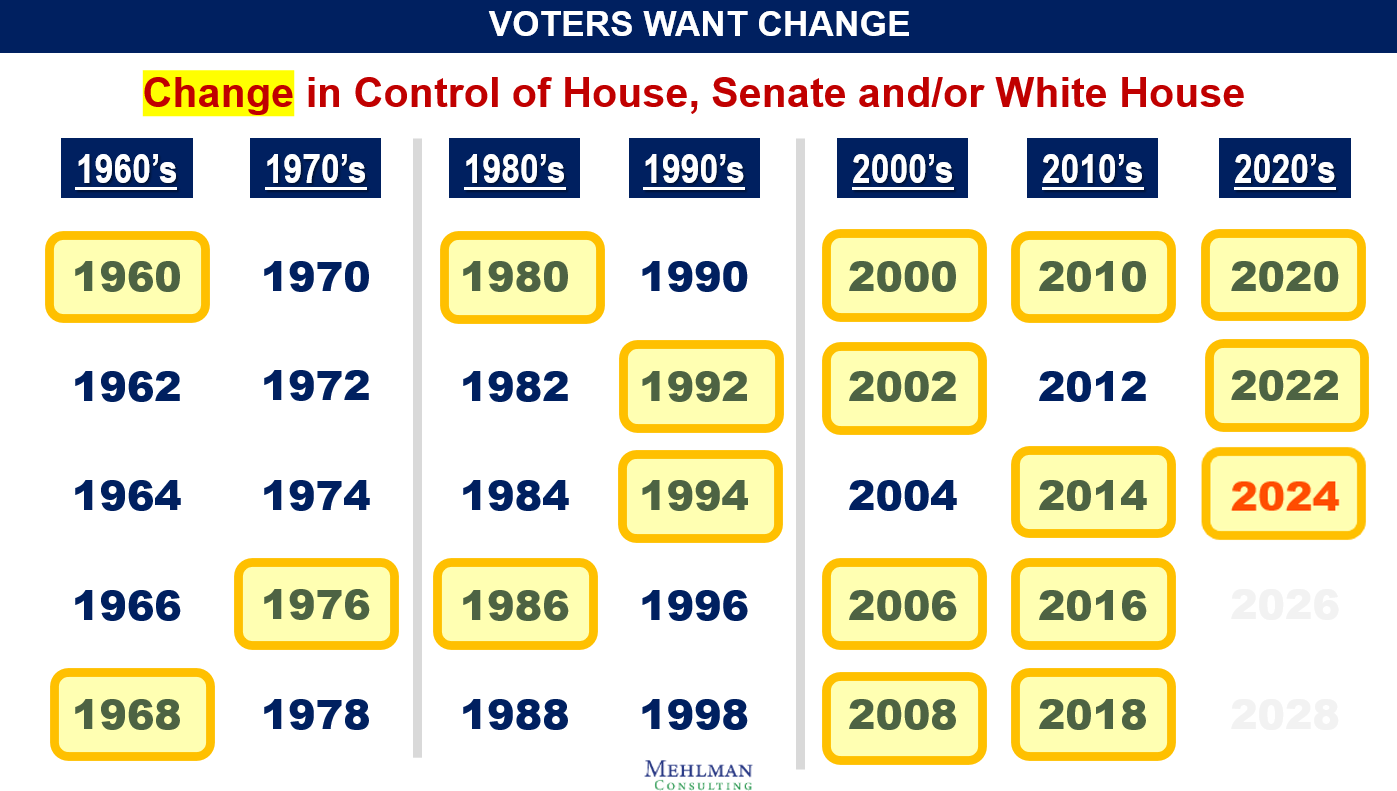
Voters in the U.S. and around the world are unhappy with the direction of their countries and keep voting to “throw the bums out”. In the U.S. there were just 3 change elections (where the party controlling the House, Senate and/or White House changed) out of the 10 held in the 1960’s & 70s. In the 80’s & 90’s it happened 4 times in 10 elections. This century? 11 out of 13 elections.

Thursday, May 29, 2025

Court Strikes Down Tariffs

Many posts have dealt with tariffs and trade.

The debate over President Donald Trump’s tariffs often focuses on whether they are prudent. Defenders insist that Trump’s tariffs will help make America great again and boost national security. Critics counter that they’ll wreck the economy. But the strongest argument against the tariffs is actually that they are unlawful. Neither the Constitution nor any statute authorizes Trump to impose what he ordered.

Now, months after sticklers for the rule of law began making that argument, it has finally been vindicated: Yesterday, the United States Court of International Trade, the federal court with jurisdiction over civil actions related to tariffs, struck down almost all of Trump’s tariffs in a 49-page ruling. The decision includes a detailed discussion of the International Emergency Economic Powers Act, the 1977 law delegating increased power over trade to the president during national emergencies, which the White House had cited to support its moves. It concludes that the law does not authorize any of Trump’s tariff orders.
State of Oregon v. Trump
Underlying the issues in this case is the notion that “the powers properly belonging to one of the departments ought not to be directly and completely administered by either of the other departments.”  Federalist No. 48 (James Madison).  Because of the Constitution’s express allocation of the tariff power to Congress, see U.S. Const. art. I, § 8, cl. 1, we do not read IEEPA to delegate an unbounded tariff authority to the President.  We instead read IEEPA’s provisions to impose meaningful limits on any such authority it confers.  Two are relevant here.  First, § 1702’s delegation of a power to “regulate . . . importation,” read in light of its legislative history and Congress’s enactment of more narrow, non-emergency legislation, at the very least does not authorize the President to impose unbounded tariffs.  The Worldwide and Retaliatory Tariffs lack any identifiable limits and thus fall outside the scope of § 1702.  Second, IEEPA’s limited authorities may be exercised only to “deal with an unusual and extraordinary threat with respect to which a national emergency has been declared . . . and may not be exercised for any other purpose.”  50 U.S.C. § 1701(b) (emphasis added).  As the Trafficking Tariffs do not meet that condition, they fall outside the scope of § 1701.  

Tuesday, April 22, 2025

Sack the Fed Head?

Many posts have discussed regulation and the administrative state. 

Peter J. Wallison at AEI:

In a 2020 case called Seila Law v. Consumer Financial Protection Bureau (CFPB), the Supreme Court created a legal foundation for the president’s control of the independent regulatory agencies, including the Fed.

The Court said in that case that in the US governmental system all the agencies of the government must be responsible to the president—the only official elected by all the people—and that the CFPB, which had a single administrator whose term of office the president could not terminate at will, was thus unconstitutionally structured because the president could not appoint his own director.

The Federal Reserve Board is headed by seven directors appointed for fixed but staggered terms of 14 years, and thus cannot be dismissed by the president under current law, unless the Supreme Court holds that the Fed is subject to the same rules as the other independent regulatory agencies.

In creating the Fed, Congress was careful to make sure that the agency was completely independent of the president and Congress. This was because the Fed’s control of the major elements of the economy—the money supply, interest rates, and the banking system—would all be important for a president (and his party) running for re-election. The Fed, for example, could lower interest rates and increase economic growth before an election, with major political implications for the president and his political party.

Accordingly, if the president is to be given control over the independent regulatory agencies, the Court must find some other way to assure that the Fed will remain independent of any president.

In Seila Law itself, before the Court decided whether the administrator of the CFPB could be removed and replaced by the president, it considered whether Congress would have created the CFPB in the first place, if it had known that the president would be able to take control of the agency.

The Court concluded that there was nothing in the legislative history of the CFPB to suggest that Congress cared whether the president controlled the agency or not. Accordingly, the Court allowed the agency to continue operations under the president’s control.

In the case of the Fed, however, the Court’s answer would almost certainly be different. It would be clear from the congressional debates over the Fed’s creation—and the extraordinary financial power of the Fed—that its independence from the president was a key in its establishment.

Friday, April 18, 2025

Stashing Away Residents of this Country

  The Trump administration is snatching people without due process.

 UNITED STATES COURT OF APPEALSFOR THE FOURTH CIRCUITNo. 25-1404(8:25-cv-00951-PX)KILMAR ARMANDO ABREGO GARCIA; JENNIFER STEFANIA VASQUEZSURA; A.A.V., a minor, by and through his next friend and mother, JenniferVasquez Sura,Plaintiffs – Appellees,v.KRISTI NOEM; TODD LYONS; KENNETH GENALO; NIKITA BAKER;PAMELA JO BONDI; MARCO RUBIO,Defendants – Appellants.ORDER WILKINSON, Circuit Judge, with whom KING and THACKER, Circuit Judges, join:

Upon review of the government’s motion, the court denies the motion for an emergency stay pending appeal and for a writ of mandamus. The relief the government is requesting is both extraordinary and premature. While we fully respect the Executive’s robust assertion of its Article II powers, we shall not micromanage the efforts of a fine district judge attempting to implement the Supreme Court’s recent decision.

It is difficult in some cases to get to the very heart of the matter. But in this case, it is not hard at all. The government is asserting a right to stash away residents of this country in foreign prisons without the semblance of due process that is the foundation of our constitutional order. Further, it claims in essence that because it has rid itself of custody that there is nothing that can be done. 

This should be shocking not only to judges, but to the intuitive sense of liberty that Americans far removed from courthouses still hold dear. 

The government asserts that Abrego Garcia is a terrorist and a member of MS-13. Perhaps, but perhaps not. Regardless, he is still entitled to due process. 

...

 “Energy in the [E]xecutive” is much to be respected. FEDERALIST NO. 70, at 423 (1789) (Alexander Hamilton) (Clinton Rossiter ed., 1961). It can rescue government from its lassitude and recalibrate imbalances too long left unexamined. The knowledge that executive energy is a perishable quality understandably breeds impatience with the courts. Courts, in turn, are frequently attuned to caution and are often uneasy with the Executive Branch’s breakneck pace. 

And the differences do not end there. The Executive is inherently focused upon ends; the Judiciary much more so upon means. Ends are bestowed on the Executive by electoral outcomes. Means are entrusted to all of government, but most especially to the Judiciary by the Constitution itself.

The Executive possesses enormous powers to prosecute and to deport, but with powers come restraints. If today the Executive claims the right to deport without due process and in disregard of court orders, what assurance will there be tomorrow that it will not deport American citizens and then disclaim responsibility to bring them home?∗ And what assurance shall there be that the Executive will not train its broad discretionary powers upon its political enemies? The threat, even if not the actuality, would always be present, and the Executive’s obligation to “take Care that the Laws be faithfully executed” would lose its meaning. U.S. CONST. art. II, § 3; see also id. art. II, § 1, cl. 8.

-- Judge J. Harvie Wilkinson 

* See, e.g., Michelle Stoddart, ‘Homegrowns are Next’: Trump Doubles Down on Sending American ‘Criminals’ to Foreign Prisons, ABC NEWS (Apr. 14, 2025, 6:04 PM); David Rutz, Trump Open to Sending Violent American Criminals to El Salvador Prisons, FOX NEWS (Apr. 15, 2025, 11:01 AM EDT).