Search This Blog

Showing posts with label elections. Show all posts

Sunday, November 9, 2025

Anecdote About Knowledge and the 2025 Elections

Many posts have discussed what Americans do and do not know about their government.

Robin Abcarian at LAT:

“We’re getting calls about polls being closed,” Kentucky’s Republican Secretary of State Michael Adams posted Tuesday on X. “They are closed because we do not have elections today. Kentucky votes next year. You cannot vote today in Kentucky for the mayor of New York City or the Governor of Virginia. Sorry.” (In a subsequent post, he mused about the importance of civics education.)

Wednesday, July 23, 2025

Change Elections

Many posts have discussed the state of Congress.

Bruce Mehlman:
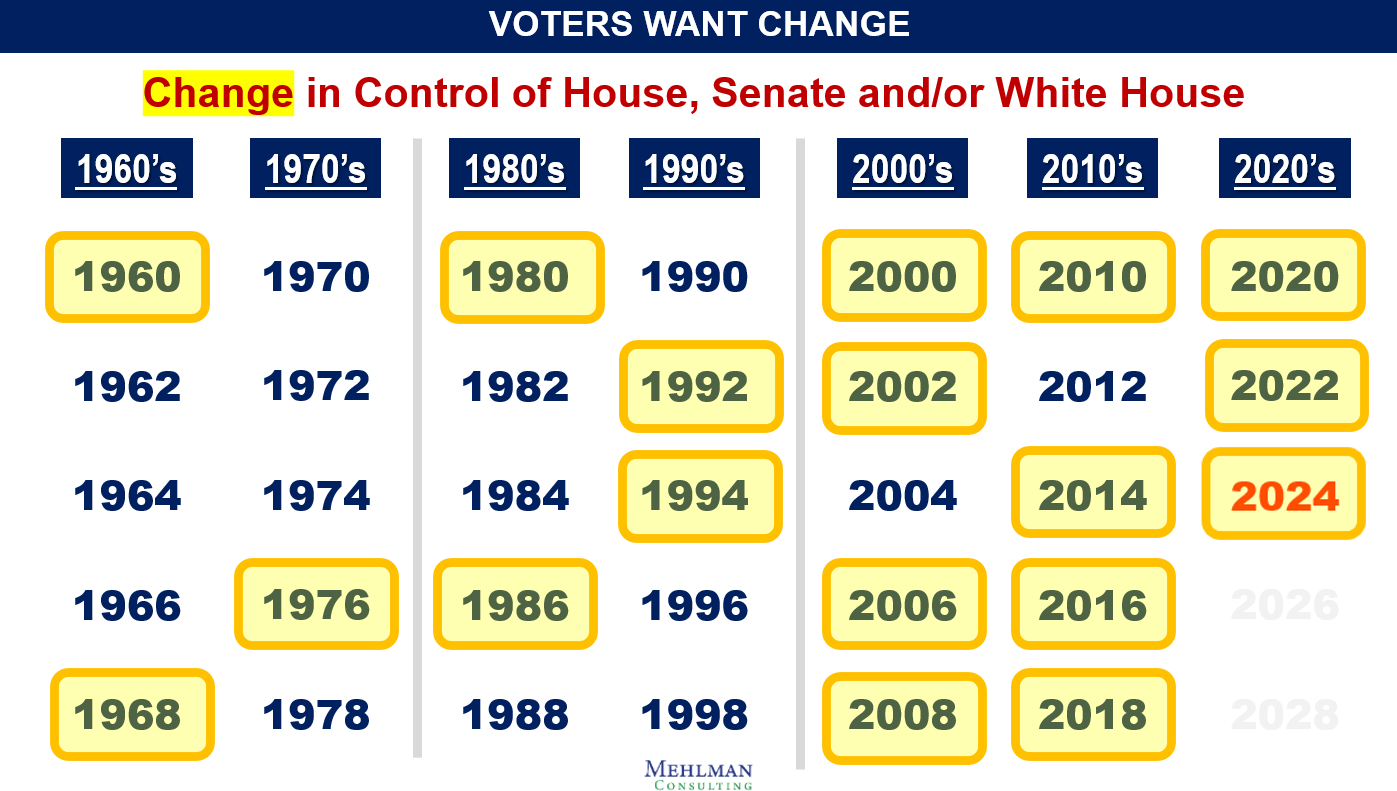
Voters in the U.S. and around the world are unhappy with the direction of their countries and keep voting to “throw the bums out”. In the U.S. there were just 3 change elections (where the party controlling the House, Senate and/or White House changed) out of the 10 held in the 1960’s & 70s. In the 80’s & 90’s it happened 4 times in 10 elections. This century? 11 out of 13 elections.

Tuesday, November 5, 2024

"Democracy is a system in which parties lose elections."

Adam Przeworski, Democracy and the Market: Political and Economic Reforms in Eastern Europe and Latin America

In his opening speech to the Constituent Assembly, Adolfo Suárez, the prime minister of the Spanish transition to democracy, announced that henceforth “the future is not written, because only the people can write it” (Verou 1976). Heralding this plunge into the unknown, he caught two quintessential features of democracy: Outcomes of the democratic process are uncertain, indeterminate ex ante; and it is “the people,” political forces competing to promote their interests and values, who determine what these outcomes will be.

Democracy is a system in which parties lose elections. There are parties: divisions of interests, values, and opinions. There is competition, organized by rules. And there are periodic winners and losers. Obviously not all democracies are the same; one can list innumerable variations and distinguish several types of democratic institutions. Yet beneath all the institutional diversity, one elementary feature – contestation open to participation (Dahl 1971) – is sufficient to identify a political system as democratic.

Democracy is, as Linz (1984) put it, government pro tempore. Conflicts are regularly terminated under established rules. They are “terminated” (Coser 1959), temporarily suspended, rather than resolved definitively. Elections fill offices, legislatures establish rules, bureaucracies issue decisions, associations arrive at agreements, courts adjudicate conflicts, and these outcomes are binding until and unless they are altered according to rules. At the same time, all such outcomes are temporary, since losers do not forfeit the right to compete in elections, negotiate again, influence legislation, pressure the bureaucracy, or seek recourse to courts.

Saturday, November 2, 2024

Madison and Virtue

 Many posts have discussed civic virtue.

James Madison, June 20, 1788

 But I go on this great republican principle, that the people will have virtue and intelligence to select men of virtue and wisdom. Is there no virtue among us? If there be not, we are in a wretched situation. No theoretical checks—no form of government can render us secure. To suppose that any form of government will secure liberty or happiness without any virtue in the people, is a chimerical idea. If there be sufficient virtue and intelligence in the community, it will be exercised in the selection of these men. So that we do not depend on their virtue, or put confidence in our rulers, but in the people who are to choose them.

Tuesday, October 22, 2024

Election Guardrails

Many posts have discussed the legal aspects of elections.

 Richard Pildes at Election Law Blog:

As we get closer to the election, we will see numerous about various ways partisan actors might try to corrupt the outcome. A recent essay Neal Katyal authored in the New York Times is a good illustration of these anxieties. Katyal raised several nightmare scenarios for “a potential election crisis” under which, in his view, corrupt partisan actors could seek to deprive Vice President Kamala Harris of a lawful victory, if in fact she wins the election.

I’ve posted this essay on Lawfare going point by point through the scenarios Katyal raises to explain the legal, institutional, and political guardrails in place to thwart various efforts to corrupt the outcome of the election. This is a companion essay to the recent ELB post I did here, explaining in more specific legal terms how the bipartisan Electoral Count Reform Act works.

My Lawfare essay is too detailed to excerpt easily, but here’s how it concludes:

Post-voting partisan efforts to manipulate the process could undermine public confidence, be disruptive, and even lead to civil unrest. But there are many more mechanisms in place than a lot of anxious public commentary recognizes to ensure the lawful outcome of the 2024 election.

Wednesday, April 17, 2024

Older Homeowners Dominate Local Elections

 The Gray Vote: How Older Home-Owning VotersDominate Local ElectionsKatherine Levine Einstein∗Maxwell Palmer†Ellis Hamilton‡Ethan Singer

Abstract 

Local elections are widely recognized as low turnout affairs compared with their national level counterparts. But, scholars have little systematic national data on the composition of the local electorate, and how compositional disparities may vary by context. In this paper, we use a national voter file to compare turnout in general, midterm, and off-cycle local elections in over 500 cities. We provide novel estimates of turnout gaps by race, age, and homeownership status in local elections, and identify stark inequalities compared with national and state elections. We find sizable turnout gaps both by age and homeownership status at the local levels, far exceeding those in national contests. Turnout disparities by age and homeownership status are twice as large as those between Black and white voters, and are considerably larger in off-cycle contests.

Thursday, April 4, 2024

Misinformation about Arizona Voter Registration

 Many posts have discussed myths and misinformation, including falsehoods about elections

On X, Maricopa County Recorder Stephen Richer responds to Elon Musk:

Hi Elon!

The post you're quote-tweeting seems to suggest that, based on Social Security Administration data, 220,731 illegal immigrants have registered to vote in Arizona since January 1, 2024.

A few things if I may be so bold (since I have easy access to Maricopa County's data -- which makes up 62% of Arizona):

1) Only 39,653 new voters have registered in Maricopa County in 2024 in total.  For Arizona, that number is about 60,000.

2) Arizona's voter rolls have actually been going down.  In Maricopa County, we've gone from about 2.6 million active registered voters in 2020 to about 2.4 million active registered voters in 2024.

3) SSA is not used to check citizenship.  It's used to check proof of identity.

4) Motor Vehicle Divisions are typically used for proof of citizenship.  In Arizona, since October 1, 1996, drivers have had to provide proof of citizenship for driver's licenses (except Type F).  We use this data to confirm citizenship for the vast majority of registration applicants.  We also have some other tools at our disposal, or we communicate directly with the voter to get documentation.

5) If the voter cannot provide documented proof of citizenship, but still attests under penalty of law that he is a citizen, he goes on what is called the "Federal Only" list in Arizona.

6) In Maricopa County, there are 20,768 registered voters on the Federal Only list.  There are about 30,000 for all of Arizona.

7) Again, these people attest that they are U.S. Citizens, but they have not provided documented proof.

8) Most studies show that these people are disproportionately college-aged students (perhaps who don't have ready access to a birth certificate).

But there is 0 validity to the suggestion in the original post that 220,731 illegal immigrants have registered in Arizona in 2024.

Hope this helps.

We loved the recent rocket launch that we could see in the Arizona sky.  Thanks for all the cool sciencey stuff you continue to do.

Stephen

(owner of many, many Musk-related products, and former user of TBC "flamethrower")


Friday, March 1, 2024

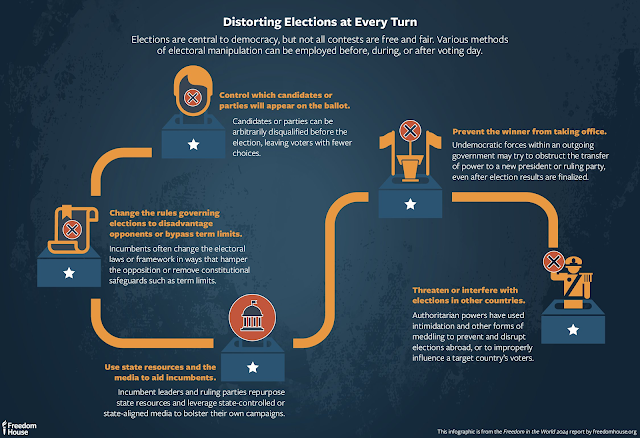
Freedom in the World 2024

From Freedom House:

Global freedom declined for the 18th consecutive year in 2023. The breadth and depth of the deterioration were extensive. Political rights and civil liberties were diminished in 52 countries, while only 21 countries made improvements. Flawed elections and armed conflict contributed to the decline, endangering freedom and causing severe human suffering.

...

 In the United States, harassment and intimidation of federal, state, and local politicians, election administrators, and judges pose a serious challenge to the conduct of November’s presidential election. Threats of violence can have far-reaching, harmful effects, potentially undermining compliance with election rules or deterring participation entirely. Actual violence related to political disputes can and has cost people their lives. Still haunted by the January 2021 attack on the Capitol and related court cases, Americans are heading into a decisive election starkly divided, with some questioning the very utility of fundamental democratic institutions.

The conduct of national elections in South Africa, India, and the United States, three of the most influential democracies in the world, will have rippm in authoritarian settings. But other electoral contests will also have important consequences.le effects across the globe, with implications for international trade, interstate relations, and movements for freedom.


Thursday, November 2, 2023

The Decline of Electoral Competition

David A. Lieb and Emily Wagster Pettus at AP:
More than four-fifths of Mississippi’s legislative candidates will have no major-party opposition in the Nov. 7 general election. And more than half of this year’s winners will have faced no other Republicans or Democrats in either the primary or the general election.

...

Though Mississippi represents an extreme example, it highlights a national decline in competition for state legislative seats. New research suggests the reasons are more complex than mere voter satisfaction with incumbents. It also raises questions about the ability of American voters to hold their elected representatives accountable.

In some states, “there’s so many uncontested seats that one party wins the chamber before an election takes place,” said Steven Rogers, a political scientist at Saint Louis University who focuses on state legislatures.

A democracy “relies on this notion that the people will have some sort of choice,” Rogers added. But “without someone running for office, there isn’t really a choice.”

In Mississippi, the percentage of legislative seats with no major-party opposition in the general election has risen steadily from 63% in 2011 to 85% this year. The percentage with no Republican or Democratic challengers in either the primary or the general election has grown from 45% to 57% over that same time, according to data compiled for The Associated Press by Ballotpedia, a nonprofit organization that tracks elections.

Sunday, March 26, 2023

Crime Pushes SF Asian American Voters to the Center


Thursday, November 10, 2022

Being a Good Member of Society

Many posts have discussed topics such as civic duty and partisan polarization.

Laura Silver at Pew:

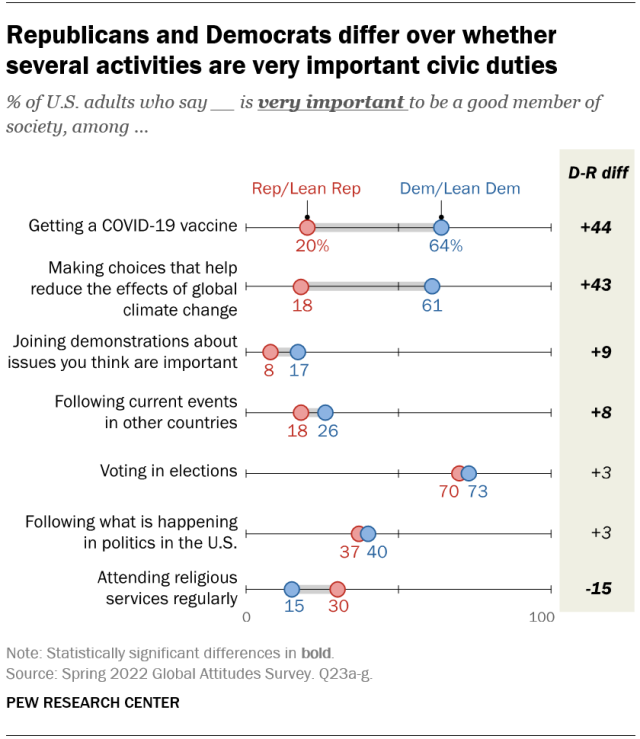
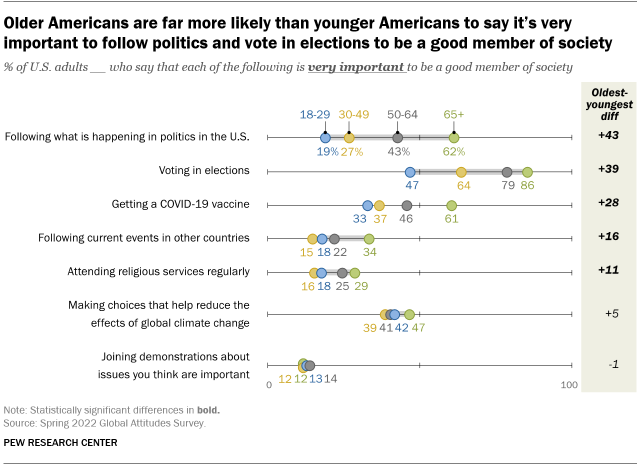
Around seven-in-ten U.S. adults (69%) say it’s very important to vote in elections to be a good member of society – more than say the same about any of the other activities included in a Pew Research Center survey conducted earlier this year. 


Young and old differ on some points.


Sunday, September 18, 2022

Threats to Democracy

David Leonhardt at NYT identifies election denialism as one threat to American democracy.
“There is the possibility, for the first time in American history, that a legitimately elected president will not be able to take office,” said Yascha Mounk, a political scientist at Johns Hopkins University who studies democracy.

The second threat to democracy is chronic but also growing: The power to set government policy is becoming increasingly disconnected from public opinion.

The run of recent Supreme Court decisions — both sweeping and, according to polls, unpopular — highlight this disconnect. Although the Democratic Party has won the popular vote in seven of the past eight presidential elections, a Supreme Court dominated by Republican appointees seems poised to shape American politics for years, if not decades. And the court is only one of the means through which policy outcomes are becoming less closely tied to the popular will.

Two of the past four presidents have taken office despite losing the popular vote. Senators representing a majority of Americans are often unable to pass bills, partly because of the increasing use of the filibuster. Even the House, intended as the branch of the government that most reflects the popular will, does not always do so, because of the way districts are drawn.

“We are far and away the most countermajoritarian
democracy in the world,” said Steven Levitsky, a professor of government at Harvard University and a co-author of the book “How Democracies Die,” with Daniel Ziblatt.

Sunday, January 16, 2022

Exit Polls

Many posts have discussed issues with survey research.

AEI interviewed Joe Lenski, who conduct the National Election Pool:

AEI: How many people worked on the exit poll in 2020?
Joe Lenski: For presidential general elections or midterms, we typically have people at 700 to 1,000 precinct locations. In 2020, we also had people at 200 early voting centers around the country. We interviewed about 30,000 people by telephone before Election Day to identify by mail and early voters. Every survey you saw in 2020 was some mix of these three modes. Seventy percent of the vote in 2020 was early or by mail. So we increased the number of telephone interviews of by-mail voters and increased the number of early voter locations where we interview people in person. The techniques are the same as an exit poll. We interview people right after they cast their ballot, but now it is during the weeks leading up to the election at early voting centers. So in every survey you see some mix of those three modes.
AEI: How does the process of writing the questionnaire unfold?
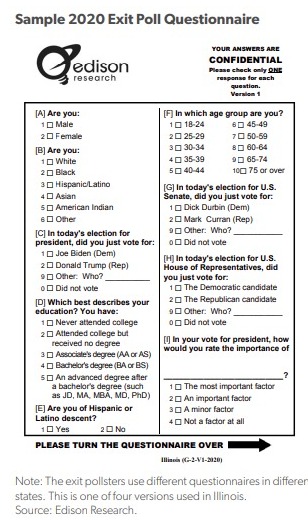
Joe Lenski: The exit poll questionnaire is written by a committee made up of the polling directors at the news organizations of the NEP. Three of the four members have to agree to put a question onto the questionnaire. There is usually consensus. The real issue is that you have a limited amount of space on a self-administered questionnaire. Typically, it is a 5.5 by 8.5 piece of paper. It usually fits 18–20 questions. If there is a sufficient sample size, we have multiple versions of the questionnaire. In most states in 2020, we used two versions of the questionnaire. There were four national versions. The questionnaire is basically the same for Election Day voters, for mail and early voters, and for telephone surveys with some adaptations. (See page 3.) 

Sample 2020 Exit Poll Questionnaire Note: The exit pollsters use different questionnaires in different states. This is one of four versions used in Illinois. Source: Edison Research.


Monday, January 4, 2021

Defense Secretaries Speak Out

 Ashton Carter, Dick Cheney, William Cohen, Mark Esper, Robert Gates, Chuck Hagel, James Mattis, Leon Panetta, William Perry and Donald Rumsfeld are the 10 living former U.S. secretaries of defense.

As former secretaries of defense, we hold a common view of the solemn obligations of the U.S. armed forces and the Defense Department. Each of us swore an oath to support and defend the Constitution against all enemies, foreign and domestic. We did not swear it to an individual or a party.

American elections and the peaceful transfers of power that result are hallmarks of our democracy. With one singular and tragic exception that cost the lives of more Americans than all of our other wars combined, the United States has had an unbroken record of such transitions since 1789, including in times of partisan strife, war, epidemics and economic depression. This year should be no exception.

Our elections have occurred. Recounts and audits have been conducted. Appropriate challenges have been addressed by the courts. Governors have certified the results. And the electoral college has voted. The time for questioning the results has passed; the time for the formal counting of the electoral college votes, as prescribed in the Constitution and statute, has arrived.

As senior Defense Department leaders have noted, “there’s no role for the U.S. military in determining the outcome of a U.S. election.” Efforts to involve the U.S. armed forces in resolving election disputes would take us into dangerous, unlawful and unconstitutional territory. Civilian and military officials who direct or carry out such measures would be accountable, including potentially facing criminal penalties, for the grave consequences of their actions on our republic.

Transitions, which all of us have experienced, are a crucial part of the successful transfer of power. They often occur at times of international uncertainty about U.S. national security policy and posture. They can be a moment when the nation is vulnerable to actions by adversaries seeking to take advantage of the situation.

Given these factors, particularly at a time when U.S. forces are engaged in active operations around the world, it is all the more imperative that the transition at the Defense Department be carried out fully, cooperatively and transparently. Acting defense secretary Christopher C. Miller and his subordinates — political appointees, officers and civil servants — are each bound by oath, law and precedent to facilitate the entry into office of the incoming administration, and to do so wholeheartedly. They must also refrain from any political actions that undermine the results of the election or hinder the success of the new team.

We call upon them, in the strongest terms, to do as so many generations of Americans have done before them. This final action is in keeping with the highest traditions and professionalism of the U.S. armed forces, and the history of democratic transition in our great country.

Saturday, March 21, 2020

Cancel or Postpone?

Some states have postponed primary elections.

So many people are wondering: could a president remain in power by unilaterally canceling or postponing a general election?

NOPE: the Constitution sets strict expiration dates for terms of office, with no exceptions.
  • 20th Amendment: "The terms of the President and Vice President shall end at noon on the 20th day of January, and the terms of Senators and Representatives at noon on the 3d day of January, of the years in which such terms would have ended if this article had not been ratified; and the terms of their successors shall then begin."
Congress, however, could shift the election date, but only by a few weeks at most, because of the dates above.
  • Article II, section 1: "The Congress may determine the time of choosing the electors, and the day on which they shall give their votes; which day shall be the same throughout the United States."
  • Article I, section 4: "The Times, Places and Manner of holding Elections for Senators and Representatives, shall be prescribed in each State by the Legislature thereof; but the Congress may at any time by Law make or alter such Regulations, except as to the Places of chusing Senators."


Friday, March 13, 2020

Americans Want to End the Electoral College

Andrew Daniller at Pew:
A majority of U.S. adults (58%) say the Constitution should be amended so the presidential candidate who receives the most votes nationwide wins, while 40% prefer to keep the current system in which the candidate who receives the most Electoral College vote wins the election.
Support for amending the Constitution has increased slightly since the period immediately following the 2016 election. In a November 2016 CNN/ORC survey, roughly half of adults (51%) favored amending the Constitution to eliminate the Electoral College. And in a March 2018 Pew Research Center survey, 55% favored taking this step.

Monday, March 9, 2020

Early Voting, Mail Voting, and Coronavirus


Early voting does have disadvantages, especially in nomination contests where candidates may drop out between the printing of ballots and the casting of votes.  But it also has advantages.

Stephen Wolf at Daily Kos:
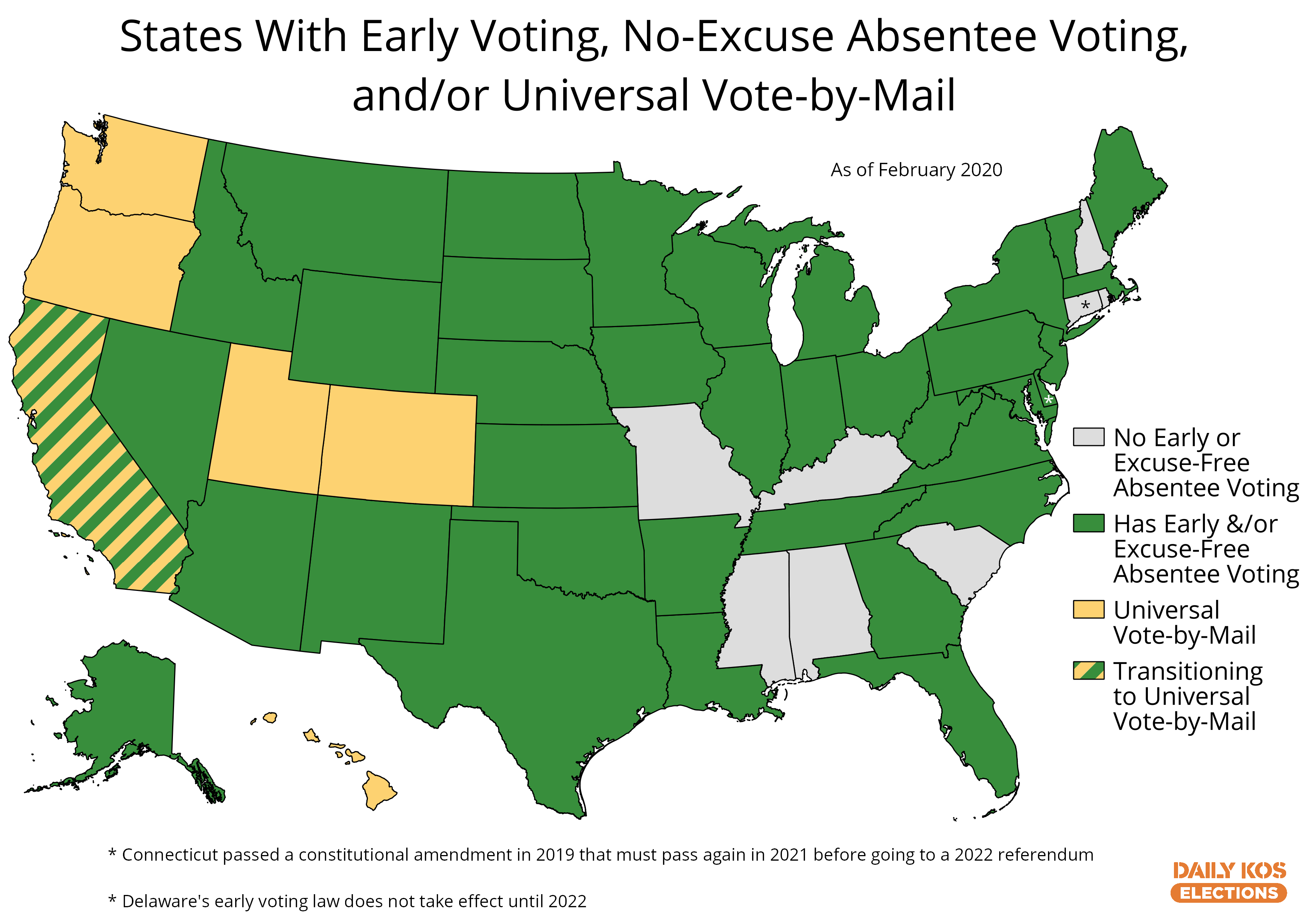
As shown on the map at the top of this post (see here for a larger version), Colorado, Hawaii, Oregon, Utah, and Washington have already transitioned to universal voting by mail ahead of November's elections, and states such as California and Arizona have seen a majority of voters cast their ballots by mail in recent years. Furthermore, states such as Michigan, Pennsylvania, and Virginia have made it considerably easier to vote absentee by mail since the last election. But a large number of states still don’t even allow absentee mail voting without an excuse, let alone mail every registered voter a ballot as the default voting method.
Adopting universal voting by mail is imperative as the coronavirus threatens to become a pandemic. As governments urge citizens to avoid crowded public spaces and to vigilantly wash their hands, having millions of people stand in lines on Election Day and use the same voting machines or even the same pens to fill out paper ballots threatens public health and could dampen voter turnout. Furthermore, because poll workers are very disproportionately the same elderly Americans who are most at risk in a flu pandemic, states and localities may have trouble finding enough poll workers, and those who do show up will be at greater risk of catching or spreading the disease.
These problems should be largely avoidable with universal voting by mail, since it almost entirely eliminates in-person voting and the public gatherings that go with it. Furthermore, vote-by-mail is a cost-saving measure that frees up resources for other things because governments have to operate far fewer in-person polling places. It also has a long track record of increasing voter turnout in the states that have adopted it thanks to the ease of voting that way, especially with prepaid postage negating the need for voters to go to the post office.

Sunday, February 23, 2020

Views of Russia

Carroll Doherty at Pew:
  • Around seven-in-ten Americans (72%) say it is very or somewhat likely that Russia or other foreign governments will try to influence the November 2020 election. Far more Democrats and Democratic-leaning independents (84%) than Republicans and Republicans leaners (59%) expect foreign interference in the election. Among those who see interference as likely, 82% of Democrats say it is a major problem; only 39% of Republicans say the same.
  • The share of Americans with a positive view of Russia is at its lowest point in a decade. Just 18% have a favorable impression, far lower than the 44% who viewed Russia positively in 2007, when the question was first asked.
  • Just 20% of the U.S. public has confidence in Putin to do the right thing regarding world affairs; 73% have no confidence. While Putin engenders relatively low confidence among members of both parties, a larger share of Republicans (31%) than Democrats (10%) express confidence in him. The partisan gap in views of Putin is now the largest measured by Pew Research Center.
  • Last year, half of Americans said that Russia’s power and influence posed a major threat to the well-being of the U.S. These opinions, like many about Russia, also were sharply divided along partisan lines. Nearly two-thirds of Democrats (65%) said Russia was a major threat, compared with 35% of Republicans.

Tuesday, February 11, 2020

Would Vote For...

Lydia Saad at Gallup:
More than nine in 10 Americans say they would vote for a presidential candidate nominated by their party who happened to be black, Catholic, Hispanic, Jewish or a woman. Such willingness drops to eight in 10 for candidates who are evangelical Christians or are gays or lesbians. Between six and seven in 10 would vote for someone who is under 40 years of age, over 70, a Muslim or an atheist.

Just one group tested -- socialists -- receives majority opposition. Less than half of Americans, 45%, say they would vote for a socialist for president, while 53% say they would not.

Monday, February 10, 2020

Election Security and Human Error

At R Street, Kristen Nyman and Kathryn Waldron write that human error is the top threat to election systems.  Errors include failure to recognize and avoid phishing attacks.
While problems with voting technology can bedevil any election — as was amply illustrated by the chaos surrounding this week’s Iowa Democratic caucuses — human error is a major vulnerability in any voting system. Tales of worker error in elections range from optical scanners left unplugged to distribution of ballots to the wrong precinct. One study of poll workers in California reported several such breaches of standard operating procedures, including leaving a memory card with vote totals at the polling site at the end of the day and leaving the door to a ballot box unlocked.
A majority of poll workers are older than 60, which is unsurprising given that most people under that age are too busy with work or school to take off the time. And without proper training, many older poll workers lack an adept understanding of technology and cybersecurity. This leads to an insecure voting environment.
Additional training may sound discouraging to counties that already struggle to recruit poll workers, and local governments may feel that additional time commitments will only exacerbate that problem and increase their financial burdens. This could explain why election officials in Arizona, Michigan and Pennsylvania told NBC that they never received cybersecurity training.
Also, the U S election system is decentralized -- which is both an asset and a liability.  On the one hand, it would be impossible to mount a simultaneous national attack on such a fragmented system.  On the other hand, standards and capabilities vary widely.