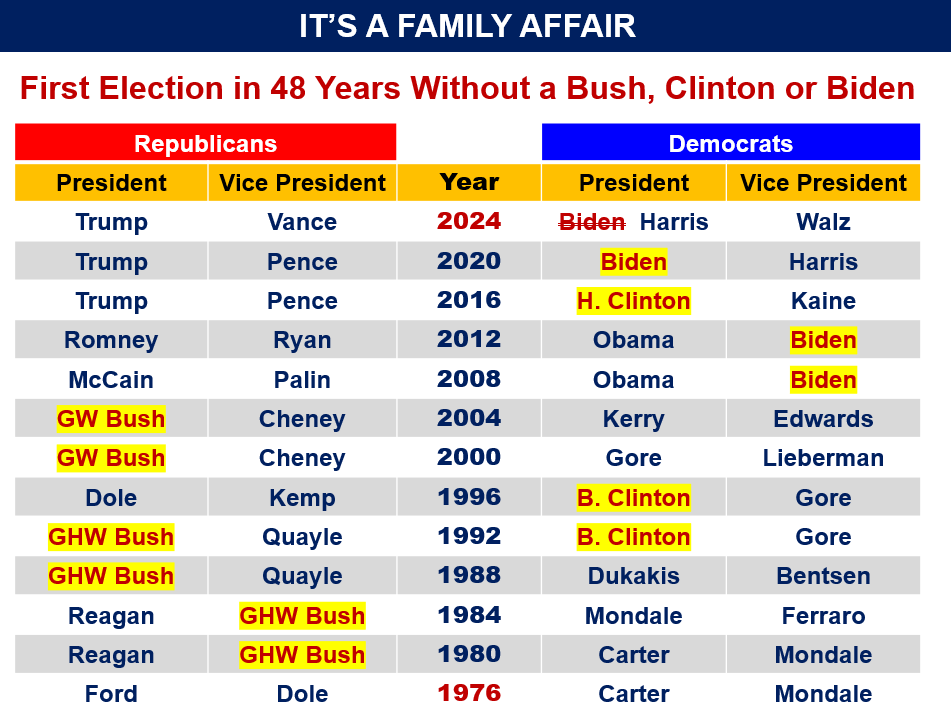
Out-party voters are energized, active and loud. In-power voters are often frustrated that their teams’ promises prove harder to accomplish, take too long or require compromises they don’t like.
Bessette/Pitney’s AMERICAN GOVERNMENT AND POLITICS: DELIBERATION, DEMOCRACY AND CITIZENSHIP reviews the idea of "deliberative democracy." Building on the book, this blog offers insights, analysis, and facts about recent events.
Out-party voters are energized, active and loud. In-power voters are often frustrated that their teams’ promises prove harder to accomplish, take too long or require compromises they don’t like.
Many posts have discussed the role of religion in American life.
What role do Americans think God played in the last two presidential elections? In a May 2025 survey, most U.S. adults say God played no role at all, while about a third say recent election results are part of God’s overall plan but don’t necessarily mean God approved of the winner’s policies. Very few say God chose the winners because of their policies.
Every Democrat nominated for President or Vice President for the past 40 years was a lawyer until Tim Walz. (21/22 D’s & 7/21 R’s)
Many posts have discussed the legal aspects of elections.
The Electors Clause of the Constitution (Article II, Section 1, clause 2) provides that “[e]ach state shall appoint” presidential and vice presidential electors in the manner “as the Legislature thereof may direct.” Article II, Section 1, clause 4, further provides Congress with power to determine when the states choose their electors or “the Day on which they shall give their Votes; which Day shall be the same throughout the United States.” Accordingly, Congress enacted a federal statute establishing Election Day for presidential and vice presidential electors as the first Tuesday after the first Monday in November every four years. Federal law further provides that whenever a state holds an election for presidential electors “and has failed to make a choice on the day prescribed by law,” electors can be appointed on a later date “in such a manner as the legislature of such State may direct.
The ECA requires that “the executive of each State” send to the Archivist of the United States (Archivist), by registered mail and under state seal, “a certificate of such ascertainment of the electors appointed,” including the name of, and number of votes cast for, each elector. Further, the ECA commands that such certificates of ascertainment be sent “as soon as practicable” after the “final ascertainment” of the appointment of the electors or “as soon as practicable” after the “final determination of any [election] controversy or contest” that was resolved under the state’s statutory procedure for election contests.
On or before the electors meet to cast their votes, the ECA directs “the executive of each State” to deliver to the electors of the state, under state seal, “six duplicate-originals of the same certificate” of ascertainment that were sent to the Archivist. At the first meeting of Congress following the appointment of the presidential electors, the ECA requires the Archivist to transmit “copies in full of each and every” certificate of ascertainment to the two houses of Congress.
The ECA specifies that if a state, under laws enacted before Election Day and “by judicial or other methods,” has made a “final determination of any controversy or contest” regarding the appointment of electors in the state, and if that determination is made at least six days prior to the day that the electors are to meet to cast their votes, such determination “shall be conclusive, and shall govern in the counting of the electoral votes.” Known as the “safe harbor” provision, this clause seeks to “assure finality of the State’s determination” in resolving a presidential election contest (Bush v. Gore, 531 U.S. 98, 113 (2000) (Rehnquist, C.J., concurring).
This presidential election is likely to be close. This guess rests not only on current polls but also recent history.
Winner's popular vote margin 1976-1996
The Electoral College allocates a number of electors based on how many senators and representatives each state has in Congress (plus three electors for the District of Columbia, for a total of 538). Most states award all of their electoral votes to the candidate who wins that state.
More than six-in-ten Americans (63%) would instead prefer to see the winner of the presidential election be the person who wins the most votes nationally. Roughly a third (35%) favor retaining the Electoral College system, according to a Pew Research Center survey of 9,720 adults conducted Aug. 26-Sept. 2, 2024.
Pollsters are making changes in response to the problems in previous elections. As a result, polling is different today than in 2016. Most U.S. polling organizations that conducted and publicly released national surveys in both 2016 and 2022 (61%) used methods in 2022 that differed from what they used in 2016. And change has continued since 2022.
One change is that the number of active polling organizations has grown significantly, indicating that there are fewer barriers to entry into the polling field. The number of organizations that conduct national election polls more than doubled between 2000 and 2022.
This growth has been driven largely by pollsters using inexpensive opt-in sampling methods. But previous Pew Research Center analyses have demonstrated how surveys that use nonprobability sampling may have errors twice as large, on average, as those that use probability sampling.
The second change is that many of the more prominent polling organizations that use probability sampling – including Pew Research Center – have shifted from conducting polls primarily by telephone to using online methods, or some combination of online, mail and telephone. The result is that polling methodologies are far more diverse now than in the past.
All good polling relies on statistical adjustment called “weighting,” which makes sure that the survey sample aligns with the broader population on key characteristics. Historically, public opinion researchers have adjusted their data using a core set of demographic variables to correct imbalances between the survey sample and the population.
But there is a growing realization among survey researchers that weighting a poll on just a few variables like age, race and gender is insufficient for getting accurate results. Some groups of people – such as older adults and college graduates – are more likely to take surveys, which can lead to errors that are too sizable for a simple three- or four-variable adjustment to work well. Adjusting on more variables produces more accurate results, according to Center studies in 2016 and 2018.
Polls are less predictive when Trump is on the ballot.
One is about the difficulty of estimating who will turn out to vote. Research has found that Trump is popular among people who tend to sit out midterms but turn out for him in presidential election years. Since pollsters often use past turnout to predict who will vote, it can be difficult to anticipate when irregular voters will actually show up.
The other explanation is that Republicans in the Trump era have become a little less likely than Democrats to participate in polls. Pollsters call this “partisan nonresponse bias.” Surprisingly, polls historically have not shown any particular pattern of favoring one side or the other. The errors that favored Democratic candidates in the past eight years may be a result of the growth of political polarization, along with declining trust among conservatives in news organizations and other institutions that conduct polls.
The current situation is unusual. Theodore Roosevelt, Calvin Coolidge, Harry Truman, and Lyndon Johnson all stepped down after one elected term -- but all four had been vice presidents who assumed the presidency after their predecessors died. (TR would run again in 1912.) One has to go back to Rutherford B. Hayes to find a president who voluntarily retired after four years. His vice president, William Wheeler, also declined to run in the election of 1880
By now, most of us are used to living in "unprecedented times." But just how unprecedented is Joe Biden’s decision to drop out of the 2024 presidential race a little more than three months before Election Day?
Occasionally, incumbent presidents have decided to not seek reelection. But dropping out midcampaign is incredibly rare. And it has never happened this close to an election.
...
The two closest political shake-ups to Biden’s were withdrawals by President Harry S. Truman before the 1952 election and President Lyndon B. Johnson before the 1968 election.
Both Truman and Johnson had assumed office following a president’s death and served a full term of their own; they each would have been eligible to run for a second full term had they wanted to. But following poor showings in each of their respective New Hampshire primaries in 1952 and 1968, both exited the race.
Truman withdrew his name from the presidential election on March 29, 1952, or 220 days before Election Day. Truman, who was suffering from low popularity amid the Korean War, dropped out less than three weeks after losing the New Hampshire primary. (In that era, there were relatively few primaries; in many states, party insiders controlled the nomination process.)
Ultimately, Adlai Stevenson II won the Democratic nomination but lost in the general election to Dwight Eisenhower, a five-star U.S. Army general from World War II who ran as a Republican.
Johnson dropped out of the race March 31, 1968, 219 days before the election. Johnson — who had become broadly unpopular because of another war, Vietnam — had not formally filed to run, and was on the New Hampshire ballot only as a write-in. But after a poor showing, and facing primary challenges from two strong contenders, Eugene McCarthy and Robert F. Kennedy, Johnson dropped out.
In the end, Johnson’s vice president, Hubert Humphrey, was nominated but lost the general election to Richard Nixon.
Biden’s move is far closer to Election Day — 107 days — and comes after all Democratic voters have had their say in the presidential primaries.
Does a criminal indictment or conviction prevent someone from running for president?
Not necessarily. The Constitution doesn't address this issue directly. Some federal statutes (like the one that makes mishandling official records a crime) disqualify a convicted person from holding public office. Nevertheless, there is ongoing debate about whether such a punishment contravenes Article II of the Constitution.
If the Senate convicts someone in an impeachment trial, it can bar them from holding federal office. Similarly, anyone "engaged in insurrection or rebellion" against the United States cannot hold public office under the Fourteenth Amendment's disqualification clause.
Can someone who is incarcerated be president?
An incarcerated person can run for and, in theory, become president. In practice, Congress would likely find them unfit to serve because their imprisonment would hinder their ability to perform their duties.
But there's nothing legally stopping an incarcerated person from running for president. Several other people have run for president while in prison. For example, Eugene V. Debs ran for president while incarcerated, receiving almost one million votes.
However, if someone were elected from behind bars, they would likely struggle to perform their presidential duties. In that case, they might be found unfit to serve and removed from office under the Twenty-Fifth Amendment.
Key principles of the American constitutionalorder strongly contradict the notion that the framers vested in the vice president the unilateral authority to resolve Electoral College disputes: (1) the framers’ understanding of responsible, or accountable, republican government; (2) checks and balances in the constitutional structure; (3) Madison’s principle that “no man is allowed to be a judge in his own cause because his interest would certainly bias his judgment, and, not improbably, corrupt his integrity” and (4) the rule of law.The framers may rightly be criticized for, apparently, not having considered the problem of contested electoral votes when they designed their fairly intricate system of presidential elections. Fortunately, the document they crafted fully empowers Congress to devise procedures for resolving such controversies.
This Week interview with Asa Hutchinson:
KARL: You suggested recently that if Trump were to get indicted that he should drop out of the race. Do you believe that now that he's been indicted, should he drop out?
HUTCHINSON: Well, I do. And for a couple reasons. I mean, first of all, the office is more important than any individual person. And so for the sake of the office of the presidency, I do think that’s too much of a sideshow and distraction, and he needs to be able to concentrate on his due process, and there is a presumption of innocence.
But the second reason is, throughout my eight years as governor and as a political leader, I've always said that people don't have to step aside from public office if they’re under investigation, but if it reaches the point of criminal charges that have to be answered, the office is always more important than a person. And so there's some consistency there. I do believe if -- if we're looking at the presidency and the future of our country, then we don't need that distraction and he needs to be able to concentrate on the legal issues that he faces.
I am going to re-up this April 2020 piece I wrote for the @thedispatch about the "dead nominee" problem, which Congress should have addressed long ago. Because we might in 2024 have an octogenarian vs. septuagenarian presidential contest. https://t.co/s1JaWQYZnx
— Kevin R Kosar (@kevinrkosar) November 11, 2022
Around six-in-ten U.S. adults (63%) say the way the president is elected should be changed so that the winner of the popular vote nationwide wins the presidency, while 35% favor keeping the current Electoral College system, according to a Pew Research Center survey conducted June 27-July 4, 2022. There has been a modest increase in the share of Americans who favor changing the way presidents are elected: In January 2021, the last time the Center asked this question, 55% said the system should be changed, while 43% supported maintaining the existing system.
The current electoral system in the United States allows for the possibility that the winner of the popular vote may not be able to secure enough Electoral College votes to win the presidency. This was the case in both the 2000 and 2016 elections, which were won by George W. Bush and Donald Trump, respectively.
In her statement Thursday night, Liz Cheney mentioned that, before 2020, presidents had always been willing to accept electoral defeat. She cited the example of Lincoln.
Abraham Lincoln, Memorandum on Probable Failure of Re-Election1, August 23, 1864
1 A summer of costly military stalemate and widespread disaffection among War Democrats and conservative Republicans with the administration's policies toward slavery persuaded Lincoln that he would probably be defeated in the 1864 presidential election. Perhaps to bear witness to his determination to save the Union even if defeated, he wrote out this memorandum, indicating his fear that General McClellan, if elected, would be forced by members of his party to seek an armistice with the Confederacy. Such an armistice could be tantamount to recognition of Confederate independence. Lincoln's memorandum, which he asked the members of his cabinet to sign as witnesses without reading, amounts to a pledge to work in concert with McClellan before the latter's inauguration.
Executive Mansion
Washington, Aug 23, 1864.
This morning, as for some days past, it seems exceedingly probable that this Administration will not be re-elected. Then it will be my duty to so co-operate with the President elect, as to save the Union between the election and the inauguration; as he will have secured his election on such ground that he can not possibly save it afterwards.
A. Lincoln
[Endorsed on Reverse:]
August 23. 1864.2
2 The date is in Lincoln's hand.
The abstract:
The 2020 election was both a miracle and a tragedy. In the midst of a pandemic posing unprecedented challenges, local and state administrators pulled off a safe, secure, and professional election. This article discusses metrics of success in the adaptations that took place—record-high turnout, widespread voter satisfaction, a doubling of mail voting without a concomitant increase in problems often associated with absentee ballots, and the recruitment of hundreds of thousands of new poll workers. However, a competing narrative of a “stolen election” led to a historically deep chasm between partisans in their trust of the election process and outcome.
Mr. Speaker, since this is an unprecedented situation, I would like to ask permission to impose upon the time of the Members of this Congress to make a statement which in itself is somewhat unprecedented.
I promise to be brief. I shall be guided by the 1-minute rule of the House rather than the unlimited time rule that prevails in the Senate.
This is the first time in 100 years that a candidate for the Presidency announced the result of an election in which he was defeated and announced the victory of his opponent. I do not think we could have a more striking and eloquent example of the stability of our constitutional system and of the proud tradition. of the American people of developing, respecting, and honoring institutions of self-government.In our campaigns, no matter how hard fought they may be, no matter how close the election may turn out to be, those who lose accept the verdict, and support those who win. And I would like to add that, having served now in Government for 14 years, a period which began in the House just 14 years ago, almost to the day, which continued with 2 years in the Senate and 8 years as Vice President, as I complete that 14-year period it is indeed a very great honor to me to extend to my colleagues in the House and Senate on both sides of the aisle who have been elected; to extend to John F. Kennedy and Lyndon Johnson, who have been elected President and Vice President of the United States, my heartfelt best wishes, as all of you work in a cause that is bigger than any man's ambition, greater than any party. It is the cause of freedom, of justice, and peace for all mankind.
It is in that spirit that I now declare that John F. Kennedy has been elected President of the United States, and Lyndon B. Johnson Vice President of the United States.
Members of the Congress, the purpose for which the joint session of the two Houses of Congress has been called pursuant to Senate Concurrent Resolution 1, having been accomplished, the Chair declares the joint session dissolved.
December 14, 2020: Electors Vote in Their States Monday after the second Wednesday in December of presidential election years is set (3 U.S.C. §7) as the date on which the electors meet and vote. In 2020, the meeting is on December 14. Electoral college delegations meet separately in their respective states and the District of Columbia at places designated by their state legislature. The electors vote by paper ballot, casting one ballot for President and one for Vice President. The electors count the results and then sign six certificates, each of which contains two lists, one of which includes the electoral votes for the President, the other, electoral votes for the Vice President, each of which includes the names of persons receiving votes and the number of votes cast for them. These are known as Certificates of the Vote, which the electors are required to sign. They then pair the six Certificates of Ascertainment provided by the state governors with the Certificates of the Vote, and sign, seal, and certify them (3 U.S.C. §§8-10). The six certificates are then distributed by registered mail as follows: (1) one certificate to the President of the U.S. Senate (the Vice President); (2) two certificates to the secretary of state (or equivalent officer) of the state in which the electors met; (3) two certificates to the Archivist; and (4) one certificate to the judge of the U.S. district court of the district in which the electors met (3 U.S.C. §11).