Search This Blog

Showing posts with label demographics. Show all posts

Monday, August 24, 2026

Why Has Violent Crime Dropped?

  Many posts have discussed crime in the United States.

Mike Allen at Axios:

By the numbers: The U.S. violent-crime rate plunged 9.7% in 2025, the largest annual decline since FBI national estimates began 90 years ago.The murder rate fell 18.5% to 4.1 per 100,000 people, tying 1955 and 1956 for the lowest since national estimates began.
And the decline hasn't stopped: An Axios analysis shows violent crime in big cities fell again in the first half of 2026.

Criminologists describe a complicated picture of why crime is down. No one's sure, but several overlapping forces seem to be driving the drop: 
  • Vice consumption cooled: Pandemic-era spikes in alcohol consumption, illicit drug use and firearm purchases — three factors linked to the 2020–2021 homicide surge — have receded.
  • Return to routine: COVID lockdowns disrupted community guardrails and displaced young men and teens. Employment and social routines have since stabilized.
  • Law enforcement tech boom: Police departments are using more AI tools, predictive analytics and platforms such as Palantir's Gotham to deploy resources and identify crime hotspots.
 Under-the-radar demographic and health trends are also quietly reshaping public safety:The proportion of young people in America is declining, shrinking the demographic most historically linked to street crime. In a fascinating medical twist, the explosion of GLP-1 weight-loss drugs (like Ozempic) has been clinically linked to decreased alcohol abuse and improved impulse control — two major factors in violent offenses.


Monday, August 10, 2026

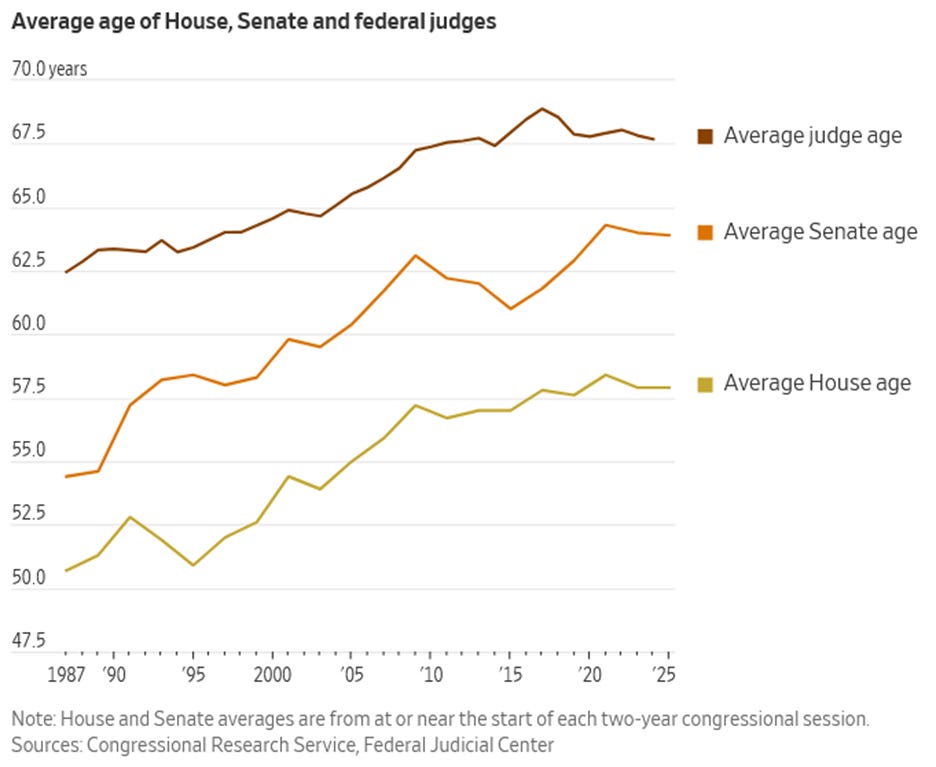
Boomers Cling to Wealth and Power

The first of the Baby Boomer generation turns 80 this year, with the fourth and likely last of the Baby Boomer Presidents well-into his second term. Leadership will eventually pass to younger generations. But Boomers still hold much of the wealth and many of the offices, and they appear in no hurry to hand things over. A brief look at generational inheritance.
...
Decades of rising earnings and asset values left Baby Boomers and older Americans holding nearly two-thirds of assets. And the wealth has outlasted the traditional handoff: Americans are living and working longer, while judges, Senators, House members and CEOs are markedly older than they were a generation ago.


Older generations are also sticking around longer in government & business… the average age of judges, Senators, House members & CEOs climbed for four decades and remains at or near record highs.


Thursday, July 30, 2026

Inequality, Households, and Teen College Plans

Many posts have discussed economic and educational inequality


Inequalities feed on one another. Kids from noncollege families engage in fewer extracurriculars,which in turn hurts their chances at getting into good colleges and getting good jobs.

Teens’ planned trajectory after graduation varies dramatically between not only boys and girls but also those with college-educated parents and those without. Nearly three-quarters (74 percent) of teen girls with college-educated parents report that they are planning on going to a four-year college after graduation. About half of teen boys with college-educated parents say they are planning on going to college themselves. Nearly as many teen girls (46 percent) raised in noncollege households plan on attending a four-year college or university. About half as many of their male peers (24 percent) report that they plan on going to college.

Sunday, July 19, 2026

Aging Congress

Many posts have discussed the state of Congress.

Elena Shao at NYT:
The sudden death of Senator Lindsey Graham, the 71-year-old Republican of South Carolina, has renewed criticism of an increasingly aging Congress and the systems and norms that continue to reward seniority and tenure.

More than a third of U.S. senators are 70 or older. In the Senate and the House, that age cohort has grown markedly over the past few decades, and now makes up a quarter of membership across both chambers.


Monday, June 22, 2026

US: Still Religious and Prosperous

Many posts have discussed international views of religion.

Ryan Burge on the World Values Survey

The most recent version of the survey is Wave 7, and it was fielded between 2017 and 2022. It contains 64 total countries, but some don’t have responses to religion questions, so we are left with 54 countries. Which is still a lot.

...

One final scatterplot before I close up today. This one is just a simple replication that is widespread in my corner of the world: specifically, the secularization hypothesis. This is the idea that as a country becomes educationally advanced and economically prosperous, it will be less religious. I created a composite index of religiosity based on a number of questions about religious belief, belonging, and behavior. Then I grabbed a measure of GDP per capita to assess economic prosperity.
What about outliers above the line? One big surprise is Puerto Rico. Its GDP is $40K but their religiosity index is .83. The combination of a strong Catholic Church and the rise of Pentecostalism probably explains a lot of that. Then you’ve got a bunch of Eastern Orthodox countries who are more religious than they should be based on their GDP: Cyprus, Greece, and Romania all fit this pattern.

Where does the United States fit? Well, it’s still an outlier. The religiosity index is .62, and GDP is nearly $70K. In order to fit the trend line in this scatterplot, GDP would need to drop to just $28,000 or religiosity would need to dip to .47. 

Friday, May 22, 2026

No Religious Revival


Many posts have discussed the role of religion in American life.

A release from the Public Religion Research Institute:
The annual PRRI Census of American Religion finds no evidence that Americans are returning to church in higher numbers – and little change in Americans’ religious affiliation in the past year.

Surveying a random sample of 40,000 adults throughout 2025, PRRI finds that two-thirds of Americans (66%) identify as Christian, including 41% who are white Christians and 25% who are Christians of color. Roughly three in ten Americans (28%) are religiously unaffiliated, and 6% identify with a non-Christian religion. All percentages closely mirror those from 2024.

“Despite anecdotal claims of a religious revival, our data show that Americans’ religious affiliation held steady in 2025 while worship weekly attendance did not increase,” said Melissa Deckman, CEO of PRRI. “Looking at young adults, there is a shift happening – but it’s not Gen Z men becoming more religious, as some suggest. Instead, young women’s declining religiosity has brought them on par with their male counterparts for the first time.”

Young women (18-29) have shed religious labels steadily since 2013, when 29% identified as religiously unaffiliated. By 2024, that figure grew to 40%, and in 2025, it increased to 43%.

While there has been a slight pause in the overall rate of religious disaffiliation, religious affiliation did not grow in 2025. The percent of Americans who identify as members of white Christian traditions saw little change between 2024 and 2025.

In 2025, 13% of Americans identify as white evangelical Protestants, 13% as white mainline/non-evangelical Protestants, and 12% as white Catholics — all unchanged from 2024. Fewer than 1% of Americans identify as Orthodox Christian in 2025, also unchanged from 2024. Among Americans ages 18-29, the percentage of white Christians has remained stable between 2024 and 2025 (28% both years).

“Today, white evangelical Protestants comprise just 13% of the American population, and all white Christians together only account for four in ten Americans today,” said Robert P. Jones, president and founder of PRRI. “These changing demographics help explain why — in a desperate gambit to hold onto power — white evangelicals have been willing to give themselves over to the MAGA movement and to turn against the principles of a pluralistic democracy.”

There is little evidence that Americans are returning to church in higher numbers. In 2025, 26% of Americans attend church weekly (unchanged from 2024). More than ten years prior, in 2013, 31% of Americans attended church weekly. The share of Americans who seldom or never attend religious services has increased substantially in the past decade, rising from 42% in 2013 to 53% in 2025.

Just one in five young women (21%) and men (20%) attended church weekly in 2025, which matched their rates of weekly church attendance in 2024. Rates of church attendance among younger Americans have remained largely unchanged since 2013. Younger Americans continue to be less religious than older Americans, in terms of both religious affiliation and regular church attendance

After years of consistent growth, the percentage of religiously unaffiliated Americans has plateaued. In both 2024 and 2025, 28% of Americans did not identify with a religious tradition. Among young Americans (ages 18-29), there is a significant gender gap: 43% of young women identify as unaffiliated in 2025, compared with 35% of young men.

The religious makeup of the two major political parties differs dramatically. White Christians account for a much larger percentage of the Republican Party (68%) than the Democratic Party (23%). Around one-third of Democrats are Christians of color (34%) compared with 16% of Republicans. Democrats are more likely to identify as religiously unaffiliated (34%) or with a non-Christian religion (8%) than Republicans (13% and 4%, respectively). Independents are 36% white Christian, 33% unaffiliated, 24% Christians of color, and 7% non-Christian.


Thursday, April 30, 2026

Relationships with News

 Many posts have dealt with media problems.

 A release from the Northwestern University Medill School of Journalism:

Americans’ relationships with news are rapidly evolving, with teenagers and adults navigating a far more complex and fragmented media environment than ever before, according to a new national study from the Media Insight Project, a collaboration of The Associated Press-NORC Center for Public Affairs Research, the American Press Institute, Northwestern University Medill School of Journalism, Media, Integrated Marketing Communications and the Local News Network at the University of Maryland’s Philip Merrill College of Journalism.

Influencers and independent creators have emerged as a significant — and growing — source of news and information across all generations, especially among teens and younger adults. More than half of Americans ages 13 and older (57%) say they get news and information from influencers or independent creators at least sometimes. Among teenagers ages 13-17, that share rises to 81%, signaling a shift in how younger Americans engage with the information ecosystem. Despite concerns about misinformation, most say influencers do at least somewhat well at verifying facts, being transparent, and offering different viewpoints.

...
Local news continues to play an essential role in community life and remains the most trusted sector of the news ecosystem, even as its financial future in smaller markets remains uncertain. Americans ages 13 and older view local news largely positively, with 76% getting information from local news sources often or sometimes. Across age groups, local news outlets rank highest for trust, including for verifying facts, covering important issues, and providing useful information. While teens 13-17 are more likely to encounter local information via social media or local independent creators, older adults are more likely to get their local news from traditional outlets like television and radio — pointing to a generational shift in how communities stay informed.

...

The study also reveals widespread skepticism toward artificial intelligence as a source of news and information. Only about one in ten teens and adults say AI chatbots are more trustworthy than other sources, though two-thirds of Americans say they never use AI for news at all, suggesting low trust may be tied to limited exposure.

Beyond questions of trust and platforms, the findings underscore growing stress and fatigue in Americans’ relationship with news. While most feel confident in their ability to find reliable information, only 10% say news gives them a hopeful view of the world. Many actively avoid specific topics — particularly celebrity and political news. Rather than rejecting news altogether, people are managing their exposure by setting boundaries around their time online.

Politicians and social media companies are seen as the biggest sources of misinformation. Americans point to politicians (66%), social media companies (55%), and social media users (54%) as the primary drivers of misinformation. Clear partisan differences emerge here, with Democrats more likely than Republicans to assign responsibility to these actors (75% vs. 65% for politicians, 64% vs. 53% for social media companies). Local news outlets receive the least blame, which may help explain why trust in local journalism remains comparatively resilient even amid declining confidence in the media more broadly.

...
Together, these findings suggest that journalism’s influence is no longer defined solely by legacy institutions, but by a comparative, choice-driven environment in which audiences weigh multiple sources against one another. The findings offer a nuanced portrait of the public navigating an increasingly crowded media landscape — one in which attention is fragmented but demand for reliable information remains strong.

Read the full report


Friday, February 27, 2026

Negative Net Migration

Many posts have discussed citizenship and expatriation.

Drew Hinshaw and Joe Parkinson  at The Wall Street Journal:

In its 250th year, is America, land of immigration, becoming a country of emigration?

Last year the U.S. experienced something that hasn’t definitively occurred since the Great Depression: More people moved out than moved in. The Trump administration has hailed the exodus—negative net migration—as the fulfillment of its promise to ramp up deportations and restrict new visas. Beneath the stormy optics of that immigration crackdown, however, lies a less-noticed reversal: America’s own citizens are leaving in record numbers, replanting themselves and their families in lands they find more affordable and safe.

Since the Eisenhower administration, the U.S. hasn’t collected comprehensive statistics on the number of citizens leaving. Yet data on residence permits, foreign home purchases, student enrollments and other metrics from more than 50 countries show that Americans are voting with their feet to an unprecedented degree. A millions-strong diaspora is studying, telecommuting and retiring overseas.

...
The U.S. experienced net negative migration—an estimated loss of some 150,000 people—in 2025, and the outflow will likely increase in 2026, according to calculations by the Brookings Institution, a public-policy think tank. The number could be larger or smaller because official U.S. data doesn’t yet fully capture the number of people leaving, Brookings analysts noted. The total in-migration was between around 2.6 and 2.7 million in 2025, down from a peak of almost 6 million in 2023.
The U.S. saw 675,000 deportations and 2.2 million “self-deportations” last year, according to data from the Department of Homeland Security.

A Wall Street Journal analysis of 15 countries providing full or partial 2025 data showed that at least 180,000 Americans joined them—a number likely to be far higher when other countries report full statistics.


Tuesday, February 24, 2026

LGBTQ Estimates and Opinion


Jeffrey M. Jones at Gallup:
The Data: Nine percent of U.S. adults in 2025 said they identify as lesbian, gay, bisexual, transgender or something other than heterosexual, essentially unchanged from 2024 but more than double the 3.5% measured in 2012. The 2025 estimate is based on combined data from over 13,000 interviews with U.S. adults.

Identity Distribution: Eighty-six percent of adults identify as heterosexual, while 5% do not provide a response. Among LGBTQ+ adults, more than half identify as bisexual, representing about 5% of all U.S. adults. Seventeen percent of LGBTQ+ adults identify as gay, 16% as lesbian and 12% as transgender, each accounting for between 1% and 2% of the U.S. adult population.


Sunday, February 15, 2026

Universal Nation


James Pethokoukis at AEI:
Abroad, the American way of life had become, in his phrase, “the pervasive, persuasive, universal model” worldwide, encompassing consumer capitalism, popular entertainment, and democratic institutions. (“Isn’t that what the number one nation is supposed to be about?,” he asked in his 1991 book, The First Universal Nation.) Unlike Rome or Britain, the United States didn’t rule by conquest. It persuaded, absorbed, and broadcast. (And this was before the internet.)

Three decades on, Wattenberg’s framework seems as valid as ever, even if public confidence in it has weakened.

Start with the 2026 Winter Olympics. Of roughly 230 athletes on Team USA, according to The Seattle Times, seven are foreign-born and another 31 are the children of immigrants. Just one story: Top men’s figure skater Ilia Malinin—the American-born son of two former Olympic figure skaters who competed for Uzbekistan. A George Mason University student, he helped push Team USA to gold in the Olympic team event over the weekend. But the medal count here is secondary. On a global stage designed to celebrate peaceful national competition, the US presents itself as a country whose identity is beneficially additive. A success sequence worth celebrating and not screwing up: Global talent enters American institutions and then successfully represents the country back to the world.

Then consider the Super Bowl halftime show headlined by rapper Bad Bunny. The most American of spectacles briefly became a Spanish-language celebration of Puerto Rican identity. Talk about a cultural flex. I doubt many other countries’ signature sporting event would hand its stage to a performer singing anything other than that country’s primary language. What audiences here and globally saw was a country roomy and confident enough to absorb and amplify an identity rather than suppress it. The NFL certainly sees Wattenberg’s universal nation as an asset to its global ambitions.

America today is unsure of itself in ways it likely wasn’t 30 years ago when it became the planet’s only superpower. And our journey toward universality is hardly a walk in the park. It never has been. (Wattenberg: “We are becoming a universal nation at home; we come from everywhere. We are a ‘wondrous race,’ although, Lord knows, it’s not always easy, and we self-inflict more than a few wounds. Still, as demonstrated, it’s worked, and it’s working.”)

Wednesday, December 17, 2025

Social Security, Early and Late

Many posts have discussed Social Security and Medicare.

Brian O'Connor at NYT:
The amount of money you get from Social Security each month depends on when you start receiving benefits.

If you were born after Jan. 1, 1960, your full retirement age is 67. Wait longer, and your benefit rises by 8 percent a year until age 70.

But if you claim Social Security “early,” or before your full retirement age, your payment is reduced, often drastically. Claiming at 62 results in your payment being slashed by as much as 30 percent from the full retirement age benefit. The reduction shrinks each year until your full retirement age. Claiming early also means that any income you earn above a set limit results in part of your benefits being temporarily withheld until you reach full retirement age. While there are limited options to withdraw or pause to reset your benefits, you should consider your initial choice to be permanent.

There are understandable reasons people cannot wait. Ruth Finkelstein, executive director of the Brookdale Center for Healthy Aging at Hunter College, said many people who claim benefits at 62 have been out of work or underemployed for years.

“The mass of people who ‘retire’ between 50 and 62 were pushed out of the workplace or had to leave because of someone in the family with health concerns,” Ms. Finkelstein said. “They’ve been holding on until 62.”


About 40 percent of retirees get more than half of their retirement income from Social Security, according to the National Bureau of Economic Research. About 13 percent depend entirely on their benefits.

And there’s a fear factor: According to Schroders’ 2025 U.S. Retirement Survey, more than one-third of non-retired Americans say they worry that the Social Security program will run out of money. That worry is based on federal estimates that by 2033, the program trust fund can afford to pay only 77 percent of all scheduled benefits.

Tuesday, December 9, 2025

No Religious Revival

Many posts have discussed the role of religion in American life.

So, what is happening with religion among young adults today? Some media reports have suggested there may be a religious revival taking place among young adults, especially young men, in the U.S. But our recent polls, along with other high-quality surveys we have analyzed, show no clear evidence that this kind of nationwide religious resurgence is underway.

On average, young adults remain much less religious than older Americans. Today’s young adults also are less religious than young people were a decade ago. And there is no indication that young men are converting to Christianity in large numbers.


Monday, December 1, 2025

Silver Tsunami

 Many posts have discussed demographic trends, especially the decline of births and the aging of the population.

Emily Peck at Axios:

A silver tsunami is washing across our shores, as record numbers of Americans start hitting retirement age. The U.S. isn't ready.

...
About 45% of Americans will experience retirement-funding shortfalls if they retire at 65, according to Morningstar's projections from last year.
...
.Out-of-pocket medical expenses are escalating, the cost of in-home care is growing more than three times faster than inflation, and an increasing share of the elderly are spending more than a third of their income on real estate too.

...
Only about 14% of Generation X (those ages 45-60) have a pension plan, according to the National Institute on Retirement Security.

...
.On paper, retirement accounts might make older Americans appear wealthy. There are an increasing number of 401(k) millionaires, after all.

But with costs and debts rising — and lifespans lengthening — older Americans might run out of money, she says, or be forced to severely cut back spending. "We have shades of the retirement crisis right now."

Between the lines: There's massive inequality when it comes to retirement readiness — workers earning more than $150,000 a year contribute nearly 13 times more toward retirement than those earning under $50,000, a report out in November found.
...
...
About 56 million Americans age 65 and older receive Social Security benefits, per federal data.
The lowest-earning workers rely on it. Social Security is the primary source of income for retirees with household incomes below $50,000, according to Transamerica's 2025 retirement survey.

A cut of 20% to 25% in Social Security benefits would have a devastating impact on retirees who rely heavily or solely on those payments," said Kristi Martin Rodriguez, who leads the Nationwide Retirement Institute. "61% of current recipients say missing even half of a payment would leave them unable to survive financially."