Many posts have discussed demographic trends, especially the decline of births and the aging of the population.


Many posts have discussed demographic trends, especially the decline of births and the aging of the population.


Ana Murguia remembers the day the man she had regarded as a hero called her house and summoned her to see him. She walked along a dirt trail, entered the rundown building, passed his secretary and stepped into his office.
He locked the door, as he always did when he called her, and told her how lonely he had been. He brought her onto the yoga mat that he often used in his office for meditation, kissed her and pulled her pants down. “Don’t tell anyone,” he told her afterward. “They’d get jealous.”
The man, Cesar Chavez, one of the most revered figures in the Latino civil rights movement, was 45. She was 13. Ms. Murguia said she was summoned for sexual encounters with him dozens of times over the next four years.
Recently, more than 50 years later, Ms. Murguia learned that a street near her home in the Central California city of Bakersfield was in the process of being renamed. City officials want to name it in honor of her abuser.
Ms. Murguia and another woman, Debra Rojas, say that Mr. Chavez sexually abused them for years when they were girls, from around 1972 to 1977. He was in his 40s and had become a powerful, charismatic figure who captured global attention as a champion of farmworker rights.
The two women have not shared their stories publicly before, and an investigation by The New York Times has uncovered extensive evidence to support their accusations and those raised by several other women against Mr. Chavez, the United Farm Workers co-founder who died in 1993 at the age of 66.
The questions raised by The Times about Mr. Chavez, one of the most consequential figures in Mexican American history, set off immediate reverberations and alarmed and disturbed his allies. Even before this article was published, upon learning of the reporters’ inquiries, the U.F.W. canceled its annual celebrations honoring Mr. Chavez, a response to what the union he once led called “profoundly shocking” accusations.
Ms. Murguia and Ms. Rojas, both of whom are now 66, were the daughters of longtime organizers who had marched in rallies alongside Mr. Chavez. He used the privacy of his California office to frequently molest Ms. Murguia, she said. He had known her since she was 8 years old. She became so traumatized that she attempted to end her life multiple times by the age of 15.
Ms. Rojas said she was 12 when Mr. Chavez first touched her inappropriately, groping her breasts in the same office where he’d meet with Ms. Murguia. When Ms. Rojas was 15, he arranged to have her stay at a motel during a weekslong march through California, she said, and had sexual intercourse with her — rape, under state law, because she was not old enough to consent. (Ms. Murguia said Mr. Chavez molested her but never had intercourse with her.)
The abuse allegations appear to be part of a larger pattern of sexual misconduct by Mr. Chavez, much of which has never been publicly revealed. The Times investigation found that Mr. Chavez also used many of the women who worked and volunteered in his movement for his own sexual gratification. His most prominent female ally in the movement, Dolores Huerta, said in an interview that he sexually assaulted her, a disclosure she has never before made publicly.
New:
— Ashley Zavala (@ZavalaA) March 18, 2026
Dolores Huerta writes lengthy statement following @nytimes investigation into Cesar Chavez.
Huerta says she had sexual encounters with Chavez resulting in 2 children.
“I have kept a secret because I believed that exposing the truth would hurt the farm worker movement…” pic.twitter.com/hdL5KnhSi9
Today, the Supreme Court issued a "shadow docket" ruling staying a district court decision that had enjoined ICE from engaging in racial and ethnic profiling in immigration enforcement in Los Angeles. The decision was apparently joined by the six conservative justices; the three liberals dissented. As is often the case with "emergency"/shadow docket rulings, there is no majority opinion. Thus, we cannot know for sure what the majority justices' reasoning was. We have only a concurring opinion by Justice Brett Kavanaugh. But that opinion has deeply problematic elements. Most importantly, it is fundamentally at odds with the principle that government must be "color-blind" and abjure racial discrimination.
The district court found extensive use of racial profiling by ICE in immigration enforcement in the LA area, and issued an injunction barring it. Justice Kavanaugh, however, contends that the profiling is not so bad, and does not necessarily violate the Fourth Amendment because, while "apparent ethnicity alone cannot furnish reasonable suspicion," it could count as a "relevant factor when considered along with other salient factors."
The Supreme Court long has had an emergency docket. These are matters where a party comes to the court for an order on an emergency basis without full briefing and oral argument. For example, those facing the death penalty often have gone to the court seeking a last-minute, emergency stay of execution. But as Stephen Vladeck documented in his excellent book, The Shadow Docket, over the past decade there was a notable growth in matters decided by the court on its emergency docket.
Since Professor Vladeck’s book was published in 2023, the emergency docket has taken on even greater significance. In the 2023-24 term, there were 44 matters on the emergency docket. In the 2024-25 term, through June 27 (the last day decisions were released), there were 113 matters on the emergency docket.
In the past two months, the court has issued a number of important rulings on its emergency docket concerning the legality of actions by President Donald Trump. Virtually all have been 6-3 rulings, with Justices Sonia Sotomayor, Elena Kagan, and Ketanji Brown Jackson dissenting.
...
Significant rulings without the benefit of full briefing, oral argument, and deliberation among the justices. As a lawyer, I want the opportunity to fully brief my case and to argue it to the court. The procedures in every appellate court are based on the assumption that briefing and argument can matter greatly. Yet, the briefs in cases on the emergency docket are nowhere near as developed as those in cases on the merits, and there is no oral argument. Nor do the justices even meet to discuss these cases before issuing rulings on them. If one believes that briefing, arguing, and deliberating matters are essential to a system of law – and I certainly do – we should be deeply troubled by their absence when the court is issuing major rulings without them.
In the long-running debates about which terms to use to describe the U.S. population with roots in Latin America and Spain, “Latinx” has emerged as a gender-neutral alternative to Hispanic and Latino, the two most popular pan-ethnic terms used today.
After years of public use by celebrities, leaders, media, academics and others, awareness of Latinx has grown among U.S. Latinos.1 Nearly half (47%) say they have heard of Latinx, up from 23% who said the same in 2019. Notably, awareness of Latinx has grown across nearly all major demographic subgroups of U.S. Latinos.
Still, about half of the population that Latinx is meant to describe has never heard of the term.
While awareness of the term has grown, the share who use Latinx to describe themselves is statistically unchanged: 4% of Latino adults say they have used Latinx to describe themselves, little changed from the 3% who said the same in 2019.
Importantly, the 4% of Latino adults who say they have used Latinx to describe themselves amount to an estimated 1.9 million people.2
As awareness of Latinx has grown, its rise in use in some spaces has brought increased scrutiny in the United States and abroad.
In the U.S., a Latino civil rights organization dropped its use of Latinx in 2021, while federal and state elected officials across both major political parties have moved to ban the term. Arkansas’ governor banned the use of Latinx in state government documents in 2023. Meanwhile, others remain advocates for the term and other gender-neutral alternatives.
Latinx is broadly unpopular among Latino adults who have heard of it, according to the survey.75% of Latinos who have heard of the term Latinx say it should not be used to describe the Hispanic or Latino population, up from 65% saying the same in 2019.
Many posts have discussed partisan polarization.
The partisan coalitions are increasingly different. Both parties are more racially and ethnically diverse than in the past. However, this has had a far greater impact on the composition of the Democratic Party than the Republican Party.
The share of voters who are Hispanic has roughly tripled since the mid-1990s; the share who are Asian has increased sixfold over the same period. Today, 44% of Democratic and Democratic-leaning voters are Hispanic, Black, Asian, another race or multiracial, compared with 20% of Republicans and Republican leaners. However, the Democratic Party’s advantages among Black and Hispanic voters, in particular, have narrowed somewhat in recent years. (Explore this further in Chapter 8.)
Education and partisanship: The share of voters with a four-year bachelor’s degree keeps increasing, reaching 40% in 2023. And the gap in partisanship between voters with and without a college degree continues to grow, especially among White voters. More than six-in-ten White voters who do not have a four-year degree (63%) associate with the Republican Party, which is up substantially over the past 15 years. White college graduates are closely divided; this was not the case in the 1990s and early 2000s, when they mostly aligned with the GOP. (Explore this further in Chapter 2.)
Rural voters move toward the GOP, while the suburbs remain divided: In 2008, when Barack Obama sought his first term as president, voters in rural counties were evenly split in their partisan loyalties. Today, Republicans hold a 25 percentage point advantage among rural residents (60% to 35%). There has been less change among voters in urban counties, who are mostly Democratic by a nearly identical margin (60% to 37%). The suburbs – perennially a political battleground – remain about evenly divided. (Explore this further in Chapter 7.)
Growing differences among religious groups: Mirroring movement in the population overall, the share of voters who are religiously unaffiliated has grown dramatically over the past 15 years. These voters, who have long aligned with the Democratic Party, have become even more Democratic over time: Today 70% identify as Democrats or lean Democratic. In contrast, Republicans have made gains among several groups of religiously affiliated voters, particularly White Catholics and White evangelical Protestants. White evangelical Protestants now align with the Republican Party by about a 70-point margin (85% to 14%). (Explore this further in Chapter 5.)
Many Americans assume race is a constant: something people are born into and that — like their birth date or country of origin — simply doesn’t change.
But for a surprising number of us, race is a fluid concept. Polling data show that roughly 8 percent of adults jumped from one racial category to another in recent years. And that has important political implications for the Republican Party.
The best data on race-switching comes from panel surveys conducted by academics. These studies — such as the General Social Survey, the American National Election Studies and the Cooperative Election Study — ask a representative sample of Americans about their views and identities and then contact them again four to eight years later to track how they have changed.
...
In recent elections, some voters changed their race and their vote at the same time.
For example, 59 percent of multiracial Trump converts — that is, mixed-race voters who passed on Mitt Romney in 2012 but voted for Donald Trump in 2016 — also switched their race to White. Among multiracial voters who didn’t support Trump or Romney, only 4 percent moved into the White category.
Juliana Jiménez Jaramillo at Slate:
Ricky and Lucy were considered one of the first interracial couples on television, even though Desi Arnaz, who played Ricky on I Love Lucy, came from a white Cuban family. Despite being white, television executives opposed his casting, saying the public wouldn’t go for a “Latin” as the husband of an “All-American girl.” It was only after Lucille Ball insisted that they reluctantly agreed.
His whiteness wasn’t enough for him to go unnoticed, but it did allow him to get as far as he did in show business in 1950s America. A CBS creative consultant on the I Love Lucy 50th Anniversary Special, Alex Abella, who is Cuban-born himself, said to Hispanic magazine in 2001, “If Desi were black or had black blood, he wouldn’t have had any success or been allowed on the air. Americans could accept him because—like it or not—he was white.”
The ethnic differences in the prevalence of traditional marriage are huge. Among the nearly five million children in the ACS from 2014 to 2021, these were the percentages of children living with married birth parents broken down by the child’s ethnicity:
Child’s Ethnicity Married Birth Parents
Asian ............................82%
White ............................62%
Other or Mixed ,,,,,,,,,,,,50%
Latino ,,,,,,,,,,,,,,,,,,,,,,,,,,,,43%
Black ............................23%
Asian children and black children effectively live in different familial worlds. The difference in living situations between white and black children is less dramatic but still extremely large.
Many posts have discussed the role of religion in American life. Recent studies suggest that religious affiliation is on the decline in the United States.
A majority of Americans (55%) say the growing number of newcomers from other countries strengthens American society, while four in ten (40%) say the growing number of newcomers from other countries threatens traditional American customs and values. Republicans (69%) are about twice as likely as independents (37%) and about four more times as likely as Democrats (17%) to say newcomers threaten traditional American customs and values. Though there is now a 52-percentage-point difference between Republicans and Democrats on this question, a little over a decade ago, in 2011, the difference was much lower, at 22 percentage points (Republicans 55% vs. Democrats 33%).
Among religious groups surveyed, white Christians are the most likely to think that newcomers threaten traditional American customs and values. This includes about two-thirds of white evangelical Protestants (65%), a slim majority of white mainline Protestants (53%) and half of white Catholics (50%). By contrast, four in ten other Christians (40%) and about three in ten Hispanic Catholics (31%), Black Protestants (29%), religiously unaffiliated Americans (27%), and members of non-Christian religions (27%) also say immigrants are a threat to American society.[5]
White Americans (46%) are notably more likely than Hispanic Americans (31%), Americans of another race (31%), and Black Americans (28%) to think that newcomers threaten traditional American customs and values.[6] Furthermore, white Americans without a four-year college degree are notably more likely than those with a four-year college degree to hold this view (53% vs. 34%).
People’s views on this topic are significantly affected by whether they know people who are immigrants or are immigrants themselves. Documented immigrants and those who know someone who is a documented immigrant are less likely than those who do not know any documented immigrants to say newcomers threaten traditional American customs and values (36% vs. 49%). The same is true for those who do and don’t know any undocumented immigrants (33% vs. 43%).
Americans’ proximity to people of different races and ethnicities also has an impact on whether they think immigrants threaten American customs and values. About four in ten Americans who are close friends with or know someone of a different race (39%) say that immigrants threaten traditional American customs and values, compared with a slim majority of those who don’t know anyone of a different race or ethnicity (51%).
Answers to the threat question also correlate with media consumption. Those who most trust conservative television media (76%) or Fox News (74%) are significantly more likely than those whose most trusted news source is a non-television source (42%) or a mainstream television source (28%) to say that newcomers from other countries threaten traditional American customs and values.
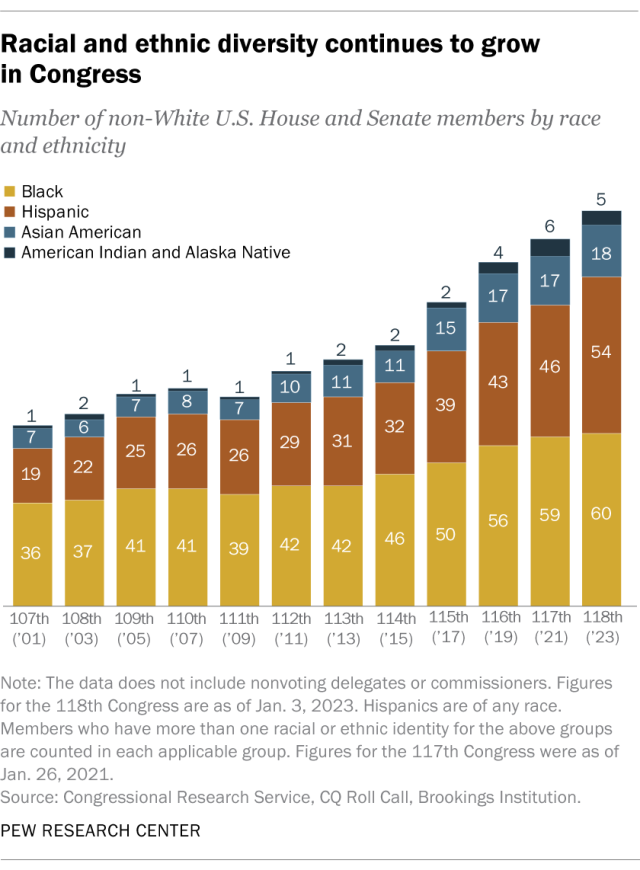
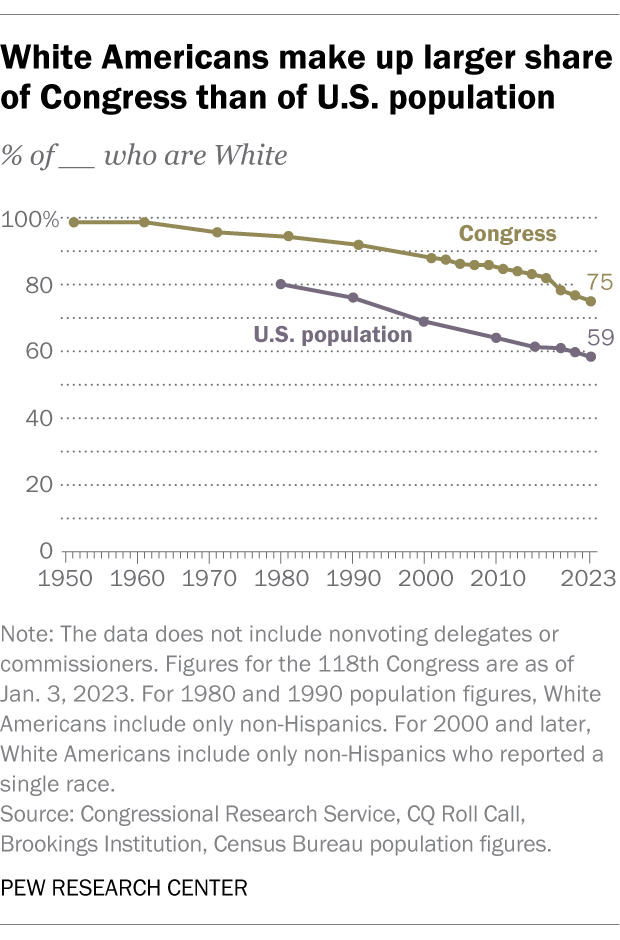
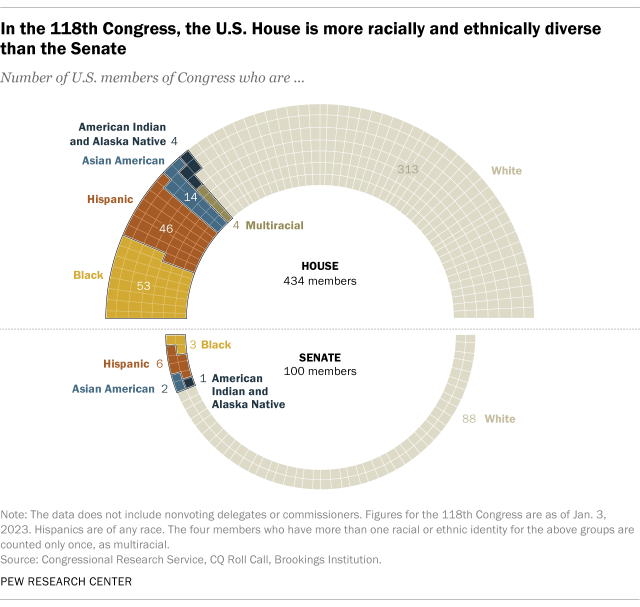
A quarter of voting members of the U.S. Congress identify their race or ethnicity as something other than non-Hispanic White, making the 118th Congress the most racially and ethnically diverse to date. This continues a long-running trend toward more racial and ethnic diversity on Capitol Hill: This is the seventh Congress to break the record set by the one before it.
Overall, 133 senators and representatives today identify as Black, Hispanic, Asian American, American Indian or Alaska Native, according to a Pew Research Center analysis of data from the Congressional Research Service. This number has nearly doubled in the two decades since the 108th Congress of 2003-05, which had 67 minority members.
Our analysis of the 118th Congress reflects the 534 voting members of Congress as of Jan. 3, 2023. Portuguese American members are not included in the Hispanic count.
The vast majority (80%) of racial and ethnic minority members in the new Congress are Democrats, while 20% are Republicans. This split is similar to the previous Congress, when 83% of non-White lawmakers were Democrats and 17% were Republicans.
Sandy Dietrich and Erik Hernandez at the US Census Bureau:
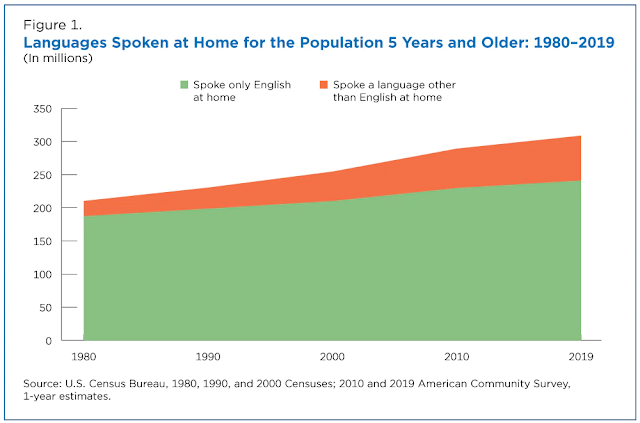
The number of people in the United States who spoke a language other than English at home nearly tripled from 23.1 million (about 1 in 10) in 1980 to 67.8 million (almost 1 in 5) in 2019, according to a recent U.S. Census Bureau report.
At the same time, the number of people who spoke only English also increased, growing by approximately one-fourth from 187.2 million in 1980 to 241 million in 2019 (Figure 1).
The report, Language Use in the United States: 2019, uses American Community Survey (ACS) data to highlight trends and characteristics of the different languages spoken in the United States over the past four decades.
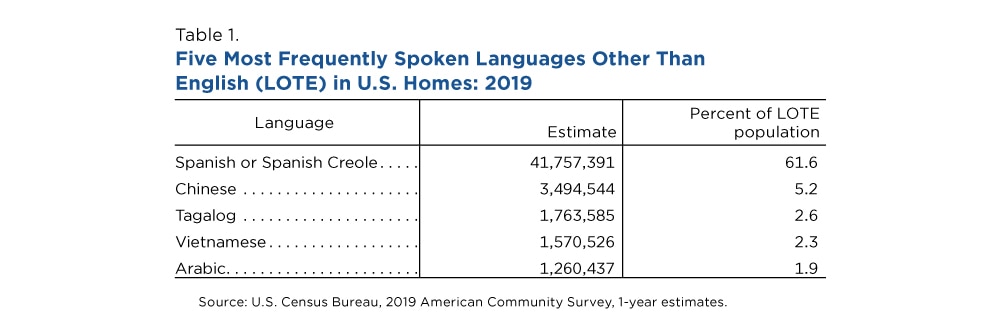
The Hispanic population is the largest minority group in the United States. So it is not surprising Spanish was the most common non-English language spoken in U.S. homes (62%) in 2019 – 12 times greater than the next four most common languages.
When Karen Bass is sworn in as Los Angeles mayor next month, she’ll be making history in more ways than one.
Not only will she be the first woman to lead LA, Bass will complete a rare tetrafecta of sorts: Black mayors will be running the nation’s four largest cities, with the congresswoman joining Eric Adams of New York, Lori Lightfoot of Chicago and Sylvester Turner of Houston.
“Anytime we get a new mayor, it’s exciting,” Frank Scott, the Democratic mayor of Little Rock, Ark., said in a phone interview. “But to have another mayor, a Black woman, who’s going to lead one of our nation’s major cities? That’s a big deal.”
This marks the first time these major metropolises will simultaneously be led by African Americans — and it may be for just a brief period. The leadership acumen of big city mayors is being tested now in how they address issues ranging from upticks in crime, to a sagging economy and high inflation, to housing affordability and homelessness.
And this is all taking place as the cities undergo seismic demographic shifts. All four are “majority minority” cities and these Black mayors are governing municipalities where Latinos, not Black residents, make up the largest non-white ethnic group.
Hispanics accounted for more than half of the growth in the U.S. population, according to the 2020 Census. Meanwhile, New York, Chicago, Los Angeles and other big cities have seen their Black populations shrink in recent years in something of a reversal of what happened in the 1970s. These new migration patterns are altering political dynamics as Latinos consolidate power.
Democrats in cities across America are having trouble holding their coalitions together.
In Los Angeles, the battle is over power in the form of representation on the City Council; in San Francisco and New York, it’s over affordable housing and access to public schools; across the nation, it’s over tough versus tolerant criminal prosecution and lenient versus punitive approaches to homelessness.
These tensions are, in turn, aggravated by white gentrification and have one thing in common: limited or declining resources, with shuttered businesses no longer paying taxes evident on downtown streets. An absence of growth prevents elected officials from expanding benefits for some without paring them for others.
Political tensions between African American, Hispanic American, Asian American and white communities in Los Angeles are now on full display as a result of the publication of a secretly taped conversation that exposed the crude, racist scheming of three Hispanic City Council officials and a Hispanic labor leader — who were, in the main, angling to enhance their power at the expense of Black competitors.
These zero-sum conflicts epitomize the problem for liberals struggling to sustain a viable political alliance encompassing core minority constituencies.
Some observers may dismiss this episode as simply a few biased people. Others might attribute the incident to some Latinos’ exposure to anti-Black ideologies in their home countries.
But our research finds that Latinos’ anti-Black prejudice has strong roots in the United States, which has been steeped in anti-Black racism since its founding. When immigrants arrive here, they and their U.S.-born children learn that however low they might be on the social scale, another group is despised more. A series of such groups, including the Irish, Italians and Poles, earned their identity as Americans by expressing anti-Black prejudice. These efforts have ranged from hurling racial epithets at African Americans to violently keeping Black families out of neighborhoods and schools.
Many Latinos — along with other communities of color — are repeating this same pattern, asserting their position in the American fabric by denigrating Black people. For example, the 2012 installment of the American National Election Study — widely considered a benchmark survey of U.S. politics — examined a large oversample of about 1,000 Latino adults. In that survey, more than half of Latino respondents agreed with statements used to measure anti-Black racism, including: “It’s really a matter of some people not trying hard enough; if Blacks would only try harder they could be just as well off as Whites.”
“They just made public that their colonial minds have not changed,” said Odilia Romero, director and co-founder of Comunidades Indígenas en Liderazgo, or Indigenous Communities in Leadership.
People from native, pre-colonial communities in Latin America have frequently faced harassment in Los Angeles, a city that prides itself for being tolerant and diverse — and not just from white people.
“The assumption that if you are Latino and progressive, you don’t hold racist views, ignores the reality that racism is very deeply ingrained in Mexican and Latin American cultures,” said Gabriela Domenzain, a Mexican American who worked as a Hispanic community expert in both the Obama 2012 and O’Malley 2016 presidential campaigns.
Latin America is one of the world’s most ethnically diverse regions, and throughout its history, racial and ethnic groups have converged there — Indigenous people, white colonizers and Black people brought as slaves. Their mixing gave rise to a “browning” of Latin America, with people of different shades of skin depending on their heritage.
Many people are now of mixed ethnicity, but people with lighter skin have remained at the top of the socioeconomic hierarchy, while those with darker skin, whether Indigenous or Black, often tend to be poorer and to be shut out of elite social and political circles.
That unofficial caste system was exported to the United States, which has its own history of racial stratification and tensions. Among Latinos, who are all considered people of color, studies have found that those who are lighter-skinned are more likely to make economic strides than their darker-skinned brethren, like Black Cubans, Indigenous Mexicans and Central Americans.
“What you get is this convergence of colonial racism from Latin America recreated in communities in the U.S.,” said Lynn Stephen, a professor of ethnic studies at the University of Oregon.
Indigenous Mexicans and Central Americans typically are shorter and have darker skin than other Latinos, and their first language is often not Spanish. Prejudice against them is commonplace at workplaces in farm fields, in restaurants and even on construction sites, where subcontractors sometimes separate Indigenous crews from other Latinos on the same job to avoid conflict.
“We are regarded as dark, short people, brown people who are ugly and ignorant,” said Arcenio López, a former farmworker who is executive director of Mixteco Indigena Community Organizing Project, an organization that advocates for Indigenous field workers in California.
“On top of being exploited by employers, Indigenous farmworkers suffer discrimination from co-workers,” he said.
In our NEW survey of US Latinos, we asked which term is preferred to describe the nation's Latino population -- Hispanic, Latino or Latinx? Or do they have no preference. Here is what we found. @pewidentity @pewresearch https://t.co/vQ2cOqn0tR pic.twitter.com/OHlLPEVatL
— Mark Hugo Lopez (@mhugolopez) September 29, 2022
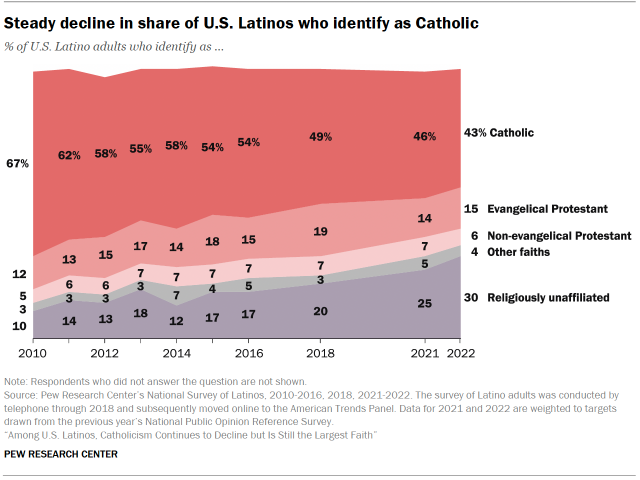
The percentage of Latinos who identify as Protestant — evangelical and other Christian faiths — is expected to grow from about 25% today to 50% by 2030.
Why it matters: More Latinos are leaving Catholicism for Protestant churches, which is influencing the political landscape in the U.S.
By the numbers: Half of U.S. Hispanics identified as Roman Catholic and 15% as evangelical in 2020, according to data from the Public Religion Research Institute.Two decades ago, those numbers were 53% and 8%, respectively.
An Axios-Ipsos Latino Poll in partnership with Noticias Telemundo also found younger generations of Latinos are less likely to identify as Catholic.
The big picture: People who left the Roman Catholic Church are driving most of the Protestant growth among Latinos, studies show.The boom is also attributed to immigration to the U.S. from countries where evangelicalism is already strong, like Guatemala, according to Jonathan Calvillo, assistant professor at Emory University's School of Theology.
Sociologist Aida I. Ramos, dean of the College of Education, Social and Behavioral Sciences at John Brown University, interviewed Latinos who converted for an upcoming study. She says the most common reasons given for the switch are:They feel disconnected from the Catholic Church that they grew up with and the Protestant “style of worship can feel less confined” to them.
Protestant traditions offered them more community support.
What they’re saying: White non-Hispanic Protestants have often worked to convert Hispanics, Ramos says. But, increasingly, “Latinos are converting other Latinos.”“It's actually Latino congregations and congregants who are inviting their family members, inviting their friends, and are introducing the faith to other Latinos,” Ramos said.
Between the lines: Growing evangelicalism among U.S. Hispanic communities is one of the factors moving Latinos to the right on political issues.
Of note: Most Latino Protestants live in Texas, New Mexico and California counties near the border, with growing numbers in south Florida and in Washington state, data from the Public Religion Research Institute shows.
Americans overall are more likely to see the Republican Party as fighting for White people than for Black people — by more than two to one. In fact, more say the Republican Party fights against the interests of Black Americans than is neutral toward them. It's similarly true for views of the Republican Party's approach to Hispanic people, with more feeling it works against them, rather than for them, and by more than two to one, against LGBTQ people than for them. Americans do think the GOP fights more for people of faith than do Democrats.
Conversely, they see the Democratic Party as fighting for Black and Hispanic Americans more so than for White Americans.
Americans are more likely to believe the GOP fights more against the interests of women than for women, and women overall describe things this way.
Men, meanwhile, are much more likely to think the Democrats fight more for women than for men, but a majority of men think the Republican Party fights for them (and more so than for women).
Echoing some of these perceptions are big differences in how partisans within the parties approach the country's racial diversity — and each group's partisans tend to think they're not being treated fairly.
Big majorities of Democrats think immigrants make America better in the long run; a majority of Republicans say they make America worse.
Republicans are more likely to say White Americans suffer "a lot" of discrimination than they are to say Black Americans do.
Democrats see quite the opposite. And Democrats are more likely to say it's very important for political leaders to condemn White nationalism.
Republicans tend to see America's changing diversity as neither good nor bad, but those who take a position tend to say bad. Democrats (whose ranks are made up of more people of color) say it's a good thing.
.The Supreme Court appears poised to overturn Roe v. Wade, the 50-year-old ruling that legalized the right to abortion in the U.S. But Americans consistently show support for legal abortion in at least some circumstances. A majority (56 percent) of the public says abortion should be legal in most or all cases. Approximately four in 10 (41 percent) say it should be illegal. Notably only one in 10 (11 percent) Americans say abortion should be illegal without any exception.
Views differ significantly across religious traditions, but few religious groups oppose the legal right to an abortion. White evangelical Protestants register the strongest opposition to legal abortion. Seventy-eight percent of White evangelical Protestants say abortion should be illegal in most or all cases. Only 20 percent say abortion should be legal. A majority (55 percent) of Hispanic Catholics also believe abortion should be illegal. In contrast, a majority of White Catholics (56 percent), White mainline Protestants (59 percent), and Black Protestants (65 percent) say abortion should be legal. No group more strongly supports the legal right to abortion than religiously unaffiliated Americans—86 percent say it should be legal in at least most cases.
The U.S. Hispanic population reached 62.1 million in 2020, an increase of 23% over the previous decade that outpaced the nation’s 7% overall population growth. At the county level, growth played out unevenly, which resulted in the continued geographic spread of Hispanics. Numerical growth of Hispanics was largest in counties that already had significant Hispanic populations, but the growth rate was largest in counties with smaller Hispanic populations, according to a Pew Research Center analysis of decennial census data from 1980 to 2020.