Search This Blog

Showing posts with label Los Angeles. Show all posts

Monday, June 1, 2026

The Streets of Los Angeles

Many posts have discussed failures of governance in California.

Constance Sommer at LA Reported:

Following this winter’s heavy rains, L.A. motorists reported 6,700 potholes in January, a 49% jump from the previous month. In the past, L.A.’s Bureau of Street Services, also known as StreetsLA, used to try to “repair every pothole within the next business day,” according to a former version of the bureau’s “How Do We Fix Potholes?” page. The current page doesn’t mention repair times at all.

L.A.’s streets are falling apart. At public hearings city workers complain that they can barely keep up with even the most basic street services. Hundreds of street staff were laid off last year. Trucks remain parked at city lots because there aren’t enough people to use them to perform major repairs. Since last July, the city has made do with stopgap measures like plugging potholes and laying down rectangular asphalt patches that stop short of a full resurfacing of the road.

According to the city’s own measurements, 60% of its streets were in good condition a year ago. Now it’s 53%.


Tuesday, May 26, 2026

Housing and Homelessness in LA

A number of posts have dealt with homelessness.  

Andrew Khouri and Doug Smith at LAT:

A 2025 poll from Politico and the UC Berkeley Citrin Center found 61% of California voters supported or somewhat agreed with arresting homeless individuals if they refused offers of shelter.

Benjamin Henwood, director of USC’s Center for Homelessness, Housing and Health Equity Research, said many in the public believe drug addiction and mental health problems to be the main causes of homelessness, because those issues are highly visible on city streets. But he said research consistently shows that while those issues play a role, the main driver is the high cost of housing.

After all, people struggle with addiction and mental health in lots of cities, but those places don’t have the high rates of homelessness seen in Los Angeles.

A recent study by the Benioff Homeless and Housing Initiative at UC San Francisco found that about 37% of homeless people were using illicit drugs regularly, and 25% said they had never used drugs. Just over 65% reported having regularly used at some point in their lives, and 27% had started after becoming homeless.

Tuesday, December 23, 2025

LA Reported

Many posts have dealt with media problems such as ghost newspapers and news deserts.

At The Wrap, Michael Calderone discusses a new initiative by Claremont McKenna College alumni David Dreier and Scott Woolley:

What has transpired in Los Angeles is part of the national crisis, as large city dailies once flush with advertising dollars have contracted, while many smaller papers and muckraking alt-weeklies have shuttered or shrunk. The number of news deserts, communities lacking reliable and timely information, climbed from 206 to 213 this year, according to Medill’s latest study, and this phenomenon isn’t relegated to large, rural expanses. In Los Angeles, a major metropolis where Hollywood and Big Tech are covered from all angles, there are communities, or news “islands,” as former Los Angeles Times executive editor Kevin Merida put it, “without coverage to serve them.”

... 

With nearly 10 million people living in Los Angeles County, there will always be stories untold. Even the Times at its most robust, with a newsroom of roughly 1,200 staffers two decades ago, couldn’t comprehensively cover every community at every moment. But the cutbacks at the Times, and elsewhere, have revealed significant gaps in coverage that journalists and civic leaders are hoping to fill through a variety of models, both for-and-non-profit.

 Forbes veteran Scott Woolley is co-founding and editing LA Reported, which launches on Jan. 8, and will utilize Substack as its primary distribution model. “Our plan is to publish a small number of deeply reported stories, written as lively and engaging narratives,” he told TheWrap. Woolley expects the outlet, which will rely on freelance writers, to cover housing, affordability, political malfeasance, transportation and public safety policy, as well as “some lighter pieces that don’t deal with such weighty topics but are just damn fun to read.”

Thursday, December 18, 2025

Failed State: Wildfire Recovery

Many posts have discussed disasters.

 David Zahniser at LAT:

It was supposed to be a speech with a clear message of hope for survivors of the Palisades fire.

In her State of the City address in April, Los Angeles Mayor Karen Bass called for a law exempting fire victims from construction permit fees — potentially saving them tens of thousands of dollars as they rebuild their homes.

Eight months later, the City Council is still debating how much permit relief the city can afford. Palisades residents have been left hanging, with some blaming Bass for failing to finalize a deal.
Advertisement


“This should have been pushed, and it wasn’t pushed,” said electrician Tom Doran, who has submitted plans to rebuild his three-bedroom home. “There was no motor on that boat. It was allowed to drift downstream.”

Since the Jan. 7 fire destroyed thousands of homes, Bass has been announcing recovery strategies with great fanfare, only for them to get bogged down in the details or abandoned altogether.


After two of the most destructive fires in the state’s history, The Times takes a critical look at the past year and the steps taken — or not taken — to prevent this from happening again in all future fires.
Read the stories

At one point, she called for the removal of traffic checkpoints around Pacific Palisades, only to reverse course after an outcry over public safety. She pushed tax relief for wildfire victims in Sacramento, only to abruptly pull the plug on her bill. Her relationship with Steve Soboroff, her first and only chief recovery officer, quickly unraveled over pay and other issues. He left after a 90-day stint.

Critics in and outside the Palisades say the mayor’s missteps have undermined public confidence in the rebuilding process. They have also made her more politically vulnerable as she ramps up her campaign for a second term.


Tuesday, September 9, 2025

Shadow Docket and ICE

 Ilya Somin at Reason:

Today, the Supreme Court issued a "shadow docket" ruling staying a district court decision that had enjoined ICE from engaging in racial and ethnic profiling in immigration enforcement in Los Angeles. The decision was apparently joined by the six conservative justices; the three liberals dissented. As is often the case with "emergency"/shadow docket rulings, there is no majority opinion. Thus, we cannot know for sure what the majority justices' reasoning was. We have only a concurring opinion by Justice Brett Kavanaugh. But that opinion has deeply problematic elements. Most importantly, it is fundamentally at odds with the principle that government must be "color-blind" and abjure racial discrimination.
The district court found extensive use of racial profiling by ICE in immigration enforcement in the LA area, and issued an injunction barring it. Justice Kavanaugh, however, contends that the profiling is not so bad, and does not necessarily violate the Fourth Amendment because, while "apparent ethnicity alone cannot furnish reasonable suspicion," it could count as a "relevant factor when considered along with other salient factors."

Last month Erwin Chemerinsky wrote at SCOTUSblog::
The Supreme Court long has had an emergency docket. These are matters where a party comes to the court for an order on an emergency basis without full briefing and oral argument. For example, those facing the death penalty often have gone to the court seeking a last-minute, emergency stay of execution. But as Stephen Vladeck documented in his excellent book, The Shadow Docket, over the past decade there was a notable growth in matters decided by the court on its emergency docket.

Since Professor Vladeck’s book was published in 2023, the emergency docket has taken on even greater significance. In the 2023-24 term, there were 44 matters on the emergency docket. In the 2024-25 term, through June 27 (the last day decisions were released), there were 113 matters on the emergency docket.

In the past two months, the court has issued a number of important rulings on its emergency docket concerning the legality of actions by President Donald Trump. Virtually all have been 6-3 rulings, with Justices Sonia Sotomayor, Elena Kagan, and Ketanji Brown Jackson dissenting.
...

Significant rulings without the benefit of full briefing, oral argument, and deliberation among the justices. As a lawyer, I want the opportunity to fully brief my case and to argue it to the court. The procedures in every appellate court are based on the assumption that briefing and argument can matter greatly. Yet, the briefs in cases on the emergency docket are nowhere near as developed as those in cases on the merits, and there is no oral argument. Nor do the justices even meet to discuss these cases before issuing rulings on them. If one believes that briefing, arguing, and deliberating matters are essential to a system of law – and I certainly do – we should be deeply troubled by their absence when the court is issuing major rulings without them.

Thursday, June 12, 2025

DTLA, AI, and Disinformation


As demonstrations against Immigration and Customs Enforcement raids continue in Los Angeles, misleading videos, conspiracies and false claims have spread on social media.

Many of the posts recycle longstanding conspiracy theories, which have often been revived during past episodes of civil unrest. Some posts have made claims that wealthy individuals engineered or financed the protests, and they have racked up millions of views online.

Some posts exaggerate the unrest, using videos of past demonstrations to depict a city overwhelmed by violence. In fact, clashes since the current protests began Friday have remained largely confined to parts of Los Angeles County.
...
One widely shared video of vandalized police cars set ablaze, which was posted by far-right conspiracy theorist Alex Jones and Sen. Ted Cruz of Texas on Sunday, was originally from news coverage of May 2020 protests in response to the death of George Floyd. 
...
Amid the recycled imagery, authentic pictures of National Guard members sleeping on the floor of a federal building in Los Angeles this week were falsely described as old or unauthentic.

The images were initially published by the San Francisco Chronicle on Monday and republished by California Gov. Gavin Newsom on X, who said they served as proof that the deployment was poorly planned, and claimed the soldiers were "without fuel, food, water or a place to sleep."

Some social media users said the images were old and depicted soldiers at previous deployments. Grok, X's AI chatbot, determined the images were likely from Afghanistan in 2021.

However, the images are authentic. Using images published by the U.S. Northern Command and other videos posted to social media, CBS News independently confirmed the images were taken from the loading dock area of the Robert Young Federal Building.

Catherine Kim at Politico:
The latest rollout of accessible AI video generators presents unique challenges to the truth — and public perception of it — because videos are “more powerful as a medium in terms of convincing people of reality,” said Jamie Cohen, an assistant professor at CUNY Queens College who studies internet literacy.

“Pictures are easily manipulated,” he said. “That idea has been there. But when it comes to videos, we’ve just been trained as an individual society to believe videos. Up until recently, we haven’t really had the opportunity to assume videos could be faked at the scale that it’s being faked at this point.”

It’s not just the sheer amount of slop that is filling social media feeds that’s posing a problem. It’s the ability to visually manipulate scenes to fit the creator’s political agenda that is making it so much harder to decipher the truth during the L.A. protests. Consider these completely fake AI-generated videos posted over the past few days: one of a hypocritical protester who preaches peace and then throws a molotov cocktail. Or another of a man screaming “Viva Mexico,” but then cowering away from an officer who says he will take him to Mexico. These clips aren’t just delivering conservative talking points either: This one emanates from the left, featuring a young man delivering a heartfelt speech about standing with his community and fighting injustice.

Until recently, the concern with manipulated images has been related to their ability to misinform a crowd and sway public opinion. But a growing body of research proves that not much can change people’s minds — not even AI misinformation. What the technology can do, however, is reinforce preexisting beliefs, leaving people impervious to actual facts.

Sunday, June 8, 2025

Boots on LA Ground

For the first time in sixty years, a president has activated the National Guard without a request from the state's governor -- in this case, over his vocal opposition.
MEMORANDUM FOR THE SECRETARY OF DEFENSE

THE ATTORNEY GENERAL

THE SECRETARY OF HOMELAND SECURITY

SUBJECT: Department of Defense Security for the Protection of Department of Homeland Security Functions

Numerous incidents of violence and disorder have recently occurred and threaten to continue in response to the enforcement of Federal law by U.S. Immigration and Customs Enforcement (ICE) and other United States Government personnel who are performing Federal functions and supporting the faithful execution of Federal immigration laws. In addition, violent protests threaten the security of and significant damage to Federal immigration detention facilities and other Federal property. To the extent that protests or acts of violence directly inhibit the execution of the laws, they constitute a form of rebellion against the authority of the Government of the United States.

In light of these incidents and credible threats of continued violence, by the authority vested in me as President by the Constitution and the laws of the United States of America, I hereby call into Federal service members and units of the National Guard under 10 U.S.C. 12406 to temporarily protect ICE and other United States Government personnel who are performing Federal functions, including the enforcement of Federal law, and to protect Federal property, at locations where protests against these functions are occurring or are likely to occur based on current threat assessments and planned operations. Further, I direct and delegate actions as necessary for the Secretary of Defense to coordinate with the Governors of the States and the National Guard Bureau in identifying and ordering into Federal service the appropriate members and units of the National Guard under this authority. The members and units of the National Guard called into Federal service shall be at least 2,000 National Guard personnel and the duration of duty shall be for 60 days or at the discretion of the Secretary of Defense. In addition, the Secretary of Defense may employ any other members of the regular Armed Forces as necessary to augment and support the protection of Federal functions and property in any number determined appropriate in his discretion.

To carry out this mission, the deployed military personnel may perform those military protective activities that the Secretary of Defense determines are reasonably necessary to ensure the protection and safety of Federal personnel and property The Secretary of Defense shall consult with the Attorney General and the Secretary of Homeland Security prior to withdrawing any personnel from any location to which they are sent. The Secretaries of Defense and Homeland Security may delegate to subordinate officials of their respective Departments any of the authorities conferred upon them by this memorandum.

DONALD J. TRUMP

10 U.S. Code § 12406 - National Guard in Federal service: call

Whenever—

(1)the United States, or any of the Commonwealths or possessions, is invaded or is in danger of invasion by a foreign nation;

(2)there is a rebellion or danger of a rebellion against the authority of the Government of the United States; or

(3)the President is unable with the regular forces to execute the laws of the United States;

the President may call into Federal service members and units of the National Guard of any State in such numbers as he considers necessary to repel the invasion, suppress the rebellion, or execute those laws. Orders for these purposes shall be issued through the governors of the States or, in the case of the District of Columbia, through the commanding general of the National Guard of the District of Columbia.

(Added Pub. L. 103–337, div. A, title XVI, § 1662(f)(1), Oct. 5, 1994, 108 Stat. 2994; amended Pub. L. 109–163, div. A, title X, § 1057(a)(5), Jan. 6, 2006, 119 Stat. 3440.)


Sunday, February 2, 2025

LA Times Edits an Op-Ed

Post

Conversation

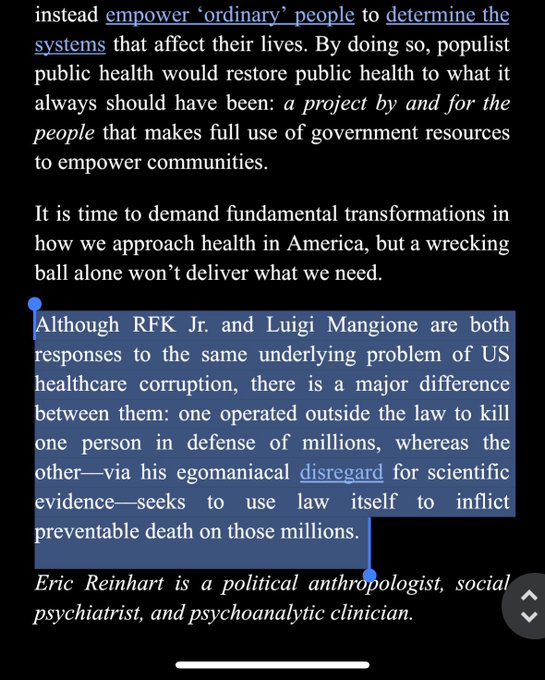
I am the author of this OpEd, which was given a misleading title and from which key lines were cut—lines that made very clear that RFK Jr is dangerously ignorant, has absolutely no business near HHS, and is effectively a mass murderer in waiting.
Quote
Dr. Pat Soon-Shiong
@DrPatSoonShiong
Trump’s healthcare disruption could pay off — if he pushes real reform ⁦@latimes⁩ ⁦@RobertKennedyJr⁩.He is our best chance of doing so latimes.com/opinion/story/
My suggested title, which reflects the content I expected to go to press, was “RFK Jr’s Wrecking Ball Won’t Fix Public Health.” A vote for RFK Jr is a vote for nothing but chaos, the opposite of the essential public-systems building I argue for in the OpEd, and mass death.
Jack Pitney
Post your reply

Editors edit and control final copy and hed; I get that. But editing out a very central and timely point in the minutes before sending to press while then also assigning a title and image that suggest an argument entirely opposite to the author’s clear intent is bad.