Search This Blog

Showing posts with label newspapers. Show all posts

Monday, September 21, 2026

McClatchy: Cutting Jobs, Agentifying the Enterprise


Mark Keierleber at Straight Arrow News:
Just last week, dozens of reporters with at least 17 McClatchy newspapers from coast to coast — including the Miami Herald, The Kansas City Star and the Sacramento Bee — were laid off as the company pivots toward lifestyle content written by artificial intelligence chatbots.

At the Herald, which has won 24 Pulitzer Prizes, including one this year for reporting that led to sex-trafficking charges against Jeffrey Epstein, more than one-third of the editorial staff was let go as the struggling newspaper chain deals with a dwindling readership and a 41% decline in consumer revenue.

The email also recognized McClatchy employees with work anniversaries, including a reporter for the Lexington Herald-Leader in Kentucky, who has been with the company for more than 40 years. That reporter was among the lucky ones. At the Herald-Leader, which has won three Pulitzer Prizes over the past four decades, McClatchy slashed the newsroom staff by more than half.

While McClatchy journalists blasted the layoffs as a devastating loss for local news, company executives framed them as necessary to compete against social media influencers — and survive industrywide woes. Newspapers nationwide have struggled for decades, and some 40% of all local U.S. newspapers have closed shop in the past decade, including more than 130 outlets in the last year alone.

But more than other news companies, McClatchy is leaning into AI as the answer to the existential threats facing the industry.
Even before the layoffs announced last week, McClatchy executives made clear they believe the future of the news industry is AI.

During a contentious, off-the-record virtual town hall in May, company executives said their business was in freefall — and positioned AI as its savior. Executives pleaded with skeptical journalists to get on board, and issued what appeared to be a threat: Embrace AI or get out of the way.

“We have a company-wide effort to agentify the entire enterprise,” McClatchy CEO Tony Hunter said during the town hall, a recording of which was obtained by Straight Arrow.

Wednesday, April 15, 2026

Getting Local News


From Pew:
Americans turn to a range of sources for their local news, and while some traditional local news sources such as TV and radio remain common, growing numbers get local news in other ways.

About two-thirds of Americans (65%) say they at least sometimes get news from their local TV news station – down slightly from the 70% who said the same in 2018, though this remains one of the most popular sources of local news. Americans’ use of local newspapers is decreasing, too: 36% of U.S. adults say they get news from their local daily paper at least sometimes in 2025, compared with 43% in 2018.

Rising shares of Americans are getting local news at least sometimes from online forums or discussion groups (52%, up from 38% in 2018), as well as from local government agencies or officials (40%, up from 30%).

The sharpest growth in usage came from other online-only sources. As of 2025, 42% of U.S. adults say they get news at least sometimes from a source that publishes online only (and was not included in any of the other categories), more than double the share that used these sources in 2018 (15%).

Friday, March 27, 2026

Bad Newspaper News

Many posts have dealt with media problems such as ghost newspapers and news deserts.

Taylor Herzlich at NY Post:

The Washington Post suffered the worst decline in print circulation among the top 25 newspapers in 2025 ahead of bloodbath layoffs earlier this year, as Jeff Bezos’ cancellation of a Kamala Harris endorsement outraged loyal readers, according to new data.

Average daily print circulation at the broadsheet tanked 21.2% in the six months through the end of September 2025 — down to 87,576 from 111,171 the previous year, according to a Press Gazette report citing data from the Alliance for Audited Media.

The Los Angeles Times, owned by billionaire Patrick Soon-Shiong, saw the second-largest drop in average print circulation, falling 19.8% to 63,492,according to the data.

It was another rough year for print papers across the industry, as the combined average daily print circulation of the top 25 largest newspapers fell 12.5% over the same period, and all but one of the top 25 saw declines.

But WaPo and the LA Times were hit especially hard following significant subscription cancellations after the papers’ editorial boards were blocked from printing endorsements of Harris ahead of the 2024 presidential election, according to the Press Gazette report.


Last month, the Washington Post axed a third of its newsroom — more than 300 journalists, including its entire sports desk — ignoring reporters’ impassioned pleas to Bezos.
Alice Brooker at PressGazette:
The combined average daily print circulation at 25 of the largest audited newspapers in the US fell by 12.5% in the six months to the end of September 2025, according to new data from Alliance for Audited Media (AAM). Figures supplied exclusively to Press Gazette show that only one title among the top 25 by combined print and digital circulations saw a rise in print circulation year on year. However, AAM has flagged that its circulation data does not include all digital newspaper subscriptions, and the non-profit organisation rolled out new digital reporting rules in February 2026.

Image


Sunday, December 7, 2025

The News About the News is Still Bad


Our first State of Local News report, published in 2016, examined the local news landscape across America over the previous 10 years, taking data from 2005 as its starting point. Now, in the project’s 10th year, we are able to look back through the past two decades and see dramatic transformations in the ecosystem of local news. Almost 40% of all local U.S. newspapers have vanished, leaving 50 million Americans with limited or no access to a reliable source of local news. This trend continues to impact the media industry and audiences nationwide. Newspapers are disappearing at the same rate as in 2024; more than 130 papers shut down in the past year alone. Newspaper employment is sliding steadily downward. And although there has been some growth in stand-alone and network digital sites, these startups remain heavily centralized in urban areas, and they have not been appearing fast enough to offset the losses elsewhere. As a result, news deserts – areas with extremely limited access to local news – continue to grow. In 2005, just over 150 counties lacked a source of local news; today, there are more than 210. Meanwhile, the journalism industry faces new and intensified challenges including: shrinking circulation and steep losses of revenue from changes to search and the adoption of AI technologies, while political attacks against public broadcasters threaten to leave large swaths of rural America without local news.

 From the press release:

Key findings from the Medill study: 

  • The number of news desert counties rose to 213 in 2025, a jump from 206 in last year’s report. In another 1,524 counties, there’s only one remaining news source. Taken together, some 50 million Americans have limited to no access to local news. Twenty years ago, there were about 150 news desert counties, with about 37 million Americans at the time living in news deserts.

  • The rise in news deserts was accompanied by an increase in newspaper closures, which ticked up to 136 this past year, a rate of more than two per week. Medill tracked 130 in last year’s report.

  • In a marked departure, most of this year’s closures came at smaller, independently owned newspapers — not those controlled by large chains — signaling that an increasing number of long-time family publishers are surrendering to economic pressures.

  • Total jobs at newspapers slumped 7% in the past year. The industry has now lost more than three-quarters of its jobs since 2005.

  • More than 200 newspapers changed hands in the past year, down from the number of transactions last year but still a torrid pace by historical standards.

  • Nearly 300 public radio stations and more than 100 public television stations are producing local reporting. In nine counties, public radio is the sole news source, making those areas especially vulnerable to becoming news deserts in coming months.

  • Utilizing predictive modeling created by the school’s Spiegel Research Center, the Medill team found 250 counties at high risk of becoming news deserts over the next decade.

  • Web traffic to 100 of the largest newspapers has plummeted more than 45% in the past four years, according to a Medill analysis of data tracked by the media analytics company Comscore.

  • The report counted more than 300 local news startups in the past five years across virtually every state, demonstrating a surge of entrepreneurship that has come along with a wave of philanthropic support. The vast majority of those startups, however, are in metro areas, leaving rural and less affluent areas further behind.

  • The number of local news sites that are part of larger national networks is continuing to multiply. This year, there are 849 sites across 54 separate networks, up 14% from the 742 individual sites across 23 networks. This growth illustrates the increasingly prominent role of digital network sites on the local news landscape.

Saturday, November 15, 2025

Presidents and the Press: The Early Years

 Many posts have discussed the relationship between presidents and the press. 

Todd Andrlik at Mount Vernon:

Washington read newspapers voraciously and understood the immense power of the printed word. Bruce Chadwick, one of 37 historian contributors to Reporting the Revolutionary War, wrote in George Washington’s War (2004) that “The help of the press was another part of Washington’s winter [of 1777] strategy. The general read as many newspapers as he could… he had friends in every major city in the states send him their newspapers and asked anyone scheduled to visit him to bring along the latest editions. He read them to find out how the press and public felt about the army – and him – but also to determine what the British were doing.”

The following winter, Washington received authorization from Congress to fund the publication of the New-Jersey Journal, a completely army-controlled newspaper that served as Washington’s mouthpiece and helped offset the political vitriol from James Rivington’s and James Humphreys’ Loyalist papers being printed in British-occupied New York and Philadelphia. The story of the Journal is well told in Chadwick’s volume. In Reporting the Revolutionary War, general audiences can now experience firsthand the same impressive assortment of war intelligence and public opinion that Washington craved from newspapers.

Shannon Duffy at Mount Vernon:

The peak of press attacks against Washington came with the public announcement of the controversial Jay Treaty with Great Britain in 1794, which attempted to ward off an impending war with Britain at the expense of American-French relations. Even before the terms of the treaty were announced, Jay's negotiations stirred up widespread opposition. The hostility was triggered not only by anti-British sentiment, but also by fears that the President was overstepping his authority in negotiating the treaty.

Washington's apparent refusal to acknowledge public opposition to the treaty added to a general discomfort with the power he was wielding. "Belisarius" cast harsh aspersions upon Washington's high-handed manner, which he saw as emblematic of the entire administration: "a brief but trite review of your six years administration, mark the progressive steps which have led the way to the present public evils that afflict your country. . .the unerring voice of posterity will not fail to render the just sentence of condemnation on the man who has entailed upon his country deep and incurable public evils."3

John R. Vile at The Free Speech Center:

In 1792, the new Congress under the Constitution adopted further legislation on the postal service. In setting rates, from 6 cents to 25 cents per letter (depending on the distance it was being sent), Congress provided that newspapers would be charged only 1 or 1 1/2 cents, again based on distance. The law also allowed designated governmental officials including the president, vice president, cabinet officers, and members of Congress to send mail related to their offices for free. This practice, which continues today, is known as the franking privilege.

To facilitate the exchange of information, the law continued the earlier practice that provided that “every printer of newspapers may send one paper to each and every other printer of newspapers within the United States, free of postage, under such regulations, as the Postmaster General shall provide.”

Peter McNamara at The Free Speech Center:

Scholars have traditionally cited 17 indictments and 10 convictions, many upon charges so flimsy as to be comical.  Targets of the act tended to be the editors of Democratic-Republican newspapers who criticized the Federalist administration of President John Adams.
...

The prosecutions and subsequent convictions under the Sedition Act galvanized opposition to the Federalist administration. (Samuel Chase, a Supreme Court justice, was particularly partisan toward the Sedition Act when presiding over prosecutions, and was later impeached for this.) The prosecuted Republican printers and editors became folk heroes. In the election of 1800, the Federalists were swept from power—never to return—and Jefferson, the new Democratic-Republican president, subsequently pardoned those who had been convicted under the law.

Almost 170 years later, the Supreme Court wrote in the celebrated libel case New York Times Co. v. Sullivan (1964): “Although the Sedition Act was never tested in this Court, the attack upon its validity has carried the day in the court of history.” Today, the Sedition Act of 1798 is generally remembered as a violation of fundamental First Amendment principles.


The Federalists in 1800 turned to papers to warn about the election of Thomas Jefferson: 


Monticello:

In order to curb Alexander Hamilton's influence, [James Thomson} Callender published, in his The History of the United States for 1796, a report of the affair between Alexander Hamilton and Maria Reynolds, a married woman.[4] The day before the Alien and Sedition Acts became law on July 13, 1798, Callender fled to Virginia to the home of Senator Stevens Thomson Mason of Loudoun County. Then, in 1799, he moved to Richmond where he wrote for the Richmond Recorder. His anti-Federalist pamphlet, The Prospect Before Us, led to his prosecution under the Sedition Act.[5] He was sentenced on May 24, 1800, to nine months in jail and a $200 fine.

When he got out of jail in the spring of 1801, Callender expected President Jefferson to reward him for his work and his loyalty. He wanted the Richmond postmaster job but he did not get it. In the president's view, Callender was now too radical, and in an attempt to foster reconciliation after the difficult election of 1800, Jefferson did not patronize the more militant or radical Republicans. As Jefferson wrote, "I am really mortified at the base ingratitude of Callender. it presents human nature in a hideous form."[6] In February 1802, Callender joined with Federalist newspaper editor Henry Pace and began to attack both parties, particularly the Republicans and specifically Jefferson. In a series of articles beginning on September 1, 1802, Callender alleged that Jefferson had several children by a slave concubine, Sally Hemings.[7]

Free Speech Center;

Before either of these events, a riot in Baltimore reflected local anger over the publication of the Federalist Republic, a newspaper run by Alexander Contee Hanson.

Reflecting sentiments that prevailed among members of the Federalist Party, it had vehemently opposed American participation in the War of 1812, which Congress had declared at the request of President James Madison, largely over English interference with American shipping. After being driven from his business by rioters, Hanson had retreated to Georgetown but returned to Baltimore where he resumed his vitriolic verbal attacks against the war and its Democratic-Republican supporters.


Friday, September 26, 2025

News Consumption Across Platforms

Many posts have dealt with news media 

From Pew:
News consumption across platforms varies by age, gender, race, ethnicity and educational attainment. For example, Americans ages 50 and older are more likely than younger adults to turn to television and print publications for news – and less likely to use digital sources such as social media or podcasts.

Americans with a college degree are more likely than those without one to get news at least sometimes from news websites or apps, podcasts, or email newsletters. Those without a college degree, on the other hand, are more likely than those with one to say they get news from social media.


Monday, August 18, 2025

Education and News Sources

Many posts have dealt with news media 


For more information about the audiences of these news sources, refer to our News Media Tracker. For a full breakdown of education levels within the audience of each news source, refer to this detailed table.

Note: Here are the questions used for this analysis, the topline and the survey methodology.


Friday, July 11, 2025

The Evaporation of Local Journalism

 Many posts have dealt with media problems.

From Muck Rack:

In 2000, many Americans lived in a community with journalists — people whose job it was to cover school board decisions, announce small business openings and closures, root out corruption at city hall, warn commuters about road work and trumpet the exploits of the high school teams. Today, most of those journalists are gone. The evaporation of local news coverage has hit small towns and big cities, suburbs and rural areas. Even as the country has grown, we’ve lost journalists.


Using data that’s never been tapped before, we now know just how severe this local journalist shortage has become. Less than a quarter-century ago, the United States had about 40 journalists per 100,000 residents on average. Now, the equivalent number is 8.2 Local Journalist Equivalents, about a 75% decline. (Local Journalist Equivalent is a new measure we’re introducing, akin to a Full Time Equivalent or FTE).

...

We also cannot assume the local news crisis is largely a rural phenomenon. The new data shows the extent to which the layoffs of journalists over time have left acute reporting shortages in many urban and suburban areas. If you’re in a big city like Los Angeles, which has a mere 3.6 Local Journalist Equivalents per 100,000 people, your neighborhood might be covered if there’s a serious crime but not much else. You may get little reliable information on local candidates in many of L.A. County’s cities, whether the schools in your neighborhood are improving, whether the hospital nearby has a bad mortality rate, or how inspiring people might be working to repair your playground.

Sunday, February 2, 2025

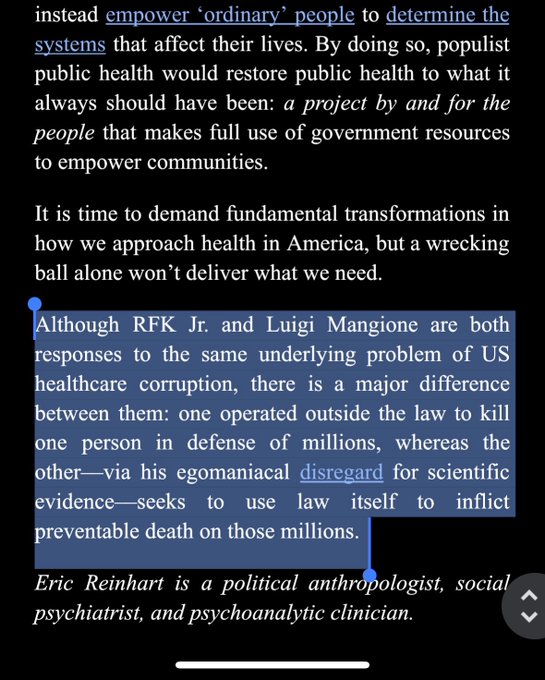
LA Times Edits an Op-Ed

Post

Conversation

I am the author of this OpEd, which was given a misleading title and from which key lines were cut—lines that made very clear that RFK Jr is dangerously ignorant, has absolutely no business near HHS, and is effectively a mass murderer in waiting.
Quote
Dr. Pat Soon-Shiong
@DrPatSoonShiong
Trump’s healthcare disruption could pay off — if he pushes real reform ⁦@latimes⁩ ⁦@RobertKennedyJr⁩.He is our best chance of doing so latimes.com/opinion/story/
My suggested title, which reflects the content I expected to go to press, was “RFK Jr’s Wrecking Ball Won’t Fix Public Health.” A vote for RFK Jr is a vote for nothing but chaos, the opposite of the essential public-systems building I argue for in the OpEd, and mass death.
Jack Pitney
Post your reply

Editors edit and control final copy and hed; I get that. But editing out a very central and timely point in the minutes before sending to press while then also assigning a title and image that suggest an argument entirely opposite to the author’s clear intent is bad.