Search This Blog

Showing posts with label higher education. Show all posts

Thursday, July 30, 2026

Inequality, Households, and Teen College Plans

Many posts have discussed economic and educational inequality


Inequalities feed on one another. Kids from noncollege families engage in fewer extracurriculars,which in turn hurts their chances at getting into good colleges and getting good jobs.

Teens’ planned trajectory after graduation varies dramatically between not only boys and girls but also those with college-educated parents and those without. Nearly three-quarters (74 percent) of teen girls with college-educated parents report that they are planning on going to a four-year college after graduation. About half of teen boys with college-educated parents say they are planning on going to college themselves. Nearly as many teen girls (46 percent) raised in noncollege households plan on attending a four-year college or university. About half as many of their male peers (24 percent) report that they plan on going to college.

Monday, July 27, 2026

Teens, Extracurriculars, and Inequality


Inequalities feed on one another. Kids from noncollege families engage in fewer extracurriculars,which in turn hurts their chances at getting into good colleges and getting good jobs.

Daniel A. Cox reports on the 2026 American Teenagers Survey from the American Enterprise Institute’s Survey Center on American Life:
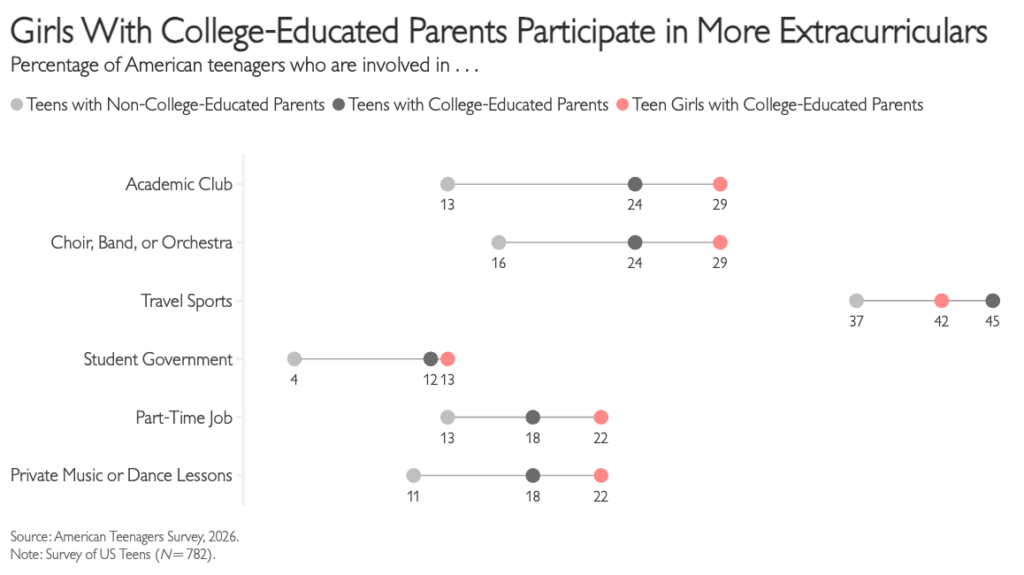
In addition to age, parental education levels shape how teens engage in extracurricular activities. Teens with college-educated parents tend to participate in a greater range of activities than those whose parents do not have a four-year college degree do. For instance, nearly one in four teens—including 29 percent of teen girls—with college-educated parents report participating in an academic club, compared with 13 percent of teens whose parents did not graduate from college. Teens with college-educated parents are also three times as likely to participate in student government or debate as those with less educated parents (12 percent vs. 4 percent).
With an expanding list of extracurriculars to participate in, teens live more scheduled lives now than ever before. Only 28 percent of teens say that they get at least eight hours of sleep every night. Forty-one percent say they get this much sleep a few times a week. Three in 10 teenagers report getting eight hours of sleep no more than once per week.

Sunday, May 31, 2026

Religion and Education

Many posts have discussed the role of religion in American life.


Saturday, May 30, 2026

Faculty Ideology and Campaign Contributions

Many posts have discussed the politics of colleges and universities in the United States.

A release from FIRE:

A new study commissioned by the Foundation for Individual Rights and Expression indicates that donations from faculty at top universities have become increasingly one-sided, with the range of opinion becoming concentrated on the left.

“Free speech is not just the right to speak, it is the condition that lets universities test ideas through real disagreement,” FIRE Vice President of Research Angela Erickson said. “Our findings suggest politically active faculty are clustered within a narrow ideological band, which raises serious concerns about whether students and scholars are getting the full benefit of the open inquiry universities promise.”

FIRE provided University of Rochester Professor David Primo with a list of more than 100,000 faculty members at 55 universities that was first compiled for use in the 2024 FIRE Faculty Survey Report. Primo then analyzed a dataset created by cross-referencing those names with a database of over 850 million state and federal campaign contributions compiled by a Stanford University professor. Faculty members who could be matched with donations were assigned a “CFscore,” a measure used by researchers to estimate a person’s political ideology based on who they donate to.

“Studying faculty campaign contributors provides a unique window into the views of politically active professors,” Primo said. “These data allow us to systematically measure viewpoint diversity at top universities and lay a foundation for strengthening discourse, teaching, and research on college campuses.”

By relying on contribution data rather than voter registration data, Primo was able to measure professors’ ideology instead of just their party affiliation. A Republican professor who gives exclusively to Maine Sen. Susan Collins (CFscore: 0.70) would score differently than a Republican professor giving exclusively to Texas Sen. Ted Cruz (CFscore: 1.52), for example.

The average ideology score of faculty donors in the 55-school sample was -1.02. That’s only slightly less left-leaning than some of the most left-wing members of the U.S. Senate, such as Vermont Sen. Bernie Sanders and Massachusetts Sen. Elizabeth Warren, who are tied with CFscores of -1.14. Notably, there was no equivalent critical mass of donations on the Republican side.


Thursday, May 28, 2026

Problems with Scholarly Journals


Robert Maranto at AEI:
In their current state, scholarly journals are beset with mediocre research, shoddy in its execution and biased in its choice of topics. In the infamous case of the “nudge” studies that affected public policy in multiple countries, Duke University Professor Dan Ariely and Harvard University Professor Francesca Gino (at the time one of the five highest paid Harvard employees) spent nearly a decade faking data, duping both the public and dozens of coauthors.2 Such outright fraud is likely rare, but as Harvard Business School professor and former Gino collaborator Max Bazerman argues, sloppiness and questionable practices like p hacking (stopping data collection and analyses the instant desired findings are found) are common.3 Moreover, as Alvaro de Menard reports in “What’s Wrong with Social Science and How to Fix It,” scholarly studies are rarely replicated, and when they are, the original findings often turn out to be questionable or outright wrong.4

Even worse, in many fields leftist bias in scholarly publication is practically ubiquitous. For example, Richard Kahlenberg and Lief Lin detail how over a three-year period, the leading American studies scholarly journal, American Quarterly, published 77 essays and articles fundamentally critical of America, 19 neutral pieces, and zero America-positive manuscripts.5

Similarly, in a rare bit of investigative reporting, Goldwater Institute political scientist Timothy Minella finds that the American Political Science Association (APSA) governing council in 2020 selected a group calling itself “the Feminist Collective” to edit the APSA’s flagship journal, American Political Science Review (APSR).6 This group declared its intent to “actively dismantle the institutionalized racism, sexism, heterosexism, ableism, and settler colonialism that continue to characterize and structure [political science].”7 As any editor knows, most manuscripts are “desk rejected” by editors rather than sent out for anonymous peer review by scholars in the field. To fight alleged bias favoring heteronormative white males, the Feminist Collective promised in its application to edit APSR that only submissions by the privileged (i.e., heteronormative white males) would face desk rejections. Articles by others enjoyed automatic peer review, an obvious display of discrimination.

Other critical theorists took over the prestigious Review of Educational Research (RER), a journal sponsored by the 110-year-old American Educational Research Association (AERA). The new editors of this hitherto rigorous quantitative journal, devoted to testing hypotheses and presenting research through systematic meta-analyses, announced in their inaugural essay that they would deign to allow quantitative articles, but only from scholars who “apply critical race theory to quantitative data” or “draw their scholarly genealogy from the conflict theory tradition of sociology that centers class conflict.”8 AERA’s critical theory fetish ignores the concerns of classroom teachers, who surveys show focus on student behavior, mental health, and technology use rather than leftist political activism.9


2.Frederick M. Hess, “What If Social Science Is a Scam?,” Education Next, September 30, 2025, https://www.educationnext.org/what-if-social-science-is-a-scam/.
3 Max H. Bazerman, Inside an Academic Scandal: A Story of Fraud and Betrayal (MIT Press, 2025).
4.Alvaro de Menard, “What’s Wrong with Social Science and How to Fix It: Reflections After Reading 2578 Papers,” Fantastic Anachronism, September 11, 2020, https://www.fantasticanachronism.com/p/whats-wrong-with-social-science-and-how-to-fix-it. Perhaps due to its relative ideological diversity, which enables researchers to ask a range of questions, economics does somewhat better than other fields with respect to work quality and bias. Interestingly, colleges and universities led by economists are overrepresented among high performers on the Foundation for Individual Rights and Expression campus free speech rankings. Robert Maranto and Martha Bradley-Dorsey, “Yelling FIRE on Campus: Higher Education Free Speech Leaders and Laggards,” Academic Questions 36, no. 1 (2023): 23–33, https://academicquestions.org/yelling-fire-on-campus-free-speech-leaders-and-laggards/.
5 Richard D. Kahlenberg and Lief Lin, The Distortion of American Studies: How the Field’s Leading Journal Has Embraced a Worldview as Slanted as Donald Trump’s, Progressive Policy Institute, January 22, 2026, https://www.progressivepolicy.org/the-distortion-of-american-studies/.
6Timothy K. Minella, Peer Review Gone Wild: Flagship Political Science Journal Shows How Academic Gatekeepers Promote Ideology over Scholarship, Goldwater Institute, December 2, 2025, https://www.goldwaterinstitute.org/peer-review-gone-wild/.
7 Minella, Peer Review Gone Wild.
8 Mildred Boveda et al., “Editorial Vision 2022–2025,” Review of Educational Research 93, no. 5 (2023): 638–40, https://doi.org/10.3102/00346543231170179.
9 David T. Marshall et al., “Teacher and Research Priorities: To What Extent Do They Align?” (working paper, SocArXiv, December 20, 2025), https://doi.org/10.31235/osf.io/h82rk_v1.


Wednesday, May 13, 2026

GOP v. Trends in Higher Ed


Schickler E, Rodriguez EM. The College Campus and the Culture War: The Development of Party Polarization on Higher Education, 1980–2025. Studies in American Political Development. Published online 2026:1-21. doi:10.1017/S0898588X26100327

Abstract
We draw on a dataset of 1,044 state and national party platforms from 1980 to 2025 to track the evolution of Democratic and Republican positions with respect to higher education. The sector enjoyed considerable bipartisan support in the 1980s and early 1990s, with both parties generally expressing the view that 4-year colleges and universities contribute to economic vitality and student advancement. Starting in the mid-1990s, Republicans’ position gradually became more critical—even so, there is considerable diversity in views across states as late as 2010. In recent years, the party’s platforms have become almost uniformly negative toward higher education. The first line of GOP criticism focused on concerns about speech and alleged liberal bias. In the past decade, the party increasingly focused its criticism on higher education’s approach to racial and gender/sexuality issues—just as the intensity of opposition ramped up. Democratic platforms show much more stability but have expressed increased concern about college costs since the 2010s. Democrats also became more likely to express a liberal position on race and gender/sexuality policies just as the GOP became more vocal in criticizing these policies from the right. Our evidence suggests that the shift in the GOP’s positioning began at the national level and was instigated by nationally oriented ideological activists rather than mass-level demands. In a highly polarized and nationalized two-party system, the case of higher education illuminates the dangers that exist for any civil society institution when one party becomes hostile to its purposes and orientation.

Saturday, May 9, 2026

Neighbors and Inequality

Many posts have discussed social capitalvolunteering and civic virtue.

Daniel A. Cox, Jae Grace, Avery Shields, "Strangers Next Door: The Decline of Neighborhood Socializing and the Class Divide in Belonging," AEI 5/5/26 

Key Points
  • Since 2012, the percentage of young adults who talk to their neighbors at least a few times per week dropped from 51 percent to 25 percent. Among seniors, the decline was only seven points (63 percent to 56 percent).
  • Compared with Americans without a degree, college-educated Americans are more likely to have worked with their neighbors to improve a condition in their community (46 percent vs. 34 percent), spent a social evening with a neighbor (58 percent vs. 46 percent), and exchanged texts or emails with a neighbor (65 percent vs. 45 percent).
  • Forty-nine percent of Americans who attend religious services weekly talk to their neighbors regularly, compared with only 31 percent of Americans who never attend religious services.
Executive Summary

The 2025 American Neighbor Survey explores the various ways in which Americans are—and are not—interacting with the people in their immediate communities. In the past decade, the frequency of neighborly interactions has plummeted. This withdrawal has been particularly prevalent among young adults, while seniors have remained more consistently in touch with their neighbors. College-educated Americans also experience stronger neighborhood ties. Compared with Americans who have a high school degree or less, college graduates are more trusting of their neighbors, socialize with them more frequently, and are quicker to rely on them for help in times of need. The report also examines the association between attending religious services and the health of neighborhood ties, finding that more frequent attendees are more engaged neighbors.

Sunday, April 26, 2026

The Impact of State and Federal Policies on Academic Researchers


Ithaka S+R The Impact of State and Federal Policies on Academic Researchers
Findings from a National Survey Dylan Ruediger, Chelsea McCracken, Jonathan Barefield
In open-ended comments left by 663 survey respondents, concerns about the state of academic freedom within the research enterprise were a common theme. Recent federal policies, noted one, are “beyond perilous for the system of higher education, and will have a far-reaching impact on the quality of life in the US and the world.” Another described their state government as working aggressively to limit academic freedom and institutional autonomy. While a few respondents noted that they agreed with the premise of divisive concepts or anti-DEI legislation or felt that this type of legislation had improved academic freedom, we heard most often from those who expressed concern that the future was bleak. “The collective institutional research capacity of the United States is in free-fall,” said one respondent, “we are losing our leadership position in the world.”

Key findings: 
  • State and federal policies targeting divisive concepts or DEI are shaping research agendas at scale and across disciplines. Twenty percent of all respondents, and 29 percent of researchers working in states with divisive concepts or similar laws, reported having avoided certain research topics because of state laws and policies.
  • Eight percent of respondents representing a wide range of disciplines reported having had a federal grant cancelled in 2025.
  • Eleven percent of respondents reported that federal and state policies restricting research activities are compelling them to seek employment out of state, to leave the academy, or to look for academic positions overseas.
  • Researchers, particularly those at doctoral institutions and those employed in states with divisive concepts legislation, report concerns about whether university presidents and, especially, boards are willing to advocate for their academic freedom as researchers.

Tuesday, April 21, 2026

Trust in HIgher Education

Elite academia leans heavily to the left.

Report of the Yale Committee  on Trust in Higher Education

 It should come as no surprise that trust in higher education has fallen most among those Americans who identify as Republican or conservative. According to Gallup, the percentage of self-identified Republicans who expressed “a great deal” or “quite a lot” of confidence in higher education declined from 56 percent in 2015 to 26 percent in 2025, while confidence among Democrats fell more modestly, from 68 to 61 percent.42 In one national survey, only 19 percent of Republicans expressed “quite a lot” of confidence that the nation’s leading research universities “teach students neutrally and without political bias.”43 
The complaint that colleges and universities lean left is hardly new. William F. Buckley, Jr., made much the same case about Yale in 1951.44 Yet something distinctive has happened in recent decades. In 1989 approximately 40 percent of the nation’s faculty identified as liberal, 40 percent as moderate, and 20 percent as conservative. By 2014, those numbers had shifted to 60 percent liberal, 30 percent moderate, and 10 percent conservative.45 Of course it is not just the faculty that has changed. The political system has changed too. Fifty years ago, the Democratic and Republican parties were less ideologically divided than they are today. As the parties resorted, so did the partisan preferences of many professions, including within higher education. 

42 Jeffrey M. Jones, “U.S. Confidence in Higher Education Now Closely Divided,” Gallup, July 8, 2024; Jones, “U.S. Public Trust in Higher Ed Rises From Recent Low.” 43 Ken Goldstein, “Yale public opinion studies: September 2025 national, state, and local studies,” presentation, November 19, 2025. 44 William F. Buckley, Jr., God and Man at Yale: The Superstitions of Academic Freedom (Regnery, 1951). 45 Samuel J. Abrams, “Mind the Professors,” The American Interest, March 10, 2017. 


Friday, April 3, 2026

Decline of Elite-Educated Republican Lawmakers

Many posts have discussed the politics of colleges and universities in the United States.

Volden C, Wai J, Wiseman AE. On the Decline of Elite-Educated Republicans in Congress. Perspectives on Politics. 2026;24(1):256-268. doi:10.1017/S1537592725102260
We identify a rise in educational polarization among members of the US Congress mirroring the educational polarization in the American mass public. Over the past half-century, the percentage of Republican representatives who attended elite educational institutions declined from 40% to 15%, and the percentage of similarly educated Republican senators declined from 55% to 35%, while the ranks of elite-educated Democrats rose in both chambers. These changes across the parties have mapped into observable differences in behavior and approaches toward lawmaking. We find that elite-educated legislators are much more liberal in their voting patterns, suggesting a link between the decline in elite-educated Republicans and ideological polarization in Congress. We also demonstrate that, in the House, elite-educated Democrats are especially effective lawmakers, but not so for elite-educated Republicans. In the Senate, we establish a link between the decline of elite-educated Republicans and the rise of partisan warrior “Gingrich Senators.” Overall, these patterns offer initial glimpses into how political elites are being drawn from different educational cohorts, representing an important transition in American governance.


Friday, March 20, 2026

Leftward Trend in Social Science Research?


Manzi, J. The ideological orientation of academic social science research 1960–2024. Theor Soc 55, 25 (2026). https://doi.org/10.1007/s11186-026-09690-2
This study analyzes approximately 600,000 English-language social science abstracts published between 1960 and 2024 to estimate the long-run ideological orientation of disciplinary research output. Large language models (LLMs) were applied to each abstract using a fixed 2025 U.S. ideological spectrum, enabling consistent coding across six decades. Five key findings emerged. First, roughly 90 percent of politically relevant social science articles leaned left 1960–2024, and the mean political stance of every social science discipline was left-of-center every year during the period. Second, all disciplines showed leftward movement between 1990 and 2024. Third, policy-proximal disciplines generally showed limited rightward moderation between roughly 1970 and 1990, though policy-distal disciplines did not. Fourth, disciplines with greater leftward orientation generally displayed greater ideological homogeneity Fifth, sociocultural content was more consistently left-leaning than economic content, and that gap widened over time. Robustness checks using a wide assortment of alternative datasets and analytical methodologies indicated that these findings were unlikely to be artifacts of idiosyncratic assumptions. Methodologically, the study demonstrates the capacity of LLM-based text classification to deliver reliable, large-scale ideological measurement over time, a task previously impractical with human coding alone. Taken together, the analysis provides the first systematic, cross-disciplinary evidence of the long-run political orientation of anglophone social science scholarship, revealing both the persistence and the intensification of its leftward tendencies, particularly in sociocultural domains.

Huge caveat, from the article:In this study, ideology was operationalized as the relative positioning of a given text along a left–right spectrum of U.S. political thought. This includes economic and sociocultural dimensions, each characterized by their association with recognizable ideological actors and institutions. To ensure interpretive consistency over a 65-year period (1960 to 2024), political stance was evaluated against a fixed 2025 reference frame, derived from contemporary U.S. political categories.

This approach involved trade-offs. Using a static ideological scale, anchored to notions such as the 2025 political positions of Joe Biden, Elizabeth Warren, or the Heritage Foundation, ensured that the LLM’s judgments were grounded in stable, well-defined anchor points. It avoided the problem of ideological drift, in which the meaning of ‘left’ or ‘right’ might evolve over time due to shifting partisan alignments or cultural contexts. However, this came at the cost of temporal anachronism. Texts written in earlier decades may have been judged by standards they would not have recognized.

There is no doubt that the academy leans left, and has done so for a long time.  But the core problem with Manzi's analysis is that the entire US political spectrum has moved to the left, especially on cultural issues.  On abortion, civil rights, marriage, gender equality and a range of other issues, positions that were once radical left (e.g., support for same-sex marriage) are now mainstream.  Judge Glock at National Affairs:

The interaction of politics, policy, and public opinion should change how we look at polarization. In one sense, some conservative Republicans have indeed moved away from what we now consider the center. But the center itself has also changed, and veered emphatically to the left. Both parties, to varying degrees, have followed this shift over time. The changing context helps explain why each party can see the other as "radical" relative to what it considers the center, and why the argument that the right has moved rightward more than the left has moved leftward is unpersuasive.


Sunday, March 15, 2026

Policy Schools Are Short on Conservative Voices

Many posts have discussed the politics of colleges and universities in the United States.

Frederick Hess at AEI:

It’d be good for everyone if there were a deeper bench of Republican policy professionals who really knew how government works. That’s why it’s such a big problem that the nation’s public policy schools serve as owned-and-operated subsidiaries of the Democratic Party.

Faculty at leading programs lean lopsidedly to the left; unsurprisingly, they emphasize predictable priorities, such as prison reform, homelessness, or healthcare. The technocratic progressives are joined by colleagues who go further still, recasting policy debates in identity-driven and baldly ideological terms to “expose” systemic racism and the evils of U.S. capitalism.

Right-leaning priorities are routinely marginalized or dismissed as backward-looking, as is the case with immigration enforcement, entitlement reform, educational choice, or tax-cutting. As a result of this bias, a broad swath of aspiring conservative policy professionals has sensibly opted to avoid these programs altogether. The result: Republicans are short on skilled policy professionals, while left-leaning students and scholars operate in a blue bubble in which they too rarely engage with those who think differently.

Sunday, October 26, 2025

America's Self-Lobotomy


Three of the six U.S. winners in the 2025 Nobel Prize science categories immigrated to the United States, one of them as a teenager. These examples of immigrants contributing to science and technology fields come as Trump officials have proposed or enacted new policies to restrict immigration, including that of highly skilled individuals. The Trump administration’s policies include limiting international students to fixed entry periods and restricting H-1B visas, which are typically the only practical way for high-skilled foreign nationals to work in the United States. The measures include imposing a $100,000 fee on the entry of many H-1B visa holders, as well as an upcoming H-1B rule. The latest Nobel Prize announcements provide an opportunity for Americans to learn more about the achievements of their fellow citizens.
The pipeline for Ph.D.s out of U.S. universities is shrinking at an unprecedented rate: Spots are disappearing, interest is fading and other countries are eager to fill the void.

Why it matters: America graduates more Ph.D.s than any other country. They go on to invent things, cure diseases and win Nobel Prizes.

“There are some permanent effects,” said Emily Levesque, an astronomer at the University of Washington. “There’ll be students who never got to pursue Ph.D.s. That’s a group of experts that’s lost forever.”

By the numbers: Harvard is cutting Ph.D. admission slots in sciences by 75% and in humanities by 60%, the Harvard Crimson reported this past week.Several departments at other top universities are shrinking admit pools or pausing admissions altogether, Nature’s Alexandra Witze reports. MIT admitted fewer biology Ph.D.s this year than last. The University of Washington’s astronomy department is suspending Ph.D. admissions for the upcoming academic year.
Brown is pausing PhD admissions in at least six humanities and social science departments, per The Brown Daily Herald.

Zoom out: Trouble has been brewing for years. ”This is an acceleration of a trend that was already underway,” said Julie Posselt, a professor of higher education at the University of Southern California. “It’s not a situation that we can solely place blame on the Trump administration for.”As more graduate students unionize, it’s becoming tougher for universities to afford their salaries, pushing some programs to shrink, she notes.
Even before the Trump administration started revoking international students’ visas, many were already choosing programs in Australia, China, the U.K., Germany and beyond over U.S. schools.
At the same time, the “is college worth it?” debate looms large, and many prospective students are wary of taking on debt to pursue grad school. About 70% of Americans say higher education is “going in the wrong direction,” per a recent Pew Research Center survey.

Sunday, September 14, 2025

The Economic Value of College

    The share of Americans who say college is "very important" plummeted over the past decade, new Gallup polling finds.

    Why it matters: College may not live up to the American Dream that it promised in the past, and there are other pathways for success becoming more appealing for Gen Z, but in terms of lifetime earnings, a college degree is actually still incredibly important.

    The big picture: There are plenty of reasons for the decline in perceived value among Americans.School is expensive, student loan debt is often onerous and job security for those with degrees has diminished— even more so with the advent of AI. Plus, at the moment new graduates are seeing higher unemployment rates.
    There's also growing interest and appeal for young adults in the skilled trades — becoming plumbers, electricians, etc. — especially as AI appears to threaten white collar work.

    Between the lines: There's also been loud criticism, particularly from conservatives, over the political leanings of universities, criticized as "elitist" "woke" "leftist," etc.Yet both Democrats and Republicans express far less support for higher education than they did more than a decade ago.

    By the numbers: In 2013, 68% of Republicans said a college education was very important; this year that number fell to 20%, per Gallup.There's an even split between Republicans who say it's "not too important" (39%) and those who say it's "fairly important" (39%).Democrats went from 83% who said college was "very important" to 42%. Most, however, describe college as "fairly important."

    Where it stands: College grads earn more than twice what high-school graduates make.The median income in a household headed by someone with at least a bachelor's degree was $132,700 last year — that's more than double the $58,410 median income of a household led by a high-school grad, according to Census income data released last week.

    And earnings for college-led households have pulled away from the pack — rising more than 6% over the past two decades, compared with a 3% increase for high school graduates.


Monday, August 18, 2025

Education and News Sources

Many posts have dealt with news media 


For more information about the audiences of these news sources, refer to our News Media Tracker. For a full breakdown of education levels within the audience of each news source, refer to this detailed table.

Note: Here are the questions used for this analysis, the topline and the survey methodology.


Friday, August 15, 2025

Class Segregation

 Many posts have discussed economic and educational inequality. The effects of inequality reach many corners of American life.

David Brooks at NYT:

This experience has produced in me one central conviction about what ails America: segregation. Not just racial segregation — which at least in schools is actually getting worsebut also class segregation. I’m constantly traveling between places where college grads dominate and places where high school grads dominate, and it’s a bit like traveling between different planets.

Back in 2003, Theda Skocpol of Harvard published a book called “Diminished Democracy.” One of her arguments was that more Americans used to join cross-class community organizations like the Rotary or the Elks clubs. But gradually, highly educated people left them for professional organizations filled with others more like themselves. Skocpol wrote: “Once highly educated Americans would have been members and leaders of such cross-class voluntary federations. Now many barely know about them.”

That self-segregation was symptomatic. Many college-educated people were at the same time segregating themselves in neighborhoods where nearly everybody had college degrees into professions where everybody did, into social circles in which you can go weeks without meeting somebody from the working class. Last year a group of researchers published a study in the journal Nature in which they surveyed leaders in 30 fields, including law, media, politics and so on. They found that not only had nearly all of society’s power brokers gone to college, 54 percent of them went to the same 34 elite schools. That’s segregation on steroids.

Those of us in the college-educated class are good at segregating ourselves from others, but we’re astoundingly good at segregating our kids — simply by equipping them to join our ranks. Before kindergarten, the children of the affluent are much more likely to be in preschool. By sixth grade, students in the richest school districts are four grade levels above children in the poorest school districts. By high school, richer kids’ average reading skills are five years ahead of poorer kids’. By college, according to a 2017 study led by Raj Chetty, children from the richest 1 percent of earners were 77 times more likely to go to Ivy League schools than children from families making $30,000 a year or less. In his 2019 book, “The Meritocracy Trap,” Daniel Markovits writes that the academic gap between the affluent and less affluent is greater today than the achievement gap between white Americans and Black Americans in the final days of Jim Crow


Tuesday, August 5, 2025

Employment Class Divide

 Many posts have discussed economic and educational inequality. The effects of inequality reach many corners of American life.

Emily Peck at Axios:

College-educated women, particularly mothers, triumphed in the work force in recent years; for those without a degree, the story is less rosy.

Why it matters: The difference is likely about job quality — women with degrees can land positions with paid leave and flexibility that allow them to manage parenting and paid work (a responsibility that they're more likely to shoulder).
Those without degrees are not as lucky and are more likely to wind up in low-paying, service-sector roles with inconsistent schedules.

By the numbers: The share of college-educated women age 25-44 working full time increased to 73%, from 64%, over the past two decades, per an analysis of Census data shared exclusively with Axios, by Third Way, a center-left think tank.Non-college women's participation in the workforce meanwhile has essentially stagnated, only increasing by a single percentage point to 53% over that same period.

Zoom in: Mothers with college degrees are driving these advances.The share working full-time spiked to 68% in 2024, from 57% in 2004; while not budging for moms who didn't finish college.

The big picture: The rise of remote work has been particularly pivotal for women, allowing them to stay employed and still get parenting done — take children to the doctor, drop them off at the bus, etc.

Friction point: The education divide is even worse for men.The share of men without college degrees in the workforce has been declining for years, for different reasons — and not merely stagnating as it is for their women peers.

Between the lines: Unlike other advanced economies, the U.S. doesn't have any kind of nationwide paid family leave or sick leave offerings — instead it's left up to private businesses to decide what kinds of benefits to offer employees.


Saturday, May 24, 2025

Higher Education Fights Back


Over the course of the past week, the federal government has taken several actions following Harvard’s refusal to comply with its illegal demands. Although some members of the administration have said their April 11 letter was sent by mistake, other statements and their actions suggest otherwise. Doubling down on the letter’s sweeping and intrusive demands—which would impose unprecedented and improper control over the University—the government has, in addition to the initial freeze of $2.2 billion in funding, considered taking steps to freeze an additional $1 billion in grants, initiated numerous investigations of Harvard’s operations, threatened the education of international students, and announced that it is considering a revocation of Harvard’s 501(c)(3) tax-exempt status. These actions have stark real-life consequences for patients, students, faculty, staff, researchers, and the standing of American higher education in the world.

Moments ago, we filed a lawsuit to halt the funding freeze because it is unlawful and beyond the government’s authority. I encourage you to read our complaint.
Yale President Maurie McInnis:
Earlier today, the U.S. House of Representatives passed legislation that proposes to raise the tax on the investment income of Yale and a number of other universities from 1.4% to 21%. Each year, this increased endowment tax would strip from Yale’s budget hundreds of millions of dollars that currently fund financial aid, research, scholarship, and teaching.

This legislation presents a greater threat to Yale than any other bill in memory. Today, I ask you to join me in defending the research that saves lives and keeps America competitive, the faculty who enrich minds and help us make sense of our complex world, and the students who keep our future bright. What is at stake is Yale’s ability to offer financial aid, to contribute to the vitality of our nation’s culture and civic life, and to introduce discoveries and innovations that transform the world.
A federal judge on Thursday blocked the Trump administration’s wide-reaching effort to detain and deport international students, barring the federal government from arresting those students or revoking their visas while the case plays out in court.

Judge Jeffrey S. White of the Northern District of California, who was appointed to the court by President George W. Bush, granted a temporary injunction protecting international students who were among the thousands whose visas were revoked earlier this year without clear justification, writing that government officials had “uniformly wreaked havoc” and “likely exceeded their authority and acted arbitrarily and capriciously” by the mass revocation of students’ immigration status.

“The relief the court grants provides plaintiffs with a measure of stability and certainty,” Judge White wrote in the 21-page order. “That they will be able to continue their studies or their employment without the threat of re-termination hanging over their heads.”

It's not just the "woke" Ivy League.  CAITLIN OPRYSKO at POLITICO:

Hillsdale College has become an exemplar for higher education on the right, even partnering with the White House last month. But the conservative Christian school located in Michigan has turned to K Street in an effort to avoid being swept up in congressional Republicans’ efforts to crack down on “woke, elite universities,” according to a disclosure filing.

Hillsdale last month retained Williams and Jensen to lobby on “specific threats to the institutional and financial independence of the college, primarily related to the higher education endowment tax,” the filing shows. The team of lobbyists working on the account includes Dan Ziegler, who served as House Speaker Mike Johnson’s top policy aide before returning to the firm in March.

— Wealthy universities were first hit with a 1.4 percent excise tax on their endowments in the 2017 GOP tax law. But the reconciliation package approved last week by the House Ways and Means Committee calls for a tiered endowment tax that would see some schools’ rate soar as high as 21 percent.

— Hillsdale dodged an endowment tax once before. During Senate debate on the 2017 tax bill, four Republicans sided with all Democrats to strip out language that would have exempted schools that don’t accept federal financial aid — a provision lawmakers said would have only applied to Hillsdale. But the size of Hillsdale’s endowment, when adjusted for the number of students, fell below the threshold included in the final bill, sparing the college.

— That’s no longer the case. Under the House bill, Hillsdale would be eligible for the lowest rate of 1.4 percent. The bill includes a provision that would exempt certain religious institutions from the endowment tax, though it’s unclear if that would apply to Hillsdale. Hillsdale did not respond to a request for comment.

— The school’s president, Larry Arnn, ripped the House proposal in an op-ed last week that called the changes “not merely bad policy,” but “a profound inversion of the American idea.”

— Arnn argued the bill, as approved by the Ways and Means Committee, “penalizes most severely those institutions that have chosen the harder path of independence,” by refusing federal funds, while leaving “untouched the vast web of colleges and universities sustained by taxpayer dollars, often bloated with bureaucracies committed to fashionable ideas, far removed from the purposes of education.”

— “Worse still,” he continued, “this tax turns the incentives backward; it rewards dependence and punishes self-reliance. It encourages institutions to seek the shelter of government aid, where subsidies can offset tax burdens.”