Search This Blog

Showing posts with label international perspectives. Show all posts

Wednesday, October 7, 2026

Perceptions of Media Freedom

 Many posts have dealt with media problems.

Benedict Vigers at Gallup:

Even though most Americans continue to say the U.S. media have a lot of freedom, the percentage saying so has reached a new low this year. Slightly more than two in three Americans (69%) surveyed in May and June say there is a lot of media freedom in the U.S., down six percentage points from the previous low of 75% in 2025.

...

For much of the past 15 years, perceptions of media freedom in the U.S. have outpaced those in other advanced economies. Across 38 Organisation for Economic Co-operation and Development (OECD) countries, median perceptions of media freedom have typically hovered around 80%, slightly lower than in the United States. Last year was the first time on record that the two were tied, both at 75%, despite similarities in 2023 and 2015, when the U.S. advantage was smaller. While Gallup has not yet completed data collection in all OECD countries this year, based on available data, the OECD median will be between 70% and 76%. This means that 2026 is the first year on record in which the U.S. ranks below the bloc's median.

Thursday, July 23, 2026

Politics as a Safety Risk

Many posts have discussed  partisan polarization and political violence.

Benedict Vigers at Pew:

Although Americans are most likely to name road accidents and crime as the two biggest threats to their personal safety, no other population in the world is more likely to identify politics as a safety concern.

According to a 2026 Lloyd's Register Foundation World Risk Poll report, one in 10 U.S. adults identify politics as the greatest source of risk to their personal safety when asked an open-ended question. This is up from 6% in both 2021 and 2023 and 10 times the global average of 1% across 140 countries.

The U.S. statistically ties with Hungary (at 9%, measured several months before the recent election) for the highest percentage of adults identifying politics as their top safety concern. Other countries with relatively high percentages of mentions include Serbia, Latvia and Lithuania (at 6% each) and Slovakia, Russia, Myanmar, Spain and Israel (all at 5%).

...

Polarization unites these responses, whether people express it directly or indirectly. Many Democrats cite the current administration, while many Republicans point to the Democratic Party — both indirect demonstrations of polarization. However, others from across the political spectrum name polarization and the wider political climate directly when thinking about risks to their safety:

“I would have to say the state of polarization of the American people.” (Republican, 54, Male)

“I would say political extremism. I don't have a lot of personal risk, but I do feel the biggest risk is people that are fanatical about their position and that they could be violent.” (Independent, 42, Male)

“The political situation has a lot to do with the fact whether if I am safe or not. I am concerned where we're going or might go.” (Democrat, 69, Female)


Thursday, July 16, 2026

In Global Public Opinion, the US is Losing to China


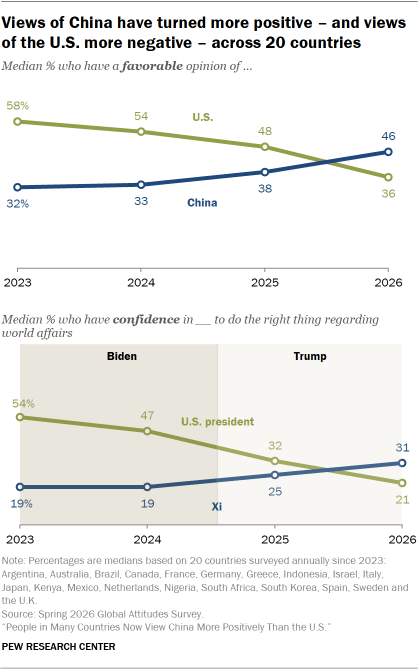
Global views of the United States worsened last year as President Donald Trump’s second term began, though most people still had a more positive opinion of the U.S. than China. This year, that is no longer the case.

Views of China have improved in recent years while opinions of the U.S. have worsened, to the point where China is now seen more positively than the U.S. in most of 36 countries surveyed.

Confidence in these countries’ respective leaders to do the right thing regarding world affairs has followed a similar pattern. In the latter half of Joe Biden’s presidency, confidence in him was higher than confidence in Chinese President Xi Jinping across most countries surveyed, though Biden’s rating declined in many places from 2023 to 2024.

During the first two years of Trump’s second term, ratings of the U.S. president worsened significantly. While many people still lack confidence in Xi, positive views of him have become more widespread, and more overall now say they have confidence in Xi than in Trump.

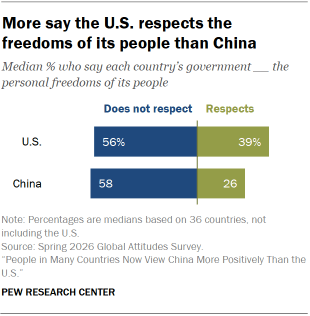
One area where the U.S. still gets higher ratings than China has to do with personal freedoms: More say the U.S. government respects the personal freedoms of its people than say the same of the Chinese government. Still, the gap has been narrowing – driven by large drops in the shares saying the U.S.  government respects personal freedoms.


Friday, July 3, 2026

The Hardest Constitution to Amend

There has not been a constitutional convention since the original in Philadelphia. A 2016 report from the Congressional Research Service discusses the process of calling a convention, as well as the questions and uncertainties surrounding that process. There have been 27 amendments, but passing one is very hard.

 Drew DeSilver at Pew:

In Pew Research Center surveys, Americans overwhelmingly favor several proposed changes to the U.S. political system, from term and age limits for government officials to campaign finance limitations. But many of those changes would require amending the Constitution, which is extremely difficult. The Constitution has been in effect for 237 years but has been formally amended just 27 times.

Using a classification scheme developed by the late political scientist Donald S. Lutz, we scored the amendment rules of 101 democratic constitutions. (The other five democracies have “uncodified” constitutions, meaning their governance rules are distributed across multiple statutes, legal precedents, customs and unwritten norms.) For constitutions that contain more than one amendment procedure, we used the “least difficult” path, which may or may not be the most frequently employed.

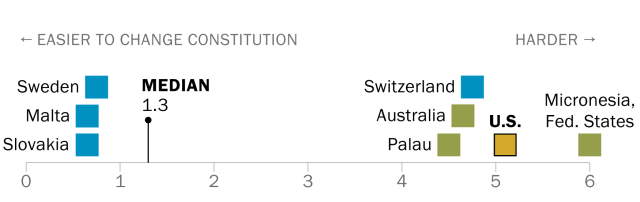
Of all 101 constitutions, the U.S. Constitution has the second-most onerous amendment process. Amendments must be approved by two-thirds votes in both the House and Senate – itself a tall order in these polarized times – and then be ratified by three-quarters of state legislatures, or 38 of 50.

The only democracy whose constitution is even harder to change is the Federated States of Micronesia (FSM), a former U.S. trust territory in the South Pacific with about 76,000 inhabitants. The easiest path to changing the FSM’s constitution involves two separate two-thirds majority votes in the 14-person legislature, approval by the country’s president, and subsequent approval by three-quarters of voters in at least three of the FSM’s four states.

Other countries with constitutions that are nearly as hard to change are Palau, Switzerland and Australia. Like the U.S. and the FSM, these countries all require ratification at both the national and state levels.

At the other extreme, many countries with unicameral (single-chamber) legislatures can amend their constitutions much like how they pass regular laws, just requiring a larger majority in favor.

Hardest and easiest national constitutions to amend
Difficulty score based on easiest pathway, as specified in constitution
Note: When a constitution specifies more than one amendment process, the “difficulty of amendment” scores represent the least difficult process. Data is based on the 106 countries we classify as democracies and includes some fully self-governing territories whose sovereign status is disputed.
Source: Pew Research Center analysis using scoring system based on “Toward a Theory of Constitutional Amendment” by Donald S. Lutz (American Political Science Review, June 1994).

Wednesday, June 24, 2026

Other Countries Now Take a Dimmer View of the US

Many.posts have dealt with international views of the United States.  They have taken a negative turn.

Richard Wike, Laura Silver, Moira Fagan and Jonathan Schulman at Pew: 

A new Pew Research Center survey finds negative – and often overwhelmingly negative – views of U.S. President Donald Trump in regions around the globe.

Across 36 nations polled, a median of 23% of adults express confidence in his leadership of world affairs. In many countries, confidence in Trump has slipped since last year.

Overall ratings for the United States are also largely negative. Favorable views of the country have declined in many places over the past year, including double-digit drops in Indonesia, Italy, Nigeria, South Africa, South Korea and Turkey.

There are seven nations in the study where a majority of adults rate the U.S. positively. The highest rating (81% favorable) comes from Israel. Some of the lowest ratings are from predominantly Muslim publics, such as Malaysians, Pakistanis, Turks, and Palestinians in the West Bank and East Jerusalem. (We were unable to survey in Gaza.)

Pew took the poll before the US-Iran memorandum of understanding, which has cratered Trump's standing in Israel. 


Monday, June 22, 2026

US: Still Religious and Prosperous

Many posts have discussed international views of religion.

Ryan Burge on the World Values Survey: 

The most recent version of the survey is Wave 7, and it was fielded between 2017 and 2022. It contains 64 total countries, but some don’t have responses to religion questions, so we are left with 54 countries. Which is still a lot.

...

One final scatterplot before I close up today. This one is just a simple replication that is widespread in my corner of the world: specifically, the secularization hypothesis. This is the idea that as a country becomes educationally advanced and economically prosperous, it will be less religious. I created a composite index of religiosity based on a number of questions about religious belief, belonging, and behavior. Then I grabbed a measure of GDP per capita to assess economic prosperity.
What about outliers above the line? One big surprise is Puerto Rico. Its GDP is $40K but their religiosity index is .83. The combination of a strong Catholic Church and the rise of Pentecostalism probably explains a lot of that. Then you’ve got a bunch of Eastern Orthodox countries who are more religious than they should be based on their GDP: Cyprus, Greece, and Romania all fit this pattern.

Where does the United States fit? Well, it’s still an outlier. The religiosity index is .62, and GDP is nearly $70K. In order to fit the trend line in this scatterplot, GDP would need to drop to just $28,000 or religiosity would need to dip to .47. 

Friday, June 12, 2026

International Perspectives on How Democracy Is Working

Many.posts have dealt with international perspectives.

 Jonathan Schulman and Richard Wike at Pew:

Around seven-in-ten U.S. adults (69%) say they are dissatisfied with the way democracy is working in their country. This share is higher than in most other high-income countries surveyed by Pew Research Center this spring.


Wednesday, May 27, 2026

The Pope on Slavery


The first American Pope is very much aware of it.

ENCYCLICAL LETTER
OF HIS HOLINESS
POPE LEO XIV
ON SAFEGUARDING THE HUMAN PERSON
IN THE TIME OF ARTIFICIAL INTELLIGENCE
176. In the development of her doctrine, the Church has gradually come to a deeper awareness of the gravity of these issues. It is true that past events cannot be judged anachronistically, as though the moral criteria that matured over time had always been available. Yet neither can we deny or diminish the delay with which both society and the Church came to denounce the scourge of slavery. In antiquity and the Middle Ages many individuals and even ecclesiastical institutions had slaves. Already in the early modern period, the Apostolic See of Rome, responding to requests from Sovereigns, intervened several times in order to regulate and legitimize forms of subjugation, and, in certain cases, the enslavement of “infidels.” [174] It was only in the nineteenth century that a formal, absolute and universal condemnation of slavery was clearly articulated, notably under Pope Leo XIII. [175] This development offers a clear example of the Church’s growth in understanding the perennial truths of Revelation that she safeguards. Although there was not always consistency in practice — given that slavery was long tolerated before being unequivocally condemned — there has been a continuous affirmation throughout history of the dignity of every human being, created in the image of God, even if it took eighteen centuries for its full incompatibility with slavery to be explicitly recognized. This constitutes a wound in Christian memory, one from which we cannot consider ourselves detached. [176] It is impossible not to feel deep sorrow when contemplating the immense suffering and humiliation endured by so many in stark contrast to their immeasurable dignity as persons infinitely loved by the Lord. For this, in the name of the Church, I sincerely ask for pardon.

Tuesday, May 19, 2026

Swedish Capitalism


Tom Fairless at WSJ:
For decades, Sweden was shorthand for the brand of high-tax, high-spend government that managed people’s lives from cradle to grave through state-run hospitals, schools and care homes.

No longer. With little fanfare, this Nordic country of 11 million has embraced capitalism.

Today, nearly half of primary healthcare clinics are privately owned, many by private-equity firms. One in three public high schools is privately run, up from 20% in 2011. School operators are listed on the stock exchange.

Sweden’s experience has lessons—good and bad—for other rich countries, including the U.S., where New York City Mayor Zohran Mamdani is looking to emulate parts of the state-centric model such as universal child care and city-run stores.

The capitalist makeover has allowed Sweden to do what few industrialized countries have managed in recent years: shrink the size of the state. That has enabled the government to sharply lower taxes and, economists say, sparked a surge in entrepreneurship and economic growth.

Its total public social spending bill—which includes healthcare, education and all welfare payments—has fallen to 24% of gross domestic product, similar to the U.S. and well below the over 30% for nations like France and Italy.

Sunday, May 10, 2026

Regulating the Internet

 Bruce Mehlman:

National governments are also considering AI oversight and regulation, but the past three decades of internet policy have shown profoundly different goals & approaches. The U.S. has prioritized innovation, the EU consumer protection, China governmental control. As a result, America has enjoyed the most tech entrepreneurship by a wide margin, but we lack many rules to protect children, contain misinformation or fight fraud
.

Friday, May 1, 2026

Perceptions of Media Freedom

Many posts have discussed freedom of the press.

Benedict Vigers  at Gallup:

As the world marks World Press Freedom Day this weekend, perceptions of media freedom worldwide show little movement, remaining near the levels recorded each year since 2010. Overall, a median of 64% of adults across 131 countries in 2025 said they believe the media in their country have a lot of freedom, while 30% disagreed.

...

Three in four U.S. adults (75%) in 2025 think the U.S. media have a lot of freedom, among the lowest totals measured in the past 15 years and statistically tied with the other low point of 78% in 2023. This year also marks one of the few times the U.S. has been statistically tied with, rather than ahead of, the Organisation for Economic Co-operation and Development in these perceptions.

Since 2022, Americans’ perceptions that the press in their country has a lot of freedom have fallen 11 points (from 86%), compared with a one-point decline in the median among OECD countries. While this decline has been uneven — the measure rebounded slightly in 2024 before dipping again in 2025 — only three other countries have seen larger absolute declines in perceived media freedom than the U.S. since 2022: Ukraine (-18 pts.), Pakistan (-18 pts.) and Morocco (-15 pts.).


Thursday, April 23, 2026

Declining Desire to Move to the US

Many.posts have dealt with international views of the United States.  They have taken a negative turn.

 Julie Ray and Anita Pugliese at Gallup:

The U.S. remains the most desired destination for people who would like to leave their own countries permanently, but Gallup's latest data show it is less attractive than it once was.

In 2025, 15% of adults worldwide who say they would like to move permanently to another country name the U.S. as their preferred destination, the lowest level recorded in nearly two decades of Gallup research. From 2007 to 2009, 24% of would-be migrants named the U.S. as their top choice, and that figure remained near 20% through 2016. Since 2017, it has been at or below 18%.

The rank order of the countries attracting the most interest from potential migrants has seen little change since Gallup’s first measure. Canada ranks second, as it has for several years, with 9% of potential migrants mentioning the U.S. neighbor. The appeal of these desired destinations did not change in 2025, even as the U.S. became less desirable.


Friday, April 17, 2026

Democratic Decline in 2025


The health of America’s democracy declined in 2025, according to new evaluations from organizations that have long tracked how well democracies around the world are working.

The assessments come as most Americans say democracy in the United States used to be a good example for other countries to follow but has not been in recent years, according to a new Pew Research Center survey. And roughly seven-in-ten Americans are dissatisfied with the way their democracy is working. (Read more below.)

The new ratings of America’s democracy come from three organizations:The Varieties of Democracy (V-Dem) Institute surveys scholars and country experts to rate countries on elements of democracy including free and fair elections, checks and balances and civil rights.

Freedom House publishes the yearly Freedom in the World report, which rates countries on political rights and civil liberties and is based on the views of local experts.

The Economist Intelligence Unit (EIU) publishes the annual Democracy Index, which rates countries on electoral processes, governance, civil liberties, political participation and political culture.


Tuesday, April 7, 2026

The World Does Not Like US Leadership

 Many posts have discussed international public opinion about the United States.

Julie Ray, Benedict Vigers and Zaccary Ritter at Gallup:
While neither country commands broad support, China surpassed the United States in global approval ratings in 2025, with a median of 36% approving of China’s leadership, compared with 31% for the U.S. China’s five-percentage-point advantage over the U.S. is the widest Gallup has recorded in China’s favor in nearly 20 years.

The recent shift reflects a decline in U.S. ratings alongside an increase for China. Median approval of U.S. leadership fell from 39% in 2024 to 31% in 2025, returning to earlier lows, while China’s approval rose from 32% to 36%.

At the same time, disapproval of U.S. leadership rose to a record-high 48%, while China’s disapproval rating remained flat at 37%.

...

Approval of U.S. leadership declined by 10 points or more in 44 countries between 2024 and 2025, while it increased by a similar amount in only seven. The declines were concentrated among U.S. allies, including many NATO partners.

Germany led the world in declines; its approval of U.S. leadership fell by 39 points, followed closely by Portugal (down 38 points). Several other long-standing U.S. partners — including Canada, the United Kingdom and Italy — also showed substantial decreases.

U.S. standing improved by more than 10 points among Israelis, marking an exception among U.S. allies. Approval of U.S. leadership in Israel, which surged after the October 2023 Hamas attack and then fell sharply in 2024, rebounded to 76% in 2025 after Trump’s return to the White House — a 13-point increase, among the highest levels globally.

Monday, March 23, 2026

Democratic Backsliding

Previous posts have discussed authoritarian moves by the executive branch.

V-Dem  Institute:

Democratic backsliding is now happening in well-established democracies. Democracy in the USA is deteriorating at unprecedented speed, and media and journalists are increasingly targeted across the world. This, and more, is reported in the latest Democracy Report from the V-Dem Institute at the University of Gothenburg.

Nearly a quarter of the world’s nations are going through democratic backsliding, or autocratization, in 2025, and six out of the ten new autocratizing countries identified in the 2026 Democracy Report are in Europe and North America. Among them are large and influential countries like Italy, the United Kingdom, and the USA, according to the report authored by a team led by Professor Staffan I Lindberg at the V-Dem Institute, University of Gothenburg.

“The fact that many populous and economically powerful countries are autocratizing is especially worrying. Several of these countries have the economic and political weight to reshape international organizations, norms, and trade, effectively reshaping the global order. I think we are already seeing the effect of that,” says Staffan I Lindberg.
Three major trends in democratic backsliding

The report finds three clear patterns in the current trend of democratic backsliding. The first one is the democratic backsliding in some traditionally stable democracies; the second is significant reversals and often breakdown of democracy in countries that successfully democratized during the late 20th and early 21st centuries; and thirdly, the deepening of autocracy in already autocratic states.

Freedom of Expression, a core aspect of democracy, shows the most drastic global decline, and is the most common target among autocratizing leaders over the past 25 years.

“The second most common target are the liberal aspects of democracy, like rule of law, and checks and balances that prevent the abuse of powers, which are deteriorating in a worrying number of countries. For example, rule of law is deteriorating in 22 countries, including the USA,” says Staffan I Lindberg.
Democracy in the USA deteriorating at unprecedented scale and speed

The U.S. democracy is currently in a much faster deterioration process than any other democracy in modern times. Within only one year, the USA’s score on the V-Dem Liberal Democracy index has declined by 24 percent, while its world rank dropped from 20th to 51st place out of 179 nations.

The liberal aspects of democracy show the largest decline in the U.S. President Donald Trump’s second term can be summarized as a rapid concentration of powers in the presidency, according to the report.

“The current U.S. administration has been undercutting institutionalized checks and balances, politicizing civil service and oversight bodies, and intimidating the judiciary, alongside attacks on the press, academia, civil liberties, and dissenting voices ”says Staffan I Lindberg.


Since election specific indicators are only evaluated during national election years, there has not been a change in those indicators in 2025 for the U.S.

“The 2026 American midterm elections will be a critical test for the quality of elections, and democracy, in the United States. If election indicators also decline, the U.S. will fall even further,” says Staffan I Lindberg.
The democratizers

On a more positive note, the report shows that 18 nations worldwide (10 percent) are currently democratizing, with large countries such as Brazil and Poland continuing their democratization processes. In the majority of these countries, media freedom is improved. Botswana, Guatemala, and Mauritius are the three new democratizing countries identified in the 2025 data.


Download the V-Dem Institute Democracy Report 2026: “Unraveling the Democratic Era?”

Contact Lead author: Professor Staffan I. Lindberg, sil@v-dem.net.

Tuesday, March 10, 2026

Morality and Bellief in God


Jonathan Evans at Pew:
Nearly everyone in Indonesia (99%), as well as the vast majority of people in Kenya (94%), India (85%) and South Africa (80%), say it’s necessary to believe in God to be moral.

By contrast, in about a dozen countries, two-thirds of adults or more say it’s not necessary to believe in God to be moral. This includes the United States (68%), Poland (80%), Spain (84%) and Sweden (89%).

In some countries – including the U.S. – declining shares of people say it’s necessary to believe in God to be moral and have good values, according to the survey.

In the U.S., we’ve asked this question 18 times since 2002. That includes eight surveys conducted online using our American Trends Panel and 10 surveys conducted by telephone.


From 2002 through 2011, Americans were split fairly evenly or tilted toward the view that people need to believe in God to be moral and have good values.

Starting in 2014, however, Americans have been more likely to say the opposite – that belief in God is not necessary to be moral. Since 2020, about two-thirds of U.S. adults have taken this position.


Sunday, March 8, 2026

Americans Question Fellow Americans' Morality

Many.posts have dealt with international perspectives.

Jonathan Evans at Pew: 

Americans are more likely than people in other countries surveyed in 2025 to question the morality of their fellow countrymen, according to Pew Research Center surveys in 25 countries.

We asked people around the world to rate the morality and ethics of others in their country.

In nearly all countries surveyed, more people say that others in their country have somewhat or very good morals than say their compatriots display somewhat or very bad levels of morality.

The United States is the only place we surveyed where more adults (ages 18 and older) describe the morality and ethics of others living in the country as bad (53%) than as good (47%).


Tuesday, February 10, 2026

Goodbye, CIA World Factbook

"Every record has been destroyed or falsified, every book has been rewritten, every picture has been repainted, every statue and street and building has been renamed, every date has been altered. And that process is continuing day by day and minute by minute."   -- George Orwell, 1984

A number of posts have discussed presidential documents, official data, and government websites.  The Trump administration has killed off or limited access to many such resources, including now the CIA World Factbook. 

 David A. Graham at The Atlantic:

Memories are now the only place the World Factbook resides. In a post online yesterday, the agency noted that the site “has sunset,” though it provided no explanation for why. (The agency did not immediately reply to my inquiry about why, nor has it replied to other outlets.) The Associated Press noted that the move “follows a vow from Director John Ratcliffe to end programs that don’t advance the agency’s core missions.”

The demise of the World Factbook is part of a broad war on information being waged by the Trump administration. This is different from the administration’s assault on truth, in which the president and the White House lie prolifically or deny reality. This is something more fundamental: It’s a series of steps that by design or in effect block access to data, and in doing so erode the concept of a shared frame for all Americans. “Though the World Factbook is gone, in the spirit of its global reach and legacy, we hope you will stay curious about the world and find ways to explore it … in person or virtually,” the CIA wrote in the valedictory post. Left unsaid: You’re on your own to figure it out now.

If the World Factbook was indeed shut down because it didn’t meet Ratcliffe’s standard for core CIA functions, that reflects the Trump administration’s impoverished view of the government’s role. The World Factbook was a public service that helped Americans and others around the globe be informed, created a positive association with a shadowy agency, and spread U.S. soft power by providing a useful service free to all. I’ve been unable to determine how much it cost the government to maintain, but there’s no reason to think it would be substantive.


Saturday, February 7, 2026

The World Boos the US Government


Jon Henley at The Guardian:
Western Europeans prize Europe’s autonomy and values over transatlantic ties and will not give them up to placate Donald Trump, according to a poll suggesting opinions of the US have plunged to their lowest since YouGov began tracking them a decade ago.

The US president’s attempted Greenland grab has succeeded in turning Europeans solidly against his country, the pollster’s latest survey found. Large majorities in Denmark, France, Germany, Italy, Spain and Great Britain all declared an unfavourable opinion.

The figures, ranging from 62% in France to 84% in Denmark – of which Greenland is a self-governing territory – mark a further steep rise in negative perceptions of the US even since November, when the range was between 49% and 70%.


DANIELLA MATAR and COLLEEN BARRY AT AP

American athletes received an enthusiastic welcome at the opening ceremony for the Milan Cortina Winter Olympics, but the mood shifted when cameras briefly turned to Vice President JD Vance.

Led by speedskater and flag bearer Erin Jackson, Team USA was among the last delegations to enter Milan’s San Siro stadium in the parade of nations on Friday.

The crowd cheered for the Americans but jeers and whistles could be heard as Vance and his wife, second lady Usha Vance, were shown on the stadium screens, waving American flags from the tribune.

Support for the U.S. among its allies has been eroding as the Trump administration has taken an aggressive posture on foreign policy, including punishing tariffs, military action in Venezuela and threats to invade Greenland.

Tuesday, February 3, 2026

US as Adversary

Many posts have discussed foreign policy, war powers and the US military.

Mike Allen at Axios: 

Imagine a world where ties to the U.S. feel like a burden, not a benefit to free society."How America First Risks Becoming America Alone," an essay in this weekend's Wall Street Journal, says American allies — soured by President Trump's treatment — are "searching for alternatives to what increasingly feels like an abusive relationship."

  • 📊 Positive views of the U.S. are declining worldwide, the essay notes:Brits who view the U.S. unfavorably doubled in the past two years to 64%. (YouGov)
  • In Germany, 71% view the U.S. as an "adversary." (German polling firm Forsa)
  • Across Europe, just 16% view the U.S. as an ally. (European Council on Foreign Relations)
  • Nearly two-thirds of Canadians, Mexicans and Brazilians hold unfavorable views of the U.S., "and view their neighbor as a bigger threat than China."


Data: European Council on Foreign Relations. Chart: Axios Visuals