Search This Blog

Showing posts with label freedom. Show all posts

Thursday, June 18, 2026

Surrender

Many posts have discussed war powers and the US military


Despite the brilliant performance of the US military in the war against Iran, Trump signed a memorandum of understanding that amounts to a surrender ... by the United States.

Mike Nelson at The Dispatch:

Finally, and shamefully, the agreement puts a final nail in the coffin of the Iranian people’s hopes that the United States would support their cries for freedom. “The Islamic Republic of Iran and the United States undertake to respect each other’s sovereignty and territorial integrity, and to refrain from interfering in each other’s internal affairs.” A conflict that started with the hopeful protests of a people pushing back against almost five decades of oppression ends with the country meant to be the beacon of freedom agreeing to turn a blind eye to the slaughter of 30,000 Iranians, or the inevitable continued crackdowns, executions, and repression. No matter how he wishes to run from it now, we should never forget the president’s undeniably clear messages to the Iranian people when he thought this would be easy—“help is on the way,” “the hour of your liberation is at hand.” Vance, already having shown his callous disregard for the deaths of Ukrainians, adds the Iranian people to the mix in his attempt to carry his boss’s water, “if the Iranian people want to rise up, great. That's their business. That's between them and their government.”

The conflict ends with a seeming disregard for the disposition of uranium we said we were fighting to secure, for the arsenal of missiles we said we were seeking to destroy, and for the oppressed Iranians we promised we were going to help. The war ends with nothing of value to show for it. We will have killed thousands of Iranians, destroyed hundreds of missile launchers and air defense systems, but to what end? For the privilege of achieving nothing quantifiable, we have provided Iran with proof of a strategic deterrent it can exercise at any time, provided the regime with access to a massive cash influx, rebuilt its relationship with proxies that was damaged after October 7, damaged our alliances and relationships, spent billions of dollars, expended a large percentage of our critically short precision munitions, and lost 13 American lives, to say nothing of the hundreds of wounded. As with so many of his missteps or failures, President Trump will likely try to categorize this as a win, shift the way it is remembered with the passage of time, blame someone else, or just hope it fades from memory as he moves on to what he deems truly important business, like ballrooms and reflecting pools. But this will likely be the largest and costliest error of his presidency, and one for which he deserves permanent shame.


Friday, May 1, 2026

Perceptions of Media Freedom

Many posts have discussed freedom of the press.

Benedict Vigers  at Gallup:

As the world marks World Press Freedom Day this weekend, perceptions of media freedom worldwide show little movement, remaining near the levels recorded each year since 2010. Overall, a median of 64% of adults across 131 countries in 2025 said they believe the media in their country have a lot of freedom, while 30% disagreed.

...

Three in four U.S. adults (75%) in 2025 think the U.S. media have a lot of freedom, among the lowest totals measured in the past 15 years and statistically tied with the other low point of 78% in 2023. This year also marks one of the few times the U.S. has been statistically tied with, rather than ahead of, the Organisation for Economic Co-operation and Development in these perceptions.

Since 2022, Americans’ perceptions that the press in their country has a lot of freedom have fallen 11 points (from 86%), compared with a one-point decline in the median among OECD countries. While this decline has been uneven — the measure rebounded slightly in 2024 before dipping again in 2025 — only three other countries have seen larger absolute declines in perceived media freedom than the U.S. since 2022: Ukraine (-18 pts.), Pakistan (-18 pts.) and Morocco (-15 pts.).


Tuesday, September 16, 2025

"Hate Speech"

From FIRE:
There is no “hate speech” exception to the First Amendment. So, many Americans wonder: Is hate speech legal?

Contrary to a common misconception, most expression one might identify as “hate speech” is protected by the First Amendment and cannot lawfully be censored, punished, or unduly burdened by the government — including public colleges and universities.

The Supreme Court of the United States has repeatedly rejected government attempts to prohibit or punish hate speech. Instead, the Court has come to identify within the First Amendment a broad guarantee of “freedom for the thought that we hate,” as Justice Oliver Wendell Holmes described the concept in a 1929 dissent. In a 2011 ruling, Chief Justice John Roberts described our national commitment to protecting hate speech in order to preserve a robust democratic dialogue:
Speech is powerful. It can stir people to action, move them to tears of both joy and sorrow, and—as it did here—inflict great pain. On the facts before us, we cannot react to that pain by punishing the speaker. As a Nation we have chosen a different course—to protect even hurtful speech on public issues to ensure that we do not stifle public debate.
In other words, the First Amendment recognizes that the government cannot regulate hate speech without inevitably silencing the dissent and dialogue that democracy requires. Instead, we as citizens possess the power to most effectively answer hateful speech — whether through debate, protest, questioning, laughter, silence, or simply walking away.

As Justice Louis Brandeis put it, the framers of the Bill of Rights “believed that freedom to think as you will and to speak as you think are means indispensable to the discovery and spread of political truth; that without free speech and assembly discussion would be futile; that with them, discussion affords ordinarily adequate protection against the dissemination of noxious doctrine; that the greatest menace to freedom is an inert people; that public discussion is a political duty; and that this should be a fundamental principle of the American government.”

Justice Brandeis argued that our nation’s founders believed that prohibiting “evil counsels” — what today we might call hate speech — would backfire
:They recognized the risks to which all human institutions are subject. But they knew that order cannot be secured merely through fear of punishment for its infraction; that it is hazardous to discourage thought, hope and imagination; that fear breeds repression; that repression breeds hate; that hate menaces stable government; that the path of safety lies in the opportunity to discuss freely supposed grievances and proposed remedies; and that the fitting remedy for evil counsels is good ones. Believing in the power of reason as applied through public discussion, they eschewed silence coerced by law — the argument of force in its worst form. Recognizing the occasional tyrannies of governing majorities, they amended the Constitution so that free speech and assembly should be guaranteed.

Saturday, April 26, 2025

Going After Journalists

Many posts have discussed freedom of the press.


Saturday, January 18, 2025

Trump v. Freedom of Expression

Ted Johnson at Deadline:

In an early morning rant, Donald Trump went off on Seth Meyers‘ late-night NBC show, declaring that “Comcast should pay a BIG price” for shows that he calls “political hits.”

In Trump’s 1:24 a.m. ET post on Truth Social, he said that he had watched Meyers’ show recently. Meyers’ humor for years has been biting when it comes to Trump, with his segments also serving as a form of commentary.

Trump wrote, “How bad is Seth Meyers on NBC, a ‘network’ run by a truly bad group of people — Remember, they also run MSDNC. I got stuck watching Marble Mouth Meyers the other night, the first time in months, and every time I watch this moron I feel an obligation to say how dumb and untalented he is, merely a slot filler for the Scum that runs Comcast. These guys should be paying a lot of money for the right to give these ‘in kind’ contributions to the Radical Left Democrat Party. These are not shows or entertainment, they are simply political hits, 100% of the time, to me and the Republican Party. Comcast should pay a BIG price for this!”
Trump has long bashed Comcast, NBC and MSNBC. During his first term, he suggested pulling the network’s FCC license after he got angered by an NBC News report. Ajit Pai, who he appointed FCC chair, later noted that the agency licenses stations, not networks, and that news programming was protected by the First Amendment.
But Trump’s appointee as chair of the FCC during his next term, Brendan Carr, has suggested that the agency can examine complaints over news programming, including one that challenged the way that 60 Minutes edited an interview with Kamala Harris. He also bashed NBC for featuring Harris on Saturday Night Live in the final show before the election, warning that it was a violation of equal time rules. The network gave Trump’s campaign time the next day, but Carr warned that other third-party candidates may have been denied airtime.

David Enrich and Katie Robertson at NYT:

Reporters and editors at national newspapers are increasing their reliance on encrypted communications to help shield themselves and their sources from potential federal leak investigations and subpoenas.

Multiple media organizations are evaluating whether they have enough insurance coverage to absorb a potential wave of libel and other litigation from officials who have already shown an inclination to file such suits.

And a nonprofit investigative journalism outlet is preparing for the possibility that the government will investigate issues like whether its use of freelancers complies with labor regulations.

With President-elect Donald J. Trump returning to the White House, media outlets large and small are taking steps to prepare for what they fear could be a legal and political onslaught against them from the new administration and Mr. Trump’s allies inside and outside the government.
For nearly a decade, Mr. Trump has demonized and tried to delegitimize the media. He has attacked reporters as “the enemy of the people.” He has repeatedly sued news organizations. In his first administration, the White House at times barred out-of-favor journalists from attending events.

But the early indications are that his new administration could be more hostile to the press. For example, Mr. Trump’s choice to run the F.B.I., Kash Patel, said before the election that a new Trump administration would “come after the people in the media.” Brendan Carr, the expected chairman of the Federal Communications Commission, recently raised the prospect of revoking federal broadcast licenses for television stations that he perceived as biased against conservatives.

 But even if FCC does not license networks themselves, it can cause trouble for media companies.  On September 15, 1972, Nixon discussed using it to punish The Washington Post.

PRESIDENT: The Post has asked -- it's going to have its problems.

HALDEMAN: (Unintelligible)

DEAN: The networks, the networks are good with Maury [Maurice Stans]coming back three days in a row and --

PRESIDENT: That's right. Right. The main thing is the Post is going to have damnable, damnable problems out of this one. They have a television station.

DEAN: That's right, they do.
PRESIDENT: And they're going to have to get it renewed.

HALDEMAN: They've got a radio station, too.

PRESIDENT: Does that come up too? The point is, when does it come up?

DEAN: I don't know. But the practice of nonlicensees filing on top of licensees has certainly gotten more,...

PRESIDENT: That's right.

DEAN: more active in the, in the area.

PRESIDENT: And it's going to be God damn active here.

DEAN: (Laughs)

PRESIDENT: Well, the game has to be played awfully rough.

Friday, March 1, 2024

Freedom in the World 2024

From Freedom House:

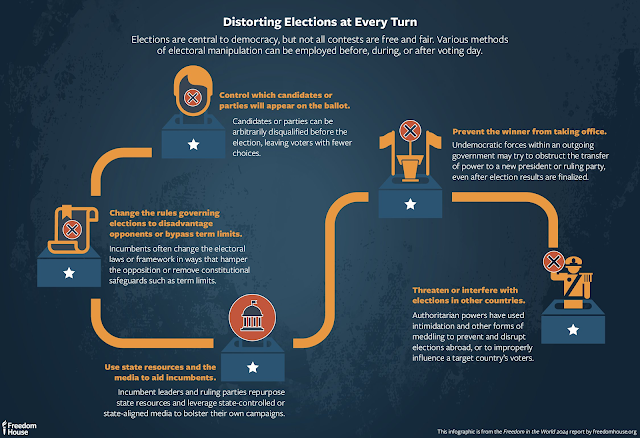
Global freedom declined for the 18th consecutive year in 2023. The breadth and depth of the deterioration were extensive. Political rights and civil liberties were diminished in 52 countries, while only 21 countries made improvements. Flawed elections and armed conflict contributed to the decline, endangering freedom and causing severe human suffering.

...

 In the United States, harassment and intimidation of federal, state, and local politicians, election administrators, and judges pose a serious challenge to the conduct of November’s presidential election. Threats of violence can have far-reaching, harmful effects, potentially undermining compliance with election rules or deterring participation entirely. Actual violence related to political disputes can and has cost people their lives. Still haunted by the January 2021 attack on the Capitol and related court cases, Americans are heading into a decisive election starkly divided, with some questioning the very utility of fundamental democratic institutions.

The conduct of national elections in South Africa, India, and the United States, three of the most influential democracies in the world, will have rippm in authoritarian settings. But other electoral contests will also have important consequences.le effects across the globe, with implications for international trade, interstate relations, and movements for freedom.


Monday, September 25, 2023

Polarization and Free Speech

At RealClearPolitics, Carl Cannon reports on a new survey:

Traditionally, opposing censorship — whether imposed by government or corporations — was a bedrock principle of liberalism in this country. The American Civil Liberties Union was founded in 1920 to promote and defend free expression. And this ideal was at the heart of liberal thought, liberal lawmaking, and liberal jurisprudence during most of the 20th century. But times change. And notwithstanding the controversial current push by social conservatives to denude public school libraries of content they dislike, the new RealClear Opinion Research poll is the latest to document the gradual change that has taken place on the left when it comes to this free expression. Here are some of its findings:

  • Republican voters (74%) and independents (61%) believe speech should be legal “under any circumstances, while Democrats are almost evenly divided. A bare majority of Democrats (53%) say speech should be legal under any circumstances, while 47% say it should be legal “only under certain circumstances.”

  • Nearly one-third of Democratic voters (34%) say Americans have “too much freedom.” This compared to 14.6% of Republicans. Republicans were most likely to say Americans have too little freedom (46%), while only 22% of Democrats feel that way. Independents were in the middle in both categories.

  • Although majorities of Democrats, Republicans, and independents agree the news media should be able to report stories they believe are in the national interest, this consensus shifts when it comes to social media censorship. A majority of Democrats (52%) approve of the government censoring social media content under the rubric of protecting national security. Among Republicans and independents, this percentage is only one-third.

  • Poll respondents were read this statement: “I disapprove of what you say, but I will defend to the death your right to say it.” Only 31% of Democratic voters “strongly agreed” with that sentiment, compared to 51% of Republicans.

  • Fully three-fourths of Democrats believe government has a responsibility to limit “hateful” social media posts, while Republicans are more split, with 50% believing the government has a responsibility to restrict hateful posts. (Independents, once again, are in the middle.)

  • Democrats are significantly more likely than Republicans to favor stifling the free speech rights of political extremists. Also, Republicans don’t vary by the group: Only about half of GOP voters favor censorship — whether asked about the Ku Klux Klan, Nazis, or the Communist Party.

Wednesday, October 5, 2022

Democgraphics of Self-Censorship on Campus

 Samuel Abrams at AEI:

A common refrain on campuses today is that students are likely to self-censor their views and ideas. Looking at the data, this is an experience shared by nearly all students and amongst almost all races.

In 2016, when students were asked about the security of their freedom of speech, almost three-quarters (73%) felt secure in their First Amendment right, according to a Knight Foundation study. In 2021, that number declined to 47%. During that time, nearly two-thirds (65%) of students felt their school stifles free expression, up from 54% in 2016.

There is a rampant culture of self-censorship. As a professor, I see this all the time in class and during campus events; students anxiously want to ask questions or make particular points but opt to say nothing instead.

Data from the Foundation for Individual Rights and Expression (FIRE)’s new study of almost 45,000 currently enrolled students at more than 200 colleges and universities around the nation provides a deeper look at how students think about self-censorship. Disturbingly, the desire to silence dissent is not only widespread, but also far too common across all racial and ethnic groups.

Some claim that speech codes and other restrictions on free expression on campus are necessary because free speech, as currently defined, effectively silences minority groups. They say as a corrective, it’s important to be far more sensitive to the harm that words can do — creating safe spaces and, in some cases, silencing controversial speakers.

But data from FIRE shows that the racial differences between how young people perceive campus climates is minimal. Fifty-six percent of Black students report that they limit what they say out of concern for reactions — a number far too high. Fifty percent of Hispanic students, 56% of Asian students, and 54% of white students report doing the exact same thing.


Tuesday, September 20, 2022

Self-Censorship on Campus

 Samuel Abrams at AEI:

Fire’s 2022-23 College Free Speech Rankings samples the views of almost 45,000 currently enrolled students at more than 200 American colleges and universities, the largest study of its kind to date. Like earlier iterations, it shows that conservatives are far more likely to self-censor than their liberal counterparts. For instance, when presented with the question of how often students have felt that they could not express their opinions on a subject because of how students, a professor or the administration would respond, 44 per cent of Democrats report self-censoring. This figure is notably lower than the 58 per cent of independents and 73 per cent of Republicans who do so.

However, the 2022/23 survey includes a number of new questions that offer a powerful new twist on the issue. For instance, while 53 per cent of independents and 66 per cent of Republicans feel some or more significant pressure to avoid certain topics, 43 per cent of Democratic students do so, too.

The most revealing finding emerges in response to a question about how worried students are about damaging their reputations because of a misunderstanding about something they have said or done. A significant majority of students – 63 per cent – are worried to some degree. And despite a generally liberal campus environment, fostered by progressive and woke administrators and liberal faculty who often engage in activist scholarship, there is almost no difference between how worried Democratic and Republican students are.

The 62 per cent of strong and weak Democratic Party-supporting students who report being worried about reputational damage is barely lower than the 64 per cent of those who are independents and leaners towards one party or another. For strong and weak Republicans, who already regularly self-censor at much higher rates than their Democratic counterparts, 63 per cent are worried about the social and personal consequences of their expression.

This is a remarkably unhealthy state of affairs in an educational environment that is supposed to be open, authentic and liberating. It should be no wonder that American students are anxious and that depression and other mental health issues are so prominent on campuses today.


Sunday, May 1, 2022

Trevor Noah on Press Freedom


Sunday, December 5, 2021

Campus Free Speech

The Bipartisan Policy Center has a new report titled “Campus Free Expression: A New Roadmap.” From the executive summary:
  • First, colleges and universities must address the perceived tension that pits academic freedom and freedom of expression against diversity, equity, and inclusion in creating a respectful learning environment for all. While not ignoring that there may be expression that is hurtful, we believe profoundly that free expression is an essential means to an inclusive campus in addition to being essential to higher education’s academic and civic missions.
  • Second, colleges and universities should take steps to encourage more viewpoint diversity on campus. Exposing students to a wide range of perspectives and methods of confronting issues is essential for both a well-rounded education and as preparation for the rigors of citizenship in a diverse society.
  • Third, colleges and universities should adopt strong policies for the protection of free expression for students and faculty, to forestall hasty or ad hoc responses to controversial expression, and to defend the expression of unorthodox and controversial views.
  • Fourth, colleges and universities should elevate the skills and dispositions necessary to academic and civic discourse as a deliberate aim of the collegiate experience. Formal protections for free expression are necessary but insufficient to create a culture of free expression, open inquiry, and respectful, productive debate on campus and in our country. We have a national civic skills deficit, which colleges and universities have an essential role in remedying. Matriculating students typically need coaching and instruction in these skills and habits of mind, and our aim should be to graduate students who raise the bar for national discourse
Lori S. White, president of DePauw University and a member of the task force that met for a year to write the report, said during a panel discussion Tuesday about the report's release that she recently navigated her own campus speech controversy: she said that after a professor used the N-word in a classroom context, DePauw faced calls to ban the use of the N-word on campus.

White, who is Black, responded to these calls in a campus memo at once condemning the N-word as a “despicable and hateful word that has been used throughout history to dehumanize people who look like me.” At the same time, she wrote, banning the word “raises questions as to whether books such as John Steinbeck’s ‘Of Mice and Men’ or Harper Lee’s ‘To Kill a Mockingbird,’ which I read as an English major, could still be assigned or whether a film class could watch a Dick Gregory film that I have watched many times or whether a music critique course or a student listening to music in their residence hall could listen to certain rap music artists.”
While most students think their professors adequately encourage diverse viewpoints in the classroom, don't want speakers disinvited from campus, and are comfortable sharing controversial opinions, 85 percent of liberals think professors who say something offensive should be reported to the university.

That's according to a new survey of student attitudes conducted by North Dakota State University's Sheila and Robert Challey Institute for Global Innovation and Growth. Many of the results were positive: Most students—both liberals and conservatives—said their professors create environments that allow for many different viewpoints to be shared. Large majorities also opposed the rejection of controversial speakers from campus.

In general, conservative respondents were more supportive of free speech norms—and also more fearful that they would be punished for speaking up—than liberal students. But on many questions, majorities of both groups responded the way a free speech supporter would.

Probably the most concerning result was that 70 percent of students—85 percent of liberals, 41 percent of conservatives, and 65 percent of those classified as "independent/apolitical"—wanted professors reported to the administration for making offensive statements. Most students also felt this way about other students who said offensive things.

Sunday, October 31, 2021

Florida v. Academic Freedom


Michael Wines at NYT:
Three University of Florida professors have been barred from assisting plaintiffs in a lawsuit to overturn the state’s new law restricting voting rights, lawyers said in a federal court filing on Friday. The ban is an extraordinary limit on speech that raises questions of academic freedom and First Amendment rights.

University officials told the three that because the school was a state institution, participating in a lawsuit against the state “is adverse to U.F.’s interests” and could not be permitted. In their filing, the lawyers sought to question Gov. Ron DeSantis, a Republican, on whether he was involved in the decision.

Mr. DeSantis has resisted questioning, arguing that all of his communications about the law are protected from disclosure because discussions about legislation are privileged. In their filing on Friday, lawyers for the plaintiffs said the federal questions in the case — including whether the law discriminates against minority groups — override any state protections.

Two university representatives said they could not comment on pending litigation. Mr. DeSantis’s office did not immediately reply to a request for comment.

From the Foundation for Individual Rights in Education:

FIRE is deeply concerned by a report in The New York Times that the University of Florida has barred three professors from participating as witnesses in a voting rights lawsuit against the state of Florida.

FIRE has said it before, and we’ll say it again: The profound civic importance of fair trials requires the ability of fact and expert witnesses to come forward to testify truthfully without fear that their government employer might retaliate against them. Public university faculty are no exception. We call on UF to reverse course immediately.

UF should be aware that Plymouth State University’s ill-considered decision to punish faculty who had testified in a trial ultimately cost the state of New Hampshire’s taxpayers $350,000. FIRE warned Plymouth State then, and we’re warning UF now: If you pick a fight with the First Amendment, you will lose.


Thursday, October 21, 2021

MIT Rejects Free Speech

 Michael Powell at NYT:

The Massachusetts Institute of Technology invited the geophysicist Dorian Abbot to give a prestigious public lecture this autumn. He seemed a natural choice, a scientific star who studies climate change and whether planets in distant solar systems might harbor atmospheres conducive to life.

 Then a swell of angry resistance arose. Some faculty members and graduate students argued that Dr. Abbot, a professor at the University of Chicago, had created harm by speaking out against aspects of affirmative action and diversity programs. In videos and opinion pieces, Dr. Abbot, who is white, has asserted that such programs treat “people as members of a group rather than as individuals, repeating the mistake that made possible the atrocities of the 20th century.” He said that he favored a diverse pool of applicants selected on merit.

 He said that his planned lecture at M.I.T. would have made no mention of his views on affirmative action. But his opponents in the sciences argued he represented an “infuriating,” “inappropriate” and oppressive choice.

 On Sept. 30, M.I.T. reversed course. The head of its earth, atmospheric and planetary sciences department called off Dr. Abbot’s lecture, to be delivered to professors, graduate students and the public, including some top Black and Latino high school students.

Thursday, March 4, 2021

Democratic Decline

As a lethal pandemic, economic and physical insecurity, and violent conflict ravaged the world in 2020, democracy’s defenders sustained heavy new losses in their struggle against authoritarian foes, shifting the international balance in favor of tyranny. Incumbent leaders increasingly used force to crush opponents and settle scores, sometimes in the name of public health, while beleaguered activists—lacking effective international support—faced heavy jail sentences, torture, or murder in many settings.

These withering blows marked the 15th consecutive year of decline in global freedom. The countries experiencing deterioration outnumbered those with improvements by the largest margin recorded since the negative trend began in 2006. The long democratic recession is deepening.

The impact of the long-term democratic decline has become increasingly global in nature, broad enough to be felt by those living under the cruelest dictatorships, as well as by citizens of long-standing democracies. Nearly 75 percent of the world’s population lived in a country that faced deterioration last year. The ongoing decline has given rise to claims of democracy’s inherent inferiority. Proponents of this idea include official Chinese and Russian commentators seeking to strengthen their international influence while escaping accountability for abuses, as well as antidemocratic actors within democratic states who see an opportunity to consolidate power. They are both cheering the breakdown of democracy and exacerbating it, pitting themselves against the brave groups and individuals who have set out to reverse the damage.

...


Saturday, July 25, 2020

Self-Censorship

Emily Ekins at Cato:
A new Cato national survey finds that self‐​censorship is on the rise in the United States. Nearly two-thirds—62%—of Americans say the political climate these days prevents them from saying things they believe because others might find them offensive. The share of Americans who self‐​censor has risen several points since 2017 when 58% of Americans agreed with this statement.

These fears cross partisan lines. Majorities of Democrats (52%), independents (59%) and Republicans (77%) all agree they have political opinions they are afraid to share.
 Strong liberals stand out, however, as the only political group who feel they can express themselves. Nearly 6 in 10 (58%) of staunch liberals feel they can say what they believe. However, centrist liberals feel differently. A slim majority (52%) of liberals feel they have to self‐​censor, as do 64% of moderates, and 77% of conservatives. This demonstrates that political expression is an issue that divides the Democratic coalition between centrist Democrats and their left flank.
...
 Nearly a third (32%) of employed Americans say they personally are worried about missing out on career opportunities or losing their job if their political opinions became known. These results are particularly notable given that most personal campaign contributions to political candidates are public knowledge and can easily be found online.
And it’s not just one side of the political spectrum: 31% of liberals, 30% of moderates and 34% of conservatives are worried their political views could get them fired or harm their career trajectory. This suggests that it’s not necessarily just one particular set of views that has moved outside of acceptable public discourse. Instead these results are more consistent with a “walking on eggshells” thesis that people increasingly fear a wide range of political views could offend others or could negatively impact themselves.
These concerns are also cross‐​partisan, although more Republicans are worried: 28% of Democrats, 31% of independents, and 38% of Republicans are worried about how their political opinions could impact their career trajectories.

Wednesday, May 22, 2019

Freedom in the World

Freedom House published Freedom in the World 2019 in February. Key findings:
  • Of the 195 countries assessed, 86 (44 percent) were rated Free, 59 (30 percent) Partly Free, and 50 (26 percent) Not Free.
  • The United States currently receives a score of 86 out of 100 points. While this places it below other major democracies such as France, Germany, and the United Kingdom, it is still firmly in the Free category.
  • In 2018, the United States suffered a decline in the rule of law, as government policies and actions improperly restricted the legal rights of asylum seekers, discrimination became evident in the acceptance of refugees for resettlement, and immigration enforcement and detention policies were excessively harsh or haphazard.
  • In contrast, conditions for freedom of assembly in the country improved, with an upsurge in civic action and no repetition of the previous year’s protest-related violence.
  • Ethnic cleansing and related abuses are a growing trend, leading to a large jump over the past 13 years in the number of countries (3 to 11) that receive score reductions due to egregious efforts to alter the ethnic composition of their territory.
  • In many struggling democracies, antiliberal leaders’ verbal attacks on the media contributed to broader declines in press freedom and growing physical threats against journalists. At the same time, rulers elsewhere have been emboldened to take far more aggressive action in response to critical coverage.
  • A growing number of governments are reaching beyond their borders to target expatriates, exiles, and diasporas. Freedom House found 24 countries around the world—including heavyweights like Russia, China, Turkey,Iran, and Saudi Arabia—that have recently targeted political dissidents abroad with practices such as harassment, extradition requests, kidnapping, and even assassination. Saudi Arabia’s murder of journalist Jamal Khashoggi in Turkey put a spotlight on authoritarian regimes’ uninhibited cross-border pursuit of their perceived enemies.
  • Although the countries with net declines in this report (68) again outnumber those with net gains (50), the gap between them is smaller than in the previous year, and in 2018 more countries earned large improvements (more than 5 points) than in 2017.
  • In Angola, Armenia, Ethiopia, and Malaysia, politicians unexpectedly responded or were forced to respond to public demands for democratic change, serving as a reminder that people continue to strive for freedom, accountability, and dignity, even in countries where the odds of success seem insurmountable.
  • Hungary dropped from Free to Partly Free due to sustained attacks on the country’s democratic institutions by Prime Minister Viktor Orbán’s Fidesz party, affecting the media, religious groups, academia, NGOs, the courts, and the private sector. However, the year ended with vigorous dissent from thousands of protesters who took to the streets to denounce Orbán’s abuses.
  • Serbia also dropped from Free to Partly Free due to election irregularities, legal harassment and smear campaigns against independent journalists, and President Aleksandar Vučić’s de facto accumulation of extraconstitutional powers.
  • Nicaragua fell from Partly Free to Not Free as authorities brutally repressed an antigovernment protest movement with arrests and imprisonment of opposition figures, intimidation and attacks against religious leaders, and violence by state forces and allied armed groups that resulted in hundreds of deaths.

Saturday, February 3, 2018

Blowing Out the Moral Lights Around Us

From The Economist:
A DECADE has passed since Larry Diamond, a political scientist at Stanford University, put forward the idea of a global “democratic recession”. The tenth edition of the Economist Intelligence Unit’s Democracy Indexsuggests that this unwelcome trend remains firmly in place. The index, which comprises 60 indicators across five broad categories—electoral process and pluralism, functioning of government, political participation, democratic political culture and civil liberties—concludes that less than 5% of the world’s population currently lives in a “full democracy”. Nearly a third live under authoritarian rule, with a large share of those in China. Overall, 89 of the 167 countries assessed in 2017 received lower scores than they had the year before.
Declan Walsh at NYT:
The global tide is driven by a bewildering range of factors, including the surge of populism in Europe, waves of migration, and economic inequality. And leaders of countries like Egypt, which had long been sensitive to Washington’s influence, know they run little risk of rebuke from an American president who has largely abandoned the promotion of human rights and democracy in favor of his narrow “America First” agenda.

In Cambodia, Prime Minister Hun Sen, who has ruled the country for 33 years, has led a sweeping crackdown on opponents before elections this summer. In November, Mr. Trump flashed a big thumbs-up as he posed for a photo with Mr. Hun Sen, who later praised the American president for what he called his lack of interest in human rights.
In Honduras, President Juan Orlando Hernández was inaugurated for a second term on Saturday amid uproar from opposition figures who accused him of rigging the vote, and despite calls for a new election from the Organization of American States. Washington ignored the O.A.S. findings, with the American chargé d’affaires offering only tepid statements calling on all sides to behave peacefully.
And the Russian president, Vladimir V. Putin, who was once forced to surrender power for four years to respect his Constitution, has barred the main opposition challenger in the March election, virtually assuring that he will win a fourth term. Mr. Trump has repeatedly expressed his desires for closer ties with Mr. Putin.
Image result for trump hun sen

Friday, February 12, 2016

Limiting Free Speech on Campus

Catherine Rampell writes at The Washington Post:
For 50 years, researchers have surveyed incoming college freshmen about everything from their majors to their worldviews. On Thursday, the Higher Education Research Institute at the University of California at Los Angeles released the latest iteration of this survey, which included 141,189 full-time, first-year students attending about 200 public and private baccalaureate institutions around the country.
According to the findings, the current crop of freshmen can lay claim to multiple superlatives. Among them: most willing to shut down speech they find offensive.
About 71 percent of freshmen surveyed in the fall said they agreed with the statement that “colleges should prohibit racist/sexist speech on campus.” This question has been asked on and off for a couple of decades, and 2015 logged the highest percentage of positive responses on record. For comparison, the share in the early 1990s hovered around 60 percent; also high, but not as high as today.
 What speech counts as “racist” or “sexist” is of course in the eye of the beholder, as evidenced by recent attempts to silence public discourse on racially and sexually charged topics at Wesleyan, Yale and Northwestern universities.
A related survey question, which has been asked most years since 1967, inquired whether “colleges have the right to ban extreme speakers from campus.”

About 43 percent of freshmen said they agreed. That’s nearly twice as high as the average share saying this in the 1960s, 1970s and 1980s. It was surpassed only once, just barely, in 2004. But in general, support for banning speakers from campuses has trended upward over time.

Wednesday, July 9, 2014

Beliefs About Freedom and Corruption

Gallup reports:
Fewer Americans are satisfied with the freedom to choose what they do with their lives compared with seven years ago -- dropping 12 percentage points from 91% in 2006 to 79% in 2013. In that same period, the percentage of Americans dissatisfied with the freedom to choose what they do with their lives more than doubled, from 9% to 21%.
Gallup asks people in more than 120 countries each year whether they are satisfied or dissatisfied with the freedom to choose what they do with their lives. In 2006, the U.S. ranked among the highest in the world for people reporting satisfaction with their level of freedom. After seven years and a 12-point decline, the U.S. no longer makes the top quartile worldwide.
... 
Although unclear, the decline in perceived freedom could be more than just economics.
Another possible explanation for the decline in freedom is how Americans feel about their government. Gallup asks an additional question worldwide about whether people believe corruption is widespread throughout their government. This item is related to perceptions of freedom at the national level.
Among Americans, perceptions of widespread corruption in their government have been generally increasing over the past seven years.

Perceived widespread corruption in the U.S. government could be on the rise for several reasons, including the significant media attention on issues such as the IRS targeting of conservative groups and the National Security Agency leaks. Americans not only feel that the U.S. government is performing poorly, as demonstrated by record-low congressional approval ratings, but they also report that the U.S. government itself is one of the biggest problem facing the country today.