Black men and women are at least two times as likely as white Americans to die from strokes. Hospitals around the country have long sought to bring those numbers down.
Now, the Cleveland Clinic, a prestigious hospital system, is being accused of illegally discriminating on the basis of race for operating a program to prevent and treat strokes and other conditions among minority patients.
The allegation pushes the fight against race-based programs into untested legal territory, arguing that healthcare providers can’t use racial and ethnic demographics to target treatment, preventive care or patient education.
Activist groups have challenged private- and public-sector diversity efforts in education, employment and contracting, often using civil rights laws originally drafted to protect minority populations. These efforts gained new prominence with last summer’s Supreme Court decision barring the use of race in college admissions and are reshaping institutional practices.
“Race discrimination is a defining feature” of the programs at the Cleveland Clinic, two activist groups allege in a complaint filed Wednesday with the civil-rights office of the federal Department of Health and Human Services.
Showing posts with label affirmative action. Show all posts
Showing posts with label affirmative action. Show all posts
Thursday, August 15, 2024
DEI and Health Care


Thursday, June 13, 2024
Affirmative Action and Applications
Many posts have dealt with racial issues.
Danielle Douglas-Gabriel at WP:
Students of color appear undeterred from applying to prominent colleges despite last year’s Supreme Court ruling that bars institutions from using race as a factor in admissions, an analysis of college applications shows.
In a report released Wednesday, Common Application, an online platform that many colleges and universities use, said during the first admissions season after the landmark ruling, not much changed as far as application trends. Slightly fewer White and Asian students applied to selective schools, and students of color mentioned their race in essays slightly more often than their peers.
Still, researchers at the organization caution against reading too much into one year of application trends, especially since it doesn’t take into account admissions or enrollment data.
Tuesday, January 16, 2024
Views of Affirmative Action in Higher Education
A Gallup Center on Black Voices survey finds that about two in three Americans (68%) say the Supreme Court’s June 2023 ruling to end the use of race and ethnicity in university admission decisions is “mostly a good thing.”
Black Americans are divided in their assessment of the decision, while majorities of Asian, White and Hispanic adults view the ruling mostly positively.
Ending affirmative action in college admissions was popular across the board, per new Gallup pollinghttps://t.co/ld5fXP3Hve pic.twitter.com/wUenJylSDO
— bryan metzger (@metzgov) January 16, 2024
Monday, November 27, 2023
DEI Backlash
Many posts have dealt with racial issues.
U.S. companies' diversity, equity and inclusion efforts are losing momentum this year after the Supreme Court's June affirmative action ruling, per a consulting firm's new report.
Why it matters: The slowdown is a reversal from the explosion in corporate DEI after George Floyd's killing pushed companies to act to address racial inequality."
- 2023 has undeniably shifted the DEI landscape for years to come," write the authors of a report out Monday from DEI consulting firm Paradigm.
- "External forces are no longer pushing companies to invest in DEI; instead, in some cases, external forces are pushing back on companies' investment in DEI."
...
Meanwhile: In a letter this summer, 13 Republican state attorneys general urged Fortune 100 companies to take another look at their DEI programs in the wake of the court's decision.The letter takes aim at "explicit racial quotas in hiring, recruiting retention, promotion and advancement."
Between the lines: The lawsuits and letters "will have significant downstream consequences for DEI for years to come," per the Paradigm report.
Wednesday, September 20, 2023
The Changing Politics of Race
Many posts have dealt with racial issues.
Joseph Simonson at The Washington Free Beacon:
Ibram X. Kendi’s Center for Antiracist Research made headlines this month when it announced it would axe a third of its workforce. But those layoffs may not have much of an impact, considering the center has hardly produced any original research at all.
The Boston University-based center has produced just two original research papers since its founding in June 2020, according to a Washington Free Beacon review. Output from the center’s scholars largely consists of op-eds or commentary posted on the center’s website. The group’s plans to "maintain the nation’s largest online database of racial inequity data in the United States" quickly fizzled out, and the database has been dormant since 2021.
The Center for Antiracist Research is the latest left-wing group to fall on hard times. George Soros’s Open Society Foundations, which gave $140,000 to Kendi’s center, cut 40 percent of its staff in June. The Black Lives Matter Global Network Foundation’s revenues fell 88 percent from 2021 to 2022, as support for the movement plummeted to an all-time low.
It is unclear how much money remains in the Center for Antiracist Research’s coffers. Boston University did not respond to a request for comment.
Liam Knox at Inside HIgher Ed:
The Supreme Court’s June decision striking down race-conscious admissions may have been the most significant higher ed case in years, providing a concrete answer to questions that have spurred dozens of court cases since the 1990s. But it hardly put an end to the legal fight over affirmative action.
In fact, the outcome has unleashed a stream of new challenges to colleges’ race-conscious policies and revived cases that had been dismissed or lost before the ruling was handed down.
Just yesterday, Students for Fair Admissions, the group that spearheaded the Supreme Court cases against Harvard University and the University of North Carolina, filed a lawsuit challenging the race-conscious admissions policies of the U.S. Military Academy at West Point. SFFA began building the case after the Supreme Court left open the possibility that military colleges could be exempt from the affirmative action ruling due to their “potentially distinct interests” in enrolling racially diverse student bodies.
Friday, September 8, 2023
Affirmative Action at Yale
Liam Knox at Inside Higher Ed:
A lawsuit against Yale University over its affirmative action policies was dropped on Thursday after the university agreed to make significant changes to its admissions policies.
The lawsuit was filed in 2021 by Students for Fair Admissions, the group that brought the affirmative action cases against Harvard and the University of North Carolina that resulted in the Supreme Court decision in June striking down race-conscious admissions. The Yale case was stayed pending the outcome of the Harvard and UNC cases but reopened in July.
The agreement stipulates that Yale make some of the most significant and wide-reaching admissions policy changes to be spurred by the Supreme Court’s ruling so far, encompassing not only race-conscious admissions but financial aid and data transparency as well.
They include:
- Updating the university’s training materials to make the ban on considering race explicit to application readers and admissions counselors.
- Taking “technological steps” to ensure that nobody involved in admissions decisions has access to data on the racial identity of individual applicants during the review process.
- Refraining from producing reports on the aggregate racial or ethnic makeup of applicants or admitted students during the review process.
- Ensuring that race is not a factor in any financial aid calculations or rewards
Thursday, July 27, 2023
Inequality in College Admissions
Leadership positions in the United States are held disproportionately by graduates of a group of 12 highly selective, private “Ivy-Plus” colleges—the eight colleges in the Ivy League, the University of Chicago, Duke, MIT, and Stanford. Less than one percent of Americans attend these 12 colleges, yet they account for 15% of those in the top 0.1% of the income distribution, a quarter of U.S. Senators, half of all Rhodes scholars, and three-fourths of Supreme Court justices appointed in the last half-century (Figure 1).
Furthermore, the students who attend Ivy-Plus institutions disproportionately come from high-income backgrounds themselves: just 10% of students scoring at the 99th percentile on the SAT/ACT from middle-class families attend an Ivy-Plus college, compared with 40% of similarly high-scoring students from families in the top 1 percent of the income distribution (Figure 2).
These two facts motivate our central question: Do highly selective colleges perpetuate privilege across generations and, conversely, could these colleges diversify America’s leaders by changing their admissions policies?
We answer this question using a “big data” approach—combining anonymized admissions data from several private and public colleges linked to parents’ and students’ income tax records and students’ SAT/ACT scores. We find that certain admissions practices at Ivy-Plus colleges—legacy preferences, weight placed on nonacademic factors, and athletic recruitment—give children from high-income families an advantage in admissions. Furthermore, being admitted to an Ivy-Plus college dramatically changes children’s life trajectories, giving them much greater chances of reaching positions of leadership. Together, these results imply that Ivy-Plus colleges could significantly increase the socioeconomic diversity of America’s leaders by changing their admissions practices.
KEY FINDINGS
• Ivy-Plus colleges are more than twice as likely to admit a student from a high-income family as compared to low- or middle-income families with comparable SAT/ACT scores.
• Higher admission rates for students from high-income families can be attributed to three factors: preferences for children of alumni (legacies), higher non-academic ratings, and athletic recruitment.
• The three factors underlying the high-income admissions advantage are not associated with better post-college outcomes; in contrast, SAT/ACT scores and academic ratings are highly predictive of post-college success.
• Attending an Ivy-Plus instead of a flagship public college triples students’ chances of obtaining jobs at prestigious firms and substantially increases their chances of earning in the top 1%.
• By changing their admissions policies, Ivy-Plus colleges could significantly diversify the socioeconomic backgrounds of America’s highest earners and leaders.
Tuesday, July 18, 2023
Race-Based and Legacy Admissions
In general, consideration of race and ethnicity is more common among schools with the lowest admission rates.
In the Center’s analysis of selective schools with publicly available CDS data, all 24 schools that admit fewer than 10% of applicants say they consider race and ethnicity when deciding whom to admit, although only one rated it as an important factor. And among the 48 schools that admit between 10% and 30% of applicants, all but seven consider race and ethnicity in admissions, with five rating it as an important factor.
But among the 51 schools that admit between 30% and half of all applicants, just over half (26, or 51%) consider race and ethnicity, and only four call it an important factor. Nearly half of those schools (25, or 49%) say they don’t consider race and ethnicity at all.
Among the colleges in our study group, the average admissions rate is lower among schools that consider race and ethnicity than among those that don’t (21.7% vs. 37.4%).
Also, consideration of race and ethnicity is more common for private colleges and universities, at least among the institutions we studied. All but 10 of the 92 private colleges and universities we examined (89%) considered race and ethnicity in deciding whom to admit, with 10 of those ranking it as an important factor.
But among the 31 public schools, only nine (29%) considered race and ethnicity at all, and none rated it as an important factor. (One partial explanation: Nine of the 22 public schools that don’t consider race and ethnicity in admissions are in California, where voters banned the practice in a 1996 ballot initiative.)
The Post reviewed the latest available answers for more than 140 prominent colleges and universities. Nearly all said course rigor and academic GPA were “important” or “very important.” Fewer than half put that much emphasis on test scores, with a majority stating instead that scores were “considered.”
More than 100 said race was considered or important — answers the court ruling will presumably change.
More than 100 also said they consider alumni-applicant relationships. Among them are Harvard University and the University of North Carolina at Chapel Hill, the schools that defended race-conscious admissions before the Supreme Court. Oberlin College in Ohio called alumni relationships important.
Saturday, July 15, 2023
Black Americans' Opinions of Affirmative Action
Aaron Blake at WP:
The data, from an Economist/YouGov poll conducted after the Supreme Court’s decision, shows Americans approving of it more than 2-to-1. That’s a finding in line with surveys conducted before the decision, including from The Washington Post and CBS News, which showed more than 6 in 10 Americans supported the idea of banning the use of race and ethnicity in admissions. Another poll conducted after the decision, for ABC News, showed Americans approved of it by a 20-point margin.
What’s particularly striking about the Economist/YouGov poll is how Black Americans responded. Indeed, more of them actually approved of the decision (more than 4 in 10) than disapproved (fewer than 4 in 10). And more Black Americans “strongly” approved (31 percent) than disapproved (26 percent).
This finding is also in line with previous polling. While polls have long shown Black Americans in favor of affirmative action, The Washington Post-Schar School poll showed nearly half (47 percent) supported banning the use of race and ethnicity in admissions.
If you dig a little deeper, you begin to see why that might be: the lack of a perceived personal connection to the policy.
The YouGov poll also asked people whether they felt affirmative action had had an impact on them. Just 19 percent of Black Americans felt that it had, and just 11 percent of those who felt that way said it had affected them “positively.”
Friday, June 30, 2023
"Eliminating racial discrimination means eliminating all of it"
Opinion of the Court, Students for Fair Admissions, Inc. v. President and Fellows of Harvard College
Eliminating racial discrimination means eliminating all of it. And the Equal Protection Clause, we have accordingly held, applies “without regard to any differences of race, of color, or of nationality”—it is “universal in [its] application.” Yick Wo, 118 U. S., at 369. For “[t]he guarantee of equal protection cannot mean one thing when applied to one individual and something else when applied to a person of another color.” Regents of Univ. of Cal. v. Bakke, 438 U. S. 265, 289–290 (1978) (opinion of Powell, J.). “If both are not accorded the same protection, then it is not equal.” Id., at 290.
...
For the reasons provided above, the Harvard and UNC admissions programs cannot be reconciled with the guarantees of the Equal Protection Clause. Both programs lack sufficiently focused and measurable objectives warranting the use of race, unavoidably employ race in a negative manner, involve racial stereotyping, and lack meaningful end points. We have never permitted admissions programs to work in that way, and we will not do so today.
At the same time, as all parties agree, nothing in this opinion should be construed as prohibiting universities from considering an applicant’s discussion of how race affected his or her life, be it through discrimination, inspiration, or otherwise. See, e.g., 4 App. in No. 21–707, at 1725– 1726, 1741; Tr. of Oral Arg. in No. 20–1199, at 10. But, despite the dissent’s assertion to the contrary, universities may not simply establish through application essays or other means the regime we hold unlawful today. (A dissenting opinion is generally not the best source of legal advice on how to comply with the majority opinion.) “[W]hat cannot be done directly cannot be done indirectly. The Constitution deals with substance, not shadows,” and the prohibition against racial discrimination is “levelled at the thing, not the name.” Cummings v. Missouri, 4 Wall. 277, 325 (1867). A benefit to a student who overcame racial discrimination, for example, must be tied to that student’s courage and determination. Or a benefit to a student whose heritage or culture motivated him or her to assume a leadership role or attain a particular goal must be tied to that student’s unique ability to contribute to the university. In other words, the student must be treated based on his or her experiences as an individual—not on the basis of race.
Many universities have for too long done just the opposite. And in doing so, they have concluded, wrongly, that the touchstone of an individual’s identity is not challenges bested, skills built, or lessons learned but the color of their skin. Our constitutional history does not tolerate that choice.
Wednesday, June 14, 2023
Asian Americans and Affirmative Action
As the U.S. Supreme Court prepares to decide whether colleges can continue to consider race and ethnicity in admissions, a new national survey of Asian adults finds that Asian Americans have mixed views of affirmative action and related issues.
On one hand, about half of Asian adults who have heard of affirmative action (53%) say it is a good thing, while 19% say it is a bad thing, and 27% say they don’t know whether affirmative action is good or bad. On the other hand, about three-quarters of all Asian adults (76%) say race or ethnicity should not factor into college admissions decisions.
Tuesday, June 13, 2023
Americans Disapprove of Racial and Ethnic Preferences in College Admissions
Many posts have discussed affirmative action.
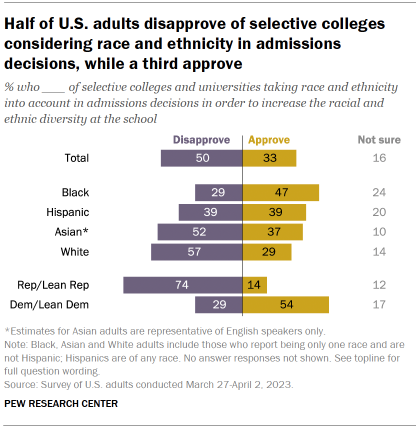
Ahead of a closely watched Supreme Court decision that may significantly affect the admissions practices of some of the nation’s top colleges, half of U.S. adults say they disapprove of selective colleges and universities taking prospective students’ racial and ethnic backgrounds into account when making admissions decisions. Fewer (33%) approve of colleges considering race and ethnicity to increase diversity at the schools, while 16% are not sure.
Tuesday, November 1, 2022
The Mechanics of Affirmative Action
Many posts have discussed affirmative action, the subject of oral argument in the Supreme Court yesterday.
Perhaps so, but the statute pretty clearly states that using race as an admissions criterion is, without exception, illegal. https://t.co/CxC5G5njrW pic.twitter.com/mrdxsTTGHG
— George Conway🌻 (@gtconway3d) November 1, 2022
As legal scholar David Bernstein points out in “Classified: The Untold Story of Racial Classification in America,” “Experience around the world shows that affirmative action categories almost always expand rather than contract, as more and more groups lobby to get affirmative action preferences and then lobby to protect those preferences.” A system that drew its political support from our desire to eradicate Jim Crow ended up covering a number of protected classes, though along somewhat arbitrary lines that were driven as much by political maneuvering as by any rational criteria. This created various ad hoc absurdities — a Pakistani is “Asian,” but an Afghan born a few miles across the border might be coded “White”; the daughter of a Spanish doctor is Hispanic, eligible for various private and government-sponsored affirmative action programs, while the child of an Italian janitor, who might be visually indistinguishable from the doctor’s child, is presumably in no need of help.
Sunday, May 22, 2022
Polarization and Diversity
From a new CBS News survey:\
Americans overall are more likely to see the Republican Party as fighting for White people than for Black people — by more than two to one. In fact, more say the Republican Party fights against the interests of Black Americans than is neutral toward them. It's similarly true for views of the Republican Party's approach to Hispanic people, with more feeling it works against them, rather than for them, and by more than two to one, against LGBTQ people than for them. Americans do think the GOP fights more for people of faith than do Democrats.
Conversely, they see the Democratic Party as fighting for Black and Hispanic Americans more so than for White Americans.
Americans are more likely to believe the GOP fights more against the interests of women than for women, and women overall describe things this way.
Men, meanwhile, are much more likely to think the Democrats fight more for women than for men, but a majority of men think the Republican Party fights for them (and more so than for women).
Echoing some of these perceptions are big differences in how partisans within the parties approach the country's racial diversity — and each group's partisans tend to think they're not being treated fairly.
Big majorities of Democrats think immigrants make America better in the long run; a majority of Republicans say they make America worse.
Republicans are more likely to say White Americans suffer "a lot" of discrimination than they are to say Black Americans do.
Democrats see quite the opposite. And Democrats are more likely to say it's very important for political leaders to condemn White nationalism.
Republicans tend to see America's changing diversity as neither good nor bad, but those who take a position tend to say bad. Democrats (whose ranks are made up of more people of color) say it's a good thing.
Wednesday, May 4, 2022
Alito's 1985 Job Application
In 1985, Samuel Alito applied to be Deputy Assistant Attorney General under Attorney General Edwin Meese during the Reagan Administration. This statement is from his application:
I am and always have been a conservative and an adherent to the same philosophical views that I believe are central to this Administration. It is obviously very difficult to summarize a set of political views in a sentence but, in capsule form, I believe very strongly in limited government, federalism, free enterprise, the supremacy of the elected branches of government, the need for a strong defense and effective law enforcement, and the legitimacy of a government role in protecting traditional values. In the field of law, I disagree strenuously with the usurpation by the judiciary of decisionmaking authority that should be exercised by the branches of government responsible to the electorate. The Administration has already made major strides toward reversing this trend through its judicial · appointments, litigation, and public debate, and it is my hope that even greater advances can be achieved during the second term, especially with Attorney General Meese's leadership at the Department of Justice.
When I first became interested in government and politics during the 1960s, the greatest influences on my views were the writings of William F. Buckley, Jr., the National Review, and Barry Goldwater's 1964 campaign. In college, I developed a deep interest in constitutional law, motivated in large part by disagreement with Warren Court decisions, particularly in the areas of criminal procedure, the Establishment Clause, and reapportionment. I discovered the writings of Alexander Bickel advocating judicial restraint, and it was largely for this reason that I decided to go to Yale Law School.
After graduation from law school, completion of my ROTC military commitment, and a judicial clerkship, I joined the U.S. Attorney's office in New Jersey, principally because of my strong views regarding law enforcement. Most recently, it has been an honor and source of personal satisfaction for me to serve in the office of the Solicitor General during President Reagan's administration and to help to advance legal positions in which I personally believe very strongly. I am particularly proud of my contributions in recent cases in which the government has argued in the Supreme Court that racial and ethnic quotas should not be allowed and that the Constitution does not protect a right to an abortion.
As a federal employee subject to the Hatch Act for nearly a decade, I have been unable to take a role in partisan politics. However, I am a life-long registered Republican and have made the sort of modest political contributions that a federal employee can afford to Republican candidates and conservative causes, including the National Republican Congressional Committee, the National Conservative Political Action Committee, Rep. Christopher Smith (4th Dist. N.J.), Rep. James Courter (12th Dist. N.J.), Governor Thomas Kean of N.J., and Jeff Bell's 1982 Senate primary campaign in N.J. I am a member of the Federalist Society for Law and Public Policy and a regular participant at its luncheon meetings and a member of the Concerned Alumni of Princeton University, a conservative alumni group. During the past year, I have submitted articles for publication in the National Review and the American Spectator.
Monday, May 2, 2022
Americans Oppose Affirmative Action in College Admissions
With the college admissions process under increasing scrutiny – by colleges themselves and the U.S. Supreme Court – more Americans say high school grades and standardized test scores should matter in the admissions process than say the same about other factors.
The poll finds that 74% say race or ethnicity should not be a factor.
Although majorities of Americans across racial and ethnic and partisan groups say race or ethnicity should not be factored into college acceptance decisions, there are variations in how widely this view is held.
About eight-in-ten White adults (79%) say race or ethnicity should not factor into admission decisions. By comparison, 68% of Hispanic adults say this, as do about six-in-ten Asian American (63%) and Black (59%) adults. And while 87% of Republicans say race or ethnicity should not be a factor in admissions, that share falls to 62% among Democrats.
While three-quarters of Americans say having a relative who attended the school should not factor into decisions, White adults (80%) are more likely than Hispanic (67%), Black (62%) and Asian American (59%) adults to say this.

Tuesday, January 25, 2022
Supreme Court Takes Affirmative Action Cases
From Students for Fair Admissions:
Today, the U.S. Supreme Court granted certiorari in Students for Fair Admissions v. Harvard and Students for Fair Admission v. University of North Carolina, federal lawsuits brought by a nonprofit membership organization in 2014 alleging that Harvard and UNC’s admissions policies discriminate against Asian-American and white applicants.
After a three-week trial in 2018, a district court in Boston ruled in Harvard’s favor. The U.S. Court of Appeals for the First Circuit upheld the lower court’s opinion. The case was appealed to the U.S. Supreme Court in February, 2021.
The trial in the UNC case was conducted in November, 2020 with the court ruling in favor of UNC nearly one year later. On November 11, 2021, SFFA petitioned the Supreme Court to grant certiorari before judgement from the U.S. Court of Appeals for the Fourth Circuit so that both the Harvard and UNC cases could be heard together.
Edward Blum, president of SFFA, said, “We are grateful the Supreme Court accepted these important cases for review. It is our hope that the justices will end the use of race as an admissions factor at Harvard, UNC and all colleges and universities.”
Blum added, “Both the Pew Research Center and Gallup have released surveys which indicate that nearly 75% of Americans of all races do not believe race or ethnicity should be a factor in college admissions. In a multi-racial, multi-ethnic nation like ours, the college admissions bar cannot be raised for some races and ethnic groups but lowered for others. Our nation cannot remedy past discrimination and racial preferences with new discrimination and different racial preferences.”
Blum noted, “Harvard and the University of North Carolina have racially gerrymandered their freshman classes in order to achieve prescribed racial quotas. Every college applicant should be judged as a unique individual, not as some representative of a racial or ethnic group.”
Blum concluded, “The cornerstone of our nation’s civil rights laws is the principle that an individual’s race should not be used to help or harm them in their life’s endeavors. We hope the Supreme Court will use these cases to begin the restoration of the colorblind legal covenant that holds together Americans of all races and ethnicities.”
The video “Admission” can be found at studentsforfairadmissions.org here.
Click here to view or download the full press release.
Click here to view the press release on PRNewswire.
Sunday, November 21, 2021
Mendacity
John McWhorter at NYT:
Our times often put me in mind of Tennessee Williams’s “Cat on a Hot Tin Roof,” when Big Daddy says: “What is the smell in this room? Don’t you notice it, Brick? Don’t you notice a powerful and obnoxious odor of mendacity in this room?”
These days, an aroma of delusion lingers, with ideas presented to us from a supposedly brave new world that is, in reality, patently nonsensical. Yet we are expected to pretend otherwise. To point out the nakedness of the emperor is the height of impropriety, and I suspect that the sheer degree to which we are asked to engage in this dissimulation will go down as a hallmark of the era: Do you believe that a commitment to diversity should be crucial to the evaluation of a candidate for a physics professorship? Do you believe that it’s mission-critical for doctors to describe people in particular danger of contracting certain diseases not as “vulnerable (or disadvantaged)” but as “oppressed (or made vulnerable or disenfranchised)”? Do you believe that being “diverse” does not make an applicant to a selective college or university more likely to be admitted?
In some circles these days, you are supposed to say you do.
Saturday, November 13, 2021
DEI Statements
At AEI, Robert Maranto and James D. Paul have a report titled "Other than merit: The prevalence of diversity, equity, and inclusion statements in university hiring." Key Points:
- Diversity, equity, and inclusion (DEI) statement requirements for job applicants seeking university faculty posts seem increasingly common.
- Proponents claim these requirements create a more inclusive academy. Critics claim they amount to political correctness loyalty oaths. Yet, until now, no one has conducted an empirical investigation of their prevalence or how these requirements vary across academic disciplines, geographic regions, type of faculty position, and university prestige.
- Prestigious universities are significantly more likely to have DEI requirements than nonprestigious universities. Perhaps surprisingly, these statements are as prevalent in STEM fields as in the humanities and social sciences, once controls are accounted for.
- Regular faculty posts are more likely to require DEI statements than adjunct and postdoc positions. Relative to other regions, jobs in the West are most likely to require DEI statements
Monday, October 25, 2021
Lying About Race on College Applications
Scott Jaschik at Inside Higher Ed:
Most colleges and universities are aggressively searching for minority applicants. They want diversity on their campuses. They want students who might have been excluded in the past to feel welcome.
All of which raises a question: Are students telling the truth about their race and ethnicity?
The website Intelligent recently asked white Americans whether they had been truthful about their race when applying to college. (Intelligent is a data-focused website that aims “to create content that helps you live better,” with a focus on students.) The survey was of 1,250 white adults who had applied to college.
The main finding: 34 percent of white Americans who applied to colleges or universities admit to lying about being a racial minority on their application. The most common lie (by 48 percent of those who lied) was to be a Native American.
Seventy-seven percent of people who claimed to be a racial minority on their applications were accepted by the colleges to which they lied.
While other factors may have played a role in their acceptance, the majority of applicants who lied and were accepted (85%) believe that falsifying their racial minority status helped them secure admission to college.
Subscribe to:
Posts (Atom)