Many posts have discussed demographic trends, especially the decline of births and the aging of the population.


Many posts have discussed demographic trends, especially the decline of births and the aging of the population.


Many posts have discussed economic and educational inequality. The effects of inequality reach many corners of American life.
Proceedings of the National Academy of Sciences (PNAS),
Yesterday Jemele Hill recirculated a study YouGov did in 2022 about the gaps between people’s perceptions and reality.
YouGov asked a series of questions on “What percentage of Americans do you think are [fill in the blank]?” with the [blank] being all sorts of qualities: black, gay, Christian, left-handed, own a passport, etc.
The results were hilarious. Here are some of the percentages that Americans (on average) think their fellow citizens are:We’ll get to the actual, in vivo percentages in a moment. First I want to point out the absurdity: 1-in-3 are gay/lesbian? Muslims and Jews make up 57 percent of the country? Blacks are 40 percent of the population?
- Transgender: 21 percent
- Muslim: 27 percent
- Jewish: 30 percent
- Black: 41 percent
- Live in New York City: 30 percent
- Gay or lesbian: 30 percent
Not to be crass, but if a third of the population is gay/lesbian then where are all the kids coming from?
If a quarter of the country is Muslim and a third is Jewish, then mosques plus synagogues would outnumber churches. Does anyone see more mosques and synagogues than churches as they drive around?
If 40 percent of the country is black then wouldn’t there be a lot more black people in Congress? I mean, there have only been 12 African-American senators ever.
You see what I mean: These perceptions do not square with any version of observable reality. Here the numbers as they actually exist in the real world:We are talking about errors of perception measured by orders of magnitude. On the trans population, the average American’s estimation is off by 2,000 percent.
- Transgender: 1 percent
- Muslim: 1 percent
- Jewish: 2 percent
- Black: 12 percent
- Live in New York City: 2 percent1
- Gay or lesbian: 3 percent
If you go down the list of characteristics YouGov asked people about, you see a persistent mistake in one direction: Americans vastly overestimate the numbers of people in minority groups. And by “minority groups” I’m talking not just about racial, ethnic, and sexual minorities. They wildly overestimate all kinds of minorities.
ABERDEEN PROVING GROUND, Md. — Juneteenth is known as America’s “second” Independence Day because it commemorates the end of slavery in America. The holiday also represents the beginning of the fulfillment of America’s promise of life, liberty, and the pursuit of happiness for Black Americans.
President Abraham Lincoln issued The Emancipation Proclamation on Jan. 1, 1863, declaring “that all persons held as slaves” within the rebellious states “are, and henceforward shall be free.” However, Texas resisted the Emancipation Proclamation for more than two years.
On June 19, 1865, U.S. Army Maj. Gen. Gordon Granger arrived in Galveston, Texas, to enforce the Emancipation Proclamation and free the last enslaved Americans in Texas from bondage. This day became known as “Juneteenth”, or “Jubilee Day,” “Freedom Day,” or “Emancipation Day.”
Juneteenth is considered the longest-running Black American holiday. Over the years and through successive waves of migration, Juneteenth celebrations spread to the rest of Texas and eventually the country at large.
The Juneteenth Day of Observance officially became the 11th federal holiday in 2021 and is the first new federal holiday since the recognition of Rev. Dr. Martin Luther King Jr.’s birthday in 1983.
“Juneteenth represents not only the commemoration of the end of slavery in America more than 150 years ago, but the ongoing work to bring true equity and racial justice into American society,” said U.S. President Joseph R. Biden before the signing of the Juneteenth National Independence Day Act on June 17, 2021.
APG Soldiers, civilians advocate for equality in Harford County
Juneteenth is an integral part of Army life. It is a time to reflect on the crucial role the Army played in the Emancipation Proclamation and ending segregation in the U.S.
On July 26, 1948, President Harry Truman signed Executive Order 9981, which ended segregation in the military. This order marked a significant moment in the civil rights movement. It was also one of the first instances where a U.S. president used an executive order to implement a civil rights policy.
Locally, APG Soldiers and civilians were instrumental in the desegregation of Harford County by leading efforts to desegregate local restaurants, facilitate school integration, and advocate for fair and open housing in the 1960s, said Patricia D. Cole, President of the Havre de Grace Colored School Museum and Cultural Center, Inc.
These efforts included peaceful protests, speeches, and involvement in lawsuits. For example, Cole said many Soldiers and civilians were involved in the Route 40 protests, advocating for the desegregation of restaurants and other public accommodations.
In the 1960s, George S. Pettit, an APG scientist, filed a lawsuit to enable his son A. Dwight Pettit to attend Aberdeen High School. After a two-year legal battle, the Pettit family won the lawsuit, allowing A. Dwight Pettit to attend Aberdeen High School instead of Havre de Grace Consolidated, a segregated school for Black students. Today, A. Dwight Pettit is a prominent Baltimore lawyer.
Cole said in 1961, APG leaders facilitated meetings between local restaurant owners and civil rights leaders to advocate for removing racial exclusions in restaurants along Route 40.
“This effort was crucial as Black Vietnam veterans returning home faced significant challenges in finding housing off the post,” Cole said.
This Juneteenth, take time to reflect on what it means to be free, celebrate the resiliency of Black Americans, and honor those who fought and sacrificed to ensure the Constitution fulfilled its promise to all Americans.
A number of posts have dealt with homelessness.
HUD Annual Homelessness Assessment Report:
The data, from an Economist/YouGov poll conducted after the Supreme Court’s decision, shows Americans approving of it more than 2-to-1. That’s a finding in line with surveys conducted before the decision, including from The Washington Post and CBS News, which showed more than 6 in 10 Americans supported the idea of banning the use of race and ethnicity in admissions. Another poll conducted after the decision, for ABC News, showed Americans approved of it by a 20-point margin.
What’s particularly striking about the Economist/YouGov poll is how Black Americans responded. Indeed, more of them actually approved of the decision (more than 4 in 10) than disapproved (fewer than 4 in 10). And more Black Americans “strongly” approved (31 percent) than disapproved (26 percent).
This finding is also in line with previous polling. While polls have long shown Black Americans in favor of affirmative action, The Washington Post-Schar School poll showed nearly half (47 percent) supported banning the use of race and ethnicity in admissions.
If you dig a little deeper, you begin to see why that might be: the lack of a perceived personal connection to the policy.
The YouGov poll also asked people whether they felt affirmative action had had an impact on them. Just 19 percent of Black Americans felt that it had, and just 11 percent of those who felt that way said it had affected them “positively.”
Daniel A. Cox and Ruy Teixeira at the Survey Center on American Life:
Public attitudes about the American dream are somewhat more positive. Most Americans believe they are already living the American dream (32 percent) or that they will reach it in their lifetime (31 percent). Thirty-six percent of Americans say they will not reach it in their lifetime.
Although white Americans are far more likely than others to report that they have achieved the American dream, black (41 percent), Hispanic (40 percent), and Asian (44 percent) Americans generally remain optimistic that it is still within reach. Nearly four in 10 (39 percent) white Americans say they are living the American dream, compared to fewer than one in four Hispanic (24 percent), Asian (21 percent), and black (18 percent) Americans. Despite these differences in experience, more than one-third of black (40 percent), Hispanic (36 percent), and Asian (35 percent), and white (34 percent) Americans believe they will not achieve the American dream in their lifetime.
Understandably, perspectives on the American dream vary with age. Sixty-three percent of retirees (age 65 and older) believe they have already achieved the American dream. An additional 12 percent say they will yet reach it. Older Americans (24 percent) are also least likely to say they will not reach the American dream in their lifetime. Roughly four in 10 young and middle-aged Americans are similarly pessimistic (40 percent vs. 39 percent, respectively).
Education, a core element of socioeconomic mobility, is closely associated with perceptions of the American dream. Twenty-three percent of high school–educated Americans say they have already achieved the American dream, compared to 30 percent of Americans with some college or an associate degree, 42 percent of Americans with a four-year degree, and 47 percent of Americans with an advanced degree. This educational divide is mirrored among Americans who say they will not reach the American dream in their lifetime. Forty-two percent of high school–educated Americans say they will not achieve the American dream, compared to 24 percent of college-educated Americans.
Ten years after the #BlackLivesMatter hashtag first appeared on Twitter, about half of U.S. adults (51%) say they support the Black Lives Matter movement, according to a new Pew Research Center survey. Three years ago, following the murder of George Floyd, two-thirds expressed support for the movement.
.
Views of the Black Lives Matter movement vary by:
l.
- Race and ethnicity: 81% of Black adults say they support the movement, compared with 63% of Asian adults, 61% of Hispanic adults and 42% of White adults. White adults are more likely than those in other racial and ethnic groups to describe the movement as divisive and dangerous (about four-in-ten White adults do so, compared with 30% or fewer among the other groups), and they are the least likely to describe it as empowering.
- Age: 64% of adults ages 18 to 29 support the movement, compared with 52% of those 30 to 49, 46% of those 50 to 64 and 41% of those 65 and older. Some 41% of young adults (ages 18 to 29) say empowering describes the movement extremely or very well and 27% say the same about inclusive, larger than the share of adults ages 30 and older who say those words describe the movement well. And while 49% of young adults say the movement has been highly effective at bringing attention to racism, 32% of those ages 30 to 49, 27% of those 50 to 64 and 22% of those 65 and older say this.
- Partisanship: 84% of Democrats and Democratic leaners support the movement, while 82% of Republicans and Republican leaners oppose it. Democrats are more likely than Republicans to say the words empowering (42% vs. 11%) and inclusive (27% vs. 11%) describe the movement extremely or very well. Republicans, in turn, are more likely than Democrats to say the words dangerous (59% vs. 9%) and divisive (54% vs. 19%) describe the movement well.
The ethnic differences in the prevalence of traditional marriage are huge. Among the nearly five million children in the ACS from 2014 to 2021, these were the percentages of children living with married birth parents broken down by the child’s ethnicity:
Child’s Ethnicity Married Birth Parents
Asian ............................82%
White ............................62%
Other or Mixed ,,,,,,,,,,,,50%
Latino ,,,,,,,,,,,,,,,,,,,,,,,,,,,,43%
Black ............................23%
Asian children and black children effectively live in different familial worlds. The difference in living situations between white and black children is less dramatic but still extremely large.
Many posts have discussed partisan polarization and aversive or negative partisanship.
In a rare rebuke, Republicans who control the state House of Representatives voted to kick out Justin Jones and Justin Pearson, two Black men who had recently joined the legislature, over their rule-breaking protest on the House floor on March 30.
Today, Tennessee represents the grim culmination of the forces corroding state politics: the nationalization of elections and governance, the tribalism between the two parties, the collapse of local media and internet-accelerated siloing of news and the incentive structure wrought by extreme gerrymandering. Also, if we’re being honest, the transition from pragmatists anchored in their communities to partisans more fixated on what’s said online than at their local Rotary Club.
...
This tunnel vision is part of what convinced the Republicans they had to take such an extreme step last week. Bill Haslam, a former GOP governor, told me he was struck by how even some pragmatic Republican lawmakers were scared for their lives because of the protests and convinced they had to show strength.
“They told me ‘You don’t understand,’” Haslam said.
In fact, it was the GOP legislators who didn’t understand how badly their retribution looked outside their cloakrooms, which is all the more apparent now that the two Justins are being hailed as martyrs and reinstated this week by their local governing bodies.
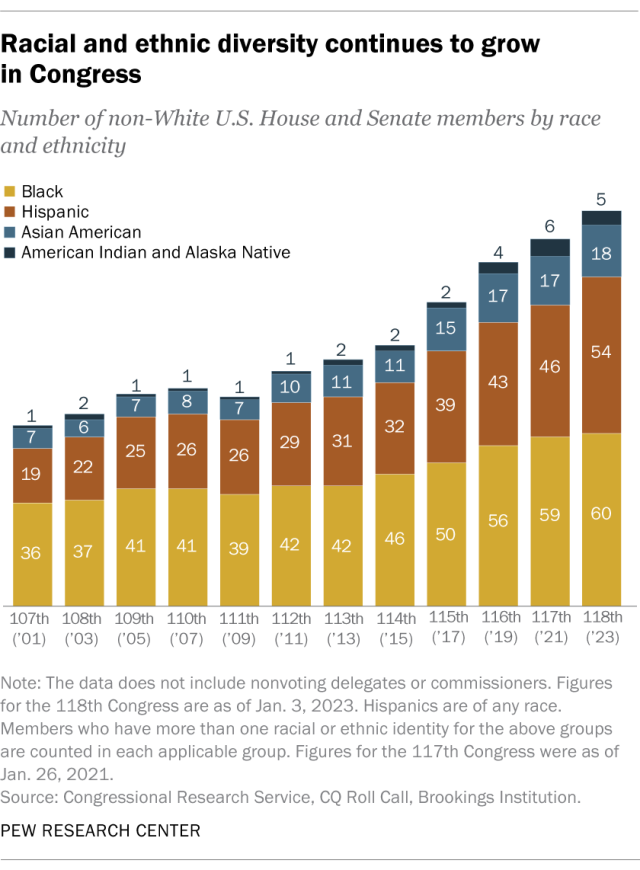
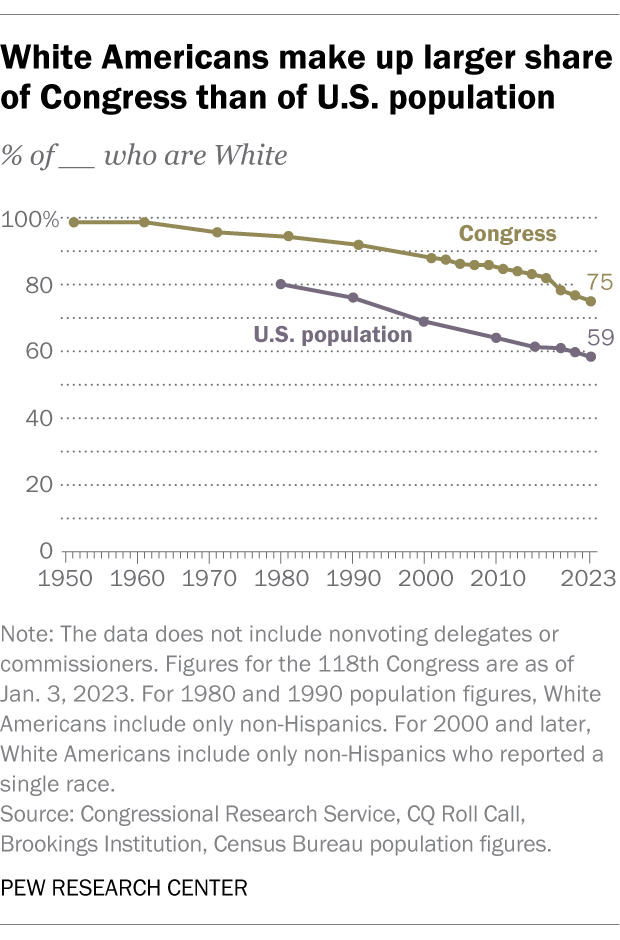
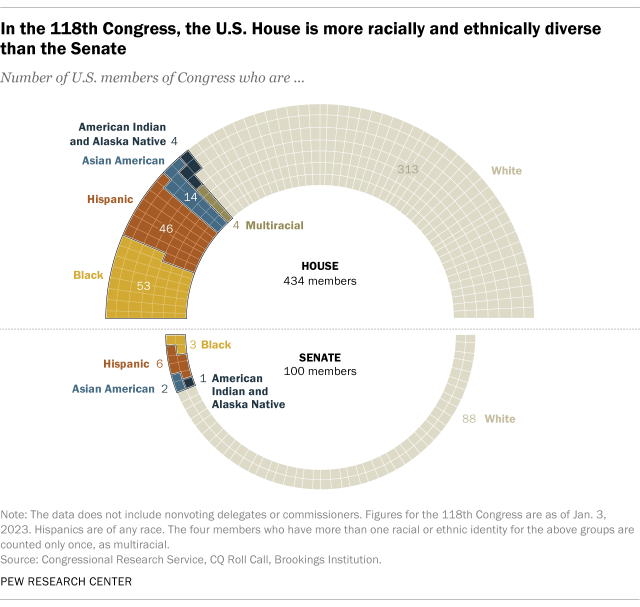
A quarter of voting members of the U.S. Congress identify their race or ethnicity as something other than non-Hispanic White, making the 118th Congress the most racially and ethnically diverse to date. This continues a long-running trend toward more racial and ethnic diversity on Capitol Hill: This is the seventh Congress to break the record set by the one before it.
Overall, 133 senators and representatives today identify as Black, Hispanic, Asian American, American Indian or Alaska Native, according to a Pew Research Center analysis of data from the Congressional Research Service. This number has nearly doubled in the two decades since the 108th Congress of 2003-05, which had 67 minority members.
Our analysis of the 118th Congress reflects the 534 voting members of Congress as of Jan. 3, 2023. Portuguese American members are not included in the Hispanic count.
The vast majority (80%) of racial and ethnic minority members in the new Congress are Democrats, while 20% are Republicans. This split is similar to the previous Congress, when 83% of non-White lawmakers were Democrats and 17% were Republicans.
When Karen Bass is sworn in as Los Angeles mayor next month, she’ll be making history in more ways than one.
Not only will she be the first woman to lead LA, Bass will complete a rare tetrafecta of sorts: Black mayors will be running the nation’s four largest cities, with the congresswoman joining Eric Adams of New York, Lori Lightfoot of Chicago and Sylvester Turner of Houston.
“Anytime we get a new mayor, it’s exciting,” Frank Scott, the Democratic mayor of Little Rock, Ark., said in a phone interview. “But to have another mayor, a Black woman, who’s going to lead one of our nation’s major cities? That’s a big deal.”
This marks the first time these major metropolises will simultaneously be led by African Americans — and it may be for just a brief period. The leadership acumen of big city mayors is being tested now in how they address issues ranging from upticks in crime, to a sagging economy and high inflation, to housing affordability and homelessness.
And this is all taking place as the cities undergo seismic demographic shifts. All four are “majority minority” cities and these Black mayors are governing municipalities where Latinos, not Black residents, make up the largest non-white ethnic group.
Hispanics accounted for more than half of the growth in the U.S. population, according to the 2020 Census. Meanwhile, New York, Chicago, Los Angeles and other big cities have seen their Black populations shrink in recent years in something of a reversal of what happened in the 1970s. These new migration patterns are altering political dynamics as Latinos consolidate power.
Democrats in cities across America are having trouble holding their coalitions together.
In Los Angeles, the battle is over power in the form of representation on the City Council; in San Francisco and New York, it’s over affordable housing and access to public schools; across the nation, it’s over tough versus tolerant criminal prosecution and lenient versus punitive approaches to homelessness.
These tensions are, in turn, aggravated by white gentrification and have one thing in common: limited or declining resources, with shuttered businesses no longer paying taxes evident on downtown streets. An absence of growth prevents elected officials from expanding benefits for some without paring them for others.
Political tensions between African American, Hispanic American, Asian American and white communities in Los Angeles are now on full display as a result of the publication of a secretly taped conversation that exposed the crude, racist scheming of three Hispanic City Council officials and a Hispanic labor leader — who were, in the main, angling to enhance their power at the expense of Black competitors.
These zero-sum conflicts epitomize the problem for liberals struggling to sustain a viable political alliance encompassing core minority constituencies.
Some observers may dismiss this episode as simply a few biased people. Others might attribute the incident to some Latinos’ exposure to anti-Black ideologies in their home countries.
But our research finds that Latinos’ anti-Black prejudice has strong roots in the United States, which has been steeped in anti-Black racism since its founding. When immigrants arrive here, they and their U.S.-born children learn that however low they might be on the social scale, another group is despised more. A series of such groups, including the Irish, Italians and Poles, earned their identity as Americans by expressing anti-Black prejudice. These efforts have ranged from hurling racial epithets at African Americans to violently keeping Black families out of neighborhoods and schools.
Many Latinos — along with other communities of color — are repeating this same pattern, asserting their position in the American fabric by denigrating Black people. For example, the 2012 installment of the American National Election Study — widely considered a benchmark survey of U.S. politics — examined a large oversample of about 1,000 Latino adults. In that survey, more than half of Latino respondents agreed with statements used to measure anti-Black racism, including: “It’s really a matter of some people not trying hard enough; if Blacks would only try harder they could be just as well off as Whites.”
Kiana Cox and Christine Tamir at Pew:
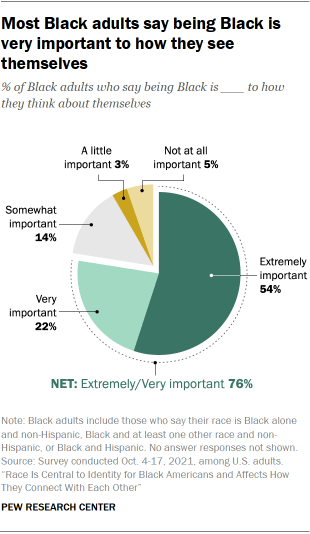
No matter where they are from, who they are, their economic circumstances or educational backgrounds, significant majorities of Black Americans say being Black is extremely or very important to how they think about themselves, with about three-quarters (76%) overall saying so.A significant share of Black Americans also say that when something happens to Black people in their local communities, across the nation or around the globe, it affects what happens in their own lives, highlighting a sense of connectedness. Black Americans say this even as they have diverse experiences and come from an array of backgrounds.
Even so, Black adults who say being Black is important to their sense of self are more likely than other Black adults to feel connected to other groups of Black people. They are also more likely to feel that what happens to Black people inside and outside the United States affects what happens in their own lives. These findings emerge from an extensive new survey of Black U.S. adults conducted by Pew Research Center
At National Affairs, Peter Schuck identifies four reasons to question the notion of systemic racism:
The best that the skeptic of this account can do is identify good reasons to doubt that racism in America today is truly systemic. As it turns out, there are four such reasons, the first of which is that rates of racist beliefs among individual Americans have declined over time. Public polling about white-black intermarriage, residential proximity, and other interactions shows dramatic increases in tolerant attitudes among whites since the 1960s. Although white-supremacist hate groups often loudly avow their racist beliefs, they remain a tiny, isolated fraction of the population, and are almost universally reviled by the political left and center as well as many on the right eager to distance themselves from fringe elements.
Of course, people harboring bigoted views often hide them in public, especially in social environments where racism is highly stigmatized. Answers in a survey are not proof that people do not hold racist views, although they do show that people are at least ashamed to admit them. That said, rates of behaviors related to or motivated by racism have fallen as well. In 2020, the FBI found that although the largest category of hate crimes (61.8%) were based on race/ethnicity/ancestry bias, the number of these incidents was under 6,000 nationwide. In a population of over 330 million, this surely does not qualify as systemic.
Second, the cohort of the U.S. population that has been most likely to hold racist views is slowly but inexorably dying out, to be gradually replaced by generations who tend to be far more accepting of racial differences. Though this theory is subject to some dispute, it is undeniable that members of younger generations seem to harbor less overtly racist beliefs than those of older generations. As these young Americans assume leadership roles in our nation's core institutions, their views will affect those institutions' structures, policies, and actions, as well as the people they influence. That virtually every major American institution in recent years has explicitly committed to combatting systemic racism suggests that we are already witnessing this trend taking shape.
A third reason to doubt the systemic-racism thesis is that anti-racist protests and highly publicized punishments of racist incidents have made racism much more newsworthy than it was in decades past. As a result, public discussion of the subject occurs much more often in our communities and traditional media today than it once did — and the tenor of this discourse is almost invariably opposed to racism. To the extent that systemic racism is inherently implicit or invisible, there is less room for it to hide now than there was in the past.
...
Even if one were to ignore these facts and insist that systemic racism remains widespread in today's America, there are good reasons to doubt that it represents the primary driver of continuing black disadvantage. For starters, the impressive upward mobility of other non-white groups — including immigrants of color — continues to confound the systemic-racism thesis. The most economically successful of these groups are Asians, particularly Chinese, Japanese, and Koreans — many of whom began life in America without American blacks' English-language advantage. In a recent study, researchers led by Raj Chetty — a leading analyst of economic mobility among different racial and ethnic groups — found that Hispanic and Asian Americans are closing much of the income gap with white Americans, while the upward mobility of lower-class black Americans has not kept pace.
Perhaps most discrediting of the ongoing systemic-racism account is the fact that black immigrants' economic mobility is much greater than that of blacks born in the United States. The median household income of the rapidly growing cohort of black immigrants is about 30% higher than that of American-born blacks. If systemic racism were the primary driver of blacks' disadvantages in America, we would expect it to hold back this population as well. Yet it seems not to have done so. Causal factors other than systemic racism, then, must be contributing significantly to black disadvantage in areas where it persists.
When it comes to estimating the size of demographic groups, Americans rarely get it right. In two recent YouGov polls, we asked respondents to guess the percentage (ranging from 0% to 100%) of American adults who are members of 43 different groups, including racial and religious groups, as well as other less frequently studied groups, such as pet owners and those who are left-handed.
When people’s average perceptions of group sizes are compared to actual population estimates, an intriguing pattern emerges: Amercians tend to vastly overestimate the size of minority groups. This holds for sexual minorities, including the proportion of gays and lesbians (estimate: 30%, true: 3%), bisexuals (estimate: 29%, true: 4%), and people who are transgender (estimate: 21%, true: 0.6%).
It also applies to religious minorities, such as Muslim Americans (estimate: 27%, true: 1%) and Jewish Americans (estimate: 30%, true: 2%). And we find the same sorts of overestimates for racial and ethnic minorities, such as Native Americans (estimate: 27%, true: 1%), Asian Americans (estimate: 29%, true: 6%), and Black Americans (estimate: 41%, true: 12%).
A parallel pattern emerges when we look at estimates of majority groups: People tend to underestimate rather than overestimate their size relative to their actual share of the adult population. For instance, we find that people underestimate the proportion of American adults who are Christian (estimate: 58%, true: 70%) and the proportion who have at least a high school degree (estimate: 65%, true: 89%).
The most accurate estimates involved groups whose real proportion fell right around 50%, including the percentage of American adults who are married (estimate: 55%, true: 51%) and have at least one child (estimate: 58%, true: 57%).
Misperceptions of the size of minority groups have been identified in prior surveys, which observers have often attributed to social causes: fear of out-groups, lack of personal exposure, or portrayals in the media. Yet consistent with prior research, we find that the tendency to misestimate the size of demographic groups is actually one instance of a broader tendency to overestimate small proportions and underestimate large ones, regardless of the topic.
Americans’ confidence in groups and institutions has turned downward compared with just a year ago. Trust in scientists and medical scientists, once seemingly buoyed by their central role in addressing the coronavirus outbreak, is now below pre-pandemic levels.
Overall, 29% of U.S. adults say they have a great deal of confidence in medical scientists to act in the best interests of the public, down from 40% who said this in November 2020. Similarly, the share with a great deal of confidence in scientists to act in the public’s best interests is down by 10 percentage points (from 39% to 29%), according to a new Pew Research Center survey.
The new findings represent a shift in the recent trajectory of attitudes toward medical scientists and scientists. Public confidence in both groups had increased shortly after the start of the coronavirus outbreak, according to an April 2020 survey. Current ratings of medical scientists and scientists have now fallen below where they were in January 2019, before the emergence of the coronavirus.
Scientists and medical scientists are not the only groups and institutions to see their confidence ratings decline in the last year. The share of Americans who say they have a great deal of confidence in the military to act in the public’s best interests has fallen 14 points, from 39% in November 2020 to 25% in the current survey. And the shares of Americans with a great deal of confidence in K-12 public school principals and police officers have also decreased (by 7 and 6 points, respectively).
...
Confidence in medical scientists and scientists across racial and ethnic groups plays out differently for Democrats and Republicans.
White Democrats (52%) are more likely than Hispanic (36%) and Black (30%) Democrats to say they have a great deal of confidence in medical scientists to act in the public’s best interests. However, large majorities of all three groups say they have at least a fair amount of confidence in medical scientists.
Among Republicans and Republican leaners, 14% of White adults say they have a great deal of confidence in medical scientists, while 52% say they have a fair amount of confidence. Views among Hispanic Republicans are very similar to those of White Republicans, in contrast to differences seen among Democrats.
There are similar patterns in confidence in scientists. (However, the sample size for Black Republicans in the survey is too small to analyze on these measures.) See the Appendix for more.
Many posts have discussed the unanticipated consequences of public policy.
The clearance of the thriving, legendary African-American neighborhood in Detroit known as Black Bottom, circa 1950, was not caused by natural disaster, gentrifying developers, or a destructive riot by its residents. The slowly gathering public policy that led to its demolition included an element of racial animus in the city's politics, but more than anything, the death of a neighborhood replete with black-owned businesses and owner-occupied property stemmed from the ideas of progressive housing reformers.
They began to build in the 1890s, when Jacob Riis, a New York police reporter deeply versed in sensationalist journalism, portrayed New York's Lower East Side in How the Other Half Lives as nothing but squalid, showing no interest in the vibrant upward mobility of its immigrants.
Riis inspired the now-obscure Johnny Appleseed of American zoning, Lawrence Veiller, who convinced communities across the country that the density that makes housing affordable (without government subsidies) must be limited. The formula that brought housing within the reach of the poor—what Boston settlement house pioneers Robert Woods and Albert Kennedy rightly celebrated as a "zone of emergence"—would be cast aside.
Its replacement—literally in the cases of Detroit's Black Bottom, Chicago's Bronzeville, St. Louis' DeSoto-Carr, and so many other healthy neighborhoods—would be public housing. The "projects" were and still are the rotten fruit that grew from seeds planted by progressive public intellectuals. The premier modernist architect Le Corbusier envisioned high-rise urban campuses without streets or stores. Less well-known but still essential figures in American housing policy history were University of Chicago sociologist Edith Elmer Wood and self-styled reformer Catherine Bauer Wurster.
In her 1934 paper "A Century of the Housing Problem," Wood led the ill-fated charge that would guide New Deal public housing policy. She inveighed against the private housing industry broadly—even arguing against the idea that homeownership was one of the means for the poor to improve their station. "The housing problem is an inevitable feature of our modern industrial civilization and does not tend to resolve itself," Wood wrote. "Supply and demand do not reach it, because the cost of new housing and the distribution of income are such that approximately two thirds of the population cannot present an effective demand for new housing."