Search This Blog

Showing posts with label mayors. Show all posts

Thursday, April 9, 2026

Most Big-City Mayors Are Democrats

Many posts have discussed local government.

Briana Ryan at Ballotpedia:
Ahead of this year's mayoral elections, we found that more Democrats than Republicans are mayors of the 100 most populous U.S. cities.

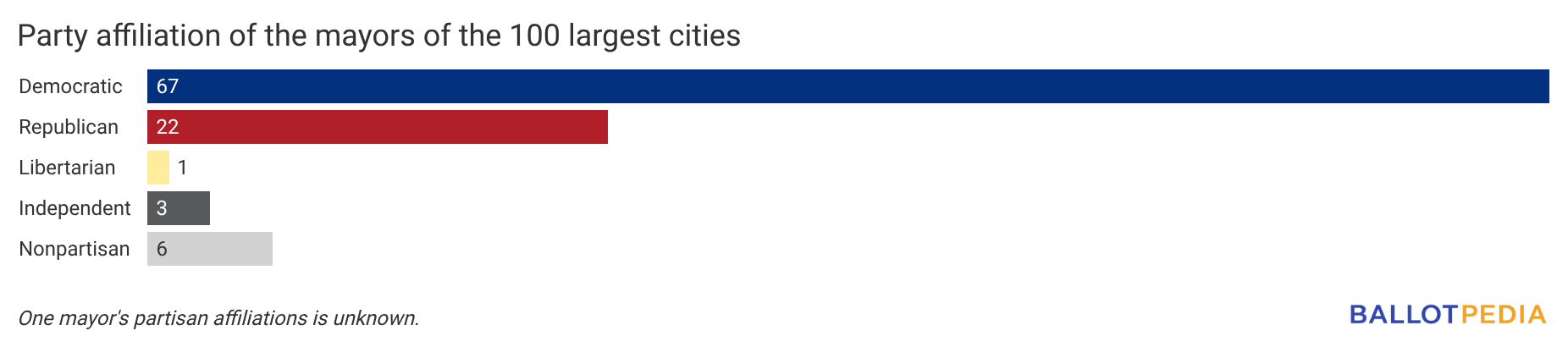
At the start of this year, 67 of the 100 most populous cities had a Democratic mayor. Eleven of those cities are holding mayoral elections this year. Twenty-two of the 100 most populous cities had a Republican mayor. Seven of those cities are holding mayoral elections this year.

The following chart shows the partisan affiliations of all mayors among the top 100 most populous cities.


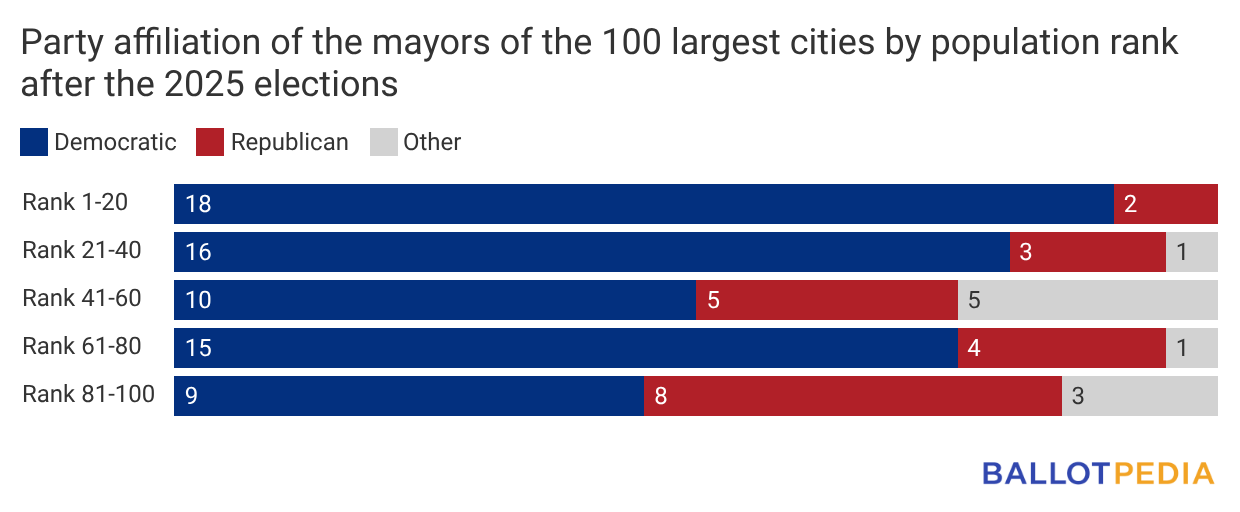
Based on 2020 population estimates, 81% of people who live in the top 100 cities have a Democratic mayor. Fourteen percent live in cities with Republican mayors. The chart below shows the partisan breakdown of the top 100 cities from largest to smallest.


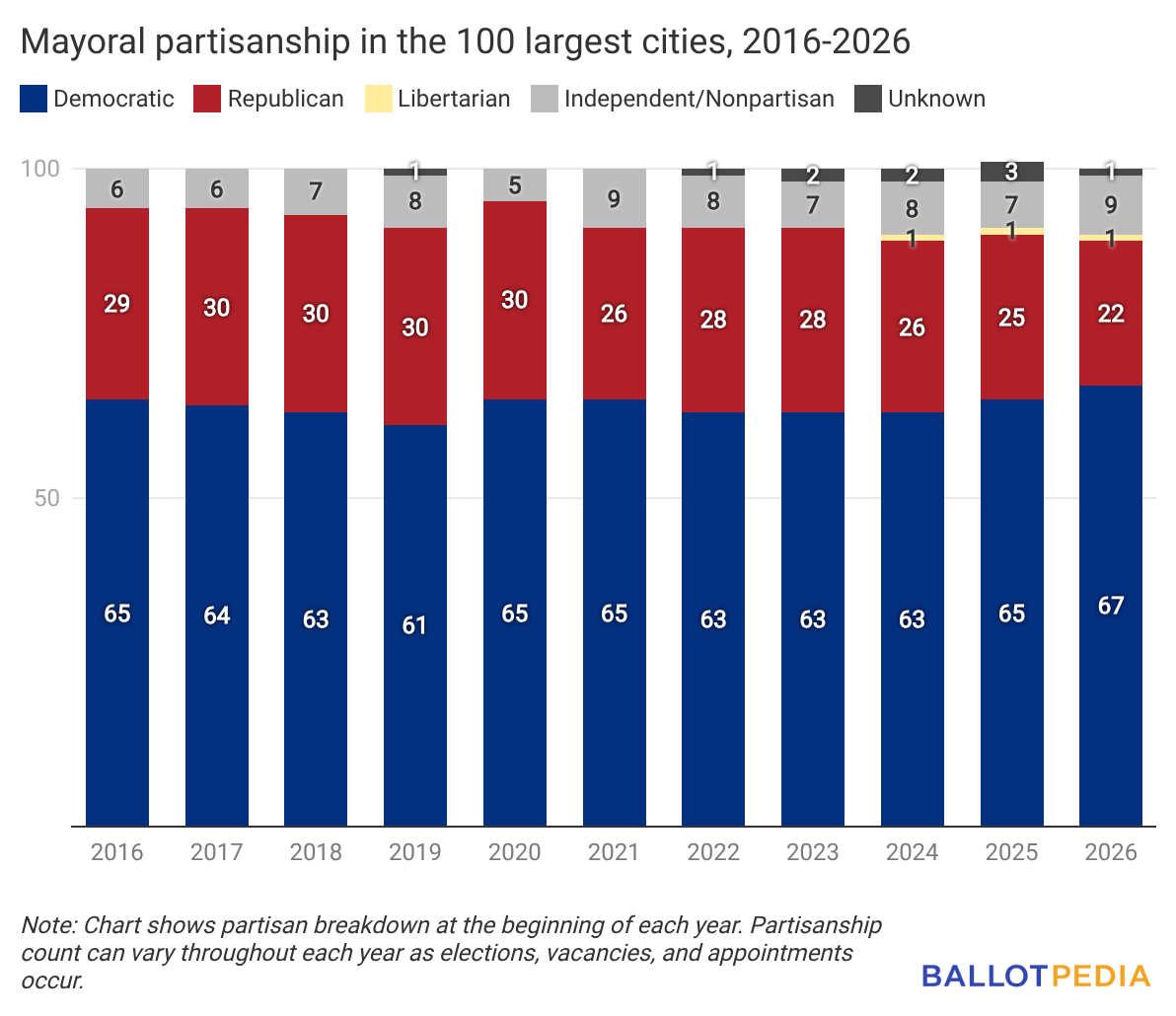
Since 2016, the number of Democratic-led top-100 cities has ranged from 61 to 67, and the number of Republican-led cities has ranged from 22 to 30. Currently, there are the most Democratic mayors and the fewest Republican mayors in the top-100 cities since 2016.


Ten state capitals are holding mayoral elections this year, including eight capitals that fall outside of the top 100 cities.

At the start of this year, 33 state capitals had a Democratic mayor. Six of those are holding mayoral elections this year. Seven state capitals had Republican mayors. Two of them are holding mayoral elections this year.

Click here to see our analysis of partisanship in this year's municipal elections.
 

Monday, November 28, 2022

Black Mayors

Brakkton Booker at Politico:
When Karen Bass is sworn in as Los Angeles mayor next month, she’ll be making history in more ways than one.

Not only will she be the first woman to lead LA, Bass will complete a rare tetrafecta of sorts: Black mayors will be running the nation’s four largest cities, with the congresswoman joining Eric Adams of New York, Lori Lightfoot of Chicago and Sylvester Turner of Houston.

“Anytime we get a new mayor, it’s exciting,” Frank Scott, the Democratic mayor of Little Rock, Ark., said in a phone interview. “But to have another mayor, a Black woman, who’s going to lead one of our nation’s major cities? That’s a big deal.”

This marks the first time these major metropolises will simultaneously be led by African Americans — and it may be for just a brief period. The leadership acumen of big city mayors is being tested now in how they address issues ranging from upticks in crime, to a sagging economy and high inflation, to housing affordability and homelessness.

And this is all taking place as the cities undergo seismic demographic shifts. All four are “majority minority” cities and these Black mayors are governing municipalities where Latinos, not Black residents, make up the largest non-white ethnic group.

Hispanics accounted for more than half of the growth in the U.S. population, according to the 2020 Census. Meanwhile, New York, Chicago, Los Angeles and other big cities have seen their Black populations shrink in recent years in something of a reversal of what happened in the 1970s. These new migration patterns are altering political dynamics as Latinos consolidate power.

Wednesday, December 18, 2019

Philanthropy as Electoral Strategy

Many posts have discussed the political uses of philanthropyMichael Bloomberg is a prominent example of politician-as-benefactor.

Alexander Burns, Nicholas Kulish and Shane Goldmacher at NYT:

As Mr. Bloomberg traverses the country as a presidential candidate, he is drawing on a vast network of city leaders whom he has funded as a philanthropist or advised as an elder statesman of municipal politics. Bloomberg Philanthropies, which has assets totaling $9 billion, has supported 196 different cities with grants, technical assistance and education programs worth a combined $350 million. Now, leaders in some of those cities are forming the spine of Mr. Bloomberg’s campaign: He has been endorsed so far by eight mayors — from larger cities like San Jose, Calif., and Louisville, Ky., and smaller ones like Gary, Ind., representing a total of more than 2.6 million Americans.
For all of those endorsers, Mr. Bloomberg has been an important benefactor. All have attended his prestigious boot camp at Harvard that gives the mayors access to ongoing strategic advice from Bloomberg-funded experts. More than half have received funding in the form of grants and other support packages from Mr. Bloomberg worth a total of nearly $10 million, according to a review of tax documents and interviews with all eight mayors.

Saturday, February 16, 2013

Contradictory Campaign Messages in Los Angeles

It's one thing to target different messages to different segments of the electorate: candidates often stress pollution when communicating with environmentalists, taxes when talking to businesspeople, and so on. But it's something else to send contradictory messages. At The Los Angeles Times, James Rainey catchesmayoral candidate Jan Perry in a particularly blatant bit of inconsistency
The Los Angeles city councilwoman came out with a bulk-mail pitch Tuesday that shows her side by side with Mayor V. Both are grinning. The headline quotes Villaraigosa, in English and Spanish, saying: "Jan Perry would make a good mayor."
It doesn't say it's an endorsement, though a voter might read it that way. But that would be wrong because a) Villaraigosa has said he does not intend to endorse, at least in the March 5 primary and b) what he actually told NBC4 political reporter Conan Nolan was: "Eric Garcetti would make a good mayor. Jan Perry would make a good mayor. Wendy Greuel would make a good mayor."
Perry's mailer somehow neglected to mention the other two.
But the intrigue only begins there because Perry — who has been positioning herself as the truth teller among a gallery of panderers —sent quite a different message with a mailer a week ago. That one showed rival Wendy Greuel and Villaraigosa arm-in-arm. The headline: "Wendy Greuel: Brought to you by the same people who brought you Antonio Villaraigosa."
...
 The mailer attacking Greuel as a Villaraigosa toady appears to be aimed at conservative voters, many of them in the San Fernando Valley. A whiff of connection to the over-taxing, electric-rate-raising fools at City Hall lands like a stink bomb in those households.
The voters who contacted the Times about the Greuel-Villaraigosa hit piece live in the San Fernando Valley.
The Spanish-English mailer, meanwhile, clearly targeted Latino voters, who played a key role in 2005 in making Villaraigosa the city's first Latino mayor in modern times. Perry appears only too happy to snuggle up next to the mayor in front of that audience.

Tuesday, April 12, 2011

Recalling Mayors

In our chapter on elections and campaigns, we discuss recall elections. On the local level, USA Today reports, such elections are becoming more common:

Buoyed by the viral power of the Internet and rising anti-government sentiment, disgruntled voters have set off a rash of recall drives against mayors in cities across the USA.

The urge to oust city leaders has intensified in the struggling economy as more mayors raise taxes and cut services to close budget shortfalls.

Fifty-seven mayors faced recall attempts last year, up from 23 in 2009, according to Ballotpedia, a non-profit that tracks recall elections. So far this year: 15. Almost all have failed.

Recalls are so frequent that the U.S. Conference of Mayors today launches a campaign warning mayors to brace for recalls. The effort includes a documentary-style film, Recall Fever: Stop the Madness. The film recounts recent recall efforts in Omaha; Miami; Akron, Ohio; and Chattanooga, Tenn.

"Any person who's coming in to serve needs to understand this is happening," says Tom Cochran, CEO and executive director of the non-partisan mayor's group. Cochran says that budgetary decisions made in this tough economic climate are likely to trigger more anger. "If they don't have a website, if they don't have a blogger," he says of mayors, "they better, by God, get one." ...

Voters generally like recalls, says Joshua Spivak, who writes a blog on recall elections and is a senior fellow at the Hugh L. Carey Institute for Government Reform at Wagner College in New York City. "That's the whole point of democracy," he says. "Mayors have to accept that … that's part of the challenges of being a public elected official."

Most recalls fail, but last month, Miami-Dade County mayor Carlos Alvarez, who listed no party preference, was ousted by 88% of voters in a special election. Alvarez angered constituents when he gave pay increases to staffers and raised property taxes during a housing bust.

At the Recall Elections Blog, Spivak faults the Conference of Mayors effort:

Specifically, it notes that the recall has targeted local leaders “who have done nothing illegal” and that voters are “expressing their feelings -- often times in destructive ways.” This seems to be a fruitless attempt to shift the blame to the voters, and by stressing the illegality red herring, ignores the fact that recalls are (in most states and localities) inherently political devices. Most recalls are not based around illegal action, and a study of the history of the recall shows that it was not intended to flush out corruption. Voters are simply not going to like this line of attacks.

This is a shame, as the mayors should be calling attention to the cost of recalls. As I’ve mentioned before, arguing that a recall is expensive does not work that well as a campaign defense. However, it is pretty much the only time that the recall’s price tag comes up. The mayors are right to bring this issue to the fore now, and try to present a reasoned explanation for why voters should limit the recall in order to save money. But the Mayors have to walk a tightrope – which their initial press release did not do – and show that they are looking out for the voters best interest, and not seeking to protect themselves and limit options for deploying the recall.