Search This Blog

Showing posts with label local government. Show all posts

Tuesday, August 4, 2026

Implementation and Public Groceries

Many posts have discussed public administration.

New York's Mayor Mamdani wants to set up public grocery stores.  As usual, good intentions crash into the reality of implementation.

California businessman Nick Kokonas at X:

I downloaded and reviewed NYC's grocery store RFP... as someone who has built biz's and bought a lot of food... wow.
Forget for a moment whether or not the govt should own a grocery store. Let's review the doc instead. Here you go... /1

NYC strongly prefers bidders who commit to all 5 stores. But 3 of the 5 sites haven’t been identified. Bidders are supposed to price unknown stores in unknown neighborhoods by assuming they’re “about 15,000 sq ft.” Absurd.

Bidders get preference for operating all 5 stores, presumably b/c scale lowers costs. But NYC awards each store separately, so an all-5 bidder may win only 1. They want scale pricing while refusing to award scale.

The stores must use a “limited SKU” model. They must also carry full grocery departments, household goods, culturally specific products, plus kosher, halal, vegan, gluten-free, dairy-free and diabetic options. Pick one.

The RFP says stores won’t have deli counters or on-site food prep. Then its Core Basket includes chicken salad, egg salad, potato salad, fruit salad and other deli-prepared foods. So, a deli w/o a deli. Oh... you're going to ship them in every day prepared. Gotcha...

NYC chooses and pays for the design, equipment, refrigeration and fitout. The operator pays utilities, maintenance, cleaning and security. So NYC makes the capital decisions while someone else pays for the consequences. That's how they control the goalposts.

The “best” bid promises 30% discounts, best-in-class wages/benefits, local sourcing, sustainability, community programs and full-time jobs. Then 20% of the score goes to whoever claims they need the least subsidy. Lowballing is the strategy.... and then cost overruns are guar.

Core Basket discounts must be universal “sticker prices,” not promotions. Then the operator must create a membership card to “implement the discount program.” Which is it? Universal shelf price or an ID card system -- btw, also says it's available to all people...

and it doesn't even properly target their goals b/c the subsidy isn’t targeted. No means test. Anyone can shop there. So taxpayers will subsidize groceries for affluent shoppers who happen to live nearby, while needy families elsewhere get zero.

I always *thought* that this was a terrible idea. They could much better help people with $$ and hey, there are already programs that they could expand. But after reading -- now I *know* it's a ridiculous idea. We have an efficient system... just change the outcomes.

so naturally one asks -- why would they *want* to build crappy grocery stores that have conflicting goals and will be mismanaged? Because either that's the goal... or else they have no idea how to actually craft an RFP or run a business.

Wednesday, April 15, 2026

Getting Local News


From Pew:
Americans turn to a range of sources for their local news, and while some traditional local news sources such as TV and radio remain common, growing numbers get local news in other ways.

About two-thirds of Americans (65%) say they at least sometimes get news from their local TV news station – down slightly from the 70% who said the same in 2018, though this remains one of the most popular sources of local news. Americans’ use of local newspapers is decreasing, too: 36% of U.S. adults say they get news from their local daily paper at least sometimes in 2025, compared with 43% in 2018.

Rising shares of Americans are getting local news at least sometimes from online forums or discussion groups (52%, up from 38% in 2018), as well as from local government agencies or officials (40%, up from 30%).

The sharpest growth in usage came from other online-only sources. As of 2025, 42% of U.S. adults say they get news at least sometimes from a source that publishes online only (and was not included in any of the other categories), more than double the share that used these sources in 2018 (15%).

Thursday, April 9, 2026

Most Big-City Mayors Are Democrats

Many posts have discussed local government.

Briana Ryan at Ballotpedia:
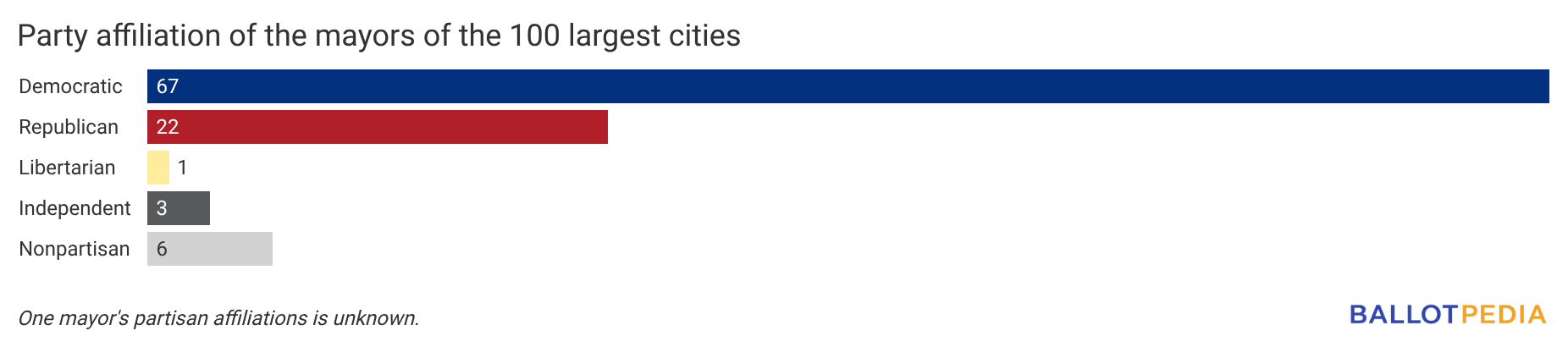
Ahead of this year's mayoral elections, we found that more Democrats than Republicans are mayors of the 100 most populous U.S. cities.

At the start of this year, 67 of the 100 most populous cities had a Democratic mayor. Eleven of those cities are holding mayoral elections this year. Twenty-two of the 100 most populous cities had a Republican mayor. Seven of those cities are holding mayoral elections this year.

The following chart shows the partisan affiliations of all mayors among the top 100 most populous cities.


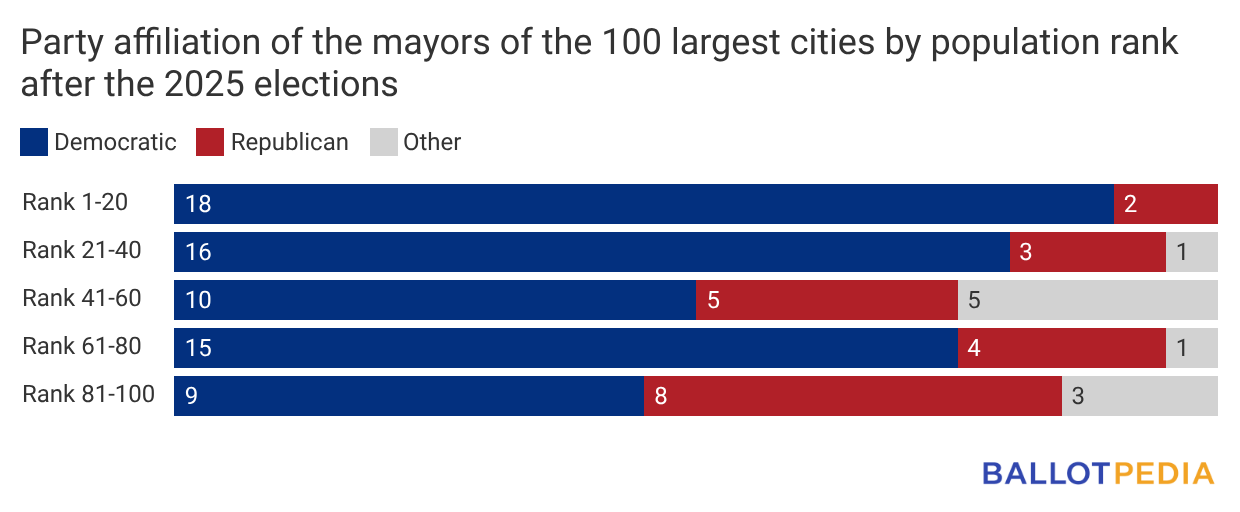
Based on 2020 population estimates, 81% of people who live in the top 100 cities have a Democratic mayor. Fourteen percent live in cities with Republican mayors. The chart below shows the partisan breakdown of the top 100 cities from largest to smallest.


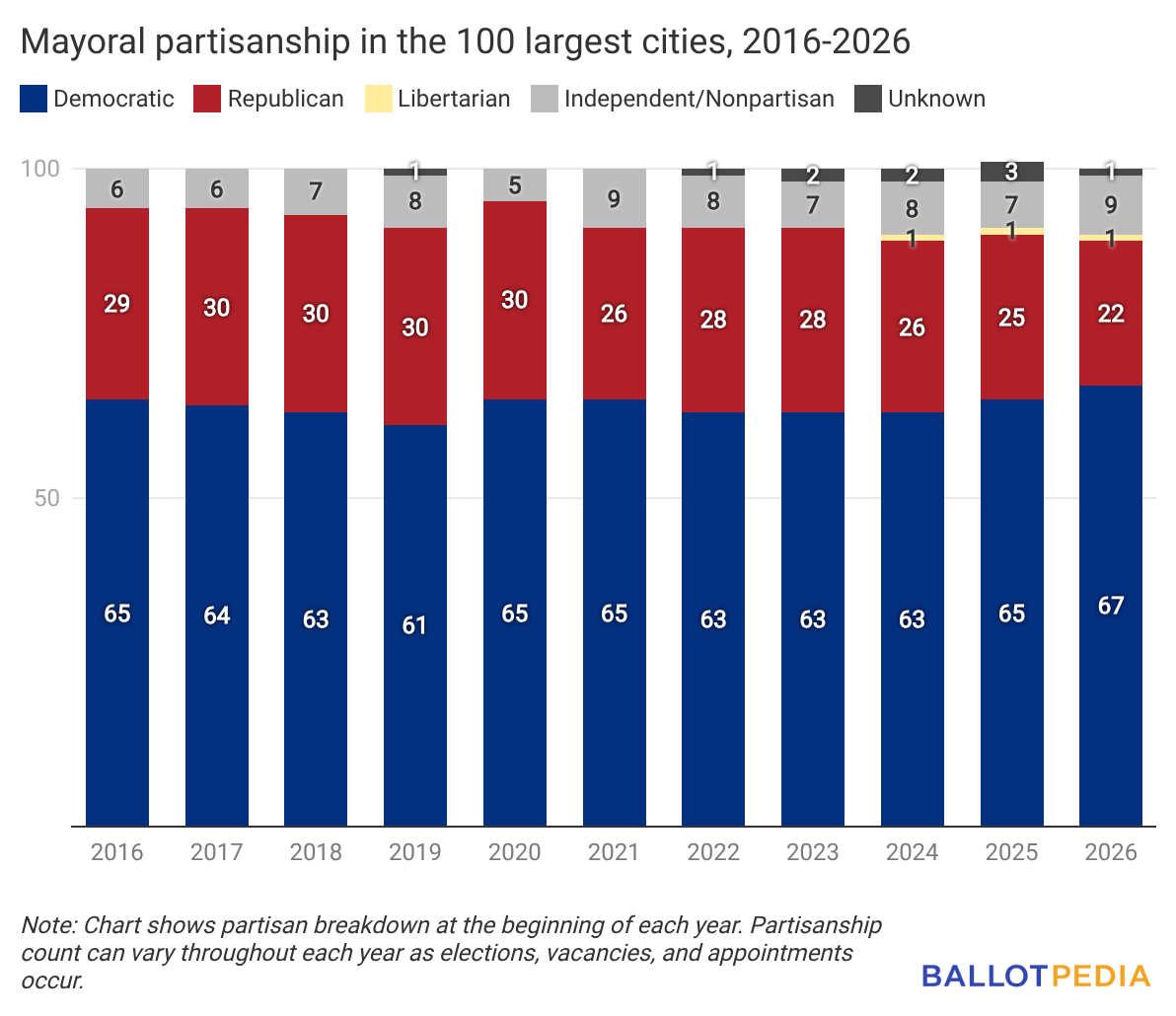
Since 2016, the number of Democratic-led top-100 cities has ranged from 61 to 67, and the number of Republican-led cities has ranged from 22 to 30. Currently, there are the most Democratic mayors and the fewest Republican mayors in the top-100 cities since 2016.


Ten state capitals are holding mayoral elections this year, including eight capitals that fall outside of the top 100 cities.

At the start of this year, 33 state capitals had a Democratic mayor. Six of those are holding mayoral elections this year. Seven state capitals had Republican mayors. Two of them are holding mayoral elections this year.

Click here to see our analysis of partisanship in this year's municipal elections.
 

Thursday, February 5, 2026

Threats and Turnover of Election Officials

Many posthave discussed political violence..

 From Issue One:

In the five years since the monumental 2020 presidential election cast an intense spotlight on election administration processes, the public servants from across the ideological spectrum who run our elections have weathered a deluge of threats, harassment, heightened stress, and increased scrutiny that does not yet show signs of abating.

 According to a new Issue One analysis that illustrates an alarming nationwide trend, 50% of chief local election officials in the nation’s Western states have left their jobs since November 2020, often leaving their positions partway through their terms for personal reasons. 

This finding builds on our September 2023 study, which uncovered that roughly 40% of chief local election officials in the Western United States had left their positions since the 2020 presidential election — departures that left half of the region’s roughly 80 million residents with new officials running the 2024 elections in their communities. This study also reinforces findings by the Bipartisan Policy Center that turnover among chief local election officials has increased steadily since 2000 — and has been increasing faster since 2020.

Thursday, December 25, 2025

Flat Fees and California Public Defenders


Anat Rubin at CalMatters:
Nearly half of California counties pay private lawyers and firms to represent poor people in criminal cases, and most of them, like San Benito, do it through what’s known as a “flat-fee” contract, meaning they pay a fixed amount, regardless of how many cases the attorneys handle or how much time they spend on each case.

It’s a far cheaper alternative — at least in the short run — to operating a public defender office with government lawyers, and it’s created a second-tier justice system in rural stretches of the state: Seven of the eight counties with the state’s highest jail and prison incarceration rates have flat-fee contracts.

These arrangements so clearly disincentivize investigating and litigating cases that they’ve been banned in other parts of the country. But they have flourished in California, which provides no funding or oversight of county-level public defense.

...

The nation’s first public defender office opened its doors in Los Angeles in 1913, the result of a decades-long advocacy effort led by Clara Shortridge Foltz, the first woman to be admitted to the bar in California. By the time the U.S. Supreme Court established a right to an attorney in state court criminal proceedings in 1963, more than a dozen California counties were operating their own public defender systems.

But as other states funneled money to government-run public defender offices, California left its system in the hands of the counties. Elected officials in many of those counties would eventually opt for the cheapest path — a flat-fee contract.

In 1984, only nine of California’s 58 counties relied on contractors for their primary public defense systems, according to a Bureau of Justice Statistics report published that year. Today, that number is 25.
...
Much of the effort to ban flat-fee contracts has focused on the ways in which the model discourages investigations, one of the most critical components of criminal defense.

Defense investigators review police reports, visit crime scenes, chase down video surveillance footage and interview witnesses — work that most attorneys are not trained to do. They often find evidence that challenges the prosecution’s case and affects the outcome of a trial or the terms of a plea deal.

A recent CalMatters investigation found that poor people accused of crimes in California are routinely sent to prison without anyone investigating the charges against them, significantly increasing the likelihood of wrongful convictions.

Friday, March 21, 2025

Minoritarianism

Steven M. Teles, "Minoritarianism Is Everythwere,: National Affairs, spring 2025

In search of the tyranny of the minority, one would be well advised to skip over the nation's capital and look instead to the crazy quilt of jurisdictions in which America's decisions about land use and infrastructure development are made. A growing field of scholarship has shown that America's unusually high level of local control over these decisions has led to a crippling undersupply of housing, coupled with dramatically higher costs for transportation and energy projects aimed at reducing carbon emissions.

...

A recent report by University of Chicago professor Christopher Berry shows that only a fifth to a quarter of citizens participate in mayoral elections in major cities, that turnout in school-board elections is in the single digits, and that participation in special-district elections is even lower. Those who do turn out tend to be whiter, richer, and older than the electorate as a whole.

Participation is exceptionally high, however, for one group in particular: members of public-sector unions. Ordinary citizens' relatively low election-participation rates provide government's own employees with an enormous comparative advantage, as they have the means, motive, and institutional context to exercise disproportionate power over local governing decisions.

...

The structure of American law leads to a peculiar form of lawmaking. Weak party discipline and congressional individualism make it exceptionally difficult for lawmakers to construct coalitions. Legislators under these conditions have strong incentives to avoid blame. Thus the laws they write have become increasingly vague, often delegating significant lawmaking authority to executive agencies. Having been passed the legislative buck, those agencies in turn transfer a great degree of rulemaking responsibility to professional organizations, whose members fill in the details with codes of "best practice" behind closed doors.

Sunday, January 12, 2025

Los Angeles on Fire


Maanvi Singh and Dani Anguiano at The Guardian:

The horrors that unfolded around US’s second largest city this week were shocking – but they were also, to some extent, expected. The blazes are part of the wildfire crisis that’s been unfolding in the American west for the last decade, from the 2017 fire siege in California’s Bay area to the 2018 blaze that destroyed Paradise and killed 85 people.

The fires that ravaged Los Angeles unfolded on a stunning landscape that is prone to burn, yet dotted with thousands of homes built over the years. Hurricane-force winds barreled through an area that hadn’t seen substantial rain in months, leading to massive conflagrations, fanned by hurricane-force gusts. It created a firestorm that spread at a rate that far exceeded firefighters’ ability to respond.

Firefighting forces across the state are deeply understaffed and have been struggling for years to battle the barrage of extreme wildfires. The 9,000 firefighters in Los Angeles county – including crews with the county’s fire department and 29 other fire agencies – were overwhelmed by the size and ferocity of the wildfires across the region, calling for aid from neighboring counties and states.

Infrastructure failed, too. “This is like a third world country,” said Rick Caruso, the billionaire real estate developer who lost the mayoral race to Bass, calling into a local radio station. Caruso was referring to reports that water hydrants in the Pacific Palisades, where his daughter lost her home, ran dry. A Los Angeles Times report that a massive reservoir in the Pacific Palisades was closed for repairs and empty at the time of the fire has raised further questions.

The city did, in fact, have enough water, but the system was not built for fighting multiple infernos. The LA department of water and power (LADWP) said that fire crews drew so much water, so fast in the initial hours of the fight, that the tanks that maintain water pressure to help supplies travel uphill to hydrants were strained.

“We pushed the system to the extreme,” the LADWP CEO Janisse Quiñones said in a news conference. “Four times the normal demand was seen for 15 hours straight, which lowered our water pressure.” Crews instead had to rely on water trucks.

Friday, December 13, 2024

Sprawl

Harry Stevens at WP:
Clarendon, a dense urban neighborhood of about 1,500 people, offered a favorable comparison. Everything we needed was just a short walk away. To be precise: 3.4 minutes, on average.

That’s according to a new study by researchers at Sony’s computer science lab in Rome. They combined population data, millions of points of interest from OpenStreetMap and an open-source routing algorithm to calculate how long it takes to walk to a bundle of amenities — from restaurants and schools to parks and theaters.

The work was inspired by the 15-minute neighborhood, an idea that has gained recent popularity as a means to create more-vibrant communities and reduce passenger vehicle travel, which accounts for about one-sixth of U.S. greenhouse gas emissions, according to a recent estimate.

The researchers analyzed cities around the world, and they agreed to share their data for some 200 metro areas in the United States. Together, these areas are home to roughly 60 percent of the U.S. population — apologies if your town is missing. You can explore the data below.
... 
Many people prefer to live in sprawl because it feels closer to nature. Yet the closer humans live to nature, the more damage they tend to do to it. Sprawl requires lots of land, encroaching on forests, wetlands and prairies. Sprawl helps explain why North America has lost an estimated 3 billion birds in the past half-century.

People, however, do not live according to the preferences of planners. Pew Research Center recently asked 5,079 American adults whether they would prefer to live in a community where the houses are smaller and closer to each other but schools, stores and restaurants are within walking distance — in other words, a 15-minute neighborhood — or where the houses are larger and farther apart but schools, stores and restaurants are several miles away — in other words, sprawl.

Most people, it turned out, preferred sprawl. The only demographic groups in which majorities were willing to give up the larger house for the walkable neighborhood were the young, highly educated and Democratic-leaning.

Thursday, October 24, 2024

News Deserts and Newspaper Closures

Many posts have dealt with media problems.

From the Medill School of Journalism at Northwestern University:

The number of local news deserts expanded in the U.S. this year, with 127 newspapers shuttering, leaving nearly 55 million Americans with limited to no access to local news, according to the Medill State of Local News Report 2024 released today.

Key Findings :

  • The nation has lost more than one-third of its newspapers since 2005. With 127 newspapers closing in the past 12 months — nearly two and a half per week — the U.S. has now seen a decline of 3,300 since 2005 as of September. The pace of newspaper closures did not slow appreciably in the past year.
  • As a result of those losses, the number of news desert counties rose to 208 this year from 204 in 2023. News deserts are counties without any locally based source of local news. In addition, the number of counties with only one news source rose to 1,563. Taken together, those counties include nearly 55 million people with limited or no access to local news. More than half of the nation’s 3,143 counties have little to no local news.
  • More than 7,000 newspaper jobs vanished between 2022 and 2023, compared to a few hundred the year before..
  • The number of newspaper mergers and acquisitions skyrocketed 43% this year, with 258 papers changing hands in 75 transactions. Smaller and newer chains, including Carpenter Media Group, are leading the acquisition surge.
  • Using predictive modeling developed by the school’s Spiegel Research Center, the Medill team substantially increased the number of counties on its “Watch List” — those at high risk of losing local news — to 279 from 228 last year. That’s a 22% percent rise.
  • For the first time, Medill tallied the growing number of national networks providing original local reporting. Researchers counted 740 network digital sites, but none of them are covering previous news desert counties.
  • There’s been a net increase of 81 stand-alone local digital news sites, the biggest one-year gain in recent years. About one-third of them are less than five years old. That gain, however, includes 30 newspapers that converted from print to digital. Nearly 90% of them are in metro areas, not in hard-hit rural counties.
  • For the second consecutive year, Medill mapped every local news startup in the U.S. And the Medill Local News Initiative identified 12 “Bright Spots” news outlets that are showing promise after receiving more than 60 nominations for that designation. The Bright Spots map was developed with support from Microsoft.

Wednesday, October 9, 2024

Hurricanes, Climate Change, and Public Policy


Florida is suffering the effects of Hurricanes Helene and Milton: Carolyn Gramling at Science News:
The rapid intensifications of both storms were fueled by the Gulf’s extremely warm water. Developing tropical storms can suck up heat from warm seawater, dragging the humid air upward where it condenses, releasing that heat into the storm’s core. As the storm moves forward, it pumps more and more water and heat into the air, and the spiraling winds will move faster and faster. Milton’s particularly explosive rate of growth may also be linked to its relatively compact size, compared with Helene (SN: 9/27/24).

Two separate reports published this week find that those warm Gulf waters were made hundreds of times more likely by human-caused climate change.

An analysis by the international World Weather Attribution, or WWA, initiative, released October 9, analyzed the role of climate change in contributing to Hurricane Helene’s intensification and its torrential rainfall, including as it moved inland across the Southern Appalachian Mountains.

Gulf of Mexico sea surface temperatures in the path of the storm were, on average, about 1.26 degrees Celsius (2.3 degrees Fahrenheit) warmer than they would have been in a world without climate change, the WWA researchers found. Or, to put it another way, the anomalously high temperatures along Helene’s path from development to landfall were made 200 to 500 times more likely due to climate change.
...
Climate Central, based in Princeton, N.J., contributed to the WWA’s sea surface temperature analysis for Helene. And, in a separate alert released October 7, Climate Central reported that elevated sea surface temperatures in the southwestern Gulf of Mexico were also behind the “explosive” increase in intensity of Hurricane Milton. The analysis found that the sea surface temperatures in the Gulf were made 400 to 800 times more likely over the past two weeks due to human-caused climate change
The Tampa and St. Petersburg metro area is the most vulnerable to flooding damage in the U.S., according to a 2015 study by risk modeler Karen Clark & Co. Among the reasons the report cited: a shallow continental shelf off the coast and a funnel effect in Tampa Bay that together create the potential for a huge buildup of water that can inundate neighborhoods.

In addition, the metro area has experienced a building boom in recent decades that has sent the population soaring to about 3.2 million. Much of the development is on low-lying ground, with poorly developed drainage systems. A third of the area’s residents live within storm-surge zones.

“It’s the recipe for a huge storm-surge disaster,” said Jeff Masters, a former hurricane scientist at the National Oceanic and Atmospheric Administration and now a contributor at Yale Climate Connections, a news service.
In 2010, the Tampa Bay Regional Planning Council drew up the Tampa Bay Catastrophic Plan, in which a hypothetical Category 5 storm dubbed “Hurricane Phoenix” hit downtown Tampa with 160 mph winds and a 26-foot storm surge. The study projected that the city would have about 2,000 deaths and nearly $250 billion in damage.

In Tampa Bay, nearly 17,000 commercial properties and apartment buildings spanning 182 million square feet are in areas at high risk of flooding, according to real-estate data company CoStar Group. Billions of dollars of private and public funds have been invested in the redevelopment of downtown Tampa’s waterfront in recent decades. Many of these buildings are in vulnerable low-lying areas, according to data from CoStar.

Newer construction that was built to Florida’s current stringent building codes should stand up well to hurricane-force winds, storm specialists say. Other, more-established neighborhoods with older structures, however, are more susceptible.

Wednesday, July 24, 2024

Local News

Many posts have dealt with media problems such as ghost newspapers and news deserts.

Some national outlets are doing fine, but local newspapers are struggling.

From Pew:

Americans want information about local government and politics. Most say they are at least somewhat interested in news about local laws and policies and local elections. And about two-thirds say they often or sometimes get local political news – higher than the shares who get news on several other local topics, including the economy and sports.

But among Americans who get news on local politics, only a quarter are highly satisfied with the quality of the news they get, according to a new Pew Research Center survey. Those who get news about weather, traffic and several other topics are more likely to be satisfied with the news they get in those areas.

Americans also do not widely see it as easy to find the news and information they need to take part in the local political process. Fewer than half of U.S. adults (45%) say it is very or somewhat easy to find the information they need to make voting decisions in local elections. By comparison, 59% say it is easy to find the information they need for presidential elections.

In both cases, much higher shares of Americans say they are at least somewhat interested in news about elections than say it is easy to find the information they need to vote.


Thursday, May 30, 2024

Local Journalism: Points of Light in Dark Times

Many posts have dealt with media problems such as ghost newspapers and news deserts.

Some national outlets are doing fine, but local newspapers are struggling.

From AP:
The Associated Press today announced five new content sharing agreements with U.S. nonprofit news outlets: CalMatters, Honolulu Civil Beat, Montana Free Press, Nebraska Journalism Trust and South Dakota News Watch.

The collaborations are part of an effort to expand the reach of local news ahead of the 2024 U.S. presidential election and increasing access to AP’s nonpartisan journalism, especially in communities that may have limited access to fact-based news. They follow the content sharing arrangement between AP and the Texas Tribune announced in March.

Each organization will share AP journalism with its audience. AP will distribute stories from each outlet to the news agency’s members and customers, supplementing AP’s existing coverage of California, Hawaii, Montana, Nebraska and South Dakota.

“As local coverage shrinks, content sharing agreements with other mission-driven news organizations across the U.S. are more important than ever,” said AP U.S. News Director Josh Hoffner. “These agreements are exciting opportunities for AP journalism to reach new audiences in an election year and simultaneously bolster the AP news report from states that can sometimes be overlooked.”

“Our mission is to inform and engage the 39 million people who call California home,” said CalMatters CEO Neil Chase, “so we’re grateful for this collaboration with The Associated Press. It makes it much easier for hundreds of news organizations across California to share our journalism with their audiences. It’s wonderful to be able to tell a newsroom that republishing our work is now as easy as publishing an AP story.”
William McKenzie, Senior Editorial Advisor, George W. Bush Institute
Not all is lost in local journalism, even though more than half of American counties have no local news source or only one outlet, often a weekly newspaper. Here are two encouraging signs:

First, Lookout Santa Cruz, City Bureau, and the Invisible Institute won Pulitzer Prizes this month. The former for breaking news reporting on devastating floods and mudslides in its California coastal town. Journalists for the latter two shared the local reporting prize for a collaborative investigative series on missing Black women and girls in Chicago. What’s more, the Invisible Institute won a second Pulitzer for audio reporting. This hyperlocal coverage comes from three digital news operations that focus deeply on their communities and neighborhoods.

Longtime newspaper executive and media analyst Ken Doctor started the digital-only Lookout Santa Cruz in 2020. The parent company, Lookout Local, now is launching a site in Eugene, Oregon.

The nonprofit City Bureau began in 2015 to cover the south and west sides of Chicago. The Invisible Institute grew out of a larger project focusing on Chicago’s South Side.

Call their successes points of light in local journalism.

Second, the Pew Research Center’s latest in-depth study of local news shows that 85% of Americans believe local news organizations are at least somewhat important to their communities. And 44% believe the organizations are extremely or very important to their towns and cities.

True, Pew found a declining share of Americans follow local news, just as fewer people follow national news. Still, an increasing share of respondents believe local journalists are in touch with their communities – 69% in 2024 versus 63% in 2018. And that local news organizations report accurately (71%), cover key stories (68%), are transparent about their work (63%), and watch local leaders (61%).

Is more work needed to improve those numbers? Of course. But the strength of our democracy rests on the health of our communities. And robust local journalism is one sure way to bolster our communities.

Friday, May 24, 2024

Sheriffs and Their Power

Law enforcement in the United States is decentralized and fragmented.  Sometimes the system works well.  Sometimes it does not.  Sheriffs wield vast and often  unchecked power.   News deserts do not help.

E.D. Cauchi, Scott Pham at CBS:
CBS News gathered and analyzed federal law enforcement data that showed while more people died overall in encounters with city police, deaths in encounters with county sheriffs occurred at a significantly higher rate. For every 100,000 people arrested, more than 27 people died in the custody of sheriffs, while that number was fewer than 10 for police officers in 2022, the most recent year of available data.
...
According to CBS News' investigation, problems were more prevalent in smaller, more remote communities where deputies typically had less training, fewer resources and limited oversight. These factors allowed sheriff misconduct to continue for longer, becoming more severe and brazen before it was discovered. Even then, they rarely faced consequences.
...

In McCurtain County, Oklahoma, Sheriff Kevin Clardy was caught on audiotape in March of 2023 talking with other county leaders about how they might kill and discreetly bury the bodies of two local journalists who had written stories about alleged corruption inside his office, among others.

...

"Nothing has happened to them," said McCurtain Gazette reporter Chris Willingham. He and his father Bruce were the journalists whose murders the sheriff and others were heard contemplating. "They have to feel untouchable, they're above the law."

...

An estimated 72% of the U.S. is rural, where more than 3,000 sheriffs act as the primary law enforcement. Only Alaska and Connecticut don't have any sheriffs; the latter abolished the position two decades ago due to high-profile corruption scandals.

What it takes to qualify for the job of sheriff varies from state to state: some require law enforcement experience, while others allow any U.S. citizen over age 18 to wear the star. The vast majority of sheriffs are elected, making voters the ultimate check on their authority. But candidates frequently run unopposed and it's not uncommon for a sheriff to remain in power for decades.


Thursday, May 9, 2024

Local News Trends

Many posts have dealt with media problems such as ghost newspapers and news deserts.

Some national outlets are doing fine, but local newspapers are struggling.

From Pew:
The local news landscape in America is going through profound changes as both news consumers and producers continue to adapt to a more digital news environment. We recently asked U.S. adults about the ways they access local news, as well as their attitudes toward local journalism, finding that:
  • A growing share of Americans prefer to get local news online, while fewer are getting news on TV or in print. And newspapers are no longer primarily consumed as a print product – the majority of readers of local daily newspapers now access them digitally.
  • The share of U.S. adults who say they are paying close attention to local news has dropped since our last major survey of attitudes toward local news in 2018, mirroring declining attention to national news.
  • Americans still see value in local news and local journalists. A large majority say local news outlets are at least somewhat important to the well-being of their local community. Most people also say local journalists are in touch with their communities and that their local news media perform well at several aspects of their jobs, such as reporting the news accurately.
  • At the same time, a relatively small share of Americans (15%) say they have paid for local news in the last year. And many seem unaware of the major financial challenges facing local news: A 63% majority (albeit a smaller majority than in 2018) say they think their local news outlets are doing very or somewhat well financially.
  • Majorities of both major parties say local media in their area are doing their jobs well. While Republicans and GOP-leaning independents are slightly less positive than Democrats and Democratic leaners in their opinions of local media, views of local news don’t have the same stark political divides that exist within Americans’ opinions about national media.
  • Most Americans say local journalists should remain neutral on issues in their community, but a substantial minority say local journalists should take a more active role. About three-in-ten say local journalists should advocate for change in their communities, a view that’s especially common among Democrats and younger adults.


Wednesday, April 17, 2024

Older Homeowners Dominate Local Elections

 The Gray Vote: How Older Home-Owning VotersDominate Local ElectionsKatherine Levine Einstein∗Maxwell Palmer†Ellis Hamilton‡Ethan Singer

Abstract 

Local elections are widely recognized as low turnout affairs compared with their national level counterparts. But, scholars have little systematic national data on the composition of the local electorate, and how compositional disparities may vary by context. In this paper, we use a national voter file to compare turnout in general, midterm, and off-cycle local elections in over 500 cities. We provide novel estimates of turnout gaps by race, age, and homeownership status in local elections, and identify stark inequalities compared with national and state elections. We find sizable turnout gaps both by age and homeownership status at the local levels, far exceeding those in national contests. Turnout disparities by age and homeownership status are twice as large as those between Black and white voters, and are considerably larger in off-cycle contests.

Saturday, October 14, 2023

Trust in Institutions 2023

Jerry M. Jones at Gallup:
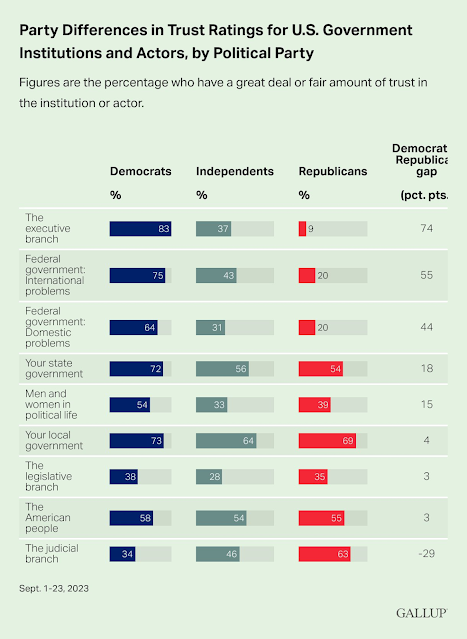
Gallup’s annual update on trust in government institutions and actors finds Americans have the most faith in local government (67%) and the least faith in the legislative branch of the federal government, or Congress (32%). Between these two extremes, majorities express trust in state government and the American people, while less than half are confident in the executive and judicial branches of the federal government, elected officials and candidates for office, and in the federal government’s ability to handle both domestic and international problems.

These data are from Gallup’s annual Governance survey, conducted Sept. 1-23. The poll finished just before Congress averted a possible government shutdown at the start of the new fiscal year by temporarily extending federal funding until mid-November. The vote to remove Speaker of the House Kevin McCarthy -- a first in U.S. history -- also occurred after the poll was completed.
Trust in each institution or actor is statistically similar to a year ago, except for Congress, which saw a drop of six percentage points, from 38% expressing a great deal or fair amount of trust in it last year to 32% this year.

However, all institutions have below-average trust levels compared with historical Gallup norms dating back to the early 1970s. Most of these -- all but state and local governments -- have trust scores more than 10 points below the historical average for that institution. Trust in the judicial branch, usually one of the most trusted branches (averaging 66%), is furthest from its historical average, with its current 49% confidence rating 17 points below its typical rating since 1972.


Thursday, September 14, 2023

School Choice Redux

At Vox, Andrew Prokop explains why the school choice movement is making progress with education savings accounts:
Universal voucher bills had long failed because most parents didn’t want radical disruption of the public school status quo. The pandemic brought this radical disruption. Polarizing battles unfolded over school closures, mask and vaccine requirements, and (after reopening) how long kids should be kept home if classmates tested positive.

Then the culture war that erupted over race, gender, and sexuality teaching in schools in 2020 and beyond ensured that things never entirely returned to “normal.” Activists like Christopher Rufo argued that “critical race theory” concepts were pervading teaching about race, Twitter accounts like Libs of TikTok spread videos of educators discussing gender identity, and such matters became omnipresent on Fox News and in conservative media.

In the right’s narrative, parents reasonably recoiled against the incompetence or ideological extremism of educators. In the left’s narrative, conservatives targeted the public school system with a strategic and unrelenting campaign of vilification, laden with exaggeration and moral panic. “The overriding message has been to drive a wedge between parents and public schools,” Polikoff said.

Conservative activists saw opportunity. “It is time for the school choice movement to embrace the culture war,” the Heritage Foundation’s Jay Greene and James Paul wrote in 2022.

In a 2019 survey, 31 percent of Republican respondents said they had very little or no confidence in public schools; in a 2022 survey, that number had risen to 50 percent. Democratic and independent voters, in contrast, remained roughly as confident in the public school system as before the pandemic.

But the drop in Republican support shifted the previous political status quo, especially in red states, making rank-and-file GOP voters less hostile about proposals to shake up the system.

Sunday, January 29, 2023

Police Unions and Civilian Oversight

Organized labor in general has fallen on hard times.  But in many places, public-employee unions retain enormous power.

Jamiles Lartey at the Marhsall Project:
If you heard about a group called “Voters for Oversight and Police Accountability,” who would you guess is funding and coordinating its efforts? Progressive activists? Civic-minded community members?

How about a police union?

That’s the situation in Austin, Texas, where this fall, canvassers for “VOPA” appear to have amassed the 25,000 signatures needed to get a referendum on the so-called “Austin Police Oversight Act” into the city’s May 6 election.

The thing is, there was already an “Austin Police Oversight Act” on the ballot. The duplicate effort, funded by the Austin Police Association, is similar — but seriously watered down, when compared with the original promoted by the progressive political action committee Equity Action. That original proposal seeks to open up public access to police records, and give the city’s office of police oversight the ability to participate in investigations of officer conduct.

By contrast, the police union-funded ballot initiative would keep certain misconduct records hidden from the public and leave the board with a more passive role in investigations.

Reporting late last year found that the police union was running VOPA’s website, and this week, a reporter with the Austin Chronicle uncovered that the union had contributed virtually every penny of the nearly $300,000 raised for the campaign. The union did not respond to a request for comment from The Marshall Project, and has not responded to a request from the local Fox affiliate.

The effort appears to be a brazen version of something police unions have attempted in numerous cities recently: to derail and disempower civilian oversight groups tasked with monitoring and reviewing police conduct.

Friday, January 20, 2023

Lowest Unionization Rate on Record

 From BLS:

The union membership rate--the percent of wage and salary workers who were members of unions--was 10.1 percent in 2022, down from 10.3 percent in 2021, the U.S. Bureau of Labor Statistics reported today. The number of wage and salary workers belonging to unions, at 14.3 million in 2022, increased by 273,000, or 1.9 percent, from 2021. However, the total number of wage and salary workers grew by 5.3 million (mostly among nonunion workers), or 3.9 percent. This disproportionately large increase in the number of total wage and salary employment compared with the increase in the number of union members led to a decrease in the union membership rate. The 2022 unionization rate (10.1 percent) is the lowest on record. In 1983, the first year where comparable union data are available, the union membership rate was 20.1 percent and there were 17.7 million union workers.

... 

In 2022, 7.1 million employees in the public sector belonged to unions, about the same as in the private sector (7.2 million). (See table 3.)
Union membership was little changed over the year (+80,000) in the public sector, after a decline the prior year (-191,000). The public-sector union membership rate continued to decline in 2022; the rate went down by 0.8 percentage point to 33.1 percent. In 2022, the union membership rate continued to be highest in local government (38.8 percent), which employs many workers in heavily unionized occupations, such as police officers, firefighters, and teachers.
The number of union workers employed in the private sector increased by 193,000 to 7.2 million over the year. The private-sector unionization rate edged down by 0.1 percentage point in 2022 to 6.0 percent. Industries with high unionization rates included utilities (19.6 percent), motion pictures and sound recording industries (17.3 percent), and transportation and warehousing (14.5 percent). Low unionization rates occurred in insurance (1.2 percent), finance (1.3 percent), professional and technical services (1.3 percent), and food services and drinking places (1.4 percent).