Many posts have discussed confidence in institutions.


Creating America wasn’t easy, and the fulfillment of our founding documents still demands much. But we make a grave mistake if we think this nation is only for what some call “heritage Americans,” whose forebears—specifically Anglo and Scots-Irish Protestants—fought in the Revolution or Civil War.
This notion that there is a select subset of “real” Americans is being pushed by, among others, Vice President JD Vance. He says that “America is not just an idea” but “a particular place, with a particular people.” Our country is more than an idea, but it began as one. Our people are particular, yet it makes no difference whether your forebear wintered at Valley Forge or fought at Gettysburg. What matters is living up to the Declaration’s promises.
It is ironic that Mr. Vance, a Catholic convert, would advocate “heritage Americans.” In the past, such movements routinely declared Catholics unacceptable members of our national family. One of the largest such groups was the American Protective Association, an anti-immigrant organization in the Gilded Age. It claimed 2.5 million adherents at its height. Its members swore an oath denouncing the pope and “the diabolical work of the Roman Catholic Church.” The APA was particularly strong in Mr. Vance’s home state of Ohio.
This notion of “heritage Americans” is at odds with the Declaration. America’s birth didn’t include a new aristocracy based on inherited valor.
Consider some Americans without Revolution or Civil War forebears: Elon Musk, Google CEO Sundar Pichai, Nvidia co-founder Jensen Huang, Arnold Schwarzenegger, Charlize Theron, Hakeem Olajuwon, former Pepsi CEO Indra Nooyi, Albert Einstein, Nikola Tesla, Salma Hayek, Henry Kissinger, Oracle’s Safra Catz, Bob Hope, Irving Berlin, Interactive Brokers’ founder Thomas Peterffy, Yo-Yo Ma, Alex Trebek and at least 40 winners of the Nobel Prize for Medicine.


Many posts have discussed confidence in institutions and partisan polarization.
Americans’ confidence in U.S. institutions remains historically low, as reflected in their average view of 14 institutions measured each year since 1993. Currently, 27% of Americans express “a great deal” or “quite a lot” of confidence in these core institutions, one percentage point above the record-low average in 2023.
When limited to the nine institutions measured about annually since 1979, average confidence is also 27%, reflecting the broader similarity of the two trends. Both lists include a mix of government and private sector institutions, making either version appropriate for use as a barometer of national confidence.
Americans’ average confidence in institutions has been trending downward since 1979 — not gradually, but rather driven by several steep drops. Confidence fell sharply in the early 1980s and again in the early 1990s, each time quickly followed by partial recoveries. An even sharper decline in the mid-2000s associated with the onset of the Great Recession proved more resistant, with confidence remaining at the 2007 low point and sinking even further over the next nine years. Confidence finally showed significant improvement in 2020, at the start of the COVID-19 pandemic, due to heightened public trust in several institutions most affected by that crisis — particularly the medical system and public schools. However, average confidence quickly reverted and sunk further to 27% in 2022.
...
Partisan differences in confidence were modest through much of the 1980s and early 1990s, with Republicans and Democrats expressing similar levels of confidence regardless of which party controlled the White House. The gap first widened during Bill Clinton's presidency in Democrats' favor before reversing under George W. Bush. It narrowed somewhat during Barack Obama's administration before swinging back toward Republicans during Donald Trump's first term and then toward Democrats during Joe Biden's presidency.
The gap has widened during Trump’s second term, with Republicans now 13 points more confident in U.S. institutions than Democrats are, similar to last year’s 11-point gap. This is due to Democrats, for the first time, showing less confidence in an incoming Republican president at the same time Republicans’ confidence has surged. The finding echoes Democrats’ historically negative outlook on national conditions during Trump’s second term that Gallup reported earlier this year.
Many posts have discussed the role of religion in American life.
In September of 1774, the First Continental Congress gathered at Carpenters' Hall in Philadelphia. The delegates were divided by geography, culture, and religion—uncertain whether so fractious a body could act as one. When a proposal to open with prayer met with resistance, Samuel Adams rose and declared he would pray with any man who was a friend of his country—and they opened the session with Psalm 35. Rabbi Soloveichik reflects on what that moment reveals about the Hebrew Bible in American civic life, illustrating how faith serves not as a source of division, but as the unifying foundation of our national covenant.
If some obstacle blocks the public road halting the circulation of traffic, the neighbors at once form a deliberative body; this improvised assembly produces an executive authority which remedies the trouble before anyone has thought of the possibility of some previously constituted authority beyond that of those concerned. Where enjoyment is concerned, people associate to make the festivities grander and more orderly.
Being out and about is a good way to meet your neighbors. One of the strongest predictors of neighborly interaction is also the most obvious: spending time in the neighborhood. Americans who report that they take walks or run through their neighborhood are much more likely to converse with neighbors. A majority (55 percent) of Americans who walk around their neighborhood at least once a week say they talk to their neighbors at least a few times a week. Americans who walk less often report much less neighborly interaction. The share of Americans who talk with their neighbors at least weekly is only 29 percent among those who walk only once or a few times a year and 19 percent among those who do not walk around their neighborhood at all.
Dog ownership is also associated with increased social engagement with neighbors, but only for those who walk their dog. Half of Americans who own a dog and walk it regularly report that they talk with their neighbors at least a few times a week. In contrast, only 33 percent of dog owners who do not walk their pets say they talk to neighbors this often.
As the United States approaches its 250th anniversary, just 19% of Americans say the signers of the Declaration of Independence would be pleased with how the country has turned out.
Just over three in four Americans (77%) now say the founders would be disappointed, compared with 71% in 2013 and 42% in 2001. The latest findings come from a May 2026 Gallup survey.


Many posts have discussed patriotism and American exceptionalism.
GARY FIELDS, LINLEY SANDERS and NICHOLAS RICCARDI at AP:The survey from The Associated Press-NORC Center for Public Affairs Research highlights many Americans’ feeling of unease over the future of its representative government — particularly among young people. It presents a jarring contrast as communities around the country commemorate the nation’s 250th anniversary.
Only about one-quarter of Americans say the U.S. stands above all other countries in the world, the new poll found, while 44% say it’s one of the greatest countries in the world, along with some others. About 3 in 10 say there are better countries than the U.S., an increase from 19% in an AP-NORC poll conducted in June 2016.
Americans remain divided about whether diversity is an essential feature of the U.S.'s identity, and agreement about other aspects of the country’s underlying character appears to be eroding, the survey found. Americans are less likely to see a democratically elected government as “extremely” or “very” important to the United States’ identity as a nation than they were just a few years ago. About two-thirds of U.S. adults now say a democratically elected government is highly important to the U.S.’s identity as a nation, down from 80% in 2021.
...
Toung adults are much less likely than older Americans to believe the U.S. is special, compared with other nations, the poll found.About 4 in 10, 44%, of U.S. adults under 30 say there are other countries better than the U.S., compared with 22% of U.S. adults ages 60 and older.Fewer, too, see democracy as a key element of the U.S.’s identity. Only about half of Americans under 30 believe this, compared with 81% of those 60 and older.
Many posts have discussed patriotism.
Dueling events for America's 250th birthday are creating confusion as celebrations ramp up across the U.S.
Why it matters: The disconnect made headlines last week when a group of performers withdrew from on the National Mall, prompting President Trump to step in.
Those concerts were organized by Freedom 250, a White House-established initiative. America 250, a separate, Congress-approved missive, has planned events nationwide in the run-up to Independence Day.
The intrigue: Several of the performers who canceled cited being misled about the event.Country singer Martina McBride said on Instagram that she "was assured this was a nonpartisan event that was meant to celebrate ALL 50 states. ...Yesterday things started changing and what we were told is, in fact, not what is happening."...
Freedom 250 is planning events that reflect Trump's flair for spectacle.
That includes a UFC fight on the White House South Lawn, an IndyCar race through downtown Washington, D.C., a FIFA World Cup fan zone and the Great American State Fair — both to be held on the National Mall.
The issue is not hosting a sporting event, it’s the one they chose and what it says.
If the White House wanted to host a sporting event commemorating the nation’s 250th anniversary, they could have chosen “America’s Pastime”—baseball.
And they could have held it at a stadium dedicated to the purpose, not spent tens of millions constructing a temporary arena that may leave scars on the landscape for a long time to come.
Instead they chose cage fighting, the most visceral expression of violence for sport.
What does it mean to normalize blood sport at that address?
Whatever your personal opinion of MMA as a sport, this is a deliberate choice about what power looks like, what celebration looks like, and what America is supposed to mean.
Yet it’s not a departure from this regime’s ethos; it’s right in line with their performance of masculinity.
Now let’s not dismiss our current troubles, but where they see only problems, I see possibilities — as vast and diverse as the American family itself. Even as we meet, the rest of the world is astounded by the pundits and finger pointers who are so down on us as a nation.
Well I’ve said it before and I’ll say it again — America’s best days are yet to come. Our proudest moments are yet to be. Our most glorious achievements are just ahead. America remains what Emerson called her 150 years ago, “the country of tomorrow.”
Alas, most Americans no longer see it that way. Blen Wondimu at Pew:
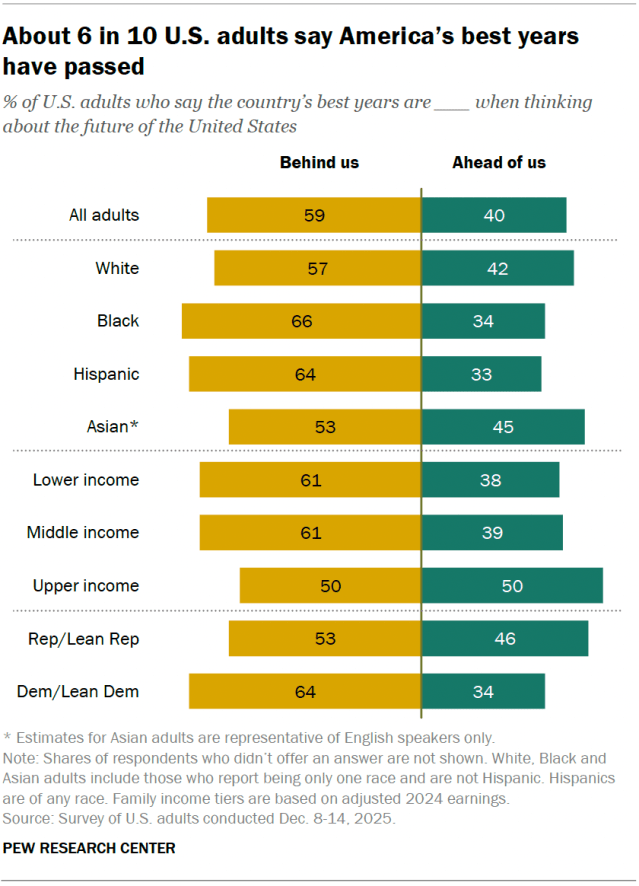
Ahead of the United States’ 250th anniversary, 59% of Americans say the country’s best years are behind us, while 40% say its best years are ahead.
Americans are also much more pessimistic (44%) than optimistic (28%) when asked to think about what things will be like in the U.S. 50 years from now. Another 27% are neither optimistic nor pessimistic, according to a December 2025 Pew Research Center survey.
This research is part of an effort to study public perception on the direction of the U.S. ahead of the 250th anniversary of its founding. It coincides with our analysis about how the U.S. has changed since the country’s bicentennial in 1976.
Views on whether the country’s best years are behind or ahead of us differ somewhat across demographic and political groups.
Race and ethnicity: Majorities of Black (66%), Hispanic (64%) and White adults (57%) say the country’s best years are behind us, as do 53% of Asian adults.
Income: Majorities of adults with lower and middle incomes say the country’s best years are behind us (61% each). Upper-income adults are evenly split: Half say the nation’s best years are behind us and half say its best years are still to come.
Party: Democrats and those who lean toward the Democratic Party are more likely to say the country’s best years are behind us (64%) rather than ahead (34%). Republicans and Republican leaners are more evenly divided: 53% say the country’s best years are behind us, while 46% say they’re ahead.
Abroad, the American way of life had become, in his phrase, “the pervasive, persuasive, universal model” worldwide, encompassing consumer capitalism, popular entertainment, and democratic institutions. (“Isn’t that what the number one nation is supposed to be about?,” he asked in his 1991 book, The First Universal Nation.) Unlike Rome or Britain, the United States didn’t rule by conquest. It persuaded, absorbed, and broadcast. (And this was before the internet.)
Three decades on, Wattenberg’s framework seems as valid as ever, even if public confidence in it has weakened.
Start with the 2026 Winter Olympics. Of roughly 230 athletes on Team USA, according to The Seattle Times, seven are foreign-born and another 31 are the children of immigrants. Just one story: Top men’s figure skater Ilia Malinin—the American-born son of two former Olympic figure skaters who competed for Uzbekistan. A George Mason University student, he helped push Team USA to gold in the Olympic team event over the weekend. But the medal count here is secondary. On a global stage designed to celebrate peaceful national competition, the US presents itself as a country whose identity is beneficially additive. A success sequence worth celebrating and not screwing up: Global talent enters American institutions and then successfully represents the country back to the world.
Then consider the Super Bowl halftime show headlined by rapper Bad Bunny. The most American of spectacles briefly became a Spanish-language celebration of Puerto Rican identity. Talk about a cultural flex. I doubt many other countries’ signature sporting event would hand its stage to a performer singing anything other than that country’s primary language. What audiences here and globally saw was a country roomy and confident enough to absorb and amplify an identity rather than suppress it. The NFL certainly sees Wattenberg’s universal nation as an asset to its global ambitions.
America today is unsure of itself in ways it likely wasn’t 30 years ago when it became the planet’s only superpower. And our journey toward universality is hardly a walk in the park. It never has been. (Wattenberg: “We are becoming a universal nation at home; we come from everywhere. We are a ‘wondrous race,’ although, Lord knows, it’s not always easy, and we self-inflict more than a few wounds. Still, as demonstrated, it’s worked, and it’s working.”)
Bad Bunny — who introduced himself with his real full name, Benito Antonio Martínez Ocasio — brought the iconography of Puerto Rican culture to his Super Bowl halftime show performance, a joyous and high-energy affair that celebrated the island where he was born and its place in the American story.
The artist did not shy away from overt political symbolism, ending the authentic and confident performance on a note of unity.
After playing some of his biggest hits, Bad Bunny stared down the camera and spoke in English for the only time during the performance to say, “God Bless America.”
He followed with a list of more than 20 nations in North, Central and South America while dancers trailed him displaying the flags of many of those nations, with the US and Puerto Rican flags most visible directly behind him.
While the US often uses the word “America” to identify itself as a single, distinct country, many of its neighbors use it to refer to a greater unified continent, a point that Bad Bunny hammered home when he spiked a football that read “Together we are America,” before launching into his nostalgic anthem “DtMF.”
Puerto Rico – officially the Commonwealth of Puerto Rico – is one of five U.S. territories with a permanent population, along with American Samoa, Guam, the Northern Mariana Islands and the U.S. Virgin Islands. It’s located about 1,000 miles southeast of the Florida coast.
Puerto Rico was a Spanish colony for centuries before it was ceded to the U.S. in 1898 following the Spanish-American War. A 1917 act of Congress established that people born in Puerto Rico are U.S. citizens.
The island has had its own constitution since 1952 but is also subject to federal law, like U.S. states. Unlike people living in the states, Puerto Ricans living on the island can’t vote in federal elections and don’t pay federal taxes on income earned there.
Puerto Rico has some representation in Congress, but not as much as the states do. Its sole delegate in the U.S. House of Representatives, Democrat Pablo José Hernández Rivera, has limited voting privileges. The territory does not have any senators.
Since 1967, there have been seven votes on the island over whether Puerto Rico should change its political status, most recently in 2024. However, the results of these votes were nonbinding, and efforts to give Puerto Ricans a binding vote on statehood have stalled in recent Congresses.
Many posts have discussed volunteering and civic virtue.
Majorities of Americans continue to support charitable causes, with 76% reporting that they gave money to a religious or other nonprofit organization in the past year and 63% saying they volunteered their time to such an organization.
Americans’ current levels of charitable activities are somewhat different from what they were in 2021 during the COVID-19 pandemic. Financial contributions have eased slightly, registering five percentage points lower than in 2021, but volunteering is seven points higher now.
Meanwhile, a steady 17% of U.S. adults say they gave blood in the past 12 months.
...
In recent years, as U.S. adults have become less likely to identify with a religion, they have also become less likely to report that they donate money to a religious group. The 41% of Americans saying in 2025 that they donated to a religious organization is the lowest to date, down 21 points from the initial measurement in 2001, including three points since 2021. At the same time, volunteering for a religious organization has been less variable, and it has ticked up four points to 39% in the latest poll, approaching its pre-pandemic level.
The U.S. is undergoing its fastest religious shift in modern history, marked by a rapid increase in the religiously unaffiliated and numerous church closures nationwide.
Why it matters: The great unchurching of America comes as identity and reality are increasingly shaped by non-institutional spiritual sources — YouTube mystics, TikTok tarot, digital skeptics, folk saints and AI-generated prayer bots.
...Nearly three in 10 American adults today identify as religiously unaffiliated — a 33% jump since 2013, according to the nonpartisan Public Religion Research Institute (PRRI).That's quicker than almost any major religious shift in modern U.S. history, and it's happening across racial groups, an Axios analysis found.About four in ten Americans ages 18 to 29 identify as religiously unaffiliated (38%), an increase from 32% in 2013, PRRI said.
Driving the news: The religious shift has made it harder for political parties and candidates to reach voters, Sisto Abeyta, a Democratic political consultant based in New Mexico with the Nevada-based firm TriStrategies, tells Axios."We have to find (religiously unaffiliated voters), engage them and answer their skeptical questions, rather than just go to a church and pass out campaign literature," Abeyta said. "And they're growing in numbers."
It costs campaigns about $1.40 to reach out to a single religiously unaffiliated voter, compared to $ 0.45 per faith-based voter, he said.
...
Between the lines: The racial makeup of Christians within each party is vastly different, and that is shaping the influence of faith voters on Democrats' and Republicans' platforms.Within the Republican party, the largest group is white Christians (68%) and only 12% identify as religiously unaffiliated, per PRRI.Among Democrats, Christians of color (35%) and religiously unaffiliated (34%) make up the bulk of the party.
Zoom out: The shift in religious activity also is leaving behind a trail of "church graveyards," or empty buildings that are now difficult to sell or have been abandoned.These churches once served as community gathering places for Alcoholics Anonymous meetings, voting precincts, or town halls, leaving a void.Megachurches show signs of stability but not enough to reverse overall declines.
Free entry to National Parks will now be granted on President Trump's birthday but not on Martin Luther King Jr. Day or Juneteenth.
Why it matters: The Trump administration has almost entirely overhauled the list of free National Park days, favoring days that celebrate U.S. patriotism instead of traditional federal holidays.
The Department of the Interior, National Park Service and White House did not immediately respond to Axios' request for comment.
State of play: The June 14 free day falls on both Trump's birthday and Flag Day.Veterans Day is the only free day that was carried into the list for 2026.
Context: Calendar changes were announced on Nov. 25 along with international tourist price hikes, which the Interior Secretary Doug Burgum called "America-first pricing."Beginning next year, free entrance on these days is only for U.S. citizens and residents. Nonresidents will pay the regular entrance fee and applicable nonresident fees.
And yes, the NPS notice specifically mentions Trump's birthday:
Come experience the national parks! All National Park Service sites that charge an entrance fee will offer free admission to everyone (other fees, including timed entry or reservation fees, may apply). Mark your calendar for these entrance fee-free dates:
Beginning in 2026, free entrance on these days will be for US citizens and residents only. Nonresidents will pay the regular entrance fee and any applicable nonresident fees.
Michelle L. Price and Gary Fields at AP:The Trump administration has renamed the U.S. Institute of Peace after President Donald Trump and has planted the president’s name on its headquarters despite an ongoing fight over control of the institute.
It’s the latest twist in a seesaw court battle over who controls the U.S. Institute of Peace, a nonprofit think tank that focuses on peace initiatives. It was an early target of the Department of Government Efficiency this year.
On Wednesday, the State Department said it renamed the organization to the Donald J. Trump Institute of Peace to “reflect the greatest dealmaker in our nation’s history.” The new name could be seen on its building, which is near the State Department.
Most Americans (78%) believe that “America is best understood as a nation built around the idea that all people, regardless of the circumstances of their birth or station in life, have equal rights and freedoms,” while 19% believe that “America is best understood as a nation comprised of people with a shared heritage and homeland.” Majorities of Democrats (88%), independents (79%), and Republicans (70%) agree with the first statement, while far fewer agree with second statement (11%, 18%, 27%, respectively).
Majorities across religious groups and Christian nationalism groups agree that America is best understood as a nation built around the idea that all people have equal rights and freedoms.
...
When asked about how important the following traits are to being “truly American,” most Americans say that believing in individual freedoms, such as freedom of speech (93%), believing in the Constitution (91%), accepting people of diverse racial and religious backgrounds (89%), believing in the Declaration of Independence (88%), respecting American political institutions and laws (88%), and being able to speak English (75%) are very or somewhat important.
Americans are more divided over whether believing in God (57%) and being born in America (54%) are very or somewhat important to being truly American. Americans are less likely to say that being a Christian (43%) or having ancestors who served in the military in previous wars, such as the World Wars and the Civil War (42%) are important. Just 23% of Americans say that being of Western European heritage is important to being truly American.
With the exception of Western European heritage, where only one-third say this trait is important (33%), majorities of Republicans believe every other trait is important to being truly American. Conversely, fewer than half of Democrats say that being born in America (42%), believing in God (41%), having ancestors who served in the military in previous wars, such as the World Wars and the Civil War (34%), and being a Christian (29%) are important to being truly American. Majorities of Democrats say all other traits are important. Though independents mirror all Americans very closely, they are 8 percentage points less likely to say believing in God (49% vs. 57%) or being Christian (35% vs. 43%) are very important to being truly American.
A landmark national study released today reveals a striking paradox regarding civility in America: while individuals overwhelmingly see themselves as civil and respectful, only 26% believe society itself feels civil. The research, sponsored by IW Group, reports that half of Americans believe civility has declined in just the past 12 months and that incivility significantly affects the nation’s mental health and social fabric.
“The Civility Paradox,” a survey of 3,000 U.S. adults conducted May 22 to June 2, 2025, found that 53% of Americans describe society as uncivil compared to 26% who say society is civil. Respondents were more than twice as likely to call it “extremely uncivil” (18%) as “extremely civil” (7%). The research comprehensively examines how civility is defined, learned and practiced across America’s diverse communities.
“We're witnessing a crisis of civility coupled with a deep distrust of others,” said Bill Imada, Chairman and Chief Connectivity Officer of IW Group, a multicultural and multigenerational communications agency. “The result is great collective suffering, with deep divisions about both the experience of civility today and the solutions that could restore it. Ultimately, we hope groups from different political, generational, geographic, racial, and ethnic backgrounds will come together to talk about how differently they see and experience our society and create a blueprint to realize people’s hopes for a more civil future.”
The mental health toll
The study shows incivility has become a mental health issue, with 67% of Americans reporting negative mental health impacts from uncivil behavior in the past year. Nearly one in four (24%) reports experiencing these impacts weekly or more frequently, with certain demographics saying they experience negative impacts from incivility on their mental health weekly or more frequently (Gen Z, 33%; White respondents, 27%; liberal respondents, 27%, and LGBTQ+ respondents, 40%). Black and Asian American communities reported greater resilience, with 43% and 44%, respectively, reporting no adverse mental health effects from incivility in the past year.
“The findings highlight what we see in workplaces every day: uncivil behavior undermines both mental health and organizational performance,” said Haruka Kokaze, M.A., Workplace Mental Health Research Associate and Lead Japan Strategy Analyst at One Mind. “Leaders have an opportunity and responsibility to foster cultures of respect and psychological safety that enable people to flourish, innovate, and contribute fully. These outcomes are essential for America’s long-term well-being.”
Americans encounter incivility with alarming frequency, reporting weekly or daily incidents of incivility both online (34%) and in person (33%). Silence has become a default, with 57% of Americans saying they've held back honest opinions in the past year to avoid conflict, and 35% of respondents saying they don’t feel safe sharing their honest opinion on social media. Only 33% said they would intervene if they saw something harmful online.
Digital aggression and political polarization
When asked what drives society's decline in civility, respondents in 2,355 open-ended responses pointed to two primary causes: digital aggression through social media (28%) and political polarization (21%). The erosion of basic kindness (17%) and the media's role in amplifying outrage (13%) also emerged as significant factors.
The research identifies a sharp divide between those seen as “uniters” and “dividers” in society. Teachers and educators top the list of uniters (54%), followed by religious leaders (42%), sports coaches (40%), and community elders (39%). In contrast, federal government officials (59%), television news (55%), and social media influencers (50%) are viewed as the primary forces dividing Americans.
The “self vs. others” gap
The survey revealed significant differences between people’s views of their behaviors and capabilities regarding civility and their views of others. Respondents say they:
- Take responsibility for their actions (89%)
- Treat others with respect, even when they disagree (80%)
- Try to understand others’ perspectives before responding (77%)
At the same time, respondents say they don’t trust others:
- Only 30% said most people can be trusted
- Only 43% said they believe people are generally kind
- Only 50% say they believe most people try to do the right thing
“The third-person effect in this research—where people think they are civil, but others are not—is significant,” said Betsy Emmons, Ph.D., Associate Professor of advertising and public relations at the University of Nebraska. “It suggests that we need to help people recognize that most people aspire to be civil, despite our perceptions of others. These insights can spark important conversations.”
People’s perceptions of others are fueled by negative assumptions, with 90% saying people are quick to judge others, 86% saying people are more focused on winning arguments than understanding and 80% saying people are more self-centered than they used to be. Yet people report confidence in their own ability to be civil during disagreements, with 80% saying they are confident they can ask questions to clarify perspectives, 77% saying they can express their point of view clearly without putting others down, and 66% saying they handle conflict through collaboration or compromise.
A downward slope with glimmers of hope
The trend lines are sobering: 49% of Americans believe civility has declined in the past year, and 58% say it's gotten worse over the past five years. Looking ahead, only 9% expect improvement in the next year and nearly half expect a continued decline over the next decade. Despite this, 42% of Americans are hopeful that people will treat each other with more civility in the future.
The path forward: Individual action, institutional support
The study finds that 63% of Americans believe responsibility for civility starts with individuals, rather than institutions, communities, or leaders. The top actions people believe can make a difference include teaching children strong values at home (43%), speaking and listening more respectfully (37%), and practicing empathy even when disagreeing (30%).
However, the research also highlights the need for institutional support. Americans want schools to teach mutual respect regardless of identity (45%), communities to promote good citizenship (35%), and media to report facts without amplifying false claims (43%).
Deep divisions complicate solutions
The study reveals significant fault lines across political, generational, and racial groups. Conservatives and liberals disagree on a host of potential civility solutions, with the most significant differences emerging around what schools should teach and which individual actions could help. For example, while 37% of respondents said leaders needed to set a better example for people to treat each other better, 49% of liberals said that was true, while just 26% of conservatives agreed. Generational gaps are equally stark, with 60% of Boomers seeing the decline in civility in the past year compared to just 43% of Gen Z. At the same time, Boomers and Gen X were more likely to say that civility was an individual responsibility (71% and 70%, respectively) than Gen Z (48%).
About The Civility Paradox
“The Civility Paradox” surveyed 3,000 U.S. adults aged 18-75 from May 22 to June 2, 2025, via a national representation online panel with Census-balanced demographics. The research was sponsored by IW Group, in partnership with Orangefiery, Two Cents, Prodege, and Edwin Wong, General Manager, Research. The study used a mixed-mode research approach that included a comprehensive survey examining how civility is defined, learned, and practiced across diverse American communities, with findings reported at a 95% confidence level.
About IW Group
IW Group is an advertising, marketing, and communications agency focusing on the growing multicultural and multigenerational markets. Founded by Bill Imada, who serves as Chairman and Chief Connectivity Officer, IW Group has assisted corporations, foundations, governmental agencies, and nonprofit organizations navigate cultural shifts and connect authentically with diverse communities through strategic communications, branding, experiential marketing, and civic engagement.
How many Americans think believing in the principles of the Declaration of Independence is more important for being American than...
— YouGov America (@YouGovAmerica) August 2, 2025
Supporting the U.S. Constitution 25%
Being a U.S. citizen 47%
Obeying U.S. laws 56%
Having American parents 87%https://t.co/uCSIg8lHz5 pic.twitter.com/AWd4rVI1FS
Many posts have discussed partisan polarization.
Americans' average confidence in major U.S. institutions is unchanged since last year, with a near-record-low 28% of U.S. adults expressing "a great deal" or "quite a lot" of confidence in nine institutions tracked consistently since 1979. This is the fourth consecutive year of sub-30% averages, but this overall stability belies significant shifts in partisans’ confidence after Donald Trump replaced Joe Biden as president.
On average across these nine institutions, Democrats’ confidence, at 26%, has decreased by five percentage points and sits at a new low, while Republicans’ 37% reflects an increase of nine points and is the highest reading since 2020. Partisans’ confidence levels diverge the most on the presidency and the police, with Republicans much more confident than Democrats in each.
More generally, of 18 key U.S. institutions included in this year’s survey, just three earn majority-level confidence from Americans — small business, the military and science.

Many posts have discussed volunteering and civic virtue.
Tocqueville’s concern about the government’s domestication of nonprofits would no doubt increase after learning how many of them rely on public funding from different levels of government (over and above the subsidy they get via the tax code). A recent Urban Institute survey found that “in 2022, 68 percent of nonprofits received government grants or contracts and 29 percent of nonprofits’ revenue came from government agencies.” In cities like New York, many nonprofits supporting individuals and families needing intensive social services have come to rely on government grants and contracts for most of their budgets. Tocqueville would be hard-pressed to regard these entities as associations forming democratic citizens. Rather, he would see them as vendors and appendages of the government that inexorably find themselves beholden to their paymasters.
Tocqueville’s doubts about nonprofits’ autonomy and ability to help shape citizens would spike further given the limited role that these organizations play in most Americans’ day-to-day lives. Today, full-time professionals and paid staff, not volunteers and concerned citizens, form the rank and file of most major nonprofits. What was once fittingly called the voluntary sector is now, for most of those who participate regularly in its activities, better described as their place of employment. Indeed, recent appeals by nonprofit sector advocates to government policymakers have come to place the primary emphasis not on the aggregate impact of nonprofits’ missions but rather on the size and economic importance of the nonprofit workforce — now nearly 10% of all private sector jobs in the country.
As Americans’ involvement with associations has diminished markedly, so, in turn, has the power of these associations to help form citizens capable of sustaining democracy in America. In “Bowling Alone,” Robert Putnam famously traced Americans’ declining demand for civic engagement in the second half of the 20th century — and the collapse of community it produced. The first quarter of this century has seen these patterns of civic disengagement continue to accelerate. The recent landmark report of the Generosity Commission, for example, highlighted how rates of everyday charitable giving have trended downward. Nearly two-thirds of American households donated to charity in 2008. By 2018, fewer than half did.
In “Diminished Democracy,” Theda Skocpol illuminated less familiar but equally important shifts and shortcomings in the supply of civil associations. She documented the steady demise, starting in the 1960s, of the national, federated, cross-class and volunteer-driven associations that had long structured Americans’ civic lives. A different set of associations arose in their stead — issue-driven advocacy and activist groups led by professional staff in Washington, D.C. In these entities, paid staff managed the work while the participation of ostensible “members,” i.e., those on mailing lists for fundraising solicitations, remained largely passive. These new advocacy groups did achieve some victories, but Skocpol concluded that “vital links in the nations’ associational life have frayed, and we need to find creative ways to repair those links if America is to avoid becoming a country of managers and manipulated spectators rather than a national community of fellow democratic citizens.”
Many posts have discussed patriotism and the role of religion in American life.
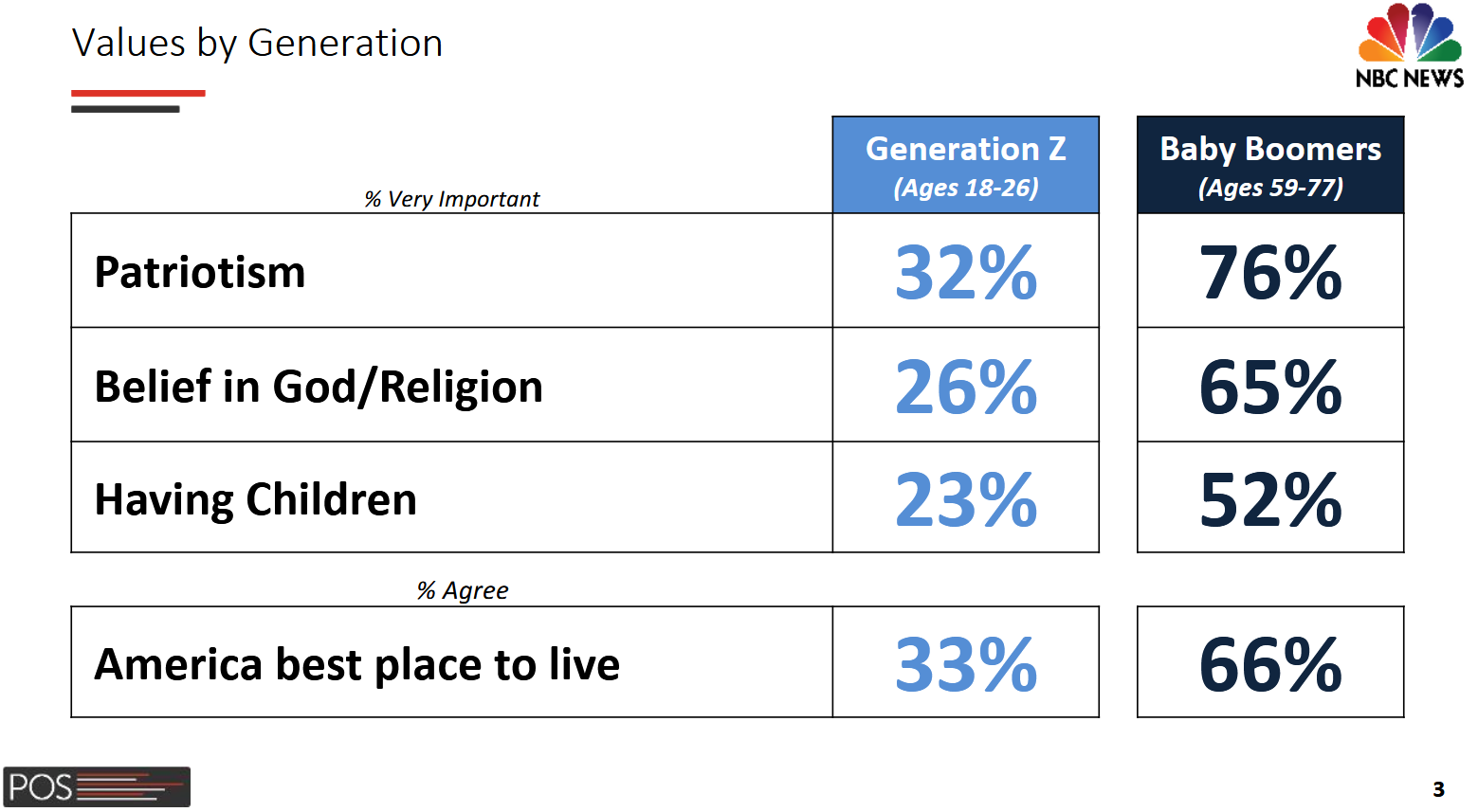
Earlier this year Public Opinion Strategies’ Bill McInturff, who looked at “key data by generation” (38 slides) and found Gen-Z a lot less likely to prioritize more traditional community values. [The April 2024 slide deck is here.]
 |