The reasons why our politics has been a cold shower for Americans’ patriotism are not hard to discern. One of them is the president. Donald Trump won the Republican nomination in 2016 by framing the U.S. as a nation in terminal decline, and he has frequently drawn a moral equivalence between the actions of foreign dictators and America’s own foreign policy. In the period since Trump overtook the Republican Party, right-wingers have become much more critical about America as it actually exists. And though Trump regularly expresses patriotism, his pageantry and truculent manner have been more polarizing than unifying. He seems to miss no opportunity to associate love of country with his own personal MAGA brand.
But it’s by no means just the fault of Trump and his party. Democrats have long practiced what we might call a “yes, but” approach to patriotism. The general idea is that patriotism is kind of okay but only if it’s immediately linked to the terrible things that America has done in the past and the injustices that still exist today. Simply being patriotic, full stop, is viewed with suspicion if not outright hostility. And on the party’s ascendant far left, the Democratic Socialists of America—which stands to see a number of their members elected to Congress in November—recently released a platform that called for getting rid of the Constitution altogether.
But you don’t just need to look at the radical left to find Democratic objections to patriotism. Just this week, Fox News reported that Christina Bohannan, an Iowa Democrat trying to swing a critical House seat, called patriotism “sensitive and controversial” in a statement she issued in 2021. And last month, moderate Democratic representative Tom Suozzi of New York bemoaned his party’s aversion to patriotism. “The choice Democrats face is clear,” he wrote in The Wall Street Journal. “We can allow patriotism to become a partisan label, or we can reclaim a tradition that rightly belongs to every American.”
Showing posts with label patriotism. Show all posts
Showing posts with label patriotism. Show all posts
Friday, August 14, 2026
Party and Patriotism


Thursday, July 2, 2026
American Pride Drops and Polarizes
Many posts have discussed patriotism and American exceptionalism.
As the United States marks its 250th anniversary, 33% of U.S. adults say they are “extremely proud” to be an American, the lowest reading in Gallup's trend dating back to 2001. Another 20% say they are “very proud,” which means just over half of Americans express high levels of pride in their country.
The remaining shares say they are “moderately proud” (22%), “only a little proud” (15%) or “not at all proud” (9%).
...
The current 56-point gap between Republicans’ and Democrats’ reported extreme pride is similar to last year’s 57-point difference, the highest on record.


Friday, June 26, 2026
Stripes at 45: A Patriotic Movie
Many posts have discussed patriotism and American exceptionalism.
Stripes premiered 45 years ago today. Two years ago, Rich Cohen wrote at WSJ:
Released in 1981, “Stripes” is the story of a burnout named John Winger who, seeking direction, joins the Army. It was the first summer after the election of Ronald Reagan, whose campaign had been powered by the eerily familiar slogan, “Let’s Make America Great Again!” It was a time of high inflation, simmering tension with a communist rival and deep polarization in our politics.
In other words, a moment much like our own, which might explain why Murray’s speech still speaks so powerfully to my own teenage kids. I can’t think of a better statement of what ails us and what still makes America and Americans exceptional.
“We’re not Watusi,” Murray tells his fellow grunts in a moment of disunity and crisis. “We’re not Spartans. We’re Americans, with a capital ‘A,’ huh? You know what that means? Do ya? That means that our forefathers were kicked out of every decent country in the world. We are the wretched refuse. We’re the underdog. We’re mutts!…But there’s no animal that’s more faithful, that’s more loyal, more lovable than the mutt.”
Murray played it for laughs, and it was funny, but it was serious too. It celebrates our tolerance, stick-to-it-ness and ethnic jumble. It’s John Winthrop’s City on a Hill remade in the shadow of “Saturday Night Live.” I rank it with FDR’s First Inaugural and Lincoln at Gettysburg. It’s the speech we need today.
...
This silly speech in a silly movie expressed a powerful truth. The Germans of World War II were all the same because they were all the same. We are all the same because we are all different. Which means those differences don’t really matter. Our ancestors came to this country to leave all that B.S. behind. It was the American creed rephrased in the vernacular. It was beautiful.
Only later did I fully appreciate that Murray, along with screenwriters Harold Ramis and Len Blum, had given us a great gift: a way to love our country without feeling gullible, sentimental or corny.
Thursday, June 25, 2026
America: The Signers Would Be Disappointed
As the United States approaches its 250th anniversary, just 19% of Americans say the signers of the Declaration of Independence would be pleased with how the country has turned out.
Just over three in four Americans (77%) now say the founders would be disappointed, compared with 71% in 2013 and 42% in 2001. The latest findings come from a May 2026 Gallup survey.


Monday, February 9, 2026
Bad Bunny and America
Previous posts have discussed Puerto Rico:
At CNN, Alli Rosenbloom reports on Bad Bunny's Super Bowl halftime show:
At CNN, Alli Rosenbloom reports on Bad Bunny's Super Bowl halftime show:
Bad Bunny — who introduced himself with his real full name, Benito Antonio Martínez Ocasio — brought the iconography of Puerto Rican culture to his Super Bowl halftime show performance, a joyous and high-energy affair that celebrated the island where he was born and its place in the American story.
The artist did not shy away from overt political symbolism, ending the authentic and confident performance on a note of unity.
After playing some of his biggest hits, Bad Bunny stared down the camera and spoke in English for the only time during the performance to say, “God Bless America.”
He followed with a list of more than 20 nations in North, Central and South America while dancers trailed him displaying the flags of many of those nations, with the US and Puerto Rican flags most visible directly behind him.
While the US often uses the word “America” to identify itself as a single, distinct country, many of its neighbors use it to refer to a greater unified continent, a point that Bad Bunny hammered home when he spiked a football that read “Together we are America,” before launching into his nostalgic anthem “DtMF.”
Puerto Rico – officially the Commonwealth of Puerto Rico – is one of five U.S. territories with a permanent population, along with American Samoa, Guam, the Northern Mariana Islands and the U.S. Virgin Islands. It’s located about 1,000 miles southeast of the Florida coast.
Puerto Rico was a Spanish colony for centuries before it was ceded to the U.S. in 1898 following the Spanish-American War. A 1917 act of Congress established that people born in Puerto Rico are U.S. citizens.
The island has had its own constitution since 1952 but is also subject to federal law, like U.S. states. Unlike people living in the states, Puerto Ricans living on the island can’t vote in federal elections and don’t pay federal taxes on income earned there.
Puerto Rico has some representation in Congress, but not as much as the states do. Its sole delegate in the U.S. House of Representatives, Democrat Pablo José Hernández Rivera, has limited voting privileges. The territory does not have any senators.
Since 1967, there have been seven votes on the island over whether Puerto Rico should change its political status, most recently in 2024. However, the results of these votes were nonbinding, and efforts to give Puerto Ricans a binding vote on statehood have stalled in recent Congresses.
Saturday, December 6, 2025
Holidays, National Parks, and a Renamed Institute of Peace
Free entry to National Parks will now be granted on President Trump's birthday but not on Martin Luther King Jr. Day or Juneteenth.
Why it matters: The Trump administration has almost entirely overhauled the list of free National Park days, favoring days that celebrate U.S. patriotism instead of traditional federal holidays.
The Department of the Interior, National Park Service and White House did not immediately respond to Axios' request for comment.
State of play: The June 14 free day falls on both Trump's birthday and Flag Day.Veterans Day is the only free day that was carried into the list for 2026.
Context: Calendar changes were announced on Nov. 25 along with international tourist price hikes, which the Interior Secretary Doug Burgum called "America-first pricing."Beginning next year, free entrance on these days is only for U.S. citizens and residents. Nonresidents will pay the regular entrance fee and applicable nonresident fees.
And yes, the NPS notice specifically mentions Trump's birthday:
Come experience the national parks! All National Park Service sites that charge an entrance fee will offer free admission to everyone (other fees, including timed entry or reservation fees, may apply). Mark your calendar for these entrance fee-free dates:
- February 16: Presidents Day (Washington's Birthday)
- May 25: Memorial Day
- June 14: Flag Day/President Trump's birthday
- July 3–5: Independence Day weekend
- August 25: 110th Birthday of the National Park Service
- September 17: Constitution Day
- October 27: Theodore Roosevelt's birthday
- November 11: Veterans Day
Beginning in 2026, free entrance on these days will be for US citizens and residents only. Nonresidents will pay the regular entrance fee and any applicable nonresident fees.
Michelle L. Price and Gary Fields at AP:The Trump administration has renamed the U.S. Institute of Peace after President Donald Trump and has planted the president’s name on its headquarters despite an ongoing fight over control of the institute.
It’s the latest twist in a seesaw court battle over who controls the U.S. Institute of Peace, a nonprofit think tank that focuses on peace initiatives. It was an early target of the Department of Government Efficiency this year.
On Wednesday, the State Department said it renamed the organization to the Donald J. Trump Institute of Peace to “reflect the greatest dealmaker in our nation’s history.” The new name could be seen on its building, which is near the State Department.
Thursday, October 23, 2025
"Truly American" and National Identity
Many posts have discussed patriotism and the role of religion in American life.
The late John McCain said: "We are citizens of the world's greatest republic, a nation of ideals, not blood and soil."
Public Religion Research Institute:
Most Americans (78%) believe that “America is best understood as a nation built around the idea that all people, regardless of the circumstances of their birth or station in life, have equal rights and freedoms,” while 19% believe that “America is best understood as a nation comprised of people with a shared heritage and homeland.” Majorities of Democrats (88%), independents (79%), and Republicans (70%) agree with the first statement, while far fewer agree with second statement (11%, 18%, 27%, respectively).
Majorities across religious groups and Christian nationalism groups agree that America is best understood as a nation built around the idea that all people have equal rights and freedoms.
...
When asked about how important the following traits are to being “truly American,” most Americans say that believing in individual freedoms, such as freedom of speech (93%), believing in the Constitution (91%), accepting people of diverse racial and religious backgrounds (89%), believing in the Declaration of Independence (88%), respecting American political institutions and laws (88%), and being able to speak English (75%) are very or somewhat important.
Americans are more divided over whether believing in God (57%) and being born in America (54%) are very or somewhat important to being truly American. Americans are less likely to say that being a Christian (43%) or having ancestors who served in the military in previous wars, such as the World Wars and the Civil War (42%) are important. Just 23% of Americans say that being of Western European heritage is important to being truly American.
With the exception of Western European heritage, where only one-third say this trait is important (33%), majorities of Republicans believe every other trait is important to being truly American. Conversely, fewer than half of Democrats say that being born in America (42%), believing in God (41%), having ancestors who served in the military in previous wars, such as the World Wars and the Civil War (34%), and being a Christian (29%) are important to being truly American. Majorities of Democrats say all other traits are important. Though independents mirror all Americans very closely, they are 8 percentage points less likely to say believing in God (49% vs. 57%) or being Christian (35% vs. 43%) are very important to being truly American.
Monday, August 4, 2025
What's Important to Being American?
How many Americans think believing in the principles of the Declaration of Independence is more important for being American than...
— YouGov America (@YouGovAmerica) August 2, 2025
Supporting the U.S. Constitution 25%
Being a U.S. citizen 47%
Obeying U.S. laws 56%
Having American parents 87%https://t.co/uCSIg8lHz5 pic.twitter.com/AWd4rVI1FS
Friday, July 4, 2025
Pride and Patriotism
Many posts have discussed patriotism.
New YouGov polling on July 4 and patriotism
— YouGov America (@YouGovAmerica) June 30, 2025
The share of Americans who are very proud to be American has fallen.
% who said they were very proud to be an American in June 2024 | June 2025
U.S. adult citizens 56% | 48%
Democrats 52% | 27%
Republicans 74% | 82%
(Link in reply) pic.twitter.com/freBOTJqUD
A record-low 58% of U.S. adults say they are “extremely” (41%) or “very” (17%) proud to be an American, down nine percentage points from last year and five points below the prior low from 2020. The 41% who are “extremely proud” is not statistically different from prior lows of 38% in 2022 and 39% in 2023, indicating most of the change this year is attributable to a decline in the percentage who are “very proud.”
...
At the beginning of the 21st century, U.S. adults were nearly unanimous in saying they were extremely or very proud to be Americans. But that national unity has eroded over the past 25 years due to a combination of political and generational changes. Democrats today are much less likely than in the past to express pride in their country; in fact, their national pride has hit a new low. Additionally, Generation Z and millennials are much less proud of their country than their elders are.
These changes have occurred mostly over the past decade, and have done so amid greater pessimism about the economic prospects for young people, widespread dissatisfaction with the state of the nation, greater ideological divides between the parties, unfavorable images of both parties, and intense partisan rancor during the Trump and Biden administrations.


Thursday, July 3, 2025
The Greatest Country?
Many posts have discussed patriotism and American exceptionalism.
In 1955, the Gallup Organization asked Americans to suppose they were talking in a general way about the United States and other countries. The organization then asked which of three statements came closer to the respondent’s point of view. Two-thirds chose the response that the United States was the “greatest country in the world, better than all other countries in every possible way.” Thirty-one percent believed the US was “a great country but so are certain other countries.” And finally, 1% said that in many other respects, certain other countries were better than the US.
A version of this question has been asked occasionally by pollsters ever since. A 1998 survey of parents done for Public Agenda found 84% believed the United States was “a unique country that stands for something special in the world,” while 13% said the US is “just another country whose system is no better or worse than other countries.”
In 2011, the Pew Research Center began asking another version. That year, 38% responded that “the U.S. stands above all other countries in the world,” while 53% said the U.S. was “one of the greatest countries in the world, along with some others.” Eight percent said there were other countries that were better than the U.S. The 38% response has been trending downward unevenly, and in 2024, using a different methodology, 20% said the US stands above, while 55% said there were other countries that were also great. Twenty-four percent said there were other countries that were better, three times as many as had given that response in 2011
The Chicago Council for Global Affairs presents a binary choice: “Some people say the United States has a unique character that makes it the greatest country in the world. Others say that every country is unique, and the United States is no greater than other nations.” In 2012, 70% chose greatest country response, while 29% opted for the “no greater than other nations.” In 2023, the last time they asked the question, there was a big change in the no greater response: almost as many, 47%, chose it while 52% chose the greatest country. The Chicago Council looked at the responses by generations and found that majorities of the oldest generation, the Baby Boomers, and Gen X-ers all opted for the greatest response. Millennials, born in 1981 and beginning to come of age in the mid-1990s, were different. Just 40% of Millennials chose this response, and 59% opted for the no greater one. Other pollsters show the same generational differences with Millennials and younger generations more skeptical than their elders about the US’s role. The Council noted that racial and ethnic differences to the question were small.
Monday, January 13, 2025
Catholics and America
Many posts have discussed patriotism and the role of religion in American life.
With the breadth of Catholic history and teaching in mind, let us return to the underlying question with which we began: What should Catholic parents and teachers be imparting to children about our country and their role as citizens of this nation?
The answer is clear: American Catholics must teach our children to understand our country’s history, cherish and maintain its founding principles, and recognize that when we have gone wrong as a nation, it has been on those occasions when we have acted in defiance of those principles or failed to honor them.
We should teach young Catholic men and women to value our Constitution because the freedoms it protects allow us to pursue truth and goodness; they nurture and sustain our families, our communities, and our country’s civic order. And we must affirm to our children and our students that there is no reason to feel they must choose between being faithful Catholics and being patriotic Americans.
The Church does not teach that democracy is always required, or that it is the highest or best form of government. In fact, it does not pronounce any single best form of government, though it emphatically rejects certain types of government, especially totalitarian political systems such as fascism and communism. But democracy at its best does give expression — perhaps unique expression — to the principle of equal human dignity that the Church always and everywhere proclaims. Pope St. John Paul II referred to this inviolable human dignity during his visit to the United States in 1995:
Catholics of America! Always be guided by the truth — by the truth about God who created and redeemed us, and by the truth about the human person, made in the image and likeness of God and destined for a glorious fulfillment in the Kingdom to come. Always be convincing witnesses to the truth. “Stir into a flame the gift of God” that has been bestowed upon you in Baptism. Light your nation — light the world — with the power of that flame!
As John Paul also noted, “the continuing success of American democracy depends on the degree to which each new generation, native-born and immigrant, makes its own the moral truths on which the Founding Fathers staked the future of your Republic.” If this nation “under God,” as Abraham Lincoln put it in his Gettysburg Address, is to endure, we must continuously pray and work to ensure that our laws and our leaders truly honor that North Star principle — the ur-principle, as I sometimes describe it — of all sound morality: that of the profound, inherent, and equal dignity of each and every member of the human family.
Sunday, December 29, 2024
Patriotism and Generations
Many posts have discussed patriotism and the role of religion in American life.
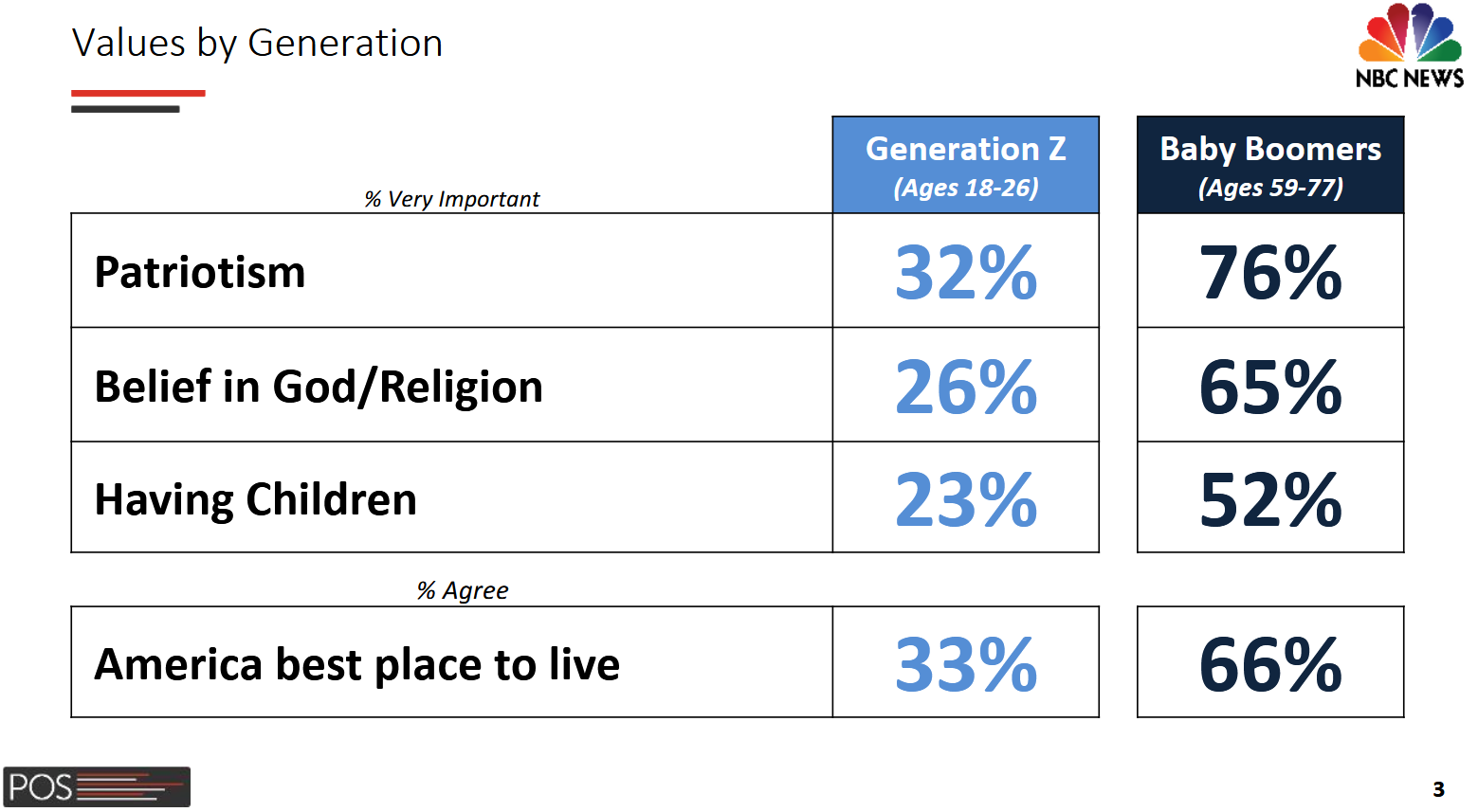
Earlier this year Public Opinion Strategies’ Bill McInturff, who looked at “key data by generation” (38 slides) and found Gen-Z a lot less likely to prioritize more traditional community values. [The April 2024 slide deck is here.]
 |
Thursday, July 4, 2024
Declining Pride
Many posts have discussed patriotism.
Two in five Americans, 41%, say they are “extremely proud” to be American, the fifth consecutive year this reading has been in the 38% to 43% range. Another 26% of U.S. adults say they are “very proud,” also in line with recent years.
The 67% combined share of Americans who are extremely or very proud is consistent with readings since 2018 and among the lowest in Gallup’s trend, just four percentage points above the record low of 63% in 2020. From 2001 through 2017, no fewer than 75% of U.S. adults said they were extremely or very proud, including majorities who were extremely proud.
.png)

Saturday, June 15, 2024
Upside-Down Flag
Megan Lebwowitz at NBC:
The veteran organization the American Legion weighed in on the upside-down American flag controversy on Thursday, noting that flags should only be flown this way if there is "extreme danger to life or property."
The potential implications of flying an American flag upside down have been the subject of debate since reports emerged that an upside-down flag flew outside Supreme Court Justice Samuel Alito's home in early 2021. The justice said the flag was raised by his wife, Martha-Ann.
Some supporters of former President Donald Trump have also reportedly flown upside-down flags in support of the former president falsely claiming that the 2020 election was stolen, leading it to be interpreted as a "stop the steal" symbol.
"The American flag is a symbol of courage, strength, freedom and democracy," said the American Legion National Commander Daniel Seehafer in a statement to NBC News. "American Legion members swore with their lives to protect all that the flag stands for."
Seehafer pointed to the Flag Code, a detailed set of guidelines laying out how the American flag should be displayed, as evidence the flag should not be inverted unless to signal distress.
Saturday, January 27, 2024
Judge: J6 Attack Was the Antithesis of Patriotism
Reagan-appointed Judge Royce Lamberth:\
Today, the Court sentenced Defendant James Little, after the D.C. Circuit vacated his initial sentence and remanded the case for resentencing. The Court ordered that Mr. Little be committed to the custody of the Bureau of Prisons for a term of 150 days, with credit for 60 days already served in prison and credit for a further 30 days that reflects the 18 months Mr. Little spent on probation. The following are the notes that the Court used when delivering portions of its oral resentencing today:
...
The Court is accustomed to defendants who refuse to accept that they did anything wrong. But in my thirty-seven years on the bench, I cannot recall a time when such meritless justifications of criminal activity have gone mainstream. I have been dismayed to see distortions and outrightfalsehoods seep into the public consciousness. I have been shocked to watch some public figures try to rewrite history, claiming rioters behaved “in an orderly fashion” like ordinary tourists, or martyrizing convicted January 6 defendants as “political prisoners” or even, incredibly, “hostages.” That is all preposterous. But the Court fears that such destructive, misguided rhetoric could presage further danger to our country.
...
So let me set the record straight, based on what I’ve learned presiding over many January 6 prosecutions, hearing from dozens of witnesses, watching hundreds of hours of video footage, and reading thousands of pages of evidence. On January 6, 2021, a mob of people invaded and occupied the United States Capitol, using force to interrupt the peaceful transfer of power mandated by the Constitution and our republican heritage.
This was not a protest that got out of hand. It was a riot; in many respects a coordinatedriot, as is clear from cases before me including Hostetter (21-cr-392) and Worrell (21-cr-292). “Protestors” would have simply shared their views on the election—as did thousands that day who did not approach the Capitol. But those who breached and occupied the Capitol building and grounds halted the counting of the Electoral College votes required by the Twelfth Amendment. The rioters interfered with a necessary step in the constitutional process, disrupted the lawful transfer of power, and thus jeopardized the American constitutional order. Although the rioters failed in their ultimate goal, their actions nonetheless resulted in the deaths of multiple people, injury to over 140 members of law enforcement, and lasting trauma for our entire nation. This was not patriotism; it was the antithesis of patriotism.
Saturday, November 25, 2023
Measuring Patriotism
Many posts have discussed patriotism.
Frank Newport at Gallup:
The Journal survey asks Americans to rate the importance of “patriotism.” Gallup doesn’t measure the importance of patriotism per se, but we do have a measure asking Americans how proud they are to be an American -- presumably measuring the same underlying concept. Additionally, the Journal question has four response options -- very important, somewhat important, not that important and not important at all, while the Gallup question has five response options -- extremely, very, moderately, only a little or not at all proud.
In our latest asking this year, 39% of Americans said they were extremely proud to be an American and 28% said very proud. The Journal’s polling in this year’s update found that 38% say patriotism is very important to them, with another 35% saying it is somewhat important.
There are differences in the trending over time on the two measures of patriotism. Gallup’s measure of those saying they are extremely proud to be an American shows a decline from 55% in 2001 to 45% in 2019, and then a modest decline to 39% this year. The combined top two categories in Gallup’s polling (that is, adding extremely and very proud together) show a leveling off over the past three years.
The Wall Street Journal trend shows a decline in the percentage choosing the top category (patriotism rated as very important) from 70% in 1998 to 61% in 2019 -- when both surveys were conducted by telephone -- but a very steep drop to 38% this year, when the survey was conducted by web. The combined top two categories (very and somewhat important) went from 93% in 1998 to 88% in 2019 to 73% this year.
Thus, while both studies show a decline over time using their respective measures of patriotism, Gallup does not see the very large decrease evident in the Journal data over the past four years. Again, how much of the Journal decline may be due to the change in the mode of interviewing is unknown. However, the consistency of Gallup telephone methods suggests that the observed leveling off since 2019 may be the more valid indicator of what is happening in the underlying population.
Tuesday, July 4, 2023
National Pride 2023
At 39%, the share of U.S. adults who are “extremely proud” to be American is essentially unchanged from last year’s 38% record low. The combined 67% of Americans who are now extremely or “very proud” (28%) also aligns with the historically subdued 65% reading one year ago.
Another 22% of U.S. adults currently say they are “moderately proud,” while 7% are “only a little” and 4% “not at all.”
...
Party identification remains the greatest demographic differentiator in expressions of national pride, and Republicans have been consistently more likely than Democrats and independents to express pride in being American throughout the trend. That gap has been particularly pronounced since 2018, with more than twice as many Republicans as Democrats saying they are extremely proud. Republicans are also nearly twice as likely as independents to express the highest degree of pride.
The latest findings, from a June 1-22 Gallup poll, show 60% of Republicans and 29% of Democrats expressing extreme pride in being American. Both figures are statistically similar to last year’s readings. Independents’ current 33% extreme pride is also essentially unchanged, but it is their lowest on record by one percentage point.
...
In addition to party identification, age appears to significantly affect Americans’ national pride. Whereas 50% of U.S. adults aged 55 and older say they are extremely proud to be American, 40% of those aged 35 to 54 and 18% of 18- to 34-year-olds say the same.
Aggregated data from 2020 to 2023 provide a sufficient sample for analysis and show that younger adults in all party groups are significantly less proud than older adults of the same political persuasion.
Tuesday, March 28, 2023
WSJ-NORC Poll on Patriotism, Religion, and Civic Culture
Aaron Zitner at WSJ:
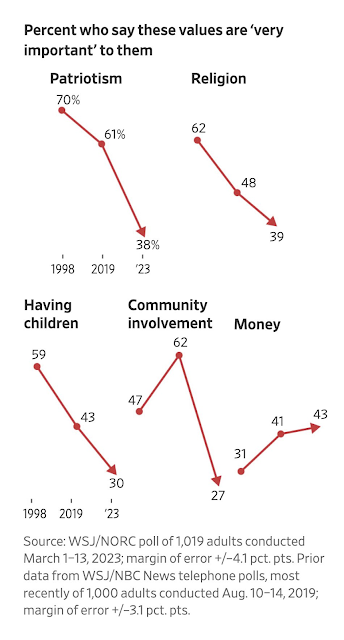
Patriotism, religious faith, having children and other priorities that helped define the national character for generations are receding in importance to Americans, a new Wall Street Journal-NORC poll finds.
WSJ/NORC POLL MARCH 2023 Read the full poll results
The survey, conducted with NORC at the University of Chicago, a nonpartisan research organization, also finds the country sharply divided by political party over social trends such as the push for racial diversity in businesses and the use of gender-neutral pronouns.
Some 38% of respondents said patriotism was very important to them, and 39% said religion was very important. That was down sharply from when the Journal first asked the question in 1998, when 70% deemed patriotism to be very important, and 62% said so of religion.
The share of Americans who say that having children, involvement in their community and hard work are very important values has also fallen. Tolerance for others, deemed very important by 80% of Americans as recently as four years ago, has fallen to 58% since then.Bill McInturff, a pollster who worked on a previous Journal survey that measured these attitudes along with NBC News, said that “these differences are so dramatic, it paints a new and surprising portrait of a changing America.’’ He surmised that “perhaps the toll of our political division, Covid and the lowest economic confidence in decades is having a startling effect on our core values.’’
A number of events have shaken and in some ways fractured the nation since the Journal first asked about unifying values, among them the Sept. 11, 2001, terrorist attacks, the financial crisis of 2008 and subsequent economic downturn and the rise of former President Donald Trump.
Monday, September 12, 2022
"America First"
Popular memory, as captured by Wikipedia, currently credits Woodrow Wilson with coining the phrase “America First” during his 1916 presidential campaign. Wilson certainly popularized it, in a 1915 speech urging native-born Americans to view hyphenate immigrant Americans with suspicion and to demand of naturalized citizens: “Is it America first, or is it not?” But he didn’t originate it.
At an 1855 “American convention” held in Philadelphia, the American Party adopted a platform that would have sweepingly denied political and civil rights to immigrants. Speaking during a downpour, a nativist politician from New York told the crowd, to cheers: “American as I am, I decidedly prefer this rain to the reign of Roman Catholicism in this country … I, as an American citizen, prefer this rain or any other rain to the reign of foreignism … I go for America first, last and always.”
“America first, last and always” may sound simply patriotic, but since the 1850s it has consistently invoked nativist restrictionism and economic protectionism, and often urged isolationism. It has often accompanied anti-immigrant violence and conspiracy theories. In 1876, an anti-Catholic editorial called on every American “in this Centennial year, to renew the declaration of independence, to declare himself and the nation free, as it ought to be, from the thraldom of every foreign power — whether England or Rome — and to begin again where our forefathers began, with America first, last and always.”
During the latter decades of the 19th century a widespread belief developed that Britain supported free trade as part of a secret plot to thwart the growth of American industry; Republicans responded with a protectionist tariff and “America First.” Well before Wilson, in 1888, Benjamin Harrison promised home labor and protectionism under the “Republic Banner” of “America First, the World Afterwards!” in an election fought over tariff policy.
Wednesday, July 13, 2022
Rep. Murphy Statement
Rep. Stephanie Murphy (D-FL) at Tuesday's hearing of the January 6 committee:
Thank you, Mr. Chairman. At one of our first hearings, Chairman Thompson explained that the members of this committee would not spend much time talking about ourselves. Rather, we would let the evidence play the leading role. And the Chairman was right, because this isn't about promoting ourselves as Individuals.
It's about protecting the country we love. And it's about preserving what actually makes America great: the rule of law, free and fair elections, and the peaceful transfer of power from one elected leader to the next. But if I may say a word about myself and why I'm proud to serve on this committee, I'm the only member of this committee who was not blessed to be born an American. I was born in Vietnam after the Vietnam War, and my family and I fled a communist government and were rescued by the US Navy, and were given sanctuary in America. My patriotism is rooted in my gratitude for America's grace and generosity. I love this country. On January 6th, four decades after my family fled a place where political power was seized through violence, I was in the United States Capitol fleeing my fellow Americans.
Members of the angry mob had been lied to by a President and other powerful people who tried to convince them without evidence that the election had been stolen from them. Some of them then tried to use physical violence to overturn the outcome of a free and fair election. Our committee's overriding objective is to fight fiction with facts; to create a full account for the American people and for the historical record; to tell the truth of what happened and why it happened; to make recommendations so it never happens again; to defend our democracy.
To me, there's nothing more patriotic than that. Thank you. Mr. Chairman, I yield back.
Subscribe to:
Posts (Atom)