Search This Blog

Showing posts with label family. Show all posts

Thursday, July 30, 2026

Inequality, Households, and Teen College Plans

Many posts have discussed economic and educational inequality. 


Inequalities feed on one another. Kids from noncollege families engage in fewer extracurriculars,which in turn hurts their chances at getting into good colleges and getting good jobs.

Teens’ planned trajectory after graduation varies dramatically between not only boys and girls but also those with college-educated parents and those without. Nearly three-quarters (74 percent) of teen girls with college-educated parents report that they are planning on going to a four-year college after graduation. About half of teen boys with college-educated parents say they are planning on going to college themselves. Nearly as many teen girls (46 percent) raised in noncollege households plan on attending a four-year college or university. About half as many of their male peers (24 percent) report that they plan on going to college.

Wednesday, January 7, 2026

The Growing Upper Middle Class

Many posts have discussed economic and educational inequality. 

Stephen J. Rose and Scott Winship at AEI:


Abstract:

Populists on both the political left and right routinely claim that the middle class has been hollowed out. These claims, to the extent they are based on evidence, rely on a relative definition of the middle class, such that if income doubles for every family, the middle class does not grow. Using an absolute definition of the middle class, we find that the “core” middle class has shrunk, but only because more families have become upper-middle class over time. The upper-middle class boomed from 10 percent of families in 1979 to 31 percent in 2024, and its share of income doubled. The share of families whose income left them short of the core middle class fell from 54 percent to 35 percent. Claims of a hollowed-out middle class wrongly reinterpret widespread (if unequal) gains across the income distribution as rising insecurity and declining living standards.

From the article:

We create five income classes, depending on how families’ inflation- and size-adjusted incomes compare with the poverty guideline: poor or near poor (less than 150 percent of the poverty guideline), lower-middle class (150 percent to under 250 percent), core middle class (250 percent to under 500 percent), upper-middle class (500 percent to under 1,500 percent), and rich (1,500 percent or higher). These thresholds were selected building on past research by one of us (Rose 2010, 2016, 2021). We report results using different thresholds as a sensitivity check below.

Table B1 displays the unadjusted family income ranges corresponding to each income class for families of different sizes. For a family of three, the thresholds dividing the five classes are, roughly, $40,000, $67,000, $133,000, and $400,000 (in 2024 dollars).


Tuesday, July 29, 2025

Cash Payments and Child Development

A number of posts have dealt with poverty.

Kimberly Noble, et al.,  "The Effect of a Monthly Unconditional Cash Transfer on Children’s Development at Four Years of Age: A Randomized Controlled Trial in the U.S." NBER Working Paper 33844 DOI 10.3386/w33844 Issue Date May 2025

ABSTRACT: Developmental differences between children growing up in poverty and their higher-income peers are frequently reported. However, the extent to which such differences are caused by differences in family income is unclear. To study the causal role of income on children’s development, the Baby’s First Years randomized control trial provided families with monthly unconditional cash transfers. One thousand racially and ethnically diverse mothers with incomes below the U.S. federal poverty line were recruited from postpartum wards in 2018-19, and randomized to receive either $333/month or $20/month for the first several years of their children’s lives. After the first four years of the intervention (n=891), we find no statistically significant impacts of the cash transfers on four preregistered primary outcomes (language, executive function, social-emotional problems, and high-frequency brain activity) nor on three secondary outcomes (visual processing/spatial perception, pre-literacy, maternal reports of developmental diagnoses). Possible explanations for these results are discussed.

Sunday, March 16, 2025

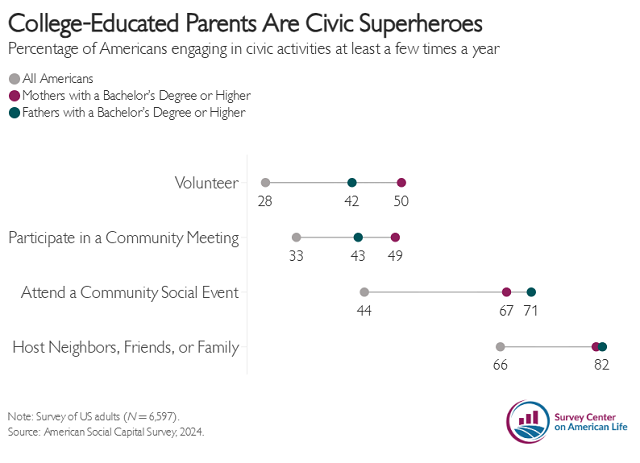
College-Educated Parents and Civic Life


Not all Americans have been as quick to abandon public spaces and communal activities. A recent report from the Survey Center on American Life found that college-educated parents remain very involved in their communities, spending much more time engaged in civic activities than other Americans. The report, Disconnected: The Growing Class Divide in American Civic Life, documents a range of activities that college-educated mothers engage in at higher rates than other Americans.

...

Becoming a parent does not instantly make someone a more caring or empathetic person. In fact, some research suggests the opposite. But for engaged caregivers, the experience of raising children fundamentally alters the incentives for being community-minded. Parents are incentivized to get to know their neighbors, take care of local parks and playgrounds, and support local schools—and they have shown a tendency to act on these incentives. They take more of an interest in local affairs and participate more regularly in community events and activities.


Thursday, March 13, 2025

The Long Shadow of COVID, continued

Many posts have discussed COVID. Five years later, we are only now starting to grasp its long-term consequences.

Megan Brenan at Gallup:

Looking back on the COVID-19 pandemic’s impact on their school-age children, U.S. parents are more likely to report negative social and emotional issues than academic or physical health troubles.

Gallup’s latest update to its COVID-19 tracking poll finds that 45% of parents of school-age children say the pandemic has had a negative impact on their child’s social skills development. Half of them, 22%, report the social difficulty is ongoing, while the other half, 23%, say it has eased. Similarly, 42% of these parents say their child’s mental health has been negatively affected by the pandemic, including 21% who say the issue persists.

In terms of academics, at least three in 10 parents say the pandemic negatively impacted their child’s skills in math (36%), reading (31%) or science (30%), with roughly half of each group saying the effects are ongoing. Fewer parents (23%) say the pandemic negatively affected their child’s physical health.

Meanwhile, solid majorities of K-12 parents -- ranging from 56% to 69% -- say there was no effect on their child’s physical health or math, reading or science skills. Fewer say the same about their child’s social skills development (47%) and mental health (52%). No more than 10% of parents say their child was positively affected by the pandemic in any of the six areas measured.


Sunday, December 29, 2024

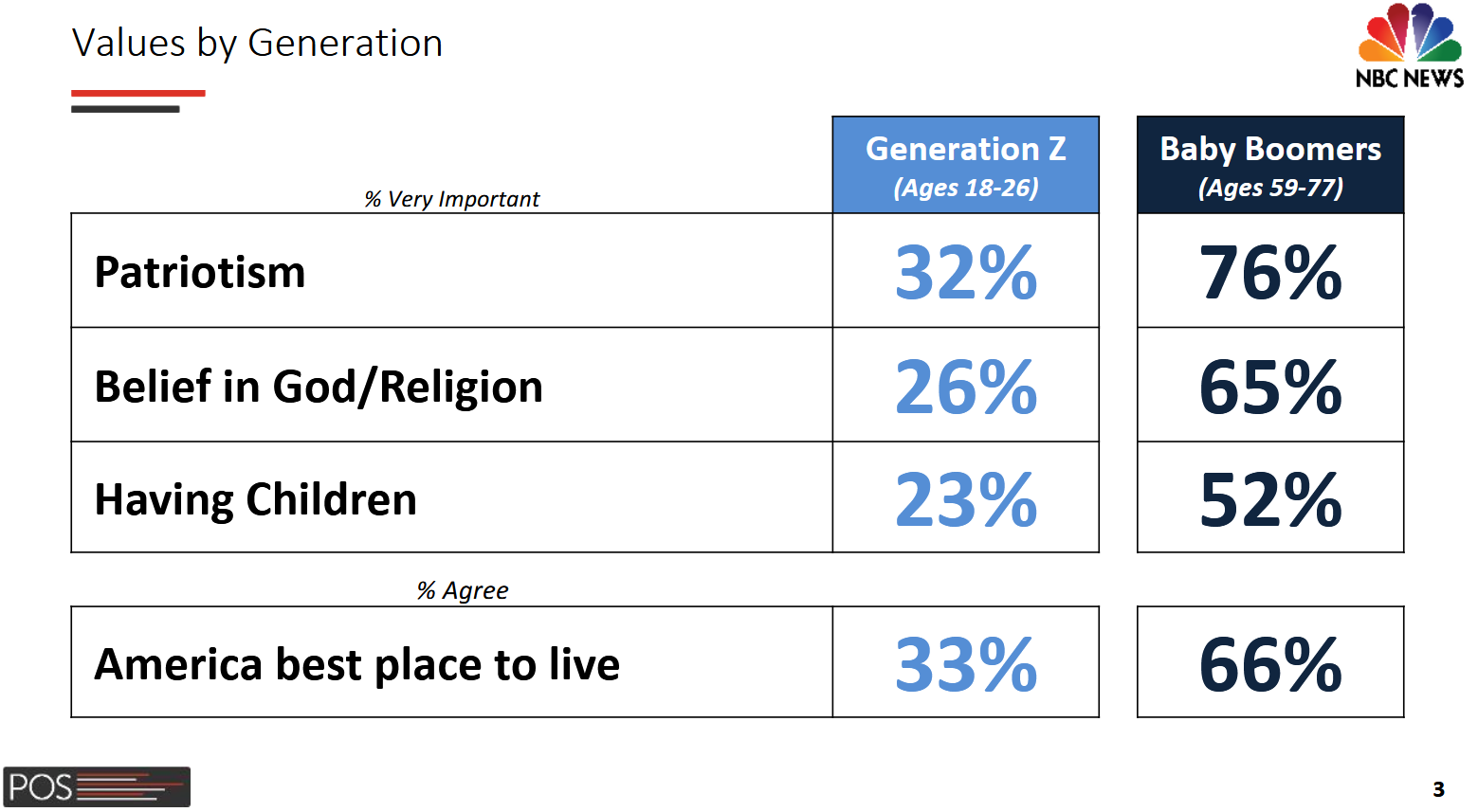
Patriotism and Generations

Many posts have discussed patriotism and the role of religion in American life.

Bruce Mehlman:

Earlier this year Public Opinion Strategies’ Bill McInturff, who looked at “key data by generation” (38 slides) and found Gen-Z a lot less likely to prioritize more traditional community values.  [The April 2024 slide deck is here.]

Tuesday, December 24, 2024

Kinless at Christmas


Alysse ElHage and Brad Wilcox at Deseret News:
In fact, starting in the past decade, the share of “kinless” prime-aged (18-55) adults — defined here as those who are never married and have no children in the home — exceeded the share of Americans who are married with children for the first time in our nation’s history.
This trend is an indication of what we have called “the closing of the American heart,” as fewer young adults take the plunge, get married and start a family. Among the many reasons for the decline in marriage is that more and more young men and women are prioritizing a “Midas Mindset” over a “Marriage Mindset” — that is, focusing on education and work like Taylor did, rather than on love and marriage. Consequently, a growing share of young women and men are slated to never marry. In fact, demographers project that a staggering share of today’s young adults — one in three — will never marry, as the Institute for Family Studies reported.
This decline in marriage is linked to the growing share of Americans who do not have children: in fact, more than 1 in 5 American 50-something adults have never had kids, according to Pew Research Center. Moreover, the share of younger Americans who don’t think they will ever be parents is growing. As Pew reports, “the share of U.S. adults younger than 50 without children who say they are unlikely to ever have kids rose 10 percentage points between 2018 and 2023 (from 37% to 47%).”

Demographer Lyman Stone projects that a record share of today’s young adults will never have children — probably about 1 in 4 men and women in their twenties now will go through life without ever having children.

The repercussions of a kinless future for more American adults extend far beyond a lonely holiday season for the growing share of women and men who have no immediate kin. As the family falls, loneliness rises, deaths of despair surge and the “pursuit of happiness” becomes more unattainable not just for individuals but communities across the nation. That’s because both marriage and parenthood are linked with increased mental and emotional well-being and better overall physical health for both men and women. And while many people today wrongly believe that a satisfying career and a good income are the keys to happiness, the No. 1 predictor of overall life satisfaction is how satisfied people are in their marriage. In fact, as “Get Married” notes, men and women who are happy in their marriages are 545% more likely to be happy in their lives than those who are unhappily married or those who are unmarried.


Sunday, September 29, 2024

Gender Differences

 Mike Allen at Axios:

A flood of data reveals a little-discussed, future-defining trend: Men and women are going separate ways.The split is clear in politics, religion, education and the labor market, Axios' Erica Pandey reports.

Why it matters: For the next generation, gender is becoming the biggest predictor of how you think, act and vote.

"There's a much broader story here," says Daniel Cox, director of the Survey Center on American Life. "Even after all the votes are tallied and we've moved on from the 2024 election, we're not going to have resolved any of the cultural and relational tension between young men and young women."
  • "You see it in politics: Women are turning left. Men are turning right.
  • You see it in religion: For the first time ever recorded in the U.S., young men are more religious than young women.
  • You see it in education: There are 2.4 million more women on U.S. college campuses than men, the American Institute for Boys and Men (AIBM) notes. Those degrees are often resulting in higher-wage jobs for women in big cities.
  • You see it in the labor market: Wages and labor force participation have increased since the 1980s for college-educated men and women, and for working-class women. But they have stagnated for working-class men, who are also now significantly less likely to be employed than four decades ago, according to AIBM's analysis.
  • You see it in visions for the future: Men are more likely than women to want marriage and kids, according to Pew Research Center.

Saturday, August 31, 2024

Fathers

 Daniel A. Cox at AEI:

Fathers today are doing more than ever. Not only are they taking on more housework—doing laundry, cooking, and cleaning—but they are more involved with child care as well. They help with homework and serve as chauffeurs, coaches and role models. Fathers with young kids spend, on average, nearly two hours a day caring for their kids. The division of domestic labor does still tilt inequitably towards women—mothers spend nearly an hour more on average on child care—yet there is no question the gender gap in parenting responsibilities has shrunk. But perhaps one of the most critical changes is that dads have become more emotionally involved and connected to their kids.

A new report from AEI’s Survey Center on American Life reveals a profound generational shift in the extent to which Americans are turning to both parents for help when facing personal problems. The pattern is clear when we compare two-parent households: 57% of young adults raised in two-parent households report that they could rely on both their mother and father for help with a personal problem, while only 40% percent of Americans aged 50 or older report the same.

That more kids are being raised by emotionally-engaged dads is an unqualified good, but this trend is being offset by the fact that fewer Americans are being raised in two-parent households. Today, nearly half of children are raised in single-parent households. Thus, our research shows that, overall, young adults are not much more likely than older Americans to say they can rely on their father for support for the simple fact that many do not have one in their lives at all.

A growing body of research has found that Americans raised by married parents are better off than those raised in other family arrangements. The economic benefits of being raised in two-parent households were extensively documented by Melissa Kearney in her book The Two-Parent Privilege. But we find benefits that extend beyond increased financial stability, improved educational outcomes, and better job prospects. Our survey shows that Americans raised in two-parent households with emotionally engaged parents tend to develop more robust social connections later in life:

Greater parental support is associated with better social outcomes later in life. Americans who report being able to turn to either parent for support—their mother or father—are more likely to have more robust social connections as adults. In two-parent households, Americans who had the support of both parents are more likely to have established close friendships in adulthood than those who could turn to only a single parent, or who had no parent they could rely on.

Sunday, August 25, 2024

College-Educated Parents and Civic Life

Many posts have discussed economic and educational inequality. The effects of inequality reach many corners of American life. 

 Daniel A. Cox and Sam Pressler at The Survey Center on American Life

One group stands out for its relatively high levels of civic effort and community care: college-educated parents. Fully half (50 percent) of college-educated mothers and more than four in 10 (42 percent) college-educated fathers report volunteering in their community at least a few times a year. Nearly three in 10 (27 percent) college-educated mothers volunteer at least once or twice a month.

More than two-thirds of mothers and fathers with college degrees report they attend community social events at least a few times a year. Close to half (48 percent) of college-educated mothers and a slightly smaller share (43 percent) of college-educated fathers participate in community meetings at least a few times a year. The educational gap in hosting neighbors, family, and friends is somewhat smaller but still significant. Half of college-educated mothers (50 percent) and fathers (48 percent) report entertaining guests at their home at least once or twice a month.


Friday, July 26, 2024

Reasons for Not Having Children

Many posts have discussed demographic trends, especially the decline of births and the aging of the population.

Rachel Minkin et al. at Pew:

The U.S. fertility rate reached a historic low in 2023, with a growing share of women ages 25 to 44 having never given birth.

And the share of U.S. adults younger than 50 without children who say they are unlikely to ever have kids rose 10 percentage points between 2018 and 2023 (from 37% to 47%), according to a Pew Research Center survey.

In this report, we explore the experiences of two groups of U.S. adults: 
  • Those ages 50 and older who don’t have children
  • Those younger than 50 who don’t have children and say they are unlikely to in the future
About four-in-ten of those in the older group (38%) say there was a time when they wanted to have children. A smaller but sizable share (32%) say they never wanted children, and 25% say they weren’t sure one way or the other. Few say they frequently felt pressure to have children from family, friends or society in general. 


Sunday, June 16, 2024

All the Presidents' Children

Aaron O'Neill at Statista:
The 45 men who have served as the President of the United States (officially there have been 46 as Grover Cleveland is counted twice) have fathered, adopted or allegedly fathered at least 190 children. Of these 190, 169 were conceived naturally, eleven were adopted and there are ten reasonable cases of alleged paternity (possibly more). Today, there are 34 living presidential children; the oldest of which is Lynda Bird Johnson Robb, daughter of Lyndon B. and Lady Bird Johnson; the youngest is Barron Trump, son of Donald and Melania Trump. John Tyler is the president who fathered the most children, having fifteen children over two marriages (and allegedly fathering more with slaves), while his successor, James K. Polk, remains the only U.S. president never to have fathered or adopted any known children. Coincidentally, as of November 2020, the U.S.' tenth president, John Tyler, has two grandsons who are still alive today, despite the fact that he was born in 1790.

The president, their children and spouse are collectively known as the First Family of the United States; the current first family is made up of President Joe Biden, First Lady Jill Biden, as well as their children, Hunter and Ashley. Two of President Biden's children died before he was elected to office; his son Beau died of cancer in 2015, while his one year old daughter Naomi was killed in a car accident in 1972, along with Biden's wife, Neilia (who was also Beau and Hunter's mother). Two presidents' sons have gone on to assume the presidency themselves; these were John Quincy Adams and George W. Bush respectively, while one presidential grandson, Benjamin Harrison, later became president.

Three U.S. presidents have allegedly fathered illegitimate children with slaves. The most well-known and substantial of these allegations relates to Thomas Jefferson and his slave, Sally Hemings; who was also the half-sister of Jefferson's wife Martha (with whom he had already fathered six children). Following Martha's passing in 1782, its is believed that the future-president would then go on to have a relationship with Hemings that spanned four decades and saw the birth of as many as eight children between 1790 and 1808. Hemings, thought to have been 14 years old at the beginning of the relationship (Jefferson was 44), and her children remained enslaved to Jefferson until his death in 1826. DNA tests conducted in recent years have confirmed a genetic connection between the Hemings and Jefferson families, and the majority of historians accept that Thomas Jefferson was the father of at least six of Hemings' children. Less substantial claims have also been levelled at John Tyler, with political opponents claiming that he fathered several children with slaves in the years following his first wife's death; although these claims have been widely disregarded by historians, with little investigation into their validity. It is alleged that William Henry Harrison also fathered at least six children with one of his slaves, Dilsia, however these claims are anecdotal and have been disregarded or ignored by historians. In spite of this, to this day, there are some African-American families in the U.S. who claim to be the descendants of both Harrison and Tyler.

It is generally accepted that two other presidents, Grover Cleveland and Warren G. Harding, fathered children through extramarital affairs. It is likely that Grover Cleveland had fathered a child out of wedlock in 1874; even paying child support to the mother, acknowledging that he could have been the father. When the child's mother accused Cleveland of rape, he had her institutionalized to discredit these accusations, and the child was taken away and raised by Cleveland's friends. The issue came to light nationally during the 1884 election campaign, but Cleveland still emerged victorious. In 1927, four years after his death in office, it came to light that Warren G. Harding had fathered a child out of wedlock a year before winning the 1920 election. The child was conceived during one of his two long-term, extramarital affairs, and Harding did pay the mother child support, although he kept the affair and child a secret. Harding died before the child's fourth birthday, his family dismissed these claims as rumors, claiming that he was infertile; however, DNA tests confirmed that the child was his in 2015. While there have been numerous accusations of presidents' infidelity in the past century, particularly relating to John F. Kennedy and Donald Trump; Trump is the only president since Harding to have had a child out of wedlock (although the couple did get married two months after the birth of their daughter, Tiffany).

Tuesday, January 9, 2024

Dynamics of Families after Nonmarital Birth

 Dynamics of Families After a Nonmarital Birth

By Angela Rachidi

American Enterprise Institute

January 08, 2024

Abstract

Despite known links between poverty rates and unmarried parenthood, we know little about how changes in family situations after a nonmarital birth affect poverty. This study explores Future of Families and Child Wellbeing Study data to document changes to the relationship status, employment status, and education level of a cohort of unmarried mothers who gave birth in urban areas in the late 1990s and the implications for poverty rates over a 15-year follow-up period. For children born to unmarried parents in urban areas, official poverty rates improved modestly in the 15 years after the birth, with maternal employment, education gains, and marriage corresponding to lower poverty rates on average over time. Using the success sequence as a framework, poverty rates were dramatically (and statistically) lower when mothers who were unmarried at the time of childbirth subsequently married, worked full-time, and had at least a high school education, suggesting the achievement of success-sequence milestones can lead to lower child poverty even after the birth of a child outside marriage

Monday, October 9, 2023

The Two-Parent Edge

Many posts have discussed marriage and family.

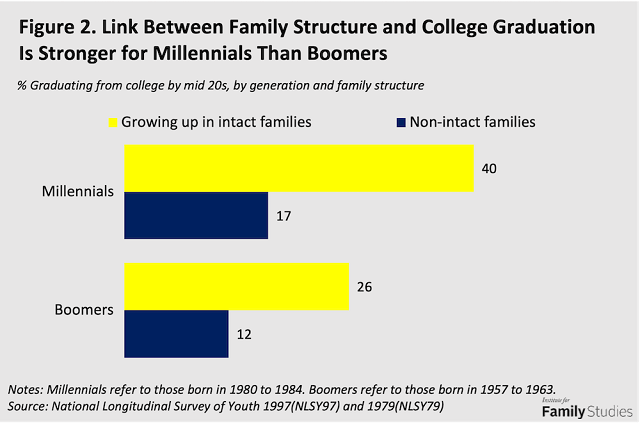
W. Bradford Wilcox, Wendy Wang,  Spencer James, Thomas Murray, "Do Two Parents Matter More Than Ever?" Institute for Family Studies, September 20, 2023

  • College graduation and economic success are more common for young adults from intact families.
  • Children who have the benefit of two parents are comparatively more advantaged today than they were in previous decades.
  • The relationship between family structure and college graduation is stronger today than it was for Boomers.


Sunday, August 13, 2023

Why Are Young People Leaving Religion


Daniel Cox, at The Survey Center on American Life:
The question remains: what is the reason so many young people are leaving religion? There’s no single answer, but the most compelling explanation is that changes in American family life precipitated this national decline. American families have changed dramatically over the past few decades and many churches have been slow to respond. Americans raised in blended families, interfaith families or single-parent families are far less likely to have participated in religion growing up. And these types of family arrangements have become far more common today than they once were. The family explanation is compelling for a few reasons: 
  1. Young people today are leaving much earlier than those of previous generations. Seventy percent of young adults who have disaffiliated shed their formative religious identities during their teen years.
  2. The Americans most likely to “leave” religion are those with the weakest formative attachments. Compared to previous generations, Generation Z reports having a less robust religious experience during their childhood.
  3. Most Americans who disaffiliate say they “drifted away” from religion rather than experiencing a singular negative or traumatic event that pushed them out. To put it another way, they quiet quit.
  4. A wealth of research has shown that religious socialization in the family is a key component of the transmission of religious values, identity, and beliefs across generations.

Friday, June 16, 2023

Belonging

 Daniel Stid at The Art of Association:

Where are we now? One early, powerful, and distressing set of signals came in March with a report from Over Zero and the American Immigration Council. Entitled The Belonging Barometer: The State of Belonging in America, it introduces a compelling new indicator of belonging, which it defines as follows: 

“Belonging is an innate motivational drive–underpinned by our ancestral origins–to form and maintain positive emotional bonds with others. Our need for belonging is so great that it permeates our thoughts, feelings, and behaviors and is integrally connected to how we perceive and pursue our life goals.”

The report goes on to convey new survey research about the extent to which Americans feel they belong in five different life settings. These include their family, friendships, workplace, local community, and the nation. Belonging, the report notes, “is not a switch but a scale,” at the opposite end of which lies exclusion, with increasingly painful levels of ambiguity in between. 

The data presented in the report are sobering. A majority of Americans report experiencing non-belonging (exclusion or ambiguity) in one or more life settings. Nearly 1 in 5 Americans report non-belonging in all five life settings. As we might expect, once we get beyond our family and friends, where 60% and 57% of us experience belonging, respectfully, feelings of ambiguity or exclusion become more common. Survey respondents reported non-belonging rates of 64% in their workplace, 68% in the nation, and 74% in their local community.


Tuesday, April 25, 2023

Ethnicity and Married Birth Parents

 Data Tools 6. The Geography of Traditional Families in America Charles Murray American Enterprise Institute April 2023

The ethnic differences in the prevalence of traditional marriage are huge. Among the nearly five million children in the ACS from 2014 to 2021, these were the percentages of children living with married birth parents broken down by the child’s ethnicity: 

Child’s Ethnicity Married Birth Parents 

Asian ............................82% 

White ............................62%

 Other or Mixed ,,,,,,,,,,,,50% 

Latino ,,,,,,,,,,,,,,,,,,,,,,,,,,,,43%

 Black ............................23% 

Asian children and black children effectively live in different familial worlds. The difference in living situations between white and black children is less dramatic but still extremely large.

Monday, March 6, 2023

Lauren Underwood: The Personal Cost of Public Service

 At WP, Ruby Cramer has a remarkable portrait of Rep. Lauren Underwood  (D-IL):   (h/t Cheryl Bonner)

Was this what she signed up for?

Not exactly. But Lauren Underwood was here to do the job, and today, on a Friday at 11 p.m., the job was to sit in the House chamber and to wait, alert, present, attentive, for her name to be called near the end of the alphabet. So that’s what she did. She had her navy-blue blanket draped over her legs. She had cough drops and hard candy in her bag. Underwood came 405th in line, about 40 minutes into each roll call, after four Johnsons, four Smiths, three Thompsons and two Torreses. Fourteen rounds of votes and still no speaker of the House. Four days of anxiety and confusion, waiting to be sworn in. It occurred to her early on that week that the world was watching, and that Congress was not exactly putting its best foot forward. There was a grimness haunting the place. It was not a happy scene. Underwood scrolled through text messages on her phone. Across the aisle sat the new Republican majority. She heard murmurs. Then she heard yelling. The word “combustible” came to mind. She turned and saw two colleagues about to lay hands on one another — an almost-fight breaking out in the House chamber. Was she surprised? After four years in this job, no, not really. She looked back down at her phone and fired off a skull emoji to her sister. One more vote and then she could begin her third term in Congress.

...

 But she was 36 years old now. She was single. She wanted kids. She dated, but life with a member of Congress, she knew, was “not for everyone.” Like a lot of women, she had mapped out what it would mean to raise a child on her own. She had researched the costs of fertility treatments, the timeline she’d need to follow, the financial reality of paying for full-time child care on top of not just one home, in Illinois, but also an apartment in Washington, on a salary of $174,000. Like a lot of women her age, Underwood said, she had health complications that put her “firmly, permanently,” in a “high, high, high risk category” for pregnancy. She knew all the data, all the risks, in part because she had made Black maternal health her signature legislation in Congress. Like a lot of women, Underwood had made sacrifices for her work.

Saturday, February 25, 2023

Marriage Rates

Many posts have discussed marriage and family.

Erica Pandey at Axios:
Americans are increasingly forgoing or delaying marriage — a dramatic shift from societal norms a generation ago.

By the numbers: Over the last 50 years, the marriage rate in the U.S. has dropped by nearly 60%.

What's happening: Taxes and some other legal structures still give an advantage to married couples, but the formal benefits of marriage are diminishing, said Andrew Cherlin, a sociologist at Johns Hopkins. And the societal pressure to marry has eroded dramatically. "Life is still a bit easier if you're married," he said. But many of the life events we link to marriage, such as cohabitating or having kids, are increasingly occurring outside of marriage.

Reality check: Even as the marriage rate is falling, the institution still holds value in the U.S., said Susan Brown, co-director of the National Center for Family & Marriage Research.Case in point: High school seniors' attitudes toward marriage have remained relatively stable over the past several decades.
In 1976, 74% of seniors said they expected to get married, and in 2020, 71% said so, according to an ongoing University of Michigan study.

Saturday, December 10, 2022

Life Experience and Politics

 Erick Erickson:

Last week, an urban planning warrior denounced the need for in-unit washers and dryers. He insisted no one ever needed to do laundry every day and once a week or two at a laundromat should be fine. He is a single childless twenty-something. He has no lived experience.

I do not think one must be in a demographic to opine on that demographic. A man should be as able to discuss issues related to women as women can with men. Civilians should be able to make informed opinions and policy decisions about the military, even with a lack of service. But credentials also should not be substituted for a lived life.

Like with the left, parts of the right are increasingly being held captive to the voices and opinions of spectacularly unaccomplished young men and women with brash Twitter personalities hiding their lack of lived lives. We probably should not be trying to set policies related to the working class based on the musings of a pampered progressive brat or of a pampered right-winger subsidized by dad. Nor should we set public policy by people who have only ever lived a political life. Unfortunately, both sides are more and more catering to the least accomplished, loudest voices whose only work experience is a political cause.